95
Generating Logical Forms from Graph Representations of Text and
Entities
Peter Shaw1, Philip Massey1, Angelica Chen1, Francesco Piccinno2, Yasemin Altun2 1Google 2Google Research
{petershaw,pmassey,angelicachen,piccinno,altun}@google.com
Abstract
Structured information about entities is critical for many semantic parsing tasks. We present an approach that uses a Graph Neural Net-work (GNN) architecture to incorporate infor-mation about relevant entities and their rela-tions during parsing. Combined with a de-coder copy mechanism, this approach provides a conceptually simple mechanism to generate logical forms with entities. We demonstrate that this approach is competitive with the state-of-the-art across several tasks without pre-training, and outperforms existing approaches when combined with BERT pre-training.
1 Introduction
Semantic parsing maps natural language utter-ances into structured meaning representations. The representation languages vary between tasks, but typically provide a precise, machine inter-pretable logical form suitable for applications such as question answering (Zelle and Mooney,1996; Zettlemoyer and Collins,2007;Liang et al.,2013; Berant et al., 2013). The logical forms typically consist of two types of symbols: a vocabulary of operators and domain-specific predicates or func-tions, and entities grounded to some knowledge base or domain.
Recent approaches to semantic parsing have cast it as a sequence-to-sequence task (Dong and Lapata, 2016; Jia and Liang, 2016; Ling et al., 2016), employing methods similar to those de-veloped for neural machine translation (Bahdanau et al., 2014), with strong results. However, spe-cial consideration is typically given to handling of entities. This is important to improve generaliza-tion and computageneraliza-tional efficiency, as most tasks require handling entities unseen during training, and the set of unique entities can be large.
Some recent approaches have replaced surface forms of entities in the utterance with
placehold-ers (Dong and Lapata,2016). This requires a pre-processing step to completely disambiguate enti-ties and replace their spans in the utterance. Ad-ditionally, for some tasks it may be beneficial to leverage relations between entities, multiple entity candidates per span, or entity candidates without a corresponding span in the utterance, while gener-ating logical forms.
Other approaches identify only types and sur-face forms of entities while constructing the log-ical form (Jia and Liang,2016), using a separate post-processing step to generate the final logical form with grounded entities. This ignores poten-tially useful knowledge about relevant entities.
Meanwhile, there has been considerable re-cent interest in Graph Neural Networks (GNNs) (Scarselli et al., 2009; Li et al., 2016; Kipf and Welling, 2017; Gilmer et al., 2017; Veliˇckovi´c et al., 2018) for effectively learning representa-tions for graph structures. We propose a GNN architecture based on extending the self-attention mechanism of the Transformer (Vaswani et al., 2017) to make use of relations between input el-ements.
We present an application of this GNN ar-chitecture to semantic parsing, conditioning on a graph representation of the given natural lan-guage utterance and potentially relevant entities. This approach is capable of handling ambigu-ous and potentially conflicting entity candidates jointly with a natural language utterance, relax-ing the need for completely disambiguatrelax-ing a set of linked entities before parsing. This graph for-mulation also enables us to incorporate knowledge about the relations between entities where avail-able. Combined with a copy mechanism while de-coding, this approach also provides a conceptually simple method for generating logical forms with grounded entities.
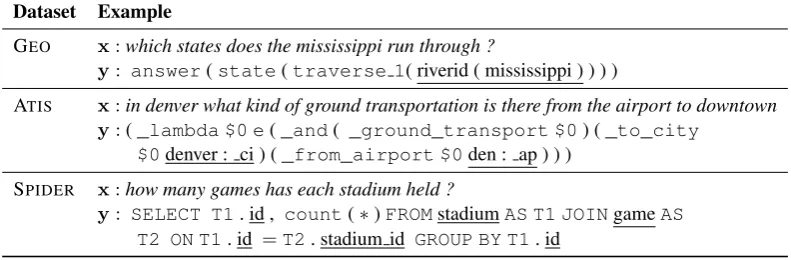
pro-Dataset Example
GEO x:which states does the mississippi run through ?
y: answer(state(traverse 1( riverid ( mississippi ) ) ) )
ATIS x:in denver what kind of ground transportation is there from the airport to downtown
y:(_lambda $0 e(_and( _ground_transport $0) (_to_city $0denver : ci ) (_from_airport $0den : ap ) ) )
SPIDER x:how many games has each stadium held ?
[image:2.595.101.497.66.196.2]y: SELECT T1. id , count(∗)FROMstadiumAS T1 JOINgameAS T2 ON T1. id =T2. stadium id GROUP BY T1. id
Table 1: Example input utterances,x, and meaning representations,y, with entities underlined.
posed architecture by achieving competitive re-sults across 3 semantic parsing tasks. Further im-provements are possible by incorporating a pre-trained BERT (Devlin et al.,2018) encoder within the architecture.
2 Task Formulation
Our goal is to learn a model for semantic pars-ing from pairs of natural language utterances and structured meaning representations. Let the nat-ural language utterance be represented as a se-quence x = (x1, . . . , x|x|)of|x|tokens, and the
meaning representation be represented as a se-quencey= (y1, . . . , y|y|)of|y|elements.
The goal is to estimatep(y|x), the conditional probability of the meaning representationygiven utterancex, which is augmented by a set of poten-tially relevant entities.
Input Utterance Each tokenxi ∈ Vinis from a vocabulary of input tokens.
Entity Candidates Given the input utterancex, we retrieve a set,e={e1, . . . , e|e|}, of potentially
relevant entity candidates, withe⊆ Ve, whereVe is in the set of all entities for a given domain. We assume the availability of an entity candidate gen-erator for each task to generate e given x, with details given in§5.2.
For each entity candidate, e ∈ Ve, we require a set of task-specific attributes containing one or more elements fromVa. These attributes can be NER types or other characteristics of the entity, such as “city” or “river” for some of the entities listed in Table1. WhereasVe can be quite large for open domains, or even infinite if it includes sets such as the natural numbers,Vais typically much smaller. Therefore, we can effectively learn repre-sentations for entities given their set of attributes,
from our set of example pairs.
Edge Labels In addition toxandefor a particu-lar example, we also consider the(|x|+|e|)2 pair-wise relations between all tokens and entity candi-dates, represented as edge labels.
The edge label between tokensxi andxj corre-sponds to the relative sequential position,j−i, of the tokens, clipped to within some range.
The edge label between tokenxiand entityej, and vice versa, corresponds to whetherxiis within the span of the entity candidateej, or not.
The edge label between entities ei andej cap-tures the relationship between the entities. These edge labels can have domain-specific interpreta-tions, such as relations in a knowledge base, or any other type of entity interaction features. For tasks where this information is not available or useful, a single generic label between entity candidates can be used.
Output We consider the logical form, y, to be a linear sequence (Vinyals et al.,2015b). We to-kenize based on the syntax of each domain. Our formulation allows each element ofyto be either an element of the output vocabulary, Vout, or an entity copied from the set of entity candidates e. Therefore,yi ∈ Vout∪ Ve. Some experiments in §5.2also allow elements ofyto be tokens∈ Vin fromxthat are copied from the input.
3 Model Architecture
x1 x2 x8
e4
e1 e2
how
stadium /table
...
games has each stadium held ?
many
game /table
...
x3 x4 x5 x6 x7
stadium_id /column
...
…
e3
id /column /primary_key
[image:3.595.131.473.79.207.2]...
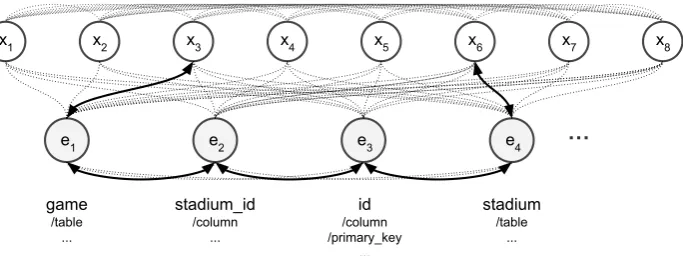
Figure 1: We use an example from SPIDERto illustrate the model inputs: tokens from the given utterance,x, a set of potentially relevant entities,e, and their relations. We selected two edge label types to highlight: edges denoting that an entity spans a token, and edges between entities that, for SPIDER, indicate a foreign key relationship between columns, or an ownership relationship between columns and tables.
3.1 GNN Sub-layer
We extend the Transformer’s self-attention mecha-nism to form a Graph Neural Network (GNN) sub-layer that incorporates a fully connected, directed graph with edge labels.
The sub-layer maps an ordered sequence of node representations, u = (u1, . . . , u|u|), to a
new sequence of node representations, u0 = (u01, . . . , u0|u|), where each node is represented∈
Rd. We use rij to denote the edge label corre-sponding touianduj.
We implement this sub-layer in terms of a func-tion f(m, l) over a node representation m ∈ Rd and an edge labell that computes a vector repre-sentation inRd
0
. We usenheads parallel attention heads, withd0 = d/nheads. For each head k, the new representation for the nodeuiis computed by
uki0=
|u|
X
j=1
αijf(uj, rij), (1)
where each coefficient αij is a softmax over the scaled dot productssij,
sij =
(Wqui)√|f(uj, rij)
d0 , (2)
andWq is a learned matrix. Finally, we concate-nate representations from each head,
u0i=Whu1i0| · · · |unheads0
i
, (3)
where Wh is another learned matrix and [ · · · ] denotes concatenation.
If we implementfas,
f(m, l) =Wrm, (4)
where Wr ∈ Rd
0×d
is a learned matrix, then the sub-layer would be effectively identical to self-attention as initially proposed in the Trans-former (Vaswani et al.,2017).
We focus on two alternative formulations of f
that represent edge labels as learned matrices and learned vectors.
Edge Matrices The first formulation represents edge labels as linear transformations, a common parameterization for GNNs (Li et al.,2016),
f(m, l) =Wlm, (5)
whereWl∈Rd0×dis a learned embedding matrix per edge label.
Edge Vectors The second formulation repre-sents edge labels as additive vectors using the same formulation as Shaw et al.(2018),
f(m, l) =Wrm+wl, (6)
whereWr ∈ Rd0×d
is a learned matrix shared by all edge labels, andwl ∈ Rdis a learned embed-ding vector per edge labell.
3.2 Encoder
Input Representations Before the initial en-coder layer, tokens are mapped to initial repre-sentations using either a learned embedding table forVin, or the output of a pre-trained BERT (
Previous Outputs
Nenc
Layers
Tokens Entities
Embed
GNN Sub-layer Feed-Forward Network
Ndec Layers
GNN Sub-layer
Embed Encoder-Decoder Attention
Select Action Generate or Copy
Output
Feed-Forward Network
Relations
[image:4.595.101.497.67.216.2]Embed / BERT Embed
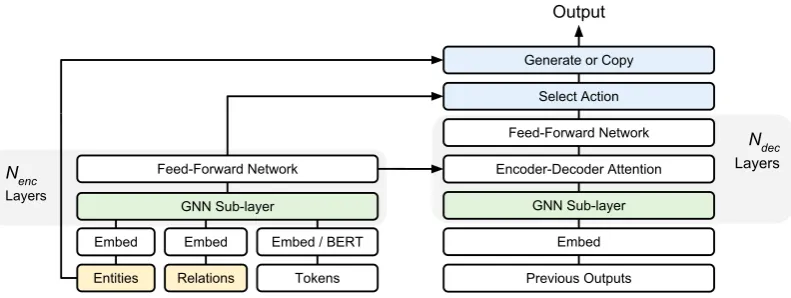
Figure 2: Our model architecture is based on the Transformer (Vaswani et al.,2017), with two modifications. First, the self-attention sub-layer has been extended to be a GNN that incorporates edge representations. In the encoder, the GNN sub-layer is conditioned on tokens, entities, and their relations. Second, the decoder has been extended to include a copy mechanism (Vinyals et al.,2015a). We can optionally incorporate a pre-trained model such as BERT to generate contextual token representations.
Va. We also concatenate an embedding represent-ing the node type, token or entity, to each input representation.
We assume some arbitrary ordering for entity candidates, generating a combined sequence of initial node representations for tokens and entities. We have edge labels between every pair of nodes as described in§2.
Encoder Layers Our encoder layers are essen-tially identical to the Transformer, except with the proposed extension to self-attention to incorpo-rate edge labels. Therefore, each encoder layer consists of two sub-layers. The first is the GNN sub-layer, which yields new sets of token and en-tity representations. The second sub-layer is an element-wise feed-forward network. Each sub-layer is followed by a residual connection and layer normalization (Ba et al., 2016). We stack
Nenc encoder layers, yielding a final set of token representations, wx(Nenc), and entity
representa-tions,we(Nenc).
3.3 Decoder
The decoder auto-regressively generates output symbols, y1, . . . , y|y|. It is similarly based on
the Transformer (Vaswani et al., 2017), with the self-attention layer replaced by the GNN sub-layer. Decoder edge labels are based only on the relative timesteps of the previous outputs. The encoder-decoder attention layer considers both en-coder outputswx(Nenc)andwe(Nenc), jointly
nor-malizing attention weights over tokens and entity
candidates. We stackNdec decoder layers to pro-duce an output vector representation at each output step,zj ∈Rdz, forj∈ {1, . . . ,|y|}.
We allow the decoder to copy tokens or entity candidates from the input, effectively combining a Pointer Network (Vinyals et al., 2015a) with a standard softmax output layer for selecting sym-bols from an output vocabulary (Gu et al., 2016; Gulcehre et al., 2016;Jia and Liang, 2016). We define a latent action at each output step, aj for
j ∈ {1, . . . ,|y|}, using similar notation as Jia et al. (2016). We normalize action probabilities with a softmax over all possible actions.
Generating Symbols We can generate a sym-bol, denotedGenerate[i],
P(aj =Generate[i]|x,y1:j−1)∝
exp(zj|wouti ), (7)
where wouti is a learned embedding vector for the element ∈ Vout with index i. If a
j = Generate[i], thenyjwill be the element∈ Vout with indexi.
Copying Entities We can also copy an entity candidate, denotedCopyEntity[i],
P(aj =CopyEntity[i]|x,y1:j−1)∝
exp((zjWe)|w(eNienc)),
(8)
where We is a learned matrix, and i ∈ {1, . . . ,|e|}. Ifaj =CopyEntity[i], thenyj =
4 Related Work
Various approaches to learning semantic parsers from pairs of utterances and logical forms have been developed over the years (Tang and Mooney, 2000; Zettlemoyer and Collins, 2007; Kwiatkowski et al., 2011;Andreas et al., 2013). More recently, encoder-decoder architectures have been applied with strong results (Dong and Lap-ata,2016;Jia and Liang,2016).
Even for tasks with relatively small domains of entities, such as GEO and ATIS, it has been shown that some special consideration of entities within an encoder-decoder architecture is impor-tant to improve generalization. This has included extending decoders with copy mechanisms (Jia and Liang,2016) and/or identifying entities in the input as a pre-processing step (Dong and Lapata, 2016).
Other work has considered open domain tasks, such as WEBQUESTIONSSP (Yih et al., 2016). Recent approaches have typically relied on a sepa-rate entity linking model, such as S-MART (Yang and Chang, 2015), to provide a single disam-biguated set of entities to consider. In principle, a learned entity linker could also serve as an en-tity candidate generator within our framework, al-though we do not explore such tasks in this work.
Considerable recent work has focused on constrained decoding of various forms within an encoder-decoder architecture to leverage the known structure of the logical forms. This has led to approaches that leverage this structure dur-ing decoddur-ing, such as usdur-ing tree decoders (Dong and Lapata, 2016; Alvarez-Melis and Jaakkola, 2017) or other mechanisms (Dong and Lapata, 2018; Goldman et al., 2017). Other approaches use grammar rules to constrain decoding (Xiao et al.,2016;Yin and Neubig,2017;Krishnamurthy et al.,2017;Yu et al.,2018b). We leave investiga-tion of such decoder constraints to future work.
Many formulations of Graph Neural Networks (GNNs) that propagate information over local neighborhoods have recently been proposed (Li et al.,2016;Kipf and Welling,2017;Gilmer et al., 2017;Veliˇckovi´c et al.,2018). Recent work has of-ten focused on large graphs (Hamilton et al.,2017) and effectively propagating information over mul-tiple graph steps (Xu et al., 2018). The graphs we consider are relatively small and are fully-connected, avoiding some of the challenges posed by learning representations for large, sparsely
con-nected graphs.
Other recent work related to ours has considered GNNs for natural language tasks, such as combin-ing structured and unstructured data for question answering (Sun et al., 2018), or for representing dependencies in tasks such as AMR parsing and machine translation (Beck et al., 2018; Bastings et al., 2017). The approach of Krishnamurthy et al. (2017) similarly considers ambiguous en-tity mentions jointly with query tokens for seman-tic parsing, although does not directly consider a GNN.
Previous work has interpreted the Transformer’s self-attention mechanism as a GNN (Veliˇckovi´c et al.,2018;Battaglia et al., 2018), and extended it to consider relative positions as edge repre-sentations (Shaw et al., 2018). Previous work has also similarly represented edge labels as vec-tors, as opposed to matrices, in order to avoid over-parameterizing the model (Marcheggiani and Titov,2017).
5 Experiments
5.1 Semantic Parsing Datasets
We consider three semantic parsing datasets, with examples given in Table1.
GEO The GeoQuery dataset consists of nat-ural language questions about US geography along with corresponding logical forms (Zelle and Mooney, 1996). We follow the convention of Zettlemoyer and Collins(2005) and use 600 train-ing examples and 280 test examples. We use log-ical forms based on Functional Query Language (FunQL) (Kate et al.,2005).
ATIS The Air Travel Information System (ATIS) dataset consists of natural language queries about travel planning (Dahl et al., 1994). We follow Zettlemoyer and Collins (2007) and use 4473 training examples, 448 test examples, and repre-sent the logical forms as lambda expressions.
5.2 Experimental Setup
Model Configuration We configured hyperpa-rameters based on performance on the validation set for each task, if provided, otherwise cross-validated on the training set.
For the encoder and decoder, we selected the number of layers from {1,2,3,4} and embed-ding and hidden dimensions from{64,128,256}, setting the feed forward layer hidden dimen-sions 4× higher. We employed dropout at training time with Pdropout selected from {0.1,0.2,0.3,0.4,0.5,0.6}. We used 8 attention heads for each task. We used a clipping distance of 8for relative position representations (Shaw et al., 2018).
We used the Adam optimizer (Kingma and Ba, 2015) withβ1 = 0.9,β2 = 0.98, and = 10−9, and tuned the learning rate for each task. We used the same warmup and decay strategy for learning rate as Vaswani et al. (2017), selecting a num-ber of warmup steps up to a maximum of 3000. Early stopping was used to determine the total training steps for each task. We used the final checkpoint for evaluation. We batched training examples together, and selected batch size from {32,64,128,256,512}. During training we used masked self-attention (Vaswani et al.,2017) to en-able parallel decoding of output sequences. For evaluation, we used greedy search.
We used a simple strategy of splitting each in-put utterance on spaces to generate a sequence of tokens. We mapped any token that didn’t occur at least 2 times in the training dataset to a special out-of-vocabulary token. For experiments that used BERT, we instead used the same wordpiece (Wu et al.,2016) tokenization as used for pre-training.
BERT For some of our experiments, we eval-uated incorporating a pre-trained BERT (Devlin et al.,2018) encoder by effectively using the out-put of the BERT encoder in place of a learned to-ken embedding table. We then continue to use graph encoder and decoder layers with randomly initialized parameters in addition to BERT, so there are many parameters that are not pre-trained. The additional encoder layers are still necessary to condition on entities and relations.
We achieved best results by freezing the pre-trained parameters for an initial number of steps, and then jointly fine-tuning all parameters, sim-ilar to existing approaches for gradual unfreez-ing (Howard and Ruder,2018). When unfreezing
the pre-trained parameters, we restart the learn-ing rate schedule. We found this to perform better than keeping pre-trained parameters either entirely frozen or entirely unfrozen during fine-tuning.
We used BERTLARGE (Devlin et al., 2018), which has 24 layers. For fine tuning we used the same Adam optimizer with weight decay and learning rate decay as used for BERT pre-training. We reduced batch sizes to accommodate the sig-nificantly larger model size, and tuned learning rate, warm up steps, and number of frozen steps for pre-trained parameters.
Entity Candidate Generator We use an entity candidate generator that, given x, can retrieve a set of potentially relevant entities,e, for the given domain. Although all generators share a common interface, their implementation varies across tasks. For GEO and ATIS we use a lexicon of entity aliases in the dataset and attempt to match with ngrams in the query. Each entity has a single at-tribute corresponding to the entity’s type. We used binary valued relations between entity candidates based on whether entity candidate spans overlap, but experiments did not show significant improve-ments from incorporating these relations.
For SPIDER, we generalize our notion of enti-ties to include tables and table columns. We in-clude all relevant tables and columns as entity can-didates, but make use of Levenshtein distance be-tween query ngrams and table and column names to determine edges between tokens and entity can-didates. We use attributes based on the types and names of tables and columns. Edges between en-tity candidates capture relations between columns and the table they belong to, and foreign key rela-tions.
For GEO, ATIS, and SPIDER, this leads to 19.5%, 32.7%, and 74.6% of examples contain-ing at least one span associated with multiple tity candidates, respectively, indicating some en-tity ambiguity.
Further details on how entity candidate genera-tors were constructed are provided in§A.1.
Method GEO ATIS
Kwiatkowski et al.(2013) 89.0 — Liang et al.(2013) 87.9 — Wang et al.(2014) — 91.3
Zhao and Huang(2015) 88.9 84.2 Jia and Liang(2016) 89.3 83.3 −data augmentation 85.0 76.3 Dong and Lapata(2016)† 87.1 84.6 Rabinovich et al.(2017)† 87.1 85.9 Dong and Lapata(2018)† 88.2 87.7
Ours
GNN w/ edge matrices 82.5 84.6
GNN w/ edge vectors 89.3 87.1
GNN w/ edge vectors + BERT 92.5 89.7
Method SPIDER
Xu et al.(2017) 10.9 Yu et al.(2018a) 8.0 Yu et al.(2018b) 24.8
−data augmentation 18.9
Ours
GNN w/ edge matrices 29.3
GNN w/ edge vectors 32.1
[image:7.595.81.289.62.253.2]GNN w/ edge vectors + BERT 23.5
Table 2: We report accuracies on GEO, ATIS, and SPIDERfor various implementations of our GNN sub-layer. For GEOand ATIS, we use†to denote neural approaches that disambiguate and replace entities in the utterance as a pre-processing step. For SPIDER, the evaluation set consists of examples for databases unseen during training.
if in the test set.
Evaluation To evaluate accuracy, we use exact match accuracy relative to gold logical forms. For GEO we directly compare output symbols. For ATIS, we compare normalized logical forms us-ing canonical variable namus-ing and sortus-ing for un-ordered arguments (Jia and Liang,2016). For SPI -DERwe use the provided evaluation script, which decomposes each SQL query and conducts set comparison within each clause without values. All accuracies are reported on the test set, except for SPIDER where we report and compare accuracies on the development set.
Copying Tokens To better understand the effect of conditioning on entities and their relations, we also conducted experiments that considered an al-ternative method for selecting and disambiguating entities similar to Jia et al. (2016). In this approach we use our model’s copy mechanism to copy to-kens corresponding to the surface forms of entity arguments, rather than copying entities directly.
P(aj =CopyToken[i]|x,y1:j−1)∝
exp((zjWx)|wx(Nienc)),
(9)
where Wx is a learned matrix, and where i ∈ {1, . . . ,|x|}refers to the index of tokenxi ∈ Vin. Ifaj =CopyToken[i], thenyj =xi.
This allows us to ablate entity information in the input while still generating logical forms. When copying tokens, the decoder determines the type of the entity using an additional output symbol. For
GEO, the actual entity can then be identified as a post-processing step, as a type and surface form is sufficient. For other tasks this could require a more complicated post-processing step to disambiguate entities given a surface form and type.
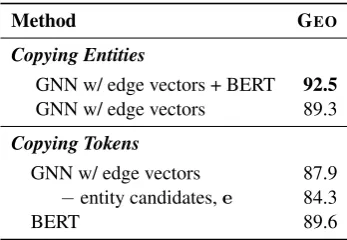
Method GEO
Copying Entities
GNN w/ edge vectors + BERT 92.5
GNN w/ edge vectors 89.3
Copying Tokens
GNN w/ edge vectors 87.9
−entity candidates,e 84.3
[image:7.595.329.503.402.522.2]BERT 89.6
Table 3: Experimental results for copying tokens in-stead of entities when decoding, with and without con-ditioning on the set of entity candidates,e.
5.3 Results and Analysis
Accuracies on GEO, ATIS, and SPIDERare shown in Table2.
they also present techniques and results that lever-age constrained decoding, which our approach would also likely further benefit from.
For GEO, we find that when ablating all en-tity information in our model and copying to-kens instead of entities, we achieve similar results as Jia and Liang (2016) when also ablating their data augmentation method, as shown in Table 3. This is expected, since when ablating entities com-pletely, our architecture essentially reduces to the same sequence-to-sequence task setup. These re-sults demonstrate the impact of conditioning on the entity candidates, as it improves performance even on the token copying setup. It appears that leveraging BERT can partly compensate for not conditioning on entity candidates, but combining BERT with our GNN approach and copying enti-ties achieves 2.9% higher accuracy than using only a BERT encoder and copying tokens.
For ATIS, our results are outperformed by Wang et al.(2014) by 1.6%. Their approach uses hand-engineered templates to build a CCG lexi-con. Some of these templates attempt to handle the specific types of ungrammatical utterances in the ATIS task.
SPIDER For SPIDER, a relatively new dataset, there is less prior work. Competitive approaches have been specific to the text-to-SQL task (Xu et al.,2017;Yu et al.,2018a,b), incorporating task-specific methods to condition on table and col-umn information, and incorporating SQL-specific structure when decoding. Our approach improves absolute accuracy by +7.3% relative to Yu et al. (2018b) without using any pre-trained language representations, or constrained decoding. Our ap-proach could also likely benefit from some of the other aspects of Yu et al. (2018b) such as more structured decoding, data augmentation, and using pre-trained representations (they use GloVe ( Pen-nington et al.,2014)) for tokens, columns, and ta-bles.
Our results were surprisingly worse when at-tempting to incorporate BERT. Of course, success-fully incorporating pre-trained representations is not always straightforward. In general, we found using BERT within our architecture to be sensi-tive to learning rates and learning rate schedules. Notably, the evaluation setup for SPIDER is very different than training, as examples are for tables unseen during training. Models may not general-ize well to unseen tables and columns. It’s likely
that successfully incorporating BERT for SPIDER would require careful tuning of hyperparameters specifically for the database split configuration.
Entity Spans and Relations Ablating span re-lations between entities and tokens for GEO and ATIS is shown in Table 4. The impact is more significant for ATIS, which contains many queries with multiple entities of the same type, such as nonstop flights seattle to boston where disam-biguating the origin and destination entities re-quires knowledge of which tokens they are asso-ciated with, given that we represent entities based only on their types for these tasks. We leave for future work consideration of edges between en-tity candidates that incorporate relevant domain knowledge for these tasks.
Edge Ablations GEO ATIS
GNN w/ edge vectors 89.3 87.1 −entity span edges 88.6 34.2
Table 4: Results for ablating information about entity candidate spans for GEOand ATIS.
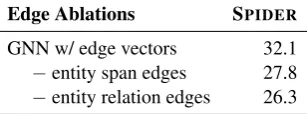
For SPIDER, results ablating relations between entities and tokens, and relations between entities, are shown in Table5. This demonstrates the im-portance of entity relations, as they include use-ful information for disambiguating entities such as which columns belong to which tables, and which columns have foreign key relations.
Edge Ablations SPIDER
GNN w/ edge vectors 32.1
[image:8.595.340.494.502.559.2]−entity span edges 27.8 −entity relation edges 26.3
Table 5: Results for ablating information about rela-tions between entity candidates and tokens for SPIDER.
heterogeneous formulation of the GNN sub-layer, that employs different formulations for different subsets of nodes, e.g. for tokens and entities.
6 Conclusions
We have presented an architecture for semantic parsing that uses a Graph Neural Network (GNN) to condition on a graph of tokens, entities, and their relations. Experimental results have demon-strated that this approach can achieve competitive results across a diverse set of tasks, while also pro-viding a conceptually simple way to incorporate entities and their relations during parsing.
For future direction, we are interested in ex-ploring constrained decoding, better incorporating pre-trained language representations within our ar-chitecture, conditioning on additional relations be-tween entities, and different GNN formulations.
More broadly, we have presented a flexible ap-proach for conditioning on available knowledge in the form of entities and their relations, and demon-strated its effectiveness for semantic parsing.
Acknowledgments
We would like to thank Karl Pichotta, Zuyao Li, Tom Kwiatkowski, and Dipanjan Das for helpful discussions. Thanks also to Ming-Wei Chang and Kristina Toutanova for their comments, and to all who provided feedback in draft reading sessions. Finally, we are grateful to the anonymous review-ers for their useful feedback.
References
D. Alvarez-Melis and T. Jaakkola. 2017. Tree struc-tured decoding with doubly recurrent neural net-works. In International Conference on Learning Representations (ICLR).
Jacob Andreas, Andreas Vlachos, and Stephen Clark. 2013. Semantic parsing as machine translation. In
Proceedings of the 51st Annual Meeting of the As-sociation for Computational Linguistics (Volume 2: Short Papers), volume 2, pages 47–52.
Jimmy Lei Ba, Jamie Ryan Kiros, and Geoffrey E Hin-ton. 2016. Layer normalization. arXiv preprint arXiv:1607.06450.
Dzmitry Bahdanau, Kyunghyun Cho, and Yoshua Ben-gio. 2014. Neural machine translation by jointly learning to align and translate. arXiv preprint arXiv:1409.0473.
Joost Bastings, Ivan Titov, Wilker Aziz, Diego Marcheggiani, and Khalil Simaan. 2017. Graph
convolutional encoders for syntax-aware neural ma-chine translation. InProceedings of the 2017 Con-ference on Empirical Methods in Natural Language Processing, pages 1957–1967.
Peter W Battaglia, Jessica B Hamrick, Victor Bapst, Alvaro Sanchez-Gonzalez, Vinicius Zambaldi, Ma-teusz Malinowski, Andrea Tacchetti, David Raposo, Adam Santoro, Ryan Faulkner, et al. 2018. Rela-tional inductive biases, deep learning, and graph net-works. arXiv preprint arXiv:1806.01261.
Daniel Beck, Gholamreza Haffari, and Trevor Cohn. 2018. Graph-to-sequence learning using gated graph neural networks. InProceedings of the 56th Annual Meeting of the Association for Computa-tional Linguistics (Volume 1: Long Papers), pages 273–283.
Jonathan Berant, Andrew Chou, Roy Frostig, and Percy Liang. 2013. Semantic parsing on freebase from question-answer pairs. In Proceedings of the 2013 Conference on Empirical Methods in Natural Lan-guage Processing, pages 1533–1544.
Deborah A Dahl, Madeleine Bates, Michael Brown, William Fisher, Kate Hunicke-Smith, David Pallett, Christine Pao, Alexander Rudnicky, and Elizabeth Shriberg. 1994. Expanding the scope of the atis task: The atis-3 corpus. InProceedings of the workshop on Human Language Technology, pages 43–48. As-sociation for Computational Linguistics.
Jacob Devlin, Ming-Wei Chang, Kenton Lee, and Kristina Toutanova. 2018. Bert: Pre-training of deep bidirectional transformers for language understand-ing.arXiv preprint arXiv:1810.04805.
Li Dong and Mirella Lapata. 2016. Language to logi-cal form with neural attention. InProceedings of the 54th Annual Meeting of the Association for Compu-tational Linguistics (Volume 1: Long Papers), vol-ume 1, pages 33–43.
Li Dong and Mirella Lapata. 2018. Coarse-to-fine de-coding for neural semantic parsing. InACL.
Justin Gilmer, Samuel S Schoenholz, Patrick F Riley, Oriol Vinyals, and George E Dahl. 2017. Neural message passing for quantum chemistry. In Inter-national Conference on Machine Learning, pages 1263–1272.
Omer Goldman, Veronica Latcinnik, Udi Naveh, Amir Globerson, and Jonathan Berant. 2017. Weakly-supervised semantic parsing with abstract examples.
arXiv preprint arXiv:1711.05240.
Caglar Gulcehre, Sungjin Ahn, Ramesh Nallapati, Bowen Zhou, and Yoshua Bengio. 2016. Pointing the unknown words. InProceedings of the 54th An-nual Meeting of the Association for Computational Linguistics (Volume 1: Long Papers), volume 1, pages 140–149.
Will Hamilton, Zhitao Ying, and Jure Leskovec. 2017. Inductive representation learning on large graphs. InAdvances in Neural Information Processing Sys-tems, pages 1024–1034.
Jeremy Howard and Sebastian Ruder. 2018. Universal language model fine-tuning for text classification.
arXiv preprint arXiv:1801.06146.
Robin Jia and Percy Liang. 2016. Data recombination for neural semantic parsing. In Proceedings of the 54th Annual Meeting of the Association for Compu-tational Linguistics (Volume 1: Long Papers), vol-ume 1, pages 12–22.
Rohit J Kate, Yuk Wah Wong, and Raymond J Mooney. 2005. Learning to transform natural to formal lan-guages. InProceedings of the National Conference on Artificial Intelligence, volume 20, page 1062. Menlo Park, CA; Cambridge, MA; London; AAAI Press; MIT Press; 1999.
Diederik Kingma and Jimmy Ba. 2015. Adam: A method for stochastic optimization. InInternational Conference on Learning Representations (ICLR).
Thomas N Kipf and Max Welling. 2017. Semi-supervised classification with graph convolutional networks. InInternational Conference on Learning Representations (ICLR).
Jayant Krishnamurthy, Pradeep Dasigi, and Matt Gard-ner. 2017. Neural semantic parsing with type con-straints for semi-structured tables. InProceedings of the 2017 Conference on Empirical Methods in Nat-ural Language Processing, pages 1516–1526.
Tom Kwiatkowski, Eunsol Choi, Yoav Artzi, and Luke Zettlemoyer. 2013. Scaling semantic parsers with on-the-fly ontology matching. InProceedings of the 2013 conference on empirical methods in natural language processing, pages 1545–1556.
Tom Kwiatkowski, Luke Zettlemoyer, Sharon Goldwa-ter, and Mark Steedman. 2011. Lexical generaliza-tion in ccg grammar inducgeneraliza-tion for semantic parsing. InProceedings of the conference on empirical meth-ods in natural language processing, pages 1512– 1523. Association for Computational Linguistics.
Yujia Li, Daniel Tarlow, Marc Brockschmidt, and Richard Zemel. 2016. Gated graph sequence neural networks. InInternational Conference on Learning Representations (ICLR).
Percy Liang, Michael I Jordan, and Dan Klein. 2013. Learning dependency-based compositional seman-tics. Computational Linguistics, 39(2):389–446.
Wang Ling, Phil Blunsom, Edward Grefenstette, Karl Moritz Hermann, Tom´aˇs Koˇcisk`y, Fumin Wang, and Andrew Senior. 2016. Latent predictor networks for code generation. InProceedings of the 54th Annual Meeting of the Association for Compu-tational Linguistics (Volume 1: Long Papers), vol-ume 1, pages 599–609.
Diego Marcheggiani and Ivan Titov. 2017. Encoding sentences with graph convolutional networks for se-mantic role labeling. In Proceedings of the 2017 Conference on Empirical Methods in Natural Lan-guage Processing, pages 1506–1515.
Jeffrey Pennington, Richard Socher, and Christopher Manning. 2014. Glove: Global vectors for word representation. InProceedings of the 2014 confer-ence on empirical methods in natural language pro-cessing (EMNLP), pages 1532–1543.
Maxim Rabinovich, Mitchell Stern, and Dan Klein. 2017. Abstract syntax networks for code genera-tion and semantic parsing. In Proceedings of the 55th Annual Meeting of the Association for Compu-tational Linguistics (Volume 1: Long Papers), vol-ume 1, pages 1139–1149.
Franco Scarselli, Marco Gori, Ah Chung Tsoi, Markus Hagenbuchner, and Gabriele Monfardini. 2009. The graph neural network model. IEEE Transactions on Neural Networks, 20(1):61–80.
Peter Shaw, Jakob Uszkoreit, and Ashish Vaswani. 2018. Self-attention with relative position represen-tations. In Proceedings of the 2018 Conference of the North American Chapter of the Association for Computational Linguistics: Human Language Tech-nologies, Volume 2 (Short Papers), volume 2, pages 464–468.
Haitian Sun, Bhuwan Dhingra, Manzil Zaheer, Kathryn Mazaitis, Ruslan Salakhutdinov, and William Co-hen. 2018. Open domain question answering using early fusion of knowledge bases and text. In Pro-ceedings of the 2018 Conference on Empirical Meth-ods in Natural Language Processing, pages 4231– 4242.
Lappoon R Tang and Raymond J Mooney. 2000. Au-tomated construction of database interfaces: Inte-grating statistical and relational learning for seman-tic parsing. InProceedings of the 2000 Joint SIG-DAT conference on Empirical methods in natural language processing and very large corpora: held in conjunction with the 38th Annual Meeting of the As-sociation for Computational Linguistics-Volume 13, pages 133–141. Association for Computational Lin-guistics.
Petar Veliˇckovi´c, Guillem Cucurull, Arantxa Casanova, Adriana Romero, Pietro Li`o, and Yoshua Bengio. 2018. Graph attention networks. In International Conference on Learning Representations (ICLR).
Oriol Vinyals, Meire Fortunato, and Navdeep Jaitly. 2015a. Pointer networks. In Advances in Neural Information Processing Systems, pages 2692–2700.
Oriol Vinyals, Łukasz Kaiser, Terry Koo, Slav Petrov, Ilya Sutskever, and Geoffrey Hinton. 2015b. Gram-mar as a foreign language. InAdvances in Neural Information Processing Systems, pages 2773–2781.
Adrienne Wang, Tom Kwiatkowski, and Luke Zettle-moyer. 2014. Morpho-syntactic lexical generaliza-tion for ccg semantic parsing. InProceedings of the 2014 Conference on Empirical Methods in Natural Language Processing (EMNLP), pages 1284–1295.
Yonghui Wu, Mike Schuster, Zhifeng Chen, Quoc V Le, Mohammad Norouzi, Wolfgang Macherey, Maxim Krikun, Yuan Cao, Qin Gao, Klaus Macherey, et al. 2016. Google’s neural ma-chine translation system: Bridging the gap between human and machine translation. arXiv preprint arXiv:1609.08144.
Chunyang Xiao, Marc Dymetman, and Claire Gardent. 2016. Sequence-based structured prediction for se-mantic parsing. InProceedings of the 54th Annual Meeting of the Association for Computational Lin-guistics (Volume 1: Long Papers), volume 1, pages 1341–1350.
Keyulu Xu, Chengtao Li, Yonglong Tian, Tomo-hiro Sonobe, Ken-ichi Kawarabayashi, and Stefanie Jegelka. 2018. Representation learning on graphs with jumping knowledge networks. InInternational Conference on Learning Representations (ICLR).
Xiaojun Xu, Chang Liu, and Dawn Song. 2017. Sqlnet: Generating structured queries from natural language without reinforcement learning. arXiv preprint arXiv:1711.04436.
Yi Yang and Ming-Wei Chang. 2015. S-mart: Novel tree-based structured learning algorithms applied to tweet entity linking. InProceedings of the 53rd An-nual Meeting of the Association for Computational Linguistics and the 7th International Joint Confer-ence on Natural Language Processing (Volume 1: Long Papers), volume 1, pages 504–513.
Wen-tau Yih, Matthew Richardson, Chris Meek, Ming-Wei Chang, and Jina Suh. 2016. The value of se-mantic parse labeling for knowledge base question answering. InProceedings of the 54th Annual Meet-ing of the Association for Computational LMeet-inguistics (Volume 2: Short Papers), volume 2, pages 201–206.
Pengcheng Yin and Graham Neubig. 2017. A syntactic neural model for general-purpose code generation. In Proceedings of the 55th Annual Meeting of the Association for Computational Linguistics (Volume 1: Long Papers), volume 1, pages 440–450.
Tao Yu, Zifan Li, Zilin Zhang, Rui Zhang, and Dragomir Radev. 2018a. Typesql: Knowledge-based type-aware neural text-to-sql generation. In
Proceedings of the 2018 Conference of the North American Chapter of the Association for Computa-tional Linguistics: Human Language Technologies, Volume 2 (Short Papers), volume 2, pages 588–594.
Tao Yu, Michihiro Yasunaga, Kai Yang, Rui Zhang, Dongxu Wang, Zifan Li, and Dragomir Radev. 2018b. Syntaxsqlnet: Syntax tree networks for complex and cross-domaintext-to-sql task. arXiv preprint arXiv:1810.05237.
Tao Yu, Rui Zhang, Kai Yang, Michihiro Yasunaga, Dongxu Wang, Zifan Li, James Ma, Irene Li, Qingn-ing Yao, Shanelle Roman, et al. 2018c. Spider: A large-scale human-labeled dataset for complex and cross-domain semantic parsing and text-to-sql task.
arXiv preprint arXiv:1809.08887.
John M Zelle and Raymond J Mooney. 1996. Learn-ing to parse database queries usLearn-ing inductive logic programming. InProceedings of the thirteenth na-tional conference on Artificial intelligence-Volume 2, pages 1050–1055. AAAI Press.
Luke S Zettlemoyer and Michael Collins. 2005. Learn-ing to map sentences to logical form: structured classification with probabilistic categorial gram-mars. In Proceedings of the Twenty-First Confer-ence on Uncertainty in Artificial IntelligConfer-ence, pages 658–666. AUAI Press.
Luke S Zettlemoyer and Michael Collins. 2007. On-line learning of relaxed ccg grammars for parsing to logical form. EMNLP-CoNLL 2007, page 678.
Kai Zhao and Liang Huang. 2015. Type-driven in-cremental semantic parsing with polymorphism. In
A Supplemental Material
A.1 Entity Candidate Generator Details
In this section we provide details of how we con-structed entity candidate generators for each task.
GEO The annotator was constructed from the geobase database, which provides a list of geo-graphical facts. For each entry in the database, we extracted the name as the entity alias and the type (e.g., “state”, “city”) as its attribute. Since not all cities used in the GEO query set are listed as ex-plicit entries, we also used cities in the state en-tries. Finally, geobase has no entries around coun-tries, so we added relevant aliases for “USA” with a special “country” attribute. There was 1 example where an entity in the logical form did not appear in the input, leading to the example being dropped from the training set.
In lieu of task-specific edge relations, we used binary edge labels between entities that captured which annotations span the same tokens. How-ever, experiments demonstrated that these edges did not significantly affect performance. We leave consideration of other types of entity relations for these tasks to future work.
ATIS We constructed a lexicon mapping nat-ural language entity aliases in the dataset (e.g., “newark international”, “5pm”) to unique entity identifiers (e.g. “ewr:ap”, “1700:ti”). For ATIS, this lexicon required some manual construction. Each entity identifier has a two-letter suffix (e.g., “ap”, “ti”) that maps it to a single attribute (e.g., “airport”, “time”). We allowed overlapping entity mentions when the entities referred to different en-tity identifiers. For instance, in the query span “at-lanta airport”, we include both the city of At“at-lanta and the Atlanta airport.
Notably there were 9 examples where one of the entities used as an argument in the logical form did not have a corresponding mention in the in-put utterance. From manual inspection, many of the dropped examples appear to have incorrectly annotated logical forms. These examples were dropped from training set or marked as incorrect if they appeared in the test set.
We use the same binary edge labels between en-tities as for GEO.
SPIDER For SPIDER we generalize our notion of entities to consider tables and columns as enti-ties. We attempt to determine spans for each
ta-ble and column by computing normalized Leven-shtein distance between table and column names and unigrams or bigrams in the utterance. The best alignment having a score> 0.75is selected, and we use these generated alignments to populate the edges between tokens and entity candidates.
We generate a set of attributes for the table based on unigrams in the table name, and an at-tribute to identify the entity as a table. Likewise, for columns, we generate a set of attributes based on unigrams in the column name as well as an at-tribute to identify the value type of the column. We also include attributes indicating whether an align-ment was found between the entity and the input text.