Faculty of Engineering and Resource Science, Akita University, Akita 010-8502, Japan
4Metals Technology Center, Japan Oil Gas and Metals National Corporation, Kazuno-gun, Akita 017-0202, Japan
Iron-oxide hosted copper-gold (IOCG) deposit is a newly recognized raw material for copper recovery. A poor understanding of its hydrometallurgical behavior has limited the development of its commercial practice for copper extraction. In this paper, the leaching behavior of IOCG ore in sulfuric acid medium containing hydrogen peroxide were studied in shaking flask and rolling-ball (RB) vessel. The dissolved copper and iron, pH and oxidation-reduction potential were monitored versus time. It was found that the IOCG ore is more difficult to leach than primary and secondary copper ores. Furthermore, some variables including sulfuric acid dosage, hydrogen peroxide addition and particle sizes were considered and investigated. The similar copper recovery was observed with the variation of the amount of sulfuric acid, and the addition of hydrogen peroxide did not enhance copper yield considerably. Although the higher copper recovery occurred with smaller particle sizes, the highest copper extraction was still not over 40% even for0:02mm size. The dissolved copper level behavior with time in shaking flask indicates the hindered dissolution is occurring. Moreover, more than 90% copper recovery in RB leaching confirmed the existing hindered dissolution in shaking flask. The passivation candidates of elemental sulfur was detected and confirmed by X-ray diffraction further, which were responsible for the low copper yield in shaking flask. [doi:10.2320/matertrans.M-MRA2008834]
(Received March 21, 2008; Accepted August 11, 2008; Published October 25, 2008)
Keywords: iron-oxide hosted copper-gold ore, leaching, sulfuric acid medium, hindered dissolution
1. Introduction
In recent years, there has been a heightened interest in the hydrometallurgy of copper ore and concentrates. Many attempts in searching for hydrometallurgical alternatives to traditional pyrometallurgical processes have been carried out all over the world, and the historical and current develop-ments are discussed in the literature.1)Currently, more than 20% of world copper production is produced by this route and undoubtedly, it will increase steadily in the future.2) Hence, some new types of copper ores have to be considered to meet with the growth of world demand for copper.
The iron-oxide hosted copper-gold (IOCG) ore,3,4) discov-ered in the giant Olympic Dam deposit in Australia firstly, is characterized by having a predominant amount of magnetite with fine chalcopyrite. It has attracted the interest of mining companies and will be available for processing in large quantities for the future, but there are few researches reported about its leaching behavior by hydrometallurgical operation. In an effort to achieve a well understanding on it, a collaborative research focused on the IOCG ore leaching has been carrying out to improve an operation of heap bioleaching process by the Japan Oil, Gas and Metals National Corporation (JOGMEC) and Akita University.5,6)It is well known that heap bioleaching combined with solvent extraction-electrowinning (SX-EW) is the most promising low-cost hydrometallurgical route.7)An indirect indicator of the notable increase on hydrometallurgical copper production over recent years is the increased overall capacity of SX-EW plants producing cathode copper.
In Akita University, basic leaching experiments are being conducted without any bacterial in order to make the
mechanistic issues and the characteristics of IOCG ore leaching clearer. With respect to the leaching medium, chalcopyrite leaching in chloride medium is faster than acidic sulfate medium. Even so, the sulfuric acid condition was still selected considering the subsequent SX-EW, because there were numerous problems associated with chloride system, for example, electrowinning from such media produced dendritic powder which was difficult to wash. On the other hand, the parallel chemistry behind the sulfuric acid dissolution of copper mineral is sure to occur in a microbiologically mediated situation, such as heap bioleaching. Consequently, the study on the leaching behavior of IOCG ore in sulfuric acid medium will give significant guidance for both abiotic and microbial heap leaching of this ore.
In the present work, the copper leaching was performed under a sulfuric acid medium containing hydrogen peroxide. Two types of leaching equipment, shaking flask and rolling-ball (RB) vessel, were used in the experiments. For insight into the nature of the IOCG ore leaching behavior, most experiments go over time period up to one year. Besides the comparative trials between IOCG ore and other copper sulfide ore, the experiments concerning the effect of sulfuric acid amount, hydrogen peroxide and particle sizes on IOCG leaching were conducted in shaking flask. Likewise, the leaching behavior of IOCG ore was studied in RB leaching. Moreover, the leached residues were detected by X-ray Diffraction (XRD) in an attempt to provide concrete information about passivation candidates in the IOCG ore leaching.
2. Experimental Materials and Methods
2.1 Ore and concentrates
The copper ore and concentrates were mostly provided by
JOGMEC. The following ore and three concentrates were used for the leaching experiments: (1) Iron-oxide hosted copper-gold (IOCG) ore, (2) Concentrate beneficiated from IOCG ore (IOCC), (3) Primary sulfide concentrate (PSC) and (4) Secondary sulfide concentrate (SCC). Chemical analyses for copper, iron and sulfur were done, and the results are listed in Table 1, respectively. While for targeted IOCG ore, the XRD detection, shown in Fig. 1, indicates that quartz, magnetite and pyrite are the main components of IOCG ore.
2.2 Sulfuric acid and hydrogen peroxide addition
In all the tests, distilled water and reagent-grade chemicals were used to make up all required solutions. The amount of reagents was calculated on the basis of the mineral compositions, assuming that chalcopyrite would be com-pletely leached by ferric ion and hydrogen peroxide as shown in eq. (1). In the case of IOCG ore, as an example, the
necessary amount of sulfuric acid and hydrogen peroxide to leach all the iron was calculated according to eqs. (2) and (3). The addition of ferric iron was not done, because the expected amount of iron released from the reactions was higher than the amount necessary for eq. (1). The hydrogen peroxide was used as oxidizing agent for the ferrous re-oxidation back to ferric for recycle, taking the place of bacteria in bioleaching operation. The basic additions were set as 1.5 times the stoichiometrical amount of sulfuric acid and hydrogen peroxide, other doses conditions will be indicated later in the results.
CuFeS2þFe2(SO4)3þ7H2O2
¼CuSO4þ3FeSO4þH2SO4þ6H2O ð1Þ
Fe2O3þ3H2SO4¼Fe2(SO4)3þ3H2O ð2Þ
2FeOþH2O2þ3H2SO4¼Fe2(SO4)3þ4H2O ð3Þ
2.3 Experimental procedures
[image:2.595.81.511.73.206.2]Ore samples were mechanically crushed and ground. After sizing with screen, the oversize fraction was manually ground to less than 0.15 or 0.02 mm. To minimize the effect by bacterial or flotation agents, the samples were washed by acetone and ethanol. Shaking Erlenmeyer flask (300 mL), as well as RB vessel (120 diameter mm and 200 mm length) were used (seen in Fig. 2). The shaking distance of flask, in which the amount of solution was 200 mL, was 50 mm Table 1 Main chemical assays of different ore and concentrates (mass%).
Specimen Element (%)
Cu Fe S
IOCG ore 1.27 20.35 2.63
IOCC 28.9 28.9 31.9
PSC 29.0 24.0 27.0
SSC 41.7 29.9 18.29
Fig. 1 XRD pattern of IOCG ore. ( : Chalcopyrite (CuFeS2, 37–471), Q: Quartz (SiO2, 33–1161) M: Magnetite (FeFe2O4,
19–629), P: Pyrite (FeS2, 6–710) H: Ferrohornblende, Sodian ((Na,K)Ca2(Fe,Mg)5(Al,Si)8O22(OH)2, 29–1258) C: Chlorite
((Mg,Al)6(Si,Al)4O10(OH)8, 52–1044))
[image:2.595.100.498.262.429.2] [image:2.595.49.289.482.560.2](SPS 3000, SII Japan). The pH and redox potential were measured by a pH meter (HM-21P, TOA, Japan), using a pH electrode and a combination oxidation-reduction potential (ORP) electrode (Pt vs. Ag/AgCl), respectively. The solid residues were dried and characterized using XRD (JDX 3530, JEOL, Japan).
3. Results and Discussion
3.1 Comparison of IOCC, PSC and SSC leaching
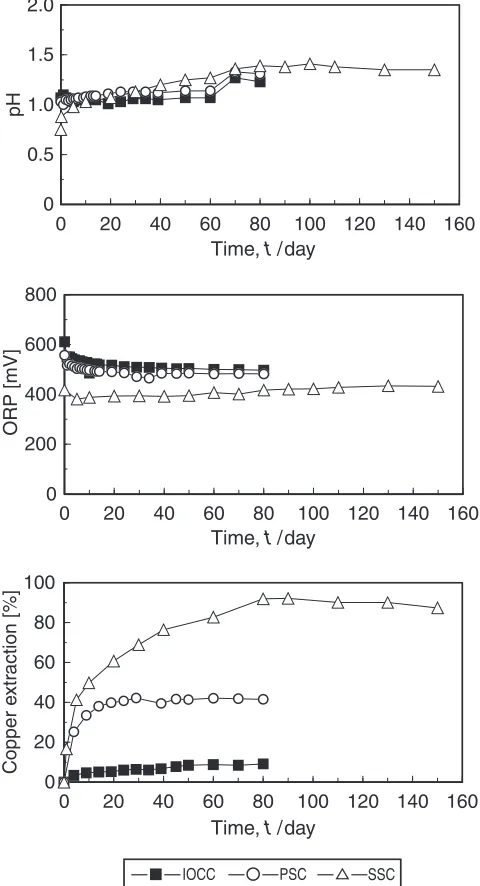
The comparative test of IOCC, PSC and SSC was carried out in shaking flask and the results for the leaching of the employed concentrates are presented in Fig. 3. It clearly demonstrates the difference in the copper yields for three types of concentrates. The copper leaching efficiency of IOCC reached to only 10% in 80 days. However, the copper recovery of PSC and SSC were around 40 and 90%, respectively. In fact, the efficiency of leaching depends strongly on the minerals that make up the concentrates. For example, the oxide ore such as tenorite (CuO), cuprite (Cu2O), malachite (Cu2 (CO3)(OH)2) and chrysocolla
(CuSiO32H2O) might be the easiest-leaching minerals. On
the other hand, the leaching rate of secondary copper sulfides such as covellite (CuS) and chalcocite (Cu2S) are relatively
high and the primary copper sulfide chalcopyrite (CuFeS2) is
the refractory mineral. From the results in this work, although it is generally agreed that the leaching of PSC is very difficult, the IOCC should be considered as the most refractory concentrate. In both of them, chalcopyrite is the main copper mineral and the responsible for the low copper recovery. The lower efficiency of copper leaching for IOCC may be attributed to its nature, which should be further investigated.
3.2 IOCG ore leaching in shaking flask
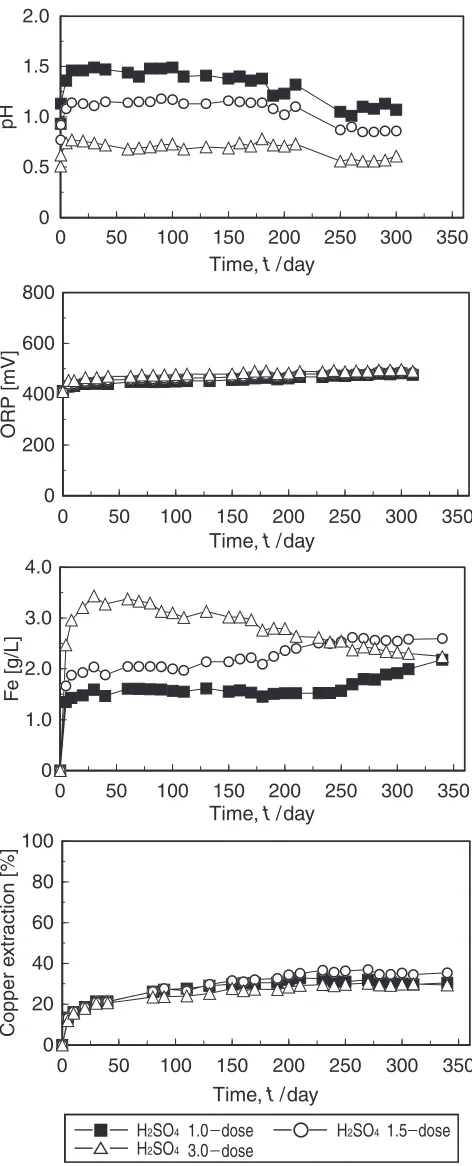
The effects of sulfuric acid amount on IOCG ore leaching were investigated in the absence of hydrogen peroxide. Figure 4 shows the plots of the copper recovery, iron release, pH and ORP versus time when the sulfuric acid amount was set to 1, 1.5 and 3-dose. After the initial fast increase, the iron concentrations stayed at about 3.5, 2.0 and 1.5 g/L and the pH values were kept at about 1.5, 1.2 and 0.8 for 1, 1.5 and 3-dose sulfuric acid amounts, respectively. High sulfuric acid content resulted in low pH values and high iron release from IOCG ore due to the dissolution of magnetite. However, comparing the data from three runs, the increase of sulfuric acid amount did not have any clear effect on the copper yield; the level of copper recovery for three runs was below 35%. Similar results have been reported in a chalcopyrite system by Antonijevicet al.8)
Also, the hydrogen peroxide was added in an attempt to improve the copper recovery at the amount of 1.5-dose. The experimental results shown in Fig. 5 represent the effect of hydrogen peroxide addition on the IOCG ore leaching under the conditions of 1-dose sulfuric acid and particle size under 0.02 mm. The results suggest that the copper leaching is not sensitive to hydrogen peroxide at 1.5-dose. The addition of hydrogen peroxide did not affect the copper yield consid-erably and obtained only an increase of 5% copper recovery (about 38%). Even though the leaching term was prolonged to 320 days, the recovery of copper was not enhanced expectedly. The initial higher ORP was considered to be due to the addition of hydrogen peroxide. Furthermore, the stepwise addition of nitric acid to maintain high ORP (over 700 mV vs. Ag/AgCl) was conducted. The data of the controlled run was shown in the Fig. 5, too. While the controlled run showed relatively low copper recovery below 30% in the initial 200 days, enhanced recovery of copper
Time, t /day
Time, t /day
Time, t /day 0
200 400 600 800
ORP [mV]
0 20 40 60 80 100
0
Copper e
xtr
action [%]
IOCC PSC SSC
0 20 40 60 80 100 120 140 160
160 140 120 100 80 60 40 20
Fig. 3 Leaching of IOCC, PSC and SSC in shaking flask. (particle size
[image:3.595.307.547.77.520.2]about 60% was noted for the later 190 days. Although the 60% of copper recovery is still not the expected copper leaching yield, the fact should be confirmed that high ORP benefits the copper leaching from IOCG ore. Hence, it could be estimated that more addition amount of hydrogen peroxide should achieve a much better copper recovery, as that was previously reported.8)
Certainly, the experiments were carried out with two particle sizes (0:15mm and0:02mm) in the 1.5 and 3.0-dose sulfuric acid containing 1.5-3.0-dose hydrogen peroxide. The effect of particle size on copper leaching is shown in Fig. 6. The results indicate that there is only 20% difference for copper recovery, though the higher copper yield occurred with smaller particle sizes. The highest copper extraction was 0 0.5 1.0 1.5 2.0 0 pH
Time, t /day
Time, t /day
Time, t /day
Time, t /day
0 200 400 600 800 ORP [mV] 0 1.0 2.0 3.0 4.0 F e [g/L] 0 20 40 60 80 100 Copper e xtr action [%] 1.5 3.0 H2SO4 H2SO4
1.0 H2SO4 350 300 250 200 150 100 50
0 50 100 150 200 250 300 350
0 50 100 150 200 250 300 350
0 50 100 150 200 250 300 350
dose
− −dose
dose
−
Fig. 4 Effect of sulfuric acid amount on the IOCG ore leaching in shaking flask without hydrogen peroxide (particle size0:02mm).
Time, t /day
Time, t /day
Time, t /day
Time, t /day 0 0.5 1.0 1.5 2.0 0 pH 0 200 400 600 800 ORP [mV] 0 1.0 2.0 3.0 4.0 F e [g/L] 0 20 40 60 80 100 Copper e x tr action [%] With H2O2 Without H2O2
Controlled by HNO3
400 300
200 100
0 100 200 300 400
0 100 200 300 400
0 100 200 300 400
[image:4.595.309.547.70.638.2] [image:4.595.51.287.71.654.2]about 17% and 37% for 0:15mm and 0:02mm sizes, respectively. The iron release shows the similar behavior with copper dissolution.
From the data stated above, the parabolic character of the plot for IOCG ore leaching can be observed and indicates that the hindered dissolution is occurring in shaking flask. In the case of IOCG ore, the hindered parabola could have multiple causes, such as the behavior of gangue mineral or passivation of targeted copper minerals. In order to clarify the reasons of hindered dissolution, further investigations of IOCG leaching behavior were conducted in the RB vessel.
3.3 IOCG ore leaching in RB
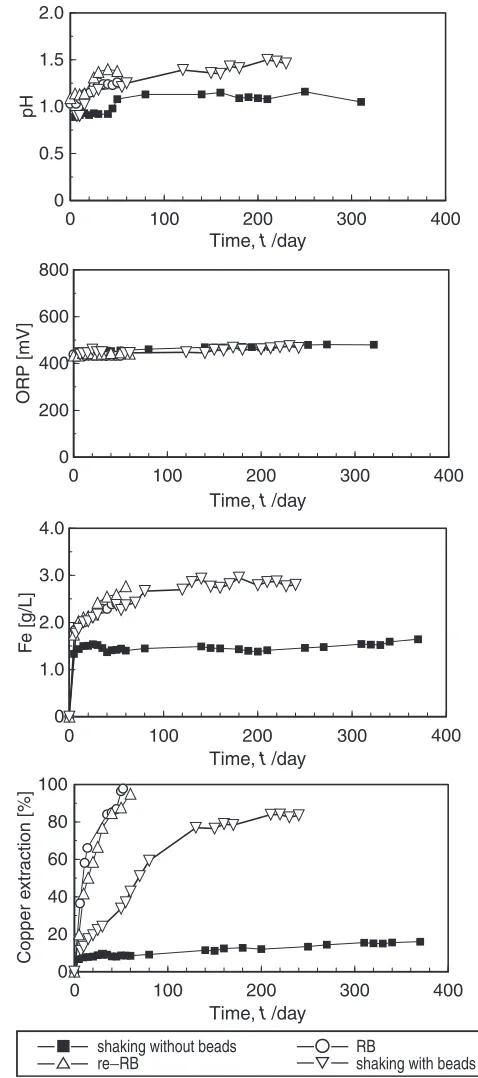
Interestingly, the RB method appears to be able to disrupt the cause of hindered dissolution. Whereas shaking leaching achieved only 37% copper extraction even in 320 days, both the RB leaching and shaking leaching with beads resulted in high copper yield. This is shown in Fig. 7. In this case, RB leaching has a dramatic effect on the dissolution, with rates and amount of recovery 2 to 3 times higher than shaking leaching under the same conditions, over 90% of copper leaching yield was obtained in about 60 days. The Time, t /day
Time, t /day
Time, t /day 0
200 400 600 800
ORP [mV]
0 1.0 2.0 3.0 4.0
F
e
[g/L]
0 20 40 60 80 100
Copper e
x
tr
action [%]
0 100 200 300 400
0 100 200 300 400
0 100 200 300 400
0.02mm H2SO4 0.15mm H2SO4
1.5 0.02mm H2SO4 0.15mm H2SO4
− −
− − 1.5−−dosedose
3.0−dose 3.0−dose
Fig. 6 Effect of particle size on the IOCG ore leaching (H2O21.5-dose).
Time, t /day
Time, t /day
Time, t /day 0
200 400 600 800
ORP [mV]
0 1.0 2.0 3.0 4.0
F
e
[g/L]
0 20 40 60 80 100
Copper e
xtr
action [%]
0 100 200 300 400
0 100 200 300 400
0 100 200 300 400
shaking without beads RB
re−RB shaking with beads
Fig. 7 Leaching of IOCG ore in rolling ball vessel (particle size
[image:5.595.50.279.68.591.2] [image:5.595.300.539.72.611.2]reproducibility was completely confirmed by the experimen-tal results and the content of residual copper in the leached residues was less than 0.13%. The ORP and pH were kept at 450 mV and about 1.0, respectively. The concentrations of released iron were 3.0 g/L. Even the shaking flask leaching where beads were added achieved more than 80% of copper recovery.
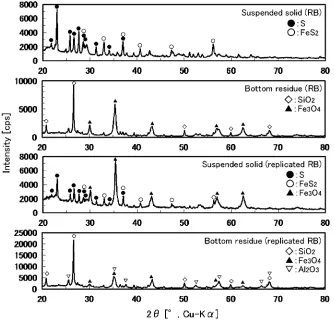
XRD analysis of leached residues in RB vessel was conducted. The solid residues from RB vessel were divided in two parts, including suspended solid that remains suspended on the surface of solution and bottom residue that descend to the bottom of the vessel. Figure 8 shows the XRD results, which indicate that elemental sulfur and pyrite are the main phases in suspended solid, while quartz and magnetite are for the bottom residue. Although the phases of elemental sulfur was detected in the RB leaching by XRD, it could be believed that the surface of copper mineral of IOCG ore could not be coated by them because high copper yield was achieved. Compared with shaking flask, the RB characterized with attrition and fragmentation enhanced the copper recovery by producing reconstructed and fresh surface of copper mineral. The different linear character of plot between shaking flask and RB vessel supports the fact that the coverage of sulfur precipitates is considered responsible for low copper yield during the IOCG ore leaching.
Another action of RB on the IOCG ore leaching is to liberate the finely disseminated chalcopyrite, which is possible to be locked as inclusions in magnetite, pyrite or gangues. RB could increase the surface area of ore and the
higher surface would expose more copper to leach solution as well as reduce the size of IOCG ore and render them more susceptible to dissolution.
4. Conclusions
Based on the results of this work, the behavior of IOCG ore under the sulfuric acid medium was interpreted and the following conclusions can be drawn:
(1) IOCG ore presents higher refractoriness than primary and secondary copper ore, with copper recovery in 80 days for three kinds of concentrates being below 10%, around 40% and over 90%, respectively.
(2) In shaking flask leaching, the amount of sulfuric acid ranging from 1 to 3-dose shows the similar copper recovery below 35%. The 1.5-dose of hydrogen peroxide addition does not affect the copper recovery remarkably and increases 5% copper yield. The high ORP over 700 mV controlled by nitric acid benefits the copper leaching and obtains about 60% copper recovery in 390 days. Although the higher copper recovery occurred with smaller particle sizes, there is only a 20% of difference for copper yield between 0:15 and 0:02mm, and the highest extraction for the latter is still not over 40%.
(3) In RB leaching, the copper recovery is enhanced and reaches the level over 90%. The low copper yield in shaking flask should be attributed to the hindered dissolution caused by the covering of the elemental sulfur, however, this kind of hindered dissolution could be disrupted in RB leaching due to the reconstructed and fresh surface produced.
[image:6.595.132.466.72.392.2]National Corporation. Otherwise, the authors express their gratitude to the support by the Venture Business Laboratory of Akita University, Japan.