Mechanical Properties of Co-Based L1
2Intermetallic Compound Co
3(Al,W)
Seiji Miura
*, Kenji Ohkubo and Tetsuo Mohri
Division of Materials Science and Engineering, Graduate School of Engineering, Hokkaido University, Sapporo 060-8628, Japan
Mechanical properties of L12-Co3(Al,W) polycrystalline sample are investigated by compression testing at various temperature ranging from room temperature to 1193 K. It was found that at room temperature the 0.2% flow stress is 410 MPa and the compressive ductility is higher than 10%, whereas at 1193 K the 0.2% flow stress is 382 MPa and the compressive ductility is about 10%. Two candidates for the reaction scheme of the Co-rich region of the Co-Al-W ternary phase diagram are proposed by combining the results of microstructure observation, X-ray diffractometry and the previous report. [doi:10.2320/matertrans.MAW200734]
(Received April 24, 2007; Accepted July 3, 2007; Published August 22, 2007)
Keywords: cobalt alloys, intermetallic compounds, high temperature deformation, phase diagram
1. Introduction
Mechanical properties of L12-type intermetallic
com-pound such as Ni3Al, Ni3Si and Co3Ti, have attracted broad
attention for more than 50 years since stress anomaly, i.e., the positive temperature dependence of the strength, of Ni3Si
was reported by Lowrie in 1952.1) Among various L1 2
compounds, Ni3Al has been intensively investigated because
the compound is the most important strengthening phase for the Ni-based superalloys.2,3) Co-based L12 compounds such
as Co3Ti and (Co,Fe)3V have also been studied4–6)but these
have not been utilized as constituent phases for commercial Co-based heat-resisting alloys because of their low phase stability, i.e., low melting point, significant decrease of the volume fraction with temperature, or low order-disorder transition temperature. However, these Co-based L12
com-pounds composed of transition metal elements have rela-tively good ductility even without microalloying of B, which is required to ductilize Ni3Al and Ni3(Si,Ti).7–9) Also
Rh-based L12 compounds containing transition metal elements,
such as Rh3Ti, Rh3Nb and Rh3Ta, were reported to possess
good ductility at wide temperature range by the present authors.10) The low room temperature ductility of
interme-tallic compound containing active elements such as Al or Si is attributed to the atomic hydrogen formation at the surface by decomposing water vapor.11)However, the brittleness is very difficult to evaluate in general whether it is because of the intrinsic nature or it is affected by extrinsic factors. For example, these ‘‘brittle’’ L12polycrystal alloys are ductile in
the form of single crystal. Moreover, the compressive ductility of these alloys is better than tensile ductility. On the other hand, some of intermetallic alloys show catastroph-ic crack propagation during compression testing even in the elastic deformation region.
Recently, a new Co-based L12 compound Co3(Al,W) was
found by Satoet al.12)Co-based two-phase alloys composed
of fcc-Co matrix and the compound as precipitates show good high temperature mechanical properties.12,13) Accord-ing to the result of first principles calculation by Yaoet al.,14) the compound is expected to have a shear modulus/bulk modulus ratio of about 0.6. Pugh proposed an empirical rule
that the metallic materials having the shear modulus/bulk modulus ratio larger than 0.5 is brittle,15)and consequently
Yaoet al.concluded that the new compound may be brittle in nature.14)However, no experimental study of the mechanical
properties of the compound has been conducted. For a further development of Co-based alloys with the new L12
com-pound, the mechanical properties of Co3(Al,W) polycrystals
are investigated in the present study using compression testing at various temperatures ranging from room temper-ature to 1193 K. Also the microstructure evolution was investigated and the Co-rich region of the Co-Al-W ternary phase diagram is assessed.
2. Experimental Procedures
The nominal compositions for alloys investigated were Co-10 at%Al-13 at%W (alloy 1) and Co-10 at%Al-12 at%W (alloy 2). The specimens were arc-melted several times in an Ar atmosphere on a water-cooled copper hearth from 99.9% Co, 99.99% Al and 99.9% W in purity. Alloy ingots, being about 20 g, were sealed in quartz tubes and annealed at various temperatures ranging from 1173 K to 1473 K for 24– 168 h. Microstructure observation using scanning electron microscopy (SEM) and chemical analysis of constituent phases by wavelength dispersive X-ray spectroscopy (WDS) with pure Co, Al and W as references were carried out on polished samples. The constituent phases are also identified using X-ray diffractometry with Cu-K (30 kV, 300 mA). The melting point of alloy 1 was determined by differential thermal analysis (DTA) under high purity Ar atmosphere with a heating rate of 10 K/min.
Compression test specimens with 336mm3 in
dimension were cut from the alloy 2 (Co-10Al-12W) ingot annealed at 1173 K for 168 h by a wheel cutter and polished with emery papers. An instron testing machine (type 5584) was used for the compression tests at various temperatures ranging from room temperature to 1193 K with an initial strain rate of 1104s1. At high temperatures the
compression tests were conducted under an Ar-flow atmo-sphere. The strain rate was alternately changed several times to1103s1, ten times higher than the initial strain rate, during plastic deformation.
3. Results and Discussion
[image:2.595.116.483.70.380.2]3.1 Phase relationship
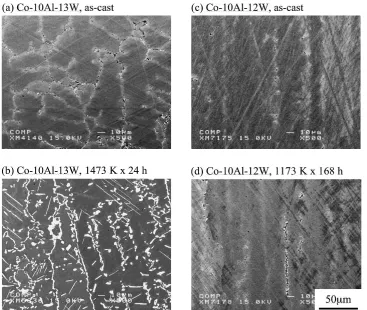
Figure 1 shows the microstructure of the alloys annealed at various temperatures, together with that of the as-cast alloys, observed using SEM. In as-cast ingots shown in Fig. 1(a) and (b), well-developed dendritic structures are found with small amount of particles at dendritic regions. The inter-dendritic phases (dark and bright) have a lamellar structure, which may indicate these regions were solidified in the manner of a ternary eutectic reaction. Electron probe micro analysis (EPMA) revealed that the bright particles at inter-dendritic regions in alloy 1 contain high W, presumably Co7W6 phase, while the dark particles contain high Al,
presumably B2-CoAl. The amount and size of minor phases are much smaller in alloy 2 than in alloy 1.
The result of microstructure observation of alloy 1 annealed at 1473 K for 24 h is shown in Fig. 1(c). The small bright particles and acicular particles are identified as Co7W6
phase since they have an average composition of 55.4Co-1.8Al-42.8W (at%). The results of XRD are shown in Fig. 2. From these results it was confirmed that the alloy 1 sample annealed at 1473 K are composed of fcc-Co solid solution and Co7W6phases. On the other hand, the phases existing in
the alloy 2 sample annealed at 1173 K for 168 h (Fig. 1(d)) are confirmed to be L12phase (matrix) and D019-Co3W (dark
particles) using XRD and EPMA. Very small bright particles at grain boundaries can not be identified though it presumably is a W-rich phase such as Co7W6. These results are consistent
with the results reported by Satoet al.12)The average size of
L12grains in alloy 2 is about 200mm.
According to the binary Co-Al and Co-W phase diagrams, the phases appearing in the Co-rich (Co>50at%) region at the temperature range around 1000 K are Co, CoAl, Co3W
and Co7W6. Although a metastable Co3Al binary phase with
L12structure was reported,16)this phase is excluded from the
consideration. Therefore, in the Co-rich region, the number of phases is 5 including Co3(Al,W). Satoet al.reported CoAl
Fig. 1 Microstructures of Alloy 1 and 2: (a) as-cast Alloy 1, (b) as-cast Alloy 2, (c) Alloy 1 annealed at 1473 K for 24 h and (d) Alloy 2 annealed at 1173 K for 168 h.
Co7W6 fcc Co
20° 40° 60° 80° 100°
2θ
Co-10Al-13W, 1473K for 24h
Co-10Al-12W, 1173K for 168h
L12-Co3(Al,W)
Co3W
Intensity (Arbitrary unit)
[image:2.595.325.527.438.626.2]equilibrates with Co7W6 at 1273 K and 1173 K.12)It can be
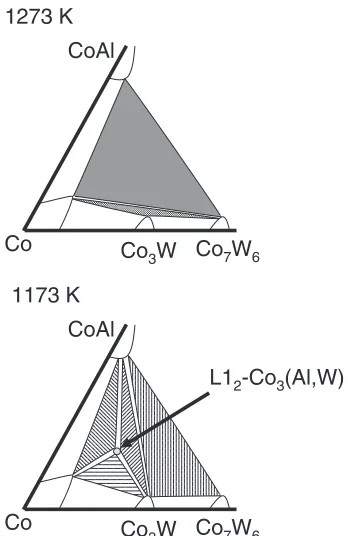
expected that a monovariant trough, L(liquid)+CoAl+ Co7W6, exists at a higher temperature region. Figure 3 is a
schematic drawing of the Co-rich corner of the Co-Al-W ternary system. At 1273 K, there are two three-phase regions composed of Co-CoAl-Co7W6 and Co-Co7W6-Co3W,
re-spectively. According to the microstructure observation, Co solid solution is the primary phase from liquid. In order to introduce the Co-CoAl-Co7W6 three-phase region during
solidification, an invariant reaction composed of L-Co-CoAl-Co7W6 is needed to exist at a higher temperature, which
related to eutectic reactions L! Co+CoAl in the Co-Al binary system and L !Co+Co7W6 in the Co-W binary
system, and a monovariant trough, L+CoAl+Co7W6.
Ac-cording to Sato et al., Co3(Al,W) phase is metastable at
1273 K.12) If this means that the Co3(Al,W) phase appears
from the Co-CoAl-Co7W6 three-phase region in the manner
of the ternary peritectoid reaction, two more invariant reactions composed of Co-Co7W6-Co3W-Co3(Al,W) and
CoAl-Co7W6-Co3W-Co3(Al,W) are required to reach the
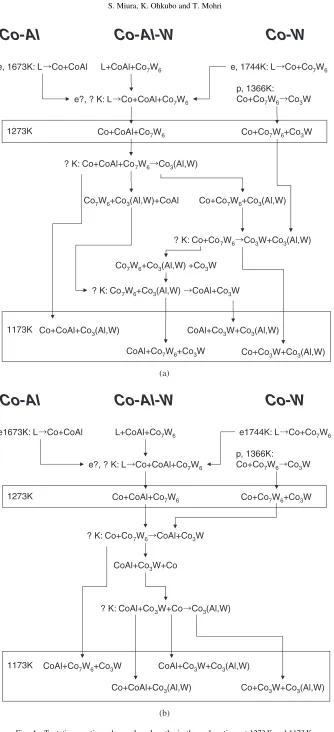
1173 K isothermal section with four three-phase regions as depicted in a tentative reaction scheme presented in Fig. 4(a). On the other hand, another set of invariant reactions can be expected. If the Co3(Al,W) phase appears directly from
Co-CoAl-Co3W three phase region in the manner of peritectoid
reaction, an invariant reaction Co+Co7W6 !CoAl+Co3W,
is needed at a temperature between two invariant reactions, L! Co+CoAl+Co7W6 and Co+CoAl+Co3W! Co3
-(Al,W). This sequence is also presented in Fig. 4(b). For determining the reaction scheme, additional isothermal sections between 1173 K and 1273 K are needed to be established. These complicated sequences for reaching a
single phase L12-Co3(Al,W) alloy seems to be a large
draw-back to obtain a single crystal sample of the alloy.
3.2 Mechanical properties
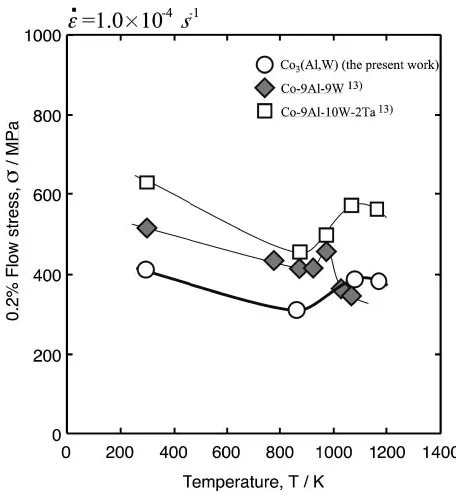
Figure 5 shows the stress-strain curves of Co-10Al-12W alloy (alloy 2) annealed at 1173 K for 168 h. Arrows indicate the strain rate dip tests. At room temperature, the 0.2% flow stress is about 410 MPa and the strain hardening rate at 1% plastic strain is of the order of 6 GPa. The 0.2% flow stress at 865 K is 310 MPa, which is smaller than that at room temperature, and at higher temperatures the 0.2% flow stress increases slightly, while the strain hardening rate decreases. Figure 6 shows the temperature dependence of the 0.2% flow stress. Reported data on various L12 compounds are also
replotted.10)The 0.2% flow stress of Co3(Al,W) alloy shows
the minimum at 865 K, and it increases more than 20% at 1080 K. Although this stress anomaly is not evident compar-ing with that of Ni3Al, a weak positive temperature
depend-ence of strength is recognized. At lower temperature range, relatively large negative temperature dependence of strength appears. Therefore, the temperature dependence of the 0.2% flow stress of this alloy resembles that of Co3Ti at the overall
temperature range, while the room temperature strength of Co3(Al,W) is much higher than that of Co3Ti. Although the
strengthening at room temperature can be attributed to W and Al atoms occupying the Ti sites in Co3Ti, the strength at high
temperature region is seemingly not affected by W and Al. In the present study it is found that the temperature range at which the 0.2% flow stress shows positive temperature dependence is quite narrow. The apparent activation energy cannot be estimated in the present study, but this should be estimated for the further understanding of the nature of stress anomaly of Co-based L12 alloys.
Positive temperature dependence of strength has been reported on various intermetallic compounds including B2-CuZn,17) L1
0-TiAl18)and D019-Ti3Al.19)Some of them are
attributed to the decrease in the degree of order with temperature, while the reason for stress anomaly in most of L12alloys are ascribed to the locking of dislocations by the
cross-slip motion of {111} screw segment onto {010} cube plane, i.e., Kear-Wilsdorf mechanism.20–22)The present alloy was subjected to the annealing at 1173 K which is higher than the temperature range at which the positive temperature dependence of the strength appears. Therefore, the lowering of the order parameter never occurs during or prior to the high temperature testing and it can be concluded that the observed stress anomaly is not caused by the decrease of the order parameter. Suzuki et al. reported that the regular Shockley-type dissociation of {111} dislocations is observed in L12-Co3(Al,W) particle embedded in Co-solid solution
matrix deformed at 1073 K.13)This strongly suggests that the
formation of the Kear-Wilsdorf lock is the reason for the stress anomaly of the present alloy.
It is well known that the peak temperature of the strength depends on the onset of high temperature deformation mechanism such as {001} cube slip and/or octahedral viscous flow.23,24) As these high temperature deformation mechanisms are thermally activated processes, the onset of these mechanisms are strongly related to the melting point Tm of materials. The 0.2% flow stress of Co3(Al,W) and
Co
CoAl
Co
3W Co
7W
61273 K
1173 K
Co
L1
2-Co
3(Al,W)
Co
7W
6CoAl
Co
3W
[image:3.595.81.255.72.340.2]e, 1673K: L Co+CoAl L+CoAl+Co7W6 e, 1744K: L Co+Co7W6
e?, ? K: L Co+CoAl+Co7W6
Co+CoAl+Co7W6 Co+Co7W6+Co3W
? K: Co+CoAl+Co7W6 Co3(Al,W)
Co+CoAl+Co3(Al,W)
Co+Co7W6+Co3(Al,W) Co7W6+Co3(Al,W)+CoAl
? K: Co+Co7W6 Co3W+Co3(Al,W)
Co+Co3W+Co3(Al,W) Co7W6+Co3(Al,W) +Co3W
? K: Co7W6+Co3(Al,W) CoAl+Co3W
CoAl+Co7W6+Co3W
CoAl+Co3W+Co3(Al,W)
Co-Al
Co-Al-W
Co-W
p, 1366K:
Co+Co7W6 Co3W
1273K
1173K
(a)
e1673K: L Co+CoAl L+CoAl+Co7W6 e1744K: L Co+Co7W6
e?, ? K: L Co+CoAl+Co7W6
Co+CoAl+Co7W6 Co+Co7W6+Co3W
Co+CoAl+Co3(Al,W) Co+Co3W+Co3(Al,W) CoAl+Co7W6+Co3W CoAl+Co3W+Co3(Al,W)
Co-Al
Co-Al-W
Co-W
1273K
1173K
p, 1366K:
Co+Co7W6 Co3W
? K: Co+Co7W6 CoAl+Co3W
CoAl+Co3W+Co
? K: CoAl+Co3W+Co Co3(Al,W)
(b)
[image:4.595.133.467.48.780.2]various L12 compounds are plotted as a function of
normalized temperature, T/Tm in Fig. 7.10) As the Tm for
the present alloy, the average of the liquidus and solidus temperatures determined by DTA (1730 K and 1550 K, respectively) for the alloy 1, 1640 K, was employed. Although the high temperature phase of the alloy is fcc-Co, the melting point of metastable L12-Co3(Al,W) is expected to
be not far below the melting point of Co solid solution. It is clear that the behavior of Co3(Al,W) is still similar to that of
Co3Ti and the peak strength temperature is relatively higher
than those of other L12 alloys. It is known that in L12alloys
the strain rate dependence is almost negligible at the temperature range below the peak strength temperature, and above peak strength temperature it becomes large because the deformation is governed by thermally activated process(es). In the present study the strain rate dependence of strength is also very small at 865 K, i.e., below the peak strength temperature, while it becomes larger with increasing temperature. However, the degree of stress increment by strain rate dip tests is still smaller than that of Ni3Al and
(Co,Ni)3(Ti,Al) alloy single crystals in the regime in which
cube slip or octahedral viscous flow dominates the deforma-tion.23–25) This implies the relatively good high temperature
strength of Co3(Al,W). In Fig. 8, the present results are
compared with the strength of Co-Co3(Al,W) two-phase
alloys with and without Ta.13)Two-phase alloys have rather
higher strength, but the Ta-free two-phase alloy shows lower strength at higher temperature range. It may be attributed to the dissolution and/or the coarsening of Co3(Al,W) particles
at this temperature range during testing.
As shown in Fig. 5, the compressive ductility is higher than 10% at all test temperatures except for that at 1193 K. In various ductile L12alloys the minimum ductility is observed
at a temperature range just above the peak strength
temper-Fig. 6 The temperature dependence of 0.2% flow stress of Co3(Al,W) and other L12alloys.10)
Fig. 7 The dependence of 0.2% flow stress of Co3(Al,W) and other L12 alloys on the normalized temperature T/Tm.10)Tmis the melting point of
alloys and compounds.
Fig. 8 The temperature dependence of 0.2% flow stress of Co3(Al,W) compared with those of Co-Co3(Al,W) two-phase alloys with and without Ta reported by Suzukiet al.13)
[image:5.595.61.278.69.246.2] [image:5.595.322.525.71.269.2] [image:5.595.69.269.289.484.2] [image:5.595.310.538.328.575.2]ature. This is attributed to the effect of oxygen,26–28) and a similar behavior is observed in the present Co3(Al,W) alloy.
On the other hand, the compressive ductility at room temperature is not as small as that of some brittle interme-tallic compounds like D022-Al3Ti which shatters during
compressive deformation. It is, therefore, concluded that the present alloy does not show brittleness as was expected by the previous calculation result.14)
4. Concluding Remarks
Two alloys Co-10Al-13W and Co-10Al-12W were pre-pared to understand the microstructure evolution and me-chanical properties of newly reported L12-Co3(Al,W). As the
candidates for the reaction scheme of the Co-rich region of the Co-Al-W ternary system, two diagrams are proposed. The compressive mechanical properties of Co3(Al,W)
polycrys-tals having a nominal composition of Co-10Al-12W and small amount of 2nd (and 3rd) precipitates are investigated at various temperatures ranging from room temperature to 1193 K. It is found that Co3(Al,W) shows a weak positive
temperature dependence of the strength at the temperature range around 1000 K. The small strain rate dependence of strength at high temperature range are also observed. The temperature dependence of the 0.2% flow stress of the present alloy resembles that of Co3Ti alloy among various
L12alloys. Even at room temperature the present Co3(Al,W)
alloy shows ductile deformation, higher than 10% plastic strain in compression.
Acknowledgements
The authors would like to express our thanks to Prof. K. Ishida of Tohoku University for valuable discussions and comments. They also acknowledge with gratitude the financial support received from Iketani Science and Tech-nology Foundation.
REFERENCES
1) R. Lowrie: Trans. AIME194(1952) 1093–1100.
2) D. P. Pope and S. S. Ezz: Int. Met. Rev.29(1984) 136–167. 3) T. Suzuki, Y. Mishima and S. Miura: ISIJ international29(1991) 1–23. 4) T. Takasugi and O. Izumi: Acta Metall.33(1985) 39–48.
5) C. T. Liu: International Metals Reviews29(1984) 168–194. 6) Y. Umakoshi, J. R. Boland, D. P. Pope and V. Vitek: Mat. Sci. Eng.64
(1984) 27–35.
7) K. Aoki and O. Izumi: J. Japan Inst. Met.43(1979) 1190–1196. 8) C. T. Liu, C. L. White and J. A. Horton: Acta Metall.33(1985) 213–
229.
9) C. L. Ma, T. Takasugi and S. Hanada: Mat. Trans. JIM36(1995) 30– 35.
10) S. Miura, K. Honma, Y. Terada, J. M. Sanchez and T. Mohri: Intermetallics8(2000) 785–791.
11) C. T. Liu, E. H. Lee and C. G. McKamey: Scripta Metall.23(1989) 875–880.
12) J. Sato, T. Omori, K. Oikawa, I. Ohnuma, R. Kainuma and K. Ishida: SCIENCE312(2006) 90–91.
13) A. Suzuki, G. C. DeNolf and T. M. Pollock: Scripta Mater.56(2007) 385–388.
14) Q. Yao, H. Xing, and J. Sun: Appl. Phys. Let.89(2006) 161906-1– 161906-3.
15) S. F. Pugh: Phil. Mag.45(1954) 823–843.
16) M. Ellner, S. Kek and B. Predel: J. Alloys and Compounds189(1992) 245–248.
17) N. Brown: Phil. Mag.4(1959) 693–704.
18) T. Kawabata, T. Kanai and O. Izumi: Acta Metall.33(1985) 1355– 1366.
19) Y. Umakoshi and T. Nakano: ISIJ Internl.32(1992) 1339–1347. 20) B. H. Kear and H. G. F. Wilsdorf: Trans. Met. Soc. AIME224(1962)
382–386.
21) S. Takeuchi and E. Kuramoto: Acta Metall.21(1973) 415–425. 22) V. Paidar, D. P. Pope and V. Vitek: Acta Metall.32(1984) 435–448. 23) S. Miura, S. Ochiai, Y. Oya, Y. Mishima and T. Suzuki: J. Japan Inst.
Met.51(1987) 400–406.
24) S. Ochiai, S. Miura, Y. Mishima and T. Suzuki: J. Japan Inst. Met.51
(1987) 608–615.
25) S. Miura, H. Kuriyama, Y. Mishima and T. Suzuki: J. Japan Inst. Met.
56(1992) 943–951.