Proceedings of the 49th Annual Meeting of the Association for Computational Linguistics, pages 976–986,
Template-Based Information Extraction without the Templates
Nathanael Chambers and Dan Jurafsky Department of Computer Science
Stanford University
{natec,jurafsky}@stanford.edu
Abstract
Standard algorithms for template-based in-formation extraction (IE) require predefined template schemas, and often labeled data, to learn to extract their slot fillers (e.g., an
embassy is the Target of a Bombing tem-plate). This paper describes an approach to template-based IE that removes this require-ment and performs extraction without know-ing the template structure in advance. Our al-gorithm instead learns the template structure automatically from raw text, inducing tem-plate schemas as sets of linked events (e.g., bombings include detonate, set off, and de-stroy events) associated with semantic roles. We also solve the standard IE task, using the induced syntactic patterns to extract role fillers from specific documents. We evaluate on the MUC-4 terrorism dataset and show that we in-duce template structure very similar to hand-created gold structure, and we extract role fillers with an F1 score of .40, approaching the performance of algorithms that require full knowledge of the templates.
1 Introduction
A template defines a specific type of event (e.g., a bombing) with a set of semantic roles (or slots) for the typical entities involved in such an event (e.g., perpetrator, target, instrument). In contrast to work in relation discovery that focuses on learning atomic facts (Banko et al., 2007a; Carlson et al., 2010), templates can extract a richer representation of a particular domain. However, unlike relation dis-covery, most template-based IE approaches assume foreknowledge of the domain’s templates. Very little work addresses how to learn the template structure
itself. Our goal in this paper is to perform the stan-dard template filling task, but to first automatically induce the templates from an unlabeled corpus.
There are many ways to represent events, rang-ing from role-based representations such as frames (Baker et al., 1998) to sequential events in scripts (Schank and Abelson, 1977) and narrative schemas (Chambers and Jurafsky, 2009; Kasch and Oates, 2010). Our approach learns narrative-like knowl-edge in the form of IE templates; we learn sets of related events and semantic roles, as shown in this sample output from our system:
Bombing Template
{detonate, blow up, plant, explode, defuse, destroy}
Perpetrator: Person who detonates, plants, blows up
Instrument: Object that is planted, detonated, defused
Target: Object that is destroyed, is blown up
A semantic role, such astarget, is a cluster of syn-tactic functions of the template’s event words (e.g., the objects of detonate and explode). Our goal is to characterize a domain by learning this template structure completely automatically. We learn tem-plates by first clustering event words based on their proximity in a training corpus. We then use a novel approach to role induction that clusters the syntactic functions of these events based on selectional prefer-ences and coreferring arguments. The induced roles are template-specific (e.g., perpetrator), not univer-sal (e.g., agent or patient) or verb-specific.
After learning a domain’s template schemas, we perform the standard IE task of role filling from in-dividual documents, for example:
This extraction stage identifies entities using the learned syntactic functions of our roles. We evalu-ate on the MUC-4 terrorism corpus with results ap-proaching those of supervised systems.
The core of this paper focuses on how to char-acterize a domain-specific corpus by learning rich template structure. We describe how to first expand the small corpus’ size, how to cluster its events, and finally how to induce semantic roles. Section 5 then describes the extraction algorithm, followed by eval-uations against previous work in section 6 and 7.
2 Previous Work
Many template extraction algorithms require full knowledge of the templates and labeled corpora, such as in rule-based systems (Chinchor et al., 1993; Rau et al., 1992) and modern supervised classi-fiers (Freitag, 1998; Chieu et al., 2003; Bunescu and Mooney, 2004; Patwardhan and Riloff, 2009). Classifiers rely on the labeled examples’ surround-ing context for features such as nearby tokens, doc-ument position, syntax, named entities, semantic classes, and discourse relations (Maslennikov and Chua, 2007). Ji and Grishman (2008) also supple-mented labeled with unlabeled data.
Weakly supervised approaches remove some of the need for fully labeled data. Most still require the templates and their slots. One common approach is to begin with unlabeled, but clustered event-specific documents, and extract common word patterns as extractors (Riloff and Schmelzenbach, 1998; Sudo et al., 2003; Riloff et al., 2005; Patwardhan and Riloff, 2007). Filatova et al. (2006) integrate named entities into pattern learning (PERSON won) to ap-proximate unknown semantic roles. Bootstrapping with seed examples of known slot fillers has been shown to be effective (Surdeanu et al., 2006; Yan-garber et al., 2000). In contrast, this paper removes these data assumptions, learning instead from a cor-pus of unknown events and unclustered documents, without seed examples.
Shinyama and Sekine (2006) describe an ap-proach to template learning without labeled data. They present unrestricted relation discovery as a means of discovering relations in unlabeled docu-ments, and extract their fillers. Central to the al-gorithm is collecting multiple documents
describ-ing the same exact event (e.g. Hurricane Ivan), and observing repeated word patterns across documents connecting the same proper nouns. Learned patterns represent binary relations, and they show how to construct tables of extracted entities for these rela-tions. Our approach draws on this idea of using un-labeled documents to discover relations in text, and of defining semantic roles by sets of entities. How-ever, the limitations to their approach are that (1) redundant documents about specific events are re-quired, (2) relations are binary, and (3) only slots with named entities are learned. We will extend their work by showing how to learn without these assumptions, obviating the need for redundant doc-uments, and learning templates with any type and any number of slots.
Large-scale learning of scripts and narrative schemas also captures template-like knowledge from unlabeled text (Chambers and Jurafsky, 2008; Kasch and Oates, 2010). Scripts are sets of re-lated event words and semantic roles learned by linking syntactic functions with coreferring argu-ments. While they learn interesting event structure, the structures are limited to frequent topics in a large corpus. We borrow ideas from this work as well, but our goal is to instead characterize a specific domain with limited data. Further, we are the first to apply this knowledge to the IE task of filling in template mentions in documents.
In summary, our work extends previous work on unsupervised IE in a number of ways. We are the first to learn MUC-4 templates, and we are the first to extract entities without knowing how many tem-plates exist, without examples of slot fillers, and without event-clustered documents.
3 The Domain and its Templates
The terrorists used explosives against the town hall. El Comercio reported that alleged Shining Path members alsoattackedpublic fa-cilities in huarpacha, Ambo, tomayquichua, and kichki. Municipal official Sergio Horna was seriously wounded in an explosion in Ambo.
The entities from this document fill the following slots in a MUC-4 bombing template.
Perp: Shining Path members Victim: Sergio Horna Target: public facilities Instrument: explosives
We focus on these four string-based slots1 from the MUC-4 corpus, as is standard in this task. The corpus consists of 1300 documents, 733 of which are labeled with at least one template. There are six types of templates, but only four are modestly fre-quent:bombing(208 docs),kidnap(83 docs),attack (479 docs), andarson(40 docs). 567 documents do not have any templates. Our learning algorithm does not know which documents contain (or do not con-tain) which templates. After learning event words that represent templates, we induce their slots, not knowing a priori how many there are, and then fill them in by extracting entities as in the standard task. In our example above, the three bold verbs (use, at-tack, wound) indicate the Bombing template, and their syntactic arguments fill its slots.
4 Learning Templates from Raw Text
Our goal is to learn templates that characterize a domain as described in unclustered, unlabeled doc-uments. This presents a two-fold problem to the learner: it does not know how many events exist, and it does not know which documents describe which event (some may describe multiple events). We ap-proach this problem with a three step process: (1) cluster the domain’s event patterns to approximate the template topics, (2) build a new corpusspecific to each clusterby retrieving documents from a larger unrelated corpus, (3) induce each template’s slots using its new (larger) corpus of documents.
4.1 Clustering Events to Learn Templates
We cluster event patterns to create templates. An event patternis either (1) a verb, (2) a noun in
Word-1There are two Perpetrator slots in MUC-4: Organization and Individual. We consider their union as a single slot.
Net under the Event synset, or (3) a verb and the head word of its syntactic object. Examples of each include (1) ‘explode’, (2) ‘explosion’, and (3) ‘ex-plode:bomb’. We also tag the corpus with an NER system and allow patterns to include named entity types, e.g., ‘kidnap:PERSON’. These patterns are crucially needed later to learn a template’s slots. However, we first need an algorithm to cluster these patterns to learn the domain’s core events. We con-sider two unsupervised algorithms: Latent Dirichlet Allocation (LDA) (Blei et al., 2003), and agglomer-ative clustering based on word distance.
4.1.1 LDA for Unknown Data
LDA is a probabilistic model that treats documents as mixtures of topics. It learns topics as discrete distributions (multinomials) over the event patterns, and thus meets our needs as it clusters patterns based on co-occurrence in documents. The algorithm re-quires the number of topics to be known ahead of time, but in practice this number is set relatively high and the resulting topics are still useful. Our best per-forming LDA model used 200 topics. We had mixed success with LDA though, and ultimately found our next approach performed slightly better on the doc-ument classification evaluation.
4.1.2 Clustering on Event Distance
Agglomerative clustering does not require fore-knowledge of the templates, but its success relies on how event pattern similarity is determined.
Ideally, we want to learn thatdetonateanddestroy belong in the same cluster representing a bombing. Vector-based approaches are often adopted to rep-resent words as feature vectors and compute their distance with cosine similarity. Unfortunately, these approaches typically learn clusters of synonymous words that can miss detonate and destroy. Our goal is to instead capture world knowledge of co-occuring events. We thus adopt an assumption that closenessin the world is reflected byclosenessin a text’s discourse. We hypothesize that two patterns are related if they occur near each other in a docu-ment more often than chance.
Letg(wi, wj)be the distance between two events (1if in the same sentence,2in neighboring, etc). Let
kidnap: kidnap, kidnap:PER, abduct, release, kidnap-ping, ransom, robbery, registration
bombing: explode, blow up, locate, place:bomb, det-onate, damage, explosion, cause, damage, ...
attack: kill, shoot down, down, kill:civilian, kill:PER, kill:soldier, kill:member, killing, shoot:PER, wave, ... arson: burn, search, burning, clip, collaborate, ...
Figure 1: The 4 clusters mapped to MUC-4 templates.
two events occurring together:
Cdist(wi, wj) =
X
d∈D
X
wi,wj∈d
1−log4(g(wi, wj)) (1)
wheredis a document in the set of all documents
D. The base 4 logarithm discounts neighboring sen-tences by0.5and within the same sentence scores1. Using this definition of distance, pointwise mutual information measures our similarity of two events:
pmi(wi, wj) =Pdist(wi, wj)/(P(wi)P(wj)) (2)
P(wi) =
C(wi)
P
jC(wj)
(3)
Pdist(wi, wj) =
Cdist(wi, wj)
P
k
P
lCdist(wk, wl) (4)
We run agglomerative clustering with pmi over all event patterns. Merging decisions use the average link score between all new links across two clusters. As with all clustering algorithms, a stopping crite-rion is needed. We continue merging clusters un-til any single cluster grows beyondm patterns. We briefly inspected the clustering process and chose
m= 40to prevent learned scenarios from intuitively growing too large and ambiguous. Post-evaluation analysis shows that this value has wide flexibility. For example, the Kidnap and Arson clusters are un-changed in30< m <80, and Bombing unchanged in30 < m < 50. Figure 1 shows 3 clusters (of 77 learned) that characterize the main template types.
4.2 Information Retrieval for Templates
Learning a domain often suffers from a lack of train-ing data. The previous section clustered events from the MUC-4 corpus, but its 1300 documents do not provide enough examples of verbs and argument counts to further learn the semantic roles in each
cluster. Our solution is to assemble a larger IR-corpus of documents for each cluster. For exam-ple, MUC-4 labels 83 documents with Kidnap, but our learned cluster (kidnap,abduct,release, ...) re-trieved 3954 documents from a general corpus.
We use the Associated Press and New York Times sections of the Gigaword Corpus (Graff, 2002) as our general corpus. These sections include approxi-mately3.5million news articles spanning12years.
Our retrieval algorithm retrieves documents that score highly with a cluster’s tokens. The docu-ment score is defined by two common metrics: word match, and word coverage. A document’s match score is defined as the average number of times the words in clustercappear in documentd:
avgm(d, c) =
P
w∈c
P
t∈d1{w=t}
|c| (5)
We define word coverageas the number of seen cluster words. Coverage penalizes documents that score highly by repeating a single cluster word a lot. We only score a document if its coverage,cvg(d, c), is at least 3 words (or less for tiny clusters):
ir(d, c) =
avgm(d, c) ifcvg(d, c)> min(3,|c|/4) 0 otherwise
A document d is retrieved for a cluster c if
ir(d, c) > 0.4. Finally, we emphasize precision by pruning away 50% of a cluster’s retrieved doc-uments that are farthest in distance from the mean document of the retrieved set. Distance is the co-sine similarity between bag-of-words vector repre-sentations. The confidence value of0.4was chosen from a manual inspection among a single cluster’s retrieved documents. Pruning 50% was arbitrarily chosen to improve precision, and we did not exper-iment with other quantities. A search for optimum parameter values may lead to better results.
4.3 Inducing Semantic Roles (Slots)
Having successfully clustered event words and re-trieved an IR-corpus for each cluster, we now ad-dress the problem ofinducing semantic roles. Our learned roles will then extract entities in the next sec-tion and we will evaluate their per-role accuracy.
Gildea, 2006) and/or knowing the number of roles (Grenager and Manning, 2006; Lang and Lapata, 2010). Our previous work (Chambers and Juraf-sky, 2009) learnedsituation-specificroles over nar-rative schemas, similar to frame roles in FrameNet (Baker et al., 1998). Schemas link the syntactic rela-tions of verbs by clustering them based on observing coreferring arguments in those positions. This paper extends this intuition by introducing a new vector-based approach to coreference similarity.
4.3.1 Syntactic Relations as Roles
We learn the roles of clusterCby clustering the syn-tactic relations RC of its words. Consider the fol-lowing example:
C ={go off, explode, set off, damage, destroy} RC={go off:s, go off:p in, explode:s, set off:s}
whereverb:sis the verb’s subject,:othe object, and p ina preposition. We ideally want to clusterRCas:
bomb ={go off:s, explode:s, set off:o, destroy:s} suspect ={set off:s}
target ={go off:p in, destroy:o}
We want to cluster all subjects, objects, and prepositions. Passive voice is normalized to active2. We adopt two views of relation similarity: coreferring arguments and selectional preferences. Chambers and Jurafsky (2008) observed that core-ferring arguments suggest a semantic relation be-tween two predicates. In the sentence, he ran and then he fell, the subjects of run and fall corefer, and so they likely belong to the same scenario-specific semantic role. We applied this idea to a new vec-tor similarity framework. We represent a relation as a vector of all relations with which their argu-ments coreferred. For instance, arguargu-ments of the relation go off:s were seen coreferring with men-tions inplant:o,set off:oandinjure:s. We represent go off:sas a vector of these relation counts, calling this itscoref vector representation.
Selectional preferences (SPs) are also useful in measuring similarity (Erk and Pado, 2008). A re-lation can be represented as a vector of its observed arguments during training. The SPs forgo off:sin our data include{bomb, device, charge, explosion}. We measure similarity using cosine similarity be-tween the vectors in both approaches. However,
2
We use the Stanford Parser at nlp.stanford.edu/software
coreference and SPs measure different types of sim-ilarity. Coreference is a looser narrative similarity (bombings cause injuries), while SPs capture syn-onymy (plant and place have similar arguments). We observed that many narrative relations are not syn-onymous, and vice versa. We thus take the max-imum of either cosine score as our final similarity metric between two relations. We then back off to the average of the two cosine scores if the max is not confident (less than0.7); the average penalizes the pair. We chose the value of0.7from a grid search to optimize extraction results on the training set.
4.3.2 Clustering Syntactic Functions
We use agglomerative clustering with the above pairwise similarity metric. Cluster similarity is the average link score over all new links crossing two clusters. We include the following sparsity penalty
r(ca, cb) if there are too few links between clusters
caandcb.
score(ca, cb) =
X
wi∈ca X
wj∈cb
sim(wi, wj)∗r(ca, cb) (6)
r(ca, cb) =
P
wi∈ca P
wj∈cb1{sim(wi, wj)>0} P
wi∈ca P
wj∈cb1
(7)
This penalizes clusters from merging when they share only a few high scoring edges. Clustering stops when the merged cluster scores drop below a threshold optimized to extraction performance on the training data.
We also begin with two assumptions about syntac-tic functions and semansyntac-tic roles. The first assumes that the subject and object of a verb carry different semantic roles. For instance, the subject ofsellfills a different role (Seller) than the object (Good). The second assumption is that each semantic role has a high-level entity type. For instance, the subject of sellis a Person or Organization, and the object is a Physical Object.
We implement the first assumption as a constraint in the clustering algorithm, preventing two clusters from merging if their union contains the same verb’s subject and object.
Bombing Template(MUC-4)
PerpetratorPerson/Orgwho detonates, blows up, plants, hurls, stages, is detained, is suspected, is blamed on, launches
InstrumentAphysical objectthat is exploded, explodes, is hurled, causes, goes off, is planted, damages, is set off, is defused
TargetAphysical objectthat is damaged, is destroyed, is exploded at, is damaged, is thrown at, is hit, is struck
PolicePerson/Orgwho raids, questions, discovers, investi-gates, defuses, arrests
N/AAphysical objectthat is blown up, destroys
Attack/Shooting Template(MUC-4)
Perpetrator Person/Org who assassinates, patrols, am-bushes, raids, shoots, is linked to
VictimPerson/Orgwho is assassinated, is toppled, is gunned down, is executed, is evacuated
TargetPerson/Orgwho is hit, is struck, is downed, is set fire to, is blown up, surrounded
InstrumentAphysical objectthat is fired, injures, downs, is set off, is exploded
Kidnap Template(MUC-4)
Perpetrator Person/Org who releases, abducts, kidnaps, ambushes, holds, forces, captures, is imprisoned, frees
TargetPerson/Orgwho is kidnapped, is released, is freed, escapes, disappears, travels, is harmed, is threatened
PolicePerson/Orgwho rules out, negotiates, condemns, is pressured, finds, arrests, combs
Weapons Smuggling Template(NEW)
PerpetratorPerson/Orgwho smuggles, is seized from, is captured, is detained
PolicePerson/Orgwho raids, seizes, captures, confiscates, detains, investigates
InstrumentAphysical objectthat is smuggled, is seized, is confiscated, is transported
Election Template(NEW)
VoterPerson/Orgwho chooses, is intimidated, favors, is ap-pealed to, turns out
GovernmentPerson/Orgwho authorizes, is chosen, blames, authorizes, denies
[image:6.612.315.531.377.445.2]CandidatePerson/Orgwho resigns, unites, advocates, ma-nipulates, pledges, is blamed
Figure 2: Five learned example templates. All knowledge except the template/role names (e.g., ‘Victim’) is learned.
class if20%of its arguments appear under the cor-responding WordNet synset3, or if the NER system labels them as such. Once labeled by type, we sep-arately cluster the syntactic functions for each role type. For instance, Person functions are clustered separate from Physical Object functions. Figure 2 shows some of the resulting roles.
Finally, since agglomerative clustering makes hard decisions, related events to a template may have been excluded in the initial event clustering stage. To address this problem, we identify the 200nearby events to each event cluster. These are simply the top scoring event patterns with the cluster’s original events. We add their syntactic functions to their best matching roles. This expands the coverage of each learned role. Varying the 200 amount does not lead to wide variation in extraction performance. Once induced, the roles are evaluated by their entity ex-traction performance in Section 5.
4.4 Template Evaluation
We now compare our learned templates to those hand-created by human annotators for the MUC-4 terrorism corpus. The corpus contains 6 template
3
Physical objects are defined as non-person physical objects
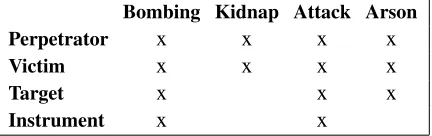
Bombing Kidnap Attack Arson
Perpetrator x x x x
Victim x x x x
Target x x x
Instrument x x
Figure 3: Slots in the hand-crafted MUC-4 templates.
types, but two of them occur in only 4 and 14 of the 1300 training documents. We thus only evaluate the 4 main templates (bombing,kidnapping,attack, and arson). The gold slots are shown in figure 3.
We thus report 92% slot recall, and precision as 14 of 16 (88%) learned slots.
We only measure agreement with the MUC tem-plate schemas, but our system learns other events as well. We show two such examples in figure 2: the Weapons Smuggling and Election Templates.
5 Information Extraction: Slot Filling
We now present how to apply our learned templates to information extraction. This section will describe how to extract slot fillers using our templates, but without knowing which templates are correct.
We could simply use a standard IE approach, for example, creating seed words for our new learned templates. But instead, we propose a new method that obviates the need for even a limited human la-beling of seed sets. We consider each learned se-mantic role as a potential slot, and we extract slot fillers using the syntactic functions that were previ-ously learned. Thus, the learned syntactic patterns (e.g., the subject ofrelease) serve the dual purpose of both inducing the template slots, and extracting appropriate slot fillers from text.
5.1 Document Classification
A document is labeled for a template if two different conditions are met: (1) it contains at least one trig-ger phrase, and (2) its average per-token conditional probability meets a strict threshold.
Both conditions require a definition of the condi-tional probability of a template given a token. The conditional is defined as the token’s importance rel-ative to its uniqueness across all templates. This is not the usual conditional probability definition as IR-corpora are different sizes.
P(t|w) = PIRt(w) P
s∈T PIRs(w)
(8)
wherePIRt(w)is the probability of patternwin the IR-corpus of templatet.
PIRt(w) =
Ct(w)
P
vCt(v)
(9)
whereCt(w)is the number of times wordwappears in the IR-corpus of templatet. A template’s trigger words are defined as words satisfyingP(t|w)>0.2.
Kidnap Bomb Attack Arson
Precision .64 .83 .66 .30
Recall .54 .63 .35 1.0
[image:7.612.320.533.71.133.2]F1 .58 .72 .46 .46
Figure 4: Document classification results on test.
Trigger phrases are thus template-specific patterns that are highly indicative of that template.
After identifying triggers, we use the above defi-nition to score a document with a template. A doc-ument is labeled with a template if it contains at least one trigger, and its average word probability is greater than a parameter optimized on the training set. A document can be (and often is) labeled with multiple templates.
Finally, we label the sentences that contain trig-gers and use them for extraction in section 5.2.
5.1.1 Experiment: Document Classification
The MUC-4 corpus links templates to documents, allowing us to evaluate our document labels. We treat each link as a gold label (kidnap, bomb, or attack) for that document, and documents can have multiple labels. Our learned clusters naturally do not have MUC labels, so we report results on the four clusters that score highest with each label.
Figure 4 shows the document classification scores. The bombing template performs best with an F1 score of .72. Arson occurs very few times, and Attack is lower because it is essentially an ag-glomeration of diverse events (discussed later).
5.2 Entity Extraction
Once documents are labeled with templates, we next extract entities into the template slots. Extraction oc-curs in the trigger sentences from the previous sec-tion. The extraction process is two-fold:
1. Extract all NPs that are arguments of patterns in the template’s induced roles.
2. Extract NPs whose heads are observed frequently with one of the roles (e.g., ‘bomb’ is seen with In-strument relations in figure 2).
Take the following MUC-4 sentence as an example:
The verbplantis in our learned bombing cluster, so step (1) will extract its passive subject bombs and map it to the correct instrument role (see figure 2). The human target,owners, is missed because intim-idatewas not learned. However, ifowner is in the selectional preferences of the learned ‘human target’ role, step (2) correctly extracts it into that role.
These are two different, but complementary, views of semantic roles. The first is that a role is de-fined by the set of syntactic relations that describe it. Thus, we find all role relations and save their argu-ments (pattern extraction). The second view is that a role is defined by the arguments that fill it. Thus, we extract all arguments that filled a role in training, regardless of their current syntactic environment.
Finally, we filter extractions whose WordNet or named entity label does not match the learned slot’s type (e.g., a Location does not match a Person).
6 Standard Evaluation
We trained on the 1300 documents in the MUC-4 corpus and tested on the 200 document TST3 and TST4 test set. We evaluate the four string-based slots: perpetrator, physical target, human target, and instrument. We merge MUC’s two perpetrator slots (individuals and orgs) into one gold Perpetrator slot. As in Patwardhan and Riloff (2007; 2009), we ig-nore missed optional slots in computing recall. We induced clusters in training, performed IR, and in-duced the slots. We then extracted entities from the test documents as described in section 5.2.
The standard evaluation for this corpus is to report the F1 score for slot type accuracy, ignoring the tem-plate type. For instance, a perpetrator of a bombing and a perpetrator of an attack are treated the same. This allows supervised classifiers to train on all per-petrators at once, rather than template-specific learn-ers. Although not ideal for our learning goals, we report it for comparison against previous work.
Several supervised approaches have presented re-sults on MUC-4, but unfortunately we cannot com-pare against them. Maslennikov and Chua (2006; 2007) evaluated a random subset of test (they report .60 and .63 F1), and Xiao et al. (2004) did not eval-uate all slot types (they report .57 F1).
Figure 5 thus shows our results with previous work that is comparable: the fully supervised and
P R F1
Patwardhan & Riloff-09 : Supervised 48 59 53 Patwardhan & Riloff-07 : Weak-Sup 42 48 44 Our Results (1 attack) 48 25 33
[image:8.612.315.546.71.145.2]Our Results (5 attack) 44 36 40
Figure 5: MUC-4 extraction, ignoring template type.
F1 Score Kidnap Bomb Arson Attack Results .53 .43 .42 .16 / .25
Figure 6: Performance of individual templates. Attack compares our 1 vs 5 best templates.
weakly supervised approaches of Patwardhan and Riloff (2009; 2007). We give two numbers for our system: mapping one learned template to Attack, and mapping five. Our learned templates for Attack have a different granularity than MUC-4. Rather than one broad Attack type, we learn several: Shoot-ing, Murder, Coup, General Injury, and Pipeline At-tack. We see these subtypes as strengths of our al-gorithm, but it misses the MUC-4 granularity of At-tack. We thus show results when we apply the best five learned templates to Attack, rather than just one. The final F1 with these Attack subtypes is .40.
Our precision is as good as (and our F1 score near) two algorithms that require knowledge of the tem-plates and/or labeled data. Our algorithm instead learned this knowledge without such supervision.
7 Specific Evaluation
In order to more precisely evaluate each learned template, we also evaluated per-template perfor-mance. Instead of merging all slots across all tem-plate types, we score the slots within each temtem-plate type. This is a stricter evaluation than Section 6; for example, bombing victims assigned to attacks were previously deemed correct4.
Figure 6 gives our results. Three of the four tem-plates score at or above .42 F1, showing that our lower score from the previous section is mainly due to the Attack template. Arson also unexpectedly
4
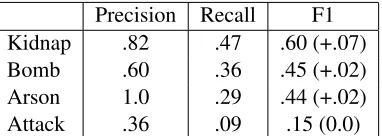
Precision Recall F1 Kidnap .82 .47 .60 (+.07)
Bomb .60 .36 .45 (+.02)
[image:9.612.92.283.71.139.2]Arson 1.0 .29 .44 (+.02) Attack .36 .09 .15 (0.0)
Figure 7: Performance of each template type, but only evaluated on documents labeled with each type. All oth-ers are removed from test. The parentheses indicate F1 gain over evaluating on all test documents (figure 6).
scored well. It only occurs in 40 documents overall, suggesting our algorithm works with little evidence. Per-template performace is good, and our .40 overall score from the previous section illustrates that we perform quite well in comparison to the .44-.53 range of weakly and fully supervised results.
These evaluations use the standard TST3 and TST4 test sets, including the documents that are not labeled with any templates. 74 of the 200 test doc-uments are unlabeled. In order to determine where the system’s false positives originate, we also mea-sure performance only on the 126 test documents that have at least one template. Figure 7 presents the results on this subset. Kidnap improves most signifi-cantly in F1 score (7 F1 points absolute), but the oth-ers only change slightly. Most of the false positives in the system thus do not originate from the unla-beled documents (the 74 unlaunla-beled), but rather from extracting incorrect entities from correctly identified documents (the 126 labeled).
8 Discussion
Template-based IE systems typically assume knowl-edge of the domain and its templates. We began by showing that domain knowledge isn’t necessar-ily required; we learned the MUC-4 template struc-ture with surprising accuracy, learning new seman-tic roles and several new template structures. We are the first to our knowledge to automatically in-duce MUC-4 templates. It is possible to take these learned slots and use a previous approach to IE (such as seed-based bootstrapping), but we presented an algorithm that instead uses our learned syntactic pat-terns. We achieved results with comparable preci-sion, and an F1 score of .40 that approaches prior algorithms that rely on hand-crafted knowledge.
The extraction results are encouraging, but the template induction itself is a central contribution of this work. Knowledge induction plays an important role in moving to new domains and assisting users who may not know what a corpus contains. Re-cent work in Open IE learns atomic relations (Banko et al., 2007b), but little work focuses on structured scenarios. We learned more templates than just the main MUC-4 templates. A user who seeks to know what information is in a body of text would instantly recognize these as key templates, and could then ex-tract the central entities.
We hope to address in the future how the al-gorithm’s unsupervised nature hurts recall. With-out labeled or seed examples, it does not learn as many patterns or robust classifiers as supervised ap-proaches. We will investigate new text sources and algorithms to try and capture more knowledge. The final experiment in figure 7 shows that perhaps new work should first focus on pattern learning and entity extraction, rather than document identification.
Finally, while our pipelined approach (template induction with an IR stage followed by entity ex-traction) has the advantages of flexibility in devel-opment and efficiency, it does involve a number of parameters. We believe the IR parameters are quite robust, and did not heavily focus on improving this stage, but the two clustering steps during tem-plate induction require parameters to control stop-ping conditions and word filtering. While all learn-ing algorithms require parameters, we think it is im-portant for future work to focus on removing some of these to help the algorithm be even more robust to new domains and genres.
Acknowledgments
References
Collin F. Baker, Charles J. Fillmore, and John B. Lowe. 1998. The Berkeley FrameNet project. In Christian Boitet and Pete Whitelock, editors,ACL-98, pages 86– 90, San Francisco, California. Morgan Kaufmann Pub-lishers.
Michele Banko, Michael J Cafarella, Stephen Soderland, Matt Broadhead, and Oren Etzioni. 2007a. Learning relations from the web. InProceedings of the Interna-tional Joint Conferences on Artificial Intelligence (IJ-CAI).
Michele Banko, Michael J Cafarella, Stephen Soderland, Matt Broadhead, and Oren Etzioni. 2007b. Open in-formation extraction from the web. InProceedings of the International Joint Conferences on Artificial Intel-ligence (IJCAI).
David Blei, Andrew Ng, and Michael Jordan. 2003. La-tent dirichlet allocation. Journal of Machine Learning Research.
Razvan Bunescu and Raymond Mooney. 2004. Collec-tive information extraction with relational markov net-works. InProceedings of the Association of Computa-tional Linguistics (ACL), pages 438–445.
Andrew Carlson, J. Betteridge, R.C. Wang, E.R. Hr-uschka Jr., and T.M. Mitchell. 2010. Coupled semi-supervised learning for information extraction. In Pro-ceedings of the ACM International Conference on Web Search and Data Mining (WSDM).
Nathanael Chambers and Dan Jurafsky. 2008. Unsuper-vised learning of narrative event chains. In Proceed-ings of the Association of Computational Linguistics (ACL), Hawaii, USA.
Nathanael Chambers and Dan Jurafsky. 2009. Unsuper-vised learning of narrative schemas and their partici-pants. InProceedings of the Association of Computa-tional Linguistics (ACL), Columbus, Ohio.
Hai Leong Chieu, Hwee Tou Ng, and Yoong Keok Lee. 2003. Closing the gap: Learning-based information extraction rivaling knowledge-engineering methods. In Proceedings of the Association of Computational Linguistics (ACL).
Nancy Chinchor, David Lewis, and Lynette Hirschman. 1993. Evaluating message understanding systems: an analysis of the third message understanding confer-ence. Computational Linguistics, 19:3:409–449. Katrin Erk and Sebastian Pado. 2008. A structured
vec-tor space model for word meaning in context. In Pro-ceedings of the 2008 Conference on Empirical Meth-ods on Natural Language Processing (EMNLP). Elena Filatova, Vasileios Hatzivassiloglou, and Kathleen
McKeown. 2006. Automatic creation of domain tem-plates. InProceedings of the Association of Computa-tional Linguistics (ACL).
Dayne Freitag. 1998. Toward general-purpose learning for information extraction. InProceedings of the As-sociation of Computational Linguistics (ACL), pages 404–408.
David Graff. 2002. English gigaword. Linguistic Data Consortium.
Trond Grenager and Christopher D. Manning. 2006. Un-supervised discovery of a statistical verb lexicon. In
Proceedings of the the 2006 Conference on Empirical Methods on Natural Language Processing (EMNLP). Shan He and Daniel Gildea. 2006. Self-training and
co-training for semantic role labeling: Primary report. Technical Report 891, University of Rochester. Heng Ji and Ralph Grishman. 2008. Refining event
ex-traction through unsupervised cross-document infer-ence. In Proceedings of the Association of Compu-tational Linguistics (ACL).
Niels Kasch and Tim Oates. 2010. Mining script-like structures from the web. In Proceedings of NAACL HLT, pages 34–42.
Joel Lang and Mirella Lapata. 2010. Unsupervised in-duction of semantic roles. InProceedings of the North American Association of Computational Linguistics. Mstislav Maslennikov and Tat-Seng Chua. 2007.
Auto-matic acquisition of domain knowledge for informa-tion extracinforma-tion. In Proceedings of the Association of Computational Linguistics (ACL).
Siddharth Patwardhan and Ellen Riloff. 2007. Effective ie with semantic affinity patterns and relevant regions. In Proceedings of the 2007 Conference on Empirical Methods on Natural Language Processing (EMNLP). Siddharth Patwardhan and Ellen Riloff. 2009. A unified
model of phrasal and sentential evidence for informa-tion extracinforma-tion. InProceedings of the 2009 Conference on Empirical Methods on Natural Language Process-ing (EMNLP).
Lisa Rau, George Krupka, Paul Jacobs, Ira Sider, and Lois Childs. 1992. Ge nltoolset: Muc-4 test results and analysis. InProceedings of the Message Under-standing Conference (MUC-4), pages 94–99.
Ellen Riloff and Mark Schmelzenbach. 1998. An em-pirical approach to conceptual case frame acquisition. In Proceedings of the Sixth Workshop on Very Large Corpora.
Ellen Riloff, Janyce Wiebe, and William Phillips. 2005. Exploiting subjectivity classification to improve infor-mation extraction. InProceedings of AAAI-05. Roger C. Schank and Robert P. Abelson. 1977. Scripts,
plans, goals and understanding. Lawrence Erlbaum. Yusuke Shinyama and Satoshi Sekine. 2006. Preemptive
Kiyoshi Sudo, Satoshi Sekine, and Ralph Grishman. 2003. An improved extraction pattern representation model for automatic ie pattern acquisition. In Pro-ceedings of the Association of Computational Linguis-tics (ACL), pages 224–231.
Beth M. Sundheim. 1991. Third message understand-ing evaluation and conference (muc-3): Phase 1 status report. InProceedings of the Message Understanding Conference.
Mihai Surdeanu, Jordi Turmo, and Alicia Ageno. 2006. A hybrid approach for the acquisition of information extraction patterns. InProceedings of the EACL Work-shop on Adaptive Text Extraction and Mining. Robert S. Swier and Suzanne Stevenson. 2004.
Unsu-pervised semantic role labelling. In Proceedings of the 2004 Conference on Empirical Methods on Nat-ural Language Processing (EMNLP).
Jing Xiao, Tat-Seng Chua, and Hang Cui. 2004. Cas-cading use of soft and hard matching pattern rules for weakly supervised information extraction. In
Proceedings of the 20th International Conference on Computational Linguistics (COLING).
Roman Yangarber, Ralph Grishman, Pasi Tapanainen, and Silja Huttunen. 2000. Automatic acquisition of domain knowledge for information extraction. In