Propminer: A Workflow for Interactive Information Extraction and
Exploration using Dependency Trees
Alan Akbik, Oresti Konomi and Michail Melnikov Technische Univerist¨at Berlin
Databases and Information Systems Group Einsteinufer 17, 10587 Berlin, Germany
Abstract
The use of deep syntactic information such as typed dependencies has been shown to be very effective in Information Ex-traction. Despite this potential, the pro-cess of manually creating rule-based in-formation extractors that operate on de-pendency trees is not intuitive for persons without an extensive NLP background. In this system demonstration, we present a tool and a workflow designed to enable initiate users to interactively explore the effect and expressivity of creating Infor-mation Extraction rules over dependency trees. We introduce the proposed five step workflow for creating information extrac-tors, the graph query based rule language, as well as the core features of the PROP -MINERtool.
1 Introduction
Information Extraction (IE) is the task of gener-ating structured information, often in the form of subject-predicate-object relation triples, from un-structured information such as natural language text. Although there are well-established methods for automatically training extractors from anno-tated data (Mintz et al., 2009), recent years have seen a renewed interest in manually created and maintained rule-based IE systems (Doan et al., 2009; Chiticariu et al., 2010). Advantages of such systems include a better transparency and explain-ability of extraction rules, and the resulting main-tainability and customizability of rule sets.
Another trend in IE is to make increasing use of deep syntactic information in extrac-tors (Bunescu and Mooney, 2005), as dependency parsers become faster and more robust on irregular text (Bohnet, 2010).
Bringing both trends together are recent works in the field of Open Information Extraction (OIE).
The systems KRAKEN (Akbik and L¨oser, 2012)
and CLAUSIE (Del Corro and Gemulla, ) use
a set of hand crafted rules on dependency trees to outperform previous classification based ap-proaches. The latter system outperforms even OL -LIE (Mausam et al., 2012), the machine learning
based state-of-the art OIE system on dependency parses. Not only does CLAUSIE report significant
precision gains over OLLIE, but also finds 2.5 to
3.5 times more relations.
These results indicate a strong potential for manually creating rule-based Information Extrac-tion systems using dependency trees. The higher level syntactic representation, we argue, may even facilitate rule writing, as - unlike in shallow lexico-syntactic rules - much linguistic variation such as inserted clauses and expressions must not be specifically addressed. This enables the creation of more succinct IE rules, leading to better ex-plainability and easier maintenance.
However, despite these advantages, experience has shown that deep syntactic information is diffi-cult to read and understand for non NLP-experts.
In this system demonstration, we propose a workflow designed to tap into this potential, and present the PROPMINER tool that allows users to
execute this workflow. It is specifically designed to help persons familiarize themselves with de-pendency trees and enable exploration and extrac-tion of relaextrac-tions from parsed document collec-tions. Core features of PROPMINERare:
Rule generation and modification. Initiate users are guided by a workflow in which they first enter and annotate an archetypical sentence with the desired relation. A rule generation process then pre-generates an overspecified rule that users modify along lines suggested by the tool. Our pre-liminary experiments show that this workflow of generating and modifying rules eases the learn-ing curve for non NLP-experts to concepts such as part-of-speech tags and typed dependencies.
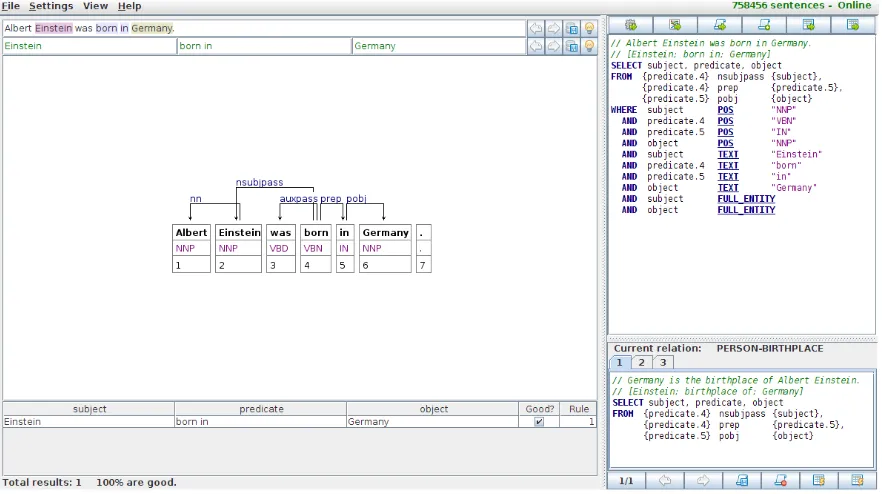
Figure 1: Sentence view of PROPMINER, where steps one and two of the workflow are executed. Users
enter (or select) a sentence in the top input field and annotate subject, predicate and object for the desired relation. A rule is generated and displayed in the upper right panel. The lower right panel is the repository of already created rules. The parse of the input sentence is displayed in the center panel.
Interactivity and feedback. Each modifica-tion of a rule is immediately queried against a large collection of parsed sentences stored in a dis-tributed graph database. The extraction results of the current state of the rule are presented at all times to the user, thereby explaining the rule by showing its effect.
Intuitive query language. Extraction rules are formulated as queries against a graph database. Our query language allows users to formulate sub-tree queries as path expressions, a concept bor-rowed from the SerQL query language (Broekstra and Kampman, 2003) because of its intuitive prop-erties. We show a visualization of the parse tree of the current sentence next to the generated rule to ease users into understanding the query language (see Figure 1).
Guided workflow. All structured information generated by the user, such as extraction rules, sentence annotations and evaluation results, are stored to build up a repository of structured infor-mation. This information is used to suggest appro-priate actions to the user.
A preliminary study shows that users with-out any NLP background are quickly able to use PROPMINERto create Information Extraction
rules. We noted that users at first stay true to the
workflow and limit manual effort to generalizing rules, but tend to more directly modify extraction rules as they grow more experienced. Further-more, PROPMINER’s interactive nature eases the
process of understanding typed dependencies and enables the interactive exploration of parsed doc-ument collections.
2 Workflow and Query Language
PROPMINER implements a workflow that
con-sists of five steps (Annotate, Generate, General-ize, Evaluate andStore). It is designed to allow users that are unfamiliar with syntactic annotation to create rule-based extractors. In the following subsections, we explain the five steps in detail. As a running example, we use the task of creating an extractor for the PERSONBIRTHPLACErelation.
2.1 Annotate
Users begin the process by constructing an
archetypicalsentence for the desired information type. This sentence constitutes an example that expresses the desired relation. For instance, a user interested in the PERSONBIRTHPLACE
rela-tion can choose a sentence such as “Albert Ein-stein was born in Germany.”.
belonging to the relation triple, assigning the roles ofsubject, predicateandobject. Subject and ob-ject are the entities in the example between which the relation holds. The predicate are the words in the sentence that express the relationship. Ac-cordingly, the user marks “Albert Einstein” and “Germany” as subject and object, and “born in” as predicate in the example sentence.
Figure 1 shows the sentence view of PROP -MINER, with the example sentence entered and
an-notated in the top input fields, and the parsed sen-tence shown in the center panel.
2.2 Generate
PROPMINER generates a rule from the annotated
sentence by determining the minimal subtree in the sentence’s dependency tree that connects all words labeled as subject, predicate and object. The rule consists of this minimal subtree, as well as constraints in the part-of-speech (POS) tags and lexical values of all involved words.
Rules are formulated as queries against a database in which parsed sentences are stored as graphs: Nodes represent words and edges repre-sent typed dependencies. At each node, the POS tag and the lexical value of the word are stored as attributes.
A PROPMINERrule (or query) consists mainly
of three parts: A SELECT clause, a FROM clause and a WHERE clause. The generated rule for the running example is displayed in Figure 1. Its indi-vidual parts are discussed in the following subsec-tions.
2.2.1 SELECT and FROM
The SELECT clause determines the fields of tu-ple to be returned by the query. Typically, this consists of a subject-predicate-object triple, but queries with fewer or more fields are possible.
The FROM clause is a path expression that specifies the subgraph in the dependency tree the rule must match, and defines which nodes in the subgraph correspond to the fields in the SELECT clause. A path expression is a set of node-edge-node triples. Each of these triples defines one edge (typed dependency) that must hold between two nodes (words). The nodes are denoted in curly brackets, where the text inside curly brackets as-signs a variable name to the node.
Consider the SELECT and FROM clauses for the rule generated for the running example, illus-trated in the following:
SELECT subject, predicate, object
FROM
{_7_} nsubj {subject} {_7_} cop {predicate} {_7_} amod {object}
SELECT subject, predicate, object
FROM
{predicate.3} nsubjpass {subject}, {predicate.3} prep {predicate.4}, {predicate.4} pobj {object}
WHERE
AND subject POS “NNS”
AND predicate.3 POS“VBN”
AND predicate.4 POS “IN”
AND object POS “NNP”
AND subject TEXT “A. Einstein”
AND predicate.3 TEXT “born”
AND predicate.4 TEXT “in”
AND object TEXT “Ulm”
AND subject FULL_ENTITY
Here, the SELECT statement defines the de-sired result of this query, namely a tuple with a “subject”, “object” and a “predicate” field: The path expression in this example is specified in the three lines in the FROM statement. It defines a subtree that consists of four nodes connected by three typed dependencies.
The nodes are assigned the variable names “subject”, “object”, “predicate.3” and “predi-cate.4”. The node “subject” is defined to be a passive subject (typed dependency “nsubjpass”) of the node “predicate.3”. The node “predicate.3” is also connected via the dependency “prep” to the node “predicate.4”, which in turn is connected to “object” with the dependency “pobj”.
If this rule matches, the lexical values of the matching nodes are returned. Because the predi-cate in this example consists of two words (“born” and “in”), two nodes are assigned the “predicate” value, subtyped per convention with a dot and a number (“predicate.3” and “predicate.4”).
2.2.2 WHERE
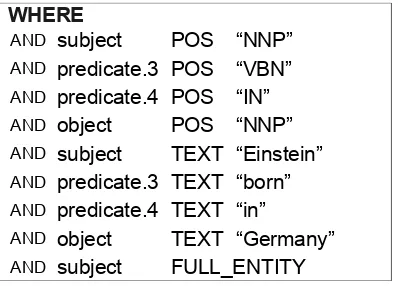
In the WHERE-clause, the attributes of words in the subtree can be further restricted. Auto-generated rules are maximally restricted. The rule for the running example is initially restricted as follows:
SELECT subject, predicate, object
FROM
{_7_} nsubj {subject} {_7_} cop {predicate} {_7_} amod {object}
WHERE
AND subject POS “NNP”
AND predicate.3 POS “VBN”
AND predicate.4 POS “IN”
AND object POS “NNP”
AND subject TEXT “Einstein”
AND predicate.3 TEXT “born”
AND predicate.4 TEXT “in”
AND object TEXT “Germany”
AND subject FULL_ENTITY
a) Generated rule b) Generalize subject text c) Generalize subject and object SELECT subject, predicate, object
FROM
{_7_} nsubj {subject} {_7_} cop {predicate} {_7_} amod {object}
SELECT subject, predicate, object
FROM { collapsed }
WHERE
subject POS “NNP”
AND predicate.3 POS “VBZ”
AND predicate.4 POS “IN”
AND object POS “NNP”
AND subject TEXT “Einstein”
AND predicate.3 TEXT “born”
AND predicate.4 TEXT “in”
AND object TEXT “Germany”
AND subject ALLCHILDREN
Subject Predicate Object
A. Einstein born in Germany
Subject Predicate Object
A. Einstein born in Germany C. F. Gauss born in Germany A. Humboldt born in Germany
... ... ...
Subject Predicate Object
A. Einstein born in Germany J. Lagrange born in Italy
I. Newton born in England ... ... ...
SELECT subject, predicate, object
FROM { collapsed }
WHERE
subject POS “NNP”
AND predicate.3 POS “VBZ”
AND predicate.4 POS “IN”
AND object POS “NNP”
AND subject TEXT “Einstein”
AND predicate.3 TEXT “born”
AND predicate.4 TEXT “in”
AND object TEXT “Germany”
AND subject ALLCHILDREN
SELECT subject, predicate, object
FROM { collapsed }
WHERE
subject POS “NNP”
AND predicate.3 POS “VBZ”
AND predicate.4 POS “IN”
AND object POS “NNP”
AND subject TEXT “Einstein”
AND predicate.3 TEXT “born”
AND predicate.4 TEXT “in”
AND object TEXT “Germany”
[image:4.595.80.525.61.260.2]AND subject ALLCHILDREN
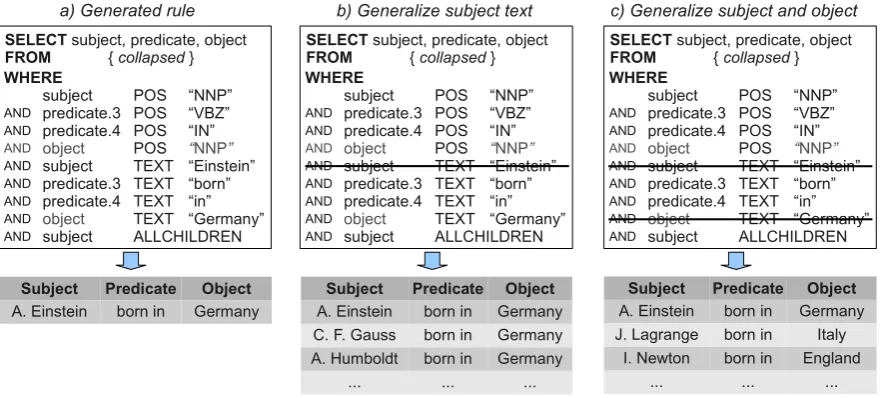
Figure 2: Conceptual example of rule modification through generalization. Below are example relation triples found for each rule. Rule a) is generated from the annotated sentence in the running example, and finds only one triple. Rule b) is the same rule without the restriction in the subject text. The rule now finds a number of relation triples in the document collection, representing different entities born in Germany. In Rule c) both subject and object text restrictions are removed. This yields a rule that finds different entities born in any entity.
Additionally, a number of subtree gathering mechanisms can be specified in the WHERE clause. For example, the keyword FULL ENTITY causes the variable binding for the subject to ex-pand to all children nodes expected to be part of a named entity.
2.3 Generalize
The rule generated in step two of the workflow is strongly overspecified to the annotated sentence; all features, including the shallow syntactic and lexical values of all words in the subtree, are con-strained. The resulting rule only finds exact in-stances of the relations as seen in the archetypical sentence. Refer to Figure 2 a) for an example.
In step three of the workflow, the user general-izes the auto-generated rule with the help of sug-gestions. Common lines of generalizing rules fo-cus on the WHERE clause; here, users can remove or modify constraints on the attributes of words. For example, by removing the restriction on the lexical value of the subject, the rule is generalized to findingall entitiesthat were born in “Germany”, instead of only entities with the lexical value “ Ein-stein”. This example is illustrated in Figure 2 b).
The rule can then be further generalized by re-moving the lexical constraint on the object, yield-ing the (desired) rule that finds all entities that were born in any location with an entity name.
Figure 2 c) shows an example of this rule, as well as example results.
Further options of generalization include re-moving the lexical constraints in one or both of the predicate words, or modifying the POS tag con-straints. At each modification, extraction results for the current state of the rule are displayed to as-sist the user. When the results match the desired relation, the user can proceed to the next step in the workflow.
2.4 Evaluate
Each rule created by the user is evaluated in the
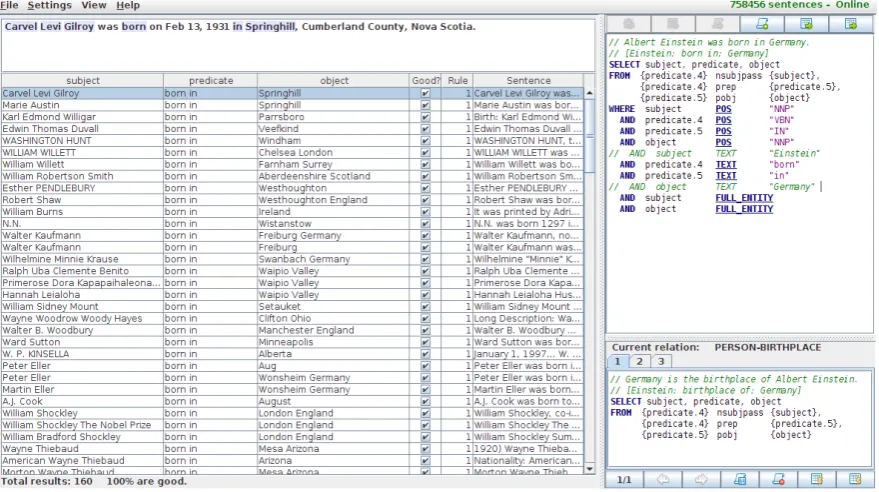
corpus view of PROPMINER, displayed in
Fig-ure 3. This view shows a sample of extraction results of the rule in a table. The user can scroll through the table and in each row see the extracted information as well as the sentence the tion was extracted from. If the extracted informa-tion matches the statement in the sentence, the user can mark this fact as correct.
2.5 Store
evalu-Figure 3: Corpus view of PROPMINER, where extraction rules are modified and evaluated. The center
panel is a table that holds the extraction results for the current rule. Users can inspect each extracted triple by clicking on the row. This will display the sentence in which the triple was found.
ation results. This enables additional functionality in subsequent executions of the workflow:
Sentence suggestions. Evaluation results are used to assist the user in finding new sentences that might be relevant to the relation. For exam-ple, a user might mark a triple with the subject “C. F. Gauss” and object “Germany” as a correct in-stance of the PERSONBIRTHPLACE relation
dur-ing evaluation. PROPMINER uses this
informa-tion to retrieve all sentences that contain these two entities from its database. These sentences are treated as probable candidates for containing the PERSONBIRTHPLACErelation, because they
con-tain two entities known to be in this relationship. Accordingly, they are suggested to the user upon request.
Conflict resolution. In order to prevent con-flicts with existing rules, the entire rule set in the repository is applied to each sentence the work-flow is started with. If any existing information extraction rule can be applied, the results of the extraction are presented to the user as annotations in the sentence. If this extraction result is already complete from the point of view of the user, he can proceed to a new sentence. If not, the user can proceed to generate a new rule, or modify existing ones.
3 Previous Work
Previous work on improving the rule creation pro-cess for IE systems has mainly focused on assist-ing users with machine learnassist-ing techniques, such as pre-generation of regular expressions (Brauer et al., 2011) or pattern suggestions (Li et al., 2011). To improve usability, (Li et al., 2012) present a tool with a wizard-like environment to guide ex-tractor development. While previous work focuses on shallow patterns, the focus of PROPMINERis to
help create rules over dependency trees and aid in the exploration of parsed document collections.
4 Evaluation and Outlook
We conducted a preliminary study in which we asked 5 computer scientists unfamiliar with com-putational linguistics to use the tool to cre-ate extractors for the relations PERSONBIRTH -PLACE, PERSONMARRIEDTOPERSON and PER -SONWONPRIZE. The participants were given a
two hour introduction explaining information ex-traction and subject-predicate-object triples. We introduced them to the five step workflow using the PERSONBIRTHPLACE example also used as
[image:5.595.80.520.64.310.2]cre-ate a rule set for each relation. After the con-clusion we interviewed the participants and asked them to rate the usability both for information ex-traction, as well as for the exploration of depen-dency tree information.
In the latter category, participants generally gave positive feedback. Participants stated that the interactive nature of the tool helped understanding extraction rules and facilitated exploring informa-tion stated in the document collecinforma-tion. 4 out of 5 participants deviated from the suggested work-flow and more directly edited rules as they be-came more comfortable with the tool. All par-ticipants consulted information on POS tags and typed dependencies during the process, in order to better understand the rules and query results. Par-ticipants suggested adding an explanation function for individual syntactic elements to the tool.
While all users were generally able to create rule sets for each of the relations, two main prob-lems were cited for the creation of extraction rules. The first is a problem in conflict resolution; in some cases, users were not able to discern why a rule gave imperfect extraction results. We re-viewed some rules and found that many of these cases stem from faulty dependency parses, which non NLP-experts cannot recognize. At present, we are searching for ways to address this problem.
A second problem were limitations of the rule language: Participants expressed the need for named entity types such as PERSON and LOCA -TION, which in the prototype were not included at
the time of evaluation. However, because of the design of the query language and the underlying graph database, such additional operators can be incorporated easily.
Consequently, current work focuses on extend-ing the range of user studies to gather more sug-gestions for the query language and the feature set, and integrating additional operators into the sys-tem.
5 Demonstration
In this demonstration we show how PROPMINER
can be used for creating extractors or exploring the parsed document collection. The hands-on demonstration allows initiate users to execute the workflow presented in this paper, but also enables persons more familiar with syntactic annotation to more directly query the graph database using our query language and feature set.
Acknowledgements
We would like to thank the anonymous reviewers for their helpful comments. Alan Akbik received funding from the Eu-ropean Union’s Seventh Framework Programme (FP7/2007-2013) under grant agreement no ICT-2009-4-1 270137 ’Scal-able Preservation Environments’ (SCAPE).
References
Alan Akbik and Alexander L¨oser. 2012. Kraken: N-ary facts in open information extraction. InAKBC-WEKEX, pages 52–56. Association for Computational Linguistics. Bernd Bohnet. 2010. Very high accuracy and fast
depen-dency parsing is not a contradiction. InCOLING, pages 89–97. Association for Computational Linguistics. Falk Brauer, Robert Rieger, Adrian Mocan, and Wojciech M
Barczynski. 2011. Enabling information extraction by inference of regular expressions from sample entities. In
CIKM, pages 1285–1294. ACM.
Jeen Broekstra and Arjohn Kampman. 2003. Serql: a second generation rdf query language. In Proc. SWAD-Europe Workshop on Semantic Web Storage and Retrieval, pages 13–14.
Razvan C Bunescu and Raymond J Mooney. 2005. A short-est path dependency kernel for relation extraction. In
EMNLP, pages 724–731. Association for Computational Linguistics.
Laura Chiticariu, Rajasekar Krishnamurthy, Yunyao Li, Sriram Raghavan, Frederick R Reiss, and Shivakumar Vaithyanathan. 2010. Systemt: an algebraic approach to declarative information extraction. InACL, pages 128– 137. Association for Computational Linguistics.
Luciano Del Corro and Rainer Gemulla. Clausie: Clause-based open information extraction. InWWW (to appear in 2013).
AnHai Doan, Jeffrey F Naughton, Raghu Ramakrishnan, Akanksha Baid, Xiaoyong Chai, Fei Chen, Ting Chen, Eric Chu, Pedro DeRose, Byron Gao, et al. 2009. In-formation extraction challenges in managing unstructured data.ACM SIGMOD Record, 37(4):14–20.
Yunyao Li, Vivian Chu, Sebastian Blohm, Huaiyu Zhu, and Howard Ho. 2011. Facilitating pattern discovery for rela-tion extracrela-tion with semantic-signature-based clustering. InCIKM, pages 1415–1424. ACM.
Yunyao Li, Laura Chiticariu, Huahai Yang, Frederick R Reiss, and Arnaldo Carreno-fuentes. 2012. Wizie: a best practices guided development environment for informa-tion extracinforma-tion. InProceedings of the ACL 2012 System Demonstrations, pages 109–114. Association for Compu-tational Linguistics.