
A Comparative Study of Target Dependency Structures
for Statistical Machine Translation
Xianchao Wu∗, Katsuhito Sudoh, Kevin Duh†, Hajime Tsukada, Masaaki Nagata NTT Communication Science Laboratories, NTT Corporation
2-4 Hikaridai Seika-cho, Soraku-gun Kyoto 619-0237 Japan
[email protected],[email protected],
[email protected],{tsukada.hajime,nagata.masaaki}@lab.ntt.co.jp
Abstract
This paper presents a comparative study of target dependency structures yielded by sev-eral state-of-the-art linguistic parsers. Our ap-proach is to measure the impact of these non-isomorphic dependency structures to be used for string-to-dependency translation. Besides using traditional dependency parsers, we also use the dependency structures transformed from PCFG trees and predicate-argument structures (PASs) which are generated by an HPSG parser and a CCG parser. The experi-ments on Chinese-to-English translation show that the HPSG parser’s PASs achieved the best dependency and translation accuracies.
1 Introduction
Target language side dependency structures have been successfully used in statistical machine trans-lation (SMT) by Shen et al. (2008) and achieved state-of-the-art results as reported in the NIST 2008 Open MT Evaluation workshop and the NTCIR-9 Chinese-to-English patent translation task (Goto et al., 2011; Ma and Matsoukas, 2011). A primary ad-vantage of dependency representations is that they have a natural mechanism for representing discon-tinuous constructions, which arise due to long-distance dependencies or in languages where gram-matical relations are often signaled by morphology instead of word order (McDonald and Nivre, 2011). It is known that dependency-style structures can be transformed from a number of linguistic
struc-∗Now at Baidu Inc.
†Now at Nara Institute of Science & Technology (NAIST)
tures. For example, using the constituent-to-dependency conversion approach proposed by Jo-hansson and Nugues (2007), we can easily yield de-pendency trees from PCFG style trees. A seman-tic dependency representation of a whole sentence, predicate-argument structures (PASs), are also in-cluded in the output trees of (1) a state-of-the-art head-driven phrase structure grammar (HPSG) (Pol-lard and Sag, 1994; Sag et al., 2003) parser, Enju1 (Miyao and Tsujii, 2008) and (2) a state-of-the-art CCG parser2 (Clark and Curran, 2007). The moti-vation of this paper is to investigate the impact of these non-isomorphic dependency structures to be used for SMT. That is, we would like to provide a comparative evaluation of these dependencies in a string-to-dependency decoder (Shen et al., 2008).
2 Gaining Dependency Structures
2.1 Dependency tree
We follow the definition of dependency graphand
dependency treeas given in (McDonald and Nivre, 2011). A dependency graph G for sentence s is called a dependency tree when it satisfies, (1) the nodes cover all the words in s besides the ROOT; (2) one node can have one and only one head (word) with a determined syntactic role; and (3) the ROOT of the graph is reachable from all other nodes.
For extracting string-to-dependency transfer rules, we use well-formed dependency structures, either fixed or floating, as defined in (Shen et al., 2008). Similarly, we ignore the syntactic roles
1http://www-tsujii.is.s.u-tokyo.ac.jp/enju/index.html 2
http://groups.inf.ed.ac.uk/ccg/software.html
when the fluid pressure cylinder 31 is used , fluid is gradually applied .
t0 t1 t2 t3 t4 t5 t6 t7 t8 t9 t10 t11 t12 c2 c5 c7 c9 c11 c12 c14 c15 c17 c20 c22 c24 c25
c3 c4
c6 c8
c10 c13
c18
c19 c21
c23 c16
c1 c0
conj_ arg12
det_ arg1
adj_ arg1
noun_ arg1
noun_ arg0
adj_ arg1
aux_ arg12
verb_ arg12
punct_ arg1
noun_ arg0
aux_ arg12
adj_ arg1
verb_ arg12
* +
* + * +
* + * +
* + * +
* * +
* + * +
* + * +
+
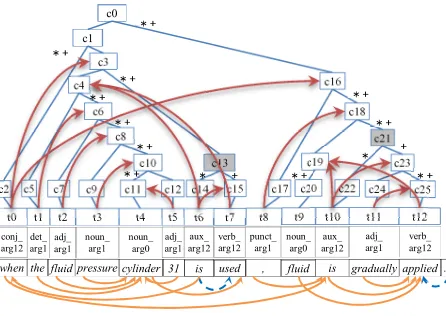
Figure 1: HPSG tree of an example sentence. ‘*’/ ‘+’=syntactic/semantic heads. Arrows in red (upper)= PASs, orange (bottom)=word-level dependencies gener-ated from PASs, blue=newly appended dependencies.
both during rule extracting and target dependency language model (LM) training.
2.2 Dependency parsing
Graph-based and transition-based are two predom-inant paradigms for data-driven dependency pars-ing. The MST parser (McDonald et al., 2005) and the Malt parser (Nivre, 2003) stand for two typical parsers, respectively. Parsing accuracy comparison and error analysis under the CoNLL-X dependency shared task data (Buchholz and Marsi, 2006) have been performed by McDonald and Nivre (2011). Here, we compare them on the SMT tasks through parsing the real-world SMT data.
2.3 PCFG parsing
For PCFG parsing, we select the Berkeley parser (Petrov and Klein, 2007). In order to generate word-level dependency trees from the PCFG tree, we use the LTH constituent-to-dependency conversion tool3
written by Johansson and Nugues (2007). The head finding rules4 are according to Magerman (1995) and Collins (1997). Similar approach has been orig-inally used by Shen et al. (2008).
2.4 HPSG parsing
In the Enju English HPSG grammar (Miyao et al., 2003) used in this paper, the semantic content of
3http://nlp.cs.lth.se/software/treebank converter/ 4
http://www.cs.columbia.edu/ mcollins/papers/heads
a sentence/phrase is represented by a PAS. In an HPSG tree, each leaf node generally introduces a predicate, which is represented by the pair made up of the lexical entry feature and predicate type fea-ture. The arguments of a predicate are designated by the arrows from the argument features in a leaf node to non-terminal nodes (e.g., t0→c3, t0→c16).
Since the PASs use the non-terminal nodes in the HPSG tree (Figure 1), this prevents their direct us-age in a string-to-dependency decoder. We thus need an algorithm to transform these phrasal predicate-argument dependencies into a word-to-word depen-dency tree. Our algorithm (refer to Figure 1 for an example) for changing PASs into word-based depen-dency trees is as follows:
1. finding, i.e., find the syntactic/semantic head word of each argument node through a bottom-up traversal of the tree;
2. mapping, i.e., determine the arc directions
(among a predicate word and the syntac-tic/semantic head words of the argument nodes) for each predicate type according to Table 1. Then, a dependency graph will be generated;
[image:2.612.78.301.60.218.2]3. checking, i.e., post modifying the dependency graph according to the definition ofdependency tree(Section 2.1).
Table 1 lists the mapping from HPSG’s PAS types to word-level dependency arcs. Since a non-terminal node in an HPSG tree has two kinds of heads, syn-tactic or semantic, we will generate two dependency graphs after mapping. We use “PAS+syn” to repre-sent the dependency trees generated from the HPSG PASs guided by the syntactic heads. For semantic heads, we use “PAS+sem”.
For example, refer to t0 = when in Figure 1. Its arg1 = c16 (with syntactic head t10), arg2 = c3 (with syntactic head t6), and PAS type = conj arg12. In Table 1, this PAS type corresponds to arg2→pred→arg1, then the result word-level de-pendency is t6(is)→t0(when)→t10(is).
PAS Type Dependency Relation
adj arg1[2] [arg2→] pred→arg1
adj mod arg1[2] [arg2→] pred→arg1→mod
aux[ mod] arg12 arg1/pred→arg2 [→mod]
conj arg1[2[3]] [arg2[/arg3]]→pred→arg1
comp arg1[2] pred→arg1 [→arg2]
comp mod arg1 arg1→pred→mod
noun arg1 pred→arg1
noun arg[1]2 arg2→pred [→arg1]
poss arg[1]2 pred→arg2 [→arg1]
prep arg12[3] arg2[/arg3]→pred→arg1
prep mod arg12[3] arg2[/arg3]→pred→arg1→mod
quote arg[1]2 [arg1→] pred→arg2
quote arg[1]23 [arg1/]arg3→pred→arg2
lparen arg123 pred/arg2→arg3→arg1
relative arg1[2] [arg2→] pred→arg1
verb arg1[2[3[4]]] arg1[/arg2[/arg3[/arg4]]]→pred verb mod arg1[2[3[4]]] arg1[/arg2[/arg3[/arg4]]]→pred→mod app arg12,coord arg12 arg2/pred→arg1
det arg1,it arg1,punct arg1 pred→arg1
dtv arg2 pred→arg2
[image:3.612.75.304.59.272.2]lgs arg2 arg2→pred
Table 1: Mapping from HPSG’s PAS types to dependency relations. Dependent(s)→head(s), / = and, [] = optional.
heads and (2) appending dependency relations for those words/punctuation that do not have any head. When one word has multiple heads, we only keep one. The selection strategy is that, if this arc was deleted, it will cause the biggest number of words that can not reach to the root word anymore. In case of a tie, we greedily pack the arc that connect two wordswiandwjwhere|i−j|is the biggest. For all the words and punctuation that do not have a head, we greedily take the root word of the sentence as their heads. In order to fully use the training data, if there are directed cycles in the result dependency graph, we still use the graph in our experiments, where only partial dependency arcs, i.e., those target flat/hierarchical phrases attached with well-formed dependency structures, can be used during transla-tion rule extractransla-tion.
2.5 CCG parsing
We also use the predicate-argument dependencies generated by the CCG parser developed by Clark and Curran (2007). The algorithm for generating word-level dependency tree is easier than processing the PASs included in the HPSG trees, since the word level predicate-argument relations have already been included in the output of CCG parser. The mapping from predicate types to the gold-standard grammat-ical relations can be found in Table 13 in (Clark and
Curran, 2007). The post-processing is like that de-scribed for HPSG parsing, except we greedily use the MST’s sentence root when we can not determine it based on the CCG parser’s PASs.
3 Experiments
3.1 Setup
We re-implemented the string-to-dependency de-coder described in (Shen et al., 2008). Dependency structures from non-isomorphic syntactic/semantic parsers are separately used to train the transfer rules as well as target dependency LMs. For intu-itive comparison, an outside SMT system is Moses (Koehn et al., 2007).
For Chinese-to-English translation, we use the parallel data from NIST Open Machine Translation Evaluation tasks. The training data contains 353,796 sentence pairs, 8.7M Chinese words and 10.4M En-glish words. The NIST 2003 and 2005 test data are respectively taken as the development and test set. We performed GIZA++ (Och and Ney, 2003) and thegrow-diag-final-and symmetrizing strategy (Koehn et al., 2007) to obtain word alignments. The Berkeley Language Modeling Toolkit, berkeleylm-1.0b35 (Pauls and Klein, 2011), was employed to train (1) a five-gram LM on the Xinhua portion of LDC English Gigaword corpus v3 (LDC2007T07) and (2) a tri-gram dependency LM on the English dependency structures of the training data. We re-port the translation quality using the case-insensitive BLEU-4 metric (Papineni et al., 2002).
3.2 Statistics of dependencies
We compare the similarity of the dependencies with each other, as shown in Table 2. Basically, we in-vestigate (1) if two dependency graphs of one sen-tence share the same root word and (2) if the head of one word in one sentence are identical in two depen-dency graphs. In terms of root word comparison, we observe that MST and CCG share 87.3% of iden-tical root words, caused by borrowing roots from MST to CCG. Then, it is interesting that Berkeley and PAS+syn share 74.8% of identical root words. Note that the Berkeley parser is trained on the Penn treebank (Marcus et al., 1994) yet the HPSG parser is trained on the HPSG treebank (Miyao and Tsujii,
5
Dependency Precision Recall BLEU-Dev BLEU-Test # phrases # hier rules # illegal dep trees # directed cycles
Moses-1 - - 0.3349 0.3207 5.4M - -
-Moses-2 - - 0.3445 0.3262 0.7M 4.5M -
-MST 0.744 0.750 0.3520 0.3291 2.4M 2.1M 251 0
Malt 0.732 0.738 0.3423 0.3203 1.5M 1.3M 130,960 0
Berkeley 0.800 0.806 0.3475 0.3312 2.4M 2.2M 282 0
PAS+syn 0.818 0.824 0.3499 0.3376 2.2M 1.9M 10,411 5,853
PAS+sem 0.777 0.782 0.3484 0.3343 2.1M 1.6M 14,271 9,747
[image:4.612.76.539.61.149.2]CCG 0.701 0.705 0.3442 0.3283 1.7M 1.3M 61,015 49,955
Table 3: Comparison of dependency and translation accuracies. Moses-1 = phrasal, Moses-2 = hierarchical.
Malt Berkeley PAS PAS CCG
+syn +sem
MST 70.5 62.5 69.2 53.3 87.3
(77.3) (64.6) (58.5) (58.1) (61.7)
Malt 66.2 73.0 46.8 62.9
(63.2) (57.7) (56.6) (58.1)
Berkeley 74.8 44.2 56.5
(64.3) (56.0) (59.2)
PAS+ 59.3 62.9
syn (79.1) (61.0)
PAS+ 60.0
[image:4.612.83.291.188.306.2]sem (58.8)
Table 2: Comparison of the dependencies of the English sentences in the training data. Without () = % of similar root words; with () = % of similar head words.
2008). In terms of head word comparison, PAS+syn and PAS+sem share 79.1% of identical head words. This is basically due to that we used the similar PASs of the HPSG trees. Interestingly, there are only 59.3% identical root words shared by PAS+syn and PAS+sem. This reflects the significant difference be-tween syntactic and semantic heads.
We also manually created the golden dependency trees for the first 200 English sentences in the train-ing data. The precision/recall (P/R) are shown in Table 3. We observe that (1) the translation accura-cies approximately follow the P/R scores yet are not that sensitive to their large variances, and (2) it is still tough for domain-adapting from the treebank-trained parsers to parse the real-world SMT data. PAS+syn performed the best by avoiding the errors of missing of arguments for a predicate, wrongly identified head words for a linguistic phrase, and in-consistency dependencies inside relatively long co-ordinate structures. These errors significantly influ-ence the number of extractable translation rules and the final translation accuracies.
Note that, these P/R scores on the first 200 sen-tences (all from less than 20 newswire documents) shall only be taken as an approximation of the total
training data and not necessarily exactly follow the tendency of the final BLEU scores. For example, CCG is worse than Malt in terms of P/R yet with a higher BLEU score. We argue this is mainly due to that the number of illegal dependency trees gener-ated by Malt is the highest. Consequently, the num-ber of flat/hierarchical rules generated by using Malt trees is the lowest. Also, PAS+sem has a lower P/R than Berkeley, yet their final BLEU scores are not statistically different.
3.3 Results
Table 3 also shows the BLEU scores, the number of flat phrases and hierarchical rules (both integrated with target dependency structures), and the num-ber of illegal dependency trees generated by each parser. From the table, we have the following ob-servations: (1) all the dependency structures (except Malt) achieved a significant better BLEU score than the phrasal Moses; (2) PAS+syn performed the best in the test set (0.3376), and it is significantly better than phrasal/hierarchical Moses (p < 0.01), MST (p < 0.05), Malt (p <0.01), Berkeley (p <0.05), and CCG (p < 0.05); and (3) CCG performed as well as MST and Berkeley. These results lead us to argue that the robustness of deep syntactic parsers can be advantageous in SMT compared with tradi-tional dependency parsers.
4 Conclusion
Acknowledgments
We thank the anonymous reviewers for their con-structive comments and suggestions.
References
Sabine Buchholz and Erwin Marsi. 2006. Conll-x shared task on multilingual dependency parsing. In Proceed-ings of the Tenth Conference on Computational Nat-ural Language Learning (CoNLL-X), pages 149–164, New York City, June. Association for Computational Linguistics.
Stephen Clark and James R. Curran. 2007. Wide-coverage efficient statistical parsing with ccg and log-linear models.Computational Linguistics, 33(4):493– 552.
Michael Collins. 1997. Three generative, lexicalised models for statistical parsing. InProceedings of the 35th Annual Meeting of the Association for Computa-tional Linguistics, pages 16–23, Madrid, Spain, July. Association for Computational Linguistics.
Isao Goto, Bin Lu, Ka Po Chow, Eiichiro Sumita, and Benjamin K. Tsou. 2011. Overview of the patent ma-chine translation task at the ntcir-9 workshop. In Pro-ceedings of NTCIR-9, pages 559–578.
Richard Johansson and Pierre Nugues. 2007. Extended constituent-to-dependency conversion for english. In
In Proceedings of NODALIDA, Tartu, Estonia, April. Philipp Koehn, Hieu Hoang, Alexandra Birch, Chris
Callison-Burch, Marcello Federico, Nicola Bertoldi, Brooke Cowan, Wade Shen, Christine Moran, Richard Zens, Chris Dyer, Ondˇrej Bojar, Alexandra Con-stantin, and Evan Herbst. 2007. Moses: Open source toolkit for statistical machine translation. In Proceed-ings of the ACL 2007 Demo and Poster Sessions, pages 177–180.
Jeff Ma and Spyros Matsoukas. 2011. Bbn’s systems for the chinese-english sub-task of the ntcir-9 patentmt evaluation. In Proceedings of NTCIR-9, pages 579– 584.
David Magerman. 1995. Statistical decision-tree models for parsing. InIn Proceedings of of the 33rd Annual Meeting of the Association for Computational Linguis-tics, pages 276–283.
Mitchell Marcus, Grace Kim, Mary Ann Marcinkiewicz, Robert MacIntyre, Ann Bies, Mark Ferguson, Karen Katz, and Britta Schasberger. 1994. The penn tree-bank: Annotating predicate argument structure. In
Proceedings of the Workshop on HLT, pages 114–119, Plainsboro.
Ryan McDonald and Joakim Nivre. 2011. Analyzing and integrating dependency parsers. Computational Linguistics, 37(1):197–230.
Ryan McDonald, Koby Crammer, and Fernando Pereira. 2005. Online large-margin training of dependency parsers. In Proceedings of the 43rd Annual Meet-ing of the Association for Computational LMeet-inguistics (ACL’05), pages 91–98, Ann Arbor, Michigan, June. Association for Computational Linguistics.
Yusuke Miyao and Jun’ichi Tsujii. 2008. Feature forest models for probabilistic hpsg parsing. Computational Lingustics, 34(1):35–80.
Yusuke Miyao, Takashi Ninomiya, and Jun’ichi Tsu-jii. 2003. Probabilistic modeling of argument struc-tures including non-local dependencies. In Proceed-ings of the International Conference on Recent Ad-vances in Natural Language Processing, pages 285– 291, Borovets.
Joakim Nivre. 2003. An efficient algorithm for projec-tive dependency parsing. InProceedings of the 8th In-ternational Workshop on Parsing Technologies (IWPT, pages 149–160.
Franz Josef Och and Hermann Ney. 2003. A system-atic comparison of various statistical alignment mod-els.Computational Linguistics, 29(1):19–51.
Kishore Papineni, Salim Roukos, Todd Ward, and Wei-Jing Zhu. 2002. Bleu: a method for automatic evalu-ation of machine translevalu-ation. InProceedings of ACL, pages 311–318.
Adam Pauls and Dan Klein. 2011. Faster and smaller n-gram language models. InProceedings of the 49th Annual Meeting of the Association for Computational Linguistics: Human Language Technologies, pages 258–267, Portland, Oregon, USA, June. Association for Computational Linguistics.
Slav Petrov and Dan Klein. 2007. Improved inference for unlexicalized parsing. InHuman Language Tech-nologies 2007: The Conference of the North Ameri-can Chapter of the Association for Computational Lin-guistics; Proceedings of the Main Conference, pages 404–411, Rochester, New York, April. Association for Computational Linguistics.
Carl Pollard and Ivan A. Sag. 1994.Head-Driven Phrase Structure Grammar. University of Chicago Press. Ivan A. Sag, Thomas Wasow, and Emily M. Bender.
2003. Syntactic Theory: A Formal Introduction. Number 152 in CSLI Lecture Notes. CSLI Publica-tions.
Libin Shen, Jinxi Xu, and Ralph Weischedel. 2008. A new string-to-dependency machine translation algo-rithm with a target dependency language model. In
![Table 1: Mapping from HPSG’s PAS types to dependencyrelations. Dependent(s) → head(s), / = and, [] = optional.](https://thumb-us.123doks.com/thumbv2/123dok_us/218669.521134/3.612.75.304.59.272/table-mapping-hpsg-pas-types-dependencyrelations-dependent-optional.webp)
