Joint Learning Improves Semantic Role Labeling
Kristina Toutanova Dept of Computer Science
Stanford University Stanford, CA, 94305
Aria Haghighi Dept of Computer Science
Stanford University Stanford, CA, 94305
Christopher D. Manning Dept of Computer Science
Stanford University Stanford, CA, 94305
Abstract
Despite much recent progress on accu-rate semantic role labeling, previous work has largely used independent classifiers, possibly combined with separate label se-quence models via Viterbi decoding. This stands in stark contrast to the linguistic observation that a core argument frame is a joint structure, with strong dependen-cies between arguments. We show how to build a joint model of argument frames, incorporating novel features that model these interactions into discriminative log-linear models. This system achieves an error reduction of 22% on all arguments and 32%on core arguments over a state-of-the art independent classifier for gold-standard parse trees on PropBank.
1 Introduction
The release of semantically annotated corpora such as FrameNet (Baker et al., 1998) and PropBank (Palmer et al., 2003) has made it possible to develop high-accuracy statistical models for automated se-mantic role labeling (Gildea and Jurafsky, 2002; Pradhan et al., 2004; Xue and Palmer, 2004). Such systems have identified several linguistically mo-tivated features for discriminating arguments and their labels (see Table 1). These features usually characterize aspects of individual arguments and the predicate.
It is evident that the labels and the features of ar-guments are highly correlated. For example, there are hard constraints – that arguments cannot overlap
with each other or the predicate, and also soft con-straints – for example, is it unlikely that a predicate will have two or more AGENTarguments, or that a predicate used in the active voice will have aTHEME
argument prior to anAGENTargument. Several sys-tems have incorporated such dependencies, for ex-ample, (Gildea and Jurafsky, 2002; Pradhan et al., 2004; Thompson et al., 2003) and several systems submitted in the CoNLL-2004 shared task (Carreras and M`arquez, 2004). However, we show that there are greater gains to be had by modeling joint infor-mation about a verb’s argument structure.
We propose a discriminative log-linear joint model for semantic role labeling, which incorpo-rates more global features and achieves superior performance in comparison to state-of-the-art mod-els. To deal with the computational complexity of the task, we employ dynamic programming and re-ranking approaches. We present performance re-sults on the February 2004 version of PropBank on gold-standard parse trees as well as results on auto-matic parses generated by Charniak’s parser (Char-niak, 2000).
2 Semantic Role Labeling: Task Definition and Architectures
Consider the pair of sentences,
• [The GM-Jaguar pact]AGENTgives
[the car market]RECIPIENT
[a much-needed boost]THEME
• [A much-needed boost]THEME was given to
[the car market]RECIPIENT
by [the GM-Jaguar pact]AGENT
Despite the different syntactic positions of the la-beled phrases, we recognize that each plays the same
role – indicated by the label – in the meaning of this sense of the verb give. We call such phrases fillers of semantic roles and our task is, given a sen-tence and a target verb, to return all such phrases along with their correct labels. Therefore one sub-task is to group the words of a sentence into phrases or constituents. As in most previous work on se-mantic role labeling, we assume the existence of a separate parsing model that can assign a parse treet
to each sentence, and the task then is to label each node in the parse tree with the semantic role of the phrase it dominates, orNONE, if the phrase does not fill any role. We do stress however that the joint framework and features proposed here can also be used when only a shallow parse (chunked) represen-tation is available as in the CoNLL-2004shared task (Carreras and M`arquez, 2004).
In the February 2004 version of the PropBank cor-pus, annotations are done on top of the Penn Tree-Bank II parse trees (Marcus et al., 1993). Possi-ble labels of arguments in this corpus are the core argument labels ARG[0-5], and the modifier argu-ment labels. The core arguargu-ments ARG[3-5] do not have consistent global roles and tend to be verb spe-cific. There are about 14 modifier labels such as
ARGM-LOC and ARGM-TMP, for location and
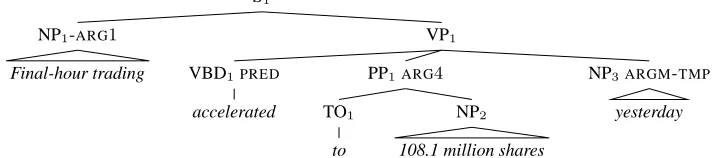
tem-poral modifiers respectively.1 Figure 1 shows an
ex-ample parse tree annotated with semantic roles.
We distinguish between models that learn to la-bel nodes in the parse tree independently, called lo-cal models, and models that incorporate dependen-cies among the labels of multiple nodes, called joint models. We build both local and joint models for se-mantic role labeling, and evaluate the gains achiev-able by incorporating joint information. We start by introducing our local models, and later build on them to define joint models.
3 Local Classifiers
In the context of role labeling, we call a classifier local if it assigns a probability (or score) to the label of an individual parse tree nodeniindependently of
the labels of other nodes.
We use the standard separation of the task of se-mantic role labeling into identification and
classifi-1
For a full listing of PropBank argument labels see (Palmer et al., 2003)
cation phases. In identification, our task is to clas-sify nodes oftas either ARG, an argument (includ-ing modifiers), orNONE, a non-argument. In clas-sification, we are given a set of arguments intand must label each one with its appropriate semantic role. Formally, letLdenote a mapping of the nodes intto a label set of semantic roles (includingNONE)
and let Id(L) be the mapping which collapses L’s non-NONE values into ARG. Then we can decom-pose the probability of a labeling Linto probabili-ties according to an identification modelPIDand a
classification modelPCLS.
PSRL(L|t, v) = PID(Id(L)|t, v)×
PCLS(L|t, v, Id(L)) (1)
This decomposition does not encode any indepen-dence assumptions, but is a useful way of thinking about the problem. Our local models for semantic role labeling use this decomposition. Previous work has also made this distinction because, for example, different features have been found to be more effec-tive for the two tasks, and it has been a good way to make training and search during testing more ef-ficient.
Here we use the same features for local identifi-cation and classifiidentifi-cation models, but use the decom-position for efficiency of training. The identification models are trained to classify each node in a parse tree asARGor NONE, and the classification models
are trained to label each argument node in the ing set with its specific label. In this way the train-ing set for the classification models is smaller. Note that we don’t do any hard pruning at the identifica-tion stage in testing and can find the exact labeling of the complete parse tree, which is the maximizer of Equation 1. Thus we do not have accuracy loss as in the two-pass hard prune strategy described in (Pradhan et al., 2005).
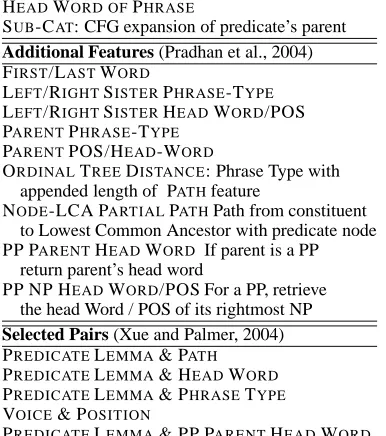
Standard Features (Gildea and Jurafsky, 2002)
PHRASETYPE: Syntactic Category of node PREDICATELEMMA: Stemmed Verb PATH: Path from node to predicate POSITION: Before or after predicate? VOICE: Active or passive relative to predicate HEADWORD OFPHRASE
SUB-CAT: CFG expansion of predicate’s parent
Additional Features (Pradhan et al., 2004)
FIRST/LASTWORD
LEFT/RIGHTSISTERPHRASE-TYPE LEFT/RIGHTSISTERHEADWORD/POS PARENTPHRASE-TYPE
PARENTPOS/HEAD-WORD
ORDINALTREEDISTANCE: Phrase Type with appended length of PATHfeature
NODE-LCA PARTIALPATHPath from constituent to Lowest Common Ancestor with predicate node PP PARENTHEADWORD If parent is a PP
return parent’s head word
PP NP HEADWORD/POS For a PP, retrieve the head Word / POS of its rightmost NP
Selected Pairs (Xue and Palmer, 2004)
PREDICATELEMMA& PATH PREDICATELEMMA& HEADWORD PREDICATELEMMA& PHRASETYPE VOICE& POSITION
[image:3.612.71.264.118.336.2]PREDICATELEMMA& PP PARENTHEADWORD
Table 1: Baseline Features
and classification models can be chained in a princi-pled way, as in Equation 1.
The features we used for local identification and classification models are outlined in Table 1. These features are a subset of features used in previous work. The standard features at the top of the table were defined by (Gildea and Jurafsky, 2002), and the rest are other useful lexical and structural fea-tures identified in more recent work (Pradhan et al., 2004; Surdeanu et al., 2003; Xue and Palmer, 2004). The most direct way to use trained local identifi-cation and classifiidentifi-cation models in testing is to se-lect a labeling L of the parse tree that maximizes the product of the probabilities according to the two models as in Equation 1. Since these models are lo-cal, this is equivalent to independently maximizing the product of the probabilities of the two models for the label liof each parse tree nodeni as shown
below in Equation 2.
PSRL` (L|t, v) = Y
ni∈t
PID(Id(li)|t, v) (2)
× Y
ni∈t
PCLS(li|t, v, Id(li))
A problem with this approach is that a maximizing labeling of the nodes could possibly violate the con-straint that argument nodes should not overlap with each other. Therefore, to produce a consistent set of arguments with local classifiers, we must have a way of enforcing the non-overlapping constraint.
3.1 Enforcing the Non-overlapping Constraint
Here we describe a fast exact dynamic programming algorithm to find the most likely non-overlapping (consistent) labeling of all nodes in the parse tree, according to a product of probabilities from local models, as in Equation 2. For simplicity, we de-scribe the dynamic program for the case where only two classes are possible –ARGandNONE. The gen-eralization to more classes is straightforward. In-tuitively, the algorithm is similar to the Viterbi al-gorithm for context-free grammars, because we can describe the non-overlapping constraint by a “gram-mar” that disallowsARGnodes to haveARG
descen-dants.
Below we will talk about maximizing the sum of the logs of local probabilities rather than the prod-uct of local probabilities, which is equivalent. The dynamic program works from the leaves of the tree up and finds a best assignment for each tree, using already computed assignments for its children. Sup-pose we want the most likely consistent assignment for subtreetwith children treest1, . . . , tkeach
stor-ing the most likely consistent assignment of nodes it dominates as well as the log-probability of the as-signment of all nodes it dominates to NONE. The most likely assignment for t is the one that corre-sponds to the maximum of:
• The sum of the log-probabilities of the most likely assignments of the children subtrees
t1, . . . , tkplus the log-probability for assigning
the nodettoNONE
• The sum of the log-probabilities for assign-ing all of ti’s nodes to NONE plus the
log-probability for assigning the nodettoARG.
a product of local identification and classification models. We use the local models in conjunction with this search procedure to select a most likely labeling in testing. Test set results for our local modelPSRL`
are given in Table 2.
4 Joint Classifiers
As discussed in previous work, there are strong de-pendencies among the labels of the semantic argu-ment nodes of a verb. A drawback of local models is that, when they decide the label of a parse tree node, they cannot use information about the labels and features of other nodes in the tree.
Furthermore, these dependencies are highly non-local. For instance, to avoid repeating argument la-bels in a frame, we need to add a dependency from each node label to the labels of all other nodes. A factorized sequence model that assumes a finite Markov horizon, such as a chain Conditional Ran-dom Field (Lafferty et al., 2001), would not be able to encode such dependencies.
The need for Re-ranking
For argument identification, the number of possi-ble assignments for a parse tree with n nodes is 2n. This number can run into the hundreds of
bil-lions for a normal-sized tree. For argument label-ing, the number of possible assignments is≈ 20m,
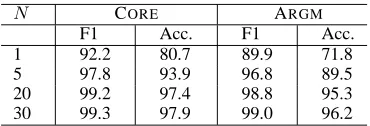
if m is the number of arguments of a verb (typi-cally between 2and 5), and 20 is the approximate number of possible labels if considering both core and modifying arguments. Training a model which has such huge number of classes is infeasible if the model does not factorize due to strong independence assumptions. Therefore, in order to be able to in-corporate long-range dependencies in our models, we chose to adopt a re-ranking approach (Collins, 2000), which selects from likely assignments gener-ated by a model which makes stronger independence assumptions. We utilize the top N assignments of our local semantic role labeling modelPSRL` to gen-erate likely assignments. As can be seen from Table 3, for relatively small values of N, our re-ranking approach does not present a serious bottleneck to performance. We used a value ofN = 20for train-ing. In Table 3 we can see that if we could pick, us-ing an oracle, the best assignment out for the top20
assignments according to the local model, we would achieve an F-Measure of98.8on all arguments. In-creasing the number of N to 30 results in a very small gain in the upper bound on performance and a large increase in memory requirements. We there-fore selectedN = 20as a good compromise.
Generation of top N most likely joint assignments
We generate the top N most likely non-overlapping joint assignments of labels to nodes in a parse tree according to a local model PSRL` , by an exact dynamic programming algorithm, which is a generalization of the algorithm for finding the top non-overlapping assignment described in section 3.1.
Parametric Models
We learn log-linear re-ranking models for joint se-mantic role labeling, which use feature maps from a parse tree and label sequence to a vector space. The form of the models is as follows. LetΦ(t, v, L) ∈ Rs denote a feature map from a tree t, target verb
v, and joint assignment Lof the nodes of the tree, to the vector spaceRs. LetL1, L2,· · · , LN denote
topN possible joint assignments. We learn a log-linear model with a parameter vectorW, with one weight for each of thes dimensions of the feature vector. The probability (or score) of an assignment
Laccording to this re-ranking model is defined as:
PSRLr (L|t, v) = e
hΦ(t,v,L),Wi PN
j=1ehΦ(t,v,Lj).Wi
(3)
The score of an assignment L not in the top N
is zero. We train the model to maximize the sum of log-likelihoods of the best assignments minus a quadratic regularization term.
In this framework, we can define arbitrary fea-tures of labeled trees that capture general properties of predicate-argument structure.
Joint Model Features
S1
NP1-ARG1
Final-hour trading
VP1
VBD1PRED
accelerated
PP1ARG4
TO1
to
NP2
108.1 million shares
NP3ARGM-TMP
[image:5.612.126.485.61.140.2]yesterday
Figure 1: An example tree from the PropBank with Semantic Role Annotations.
other nodes, but also dependencies between the la-bel of a node and input features of other argument nodes. The features are specified by instantiation of templates and the value of a feature is the number of times a particular pattern occurs in the labeled tree.
Templates
For a tree t, predicate v, and joint assignmentL
of labels to the nodes of the tree, we define the can-didate argument sequence as the sequence of
non-NONElabeled nodes[n1, l1, . . . , vP RED, nm, lm](li
is the label of nodeni). A reasonable candidate
ar-gument sequence usually contains very few of the nodes in the tree – about2to7nodes, as this is the typical number of arguments for a verb. To make it more convenient to express our feature templates, we include the predicate node v in the sequence. This sequence of labeled nodes is defined with re-spect to the left-to-right order of constituents in the parse tree. Since non-NONE labeled nodes do not overlap, there is a strict left-to-right order among these nodes. The candidate argument sequence that corresponds to the correct assignment in Figure 1 will be:
[NP1-ARG1,VBD1-PRED,PP1-ARG4,NP3-ARGM-TMP]
Features from Local Models: All features included in the local models are also included in our joint models. In particular, each template for local fea-tures is included as a joint template that concatenates the local template and the node label. For exam-ple, for the local featurePATH, we define a joint fea-ture template, that extractsPATHfrom every node in the candidate argument sequence and concatenates it with the label of the node. Both a feature with the specific argument label is created and a feature with the generic back-offARGlabel. This is similar to adding features from identification and classifi-cation models. In the case of the example candidate argument sequence above, for the node NP1we have
the features:
(NP↑S↓)-ARG1,(NP↑S↓)-ARG
When comparing a local and a joint model, we use the same set of local feature templates in the two models.
Whole Label Sequence: As observed in previous work (Gildea and Jurafsky, 2002; Pradhan et al., 2004), including information about the set or se-quence of labels assigned to argument nodes should be very helpful for disambiguation. For example, in-cluding such information will make the model less likely to pick multiple fillers for the same role or to come up with a labeling that does not contain an obligatory argument. We added a whole label se-quence feature template that extracts the labels of all argument nodes, and preserves information about the position of the predicate. The template also includes information about the voice of the predi-cate. For example, this template will be instantiated as follows for the example candidate argument se-quence:
[voice:activeARG1,PRED,ARG4,ARGM-TMP]
We also add a variant of this feature which uses a generic ARG label instead of specific labels. This feature template has the effect of counting the num-ber of arguments to the left and right of the predi-cate, which provides useful global information about argument structure. As previously observed (Prad-han et al., 2004), including modifying arguments in sequence features is not helpful. This was confirmed in our experiments and we redefined the whole label sequence features to exclude modifying arguments.
variations, and found that including the phrase type and the head of a directly dominating PP – if one exists – was most helpful. We also add a feature that detects repetitions of the same label in a candidate argument sequence, together with the phrase types of the nodes labeled with that label. For example, (NP-ARG0,WHNP-ARG0) is a common pattern of this
form.
Frame Features: Another very effective class of fea-tures we defined are feafea-tures that look at the label of a single argument node and internal features of other argument nodes. The idea of these features is to cap-ture knowledge about the label of a constituent given the syntactic realization of all arguments of the verb. This is helpful to capture syntactic alternations, such as the dative alternation. For example, consider the sentence (i) “[Shaw Publishing]ARG0 offered[Mr. Smith]ARG2 [a reimbursement]ARG1” and the alterna-tive realization (ii) “[Shaw Publishing]ARG0 offered [a reimbursement]ARG1 [to Mr. Smith]ARG2”. When classifying the NP in object position, it is useful to know whether the following argument is a PP. If yes, the NP will more likely be anARG1, and if not,
it will more likely be an ARG2. A feature template
that captures such information extracts, for each ar-gument node, its phrase type and label in the con-text of the phrase types for all other arguments. For example, the instantiation of such a template for [a reimbursement]in (ii) would be
[voice:activeNP,PRED,NP-ARG1,PP]
We also add a template that concatenates the identity of the predicate lemma itself.
We should note that Xue and Palmer (2004) define a similar feature template, called syntactic frame, which often captures similar information. The im-portant difference is that their template extracts con-textual information from noun phrases surrounding the predicate, rather than from the sequence of ar-gument nodes. Because our model is joint, we are able to use information about other argument nodes when labeling a node.
Final Pipeline
Here we describe the application in testing of a joint model for semantic role labeling, using a local model PSRL` , and a joint re-ranking model PSRLr .
PSRL` is used to generate top N non-overlapping
joint assignmentsL1, . . . , LN.
One option is to select the best Li according to
PSRLr , as in Equation 3, ignoring the score from the local model. In our experiments, we noticed that for larger values of N, the performance of our re-ranking modelPSRLr decreased. This was probably due to the fact that at test time the local classifier produces very poor argument frames near the bot-tom of the topN for largeN. Since the re-ranking model is trained on relatively few good argument frames, it cannot easily rule out very bad frames. It makes sense then to incorporate the local model into our final score. Our final score is given by:
PSRL(L|t, v) = (PSRL` (L|t, v))α PSRLr (L|t, v)
whereαis a tunable parameter2for how much fluence the local score has in the final score. Such in-terpolation with a score from a first-pass model was also used for parse re-ranking in (Collins, 2000). Given this score, at test time we choose among the topN local assignmentsL1, . . . , LN according to:
arg max
L∈{L1,...,LN}
αlogPSRL` (L|t, v) + logPSRLr (L|t, v)
5 Experiments and Results
For our experiments we used the February 2004 re-lease of PropBank. 3 As is standard, we used the annotations from sections 02–21 for training, 24 for development, and 23 for testing. As is done in some previous work on semantic role labeling, we discard the relatively infrequent discontinuous argu-ments from both the training and test sets. In addi-tion to reporting the standard results on individual argument F-Measure, we also report Frame Accu-racy (Acc.), the fraction of sentences for which we successfully label all nodes. There are reasons to prefer Frame Accuracy as a measure of performance over individual-argument statistics. Foremost, po-tential applications of role labeling may require cor-rect labeling of all (or at least the core) arguments in a sentence in order to be effective, and partially correct labelings may not be very useful.
2We foundα= 0.5to work best 3
Task CORE ARGM
F1 Acc. F1 Acc.
Identification 95.1 84.0 95.2 80.5
Classification 96.0 93.3 93.6 85.6
Id+Classification 92.2 80.7 89.9 71.8
Table 2: Performance of local classifiers on identification, classification, and identification+classification on section23, using gold-standard parse trees.
N CORE ARGM
F1 Acc. F1 Acc.
1 92.2 80.7 89.9 71.8
5 97.8 93.9 96.8 89.5
20 99.2 97.4 98.8 95.3
[image:7.612.190.427.53.106.2]30 99.3 97.9 99.0 96.2
Table 3: Oracle upper bounds for performance on the complete identification+classification task, using varying numbers of topN joint labelings according to local classifiers.
Model CORE ARGM
F1 Acc. F1 Acc.
Local 92.2 80.7 89.9 71.8
Joint 94.7 88.2 92.1 79.4
Table 4: Performance of local and joint models on identification+classification on section23, using gold-standard parse trees.
We report results for two variations of the seman-tic role labeling task. For CORE, we identify and
label only core arguments. For ARGM, we identify and label core as well as modifier arguments. We report results for local and joint models on argu-ment identification, arguargu-ment classification, and the complete identification and classification pipeline. Our local models use the features listed in Table 1 and the technique for enforcing the non-overlapping constraint discussed in Section 3.1.
The labeling of the tree in Figure 1 is a specific example of the kind of errors fixed by the joint mod-els. The local classifier labeled the first argument in the tree asARG0instead ofARG1, probably because
anARG0label is more likely for the subject position.
All joint models for these experiments used the whole sequence and frame features. As can be seen from Table 4, our joint models achieve error reduc-tions of32% and 22%over our local models in F-Measure onCOREandARGMrespectively. With re-spect to the Frame Accuracy metric, the joint error reduction is38%and26%for COREand ARGM re-spectively.
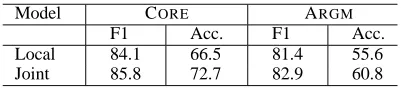
We also report results on automatic parses (see Table 5). We trained and tested on automatic parse
trees from Charniak’s parser (Charniak, 2000). For approximately 5.6% of the argument constituents in the test set, we could not find exact matches in the automatic parses. Instead of discarding these arguments, we took the largest constituent in the automatic parse having the same head-word as the gold-standard argument constituent. Also,19of the propositions in the test set were discarded because Charniak’s parser altered the tokenization of the in-put sentence and tokens could not be aligned. As our results show, the error reduction of our joint model with respect to the local model is more modest in this setting. One reason for this is the lower upper bound, due largely to the the much poorer performance of the identification model on automatic parses. For
[image:7.612.214.399.150.213.2]Model CORE ARGM
F1 Acc. F1 Acc.
Local 84.1 66.5 81.4 55.6
[image:8.612.206.408.53.97.2]Joint 85.8 72.7 82.9 60.8
Table 5: Performance of local and joint models on identification+classification on section23, using Charniak automatically generated parse trees.
6 Related Work
Several semantic role labeling systems have success-fully utilized joint information. (Gildea and Juraf-sky, 2002) used the empirical probability of the set of proposed arguments as a prior distribution. (Prad-han et al., 2004) train a language model over label sequences. (Punyakanok et al., 2004) use a linear programming framework to ensure that the only ar-gument frames which get probability mass are ones that respect global constraints on argument labels.
The key differences of our approach compared to previous work are that our model has all of the following properties: (i) we do not assume a finite Markov horizon for dependencies among node la-bels, (ii) we include features looking at the labels of multiple argument nodes and internal features of these nodes, and (iii) we train a discriminative model capable of incorporating these long-distance depen-dencies.
7 Conclusions
Reflecting linguistic intuition and in line with cur-rent work, we have shown that there are substantial gains to be had by jointly modeling the argument frames of verbs. This is especially true when we model the dependencies with discriminative models capable of incorporating long-distance features.
8 Acknowledgements
The authors would like to thank the review-ers for their helpful comments and Dan Juraf-sky for his insightful suggestions and useful dis-cussions. This work was supported in part by the Advanced Research and Development Activity (ARDA)’s Advanced Question Answering for Intel-ligence (AQUAINT) Program.
References
Collin Baker, Charles Fillmore, and John Lowe. 1998. The Berkeley Framenet project. In Proceedings of
COLING-ACL-1998.
Xavier Carreras and Lu´ıs M`arquez. 2004. Introduction to the CoNLL-2004 shared task: Semantic role labeling. In
Pro-ceedings of CoNLL-2004.
Eugene Charniak. 2000. A maximum-entropy-inspired parser. In Proceedings of NAACL, pages 132–139.
Michael Collins. 2000. Discriminative reranking for natural language parsing. In Proceedings of ICML-2000.
Daniel Gildea and Daniel Jurafsky. 2002. Automatic labeling of semantic roles. Computational Linguistics, 28(3):245–288. John Lafferty, Andrew McCallum, and Fernando Pereira. 2001.
Conditional random fields: Probabilistic models for seg-menting and labeling sequence data. In Proceedings of
ICML-2001.
Mitchell P. Marcus, Beatrice Santorini, and Mary Ann Marcinkiewicz. 1993. Building a large annotated corpus of English: The Penn Treebank. Computational Linguistics, 19(2):313–330.
Martha Palmer, Dan Gildea, and Paul Kingsbury. 2003. The proposition bank: An annotated corpus of semantic roles.
Computational Linguistics.
Sameer Pradhan, Wayne Ward, Kadri Hacioglu, James Martin, and Dan Jurafsky. 2004. Shallow semantic parsing using support vector machines. In Proceedings of
HLT/NAACL-2004.
Sameer Pradhan, Kadri Hacioglu, Valerie Krugler, Wayne Ward, James Martin, and Dan Jurafsky. 2005. Support vec-tor learning for semantic argument classification. Machine
Learning Journal.
Vasin Punyakanok, Dan Roth, Wen tau Yih, Dav Zimak, and Yuancheng Tu. 2004. Semantic role labeling via generalized inference over classifiers. In Proceedings of CoNLL-2004. Mihai Surdeanu, Sanda Harabagiu, John Williams, and Paul
Aarseth. 2003. Using predicate-argument structures for in-formation extraction. In Proceedings of ACL-2003. Cynthia A. Thompson, Roger Levy, and Christopher D.
Man-ning. 2003. A generative model for semantic role labeling. In Proceedings of ECML-2003.