Munich Personal RePEc Archive
Determinants of firm location choice in
metropolitan cities in India: A binary
Logit model analysis
Tripathi, Sabyasachi and Kumar, Shamika
Department of Economics, Lovely Professional University
24 September 2016
Online at
https://mpra.ub.uni-muenchen.de/73995/
Determinants of firm location choice in metropolitan
cities in India: A binary Logit model analysis
Sabyasachi Tripathi
*Shamika Kumar
**Abstract:
The present paper tries to investigate the economic determinants of firm location choice in the
metropolitan/large cities in India by considering firm those are using FDI (i.e., more than 10
percent of foreign investment) in 2012-13. For the analysis binary Logit model is used in this
paper by taking firm level data from Capital Line database, Prowess database provided by CMIE
(Centre for Monitoring Indian Economy) and Ace Equity plus database. The empirical
estimations shows that total value of output, capital, and exports have a negative effect on firm
location choice in the large cities. On the other hand, total value of working capital, operating
profits, age of the firm, fixed assets, material cost, and sales of a firm have a positive effect on
firm location choice in the large cities in India. However, the effect of percentage of FDI and
total value of imports is found to be statistically insignificant on the firm‘s location choice.
Finally, the paper discusses several policies in terms of location choice of firms in the large cities
such as higher level of infrastructure investment, etc. for higher and sustainable industry lead
urban development in India.
Key Wards: Location choice, firm location, Metropolitan cities, India
JEL Classifications: R3, R12, R58
*
Assistant Professor, Department of Economics, Lovely Professional University, Email; [email protected]; Phagwara, Punjab 144411.
**
I. INTRODUCTION
In the recent decades India has emerged as one of the fastest growing economy in the world.
Since 1991, the regulatory environment in the context of foreign direct investment has been
consistently eased for making India as one of the investment friendly nations in the world. In fact
the ―Make in India‖ program launched by the newly elected government of India in September
2014 is one among the several governmental initiatives aimed at making India more
investor-friendly. The main goal of this program is to encourage national and multi-national companies to
manufacture their products in India. This means that this policy has further eased the regulatory
environment in order to attract Foreign Direct Investment (FDI) in India. As per the data
provided by World Development Indicator, FDI flows to India increased from US$ 28 billion in
2013 to US$ 44 billion in 2015 which is indeed a 57% increase. On the other hand, FDI (net
inflows as % of GDP) in India was 2.1 % in 2015 whereas for China it was 2.3%. Make in India
program mainly focuses on twenty-five sectors (e.g., Automobiles, Construction,
Pharmaceuticals, etc) of the economy by allowing 100% FDI in most of these sectors.1 This has resulted in improved ranking in the World Bank‘s ease of doing business index where India is ranked 130th out of 189 countries as of 2016 whereas it was ranked 134th in the 2015 index. Moreover, out of 17 cities, World Bank‘s Doing Business in India Index in 2009 ranked
Ludhiana in the first position and Kolkata in the last position followed by New Delhi at 6th and
Mumbai at 10th as the easiest cities to do business in India. India‘s ranking among the world‘s
10 largest manufacturing countries has also improved by three places to sixth position in 2015.2
In sum, ‗Make in India‘ program will help India to become a global manufacturing hub by
increasing the contribution of the manufacturing sector to 25% of the GDP by the year 2025
from its current 16%. Among the different initiatives, promotion of foreign direct investment is
one of the major one. Manufacturing sector is crucial for development of the economy by
providing higher employment opportunities. As per the Annual Survey of Industries (ASI) data,
the number of persons working in manufacturing sector has increased from an average 7.95
million in 1981-91 to an average 8.98 million during 1991-2001, 13.4 million in 2011-12, but
1More details about the ‗Make in India‘ program can be found in the following web link:
http://www.makeinindia.com/home
decreased marginally to 12.95 million in 2012-13.3 However, manufacturing sector accounts for a small share in total employment. The latest data from 68th round of National Sample Survey (NSS) indicates a revival in employment growth in manufacturing from 11% in 2009-10 to
12.6% in 2011-12. On the other hand, NSS data also shows that employment in manufacturing
sector increased marginally from 44 million in 1999-2000 to 48.54 million in 2009-10 but
lowered to less than 55.77 million in 2004-05. Most importantly, India Labour and Employment
Report (IHD, 2014) indicates that employment in organized public manufacturing sector
decreased from 18.52 lakh in 1991 to 10.16 lakh in 2011, i.e. a decrease of about 45%. On the
other hand, employment in organized private sector increased from 44.8 lakh in 1991 to 53.97
lakh in 2011, i.e. an increase of over 20%.
Above discussion clearly shows that there is a significant rise in volatility in manufacturing
sector in India from the perspective of employment, growth rate and its contribution to national
GDP. Therefore, industrial unrest poses a challenge for industrial peace as it is detrimental to the
growth of the manufacturing sector. IHD (2014) clearly highlighted that the manufacturing
sector which has significant linkage effects with other sectors has not registered high growth rate
of employment due to low growth of output and other institutional bottlenecks.
Now the question arises how we can improve the manufacturing growth in India. It is obvious
that new FDI will help to set up new firms in India. In this context, the present papers tries to
find out what determines the locational choice of firms in the metropolitan areas or cities in
India.4 It is important to note that the successful execution of ‗Make in India‘ mission will rejuvenate the manufacturing sector not only by establishing new industries but also providing
higher level of employment through lowering institutional bottlenecks. Therefore, the main aim
of this paper is to see what factor/s actually contributes to location choice of firms in the large
Indian cities.
In the recent decades, urbanization in India has increased at very fast pace. The unique feature of India‘s urbanization is that a major chunk of urban population is concentrated mainly in class I cities (those with population 1 lakh and more) which accounted for about 70% of the total urban
population in 2011; this has led to ‗Top heavy‘ urbanization in India. Presently, 31% of India‘s
3
http://mospi.nic.in/mospi_new/upload/SYB2016/CH-32-LABOUR-EMPLOYMENT/ch32.pdf
4
population lives in urban area and their contribution account for over 63% of India‘s GDP. It is
expected that by 2020, the contribution to GDP by urban sector in India will increase to 70- 75
%. The number of cities and towns in India has increased over time, i.e. from 1915 in 1901 to
7935 in 2011. Most importantly, number of class I cities increased from 24 in 1901 to 468 in
2011. The choice of urban locations for analysis is for the following reasons: First, urban centres
provide a higher demand for manufactured goods than rural areas. Secondly, urban areas provide
higher level infrastructure such as road, water, electricity, etc. which are essential to set up new
industries. Finally, large cities (or agglomerations) have higher productivity, wages, and capital
per worker (i.e., higher economies of agglomeration), and therefore, greater efficiency benefits
(Duraton, 2008; World Bank, 2004). In addition, large cities provide the benefits of sharing
(e.g. local infrastructure), matching (e.g. employers and employees), and learning (e.g. new
technologies) (Duraton & Puga 2004). As the new industries will be using a higher percentage
share of FDI, then obviously they would choose a location where they can have higher level of
basic facilities as well as demand, which will ensure a higher level of profit for them. It is
therefore fair to assume that large agglomerations will be the first choice of entrepreneurs for
setting up manufacturing industries. Therefore, it is important to know which factors actually
contribute to location choice by firm in the large cities in India.
The rest of the paper is organized as follows. The second section provides a brief review of
literature. Sections 3 and 4 describe data base and the empirical framework for estimation of
determinants. Results of estimations and discussion are made in sections 4 and 5, respectively.
The last section presents the conclusion and policy implications.
II. Review of literature
Among the theoretical literature, Lösch (1940) developed a general location theory (i.e., central
place theory) by considering full general equilibrium of all locations and prices and argues that
firms locate in such a way as to maximize profits. Krugman (1995) extended the central place
explanation by considering market size, agglomeration and localization economies which
actually determine the firm location choice. In addition to such market-based factors, Markusen
(1999) added that policy related factors such as favoritism towards certain regions can also
New Economic Geography (NEG) pioneered by Krugman (1991) explained that there is an
inherent advantage for firms or industries in locating in the large agglomerations as it provides
a greater number of consumers with higher real wage (as consumers locate close to their
suppliers which reduces transportation cost) and higher demand. Further, firm enjoys economics
of scale by reducing fixed cost when they locate in the large agglomerations. It is beneficial for
both consumers and firms to locate close to one another as increasing returns occur at the city
level (Fujita, 2007). NEG models also predict that size of agglomeration (measured in terms of
population) also depends on trade openness of a country because when a country trades less with
rest of the world, the domestic transaction becomes more important and these transactions can, in
general, be conducted more cheaply over shorter distances. This process is reversed when a
country trades with the rest of the world (Krugman and Elizondo, 1996). In other words, when a
country is less trade- liberalized, naturally, firms will produce output for the domestic consumers
and will locate close to large agglomerations but when the country becomes more trade
liberalized, some of the firms which produce output for the international market will move away
from the large agglomeration s, and will locate in the hinterland or small towns to reap the
advantage of low cost production derived from low land rent, wages etc. This result is
empirically validated by Brülhart and Sbergami (2009) and Ades & Glaeser (1995).
In the context of India, Sridhar (2005) argued that infrastructure is an important determinant of
firm location in the growth centres of India. Without proper infrastructure (power, telecom, roads
and banking), many firms (even some representing local entrepreneurship) would not have
located in the growth centers. Rajaraman et al. (1999) found that abundance of power was an
important factor attracting investment into major Indian states during the eighties. Mani et al.
(1996) also estimated that power availability (rather than its price) reliable infrastructure and
factors of production played a significant role in firm location decisions across major Indian
states. Tulasidhar and Rao‘s (1986) analysis of a large number of medium- and large-scale
industries in an Indian state indicate that the sales tax incentive, whichever way designed, was
not the appropriate instrument to raise the level of investment or spread industries to backward
areas.
World Bank (2002) examined the investment climate and the bottlenecks that deter private
Competitiveness Surveys (FACS). The study found that while China and India are both
low-inflation countries, interest expenses account for a higher share of costs for Indian firms (12.3
per cent, relative to 5.9 per cent for Chinese firms). Meanwhile, freight as a percentage of traffic
units is a mere 5 per cent in India compared to 79 per cent in China, highlighting the much
poorer utilization of freight infrastructure in India.
Chakravorty et al. (2005) used the disaggregated industry location and size data from Mumbai,
Kolkata, and Chennai, to analyze eight industrial sectors. The empirical results suggest that general urbanization economies are more important than localization economies for firm‘s location decisions. Lall et al. (2004) found that access to market through improvements in
inter-regional infrastructure is an important determinant of firm level productivity, whereas benefits of locating in dense urban areas do not offset associated costs. Lall and Mengistae‘s (2005a) result showed that both the local business environment and agglomeration economies significantly
influence business location choices across Indian cities. A plant-level study by Lall and
Mengistae (2005b) in India‘s major industrial centers showed large productivity gaps across
cities due to differences in agglomeration economies, degree of labor regulation, severity of
power shortages, and market access. Lall et al. (2003) found that generalized urbanization
economies (manifested in local economic diversity) provide agglomeration externalities that lead
to industrial clustering in metropolitan and other urban areas in India. Chakravorty‘s (2003)
findings provide evidence both of inter-regional divergence and intra-regional convergence, and
suggest that concentrated decentralization is the appropriate framework for understanding
industrial location in post-reform India. Lall and Chakravorty (2005) examined the contribution
of economic geography factors to the cost structure of firms in eight industry sectors and showed
that local industrial diversity is an important factor with significant and substantial cost-reducing
effects.
Sridhar and Wan (2010) using large data sets—Investment Climate Surveys (ICS)—of firms
surveyed by the World Bank investigated the determinants of firm location choice in cities by
considering China, India, and Brazil. The study used Multinomial econometrics models by
Indian context, more labour-intensive firms tend to refrain from locating in medium-sized cities
relative to smaller cities. Indian firms find capital cities attractive. Exporting firms prefer larger
cities because the product value chain is better integrated in larger than in smaller cities. The
labour regulation indicator has a significant and negative impact on the odds of a firm locating in
a large city in India. Firm efficiency has a significant positive impact on the log odds of a firm
locating in the large cities of India.
In regard to FDI‘s contribution to locational choice of firms in the city of Mexico, Jordaan
(2012) using conditional Logit and nested Logit model found that the level of regional demand
enhances the probability of a region being selected by new FDI firms, as do the regional level of
schooling and labor quality. The regional level of wages impacts this probability. Further, the
regional presence of agglomerations of manufacturing firms and distributors both increase the
probability of a region being selected. Regional agglomerations of Mexican manufacturing firms
and foreign-owned distributors have the largest positive effect.
In the context of India, Mukim and Nunnenkamp (2012) employed a discrete choice model and
Poission regression model to analyze the location choices of foreign investors at Indian district
level by taking a sample of about 19,500 foreign investment projects approved in 447 districts
from 1991 to 2005. They found that foreign investors strongly prefer locations where other
foreign investors are present. They are also attracted to industrially diverse locations and those
with better infrastructure. Chakrabarti et al. (2012) examined the effect of infrastructure in 2001
on cumulative FDI flows into Indian districts during 2002-07. Using panel regressions that
include state fixed effects, they employed a two-pronged identification strategy. First, they tested
by netting out average (and maximum) FDI inflows into surrounding districts. Second, they
exploited variation among different sectors within a district depending upon the sector‘s
propensity to attract FDI. Finally, they found that FDI inflows remain insensitive to changes in
infrastructure till a threshold is reached; thereafter, FDI inflows increase steeply with an increase
in infrastructure. A theoretical explanation for the finding the present study that a threshold level
of public infrastructure is required to attract FDI, is offered by Haaland and Wooton (1999) and
Kellenberg (2007).
A study by Morris (2004), in the context of regional determinants of foreign direct investments
strictly confined to locations due to their requirements of either natural resources or the need to
be very close to markets) it is the regions with metropolitan cities, that have the advantage in ‗headquartering‘ the country operations of MNCs in India, and therefore attract the bulk of FDI.
The above literature survey clearly indicates that firm-level studies and city-level data regarding
firm locations are sparse in India. The few such studies include, Byrnes et al. (1999) pertaining
to USA, Sridhar (2006) for India and China and Sridhar and Wan (2010) for India, China and
Brazil. However, it is important to note that firm level data on the locational choice is important
for assessing investment climate or highlighting crucial aspects of city-level governance and
policies, which can thwart or promote their ability as engines of economic growth in India. This
calls for the modeling on firm location in urban areas in India. This paper constitutes a small
addition to the literature on determinants of industrial location in India and examines why
industry locates or refrains from locating in large urban areas by using invaluable firm level
financial data. Uniqueness of this exercise is the use of the firm level financial data to find out
the determinants of firm location choice in India. The determinants of location choice of firms
are very important to formulate policy prescriptions for urban based industrial policy.
III. DATABASE
A major part of the data is collected from Capital line, an online database provided by Capital
Market Ltd in India. The database provides firm level financial information of more than 13,000
companies. The study has also used Prowess database provided by CMIE (Centre for Monitoring
Indian Economy) and Ace Equity plus Database. Sectoral data is sourced from the Website of
Department of Industrial policy and Promotion (DIPP) and a monthly newsletter issued by DIPP
known as SIA newsletter. Capital line database has been used to collect the data related to
balance sheet, profit and loss account and financial statements of the different companies
included in the sample.
The data was collected for 193 firms from 8 different sectors whose financial measures are
available in 2012-13. Table 1 below shows the sector -wise distribution of the sample firms. The
categorization of industry sectors in the present study is driven by the pattern of classification of
sectors done by Reserve Bank of India (RBI). However, there are certain related sub- sectors of
industries, and they are added in the sectors to obtain sufficient number of firms for the sample.
such studies are selected to analyze the effect of FDI on firm location choice in India. A total of
6500 firms were checked from different industries related to manufacturing sector, which include
500 firms that were chosen for having received FDI of 10 percent or more. But, due to
unavailability of data on different variables like exports, imports, capital etc. or firm merger or
takeover etc., only 193 firms ultimately remained in the sample. The location of the firm is the
registered head office of the firm provided by the firm in Capital line data base maintained by
[image:10.612.72.502.249.462.2]CMIE.
Table 1: Industry Distribution of Firms
Industry/Sector Frequency of firms % of frequency
Metal and Non metal, Steel and Iron 20 10.36
Engineering - power generation 24 12.44
Electronics and electrical appliances/equipments
24
12.44 Food and dairy products - coffee, tea,
vanaspati, distilleries, sugar, fast moving consumer goods (FMCG)
24
12.44
Automobiles and auto ancillaries 30 15.54
Chemicals & allied products- 24 12.44
Pharmaceuticals and biotechnology 22 11.40
Textiles 25 12.95
Total 193 100
Source: Authors‘
As shown in Table 1, eight different industries are considered for the study. The shares of
frequencies of the firms in these 8 industries are almost equal ranging from 20 (i.e., metal and
non metal, steel and iron) to 30 (i.e., automobiles and auto ancillaries). The large cities with the
10 lakh or more population, i.e., metropolitan cities in India are considered for the study as large
cities have greater efficiency than small cities. Therefore, a firm has two options: either to locate
in the large cities or to locate in small cities/towns with populations less than 10 lakhs. The study
sample consists of 150 (or 78%) firms are located in 27 large cities and 43 (or 22%) firms are
located in 39 small cities/towns with populations less than 10 lakh. Out of 27 large cities the
highest number of firms are located in Mumbai (i.e., 43) followed by New Delhi (16), Kolkata
cities/towns, the highest number of firms are located in Gurgaon (4) followed by Anand (2) and
in other small cities/towns are having one firm each.
IV. EMPIRICAL FRAMEWORK FOR ESTIMATION OF DETERMINANTS
The principal concern of this paper is to investigate whether or not firms choose large cities over
small cities/towns and the reasons thereof. This problem can be quantified by dummy
endogenous variables and hence the determinants of firm location choice may be estimated using
a binary logit model.5 The general framework for estimation of the model is as follows.
𝑙𝑛 𝜌𝑖𝑗
1−𝜌𝑖𝑗 = 𝛼𝑗 +𝛽1𝑗.𝑋1𝑖 +𝛽2𝑗.𝑋2𝑖+ … … …. +𝛽𝑘𝑗.𝑋𝑘𝑖 +𝜀𝑖 {𝑖= 1, 2,3,… …. ,193} …….. (1)
Where ln is the base of natural logarithms; 𝜌𝑖𝑗 is the probability (defined by the standard
cumulative logistic probability distribution function) of firm location choice of the jth firm in
the large cities; (1–𝜌𝑖𝑗) is the probability of the jth firm not locating in the large cities or
agglomerations;(𝑋1𝑖 … 𝑋𝑘𝑖) is the independent variables for jth firm; ε is the random
disturbance term; and {𝛼𝑗, 𝛽1𝑗,……𝛽𝑘𝑗} is the intercept and slope parameters to be estimated.
The model in equation (1) is inherently non-linear and estimated by the technique of non-linear
maximum likelihood estimation.
Next, let the estimated model in equation (1) be equal to the equation below. The asterisk (*)
indicates the estimated value of the probability and parameters in equation (1). Then,
𝜌
𝑖𝑗∗=
ln( 𝑧𝑖𝑗∗ )
{1+ln( 𝑍𝑖𝑗∗ )} ……… (2)
where Zij* is the estimated logit and is equal to:
𝑙𝑛 𝜌𝑖𝑗∗
1− 𝜌𝑖𝑗∗ = [𝛼𝑗 ∗+𝛽
1𝑗∗.𝑋1𝑖 +𝛽2𝑗∗.𝑋2𝑖+ … … …. +𝛽𝑘𝑗∗.𝑋𝑘𝑖]
5
Thus, equation (2) gives the estimated probability of the location choice of the jth firm, given the
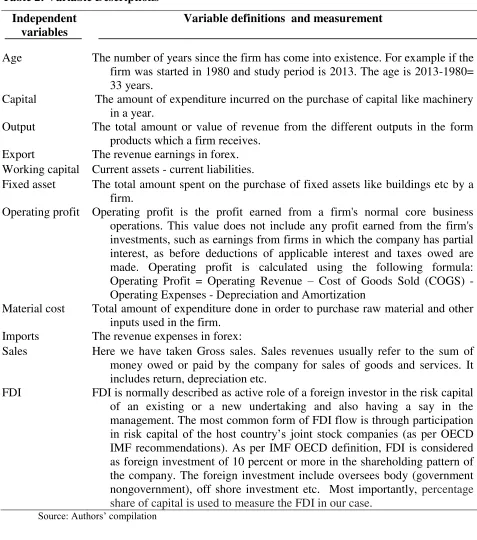
different independent variables. In this model, we have 11 independent variables. Table 2 lists all
the independent variables along with their measurements used to investigate the location choice
[image:12.612.70.547.175.715.2]of firm in the large cities in India.
Table 2: Variable Descriptions
Independent variables
Variable definitions and measurement
Age The number of years since the firm has come into existence. For example if the firm was started in 1980 and study period is 2013. The age is 2013-1980= 33 years.
Capital The amount of expenditure incurred on the purchase of capital like machinery in a year.
Output The total amount or value of revenue from the different outputs in the form products which a firm receives.
Export The revenue earnings in forex. Working capital Current assets - current liabilities.
Fixed asset The total amount spent on the purchase of fixed assets like buildings etc by a firm.
Operating profit Operating profit is the profit earned from a firm's normal core business operations. This value does not include any profit earned from the firm's investments, such as earnings from firms in which the company has partial interest, as before deductions of applicable interest and taxes owed are made. Operating profit is calculated using the following formula: Operating Profit = Operating Revenue – Cost of Goods Sold (COGS) - Operating Expenses - Depreciation and Amortization
Material cost Total amount of expenditure done in order to purchase raw material and other inputs used in the firm.
Imports The revenue expenses in forex:
Sales Here we have taken Gross sales. Sales revenues usually refer to the sum of money owed or paid by the company for sales of goods and services. It includes return, depreciation etc.
FDI FDI is normally described as active role of a foreign investor in the risk capital of an existing or a new undertaking and also having a say in the management. The most common form of FDI flow is through participation in risk capital of the host country‘s joint stock companies (as per OECD IMF recommendations). As per IMF OECD definition, FDI is considered as foreign investment of 10 percent or more in the shareholding pattern of the company. The foreign investment include oversees body (government nongovernment), off shore investment etc. Most importantly, percentage share of capital is used to measure the FDI in our case.
V. RESULTS OF ESTIMATION
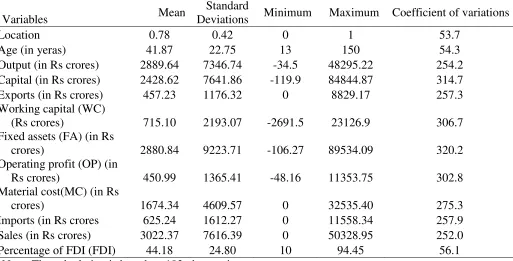
Table 3 details the means, standard deviations, minimum, maximum, and coefficient of variation
(CV) values for the variables used for the regression analysis. Most importantly, the CV aims to
describe the dispersion of the variables in a way that does not depend on the variable‘s
measurement unit. The higher values of CV for total amount capital value, total value of fixed
assets, total value of working capital, value of operating profits, indicate the greater dispersion in
these variables. On the other hand, age of the firm, percentage of FDI, total value of sales show the lower dispersion in these variables. Most importantly, the dummy variable of firm‘s location choice indicates that if the firm is located in large cities (pollution 10lakh or more) then the value
is one and if the firm is not located in large cities, the value of the dummy variable is zero. In our
[image:13.612.70.583.337.598.2]sample 78 percent of firms are located in large cities in India.
Table3: Descriptive statistics
Variables Mean
Standard
Deviations Minimum Maximum Coefficient of variations
Location 0.78 0.42 0 1 53.7
Age (in yeras) 41.87 22.75 13 150 54.3
Output (in Rs crores) 2889.64 7346.74 -34.5 48295.22 254.2 Capital (in Rs crores) 2428.62 7641.86 -119.9 84844.87 314.7
Exports (in Rs crores) 457.23 1176.32 0 8829.17 257.3
Working capital (WC)
(Rs crores) 715.10 2193.07 -2691.5 23126.9 306.7
Fixed assets (FA) (in Rs
crores) 2880.84 9223.71 -106.27 89534.09 320.2
Operating profit (OP) (in
Rs crores) 450.99 1365.41 -48.16 11353.75 302.8
Material cost(MC) (in Rs
crores) 1674.34 4609.57 0 32535.40 275.3
Imports (in Rs crores 625.24 1612.27 0 11558.34 257.9
Sales (in Rs crores) 3022.37 7616.39 0 50328.95 252.0
Percentage of FDI (FDI) 44.18 24.80 10 94.45 56.1
Note: The calculation is based on 193 observations. Source: Authors‘
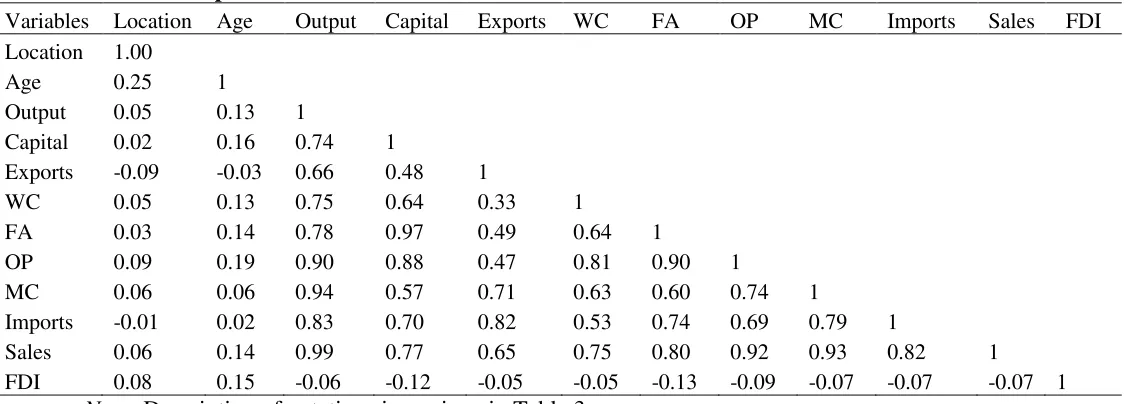
0.06). On the other hand, firm location choice is negatively associated with total value (i.e., r2 is - 0.09) and imports value (i.e., r2 is - 0.01).
Table 4: Simple correction coefficients
Variables Location Age Output Capital Exports WC FA OP MC Imports Sales FDI
Location 1.00
Age 0.25 1
Output 0.05 0.13 1
Capital 0.02 0.16 0.74 1
Exports -0.09 -0.03 0.66 0.48 1
WC 0.05 0.13 0.75 0.64 0.33 1
FA 0.03 0.14 0.78 0.97 0.49 0.64 1
OP 0.09 0.19 0.90 0.88 0.47 0.81 0.90 1
MC 0.06 0.06 0.94 0.57 0.71 0.63 0.60 0.74 1
Imports -0.01 0.02 0.83 0.70 0.82 0.53 0.74 0.69 0.79 1
Sales 0.06 0.14 0.99 0.77 0.65 0.75 0.80 0.92 0.93 0.82 1
FDI 0.08 0.15 -0.06 -0.12 -0.05 -0.05 -0.13 -0.09 -0.07 -0.07 -0.07 1
Note: Description of notations is as given in Table 3. Source: Authors‘
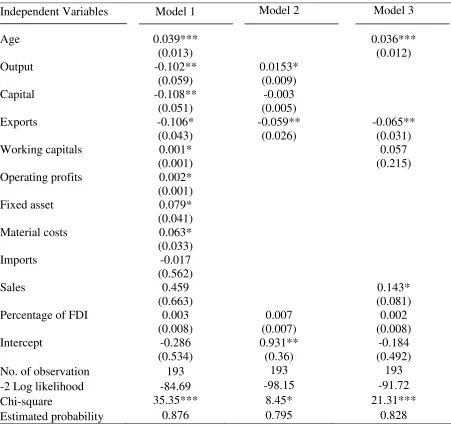
Table 5 presents the estimation results of three models by considering all the 193 firms. All
results are presented by the estimated intercept and slope coefficients and their standard errors.
In addition, goodness of fit for the entire model is presented by the log-likelihood test statistic
and chi-square test. The test showed significant results for all models. Estimated coefficients of
all the variables are statistically significant, except the coefficient of the percentage of FDI and
imports values. Among the independent variables, age of the firms, value of output, value of
capital, value of exports, value of working capital, value of fixed assets, value of operating
profits, value of material costs, and value of sales indicated significant influence on firm location
choice in large cities. For expositional purposes, all results are interpreted according to
Table 5: Binary Logit model estimates of locational choice of firms in large cities in India
Independent Variables Model 1 Model 2 Model 3
Age 0.039***
(0.013)
0.036*** (0.012)
Output -0.102**
(0.059)
0.0153* (0.009)
Capital -0.108**
(0.051)
-0.003 (0.005)
Exports -0.106*
(0.043)
-0.059** (0.026)
-0.065** (0.031)
Working capitals 0.001*
(0.001)
0.057 (0.215) Operating profits 0.002*
(0.001)
Fixed asset 0.079*
(0.041)
Material costs 0.063*
(0.033)
Imports -0.017
(0.562)
Sales 0.459
(0.663)
0.143* (0.081)
Percentage of FDI 0.003
(0.008)
0.007 (0.007)
0.002 (0.008)
Intercept -0.286
(0.534)
0.931** (0.36)
-0.184 (0.492)
No. of observation 193 193 193
-2 Log likelihood -84.69 -98.15 -91.72
Chi-square 35.35*** 8.45* 21.31***
Estimated probability 0.876 0.795 0.828
Source: Estimated by using equations (1) and (2). Figures in the parentheses are standard errors. ***, **, or * indicates that the t-statistic is significant at 1, 5, or 10 percent level.
Notes: For model 1 -3, dependent variable is whether firm located large or small city (1 if located in large cities, 0 otherwise).
The estimated coefficient of age variable is positive and statistically significant in Model 1 and 3.
This means that other things being the same, the odds are in favor of the firms locating in the
large cities than the small cities in India. This result is consistent with the known fact that large
cities provide greater efficiency than the small cities. This also indicates that old firms largely
prefer to locate in the large cities in India than in smaller ones. Interestingly, the value of total
capital also has a negative effect. This means that, other thing being equal, firms with higher
level of output and capital (i.e., large firm) have a lower probability to locate in the large cities
than in the small cities. In particular, a 1 percent increase in total value of output (or capital) lead
to decline of 0.10 (or 0.11) in the logarithm of the odds that the firm will choose to locate in the
large cities. This indicates that large firms (in terms of total value of capital and output) mainly
prefer to locate in the small cities than large cities. The estimated coefficient of total value of
exports is negative in Model 1-3. The value of the coefficient in Model1 shows that a 1 percent increase in the total value of firm‘s export leads to a decline of 0.11 in the logarithm of the odds that the firm will choose to locate in a large city. The estimated coefficients of total value of
working capital and total value of fixed assets -variables are positive in model 1. This means
that, other things being equal, firms with higher value of working capital and fixed assets have a
higher probability to locate in the large cities than small cities in India. The impact of total value
of operating profits and material costs is positive. The result implies that a 1 percent increase in
the total value of operating profits (or materials cost) leads to an increase of 0.002 (or 0.063) in
the logarithm of the odds that the firm will choose to locate in the large cities. Finally, the
estimated coefficient of total sales value is positive and statistically significant. This means that,
other things being equal, higher value of firm‘s sales have a higher probability of locating a firm
in the large city than a small city. However, the study could not find any statistically significant
effect of percentage of FDI used by the firms and total value of imports on the location choice of
the firm in the large/small cities in India.
Using equation (2), the probability of location choice of firm in the large cities was calculated
and is presented in the last row of Table 5. The estimated probability is relatively higher for
models 1, 2 and 3. Notably, it is the lowest for model 2 and the highest for model 1.
VI.
Discussions
This paper has brings to light various important and interesting results than previous studies on
the topic (Sridhar and wan, 2010, etc). The mixed effect of total output value and negative effect
of capital amount (which is used to buy machinery) indicates that the large firms tend to refrain
from locating in the large cities in India. This is because of the likely higher costs of doing
business such as costs on real estate, skills attrition, etc. This result is in line with findings of
effect on the firm location choice in the large cities in India. This result indicate that though the
old firm would have preferred to locate in the large cities, it may not be case for the new firms,
i.e., new firms are locating in the small cities in India as small cities have lower rent, lower wage
rate etc.
The total value of exports has a negative effect of firm location choice in the large cities in India.
In other words, major exporting firms prefer small cities than large cities in India. This result
supports the NEG model (Krugman and Elizondo, 1996) and the empirical findings of Brülhart and Sbergami (2009) and Ades & Glaeser (1995). It indicates that India‘s trade liberalization has transformed the firm location choice. Domestic firms which produce output for the domestic
consumer prefer to locate in the large cities in order to reduce transport cost and also proximity
to inputs. On the other hand, firms that produce output to meet foreign demand (export) prefer to
locate in the small cities or hinterlands or small towns to reap the advantage of low cost
production through the low land rent, wages etc.
On the other hand, volume of working capital is dependent on nature of business of a firm. This
is the capital of the firm used in its day-to-day trading operations, calculated as the current assets
minus the current liabilities. In other words, the current assets represent anything of value that is
highly liquid. Working capital also gives investors an idea of the company's
underlying operational efficiency. If a company's current assets do not exceed its current
liabilities, then it may run into trouble of paying back creditors in the short term. The worst-case
scenario is bankruptcy. This indicates that the amount of working capital always involves risk.
Therefore, to minimize the risk, firm with higher working capital choose to locate in the large
cities, or it may be the case that investors choose the firms which are located in the large cities
for higher investment which in turn increases the higher working capital of the firm.
On the other hand, the total value of operating profit of a firm has a significant effect on the firm‘s location choice in large cities in India. The operating profit may reflect the company‘s financial situation more positively than that reflected by net profits. While positive operating
profit may express the overall profit potential of a business, it does not guarantee that the
business is not experiencing losses. Investment decision of an investor depends on operating
operating profits of a firm has a positive impact on firm location choice in the large cities in
India.
The estimated results show that higher the costs incurred on fixed assets by a firm, higher the
propensity to locate in the large cities in India. This result supports the theoretical argument of
NEG models, which predicts that firms choose to locate in the large cities as they can enjoy
higher economies of scale by sharing the fixed cost (Krugman, 1991). The results clearly support
the hypothesis that firms that invest more money on fixed costs prefer to locate in the large cities
in order to reap the economies of scale.
Krugman (1991) explained that there is an advantage for firms or industries in locating in the
large agglomerations as it provides a greater number of consumers with higher real wage (as
consumers locate close to their suppliers which reduces transportation cost) and higher demand.,
Further, a firm enjoys economies of scale by reducing fixed cost through locating in the large
agglomerations. This way, both consumers and firms stand to gain by being close to one another
and increases returns on investment at the city level (Fujita, 2007). However, Lall et al. (2004)
found that access to market through improvements in inter-regional infrastructure is an important
determinant of firm level productivity, whereas benefits of locating in dense urban areas do not
offset associated costs. Tripathi (2014) in his analysis of firm level data in 2004-05 from Annual
Survey of Industries found that urban firms in Indian industry operate under decreasing returns to
scale, i.e, urbanization is associated with negative external economies of scale that do not
enhance productivity and do not drive urban growth and development. This indicates that though
a firm may choose to locate in the large cities to reap advantage of low fixed costs, they may still
face lower productivity due to other costs and also lack of suitable business acumen/
environment.
Higher material costs and sales values of firm have positive effect on location choice of firms in
the large cities in India. This indicates that if a firm paying higher amount of money to buy raw
materials, it tends to choose large cities for location. Firms that locate in the large cities incur
higher cost in buying raw materials, but higher sales values could still persuade a firm to locate
in the large cities, or it will be the case that due to higher demand in the large cities the firms
Most importantly, the study found that the total value of imports and percentage share of capital
of FDI have no statistically significant effect on the firm location choice in the large cities in
India. This is a very important finding, and supports the empirical findings of Chakrabarti et al.
(2012). They found that there is indeed a positive relationship between physical infrastructure and FDI inflows; the relationship is essentially non-linear with a ―threshold level‖ of infrastructure after which the positive effect becomes significant. The findings of this paper also
support their argument that Indian cities face a severe lack of adequate infrastructure. Therefore,
it is clear that the small increase in infrastructure cannot yield a proportional rise in FDI inflows
and promote location of multinational corporations in towns/cities. It is important to note here
that the Report on Indian Urban Infrastructure and Services (GOI, 2011) estimated that Rs. 39.2
lakh crore at 2009-10 prices is required over the next 20-year period to reach the level of
infrastructure needed to attract FDI inflows and sway the choice of firm location. Of this, the
outlay on urban roads accounts for Rs 17.3 lakh crore (or 44 per cent). Therefore, this paper
argues that strong governmental policy measures are essential for higher infrastructure
investment which would help to cross the infrastructure threshold necessary to attract FDI and
corresponding location of foreign enterprises.
VII. CONCLUSIONS AND POLICY IMPLICATIONS
The present paper investigates the relevant economic determinants of firm location choice in the
large cities (with population 10lakh and more) in India. Of the total 193 firms considered in this
study, 150 (or 78%) are located in 27 large cities and rest 43 (or 22%) in 39 small cities/towns
with populations less than 10 lakh. Out of total 6500 firms, the study has chosen for analysis 193
firms that have received FDI of 10 percent or more as full data set on other important variables
such as, exports, imports, capital etc of these firms are available (for analysis) for the period
2012-13. These193 firm belongs to 8 different industry groups such as metal and non metal,
steel and iron; engineering - power generation; electronics and electrical appliances/equipments;
food and dairy products - coffee, tea, vanaspati, distilleries, sugar, FMCG; Automobiles and auto
ancillaries; Chemicals & allied products; Pharmaceuticals and biotechnology; and Textiles.
The main findings from the estimation of binary logit can be summarized as follows. First, age
(i.e., the year of establishment) of the manufacturing firm has a significant positive effect on firm
and capital have a lower probability to locate in the large cities. Third, firms having higher
export share of the output choose not to locate in the large cities in India. Fourth, firms having
higher level of working capital and operating profits prefer to locate in the large cities than in the
small cities to avoid risk. Fifth, firms that have higher level of fixed assets, material cost and
higher sales values generally locate in the large cities. Finally, the study could not found any
statistically significant effect of percentage of FDI in capital and total imports values on firm
location choice in the large cities in India.
The findings carry several policy implications. First, the insignificant impact of the FDI
percentage in capital on the location choice of firms clearly indicates that Indian cities largely
lack the adequate infrastructure. Therefore, investment in urban infrastructure is essential to
create favorable condition for the location of firms in large cities in India. Recently, the
Government of India has launched several urban development policies and programmes to
streamline urban infrastructure and service delivery systems, as a part of which Rs 98,000 crore
(US$ 15,329.26 million) has been allocated to build 100 smart cities in India. It is hoped that
this policy will be helpful in persuading foreign firm to locate in the large cities of India.
Locating foreign firms in the large cities or agglomerations will have higher spillover benefits
than locating them in –smaller cities/towns. Therefore, large Indian cities need to be improved in
such a way that these cities/towns become the natural destination of FDI. Further, the highest
positive spillover effects that foreign firms can generate will be realized if they are located in the
large cities than in smaller scale agglomerations in small cities/towns.
Second, to attract higher level of FDI at the firm level, in addition to make regulatory policies
more flexible, government also needs to means to reduce production costs either by providing
substantial subsidies or tax benefits to multinational enterprises (MNEs) or through the provision
of public inputs such as infrastructure.
Third, government has to clearly distinguish the firms that produce goods for domestic markets
from those produce goods for the international market. The results of empirical analysis
conducted under this study as also theoretical reasoning indicate that it is always better to
support the domestic firms to locate closer to large cities and to support exporting firms to locate
away from the large cities or in the hinterland. This way, domestic firms can reduce production
from the lower wage rate lower land rent etc. in smaller towns/ hinterlands. In order to make this
proposition practical, government needs to make sure that exporting firms can avail facilities
such as connectivity with the port, supply of electricity etc in the small town or in the hinterland
where the firms choose to locate.
Fourth, firms which are large in terms of amount of capital (i.e., machinery cost) and value of
output need to locate in the small towns so that they can avail the benefits of lower wage rate,
land rent etc in the smaller cities/towns and maximize profit. An additional bonus of this scheme
would be reduction of pollution levels in the large cities. However, large firms with have higher
level of working capital and operating profits can locate in the large cities to avoid risk of lower
margin of profits as large cities provides higher level of consumer demand than in small cities.
The national licensing policy 1977 which mandates that new medium or large scale industries can‘t be set up in the standard urban areas of the metropolitan cities in India deters the exploitation of economies of scale of large agglomeration/cities. However, manifestly eco
friendly firms should be allowed to locate in large cities so that they can enjoy increasing returns
to scale and returns on investment. This will help not only to create industry lead urban
sustainable growth in India but also to generate higher level of employment opportunities for the
urban dwellers.
Finally, it is hoped that the findings of the paper will be helpful to promote urban-led industrial
revolution and to transform Indian cities as the engines of growth. In this case, it is important to
note that countries like England, Belgium, Germany, France, United States and Japan owe their
present developed status to their early start on the industrialization front. Even after 69 years of
Independence, India is yet to realize the benefits of low- cost urban-based industrial revolution.
So, it is high time that the country took all necessary steps to promote urban-based and
REFERENCES
Ades, A.F. and Glaeser, E.L. 1995. Trade and Circuses: Explaining Urban Giants. Quarterly Journal of Economics 110 (1), 195–227.
Brülhart, M. and Sbergami, F. 2009. Agglomeration and Growth: Cross-Country Evidence.
Journal of Urban Economics 65 (1), 48–63.
Byrnes, P., Marvel, M. and Sridhar, K.S. 1999. An Equilibrium Model of Tax Abatements: City and Firm Characteristics as Determinants of Abatement Generosity. Urban Affairs Review
34(6), 805-19.
Chakravorty, S. 2003. Industrial Location in Post‐Reform India: Patterns of Interregional Divergence and Intraregional Convergence. Journal of Development Studies 40 (2), 120‐52.
Chakravorty, S., Koo, J. and Lall, S.V. 2005. Do Localization Economies Matter in Cluster Formation? Questioning the Conventional Wisdom with Data from Indian Metropolises.
Environment and Planning A 37 (2), 331-353.
Chakrabarti, R., Subramanian, K., Meka, S. and Sudershan, K. 2012. Infrastructure and FDI: Evidence from District-level Data in India. Seminar Paper, Indian School of Business,
Hyderbad. Available at
http://www.isb.edu/faculty/KrishnamurthySubramanian/Images/FDI_infra_20Mar2012_Re Stud.pdf. Accessed on 19th September, 2016.
Duranton, G. 2008. Viewpoint: From Cities to Productivity and Growth in Developing Countries. Canadian Journal of Economics 41 (3), 689–736.
Duranton, G. and Puga, D. 2004. Micro-Foundation of Urban Agglomeration Economies. In Henderson, J.V. and Thisse, J.-F. (eds). Handbook of Regional and Urban Economics, Vol. 4: Cities and Geography. Amsterdam, Elsevier: pp. 2063–2117.
Fujita, M. 2007. The Development of Regional Integration in East Asia: From The Viewpoint of Spatial Economics. Review of Urban and Regional Development Studies 19 (1), 2–20.
Government of India. 2011. High Powered Expert Committee Report on Urban Infrastructure and Services. Report available at www.niua.org/projects/hpec/finalreport-hpec.pdf. Accessed on 19th September, 2016.
Green, W. H. 2011. Econometric Analysis. New York: Prentice Hall.
Haaland, I.J. and Wooton, I. 1999. International Competition for Multinational Investment. The Scandinavian Journal of Economics 101(4), 631-649.
Institute for Human Development (IHD). 2014. India Labour and Employment Report 2014: Workers in the Era of Globalization‖, Academic Foundation & Institute for Human Development, New Delhi. Available from http://www.ihdindia.org/ILER.html, accessed on 3rd March, 2016.
Jordaan, J.A. 2012. Agglomeration and The Location Choice of Foreign Direct Investment: New Evidence from Manufacturing FDI in Mexico. Estudios Economicos 27 (I), 61-97.
Kellenberg, K.D. 2007. The Provision of Public Inputs and Foreign Direct Investment.
Contemporary Economic Policy 25(2), 170-184.
Krugman, P. 1991. Increasing Returns and Economic Geography. Journal of Political Economy 99 (3), 483-499.
Krugman, P. and Elizondo, R.L. 1996. Trade Policy and Third World Metropolis. Journal of Development Economics 49 (1), 137–150.
Lall, S.V., Koo, J. and Chakravorty, S. 2003. Diversity Matters: The Economic Geography of Industry Location in India. Policy Research Working Paper 3072, The World Bank.
Lall, S.V. and Chakravorty, S. 2005. Industrial Location and Spatial Inequality: Theory and Evidence from India. Review of Development Economics 9 (1), 47-68.
Lall, S.V., Shalizi, Z. and Deichmann, U. 2004. Agglomeration Economies and Productivity in Indian Industry. Journal of Development Economics 73 (2), 643-673.
Lall, S.V. and Mengistae, T. 2005a. Business Environment, Clustering, and Industry Location : Evidence from Indian Cities. Policy Research Working Paper Series 3675, The World Bank.
Lall, S.V. and Mengistae, T. 2005b. The Impact of Business Environment and Economic Geography on Plant-Level Productivity: An Analysis of Indian Industry. Working Paper No. S3664, World Bank.
Lösch, A. 1940. Die Räumliche Ordnung der Wirtschaft (Gustav Fischer, Jena). English translation The Economics of Location, Yale University Press, New Haven CN, 1954. Mani, M. Pargal, S. and Huq, M. 1996. Does Environmental Regulation Matter? Determinants of
the Location of New Manufacturing Plants in India in 1994. World Bank Working Paper 1718, World Bank: Washington DC.
Markusen, A.R. 1999. National Contexts and the Emergence of Second-Tier Cities, in A.R. Markusen, Y.-S. Lee, and S. DiGiovanna (eds), Second-Tier Cities: RapidGrowth Beyond the Metropolis, University of Minnesota Press: Minneapolis MN.
Mukim, M and Nunnenkamp, P. 2012. The Location Choices of Foreign Investors: A District-Level Analysis in India. The World Economy 35 (7), 886-918.
Morris, S. 2004. A Study of the Regional Determinants of Foreign Direct Investment in India, and the Case of Gujarat. Working Paper No. 2004/03/07, Indian Institute of Management. Available at http://www.iimahd.ernet.in/publications/data/2004-03-07morris.pdf, Accessed on 19th September 2016.
Sridhar, K.S. 2005. Incentives for Regional Development: Competition among Sub-National Governments, Palgrave Macmillan: Basingstoke.
Sridhar, K. S. 2006. Location Choice of Firms: Recent Evidence from India and China. Paper presented at workshop on The Rapid Development of China and India: Domestic and International Consequences, University of Antwerp, 31 March-1 April, Antwerp.
Sridhar, K.S. and Wan, G. 2010. Firm Location Choice in Cities: Evidence from China, India, and Brazil. China Economic Review 21 (1), 113-122.
Rajaraman, I., Mukhopadhyay, H. and Bhatia, N. 1999. Fiscal Industrial Incentives of the
Government of Madhya Pradesh: Costs and Benefits. Mimeo, NIPFP: New Delhi.
Tripathi, S. 2014. Estimating Urban Agglomeration Economies for India: A New Economic Geography Perspective. Theoretical and Empirical Researches in Urban Management 9(2), 19-49.
Tulasidhar, V.B. and Rao, M. G. 1986. Cost and Efficacy of Fiscal Incentives: The Case of Sales Tax Subsidy, Economic and Political Weekly 21 (41), 1799-806.
World Bank. 2002. Improving the Investment Climate in India, World Bank group in collaboration with the Confederation of Indian Industry (CII): Washington DC.