Detection of Topic and its Extrinsic Evaluation Through Multi-Document
Summarization
Yoshimi Suzuki
Interdisciplinary Graduate School of Medicine and Engineering
University of Yamanashi Kofu, 400-8511, JAPAN
Fumiyo Fukumoto
Interdisciplinary Graduate School of Medicine and Engineering
University of Yamanashi Kofu, 400-8511, JAPAN
Abstract
This paper presents a method for detect-ing words related to a topic (we call them topic words) over time in the stream of documents. Topic words are widely dis-tributed in the stream of documents, and sometimes they frequently appear in the documents, and sometimes not. We pro-pose a method to reinforce topic words with low frequencies by collecting docu-ments from the corpus, and applied Latent Dirichlet Allocation (Blei et al., 2003) to these documents. For the results of LDA, we identified topic words by using Mov-ing Average Convergence Divergence. In order to evaluate the method, we applied the results of topic detection to extractive multi-document summarization. The re-sults showed that the method was effective for sentence selection in summarization.
1 Introduction
As the volume of online documents has drastically increased, the analysis of topic bursts, topic drift or detection of topic is a practical problem attract-ing more and more attention (Allan et al., 1998; Swan and Allan, 2000; Allan, 2003; Klinken-berg, 2004; Lazarescu et al., 2004; Folino et al., 2007). The earliest known approach is the work of Klinkenberg and Joachims (Klinkenberg and Joachims, 2000). They have attempted to han-dle concept changes by focusing a window with documents sufficiently close to the target concept.
Mane et. al. proposed a method to generate
maps that support the identification of major re-search topics and trends (Mane and Borner, 2004). The method used Kleinberg’s burst detection al-gorithm, co-occurrences of words, and graph lay-out technique. Scholz et. al. have attempted to use different ensembles obtained by training sev-eral data streams to detect concept drift (Scholz,
2007). However the ensemble method itself re-mains a problem that how to manage several clas-sifiers effectively. He and Parket attempted to find bursts, periods of elevated occurrence of events as a dynamic phenomenon instead of focusing on ar-rival rates (He and Parker, 2010). However, the fact that topics are widely distributed in the stream of documents, and sometimes they frequently ap-pear in the documents, and sometimes not often hamper such attempts.
This paper proposes a method for detecting topic over time in series of documents. We rein-forced words related to a topic with low frequen-cies by collecting documents from the corpus, and applied Latent Dirichlet Allocation (LDA) (Blei et al., 2003) to these documents in order to ex-tract topic candidates. For the results of LDA, we applied Moving Average Convergence Divergence (MACD) to find topic words while He et. al., ap-plied it to find bursts. The MACD is a technique to analyze stock market trends (Murphy, 1999). It shows the relationship between two moving av-erages of prices modeling bursts as intervals of topic dynamics, i.e., positive acceleration. Fuku-moto et. al also applied MACD to find topics. However, they applied it only to the words with high frequencies in the documents (Fukumoto et al., 2013). In contrast, we applied it to the topic candidates obtained by LDA.
We examined our method by extrinsic evalua-tion, i.e., we applied the results of topic detection to extractive multi-document summarization. We assume that a salient sentence includes words re-lated to the target topic, and an event of each doc-uments. Here, an event is something that occurs at a specific place and time associated with some specific actions(Allan et al., 1998). We identified
event words by using the traditional tf∗idf method
applied to the results of named entities. Each sen-tence in documents is represented using a vector of frequency weighted words that can be event
or topic words. We used Markov Random Walk (MRW) to compute the rank scores for the sen-tences (Page et al., 1998). Finally, we selected a certain number of sentences according to the rank score into a summary.
2 Topic Detection
2.1 Extraction of Topic Candidates
LDA presented by (Blei et al., 2003) models each document as a mixture of topics (we call
it lda topic to discriminate ourtopiccandidates),
and generates a discrete probability distribution over words for each lda topic. The generative pro-cess for LDA can be described as follows:
1. For each topic k = 1, · · ·, K, generate φk,
multinomial distribution of words specific to
the topickfrom a Dirichlet distribution with
parameterβ;
2. For each documentd= 1,· · ·,D, generateθd,
multinomial distribution of topics specific to
the documentdfrom a Dirichlet distribution
with parameterα;
3. For each wordn= 1,· · ·,Ndin documentd;
(a) Generate a topic zdn of the nth word
in the documentdfrom the multinomial
distributionθd
(b) Generate a word wdn, the word
associ-ated with the nth word in document d
from multinomialφzdn
Like much previous work on LDA, we used Gibbs
sampling to estimateφandθ. The sampling
prob-ability for topicziin documentdis given by:
P(zi|z\i, W) = (n v
\i,j+β)(nd\i,j+α)
(n·
\i,j+W β)(nd\i,·+T α)
. (1)
z\i refers to a topic setZ, not including the
cur-rent assignment zi. nv\i,j is the count of word v
in topicjthat does not include the current
assign-mentzi, andn·\i,jindicates a summation over that
dimension. W refers to a set of documents, andT
denotes the total number of unique topics. After a sufficient number of sampling iterations, the
ap-proximated posterior can be used to estimateφand
θby examining the counts of word assignments to
[image:2.595.314.523.66.205.2]topics and topic occurrences in documents. The
...
...
(i) Lda_topic clusters
(ii) Task clusters
topic id0 topic id1
cluster
task1 task3 task2
task2 task1
task1
doc ....
doc
.... ....
task1 task2
topic id2 topic id1
topic id1 topic id0
topic id0
topic id2
... ...
.... cluster
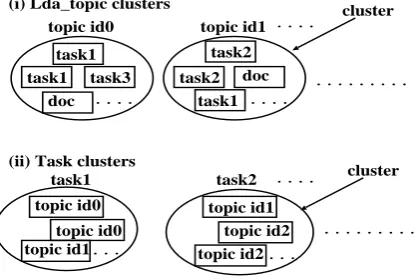
Figure 1: Lda topic cluster and task cluster
approximated probability of topic k in the
docu-mentd,θˆkd, and the assignments wordw to topic
k,φˆwk are given by:
ˆ
θk
d = NNdk+α
d+αK. (2)
ˆ
φw
k = NNkw+β
k+βV. (3)
We used documents prepared by summarization tasks, NTCIR and DUC data as each task consists of series of documents with the same topic. We applied LDA to the set consisting of all documents in the summarization tasks and documents from the corpus. We need to estimate the appropriate number of lda topic.
Let k′ be the number of lda topics and d′ be
the number of topmostd′ documents assigned to
each lda topic. We note that the result obtained by LDA can be regarded as the two types of clus-tering result shown in Figure 1: (i) each cluster corresponds to each lda topic (topic id0, topic id1
· · · in Figure 1), and each element of the clusters is the document in the summarization tasks (task1,
task2,· · · in Figure 1) or from the corpus (doc in
Figure 1), and (ii) each cluster corresponds to the summarization task and each element of the clus-ters is the document in the summarization tasks or the document from the corpus assigned topic id. For example, DUC2005 consists of 50 tasks. Therefore the number of different clusters is 50. We call the former lda topic cluster and the latter
task cluster. We estimatedk′ andd′ by using
En-tropy measure given by:
E = −log1lX j
Nj N
X
i
lrefers to the number of clusters. P(Ai, Cj)is a
probability that the elements of the clusterCj
as-signed to the correct classAi. N denotes the total
number of elements andNj shows the total
num-ber of elements assigned to the cluster Cj. The
value of E ranges from 0 to 1, and the smaller
value ofE indicates better result. Let Etopic and
Etask are entropy value of lda topic cluster and
task cluster, respectively. We chose the
parame-ters k′ and d′ whose value of the summation of
Etopic andEtask is smallest. For each lda topic, we extracted words whose probabilities are larger than zero, and regarded these as topic candidates.
2.2 Topic Detection by MACD
The proposed method does not simply use MACD to find bursts, but instead determines topic words in series of documents. Unlike Dynamic Topic Models (Blei and Lafferty, 2006), it does not as-sume Gaussian distribution so that it is a natural way to analyze bursts which depend on the data. We applied it to extract topic words in series of documents. MACD histogram defined by Eq. (6) shows a difference between the MACD and its
moving average. MACD of a variablextis defined
by the difference of n1-day and n2-day moving
averages, MACD(n1,n2) = EMA(n1) - EMA(n2).
Here, EMA(ni) refers toni-day Exponential
Mov-ing Average (EMA). For a variablex=x(t)which
has a corresponding discrete time seriesx={xt|t
= 0,1,· · · }, then-day EMA is defined by Eq. (5).
EMA(n)[x]t = αxt+ (1−α)EMA(n−1)[x]t−1
=
n X
k=0
α(1−α)kx
t−k. (5)
αrefers to a smoothing factor and it is often taken
to be (n+1)2 . MACD histogram shows a difference
between the MACD and its moving average1.
hist(n1, n2, n3) = MACD(n1, n2)−
EMA(n3)[MACD(n1, n2)]. (6)
The procedure for topic detection with MACD
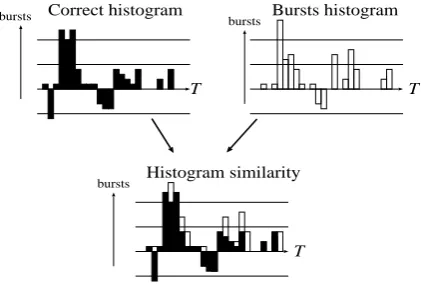
is illustrated in Figure 2. LetAbe a series of
doc-uments and wbe one of the topic candidates
ob-tained by LDA. Each document in Ais sorted in
chronological order. We set A to the documents
from the summarization task. Whether or not a
wordwis a topic word is judged as follows:
1In the experiment, we setn
1,n2, andn3to 4, 8 and 5, respectively (He and Parker, 2010).
T T
T
Correct histogram Bursts histogram
Histogram similarity
bursts bursts
[image:3.595.312.523.63.208.2]bursts
Figure 2: Topic detection with MACD
1. Create document-based MACD histogram
where X-axis refers toT, i.e., a period of time
(numbered from day 1 to 365). Y-axis is the
document count inA per day. Hereafter,
re-ferred to as correct histogram.
2. Create term-based MACD histogram where
X-axis refers toT, and Y-axis denotes bursts
of word w in A. Hereafter, referred to as
bursts histogram.
3. We assume that if a term w is informative
for summarizing a particular documents in a collection, its burstiness approximates the burstiness of documents in the collection.
Becausew is a representative word of each
document in the task. Based on this assump-tion, we computed similarity between correct
and word histograms by using KL-distance2.
Let P and Q be a normalized distance of
correct histogram, and bursts histogram,
re-spectively. KL-distance is defined byD(P ||
Q) = Pi=1P(xi) logPQ((xxi)
i) where xi refers
bursts in timei. If the value ofD(P || Q)
is smaller than a certain threshold value,wis
regarded as a topic word.
3 Extrinsic Evaluation to Summarization
3.1 Event detection
An event word is something that occurs at a cific place and time associated with some spe-cific actions (Allan, 2003; Allan et al., 1998). It refers to notions of who(person), where(place),
2We tested KL-distance, histogram intersection and
when(time) including what, why and how in a doc-ument. Therefore, we can assume that named en-tities(NE) are linguistic features for event
detec-tion. An event word refers to the theme of the
document itself, and frequently appears in the doc-ument but not frequently appear in other docu-ments. Therefore, we first applied NE recogni-tion to the target documents to be summarized, and
then calculated tf∗idf to the results of NE
recogni-tion. We extracted words whose tf∗idf values are
larger than a certain threshold value, and regarded these as event words.
3.2 Sentence extraction
We recall that our hypothesis about key sentences in multiple documents is that they include topic
and event words. Each sentence in the
docu-ments is represented using a vector of frequency weighted words that can be event or topic words.
Like much previous work on extractive sum-marization (Erkan and Radev, 2004; Mihalcea and Tarau, 2005; Wan and Yang, 2008), we used Markov Random Walk (MRW) model to compute
the rank scores for the sentences. Given a set
of documents to be summarized, G = (S, E) is
a graph reflecting the relationships between two
sentences. S is a set of vertices, and each vertex
siinSis a sentence.Eis a set of edges, and each
edgeeij inEis associated with an affinity weight
f(i→j)between sentencessiandsj(i6=j). The
affinity weight is computed using cosine measure
between the two sentences, si andsj. Two
ver-tices are connected if their affinity weight is larger
than 0 and we letf(i → i)= 0 to avoid self
tran-sition. The transition probability fromsi tosj is
then defined as follows:
p(i→j) =
f(i→j)
|S|
X
k=1 f(i→k)
, if Σf 6= 0
0, otherwise.
(7)
We used the row-normalized matrix Uij =
(Uij)|S|×|S| to describe Gwith each entry
corre-sponding to the transition probability, whereUij=
p(i→j). To makeUa stochastic matrix, the rows
with all zero elements are replaced by a smoothing
vector with all elements set to|S1|. The final
transi-tion matrix is given by formula (8), and each score of the sentence is obtained by the principal
eigen-vector of the matrixM.
M = µUT+ (1−µ)
|S| ~e~eT. (8)
We selected a certain number of sentences accord-ing to rank score into the summary.
4 Experiments
4.1 Experimental settings
We applied the results of topic detection to ex-tractive multi-document summarization task, and examined how the results of topic detection af-fect the overall performance of the salient sen-tence selection. We used two tasks, Japanese and
English summarization tasks, NTCIR-33 SUMM
Japanese and DUC4 English data. The baselines
are (i) MRW model (MRW): The method ap-plies the MRW model only to the sentences con-sisted of noun words, (ii) Event detection (Event): The method applies the MRW model to the result of event detection, (iii) Topic Detection by LDA (LDA): MRW is applied to the result of topic can-didates detection by LDA and (iv) Topic Detec-tion by LDA and MACD (LDA & MACD): MRW is applied to the result of topic detection by LDA and MACD only, i.e., the method does not include event detection.
4.2 NTCIR data
The data used in the NTCIR-3 multi-document summarization task is selected from 1998 to 1999 of Mainichi Japanese Newspaper documents. The gold standard data provided to human judges con-sists of FBFREE DryRun and FormalRun. Each data consists of 30 tasks. There are two types of correct summary according to the character length, “long” and “short”, All series of documents were tagged by CaboCha (Kudo and Matsumoto, 2003). We used person name, organization, place and proper name extracted from NE recognition (Kudo and Matsumoto, 2003) for event detection, and noun words including named entities for topic de-tection. FBFREE DryRun data is used to tuning parameters, i.e., the number of extracted words
ac-cording to the tf∗idf value, and the threshold value
of KL-distance. The size that optimized the aver-age Rouge-1(R-1) score across 30 tasks was
cho-sen. As a result, we set tf∗idf and KL-distance to
100 and 0.104, respectively.
We used FormalRun as a test data, and another set consisted of 218,724 documents from 1998 to 1999 of Mainichi newspaper as a corpus used in
3
http://research.nii.ac.jp/ntcir/
㻜㻚㻜㻜 㻜㻚㻜㻞 㻜㻚㻜㻠 㻜㻚㻜㻢 㻜㻚㻜㻤 㻜㻚㻝㻜 㻜㻚㻝㻞
㻞㻜㻜 㻟㻜㻜 㻠㻜㻜 㻡㻜㻜 㻢㻜㻜 㻣㻜㻜 㻤㻜㻜 㻥㻜㻜
㻞㻜㻜㻌㻔㼠㼛㼜㼕㼏㼟㻕 㻟㻜㻜㻌㻔㼠㼛㼜㼕㼏㼟㻕 㻠㻜㻜㻌㻔㼠㼛㼜㼕㼏㼟㻕 㻡㻜㻜㻌㻔㼠㼛㼜㼕㼏㼟㻕 㻢㻜㻜㻌㻔㼠㼛㼜㼕㼏㼟㻕 㻣㻜㻜㻌㻔㼠㼛㼜㼕㼏㼟㻕 㻤㻜㻜㻌㻔㼠㼛㼜㼕㼏㼟㻕 㻥㻜㻜㻌㻔㼠㼛㼜㼕㼏㼟㻕
[image:5.595.321.512.61.131.2]Number of documents Entropy
Figure 3: Entropy against the # of topics and doc-uments
Method Short Long
R-1 R-1
MRW .369 .454
Event .625 .724
LDA .525 .712
[image:5.595.85.270.69.186.2]LDA & MACD .630 .742 Event & Topic .678 .744
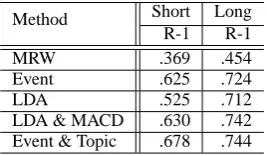
Table 1: Sentence Extraction (NTCIR-3 test data)
LDA and MACD. We estimated the number ofk′
andd′in LDA, i.e., we searchedk′andd′in steps
of 100 from 200 to 900. Figure 3 illustrates
en-tropy value against the number of topics k′ and
documents d′ using 30 tasks of FormalRun data.
Each plot shows that at least one of the docu-ments for each summarization task is included in the cluster. We can see from Figure 3 that the value of entropy depends on the number of doc-uments rather than the number of topics. From the result shown in Figure 3, the minimum entropy value was 0.025 and the number of topics and doc-uments were 400 and 300, respectively. We used them in the experiment. The summarization re-sults are shown in Table 1.
Table 1 shows that our approach, “Event & Topic” outperforms other baselines, regardless of the summary type (long/short). Topic candidates include surplus words that are not related to the topic because the results obtained by “LDA” were worse than those obtained by “LDA & MACD”, and even worse than “Event” in both short and
long summary. This shows that integration of
LDA and MACD is effective for topic detection.
4.3 DUC data
We used DUC2005 consisted of 50 tasks for train-ing, and 50 tasks of DUC2006 data for testing in
order to estimate parameters. We set tf∗idf and
Method R-1 Method R-1
MRW .381 Event .407
LDA .402 LDA & MACD .428
Event & Topic .438
PYTHY .426 HybHSum .456
[image:5.595.115.249.245.323.2]hPAM .412 TTM .447
Table 2: Comparative results (DUC2007 test data)
KL-distance to 80 and 0.9. The minimum
en-tropy value was 0.050 and the number of topics and documents were 500 and 600, respectively. 45 tasks from DUC2007 were used to evaluate the performance of the method. All documents were tagged by Tree Tagger (Schmid, 1995) and
Stanford Named Entity Tagger 5 (Finkel et al.,
2005). We used person name, organization and lo-cation for event detection, and noun words includ-ing named entities for topic detection. AQUAINT
corpus6 which consists of 1,033,461 documents
are used as a corpus in LDA and MACD. Table 2 shows Rouge-1 against unigrams.
We can see from Table 2 that Rouge-1 obtained by our approach was also the best compared to the baselines. Table 2 also shows the performance of other research sites reported by (Celikylmaz and Hakkani-Tur, 2010). The top site was “HybH-Sum” by (Celikylmaz and Hakkani-Tur, 2010). However, the method is a semi-supervised tech-nique that needs a tagged training data. Our ap-proach achieves performance apap-proaching the top-performing unsupervised method, “TTM” (Ce-likylmaz and Hakkani-Tur, 2011), and is compet-itive to “PYTHY” (Toutanoval et al., 2007) and “hPAM” (Li and McCallum, 2006). Prior work including “TTM” has demonstrated the usefulness of semantic concepts for extracting salient sen-tences. For future work, we should be able to obtain further advantages in efficacy in our topic detection and summarization approach by disam-biguating topic senses.
5 Conclusion
The research described in this paper explores a method for detecting topic words over time in se-ries of documents. The results of extrinsic evalu-ation showed that integrevalu-ation of LDA and MACD is effective for topic detection.
5
http://nlp.stanford.edu/software/CRF-NER.shtml
References
J. Allan, J. Carbonell, G. Doddington, J. Yamron, and Y. Yang. 1998. Topic Detection and Tracking Pilot Study Final Report. In Proc. of the DARPA Broad-cast News Transcription and Understanding Work-shop.
J. Allan, editor. 2003. Topic Detection and Tracking. Kluwer Academic Publishers.
D. M. Blei and J. D. Lafferty. 2006. Dynamic Topic Models. In Proc. of the 23rd International Confer-ence on Machine Learning, pages 113–120.
D. M. Blei, A. Y. Ng, and M. I. Jordan. 2003. La-tent Dirichlet Allocation. In The Journal of Machine Learning Research, volume 3, pages 993–1022.
A. Celikylmaz and D. Hakkani-Tur. 2010. A Hy-bird Hierarchical Model for Multi-Document Sum-marization. In Proc. of the 48th Annual Meeting of the Association for Computational Linguistics, pages 815–824.
A. Celikylmaz and D. Hakkani-Tur. 2011. Discovery of Topically Coherent Sentences for Extractive Sum-marization. In Proc. of the 49th Annual Meeting of the Association for Computational Linguistics: Hu-man Language Technologies, pages 491–499.
G. Erkan and D. Radev. 2004. LexPageRank: Prestige in Multi-Document Text Summarization. In Proc. of the 2004 Conference on Empirical Methods in Nat-ural Language Processing, pages 365–371.
J. R. Finkel, T. Grenager, and C. Manning. 2005. In-corporating Non-local Information into Information Extraction Systems by Gibbs Sampling. In Proc. of the 43rd Annual Meeting of the Association for Computational Linguistics, pages 363–370.
G. Folino, C. Pizzuti, and G. Spezzano. 2007. An Adaptive Distributed Ensemble Approach to Mine Concept-Drifting Data Streams. In Proc. of the 19th IEEE International Conference on Tools with Artifi-cial Intelligence, pages 183–188.
F. Fukumoto, Y. Suzuki, A. Takasu, and S. Matsuyoshi. 2013. Multi-document summarization based on event and topic detection. In Proc. of the 6th guage and Technology Conference: Human Lan-guage Technologies as a Challenge for Computer Science and Linguistics, pages 117–121.
D. He and D. S. Parker. 2010. Topic Dynamics: An Alternative Model of Bursts in Streams of Topics. In Proc. of the 16th ACM Special Interest Group on Knowledge Discovery and Data Mining, pages 443– 452.
R. Klinkenberg and T. Joachims. 2000. Detecting Concept Drift with Support Vector Machines. In Proc. of the 17th International Conference on Ma-chine Learning, pages 487–494.
R. Klinkenberg. 2004. Learning Drifting Concepts: Example Selection vs. Example Weighting. Intel-leginet Data Analysis, 8(3):281–300.
T. Kudo and Y. Matsumoto. 2003. Fast methods for kernel-based text analysis. In Proc. of 41st Annual Meeting of the Association for Computational Lin-guistics, pages 24–31.
M. M. Lazarescu, S. Venkatesh, and H. H. Bui. 2004. Using Multiple Windows to Track Concept Drift. Intelligent Data Analysis, 8(1):29–59.
W. Li and A. McCallum. 2006. Pachinko Alloca-tion: Dag-Structure Mixture Model of Topic Cor-relations. In Proc. of the 23rd International Confer-ence on Machine Learning, pages 577–584.
K. Mane and K. Borner. 2004. Mapping Topics and Topic Bursts in PNAS. Proc. of the National Academy of Sciences of the United States of Amer-ica, 101:5287–5290.
R. Mihalcea and P. Tarau. 2005. Language Indepen-dent Extractive Summarization. In In Proc. of the 43rd Annual Meeting of the Association for Compu-tational Linguistics, pages 49–52.
J. Murphy. 1999. Technical Analysis of the Financial Markets. Prentice Hall.
L. Page, S. Brin, R. Motwani, and T. Winograd. 1998. The Pagerank Citation Ranking: Bringing Order to the Web. In Technical report, Stanford Digital Li-braries.
H. Schmid. 1995. Improvements in Part-of-Speech Tagging with an Application to German. In Proc. of the European chapter of the Association for Compu-tational Linguistics SIGDAT Workshop.
M. Scholz. 2007. Boosting Classifiers for Drifting Concepts. Intelligent Data Analysis, 11(1):3–28.
R. Swan and J. Allan. 2000. Automatic Generation of Overview Timelines. In Proc. of the 23rd An-nual International ACM SIGIR Conference on Re-search and Development in Information Retrieval, pages 38–45.
K. Toutanoval, C. Brockett, M. Gammon, J. Jagarla-mudi, H. Suzuki, and L. Vanderwende. 2007. The Phthy Summarization System: Microsoft Research at DUC. In Proc. of Document Understanding Con-ference 2007.