Nonparametric Method for Data-driven Image Captioning
Rebecca Mason and Eugene Charniak
Brown Laboratory for Linguistic Information Processing (BLLIP) Brown University, Providence, RI 02912
{rebecca,ec}@cs.brown.edu
Abstract
We present a nonparametric density esti-mation technique for image caption gener-ation. Data-driven matching methods have shown to be effective for a variety of com-plex problems in Computer Vision. These methods reduce an inference problem for an unknown image to finding an exist-ing labeled image which is semantically similar. However, related approaches for image caption generation (Ordonez et al., 2011; Kuznetsova et al., 2012) are ham-pered by noisy estimations of visual con-tent and poor alignment between images and human-written captions. Our work addresses this challenge by estimating a word frequency representation of the vi-sual content of a query image. This al-lows us to cast caption generation as an extractive summarization problem. Our model strongly outperforms two state-of-the-art caption extraction systems accord-ing to human judgments of caption rele-vance.
1 Introduction
Automatic image captioning is a much studied topic in both the Natural Language Processing (NLP) and Computer Vision (CV) areas of re-search. The task is to identify the visual content of the input image, and to output a relevant natural language caption.
Much prior work treats image captioning as a retrieval problem (see Section 2). These ap-proaches use CV algorithms to retrieve similar im-ages from a large database of captioned imim-ages, and then transfer text from the captions of those images to the query image. This is a challenging problem for two main reasons. First, visual simi-larity measures do not perform reliably and do not
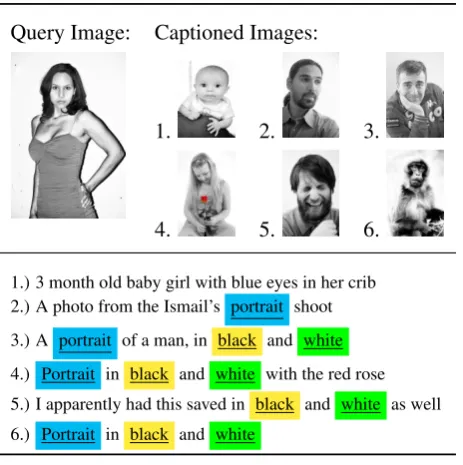
Query Image: Captioned Images:
1. 2. 3.
4. 5. 6.
[image:1.595.308.540.203.436.2]1.) 3 month old baby girl with blue eyes in her crib 2.) A photo from the Ismail’s portrait shoot 3.) A portrait of a man, in black and white 4.) Portrait in black and white with the red rose 5.) I apparently had this saved in black and white as well 6.) Portrait in black and white
Table 1: Example of a query image from the SBU-Flickr dataset (Ordonez et al., 2011), along with scene-based estimates of visually similar images. Our system models visual content using words that are frequent in these captions (highlighted) and ex-tracts a single output caption.
capture all of the relevant details which humans might describe. Second, image captions collected from the web often contain contextual or back-ground information which is not visually relevant to the image being described.
In this paper, we propose a system for transfer-based image captioning which is designed to ad-dress these challenges. Instead of selecting an out-put caption according to a single noisy estimate of visual similarity, our system uses a word fre-quency model to find a smoothed estimate of vi-sual content across multiple captions, as Table 1 illustrates. It then generates a description of the query image by extracting the caption which best represents the mutually shared content.
The contributions of this paper are as follows:
1.Our caption generation system effectively lever-ages information from the massive amounts of human-written image captions on the internet. In particular, it exhibits strong performance on the SBU-Flickr dataset (Ordonez et al., 2011), a noisy corpus of one million captioned images collected from the web. We achieve a remarkable 34% improvement in human relevance scores over a recent state-of-the-art image captioning system (Kuznetsova et al., 2012), and 48% improvement over a scene-based retrieval system (Patterson et al., 2014) using the same computed image fea-tures.
2. Our approach uses simple models which can be easily reproduced by both CV and NLP re-searchers. We provide resources to enable com-parison against future systems.1
2 Image Captioning by Transfer
The IM2TEXT model by Ordonez et al. (2011)
presents the first web-scale approach to image cap-tion generacap-tion. IM2TEXT retrieves the image
which is the closest visual match to the query age, and transfers its description to the query im-age. The COLLECTIVE model by Kuznetsova et
al. (2012) is a related approach which uses trained CV recognition systems to detect a variety of vi-sual entities in the query image. A separate de-scription is retrieved for each visual entity, which are then fused into a single output caption. Like IM2TEXT, their approach uses visual similarity as
a proxy for textual relevance.
Other related work models the text more di-rectly, but is more restrictive about the source and quality of the human-written training data. Farhadi et al. (2010) and Hodosh et al. (2013) learn joint representations for images and cap-tions, but can only be trained on data with very strong alignment between images and descriptions (i.e. captions written by Mechanical Turkers). An-other line of related work (Fan et al., 2010; Aker and Gaizauskas, 2010; Feng and Lapata, 2010) generates captions by extracting sentences from documents which are related to the query image. These approaches are tailored toward specific do-mains, such as travel and news, where images tend to appear with corresponding text.
1See http://bllip.cs.brown.edu/
download/captioning_resources.zip or ACL Anthology.
3 Dataset
In this paper, we use the SBU-Flickr dataset2.
Or-donez et al. (2011) queryFlickr.com using a huge number of words which describe visual en-tities, in order to build a corpus of one million images with captions which refer to image con-tent. However, further analysis by Hodosh et al. (2013) shows that many captions in SBU-Flickr (∼67%) describe information that cannot be ob-tained from the image itself, while a substantial fraction (∼23%) contain almost no visually rel-evant information. Nevertheless, this dataset is the only web-scale collection of captioned images, and has enabled notable research in both CV and NLP.3
4 Our Approach
4.1 Overview
For a query imageIq, our task is to generate a
rele-vant description by selecting a single caption from C, a large dataset of images with human-written captions. In this section, we first define the feature space for visual similarity, then formulate a den-sity estimation problem with the aim of modeling the words which are used to describe visually sim-ilar images to Iq. We also explore methods for
extractive caption generation.
4.2 Measuring Visual Similarity
Data-driven matching methods have shown to be very effective for a variety of challenging prob-lems (Hays and Efros, 2008; Makadia et al., 2008; Tighe and Lazebnik, 2010). Typically these methods compute global (scene-based) descriptors rather than object and entity detections. Scene-based techniques in CV are generally more robust, and can be computed more efficiently on large datasets.
The basic IM2TEXT model uses an equally
weighted average of GIST (Oliva and Torralba, 2001) and TinyImage (Torralba et al., 2008) fea-tures, which coarsely localize low-level features in scenes. The output is a multi-dimensional image space where semantically similar scenes (e.g. streets, beaches, highways) are projected near each other.
2http://tamaraberg.com/CLSP11/
Patterson and Hays (2012) present “scene at-tribute” representations which are characterized using low-level perceptual attributes as used by GIST (e.g. openness, ruggedness, naturalness), as well as high-level attributes informed by open-ended crowd-sourced image descriptions (e.g., in-door lighting, running water, places for learning). Follow-up work (Patterson et al., 2014) shows that their attributes provide improved matching for image captioning over IM2TEXT baseline. We
use their publicly available4 scene attributes for
our experiments. Training set and query images are represented using 102-dimensional real-valued vectors, and similarity between images is mea-sured using the Euclidean distance.
4.3 Density Estimation
As shown in Bishop (2006), probability density estimates at a particular point can be obtained by considering points in the training data within some local neighborhood. In our case, we define some region R in the image space which contains Iq.
The probability mass of that space is
P =
Z
Rp(Iq)dIq (1)
and if we assume thatRis small enough such that
p(Iq) is roughly constant in R, we can
approxi-mate
p(Iq)≈ k img
nimgVimg (2)
wherekimg is the number of images within Rin
the training data, nimg is the total number of
im-ages in the training data, andVimg is the volume
ofR. In this paper, we fixkimgto a constant value,
so that Vimg is determined by the training data
around the query image.5
At this point, we extend the density estima-tion technique in order to estimate a smoothed model of descriptive text. Let us begin by consid-ering p(w|Iq), the conditional probability of the
word6 wgivenI
q. This can be described using a
4https://github.com/genp/sun_
attributes
5As an alternate approach, one could fix the value of
Vimg and determinekimgfrom the number of points inR, giving rise to the kernel density approach (a.k.a. Parzen windows). However we believe the KNN approach is more appropriate here, because the number of samples is nearly 10000 times greater than the number of dimensions in the image representation.
6Here, we use word to refer to non-function words, and assume all function words have been removed from the cap-tions.
Bayesian model:
p(w|Iq) = p(Iqp|w(I)p(w)
q) (3)
The prior forwis simply its unigram frequency in C, wherentxt
w andntxtare word token counts:
p(w) = ntxtw
ntxt (4)
Note thatntxt is not the same as nimg because a
single captioned image can have multiple words in its caption. Likewise, the conditional density
p(Iq|w)≈ k txt w
ntxt
w Vimg (5)
considers instances of observed words withinR, although the volume of Ris still defined by the image space.ktxt
w is the number of timeswis used
withinRwhilentxt
w is the total number of timesw
is observed inC.
Combining Equations 2, 4, and 5 and canceling out terms gives us the posterior probability:
p(w|Iq) = k txt w
kimg·
nimg
ntxt (6)
If the number of words in each caption is inde-pendent of its image’s location in the image space, then p(w|Iq) is approximately the observed
uni-gram frequency for the captions insideR.
4.4 Extractive Caption Generation
We compare two selection methods for extractive caption generation:
1. SumBasicSumBasic (Nenkova and Vander-wende, 2005) is a sentence selection algorithm for extractive multi-document summarization which exclusively maximizes the appearance of words which have high frequency in the original docu-ments. Here, we adapt SumBasic to maximize the average value ofp(w|Iq)in a single extracted
cap-tion:
output= arg max
ctxt∈R
X
w∈ctxt 1
|ctxt|p(w|Iq) (7)
The candidate captions ctxt do not necessarily
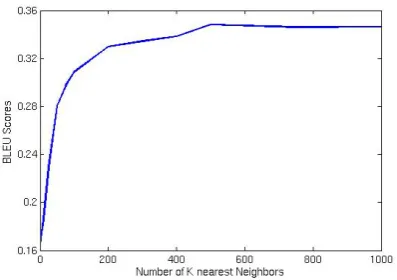
Figure 1: BLEU scores vskfor SumBasic extrac-tion.
2. KL Divergence We also consider a KL Divergence selection method. This method out-performs the SumBasic selection method for ex-tractive multi-document summarization (Haghighi and Vanderwende, 2009). It also generates the best extractive captions for Feng and Lapata (2010), who caption images by extracting text from a re-lated news article. The KL Divergence method is
output= arg min
ctxt∈R
X
w
p(w|Iq) logpp((ww|c|Itxtq))
(8) 5 Evaluation
5.1 Automatic Evaluation
Although BLEU (Papineni et al., 2002) scores are widely used for image caption evaluation, we find them to be poor indicators of the quality of our model. As shown in Figure 1, our system’s BLEU scores increase rapidly until aboutk= 25. Past this point we observe the density estimation seems to get washed out by oversmoothing, but the BLEU scores continue to improve untilk = 500
but only because the generated captions become increasingly shorter. Furthermore, although we observe that our SumBasic extracted captions ob-tain consistently higher BLEU scores, our per-sonal observations find KL Divergence captions to be better at balancing recall and precision. Never-theless, BLEU scores are the accepted metric for recent work, and our KL Divergence captions with
k = 25 still outperform all other previously pub-lished systems and baselines. We omit full results here due to space, but make our BLEU setup with captions for all systems and baselines available for documentary purposes.
System Relevance
COLLECTIVE 2.38 (σ= 1.45)
SCENEATTRIBUTES 2.15 (σ= 1.45)
SYSTEM 3.19 (σ= 1.50)
[image:4.595.92.291.72.212.2]HUMAN 4.09 (σ= 1.14)
Table 2: Human evaluations of relevance: mean ratings and standard deviations. See Section 5.2.
5.2 Human Evaluation
We perform our human evaluation of caption rele-vance using a similar setup to that of Kuznetsova et al. (2012), who have humans rate the image cap-tions on a 1-5 scale (5: perfect, 4: almost per-fect, 3: 70-80% good, 2: 50-70% good, 1: to-tally bad). Evaluation is performed using Amazon Mechanical Turk. Evaluators are shown both the caption and the query image, and are specifically instructed to ignore errors in grammaticality and coherence.
We generate captions using our system with KL Divergence sentence selection and k = 25. We also evaluate the original HUMAN captions for
the query image, as well as generated captions from two recently published caption transfer sys-tems. First, we consider the SCENEATTRIBUTES
system (Patterson et al., 2014), which represents both the best scene-based transfer model and a
k = 1 nearest-neighbor baseline for our system. We also compare against the COLLECTIVEsystem
(Kuznetsova et al., 2012), which is the best object-based transfer model.
In order to facilitate comparison, we use the same test/train split that is used in the publicly available system output for the COLLECTIVE
sys-tem7. However, we remove some query images
which have contamination between the train and test set (this occurs when a photographer takes multiple shots of the same scene and gives all the images the exact same caption). We also note that their test set is selected based on images where their object detection systems had good mance, and may not be indicative of their perfor-mance on other query images.
Table 2 shows the results of our human study. Captions generated by our system have 48% improvement in relevance over the SCENE AT -TRIBUTES system captions, and 34%
improve-7http://www.cs.sunysb.edu/
COLLECTIVE: One of the birds seen in
company of female and juvenile.
View of this woman sit-ting on the sidewalk in Mumbai by the stained glass. The boy walk-ing by next to match-ing color walls in gov t building.
Found this mother bird feeding her babies in our maple tree on the phone.
Found in floating grass spotted alongside the scenic North Cascades Hwy near Ruby arm a black bear.
SCENE
ATTRIBUTES: This small bird is prettymuch only found in the
ancient Caledonian pine forests of the Scottish Highlands.
me and allison in front
of the white house The sand in this beachwas black...I repeat BLACK SAND
Not the green one, but the almost ghost-like white one in front of it.
SYSTEM: White bird found in
park standing on brick wall
by the white house pine tree covered in ice
:) Pink flower in garden w/moth
HUMAN: Some black head bird
[image:5.595.70.528.61.334.2]taken in bray head. Us girls in front of thewhite house Male cardinal in snowytree knots Black bear by the roadbetween Ucluelet and Port Alberni, B.C., Canada
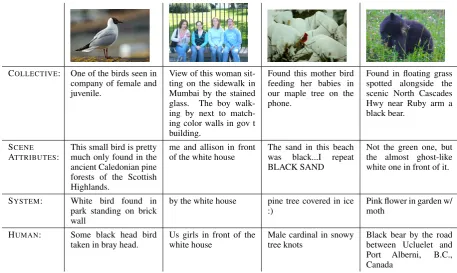
Table 3: Example query images and generated captions.
ment over the COLLECTIVEsystem captions.
Al-though our system captions score lower than the human captions on average, there are some in-stances of our system captions being judged as more relevant than the human-written captions.
6 Discussion and Examples
Example captions are shown in Table 3. In many instances, scene-based image descriptors provide enough information to generate a complete de-scription of the image, or at least a sufficiently good one. However, there are some kinds of images for which scene-based features alone are insufficient. For example, the last example de-scribes the small pink flowers in the background, but misses the bear.
Image captioning is a relatively novel task for which the most compelling applications are prob-ably not yet known. Much previous work in im-age captioning focuses on generating captions that concretely describe detected objects and entities (Kulkarni et al., 2011; Yang et al., 2011; Mitchell et al., 2012; Yu and Siskind, 2013). However, human-generated captions and annotations also describe perceptual features, contextual informa-tion, and other types of content. Additionally, our system is robust to instances where entity detec-tion systems fail to perform. However, one could
consider combined approaches which incorporate more regional content structures. For example, previous work in nonparametric hierarchical topic modeling (Blei et al., 2010) and scene labeling (Liu et al., 2011) may provide avenues for further improvement of this model. Compression meth-ods for removing visually irrelevant information (Kuznetsova et al., 2013) may also help increase the relevance of extracted captions. We leave these ideas for future work.
References
Ahmet Aker and Robert Gaizauskas. 2010. Generating image descriptions using dependency relational pat-terns. InProceedings of the 48th Annual Meeting of the Association for Computational Linguistics, ACL ’10, pages 1250–1258, Stroudsburg, PA, USA. As-sociation for Computational Linguistics.
Alexander C Berg, Tamara L Berg, Hal Daume, Jesse Dodge, Amit Goyal, Xufeng Han, Alyssa Mensch, Margaret Mitchell, Aneesh Sood, Karl Stratos, et al. 2012. Understanding and predicting importance in images. In Computer Vision and Pattern Recog-nition (CVPR), 2012 IEEE Conference on, pages 3562–3569. IEEE.
Christopher M Bishop. 2006. Pattern recognition and machine learning, volume 1. Springer New York. David M. Blei, Thomas L. Griffiths, and Michael I.
and bayesian nonparametric inference of topic hier-archies. J. ACM, 57(2):7:1–7:30, February.
Jesse Dodge, Amit Goyal, Xufeng Han, Alyssa Men-sch, Margaret Mitchell, Karl Stratos, Kota Yam-aguchi, Yejin Choi, Hal Daum´e III, Alexander C. Berg, and Tamara L. Berg. 2012. Detecting visual text. InNorth American Chapter of the Association for Computational Linguistics (NAACL).
Xin Fan, Ahmet Aker, Martin Tomko, Philip Smart, Mark Sanderson, and Robert Gaizauskas. 2010. Automatic image captioning from the web for gps photographs. In Proceedings of the international conference on Multimedia information retrieval, MIR ’10, pages 445–448, New York, NY, USA. ACM.
Ali Farhadi, Mohsen Hejrati, Mohammad Amin Sadeghi, Peter Young, Cyrus Rashtchian, Julia Hockenmaier, and David Forsyth. 2010. Every pic-ture tells a story: generating sentences from images. InProceedings of the 11th European conference on Computer vision: Part IV, ECCV’10, pages 15–29, Berlin, Heidelberg. Springer-Verlag.
Yansong Feng and Mirella Lapata. 2010. How many words is a picture worth? automatic caption genera-tion for news images. InProceedings of the 48th An-nual Meeting of the Association for Computational Linguistics, ACL ’10, pages 1239–1249, Strouds-burg, PA, USA. Association for Computational Lin-guistics.
Aria Haghighi and Lucy Vanderwende. 2009. Ex-ploring content models for multi-document summa-rization. InProceedings of Human Language Tech-nologies: The 2009 Annual Conference of the North American Chapter of the Association for Computa-tional Linguistics, pages 362–370. Association for Computational Linguistics.
James Hays and Alexei A Efros. 2008. Im2gps: esti-mating geographic information from a single image. InComputer Vision and Pattern Recognition, 2008. CVPR 2008. IEEE Conference on, pages 1–8. IEEE. Micah Hodosh, Peter Young, and Julia Hockenmaier. 2013. Framing image description as a ranking task: Data, models and evaluation metrics. Journal of Ar-tificial Intelligence Research, 47:853–899.
Girish Kulkarni, Visruth Premraj, Sagnik Dhar, Siming Li, Yejin Choi, Alexander C. Berg, and Tamara L. Berg. 2011. Baby talk: Understanding and gener-ating simple image descriptions. In CVPR, pages 1601–1608.
Polina Kuznetsova, Vicente Ordonez, Alexander C. Berg, Tamara L. Berg, and Yejin Choi. 2012. Col-lective generation of natural image descriptions. In ACL.
Polina Kuznetsova, Vicente Ordonez, Alexander Berg, Tamara Berg, and Yejin Choi. 2013. Generalizing image captions for image-text parallel corpus. In ACL.
Ce Liu, Jenny Yuen, and Antonio Torralba. 2011. Nonparametric scene parsing via label transfer. Pattern Analysis and Machine Intelligence, IEEE Transactions on, 33(12):2368–2382.
Ameesh Makadia, Vladimir Pavlovic, and Sanjiv Ku-mar. 2008. A new baseline for image annotation. In Computer Vision–ECCV 2008, pages 316–329. Springer.
Margaret Mitchell, Jesse Dodge, Amit Goyal, Kota Ya-maguchi, Karl Stratos, Xufeng Han, Alyssa Men-sch, Alexander C. Berg, Tamara L. Berg, and Hal Daum´e III. 2012. Midge: Generating image de-scriptions from computer vision detections. In Euro-pean Chapter of the Association for Computational Linguistics (EACL).
Ani Nenkova and Lucy Vanderwende. 2005. The im-pact of frequency on summarization.
Aude Oliva and Antonio Torralba. 2001. Modeling the shape of the scene: A holistic representation of the spatial envelope. International Journal of Computer Vision, 42:145–175.
V. Ordonez, G. Kulkarni, and T.L. Berg. 2011. Im2text: Describing images using 1 million cap-tioned photographs. InNIPS.
Vicente Ordonez, Jia Deng, Yejin Choi, Alexander C Berg, and Tamara L Berg. 2013. From large scale image categorization to entry-level categories. In In-ternational Conference on Computer Vision.
Kishore Papineni, Salim Roukos, Todd Ward, and Wei-Jing Zhu. 2002. Bleu: a method for automatic eval-uation of machine translation. In Proceedings of the 40th Annual Meeting on Association for Com-putational Linguistics, ACL ’02, pages 311–318, Stroudsburg, PA, USA. Association for Computa-tional Linguistics.
Genevieve Patterson and James Hays. 2012. Sun at-tribute database: Discovering, annotating, and rec-ognizing scene attributes. InComputer Vision and Pattern Recognition (CVPR), 2012 IEEE Confer-ence on, pages 2751–2758. IEEE.
Genevieve Patterson, Chen Xu, Hang Su, and James Hays. 2014. The sun attribute database: Beyond categories for deeper scene understanding. Interna-tional Journal of Computer Vision.
Joseph Tighe and Svetlana Lazebnik. 2010. Su-perparsing: scalable nonparametric image parsing with superpixels. InComputer Vision–ECCV 2010, pages 352–365. Springer.
Yezhou Yang, Ching Lik Teo, Hal Daum´e III, and Yian-nis Aloimonos. 2011. Corpus-guided sentence gen-eration of natural images. In Empirical Methods in Natural Language Processing (EMNLP), Edin-burgh, Scotland.