New Techniques for Context Modeling
E r i c S v e n R i s t a d a n d R o b e r t G . T h o m a s D e p a r t m e n t o f C o m p u t e r S c i e n c e
P r i n c e t o n U n i v e r s i t y
{ristad, rgt }~cs. princeton,
eduA b s t r a c t
We introduce three new techniques for sta- tistical language models: extension mod- eling, nonmonotonic contexts, and the di- vergence heuristic. Together these tech- niques result in language models that have few states, even fewer parameters, and low message entropies.
1 I n t r o d u c t i o n
Current approaches to a u t o m a t i c speech and hand- writing transcription demand a strong language model with a small number of states and an even smaller number of parameters. If the model entropy is high, then transcription results are abysmal. If there are too many states, then transcription be- comes computationally infeasible. And if there are too m a n y parameters; then "overfitting" occurs and predictive performance degrades.
In this paper we introduce three new techniques for statistical language models: extension modeling, nonmonotonic contexts, and the divergence heuris- tic. Together these techniques result in language models that have few states, even fewer parameters, and low message entropies. For example, our tech- niques achieve a message entropy of 1.97 bits/char on the Brown corpus using only 89,325 parameters. By modestly increasing the number of model param- eters in a principled manner, our techniques are able to further reduce the message entropy of the Brown Corpus to 1.91 bits/char. 1 In contrast, the charac- ter 4-gram model requires 250 times as m a n y pa- rameters in order to achieve a message entropy of only 2.47 bits/char. Given the logarithmic nature of codelengths, a savings of 0.5 bits/char is quite significant. The fact that our model performs signif- icantly better using vastly fewer parameters argues
1The only change to our model selection procedure is to replace the incremental cost formula ALe(w, ~', a) with a constant cost of 2 bits/extension. This small change reduces the test message entropy from 1.97 t o 1.91 bits/char but it also quadruples the number of model parameters and triples the total codelength.
that it is a much better probability model of natural language text.
Our first two techniques - n o n m o n o l o n i c contexts and e x l e n s i o n m o d e l i n g - are generalizations of the traditional context model (Cleary and W i t t e n 1984; Rissanen 1983,1986). Our third technique - t h e di- v e r g e n c e h e u r i s t i c - is an incremental model selec- tion criterion based directly on Rissanen's (1978) minimum description length (MDL) principle. T h e MDL principle states t h a t the best model is the sim- plest model t h a t provides a compact description of the observed data.
In the traditional context model, every prefix and every suffix of a context is also a context. Three consequences follow from this property. The first consequence is t h a t the context dictionary is un- necessarily large because most of these contexts are redundant. T h e second consequence is to attenu- ate the benefits of context blending, because most contexts are equivalent to their maximal proper suf- fixes. T h e third consequence is t h a t the length of the longest candidate context can increase by at most one symbol at each time step, which impairs the model's ability to model complex sources. In a non- monotonic model, this constraint is relaxed to allow compact dictionaries, discontinuous backoff, and ar- bitrary context switching.
T h e traditional context model maps every history to a unique context. All symbols are predicted us- ing that context, and those predictions are estimated using the same set of histories. In contrast, an exten- sion model maps every history to a s e l of contexts, one for each symbol in the alphabet. Each symbol is predicted in its own context, and the model's current predictions need not be estimated using the same set of histories. This is a form of parameter tying t h a t increases the accuracy of the model's predic- tions while reducing the number of free parameters in the model.
As a result of these two generalizations, nonmono- tonic extension models can o u t p e r f o r m their equiv- alent context models using significantly fewer pa- rameters. For example, an order 3 n-gram (ie., the 4-gram) requires more than 51 times as many con-
texts and 787 times as many parameters as the order 3 nonmonotonic extension model, yet already per- forms worse on the Brown corpus by 0.08 bits/char. Our third contribution is the divergence heuris- tic, which adds a more specific context to the model only when it reduces the codelength of the past data more than it increases the codelength of the model. In contrast, the traditional selection heuristic adds a more specific context to the model only if it's entropy is less than the entropy of the more general context (Rissanen 1983,1986). T h e traditional m i n i m u m en- tropy heuristic is a special case of the more effective and more powerful divergence heuristic. T h e diver- gence heuristic allows our models to generalize from the training corpus to the testing corpus, even for nonstationary sources such as the Brown corpus.
T h e remainder of our article is organized into three sections. In section 2, we formally define the class of extension models and present a heuristic model selection algorithm for that model class based on the divergence criterion. Next, in section 3, we demonstrate the efficacy of our techniques on the Brown Corpus, an eclectic collection of English prose containing approximately one million words of text. Section 4 discusses possible improvements to the model class.
2 E x t e n s i o n M o d e l C l a s s
This section consists of four parts. In 2.1, we for- mally define the class of extension models and prove that they satisfy the axioms of probability. In 2.2, we show to estimate the parameters of an exten- sion model using Moffat's (1990) "method C." In 2.3, we provide codelength formulas for our model class, based on efficient enumerative codes. These code- length formulas will be used to match the complexity of the model to the complexity of the data. In 2.4, we present a heuristic model selection algorithm that adds parameters to an extension model only when they reduce the codelength of the d a t a more than they increase the codelength of the model.
2.1 M o d e l C l a s s D e f i n i t i o n
Formally, an
extension model
¢ : (E, D, E, A) con- sists of a finite alphabet E, [E[ = m, a dictionary D of contexts, D C E*, a set of available context extensions E, E C D x E, and a probability func- tion I : E ---* [0, 1]. For every context w inD, E(w)
is the set of symbols available in the context w and A(~rlw ) is the conditional probability of the symbol c~ in the context w. Note that )--]o~ A(c~[w) < 1 for all contexts w in the dictionary D.
The probability /5(h1¢ ) of a string h given the model ¢, h • E ' , is calculated as a chain of con- ditional probabilities (1)
/5(h{¢) --"
~(hnlhl...hn_l,¢)~(hl...h,~_ll¢)
(1)while the conditional probability ih(elh, ¢) of a single
symbol ~r after the history h is defined as (2).
{ ~(~rlh ) if ( h , a ) ~ E /3(a]h, ¢) -
5(h)~(a]h2h3...h,,
¢) otherwise(2)
The expansion factor 6(h) ensures that/5(.]h, ¢) is a probability function if/5(-Ih2.., h,~, ¢) is a probabil- ity function.
1 - )~(E(h)[h)
(3)6 ( h ) - 1 - ~(E(h)Ih2...h,~,¢)
Note t h a t
E(h)
represents a set of symbols, and so by a slight abuse of notation)~(E(h)Ih )
denotes ~]~eE(h) A(a[h), ie., the sum of A(alh ) over all ~ inE(h).
E x a m p l e l . Let E : { 0 , 1 } , D : { e , " 0 " } , E ( e ) - {0, 1}, E ( " 0 " ) -= {0}. Suppose
A(010 = ½,
X(lle) = ½, and A(01"0" ) = 3 T h e n 6("0") = 1/1 _ 1 ~. ~ - y and i6(11"0",¢ ) : 5("0") •(l[e) - 1The fundamental difference between a context model and an extension model lies in the inputs to the context selection rule, not its outputs. T h e traditional context model includes a selection rule s : E* --~ D whose only input is the history. In con- trast, an extension model includes a selection rule s : E* x E --+ D whose inputs include the past history and the symbol to be predicted. This dis- tinction is preserved even if we generalize the selec- tion rule to select a set of candidate contexts. Un- der such a generalization, the context model would map every history to a set of candidate contexts, ie., s : E* ---* 2 D , while an extension model would map every history and symbol to a set of candidate contexts, ie., s : E* x E --* 2 D.
Our extension selection rule s : E* x E --+ D is de- fined implicitly by the set E of extensions currently in the model. T h e recursion in (2) says that each symbol should be predicted in its longest candidate context, while the expansion factor 6(h) says that longer contexts in the model should be trusted more than shorter contexts when combining the predic- tions from different contexts.
An extension model ¢ is
valid
iff it satisfies the following constraints:a. e C D A E ( c ) : E
c. Vw • D [E(w) : E =¢, ~oez(~o) A(~iw) : 1]
(4)
These constraints suffice to ensure that the model ¢ defines a probability function. Constraint (4a) states that every symbol has the e m p t y string as a context. This guarantees that every symbol will always have at least one context in every history and that the re- cursion in (2) will terminate. Constraint (45) states that the sum of the probabilities of the extensionsto more than unity. The third constraint (4c) states that the sum of the probabilities of the extensions
E(w)
must sum exactly to unity when every symbolis available in that context (ie., when
E(w) : E).
L e m m a 2.1 V y E E * Vcr62E [ fi(~]lY) : 1 : ~ / ] ( E I q y ) = 1 ]
P r o o f . By the definition of
6(~ry).
T h e o r e m 1
If an exlension model ¢ is valid, then
vn ]S,es,, = 1.P r o o f . By induction on n. For the base case, n : 1 and the statement is true by the definition of validity (constraints 4a and 4c). T h e induction step is true by l e m m a 2.1 and definition (1). []
2 . 2 P a r a m e t e r E s t i m a t i o n
Let us now estimate the conditional probabilities A(.[-) required for an extension model. Traditionally, these conditional probabilities are estimated using string frequencies obtained from a training corpus. Let c(c~[w) be the number of times that the symbol followed the string w in the training corpus, and let
c(w)
be the sum ~ e sc(crlw)
of all its conditionalfrequencies.
Following Moffat (1990), we first partition the conditional event space E in a given context w into two subevents: the symbols
q(w)
that have previously occurred in context w and those t h a t q(w) t h a t have not. Formally,q(w) -
{(r :
c(,r[w) > 0} and ~(w) - E -
q(w).
We estimate)~c(q(w)lw ) as e(w)/(c(w) + #(w))
and)~c(4(w)[w)
as # ( w ) / ( c ( w ) + #(w))
where # ( w ) is the to-tal weight assigned to the novel events q(w) in the context w. Currently, we calculate # ( w ) as min([q(w)l, Iq(w)[) so that highly variable con- texts receive more flattening, but no novel symbol in ~(w) receives more than unity weight. Next,
)~c(alq(w ), w)
is estimated asc(alw)/c(w )
for thepreviously seen symbols c~ e
q(w)
andAc((r]4(w), w)
is estimated uniformly as 1/[4(w)[ for the novel sym- bols ~r • 4(w). C o m b i n i n g these estimates, we ob- tain our overall estimate (5).
c( lw)
c(w) + #(w)
if c~ •q(w)
A e (alw) = # ( w ) otherwise
+
O)
Unlike Moffat, our estimate (5) does not use escape probabilities or any other form of context blending. All novel events 4(w) in the context w are assigned uniform probability. This is suboptimal but simpler. We note t h a t our frequencies are incorrect when used in an extension model that contains contexts t h a t are proper suffixes of each other. In such a sit- uation, the shorter context is only used when the longer context was
not
used. Let y andxy
be twodistinct contexts in a model ¢. Then the context y will never be used when the history is E*xy. There- fore, our estimate of A(.ly ) should be conditioned on the fact that the longer context
xy
did not occur. The interaction between candidate contexts can be- come quite complex, and we consider this problem in other work (Ristad and Thomas, 1995).P a r a m e t e r estimation is only a small part of the overall model estimation problem. Not only do we have to estimate the parameters for a model, we have to find the right parameters to use! To do this, we proceed in two steps. First, in section 2.3, we use the m i n i m u m description length (MDL) principle to quantify the total merit of a model with respect to a training corpus. Next, in section 2.4, we use our MDL codelengths to derive a practical model selec- tion algorithm with which to find a good model in the vast class of all extension models.
2.3 C o d e l e n g t h F o r m u l a s
The goal of this section is to establish the proper ten- sion between model complexity and d a t a complexity, in the fundamental units of information. Although the MDL framework obliges us to propose particu- lar encodings for the model and the data, our goal is not to actually encode the d a t a or the model.
Given an extension model ¢ and a text corpus T, ITI = t, we define the total codelength
L(T,¢I(I))
relative to the model class ~ using a 2-part code.
L(T,
¢[(I)) : L ( ¢ I ~ ) +L(TI¢ , ~)
Since conditioning on the model class (I) is always understood, we will henceforth suppress it in our notation.
Firstly, we will encode the text T using the prob- ability model ¢ and an arithmetic code, obtaining the following codelength.
L ( T [ ¢ ) = - logif(Tl¢ )
Next, we encode the model ¢ in three parts: the con- text dictionary as
L(D),
the extensions asL(EID),
and the conditional frequencies c(.[-) as
L(e[D, E).
T h e dictionary D of contexts forms a suffix tree containing ni vertices with branching factor i. T h e
m
tree contains
n = )--~i=l ni
internal vertices and no leaf vertices. There are (no + nl + . . . +nm -
1)!/no!nl!...nm!
such trees (Knuth, 1986:587). Ac-cordingly, this tree may be encoded with an enumer- ative code using
L(D)
bits.L I D ) :
L z ( n ) + l o g ( n+m-lm_l
)
+ l o g
(no + nl + . . . + nm -
1)!no!nl!...nm!
r n - 1
i
+Lz<([[DJ[,n)
i = l
+ log ( n + I LDJl 1
JLDJI-7 )
\
where [DJ is the set of all contexts in D that are proper suffixes of another context in D. T h e first term encodes the number n of internal vertices using the Elias code. The second term encodes the counts {nl, n 2 , . . . ,
am}.
Given the frequencies of these in- ternal vertices, we may calculate the number no of leaf vertices as no = 1 + n2 + 2n3 + 3n4 + . . . + (m - 1)am. T h e third term encodes the actual tree (with- out labels) using an enumerative code. The fourth term assigns labels (ie., symbols from E) to the edges in the tree. At this point the decoder knows all con- texts which are not proper suffixes of other contexts, ie., D - LD]. The fourth term encodes the magni- tude of [D] as an integer bounded by the number n of internal vertices in the suffix tree. The fifth term identifies the contexts [DJ as interior vertices in the tree t h a t are proper suffices of another context in D. Now we encode the symbols available in each con- text. Letmi
be the number of contexts that have exactly i extensions, ie., mi - J{w:JE(w)l
= i}l.7"n
Observe t h a t ~ i = 1
mi =
IDI.
( )
E
m
-F rni log i
i--1
The first t e r m represents the encoding of {mi } while the second term represents the encoding
IE(w)l for
each w in D. The third term represents the encoding of E(w) as a subset of E for each w in D.Finally, we encode the frequencies c(~rlw) used to estimate the model parameters
w E D
+ g ,o, ( C(°) +
)
IE(w)l
where [y] consists of all contexts that have y as their maximal proper suffix, ie., all contexts that y imme- diately dominates, and [y] is the maximal proper suffix of y in D, ie., the unique context that imme- diately dominates y. T h e first term encodes ITI with an Elias code and the second term recursively parti- tions
c(w)
into c([w]) for every context w. The third term partitions the context frequencyc(w)
into the available extensionsc(E(w)lw )
and the "unallocated frequency" c ( E -E(w)lw) = c(w) - c(E(w)[w)
in the context w.2.4 M o d e l S e l e c t i o n
The final component of our contribution is a model selection algorithm for the extension model class ~. Our algorithm repeatedly refines the accuracy of our model in increasingly long contexts. Adding a new parameter to the model will decrease the codelength of the d a t a and increase the codelength of the model.
Accordingly, we add a new parameter to the model only if doing so will decrease the total codelength of the d a t a
and
the model.T h e incremental cost and benefit of adding a sin- gle parameter to a given context cannot be accu- rately approximated in isolation from any other pa- rameters that might be added to that context. Ac- cordingly, the incremental cost of adding the
set E'
of extensions to the context w is defined as (6) while the incremental benefit is defined as (7).
A L e ( w , E') - L ( ¢ U ({w} × E')) - L(¢) (6)
ALT(W,
E') - L ( T I ¢ ) -L(T[¢
U ({w} x E')) (7)Keeping only significant terms that are monoton- ically nondecreasing, we approximate the incremen- tal cost A L e ( w , E') as
loglDl+log
IS'l
+ log c(Lwj) + log ( c(w)ls, i
+ C 'I )
T h e first term represents the incremental increase in the size of the context dictionary D. The second term represents the cost of encoding the candidate extensions
E(w)
= E ~. T h e third term represents (an upper bound on) the cost of encodingc(w).
The fourth term represents the cost of encodingc(.Iw )
for
E(w).
Only the second and fourth terms aresignficant.
Let us now consider the incremental benefit of adding the extensions E' to a given context w. The addition of a single parameter (w, ~r) to the model ¢ will immediately change A(alw), by definition of the model class. Any change to A(.Iw ) will also change the expansion factor
5(w)
in that context, which may in turn change the conditional probabili- ties~(E-E(w)lw,
¢) of symbols not available in that
context. Thus the incremental benefit of adding the extensions E' to the context w may be calculated asALT(w,E')
-- c(E - E ' l w ) l o g 1 - A(E'Iw)1 - ~ ( S ' l ~ , ¢)
+ ~ c('/Iwll°g~(~,lw,¢ )
a' E Fd
The first term represents the incremental benefit (in bits) for evaluating E - E' in the context w using the more accurate expansion factor 5(w). The sec- ond term represents the incremental benefit (in bits) of using the direct estimate
A(a'lw )
instead of the model probability/5(cr'lw, ¢) in the context w. Note t h a t A(a'lw) may be more or less than/~(cr'lw , ¢).Now the incremental cost and benefit of adding
a single
extension(w, cr)
to a model that alreadycontains the extensions (w, El/ may be defined as follows.
A L e ( w , E', a) -- A L e ( w , E' U {a}) - A L e ( w , E')
A L T ( w , ~', a) -
ALT(w,
~ ' U {a}) -ALT(W, ~')
Let us now use these incremental cost/benefit for- mulas to design a simple heuristic estimation algo- r i t h m for the extension model. T h e algorithm con- sists of two subroutines.
Refine(D,E,n)
augments the model with all individually profitable extensions of contexts of length n. It rests on the assump- tion that adding a new context does not change the model's performance in the shorter contexts. Extend(w) determines all profitable extensions of the candidate context w, if any exist. Since it is not feasible to evaluate the incremental profit of every subset of E, Extend(w) uses a greedy heuristic that repeatedly augments the set of profitable extensions of w by the single most profitable extension until it is not longer profitable to do so.Refine( D,E,n)
1. D , := { } ; E , := {};
2. Cn : = { w : w e Cn-1 ~']~ A c(w) > Cmi.} ;
3. if (( n > nm~=) V (ICnl = 0)) then return;
4.
for w E Cn
5. ~' := Extend(w);
6. if ISI > o then D . :-- Dn U { w } ;
En(w)
:= S;7. D : = D U D n ; E : = E U E n ;
8. Refine( D,E,n -F
1);Cn is the set of candidate contexts of length n, obtained from the training corpus.
Dn
is the set of profitable contexts of length n, while En is the set of profitable extensions of those contexts.Extend(w) 1. S : : { } ;
2. o" := argmaxoe~.
{AL(w,
{at})} 3. while ( A L ( w , S , ~ ) > O)4. S := S U {a};
S. o" := argrnax.e]g_ s {AL(w, ,S', ¢r)}
6. return(S);
T h e loop in lines 3-5 repeatedly finds the single most profitable symbol a with which to augment the set S of profitable extensions. T h e incremental profit A L ( . . . ) is the incremental benefit
ALT(...)
minus the incremental cost A L e ( . . . ) .
Our breadth-first search considers shorter con- texts before longer ones, and consequently the deci- sion to add a profitable context y m a y significantly decrease the benefit of a more profitable context
xy,
particularly when
c(xy) ~ c(y).
For example, con- sider a source with two hidden states. In the first state, the source generates the alphabet E = {0, 1,2} uniformly. In the second state, the source generates the string "012" with certainty. With appropriate state transition probabilities, the source generates strings where c(0) ~ c(1) ~ e(2),c(211)/c(1 ) >>
c(21e)/c(c),
andc(2101)/c(01 ) > c(211)/c(1 ).
In sucha situation, the best context model includes the con- texts "0" and "01" along with the e m p t y context c. However, the divergence heuristic will first deter- mine t h a t the context "1" is profitable relative to the
empty context, and add it to the model. Now the profitability of the better context °'01" is reduced, and the divergence heuristic may therefore not in- clude it in the model. This problem is best solved with a best first search. Our current implementation uses a breadth first search to limit the computational complexity of model selection.
Finally, we note t h a t our parameter estimation techniques and model selection criteria are compara- ble in computational complexity to Rissanen's con- text models (1983, 1986). For that reason, extension models should be amendable to efficient online im- plementation.
3 E m p i r i c a l R e s u l t s
By means of the following experiments, we hope to demonstrate the utility of our context modeling techniques. All results are based on the Brown cor- pus, an eclectic collection of English prose drawn from 500 sources across 15 genres (Francis and Kucera, 1982). T h e irregular and nonstationary na- ture of this corpus poses an exacting test for sta- tistical language models. We use the first 90% of each file in the corpus to estimate our models, and then use the remaining 10% of each file in the corpus to evaluate the models. Each file contains approx- imately 2000 words. Due to limited computational resources, we set nmax = 10, Cmin - ~ - 8, a n d restrict
our our alphabet size to 70 (ie., all printing ascii characters, ignoring case distinction).
Our results are summarized in the following ta- ble. Message entropy (in bits/symbol) is for the testing corpus only, as per traditional model vali- dation methodology. T h e nonmonotonic extension model (NEM) outperforms all other models for all orders using vastly fewer parameters. Its perfor- mance all the more impressive when we consider that no context blending or escaping is performed, even for novel events.
We note that the test message entropy of the n- gram model class is minimized by the 5-gram at 2.38 bits/char. This result for the 5-gram is not honest because knowledge of the test set was used to select the optimal model order. Jelinek and Mercer (1980) have shown to interpolate n-grams of different or- der using mixing parameters that are conditioned on the history. Such interpolated Markov sources are considerably more powerful than traditional n- grams but contain even more parameters.
T h e best reported results on the Brown Corpus are 1.75 b i t s / c h a r using a large interpolated trigram word model whose parameters are estimated using over 600,000,000 words of proprietary training d a t a (Brown et.al., 1992). T h e use of proprietary training d a t a means that these results are not independently repeatable. In contrast, our results were obtained using only 900,000 words of generally available train- ing data and may be independently verified by any-
M o d e l NEM NCM MCM1 MCM2 n-gram
Parameters Entropy
89,325 1.97 687,276 2.19 88,945,904 2.43 88,945,904 3.12 506,352,021,176,052 3.74
Table 1: Results for the nonmonotonic extension model (NEM), the nonmonotonic context model (NCM), Rissanen's (1983,1986) monotonic context models (MCM1, MCM2) and the n-gram model. All models are order 7. T h e rightmost column contains test message entropy in bits/symbol. NEM outper- forms all other model classes for all orders using sig- nificantly fewer parameters. It is possible to reduce the test message entropy of the NEM and NCM to 1.91 and 1.99, respectively, by quadrupling the num- ber of model parameters.
one with the inclination to do so. T h e a m o u n t of training d a t a is known to be a significant factor in model performance. Given a sufficiently rich dictio- nary of words and a sufficiently large training corpus, a model of word sequences is likely to o u t p e r f o r m an otherwise equivalent model of character sequences. For these three reasons - repeatability, training cor- pus size, and the advantage of word models over character models - the results reported by Brown et.al (1992) are not directly comparable to those re- ported here.
Section 3.1 compares the statistical efficiency of the various context model classes. Next, sec- tion 3.2 anecodatally examines the complex interac- tions among the parameters of an extension model.
3.1 M o d e l C l a s s C o m p a r i s o n
Given the tremendous risk of overfitting, the most important property of a model class is arguably its statistical efficiency. Informally, statistical efficiency measures the effectiveness of individual parameters in a given model class. A high efficiency indicates that our model class provides a good description of the data. Conversely, a low efficiency indicates t h a t the model class does not adequately describe the ob- served data.
In this section, we compare the statistical effi- ciency of three model classes: context models, ex- tension models, and fixed-length Markov processes (ie., n-grams). Our model class comparison is based on three criteria of statistical efficiency: total code- length, b i t s / p a r a m e t e r on the test message, and bits/order on the test message. The context and extension models are all of order 9, and were es- timated using the true incremental benefit and a range of fixed incremental costs (between 5 and 25 bits/extension for the extension model and between
25 and 150 b i t s / c o n t e x t for the context model). According to the first criteria of statistical effi- ciency, the best model is the one that achieves the smallest total codelength
L(T,
¢) of the training cor- pus T and model ¢ using the fewest parameters. This criteria measures the statistical efficiency of a model class according to the MDL framework, where we would like each parameter to be as cheap as pos- sible and do as much work as possible. Figure 1 graphs the number of model parameters required to achieve a given total codelength for the training cor- pus and model. T h e extension model class is the overwhelming winner.. . . N. um ,be. r, of Param,et?rs.. vs: Codele, n g ~ . . .
3,5
"l t ... M-... 2,3,4 ngrarn
• exle~lslon model .-~ E
- - ~-- context mod~ ....'"
• """ [ ..'""" i • '"" I '"'""'"'"" i
15 Btm ~ .m" ~-
10000 100000 1000000 I(XX)OO(X)
Number of parameters
Figure 1: T h e relationship between the number of model parameters and the total codelength
L(T,
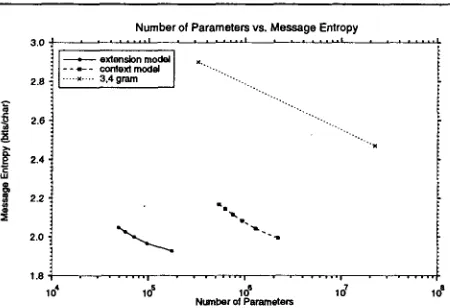
¢) of the training corpus T and the model ¢. By this criteria of statistical efficiency, the extension models completely dominate context models and n-grams.According to the second criteria of statistical effi- ciency, the best model is the one that achieves the lowest test message entropy using the fewest param- eters. This criteria measures the statistical efficiency of a model class according to traditional model vali- dation methodology, tempered by a healthy concern for overfitting. Figure 2 graphs the number of model parameters required to achieve a given test message entropy for each of the three model classes. Again, the extension model class is the clear winner. (This is particularly striking when the number of parame- ters is plotted on a linear scale.) For example, one of our extension models saves 0.98 bits/char over the trigram while using less than 1/3 as many param- eters. Given the logarithmic nature of codelength and the scarcity of training data, this is a significant improvement.
According to the third criteria of statistical effi- ciency, the best model is one that achieves the low- est test message entropy for a given model order. This criteria is widely used in the language model- ing community, in part because model order is typi-
[image:6.612.64.288.71.144.2] [image:6.612.305.531.231.384.2]"C"
&
i
' s
3 . 0 . . . . . , . . . i . . . = .
i e ~ s l o n mo~l
2.8 22 27. =~°~"~ 3 , 4 g r a m ... "'"'",... " ' . . . 2.6
' . . . . "'x 2.4
2.2
2.0
L8
1 0 4 1 0 s 1 0 6 1 0 7 N u m b e r o f P a r a m e t e r s v s . Message Entropy
. . . , . . . i . . . = . . .
N ~ r ~ P a ~ e m to ~
Figure 2: T h e relationship between the number of model parameters and test message entropy. The most striking fact about this graph is the tremen- dous efficiency of the extension model.
cally -- although not necessarily - - related to both the number of model parameters and the a m o u n t of computation required to estimate the model. Fig- ure 3 compares model order to test message entropy for each of the three model classes. As the order of the models increases from 0 (ie., unigram) to 10, we naturally expect the test message entropy to ap- proach a lower bound, which is itself bounded below by the true source entropy. By this criteria, the ex- tension model class is better than the context model class, and b o t h are significantly better than the n- gram.
4 . 4 4 . 2 4 . 0 3 . 8 3 . 6 3 . 4 3 . 2 3 . 0 2 . 8 2 . 6 2 . 4 2 . 2 2 . 0 1 . 8
M o d e l O r d e r v s . M e s s a g e Entropy
... • .. ... . - - : - - : ~ Z ~ m = ~ ~
2 4 6 8 1 0
M o d e l Order
Figure 3: T h e relationship between model order and test message entropy. T h e extension model class is the clear winner by this criteria as well.
3.2 A n e c d o t e s
It is also worthwhile to interpret the parameters of the extension model estimated from the Brown Cor- pus, to better understand the interaction between our model class and our heuristic model selection al- gorithm. According to the divergence heuristic, the decision to add an extension (w, ~) is made relative to t h a t context's maximal proper suffix LwJ in D as well as any other extensions in the context w. An extension
(w, ~)
will be added only if the direct es- timate of its conditional probability is significantly different from its conditional probability in its maxi- mal proper suffix after scaling by the expansion fac- tor in the context w, ie., if A(alw ) is significantly different t h a n6(w)~(c~ I
LwJ).This is illusrated by the three contexts and six extensions shown immediately below, where
+E(w)
includes all symbols in
E(w)
t h a t are more likely in w than they were in [wJ and- E ( w )
includes all symbols inE(w)
t h a t are less likely in w than they w e r e inL J.
W
"blish" " o u e s t a b l i s h " " e u e s t a b l i s h "
+E(w) -E(w)
e,i,mU
m e
T h e substring
blish
is most often followed by the characters 'e', 5', and 'm', corresponding to the rel- atively frequent word formspublish{ ed, er, ing}
andestablish{ ed, ing, ment}.
Accordingly, the context" b l i s h " has three positive extensions { e , i , m } , of which e has by far the greatest probability. T h e context " b l i s h " is the maximal proper suffix of two other contexts in the model, " o u e s t a b l i s h " and
"euestablish".
T h e substring o
establish
occurs most frequently in the gerundto establish,
which is nearly always followed by a space. Accordingly, the context " o u e s t a b l i s h " has a single positive extension "u". T h e substring oestablish
is also found before the characters 'm', 'e', and 'i' in sequences such asto establishments, {who, ratio, also} established,
and{ to, into, also} establishing.
Accordingly, the context" o u e s t a b l i s h " does not have any negative exten- sions.
In contrast, the substring e
establish
is overwhelm- ingly followed by the character 'm', rarely followed by 'e', and never followed by either 'i' or space. For this reason, the context " e u e s t a b l i s h " has a sin- gle positive extension {m} corresponding to the great frequency of the stringthe establishment.
This con- text also has single negative extension {e}, corre- sponding to the fact that the character 'e' is still pos- sible in the context " e u e s t a b l i s h " but considerably less likely than in t h a t context's maximal proper suf- fix "blish".Since 'i' is reasonably likely in the context " b l i s h " but completely unlikely in the context " e u e s t a b l i s h " , w e m a y well w o n d e r w h y the m o d e l
[image:7.612.76.301.65.219.2] [image:7.612.71.302.478.632.2]does not include the negative extension 'i' in addi- tion to 'e' or even instead of 'e'. This puzzle is ex- plained by the expansion factor as follows. Since the substring e establish is only followed by 'm' and 'e', the expansion factor ~ ( " e , , e s t a b l i s h " ) is essen- tially zero after 'm' and 'e' are added to that con- text, and therefore ~ ( ~ - {m, e}l " e u e s t a b l i s h " ) is also essentially zero. Thus, 'i' and space are both assigned nearly zero probability in the con- text "e, , e s t a b l i s h " , simply because 'm' and 'e' get nearly all the probability in that context.
4
C o n c l u s i o n
In ongoing work, we are investigating extension mix- ture models as well as improved model selection al- gorithms. An extension mixture model is an exten- sion model whose ~(~lw) parameters are estimated by linearly interpolating the empirical probability estimates for all extensions that dominate w with respect to c~, ie., all extensions whose symbol is and whose context is a suffix of w. Extension mix- ing allows us to remove the uniform flattening of zero frequency symbols in our parameter estimates (5). Preliminary results are promising. The idea of context mixing is due to Jelinek and Mercer (1980).
Our results highlight the fundamental tension be- tween model complexity and data complexity. If the model complexity does not match the data complex- ity, then both the total codelength of the past obser- vations and the predictive error increase. In other words, simply increasing the number of parameters in the model does not necessarily increase predictive power of the model. Therefore, it is necessary to have a a fine-grained model along with a heuristic model selection algorithm to guide the expansion of the model in a principled manner.
A c k n o w l e d g e m e n t s . Thanks to Andrew Appel, Carl de Marken, and Dafna Scheinvald for their cri- tique. The paper has benefited from discussions with the participants of DCC95. Both authors are par- tially supported by Young Investigator Award IRI- 0258517 to the first author from the National Science Foundation. The second author is additionally sup- ported by a tuition award from the Princeton Uni- versity Research Board. The research was partially supported by NSF SGER IRI-9217208.
FRANCIS, W. N., AND KUCERA, H. Frequency analysis of English usage: lexicon and grammar.
Houghton Mifflin, Boston, 1982.
JELINEK, F., AND MERCER, a . L. Interpolated es- timation of Markov source parameters from sparse data. In Pattern Recognition in Practice (Amster- dam, May 21-23 1980), E. S. Gelsema and L. N. Kanal, Eds., North Holland, pp. 381-397.
KNUTH, D. E. The Art of Computer Programming,
1 ed., vol. 1. Addison-Wesley, Reading, MA, 1968.
MOFFAT, A. Implementing the PPM data compre- sion scheme. IEEE Trans. Communications 38,
11 (1990), 1917-1921.
RISSANEN, J. Modeling by shortest data descrip- tion. Automatica 14 (1978), 465-471.
RISSANEN, J. A universal data compression system.
IEEE Trans. Information Theory IT-29, 5 (1983), 656-664.
RISSANEN, J. Complexity of strings in the class of Markov sources. IEEE Trans. Information The- ory IT-32, 4 (1986), 526-532.
RISTAD, E. S., AND THOMAS, R. G. Context models in the MDL framework. In Proceedings of 5th Data Compression Conference (Los Alamitos, CA, March 28-30 1995), J. Storer and M. Cohn, Eds., IEEE Computer Society Press, pp. 62-71.
R e f e r e n c e s
BROWN, P., PIETRA, V. D., PIETRA, S. D., LAI, J., AND MERCER, R. An estimate of an upper bound for the entropy of English. Computational Linguistics 18 (1992), 31-40.
CLEARY, J., AND WITTEN, I. Data compression using adaptive coding and partial string matching.
IEEE Trans. Comm. COM-32, 4 (1984), 396-402.