Bayesian Synchronous Tree-Substitution Grammar Induction
and its Application to Sentence Compression
Elif Yamangil and Stuart M. Shieber
Harvard University Cambridge, Massachusetts, USA {elif,shieber}@seas.harvard.edu
Abstract
We describe our experiments with training algorithms for tree-to-tree synchronous tree-substitution grammar (STSG) for monolingual translation tasks such as sentence compression and paraphrasing. These translation tasks are characterized by the relative ability to commit to parallel parse trees and availability of word align-ments, yet the unavailability of large-scale data, calling for a Bayesian tree-to-tree formalism. We formalize nonparametric Bayesian STSG with epsilon alignment in full generality, and provide a Gibbs sam-pling algorithm for posterior inference tai-lored to the task of extractive sentence compression. We achieve improvements against a number of baselines, including expectation maximization and variational Bayes training, illustrating the merits of nonparametric inference over the space of grammars as opposed to sparse parametric inference with a fixed grammar.
1 Introduction
Given an aligned corpus of tree pairs, we might want to learn a mapping between the paired trees. Such induction of tree mappings has application in a variety of natural-language-processing tasks including machine translation, paraphrase, and sentence compression. The induced tree map-pings can be expressed by synchronous grammars. Where the tree pairs are isomorphic, synchronous context-free grammars (SCFG) may suffice, but in general, non-isomorphism can make the problem of rule extraction difficult (Galley and McKeown, 2007). More expressive formalisms such as
syn-chronous substitution (Eisner, 2003) or tree-adjoining grammars may better capture the pair-ings.
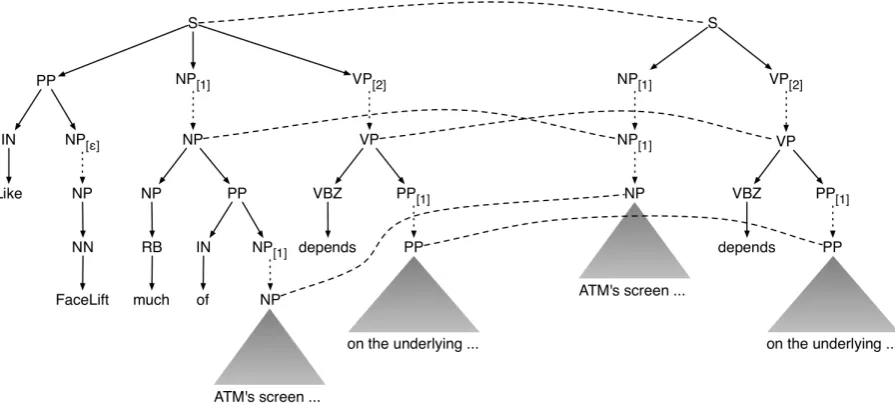
In this work, we explore techniques for inducing synchronous tree-substitution grammars (STSG) using as a testbed application extractive sentence compression. Learning an STSG from aligned trees is tantamount to determining a segmentation of the trees into elementary trees of the grammar along with an alignment of the elementary trees (see Figure 1 for an example of such a segmenta-tion), followed by estimation of the weights for the extracted tree pairs.1 These elementary tree pairs serve as the rulesof the extracted grammar. For SCFG, segmentation is trivial — each parent with its immediate children is an elementary tree — but the formalism then restricts us to deriving isomor-phic tree pairs. STSG is much more expressive, especially if we allow some elementary trees on the source or target side to be unsynchronized, so that insertions and deletions can be modeled, but the segmentation and alignment problems become nontrivial.
Previous approaches to this problem have treated the two steps — grammar extraction and weight estimation — with a variety of methods. One approach is to use word alignments (where these can be reliably estimated, as in our testbed application) to align subtrees and extract rules (Och and Ney, 2004; Galley et al., 2004) but this leaves open the question of finding the right level of generality of the rules — how deep the rules should be and how much lexicalization they should involve — necessitating resorting to heuris-tics such as minimality of rules, and leading to
1Throughout the paper we will use the word STSG to
re-fer to the tree-to-tree version of the formalism, although the string-to-tree version is also commonly used.
large grammars. Once a given set of rules is ex-tracted, weights can be imputed using a discrimi-native approach to maximize the (joint or condi-tional) likelihood or the classification margin in the training data (taking or not taking into account the derivational ambiguity). This option leverages a large amount of manual domain knowledge en-gineering and is not in general amenable to latent variable problems.
A simpler alternative to this two step approach is to use a generative model of synchronous derivation and simultaneously segment and weight the elementary tree pairs to maximize the prob-ability of the training data under that model; the simplest exemplar of this approach uses expecta-tion maximizaexpecta-tion (EM) (Dempster et al., 1977). This approach has two frailties. First, EM search over the space of all possible rules is computation-ally impractical. Second, even if such a search were practical, the method is degenerate, pushing the probability mass towards larger rules in order to better approximate the empirical distribution of the data (Goldwater et al., 2006; DeNero et al., 2006). Indeed, the optimal grammar would be one in which each tree pair in the training data is its own rule. Therefore, proposals for using EM for this task start with a precomputed subset of rules, and with EM used just to assign weights within this grammar. In summary, previous methods suf-fer from problems ofnarrownessof search, having to restrict the space of possible rules, and overfit-tingin preferring overly specific grammars.
We pursue the use of hierarchical probabilistic models incorporating sparse priors to simultane-ously solve both the narrowness and overfitting problems. Such models have been used as gener-ative solutions to several other segmentation prob-lems, ranging from word segmentation (Goldwa-ter et al., 2006), to parsing (Cohn et al., 2009; Post and Gildea, 2009) and machine translation (DeN-ero et al., 2008; Cohn and Blunsom, 2009; Liu and Gildea, 2009). Segmentation is achieved by introducing a prior bias towards grammars that are compact representations of the data, namely by en-forcingsimplicityandsparsity: preferring simple rules (smaller segments) unless the use of a com-plex rule is evidenced by the data (through repeti-tion), and thus mitigating the overfitting problem. A Dirichlet process (DP) prior is typically used to achieve this interplay. Interestingly, sampling-based nonparametric inference further allows the
possibility of searching over the infinite space of grammars (and, in machine translation, possible word alignments), thus side-stepping the narrow-ness problem outlined above as well.
In this work, we use an extension of the afore-mentioned models of generative segmentation for STSG induction, and describe an algorithm for posterior inference under this model that is tai-lored to the task of extractive sentence compres-sion. This task is characterized by the availabil-ity of word alignments, providing a clean testbed for investigating the effects of grammar extraction. We achieve substantial improvements against a number of baselines including EM, support vector machine (SVM) based discriminative training, and variational Bayes (VB). By comparing our method to a range of other methods that are subject dif-ferentially to the two problems, we can show that both play an important role in performance limi-tations, and that our method helps address both as well. Our results are thus not only encouraging for grammar estimation using sparse priors but also il-lustrate the merits of nonparametric inference over the space of grammars as opposed to sparse para-metric inference with a fixed grammar.
In the following, we define the task of extrac-tive sentence compression and the Bayesian STSG model, and algorithms we used for inference and prediction. We then describe the experiments in extractive sentence compression and present our results in contrast with alternative algorithms. We conclude by giving examples of compression pat-terns learned by the Bayesian method.
2 Sentence compression
Sentence compression is the task of summarizing a sentence while retaining most of the informational content and remaining grammatical (Jing, 2000). Inextractivesentence compression, which we fo-cus on in this paper, an order-preserving subset of the words in the sentence are selected to form the summary, that is, we summarize by deleting words (Knight and Marcu, 2002). An example sentence pair, which we use as a running example, is the following:
• Like FaceLift, much of ATM’s screen perfor-mance depends on the underlying applica-tion.
Figure 1: A portion of an STSG derivation of the example sentence and its extractive compression.
where the underlined words were deleted. In su-pervisedsentence compression, the goal is to gen-eralize from a parallel training corpus of sentences (source) and their compressions (target) to unseen sentences in a test set to predict their compres-sions. An unsupervised setup also exists; meth-ods for the unsupervised problem typically rely on language models and linguistic/discourse con-straints (Clarke and Lapata, 2006a; Turner and Charniak, 2005). Because these methods rely on dynamic programming to efficiently consider hy-potheses over the space of all possible compres-sions of a sentence, they may be harder to extend to general paraphrasing.
3 The STSG Model
Synchronous tree-substitution grammar is a for-malism for synchronously generating a pair of non-isomorphic source and target trees (Eisner, 2003). Every grammar rule is a pair of elemen-tary trees aligned at the leaf level at their frontier nodes, which we will denote using the form
cs/ct→es/et, γ
(indicessfor source,tfor target) wherecs, ctare
root nonterminals of the elementary treeses, et
re-spectively and γ is a 1-to-1 correspondence be-tween the frontier nodes inesandet. For example,
the rule
S / S→(S (PP (IN Like) NP[]) NP[1]VP[2]) /
(S NP[1]VP[2])
can be used to delete a subtree rooted at PP. We use square bracketed indices to represent the align-ment γ of frontier nodes — NP[1] aligns with
NP[1], VP[2] aligns with VP[2], NP[] aligns with
the special symboldenoting a deletion from the source tree. Symmetrically-aligned target nodes are used to represent insertions into the target tree. Similarly, the rule
NP /→(NP (NN FaceLift)) /
can be used to continue deriving the deleted sub-tree. See Figure 1 for an example of how an STSG with these rules would operate in synchronously generating our example sentence pair.
STSG is a convenient choice of formalism for a number of reasons. First, it eliminates the iso-morphism and strong independence assumptions of SCFGs. Second, the ability to have rules deeper than one level provides a principled way of model-ing lexicalization, whose importance has been em-phasized (Galley and McKeown, 2007; Yamangil and Nelken, 2008). Third, we may have our STSG operate on trees instead of sentences, which allows for efficient parsing algorithms, as well as provid-ing syntactic analyses for our predictions, which is desirable for automatic evaluation purposes.
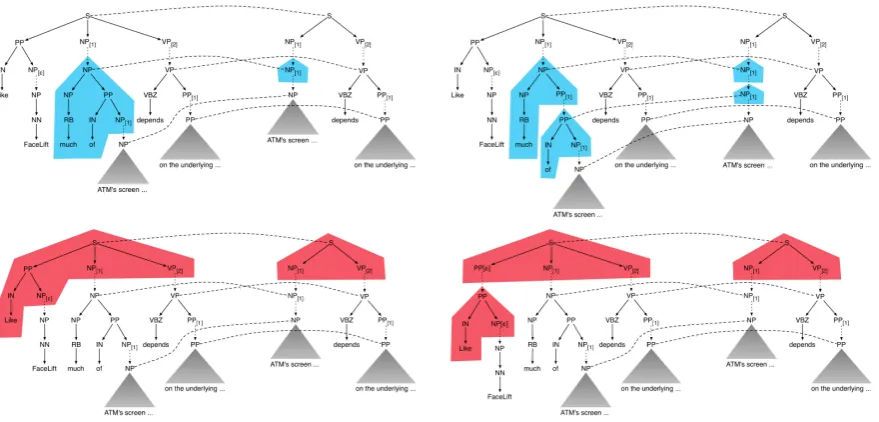
Figure 2: Gibbs sampling updates. We illustrate a sampler move to align/unalign a source node with a target node (top row in blue), and split/merge a deletion rule via aligning with(bottom row in red).
extension of the Viterbi algorithm is available for finding the maximum probability derivation, use-ful for predicting the target analysistN+1,t for a
test instance tN+1,s. (Eisner, 2003) However, as
noted earlier, EM is subject to the narrowness and overfitting problems.
3.1 The Bayesian generative process
Both of these issues can be addressed by taking a nonparametric Bayesian approach, namely, as-suming that the elementary tree pairs are sampled from an independent collection of Dirichlet pro-cess (DP) priors. We describe such a propro-cess for sampling a corpus of tree pairst.
For all pairs of root labels c = cs/ct that we
consider, where up to one ofcsorctcan be(e.g.,
S / S, NP /), we sample a sparse discrete distribu-tionGcover infinitely many elementary tree pairs e=es/etsharing the common rootcfrom a DP
Gc ∼ DP(αc, P0(· |c)) (1)
where the DP has the concentration parameterαc
controlling the sparsity of Gc, and the base
dis-tributionP0(· | c)is a distribution over novel el-ementary tree pairs that we describe more fully shortly.
We then sample a sequence of elementary tree pairs to serve as a derivation for each observed de-rived tree pair. For eachn = 1, . . . , N, we sam-ple elementary tree pairs en = en,1, . . . , en,dn in
a derivation sequence (wheredn is the number of
rules used in the derivation), consultingGc
when-ever an elementary tree pair with root c is to be sampled.
e iid∼ Gc, for allewhose root label isc
Given the derivation sequenceen, a tree pairtnis
determined, that is,
p(tn|en) =
1 en,1, . . . , en,dn derivestn
0 otherwise.
(2) The hyperparameters αc can be incorporated
into the generative model as random variables; however, we opt to fix these at various constants to investigate different levels of sparsity.
For the base distribution P0(· | c) there are a variety of choices; we used the following simple scenario. (We takec=cs/ct.)
Synchronous rules For the case where neithercs
norctare the special symbol, the base
dis-tribution first generates es and et
indepen-dently, and then samples an alignment be-tween the frontier nodes. Given a nontermi-nal, an elementary tree is generated by first making a decision to expand the nontermi-nal (with probability βc) or to leave it as a
frontier node (1−βc). If the decision to
of time from the training corpus. We expand the nonterminal using this rule, and then re-peat the same procedure for every child gen-erated that is a nonterminal until there are no generated nonterminal children left. This is done independently for both es and et.
Fi-nally, we sample an alignment between the frontier nodes uniformly at random out of all possible alingments.
Deletion/insertion rules If ct = , that is, we
have a deletion rule, we need to generate
e=es/. (The insertion rule case is
symmet-ric.) The base distribution generatesesusing
the same process described for synchronous rules above. Then with probability1we align all frontier nodes in es with . In essence,
this process generates TSG rules, rather than STSG rules, which are used to cover deleted (or inserted) subtrees.
This simple base distribution does nothing to enforce an alignment between the internal nodes ofesandet. One may come up with more
sophis-ticated base distributions. However the main point of the base distribution is to encode a control-lable preference towards simpler rules; we there-fore make the simplest possible assumption.
3.2 Posterior inference via Gibbs sampling
Assuming fixed hyperparameters α = {αc} and
β = {βc}, our inference problem is to find the
posterior distribution of the derivation sequences
e = e1, . . . , eN given the observations t = t1, . . . , tN. Applying Bayes’ rule, we have
p(e|t) ∝ p(t|e)p(e) (3)
wherep(t|e)is a0/1distribution (2) which does not depend on Gc, and p(e) can be obtained by
collapsingGcfor allc.
Consider repeatedly generating elementary tree pairse1, . . . , ei, all with the same rootc, iid from Gc. Integrating over Gc, the ei become
depen-dent. The conditional prior of thei-th elementary tree pair given previously generated ones e<i = e1, . . . , ei−1is given by
p(ei |e<i) =
nei+αcP0(ei|c) i−1 +αc
(4)
wherenei denotes the number of timesei occurs
ine<i. Since the collapsed model is exchangeable
in theei, this formula forms the backbone of the
inference procedure that we describe next. It also makes clear DP’s inductive bias to reuse elemen-tary tree pairs.
We use Gibbs sampling (Geman and Geman, 1984), a Markov chain Monte Carlo (MCMC) method, to sample from the posterior (3). A derivationeof the corpustis completely specified by an alignment between the source nodes and the corresponding target nodes (as well ason either side), which we take to be the state of the sampler. We start at a random derivation of the corpus, and at every iteration resample a derivation by amend-ing the current one through local changes made at the node level, in the style of Goldwater et al. (2006).
Our sampling updates are extensions of those used by Cohn and Blunsom (2009) in MT, but are tailored to our task of extractive sentence compres-sion. In our task, no target node can align with
(which would indicate a subtree insertion), and barring unary branches no source nodeican align with two different target nodesjandj0at the same time (indicating a tree expansion). Rather, the configurations of interest are those in which only source nodes i can align with, and two source nodesiandi0can align with the same target node
j. Thus, the alignments of interest are not arbitrary relations, but (partial) functions from nodes ines
to nodes in et or . We therefore sample in the
direction from source to target. In particular, we visit every tree pair and each of its source nodesi, and update its alignment by selecting between and within two choices: (a) unaligned, (b) aligned with some target nodejor. The number of possibil-itiesj in (b) is significantly limited, firstly by the word alignment (for instance, a source node dom-inating a deleted subspan cannot be aligned with a target node), and secondly by the current align-ment of other nearby aligned source nodes. (See Cohn and Blunsom (2009) for details of matching spans under tree constraints.)2
2
pos-More formally, let eM be the elementary tree
pair rooted at the closest aligned ancestor i0 of node i when it is unaligned; and let eA and eB
be the elementary tree pairs rooted at i0 andi re-spectively wheniis aligned with some target node
jor. Then, by exchangeability of the elementary trees sharing the same root label, and using (4), we have
p(unalign) = neM +αcMP0(eM |cM)
ncM +αcM
(5)
p(align withj) = neA+αcAP0(eA|cA)
ncA +αcA
(6)
× neB +αcBP0(eB|cB)
ncB +αcB
(7)
where the counts ne·, nc· are with respect to the
current derivation of the rest of the corpus; except forneB, ncB we also make sure to account for
hav-ing generatedeA. See Figure 2 for an illustration
of the sampling updates.
It is important to note that the sampler described can move from any derivation to any other deriva-tion with positive probability (if only, for example, by virtue of fully merging and then resegment-ing), which guarantees convergence to the poste-rior (3). However some of these transition prob-abilities can be extremely small due to passing through low probability states with large elemen-tary trees; in turn, the sampling procedure is prone to local modes. In order to counteract this and to improve mixing we used simulated annealing. The probability mass function (5-7) was raised to the power1/T withT dropping linearly fromT = 5 to T = 0. Furthermore, using a final tempera-ture of zero, we recover a maximum a posteriori (MAP) estimate which we denoteeMAP.
3.3 Prediction
We discuss the problem of predicting a target tree
tN+1,t that corresponds to a source tree tN+1,s
unseen in the observed corpus t. The maximum probability tree (MPT) can be found by consid-ering all possible ways to derive it. However a much simpler alternative is to choose the target tree implied by the maximum probability
deriva-sible to prove that our approach is equivalent up to a rescaling of the concentration parameters. Since we fit these parame-ters to the data, our approach is equivalent.
tion (MPD), which we define as
e∗ = argmax
e
p(e|ts,t)
= argmax
e
X
e
p(e|ts,e)p(e|t)
whereedenotes a derivation for t = ts/tt. (We
suppress the N + 1 subscripts for brevity.) We approximate this objective first by substituting
δeMAP(e) forp(e | t) and secondly using a finite
STSG model for the infinitep(e|ts,eMAP), which
we obtain simply by normalizing the rule counts in
eMAP. We use dynamic programming for parsing
under this finite model (Eisner, 2003).3
Unfortunately, this approach does not ensure that the test instances are parsable, since ts may
include unseen structure or novel words. A work-around is to include all zero-count context free copy rules such as
NP / NP→(NP NP[1]PP[2]) / (NP NP[1]PP[2])
NP /→(NP NP[]PP[]) /
in order to smooth our finite model. We used Laplace smoothing (adding 1 to all counts) as it gave us interpretable results.
4 Evaluation
We compared the Gibbs sampling compressor (GS) against a version of maximum a posteriori EM (with Dirichlet parameter greater than 1) and a discriminative STSG based on SVM training (Cohn and Lapata, 2008) (SVM). EM is a natural benchmark, while SVM is also appropriate since it can be taken as the state of the art for our task.4
We used a publicly available extractive sen-tence compression corpus: the Broadcast News compressions corpus (BNC) of Clarke and Lap-ata (2006a). This corpus consists of1370sentence pairs that were manually created from transcribed Broadcast News stories. We split the pairs into training, development, and testing sets of 1000,
3
We experimented with MPT using Monte Carlo integra-tion over possible derivaintegra-tions; the results were not signifi-cantly different from those using MPD.
4
SVM EM GS
Precision 55.60 58.80 58.94
Recall 53.37 56.58 64.59
Relational F1 54.46 57.67 61.64 Compression rate 59.72 64.11 65.52
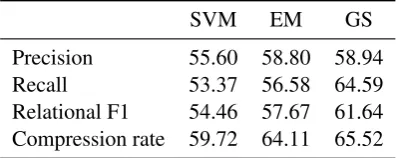
Table 1: Precision, recall, relational F1 and com-pression rate (%) for various systems on the 200-sentence BNC test set. The compression rate for the gold standard was 65.67%.
SVM EM GS Gold
Grammar 2.75† 2.85∗ 3.69 4.25
Importance 2.85 2.67∗ 3.41 3.82
[image:7.595.82.282.63.142.2]Comp. rate 68.18 64.07 67.97 62.34
Table 2: Average grammar and importance scores for various systems on the 20-sentence subsam-ple. Scores marked with ∗ are significantly dif-ferent than the corresponding GS score atα < .05 and with†atα < .01according to post-hoc Tukey tests. ANOVA was significant atp < .01both for grammar and importance.
170, and 200 pairs, respectively. The corpus was parsed using the Stanford parser (Klein and Man-ning, 2003).
In our experiments with the publicly available SVM system we used all except paraphrasal rules extracted from bilingual corpora (Cohn and Lap-ata, 2008). The model chosen for testing had pa-rameter for trade-off between training error and margin set toC = 0.001, used margin rescaling, and Hamming distance over bags of tokens with brevity penalty for loss function. EM used a sub-set of the rules extracted by SVM, namely all rules except non-head deleting compression rules, and was initialized uniformly. Each EM instance was characterized by two parameters: α, the smooth-ing parameter for MAP-EM, and δ, the smooth-ing parameter for augmentsmooth-ing the learned gram-mar with rules extracted from unseen data (add-(δ−1)smoothing was used), both of which were fit to the development set using grid-search over (1,2]. The model chosen for testing was(α, δ) = (1.0001,1.01).
GS was initialized at a random derivation. We sampled the alignments of the source nodes in ran-dom order. The sampler was run for5000
itera-tions with annealing. All hyperparametersαc, βc
were held constant atα, βfor simplicity and were fit using grid-search over α ∈ [10−6,106], β ∈ [10−3,0.5]. The model chosen for testing was (α, β) = (100,0.1).
As an automated metric of quality, we compute F-score based on grammatical relations (relational F1, or RelF1) (Riezler et al., 2003), by which the consistency between the set of predicted grammat-ical relations and those from the gold standard is measured, which has been shown by Clarke and Lapata (2006b) to correlate reliably with human judgments. We also conducted a small human sub-jective evaluation of the grammaticality and infor-mativeness of the compressions generated by the various methods.
4.1 Automated evaluation
For all three systems we obtained predictions for the test set and used the Stanford parser to extract grammatical relations from predicted trees and the gold standard. We computed precision, recall, RelF1 (all based on grammatical relations), and compression rate (percentage of the words that are
retained), which we report in Table 1. The results for GS are averages over five independent runs. EM gives a strong baseline since it already uses rules that are limited in depth and number of fron-tier nodes by stipulation, helping with the overfit-ting we have mentioned, surprisingly outperform-ing its discriminative counterpart in both precision and recall (and consequently RelF1). GS however maintains the same level of precision as EM while improving recall, bringing an overall improvement in RelF1.
4.2 Human evaluation
Figure 3: RelF1, precision, recall plotted against compression rate for GS, EM, VB.
human evaluation indicates that the superiority of the Bayesian nonparametric method is underap-preciated by the automated evaluation metric.
4.3 Discussion
The fact that GS performs better than EM can be attributed to two reasons: (1) GS uses a sparse prior and selects a compact representation of the data (grammar sizes ranged from 4K-7K for GS compared to a grammar of about 35K rules for EM). (2) GS does not commit to a precomputed grammar and searches over the space of all
gram-mars to find one that bests represents the corpus. It is possible to introduce DP-like sparsity in EM using variational Bayes (VB) training. We exper-iment with this next in order to understand how dominant the two factors are. The VB algorithm requires a simple update to the M-step formulas for EM where the expected rule counts are normal-ized, such that instead of updating the rule weight in thet-th iteration as in the following
θtc,e+1= nc,e+α−1
nc,.+Kα−K
where nc,e represents the expected count of rule c → e, and K is the total number of ways to rewrite c, we now take into account our DP(αc, P0(· | c)) prior in (1), which, when
truncated to a finite grammar, reduces to a
K-dimensional Dirichlet prior with parameter
αcP0(· |c). Thus in VB we perform avariational
E-step with the subprobabilities given by
θc,et+1 = exp (Ψ(nc,e+αcP0(e|c))) exp (Ψ(nc,.+αc))
whereΨdenotes the digamma function. (Liu and Gildea, 2009) (See MacKay (1997) for details.) Hyperparameters were handled the same way as for GS.
Instead of selecting a single model on the devel-opment set, here we provide the whole spectrum of models and their performances in order to better understand their comparative behavior. In Figure 3 we plot RelF1 on the test set versus compres-sion rate and compare GS, EM, and VB (β = 0.1 fixed,(α, δ)ranging in[10−6,106]×(1,2]). Over-all, we see that GS maintains roughly the same level of precision as EM (despite its larger com-pression rates) while achieving an improvement in recall, consequently performing at a higher RelF1 level. We note that VB somewhat bridges the gap between GS and EM, without quite reaching GS performance. We conclude that the mitigation of the two factors (narrowness and overfitting) both contribute to the performance gain of GS.5
4.4 Example rules learned
In order to provide some insight into the grammar extracted by GS, we list in Tables (3) and (4) high
5We have also experimented with VB with parametric
(ROOT (S CC[]NP[1]VP[2].[3])) / (ROOT (S NP[1]VP[2].[3]))
(ROOT (S NP[1]ADVP[]VP[2](. .))) / (ROOT (S NP[1]VP[2](. .)))
(ROOT (S ADVP[](, ,) NP[1]VP[2](. .))) / (ROOT (S NP[1]VP[2](. .)))
(ROOT (S PP[](, ,) NP[1]VP[2](. .))) / (ROOT (S NP[1]VP[2](. .)))
(ROOT (S PP[],[]NP[1]VP[2].[3])) / (ROOT (S NP[1]VP[2].[3]))
(ROOT (S NP[](VP VBP[](SBAR (S NP[1]VP[2]))) .[3])) / (ROOT (S NP[1]VP[2].[3]))
(ROOT (S ADVP[]NP[1](VP MD[2]VP[3]) .[4])) / (ROOT (S NP[1](VP MD[2]VP[3]) .[4]))
(ROOT (S (SBAR (IN as) S[]) ,[]NP[1]VP[2].[3])) / (ROOT (S NP[1]VP[2].[3]))
(ROOT (S S[](, ,) CC[](S NP[1]VP[2]) .[3])) / (ROOT (S NP[1]VP[2].[3]))
(ROOT (S PP[]NP[1]VP[2].[3])) / (ROOT (S NP[1]VP[2].[3]))
(ROOT (S S[1](, ,) CC[]S[2](. .))) / (ROOT (S NP[1]VP[2](. .)))
(ROOT (S S[],[]NP[1]ADVP[2]VP[3].[4])) / (ROOT (S NP[1]ADVP[2]VP[3].[4]))
(ROOT (S (NP (NP NNP[](POS ’s)) NNP[1]NNP[2]) / (ROOT (S (NP NNP[1]NNP[2])
[image:9.595.148.483.62.203.2](VP (VBZ reports)) .[3])) (VP (VBZ reports)) .[3]))
Table 3: High probability ROOT / ROOT compression rules from the final state of the sampler.
(S NP[1]ADVP[]VP[2]) / (S NP[1]VP[2])
(S INTJ[](, ,) NP[1]VP[2](. .)) / (S NP[1]VP[2](. .))
(S (INTJ (UH Well)) ,[]NP[1]VP[2].[3]) / (S NP[1]VP[2].[3])
(S PP[](, ,) NP[1]VP[2]) / (S NP[1]VP[2])
(S ADVP[](, ,) S[1](, ,) (CC but) S[2].[3]) / (S S[1](, ,) (CC but) S[2].[3])
(S ADVP[]NP[1]VP[2]) / (S NP[1]VP[2])
(S NP[](VP VBP[](SBAR (IN that) (S NP[1]VP[2]))) (. .)) / (S NP[1]VP[2](. .))
(S NP[](VP VBZ[]ADJP[]SBAR[1])) / S[1]
(S CC[]PP[](, ,) NP[1]VP[2](. .)) / (S NP[1]VP[2](. .))
(S NP[](, ,) NP[1]VP[2].[3]) / (S NP[1]VP[2].[3])
(S NP[1](, ,) ADVP[](, ,) VP[2]) / (S NP[1]VP[2])
(S CC[](NP PRP[1]) VP[2]) / (S (NP PRP[1]) VP[2])
(S ADVP[],[]PP[],[]NP[1]VP[2].[3]) / (S NP[1]VP[2].[3])
[image:9.595.77.285.475.562.2](S ADVP[](, ,) NP[1]VP[2]) / (S NP[1]VP[2])
Table 4: High probability S / S compression rules from the final state of the sampler.
probability subtree-deletion rules expanding cate-gories ROOT / ROOT and S / S, respectively. Of especial interest are deep lexicalized rules such as
a pattern of compression used many times in the BNC in sentence pairs such as “NPR’s Anne Gar-rels reports” / “Anne GarGar-rels reports”. Such an informative rule with nontrivial collocation (be-tween the possessive marker and the word “re-ports”) would be hard to extract heuristically and can only be extracted by reasoning across the training examples.
5 Conclusion
We explored nonparametric Bayesian learning of non-isomorphic tree mappings using Dirich-let process priors. We used the task of extrac-tive sentence compression as a testbed to
investi-gate the effects of sparse priors and nonparamet-ric inference over the space of grammars. We showed that, despite its degeneracy, expectation maximization is a strong baseline when given a reasonable grammar. However, Gibbs-sampling– based nonparametric inference achieves improve-ments against this baseline. Our investigation with variational Bayes showed that the improvement is due both to finding sparse grammars (mitigating overfitting) and to searching over the space of all grammars (mitigating narrowness). Overall, we take these results as being encouraging for STSG induction via Bayesian nonparametrics for mono-lingual translation tasks. The future for this work would involve natural extensions such as mixing over the space of word alignments; this would al-low application to MT-like tasks where flexible word reordering is allowed, such as abstractive sentence compression and paraphrasing.
References
Interna-tional Conference on ComputaInterna-tional Linguistics and 44th Annual Meeting of the Association for Compu-tational Linguistics, pages 144–151, Sydney, Aus-tralia, July. Association for Computational Linguis-tics.
James Clarke and Mirella Lapata. 2006b. Models for sentence compression: A comparison across do-mains, training requirements and evaluation mea-sures. InProceedings of the 21st International Con-ference on Computational Linguistics and 44th An-nual Meeting of the Association for Computational Linguistics, pages 377–384, Sydney, Australia, July. Association for Computational Linguistics.
Trevor Cohn and Phil Blunsom. 2009. A Bayesian model of syntax-directed tree to string grammar in-duction. InEMNLP ’09: Proceedings of the 2009 Conference on Empirical Methods in Natural Lan-guage Processing, pages 352–361, Morristown, NJ, USA. Association for Computational Linguistics.
Trevor Cohn and Mirella Lapata. 2007. Large mar-gin synchronous generation and its application to sentence compression. In Proceedings of the Con-ference on Empirical Methods in Natural Language Processing and on Computational Natural Lan-guage Learning, pages 73–82, Prague. Association for Computational Linguistics.
Trevor Cohn and Mirella Lapata. 2008. Sentence compression beyond word deletion. In COLING ’08: Proceedings of the 22nd International Confer-ence on Computational Linguistics, pages 137–144, Manchester, United Kingdom. Association for Com-putational Linguistics.
Trevor Cohn, Sharon Goldwater, and Phil Blun-som. 2009. Inducing compact but accurate tree-substitution grammars. In NAACL ’09: Proceed-ings of Human Language Technologies: The 2009 Annual Conference of the North American Chap-ter of the Association for Computational Linguistics, pages 548–556, Morristown, NJ, USA. Association for Computational Linguistics.
A. Dempster, N. Laird, and D. Rubin. 1977. Max-imum likelihood from incomplete data via the EM algorithm. Journal of the Royal Statistical Society, 39 (Series B):1–38.
John DeNero, Dan Gillick, James Zhang, and Dan Klein. 2006. Why generative phrase models under-perform surface heuristics. InStatMT ’06: Proceed-ings of the Workshop on Statistical Machine Trans-lation, pages 31–38, Morristown, NJ, USA. Associ-ation for ComputAssoci-ational Linguistics.
John DeNero, Alexandre Bouchard-Cˆot´e, and Dan Klein. 2008. Sampling alignment structure under a Bayesian translation model. InEMNLP ’08: Pro-ceedings of the Conference on Empirical Methods in Natural Language Processing, pages 314–323, Mor-ristown, NJ, USA. Association for Computational Linguistics.
Jason Eisner. 2003. Learning non-isomorphic tree mappings for machine translation. InACL ’03: Pro-ceedings of the 41st Annual Meeting on Associa-tion for ComputaAssocia-tional Linguistics, pages 205–208, Morristown, NJ, USA. Association for Computa-tional Linguistics.
Michel Galley and Kathleen McKeown. 2007. Lex-icalized Markov grammars for sentence compres-sion. In Human Language Technologies 2007: The Conference of the North American Chapter of the Association for Computational Linguistics; Pro-ceedings of the Main Conference, pages 180–187, Rochester, New York, April. Association for Com-putational Linguistics.
Michel Galley, Mark Hopkins, Kevin Knight, and Daniel Marcu. 2004. What’s in a translation rule? In Daniel Marcu Susan Dumais and Salim Roukos, editors,HLT-NAACL 2004: Main Proceed-ings, pages 273–280, Boston, Massachusetts, USA, May 2 - May 7. Association for Computational Lin-guistics.
S. Geman and D. Geman. 1984. Stochastic Relaxation, Gibbs Distributions and the Bayesian Restoration of Images. pages 6:721–741.
Sharon Goldwater, Thomas L. Griffiths, and Mark Johnson. 2006. Contextual dependencies in un-supervised word segmentation. In Proceedings of the 21st International Conference on Computational Linguistics and 44th Annual Meeting of the Associa-tion for ComputaAssocia-tional Linguistics, pages 673–680, Sydney, Australia, July. Association for Computa-tional Linguistics.
Hongyan Jing. 2000. Sentence reduction for auto-matic text summarization. In Proceedings of the sixth conference on Applied natural language pro-cessing, pages 310–315, Morristown, NJ, USA. As-sociation for Computational Linguistics.
Dan Klein and Christopher D. Manning. 2003. Fast exact inference with a factored model for natural language parsing. InAdvances in Neural Informa-tion Processing Systems 15 (NIPS, pages 3–10. MIT Press.
Kevin Knight and Daniel Marcu. 2002. Summa-rization beyond sentence extraction: a probabilis-tic approach to sentence compression. Artif. Intell., 139(1):91–107.
K. Lari and S. J. Young. 1990. The estimation of stochastic context-free grammars using the Inside-Outside algorithm. Computer Speech and Lan-guage, 4:35–56.
David J.C. MacKay. 1997. Ensemble learning for hid-den markov models. Technical report, Cavendish Laboratory, Cambridge, UK.
Franz Josef Och and Hermann Ney. 2004. The align-ment template approach to statistical machine trans-lation. Comput. Linguist., 30(4):417–449.
Matt Post and Daniel Gildea. 2009. Bayesian learning of a tree substitution grammar. InProceedings of the ACL-IJCNLP 2009 Conference Short Papers, pages 45–48, Suntec, Singapore, August. Association for Computational Linguistics.
Stefan Riezler, Tracy H. King, Richard Crouch, and Annie Zaenen. 2003. Statistical sentence condensa-tion using ambiguity packing and stochastic disam-biguation methods for lexical-functional grammar. InNAACL ’03: Proceedings of the 2003 Conference of the North American Chapter of the Association for Computational Linguistics on Human Language Technology, pages 118–125, Morristown, NJ, USA. Association for Computational Linguistics.
Jenine Turner and Eugene Charniak. 2005. Super-vised and unsuperSuper-vised learning for sentence com-pression. InACL ’05: Proceedings of the 43rd An-nual Meeting on Association for Computational Lin-guistics, pages 290–297, Morristown, NJ, USA. As-sociation for Computational Linguistics.