A Finite-Slate Parser for Use in Speech Recognition
Kenneth W. Church NE43-307
Massachusetts Institute of Technology Cambridge, MA. 02139
This paper is divided into two parts. 1 The first section motivates the application of finite-state parsing techniques at the phonetic level in order to exploit certain classes or" contextual constraints. -In the second section, the parsing framework is extended in order to account ['or 'feature spreading' (i:.g., agreement and co-articulation) in a natural way.
I. Parsing at the Phonetic Level
It is well known that phonemcs have different acoustic/phonetic realizations depending on the context. Fur example, the p h o n e m e / t / is typically realized with a different allophone (phonetic variant) in syllable initial position than in syllable final position. In syllable initial position (e.g.,
Tom),/t/is
almost always released (with a strong burst of energy) and aspirated (with h-like noise), whereas in syllable final position (e.g.,cat.), /t/
is often unreleased and unaspirated_ It is common practice in speech research to distinguish acoustic/phonetic properties that vary a great deal with context (e.g., release and aspiration) from those that are relatively invariant to context (e.g., place, manner and voicing). 2 In the past, the emphasis has been on invariants; allophonic variation is traditionally seen as problematic for recognition.(I)
"In most systems for sentence recognition, such modifications must be viewed as a kind of 'noise' that makes it more difficult to hypothesize lexical candidates given an input phonetic transcription. To see that this must be the case, we note that each phonological rule [in an example to be presented below]l, This research was ~ p p o r t e d (in part) by the National Institutes of I lealth G r a n t No. 1
POt I M 03374-01 and 03374-02 from the National Library of Medicine,
2. Place refers IO the location of the constriction in the vocal tracL Examples include: labial t'at the hpsl/p, b. f, ',. m/, velar/k, g. r~/, dental (at the teeth)/s, z, t. d, I, n / a n d palatal A, ;~, i:,'}/ Manner dislmgu~shes among vowels, liquids and slides (e.g., /1, r, y. w/t. fricatives le.s.,/s, z, f. v/t, nasals (e.g.,/n. m. r i o and stops l e g , / p , t, k, b, d, g/).
Voietng (periodie ~,ibration of the vocal fold.s) distingmshes sounds like /b, d. S/ from sounds like/p, L, k./.
results in irreversible ambiguity - the phonological rule does not have a unique inverse that cuuld be used to recover the underlying phonemic representation for a ie,xical item. l:or example .... schwa vowels could be the first vowel in a word like 'about' or the surface realization of almost any English vowel appearing in a sufficiently destressed word. The tongue tlap [El could have come from a / t / or a / d / . " Klatt (MIT) [21, pp. 548-5491
This view of allophonic variation is representative of much of the speech recognition literature, especially during the ARPA speech project. One can find similar statements by Cole and Jakim~k ICMU) [5] and by Jelinek (IBM)[17].
I prefer to think of variation as
usefid.
It is well known that atlo- phonic contrasts can be distinctive, as illustrated by the following famous minimal pairs where the crucial distinctions seem to lie in the allophonic realization of t h e / t / :(2at a tease / at ease
aspirated / flapped
(2b) night rate / ni-trate
unreteased/retroflexed
(2c) great wine / gray twineunreteased/rounded
This evidence suggests that allophonic variation provides a tich source of constraints on syllable structure and word stress. The recognizer to be discussed here (and partly tmplcmented in Church [4]) is designed to exploit allophonic and phonotactic cues by parsing the input utterance into syllables and other suprasegmental constituents using phrase- structure parsing techniques.
1.1 An Example of Lexical Retrieval
It might be helpful to work out an example it] order to illustrate
(3) [dD~hlf_lt) tam]
It is desired to decode (3) into the string ofwords:
(4) Did you hit it to Tom?
In practice, the lexical retrieval problem is complicated by errors in the
front cad. However, even with an ideal error-free front-end, it is
difficult to decode (3) because, among other things, there are extensive
nile-governed changes affecting the way that words are pronounced in
different sentence contexts, as Klatt's example illustrates:
(5a) Pabtalization o f / d / b e f o r e / y / i n didyou
(5b) Reduction o f u n s t r e s s e d / u / t o schwa in),~u
(5c) Flapping o f intervocalic / t / in hit. it
(5d) Reduction o f schwa and devoicing o f / u / i n to
(5e) Reduc:ion o f g e m i n a t e / t / i n it. to
These allophonic processes often appear to neutralize phonemic
distinctions. For example, the voicing contrast b e t w e e n / t / a n d / d / .
which is usually distinctive, is almost completely lost in wr~er/rid_er,
where bod~ / t / and / d / are realized in American English with a tongue
~ap (q.
1.2 .\n Ogtimistic "v'icw of Neutralization
Fortunately, there are many fewer cases of true neutralization
than it might seem. Even in writ.er/ri~.er, the voicing contrast is not
completely lost. The vowel in rider tends to be longer than the vowel in
w~ter due to a general process that lengthens vowels before voiced
consonants (e.g., / d / ) and shortens them before unvoiced consonants
(e.g.,/t/).
A similar lengthening argument can be used to separate I n / a n d
/ n d l (at least in some cases). It tmght be suggested that I n / i s merged
w i t h / n d / b y a / d / d e l e t i o n rule that applies in words like mena~ wind
(noun). wind (',erbL and find. (Admittedly there is little if any direct
acoustic evidence fi)r a / d / s e g m e n t in this environment.) However, [
suspect that these words can o)~en be distinguished from men, win.
)vttte. and
fine
mostly on the basis of the duration of the nasal murmur which is lengthened in the precedence of a voiced obstruent l i k e / d / .Thus, this /d/-detction process is probably not a true case of
neutralization,
Recent studies in acoustic/phonetics seem to indicate that more
and more cases of apparent neutralization can be separated as the field
progresses. For instance, it has been said t h a t / s / m e r g e s with f ~ / i n a
context like ga~ shortage [12]. lh)we~cr, a recent experiment 1271
suggests that t h e / s ~ / s e q u e n c e can be distinguished from /~,~/ las in
fisth shortage) on the basis o f a spectral tilt: the /s,~/'spectrum is more
/s/-like in the beginning and more/~,/-like at the cad, whereas the f ~
spectrum is relatively constant throughout. A similar spectral tilt
argument can be used to separate other cases of apparent gemination
( e . g . . / z ~ ' / i n ~ the).
As a final example of apparent ncutra!ization, consider the
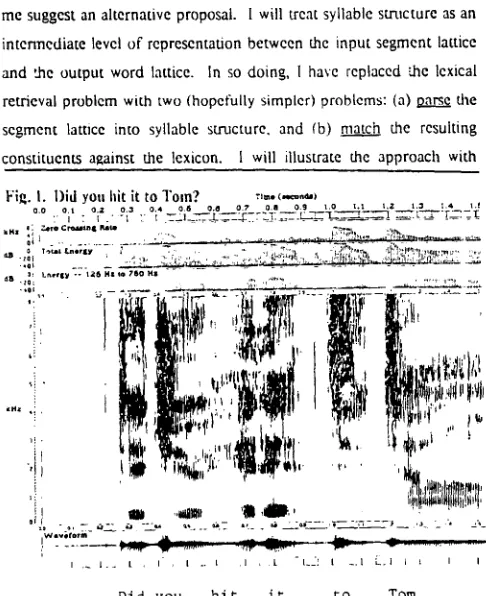
portion of the spectrogram in Figure !, between 0.85 and 1.1 seconds.
This corresponds to the two adjacent / t / s in Did you hit it to Tom?
Klatt analyzed this region with a single g e m i n a t e d / t / . However, upon
further investigation of the spectrum, I believe that there are acoustic
cues for two segments. Note especially the total energy, which displays
two peaks at 0.95 and 1.02 seconds. On the basis o f this evidence, I will
replace Klatt's transcription (6a) with (6b):
(6a) [dl]ahlf.lu taml
(6b) [dl]i}hll'I t tlmml
U
1.3 Parsing and Matching
Even though 1 might be able to re-interpret many cases of
apparent neutralization, it remains extremely difficult to "undo" the
allophonic rules by inverse transformational parsing techniques. Let
me suggest an alternative proposal, l will treat syllable structure as an
intermediate level of representation between the input segment lattice
and ',he output word lattice. In so doing, I have replaced .:.he lexical
retrieval problem with two (hopefully simpler) problems: (a) parse the
segment lattice into syllable structure, and (b) match the resulting
constituents a~ainst the lexicon. I will illustrate the approach with
Fig. I. Did you hit it to Tom? ,-,~.(..~.)
o , 0 P i t o i Z . oi.~ 0 . 4 0 6 o . e 0 . 7 O.a 0 . 9 l . o 1 . I t , Z 1.3 : . 4 l . e
a s ,:~o'; Laer¢~ - - t ~ , 6 H I m 7 6 O H 8 . . .
-,o~ . . . - - ~ - ~ - , ; - - - ~ - ' ~ - ;';' i'L " . . . . ;" ~ ' ~ ' ~ : " ~
,,ill , Igll,,
,
.I
r d l
i W a v e t o m ~ ~ ~IL . ~ ~ , . .
I . _ J . ~ L , I ' , I . . t I , L - t _ ~ ! I - . 1 L . ] I l I I
[image:2.612.326.569.392.690.2]Klatt's example (enlu, nced with allophonic diacritics to show aspiration
and glottalization):
(7)
[drjighlff tht thaml
T T r
Using phonotactic and allophonic constraints on syllable structure such
as: 3
(8a) / h / i s always syllable initial, phonotactic
(8b) [1" I is always syllable final, allophonic
(8c) [?] is always syllable final, and allophonie
(Sd) [t h] is always syllable initial, allophonic
the parser can insert the following syllable boundaries:
(9) [di~} # hlf. # I ? # tht # tham]
It is now it is relatively easy to decode the utterance with lcxical
matching routines similar to those in Smith's Noah program at CMU
{241.
parsed transcription, decodinl
dl]~ -...¢ did you
hlf= --..* hit
l ? -=+ it
th) ---., to
tham ---, Tom
In summary, I believe that the lexical retrieval device will be in a
superior position to hypothesize word candidates if it exploits allo-
phonic and phonotactic constraints on syllable structure.
1.4 Exploiting Redund:mey
In many cases, atlophonic and phonotacdc constraints are
redundant, Even if the parser should miss a few of the cues for syll~ibie
structure, it will often be able to find the correct structure by taking
advantage of some other redundam cue. [:or example, suppose that the
front end failed to notice die glottalized/t./in the word it.
(10) dl]i9 # h l f _ # I # t h a # t h a m
T
The parser could deduce that the input transcription (10) is internally
inconsistent, because of a phonotactic constraint on the lax v o w e l / I / .
[image:3.612.304.490.479.640.2]3. This formulation of the eonst/'aints is oversimplified for exlx3,sltory convenience; s e e
[10. lJ. 15] and references thereto for discussion of the more subtle issues.
Lax vowels are restricted to closed syllables (sylkdgles ending in a
consonant) [I]. However, in this case, /1/ cannot mcct the closed
syllable restriction because the following consonant is aspirated (arid
therefi)re syllable initial). Thus the transcription is internally
inconsistent. The parser shotlld probably rejcct tbc transcriot;¢,n ~md
hope that the front end can fix dxe problem. Alternatively, the parser
might attempt to correct the error by hypothesizing a s e c o n d / t / . 4
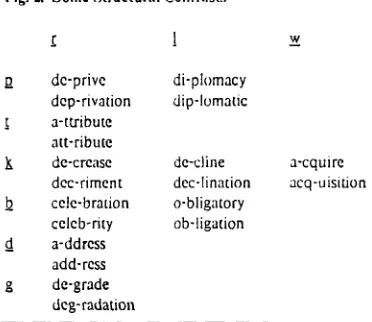
There are many other examples like (10) where phonotactic
constraints and allophonic constraints overlap. Consider the pairs
found in figure 2, where there are multiple arguments for assigning the
crucial syllable boundary. In de-prive vs. dep-rivalion, for instance, the
difference is revealed by the vowel argument above 5 and by the
aspiration rule. 6 In addition, the stress contrast will probably be cor-
related with a number of so-called 'suprasegmental' cues, e.g., duration,
fundamental frequency, and intensity [81.
In general, there seem to be a large number of multiple low level cues for syllable strt,cture. This observation, if correct, could be viewed
as a form of a 'constituency hypothesis'. Just as syntacticians have
argued for the constituent-hood of noun phrases, verb phrases and
sentences on the grounds that these constituents seem to capture crucial
linguistic generalizations (e.g., question formation, wh-movement), so
too, I might argue (along with certain phonologists such as Kahn [13])
that syllables, onsets, and rhymes are constituents because they also
capture important generalizations such as aspiration, tensing and laxing.
If this constituency hypothesis for phonology is correct (and I believe
Fig. 2. Some Structural Contrnsts
r
!
_w
t2 de-prive dep-rivation t a-ttribute
att-ribute li de-crease dec-riment b cele-bration
celcb-rity d a-ddress
add-tess g de-grade
deg-radation
di-plomacy dip-lumatic
de-cline a-cquire dec-lination acq-uisition o-bligatory
ob-ligation
4. Personally. 1 favor the first alternative: after years of ,.,.smessmg Victor Zue read spectrograms. I have become most tmpressed with the richness of low level phonetic cues.
5. The syllable de. is open because the vowel is tense (diphthongizcd): dep" is dosed because the vowel is lax
that it is) then it seems F~atural to propose a syllabic parser fi)r proccssit~g speech, by analogy with sentence parsers that have bccome standard practicc in d~e natural laoguagc community for processing .~ext.
2. P a r s e r I m p l e m e n t a t i o n a n d F e a t u r e S p r e a d i n g
A program has bcen implcmcntcd [41 which parses a lattice of phonetic segmcnts into a lattice of syllables and other phonological constituents. Except for its novcl mechanism for handling features, it is very much like a standard chart parser (e.g.. Earley's Algorithm lTD. P, ccall that a chart parser takes as input a sentence and a context-free grammar and produces as output a chart like that below, indicating the starting point and ending point of each phrase in the input string.
lnput~ Sentenc(l: 0 They t are 2 flying 3 planes 4
Gram.mar:
N "---* they V ---* are N - - * tl¥ing A -"* flying V ---* flying N --~ planes S --* NP VP VP -..* V NP VP ---.~ V VP N P ~ N N P ~ A P N P N P " - * VP AP - ' * A
('n,,.rt: o
o ( }
i!1} 2!{}
I 2 3 #
{Xt',N,they} {S} {S} {S}
{ } {VP.V.are) {VP} (VP}
{ } [ } {NP.VP,AP,N.V,A,flying| {NP.VP}
( } { } ( } {NP, N.planesl
{} {} {} {}
bLach entry in the chart represents the possible analyses of the input words between a start position (the row index) and a finish position (the column index). [-'or example, the entry {NP, VP} in Chart(2,4) represents two alternative analyses of the words between 2 and 4:
[xp fi3ulg pia,esl
add[vp flying planesl.
.the same parsing methods can be used to find syllable structure from an input transcription.
lod)u[ Sentence: O ~" £ t 2 S 3 l 4 Z 5 (this ~)
Grammar:
o n s e t ~ ~ ' [ S I Z peak---) i t [
coda --.--) ~' [ S I Z syl ----) (onset) peak (coda)
Chart: 0 J , H
o { } t { } z { } s t } 4 { } s ( I
I 2 3 4 .~ ,
{[.onset.coda} {syl} {syl} { } { }
{ } {!,pcak.syl} {syl) { } { }
{ } { } {S.onset.codal (syl} {syl}
{ } { } { } {l,peak.syl} {syl}
{ } { } { } { } {Z, onset.coda)
{} (} ( I {} (}
This chart shows that the input sentence can be decomposed into two syllables, one from 0 to 3
(this)
and another one from 4 to 5(is).
Alternatively, the input sentence can be decomposed into [~'t][slzl. In this way. standard chart parsing techniques can be adopted to process allophonic and phonotactic constraints, if the constraints are reformulated in terms o f a grammar.
How can allophonic and phonotactic constraints be cast in terms of context-free rules? In many cases, the constraints can be carried over in a straightforward way. For example, the following set of roles express the aspiration constraint discussed above. These rules allow aspiration in syllable initial position (under the onset node), but not in syllable final position (under the coda).
( l l a ) uttcrancc ---) syllable* ( l i b ) syllable ~ (onset) peak (coda)
(II.c) onset --* aspirated-t [ aspirated-k I aspirated-p I.,. ( l l d ) coda---, unrelcascd-t I unrclcased-k I unrcleased-p I-.-
The aspiration constraint (as stated above) is relatively easy to cast in terms of context-free rules. Other allophonic and pho~aotactic processes may be more difficult. 7
2..1 The Agreement Problem
In particular, context-free roles are generally considered to be awkward for expressing agreement facts. For example, in order to express subject-verb agreement in "'pure" context-free rules, it is probably necessary to expand the rule S ~ NP VP into two cases:
(12a) S ---* singular-NP singular-VP
singular case
(12b) S --) plural-NP plural-YP
plural case
7. For example, there may be a problem with constraintS that depend on rule ordering,
T h e agreement problem also arises in phonology. Consider the
example of homorganic nasal clusters (e.g., cam2II2, can't, sank), where
the nasal agrees with the following obstruent in place of articulation.
T h a t is, the labial nasal / m / is found before the labial stop / p / , the
cor9nal n a s a l / n / before the coronal s t o p / t / , and the velar n a s a l / 7 / /
before the velar s t o p / k / . This constraint, like subject-verb agreement.
poses a problem for pure unaugmented context-free rules; it seems to
be necessary to expand out each of the three cases:
(13a) homorganic-nasal-cluster ~ labial-nasal labial-obstruent
(13b) homorganie-nasal-cluster ~ coronal-nasal coronal-obstruent
(13c) homorganic-nasal-cluster---* velar-nasal velar-obstruent
In an effort to alleviate this expansion problem, many researchers have
proposed augmentations of various sorts (e.g., ATN registers [26], LFG
constraint equations [16], GPSG recta-rules till, local constraints [18],
bit vectors [6, 22]). My own solution will be suggested after I have had
a chance to describe the parser in further detail.
2..2 A Parser Based on Matrix Operations
This scction will show how the grammar can be implemented in
terms o f operations on binary matrices. Suppose that the chart is
decomposed into a s u m of binary matrices:
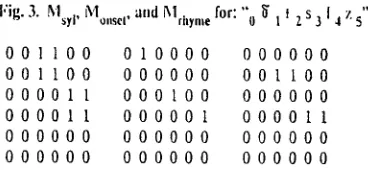
(14) Chart = syl Msy I + onset Monse t + peak Mpeak + .,.
where Msy I is a binary matrix 8 describing the location of syllables and
Monse t is a binary matrix describing the location of onsets, and so forth.
Each of these binary matrices has a I in position (i,j) if there is a
constituent of the appropriate part of speech spanning from the i m
position in the input sentence to the jth position.9 (See figure 3).
Ph'rase-structure rules will be implemented with simple oper-
ations on these binary matrices. For example, the homorganic rule (13)
could be implemented as:
8. Fhese matnccs will sometimes be called segmentatton lattices for historical reasons. Techmcally. these matnc~ need not conform to the restrictions of a lattice, and therefore, the weaker term graph L~ more correcL
9 In a probabitisuc framework, one could replace all of the I's and 0's with probabdities. A high prohabdity m loeauon (i. j~ of the s),liable matnx would say that there probably is a ss'llahle from postuon t to position 1: a low probabdity would say that there probably isn't a syllable between i and 1. Most of the following apphcs to probabdity matrices welt as binary ntawices, though the probabdity matnces may be less sparse and consequently less efficient.
Fig. 3. Msyl, Monse e and Mdtyme for: "O '~ I t Z s 3 I 4 z 5"
0 0 1 1 0 0 0 1 0 0 0 0 0 0 0 0 0 0 0 0 1 1 0 0 0 0 0 0 0 0 0 0 1 1 0 0 0 0 0 0 1 1 0 0 0 1 0 0 0 0 0 0 0 0 0 0 0 0 1 1 0 0 0 0 0 1 0 0 0 0 1 1 0 0 0 0 0 0 0 0 0 0 0 0 0 0 0 0 0 0 0 0 0 0 0 0 0 0 0 0 0 0 0 0 0 0 0 0
T h e matrices tend to be very sparse (ahnost entirely full of 0's) because syllable grammars are highly constrained. In principle, there could be n 2 entries. However, it can be shown that e (the number of l's) is linearly related to n because syllables have finite length. In Church [4], I sharpen this result by arguing that e tends to be bounded by 4n as a consequence o f a phonotactic principle known as sonority. Many more edges will be ruled out by a number of other linguistic constraints mentioned above: voicing and place assimilation, aspiration, flapping. etc. In short, these m a m c e s are sparse because allophonic and phono- tactic constraints are useful
(15) (setq homorganic-nasal-lattice
(M + (M* (phoneme-lattice #/m)labial-lattice)
(M* (phoneme-lattice # / n ) coronal-lattice)
(M* (phoneme-lattice # / G ) velar-lattice)))
illustrating tile use of M + (matrix additit)n) ttt express the uniun of
several alternatives and M* (matrix multiplication) to express the
concatenation of subparts. It is well known that any finite-state
grammar could be implemented in this way with just three matrix
operations: M , , M + , and M** (transitive closure). If context-free
power were required, Valient's algorithm [25] could be employed.
However, since there doesn't seem to be a need tbr additional
generative capacity in speech applications, the system is restricted to
handle only the simpler finite state case. 1°
2..3 Feature Manipulation
Although "pure" unaugmented finite state grammars may be
adequate fur speech applications (in the weak generative capacity
sense), [ may, nevertheless, wish to introduce additional mechanism in
order to account for agreement facts in a natural way. As discussed
above, the formulation of the homorganic rule in (15) is unattractive
because it splits the rule into three cases, one for each place of
articulation. It would be preferable to state the agreement constraint
just once, by defining a homorganic nasal cluster to be a nasal cluster
[image:5.612.302.486.60.145.2]subject to phlcc assimilation. In my language of matrix operations, I can say just exactly that:
(16)
(setq homorganic-na~l-cluster-lattice(M& nasal-cluster-lattice place-assimilation))
where M& (element-wise intersection) implements the subject to
constraint. Nasal-cluster and place-assimilation are defined as:
(17a)
(setq
nasal-cluster-lattice(M. nasal-lattice obstruent-lattice)) (17b) (setq place-assimilation-lattice
(M + (M** labial-lattice)
( M " dental-lattice) ( M ' " velar-lattice)))
In this way. M& seems to be an attractive solution to the agreement problem.
In addition, M& might also shed some light on co-articulation, another problem of'feature spreading'. Co-articulation (articulation of multiple phonemes at the same time) makes it extremely difficult (perhaps impossible) to segment the speech waveform into phoneme-
co-articulation, Fujimura su~csts that place, manner and other articulatory features be thought of as asynchronous processes, which have a certain amotmt of freedom to overlap in time.
(tSa) "Speech
is commonly viewed as the result of concatenating phonetic segments. In most discussions of the temporal structure of speech, a segment in such a model is assumed to represent a phoneme-sized phonetic unit. which possesses an inherent [invariantj target value in terms of articulation or acoustic manifestation. Any deviation from such an interpretation of observed phenomena requires special attention ... [Biased on some preliminary results of X-ray microbeam studies [which associate lip, tongue and jaw movements with phonetic events in the utteranceJ, it will be suggested that understanding articulator'/ processes, which are inherently multi-dimensional [and (more or less) asynchrouousl, may be essential for a successful description of temporal structures of speech." [9 p. 66]In light of Fujimura's suggestion, I might re-interpret my parser as a highly parallel feature-based asynchronous architecture. For example. the parser can process homorganic nasal clusters by processing place and manner phrases in parallel, and then synchronizing the results at the coda node with M&. That is,
(17a)
can be computed in parallel with(17b).
mid then the rcsulLs are aligned whcn the coda is computed with (16), as illustrated below for the word tent. Imagine that the front end produces the following analysis:(19) t a n t
dental: I-I I . . .
vowel: I - . . I
s t o p : I.I I . . . I
n a s a l i z a t i o n : I . . I
where many of the ~atures overlap m an asynchronous way. The parser will correctly locate the coda by intersecting the nasal cluster lattice (computed with (17a)) with the homorganic lattice (computed
with (17b)).
(20)
t a n tn a s a l c l u s t e r : I . . . J homonganJc: I . . . I coda: I . . . I
This parser is a bold departure from a standard practice in two respects: (1) the input stream is feature-based rather than segmental, and (2) the output parse is a heterarchy of overlapping constituents (e.g., place and m a n n e r phrases) as opposed to a list of hierarchical parse-trees. [ find these two modifications most exciting and worthy of further investigation.
In summary, two points have been made. [:irst. I suggested the use of parsing techniques at the segmental/feature level in speech applications. Secondly, I introduced M& as a possible solution to the agreement/co-articulation problem.
3. A c k , m w l e d g e m e n t s
l have received a considerable amount of help and support over the course of this project. Let me mention just a few of the people that I should thank: Jon Allen, Glenn Burke, Francine Chen, Scott Cyphers, Sarah I-ergt,son..,'vlargaret Fleck, Dan Huttenlocher, Jay Kcyser, Lori LameL Ramesh Patil. Janet Pierrehumbert, Dave Shipman, Pete Szolovits. Meg Withgott and Victor Zue.
R e f e r e n c e s
1. Bamwell, T., An Algorithm for Segment Durations in a Reading Machine Context, unpublished doctoral dis- sertation, department of Electrical Engineering and Computer Science, M1T. 1970.
L Chomsky. N. and Halle, M., The Sound Pattern of~'nglish,
Harper & R.ow, 1968.
4. Church, K., Phrase-Structure l'arsing: A Method lbr Taking Advantage of Allophonic Constraints, unpublished doctoral dissertation, department of I-',lectrical Engineering and Computer Science, MIT, 1983 (also to appear, I.CS and RLE publications, MIT).
5. Cole, R., and Jakimik, J., A Model of Speech Perception, in R. Cole (ed.). Perception and l'roduction of Fluent Speech,
Lawrence Erlbaum, HiIlsdale, N.J., 1980.
6. Dostert. B., and Thompson, F., How Features Resolve Syntactic Ambiguity, in Proceedings of the Symposium on Information Storage and Retrieval, Minker. J., and Rosenfeld, S. (¢d.), 1971.
7. Farley, J., An Efficient Context-Free Parsing Algorithm,
CACM, 13:2, February, 1970.
8. Fry, D., Duration and Intensity as Physical Correlates of Linguistic Stress, JASA 17:4, 1955, (reprinted in Lehiste (ed.), Readings in Acoustic l'honetics, MIT Press, 1967.) 9. Fujimura, O., Temporal Organization of Articulatory Move-
ments as Multidimensional Phrasal Structure, Phonetica, 33: pp. 66-83, 1981.
10. l-'ujimura, O., and Lovins. J., Syllables as Concatenative Phonetic UralS, Indiana University Linguistics Club, 1982. 11. Gazdar, G., Phrase Structure Grammar, in P. Jacobson and G. Pullum (eds.), The Nature of Syntactic Representation,
D. Rcidet, Dordrecht, in press, 1982.
12..Heffner, R., General Phonetics, The University of Wisconsin Press, 1960.
13. Kahn, D., Syllable-Based (ieneralizations ht lOtglish Pho- nology,, Indiana University Linguistics Club, 1976. 14. Kiparsky, P., Remarks on the Metrical Structure of the Syl"
lable, in W. Dressier (ed.) Phonologica 1980. Proceedings of the Fourth International Phonology Meeting 1981. 15. Kiparsky, P., Metrical Structure, Assignments in Cyclic,
Linguistic Inquiry, 10, pp. 421-441, 1979.
16. Kaplan, R. and Bresnan, J., LexicabFunctional Grammar: A Formal System for Grammatical Representation, in Bresnan (ed.), The Mental Representation of Grammatical Relations, MIT Press. 1982.
17. Jetinek, F., course notes, MIT, 1982.
18. Joshi, A., and Levy, L.. Phrase Structure Trees Bear More Fruit Than You Would Have Thought, AJCL, 8: I, [982. 19. Klatt, D., Word Verification in a Speech Understanding
System, in P,. R, eddy (ed.), Speech Recognition, Invited Papers Presented at the 1974 [EEE Symposium, Academic Press, pp. 321-344, 1974.
20. Klatt, D., Review of the ARPA Speech Understanding Project, JASA, 62:6, December 1977.
ZI. Klatt, D., Scriber and Lal's: Two New Approaches to Speech Analysis, chapter 25 in W. Lea, Trends in Speech Recog. ration, Prentice-Hall, 1980.
22. Martin, W., Church, K., and Patil, R., Prelhninary Analysis of a Breadth-First Parsing Algorithm: Theoretical attd Ex" permwntal Results, MI'I'/LCS/'I'R-261, 1981 (also to appear in I..Bolc (ed.), Natural language Parsing Systems, Macmillan, [.ondon).
23. Reddv R., Speech Recognition by Machine: A Review,
Proceedings of the IEEE, pp. 501-531, April 1976, ~ . Smith, A., Word flypothesization in the Ilearsay-ll Speech
System, Proc. IEEE Int, Conf. ASSP, pp. 549-552, 1976. 25. Valient, l.., General Context Free Recognition in Less Than
Cubic Time, J. Computer and System Sciences 10, pp. 308- 315, 1975.
26. Woods, W., Transition Network Grammars for Natural Language Analysis, CACM, 13:10, 1970.
Z7. Zue, V., and Shattuck-Hufnagel, S., When is a ,/Ts/not a