First Principles Calculation of Defect and Magnetic Structures in FeCo
Masataka Mizuno, Hideki Araki and Yasuharu Shirai
Center for Atomic and Molecular Technologies, Graduate School of Engineering, Osaka University, Suita 565-0871, Japan
First-principles electronic structure calculations have been performed for defect and magnetic structures in FeCo. The compositional dependence curves both of formation energies and lattice parameters are obtained by calculations employing supercells of various sizes. The vacancy formation energies are calculated with taking into account the compositional dependence of chemical potentials. Antisite atoms compensate the deviation from the stoichiometric composition both in Fe-rich and in Co-rich FeCo. The compositional dependence of magnetic moments is well explained by the electronic structures of antisite atoms. The vacancy formation energies obtained in the present work show a better agreement with the experimental value than those previously reported. [doi:10.2320/matertrans.47.2646]
(Received May 23, 2006; Accepted June 21, 2006; Published November 15, 2006)
Keywords: iron cobalt, vacancy, intermetallic compounds, constitutional defect, electronic structure
1. Introduction
Intermetallic compounds with the B2 structure have attracted considerable attention as promising candidates for high-temperature materials. In addition to that, FeCo alloys possess interesting magnetic properties such as high Curie temperature and high saturation magnetization. As is the case with other alloys crystallizing in the B2 structure, FeCo exists in a wide range of compositions: from 30 to 75 at%Fe at 773 K.1) In order to compensate the deviation from the stoichiometric composition, constitutional defects are intro-duced. Several properties such as lattice parameters,2) mechanical3) and magnetic4) properties, therefore, show compositional dependence originating from the constitu-tional defects. To understand the composiconstitu-tional dependence of these properties, knowledge of the defects is required. First-principles calculations for defects provide not only electronic structures but also calculated values of several properties that can be directly compared with experimental values. The effective formation energies of atomic defects in FeCo were calculated by Neumayer et al.5) using first principles pseudopotential method with supercells composed of 32 sites: a formation energy of 1.65 eV for Fe vacancy and 1.68 eV for Co vacancy in stoichiometric FeCo. On the other hand, in our investigation, an experimental value of 1.15 eV was obtained for Fe50Co50by the use of positron annihilation
spectroscopy.6)The size of supercells is one of the important factors for electronic structure calculations including defects. In our previous work, it was found that a supercell composed of 54 sites yields an overestimation of over 0.2 eV.7) The defect formation energies obtained using supercells with 32 sites could be overestimated.
In the present paper, we have performed first-principles electronic structure calculations in order to determine the defect and magnetic structures in non-stoichiometric FeCo and defect formation energies without the overestimation error caused by the supercell size. The various sizes of supercells are employed in order to obtain the compositional dependence curves both of formation energies and free energies. The stability of the constitutional defects is evaluated by the compositional dependence curves of formation energies. The defect formation energies are
obtained with taking into account the compositional depend-ence of chemical potentials.
2. Computational Method
In order to obtain the electronic structures for the constitu-tional defects, we employed first-principles plane-wave pseudopotential code VASP (Vienna ab initio) simulation package8,9) with generalized gradient approximation pro-posed by Perdew and Wang.10) First, we calculated the equilibrium lattice parameter using the kinetic energy cutoff of 350 eV and a161616k-mesh in the Monkhorst-Pack scheme with the unit cell including 2 atoms. Spin-polar-ization is taken into account. We obtained the equilibrium lattice constant of 2.8605 A˚ , which well reproduces the experimental values of 2.8562 A˚ . We estimate the stability of the constitutional defects by the formation energies of FeCo including the constitutional defects. The formation energies were calculated by subtracting the total energy of constituent elemental solids from the total energy of the compounds. In order to compare the formation energies among various chemical compositions, the formation energies were calcu-lated using the supercells with various sizes (222,3 33and444), in which the central atom was replaced by a defect and we obtained the compositional dependence curves of the formation energies. The total numbers of the lattice sites, N, in the 222, 333 and 444
supercells are 16, 54, and 128, respectively. The ordered-state structures for Fe-rich FeCo were found using cluster expansion method by Drautzet al.11)The arrangement of the Fe antisite atoms in the222 supercell coincides with the ordered-state structure of Fe9Co7. For the defect
calculations, relaxations of the atomic positions were allowed. The equilibrium lattice parameter of the supercells including a defect was obtained by performing calculations at several volumes and fitting the universal binding energy curve of Roseet al.12)The calculations of the222and
333supercell models were done using a 666 k -mesh, because a 666 k-mesh is required for the sufficient convergence of the lattice relaxation.13)For the4 44supercells, a444k-mesh was employed.
The defect formation energies can be calculated using the
defect energy parameters and the chemical potentials.14)The defect energy parameters are defined as the energy difference between of the supercell including the defect and the ideal supercell ofN atoms. In the case of AB compound with A atoms on theand B atoms on thesublattices,
"V¼EðN1;VÞ EðN;0Þ; ð1Þ
"A¼EðN1;AÞ EðN;0Þ: ð2Þ
" Vand"
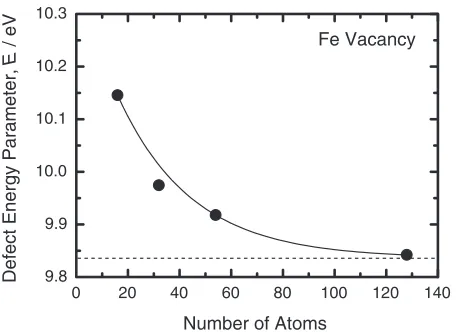
Ais the defect energy parameter for the formation of a vacancy on thesublattice and for the formation of an A antisite atom on thesublattice, respectively. In general, the concentration of the thermally excited defects is much smaller than that of the defect concentration of supercells employed in first-principles electronic structure calculations. Therefore we checked the convergence of the defect energy parameters for supercell size. Figures 1 and 2 show the defect energy parameter of Fe and Co vacancies as a function of the number of atoms in the supercells, respectively. The defect energy parameter needs to be well converged for the supercell size because there is virtually no interactions between thermal vacancies. The results indicate that the vacancy formation energies in FeCo obtained using the supercell with 32 sites5)are overestimated by about 0.2 eV.
In order to reduce an error caused by the supercell size below 0.05 eV, supercells composed of more than 100 sites are required. In the present work, we employed the 444
supercells for calculating the defect energy parameters. The convergence of defect energy parameters for supercell size strongly depends on the sort of constituent atoms of alloys. Figure 3 shows the defect energy parameters of Co vacancy in CoAl, CoTi7) and FeCo. The errors caused by supercell size in CoAl and CoTi are larger than those in FeCo. For defect energy parameters obtained using small supercells, comparisons between different alloys are not appropriate. In the case of CoTi, the lattice relaxation around vacancies induced by the charge transfer from Ti to Co atoms leads to less convergence.7,13)On the other hand, neighboring Al atoms around Co vacancy in CoAl does not sufficiently screen the positive charge of Co vacancy. As a result, the charge density of the second nearest Co atoms increases in order to screen it and induces the interaction between adjacent supercells.13)
The chemical potentials,, are used for the compensation of the energy of the atoms related to the defect formation. When calculating the defect formation energies of a vacancy on thesublattice and that of an A antisite atom on the
sublattice,
EV ¼"VþA; ð3Þ
EA ¼"AAþB: ð4Þ
In most of previous works, the chemical potentials are obtained using the calculated energies of fixed-size super-cells. This is based on the assumption that the chemical potentials are constant with the composition. In the present work, in order to taking into account the compositional dependence of the chemical potentials, they are obtained from interceptions at 0 and 100 at%Fe/Co of the tangent lines for the interpolation curve for the energies of the222,
333and444supercells.
Regarding the defect formation parameter of constitutional defects, the eq. (1) and (2) are not applicable because the concentration of constitutional defects is much larger than thermally excited defects. While the defect formation parameter can be calculated using a slope of the energy curve, the defect formation energy of constitutional defects
0 20 40 60 80 100 120 140
9.8 9.9 10.0 10.1 10.2 10.3
Defect Energy Parameter,
E
/ eV
Number of Atoms
Fe Vacancy
Fig. 1 Dependence of the defect energy parameters of Fe vacancy in FeCo on the supercell size.
0 20 40 60 80 100 120 140
8.4 8.5 8.6 8.7 8.8
Defect Energy Parameter,
E
/ eV
Number of Atoms
Co Vacancy
Fig. 2 Dependence of the defect energy parameters of Co vacancy in FeCo on the supercell size.
0 20 40 60 80 100 120 140
0.0 0.1 0.2 0.3 0.4 0.5
CoAl
CoTi
FeCo
Co Vacancy
∆
E,
E
/ eV
Number of Atoms
[image:2.595.56.284.72.238.2] [image:2.595.315.539.74.237.2] [image:2.595.55.282.291.460.2]result in zero because the chemical potential cancel out the defect energy parameter by definition.
The vacancy formation volumes were calculated using the equilibrium volume, 1V;0, of the 444 supercell
including a vacancy according to
V1FV ¼1V;0 ðN1Þ0: ð5Þ
0denotes the equilibrium atomic volume in perfect FeCo.
3. Results and Discussion
3.1 Stability of constitutional defects
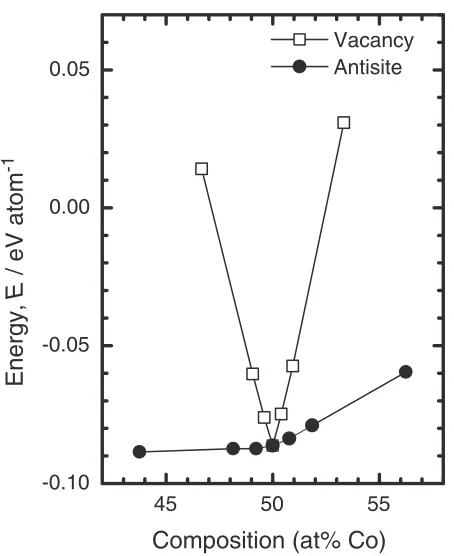
The formation energies of FeCo including a constitutional defect are plotted as a function of Co composition in Fig. 4. Both in Fe-rich and Co-rich sides, the formation energies of FeCo including antisite atoms are lower than those including vacancies. This indicates that introducing of antisite atoms compensates the deviation from stoichiometric composition in FeCo. The preference of antisite atoms is expected from small difference in atomic radius between Fe and Co atoms. In the case of alloys such as CoAl in which a large difference in atomic radius exists between constituent atoms, it requires higher energy to put a larger atom on a site of smaller atoms than to form a vacancy of smaller atom.
Figure 5 shows the change in normalized lattice parame-ters as a function of Co composition. The lattice parameparame-ters are normalized by the equilibrium lattice parameter of the stoichiometric composition. The calculated values are ob-tained for FeCo including antisite atoms as constitutional defects. The lattice parameter decreases with increasing Co composition because the atomic radius of Co is smaller than that of Fe. The change in experimental lattice parameters is well reproduced by the calculations.
3.2 Electronic structures
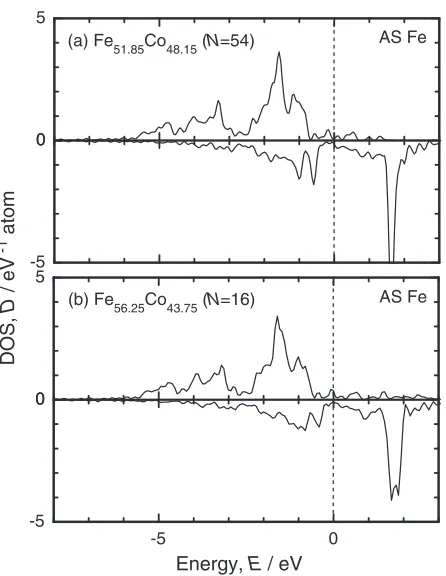
In Fig. 4, the formation energy in the Co-rich side changes more steeply than that in the Fe-rich side does. This indicates that the Fe antisite atoms in Fe-rich side are more stable than the Co antisite in Co-rich side. In order to clarify the origin of the stability of the Fe antisite atoms, electronic structures of antisite atoms are examined using density of stats (DOS). Figure 6 shows the total and site-projected partial density of states (PDOS) for stoichiometric FeCo. The DOS curves are shifted so as to set the Fermi level at zero. A pseudo gap appears at around 0:3eV and the Fermi level lies in the bottom of the antibonding band of minority spin. The PDOS of the Fe and Co antisite atoms are shown in Figs. 7 and 8, respectively. Antibonding states of minority spin of the Fe antisite atom appear in the conduction band both in Fe51:85Co48:15 and Fe56:25Co43:75. The shapes of the PDOS
curves of Fe51:85Co48:15and Fe56:25Co43:75 are similar except
for the width of the antibonding states of minority spin. The width of them increases with increasing Fe composition because of the interaction between the Fe antisite atoms. On the other hand, in the case of the Co antisite, antibonding states of minority spin of the Co antisite atom appears at around the Fermi level both in Fe48:15Co51:85 and Fe43:75
-Co56:25. The formation of the Co antisite atom, therefore,
accompanies occupation of the antibonding states and decreases the energy whereas the formation of the Fe antisite atom does not induce the filling of the antibonding states. The position of antibonding states plays very important role for the stability of antisite atoms.
3.3 Magnetic moment
The compositional dependence of magnetic moment is
45 50 55
-0.10 -0.05 0.00 0.05
Energy,
E
/ eV atom
-1
Composition (at% Co)
Vacancy Antisite
Fig. 4 The formation energy of FeCo including a constitutional defect as a function of Co composition.
40 45 50 55 60
0.996 0.997 0.998 0.999 1.000 1.001 1.002
a/a
0
Composition (at%Co)
Calcurated Experimental
[image:3.595.59.286.67.345.2] [image:3.595.318.542.71.348.2]different between the Fe and Co atoms in FeCo. It was reported that although the moments of the Co atoms do not depend on composition, that of Fe increases from 2.2Bin pure Fe to about 3 B in stoichiometric FeCo.4) The calculated magnetic moments obtained in the present work are listed in Table 1. Whereas the magnetic moment of the Co antisite atom is almost the same as that of the Co atom in stoichiometric FeCo, that of the Fe antisite atom is about 0.3Bsmaller than in stoichiometric FeCo. These calculated results agree well with the experimental observation. To explain the difference in the magnetic moment between the Fe and Co atoms, a comparison of the PDOS may be helpful. The difference originates from the minority spins since the majority spins are fully occupied in all the compositions. The Co and Fe antisite atoms have Co-Co bonds and Fe-Fe bonds instead of Fe-Co bonds, respectively. The interaction between Fe atoms is stronger than that between Co atoms because the size of 3d orbital contracts with increasing atomic number. In the case of the Co antisite, the occupation of antibonding states compensates the decrease in bonding 0
5
-5 0
0 5
-5 0
0 5
Energy, E / eV
-5 0
-5 0
(a) Total
(b) Fe
(c) Co
DOS,
D
/ eV
-1 atom
Fig. 6 Total DOS (a), site-projected PDOS for Fe (b) and for Co (c).
0 5
-5 0
Energy, E / eV
(a) Fe51.85Co48.15 (N=54)
DOS,
D
/ eV
-1 atom
0 5
-5 0
-5 0
(b) Fe56.25Co43.75 (N=16)
AS Fe
AS Fe
Fig. 7 Site-projected PDOS for the Fe antisite atom in Fe56:25Co43:75 (a) and in Fe51:85Co48:15(b).
0 5
-5 0
Energy, E / eV
(a) Fe48.15Co51.85 (N=54)
DOS,
D
/ eV
-1 atom
0 5
-5 0
-5 0
(b) Fe43.75Co56.25 (N=16)
AS Co
AS Co
[image:4.595.63.283.69.392.2]Fig. 8 Site-projected PDOS for the Co antisite atom in Fe56:25Co43:75 (a) and in Fe51:85Co48:15(b).
Table 1 Calculated magnetic moments of Fe and Co in FeCo on different compositions.
Magnetic Moment (B)
Fe antisite Co antisite Fe (average) Co (average) Fe56:25Co43:75 2.56 — 2.84 1.81 Fe51:85Co48:15 2.55 — 2.88 1.81
Stoichiometric — — 2.88 1.80
[image:4.595.319.542.74.359.2] [image:4.595.306.549.434.526.2] [image:4.595.61.284.469.757.2]states. On the other hand, the antibonding states of the Fe antisite atom are not occupied and the increase in bonding states caused by Fe-Fe bonding leads to the decrease in the magnetic moment of the Fe antisite atom.
3.4 Vacancy formation energy and volume
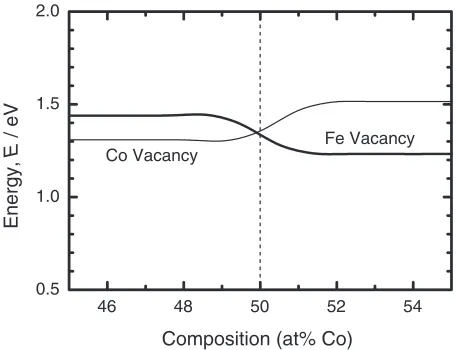
The calculated vacancy formation energies are shown in Fig. 9. These energies were calculated by Neumayer et al.5) using supercells with 32 sites: a formation energy of 1.72 eV for Fe vacancy, 1.60 eV for Co vacancy in Fe-rich FeCo, 1.57 eV for Fe vacancy and 1.75 eV for Co vacancy in Co-rich FeCo. Comparing to the previous work, the general trend of these energies is similar. Namely, the formation energy of Co vacancy is lower than that of Fe vacancy in the Fe-rich side and the hierarchy is reversed in the Co-rich side. However, all the vacancy formation energies obtained in the present work are lower by about 0.3 eV than those of the previous calculations. The decrease of energies is mainly due to reducing the overestimation error caused by the supercell size. The vacancy formation energies in the present work show a better agreement with the experimental value of 1.15 eV at Fe50Co50.6)
The compositional dependence of the vacancy formation energy appears around the stoichiometric composition. This dependence arises from the chemical potentials obtained from the energy curves calculated with the various sizes of supercells, i.e., various compositions. In Co-rich side in CoTi, the formation energy of Co vacancy is lowered than that of Ti vacancy by the composition dependence of the chemical potential. The compositional dependence appearing in FeCo is not so significant as that in CoTi.
The formation volumes of Fe and Co vacancies are 0.640
and 0.620, respectively. Unfortunately there are no
experimental and calculated results for comparison. The calculated vacancy formation volume of ferromagnetic BCC-Fe is 0.550.15) We plan to calculate vacancy formation
volumes for other B2 alloys and clarify factors determining them.
4. Summary
The defect and magnetic structures and vacancy formation energies in FeCo were determined by the first-principles electronic structure calculations. Antisite atoms compensate the deviation from the stoichiometric composition both in Fe-rich and Co-Fe-rich sides. In particular, the antibonding states of minority spin of the Fe antisite atom appear above the Fermi level, which leads to the stability of the Fe antisite atom. The increase in bonding states of minority spin of the Fe antisite atom is responsible for the decrease in magnetic moment of Fe atom in Fe-rich side. The vacancy formation energies obtained in the present work shows a better agreement with the experimental value than those obtained using supercells with 32 sites. This is due to reducing the overestimation error caused by the supercell size and taking into account the compositional dependence of chemical potentials.
Acknowledgement
This work supported by ‘Priority Assistance of the Formation of Worldwide Renowned Centers of Research– The 21st Century COE Program (Project: Center of Ex-cellence for Advanced Structural and Functional Materials Design)’ from the Ministry of Education, Sports, Science and Culture of Japan, and in part by a Grant-in-Aid for Scientific Research from Ministry of Education, Sports, Science and Culture of Japan. This work was partly carried out at the Strategic Research Base ‘‘Handai Frontier Research Center’’ supported by the Japanese Government’s Special Coordina-tion Fund for Promoting Science and Technology.
REFERENCES
1) T. Nishizawa and K. Ishida:2nd ed. Binary alloy phase diagrams, vol. 2, ed. by T. B. Massalski (Metal Park, OH, ASM International, 1990) p. 1186.
2) H. Asano, Y. Bando, N. Nakanishi and S. Kachi: Trans. Jpn Inst. Met.8
(1967) 180–184.
3) L. M. Pike, Y. A. Chang and C. T. Liu: Acta Mater.45(1997) 3709– 3719.
4) M. F. Collins and J. B. Forsyth: Philos. Mag.8(1963) 401–410. 5) M. Neumayer and M. Fa¨hnle: Phys. Rev. B64(2001) 132102-1-4. 6) A. Yabuuchi, M. Mizuno, H. Araki and Y. Shirai (unpublished). 7) M. Mizuno, H. Araki and Y. Shirai: Mater. Trans.46(2005) 1112–
1116.
8) G. Kresse and J. Furthmuller: Comput. Mater. Sci.6(1996) 15–50. 9) G. Kresse and J. Furthmuller: Phys. Rev. B54(1996) 11169–11186. 10) J. P. Perdew and Y. Wang: Phys. Rev. B45(1992) 13244–13249. 11) R. Drautz, A. Dı´az-Ortiz, M. Fa¨hnle and H. Dosch: Phys. Rev. Lett.93
(2004) 067202-1-4.
12) J. H. Rose, J. Ferrante and J. R. Smith: Phys. Rev. Lett.47(1981) 675– 678.
13) M. Mizuno, H. Araki and Y. Shirai: Phys. Rev. B68(2003) 144103-1-14.
14) J. Mayer, C. Elsa¨sser and M. Fa¨hnle: Phys. Stat. Sol. (b)191(1995) 283–298.
15) P. A. Korzhavji, I. A. Abrikosov, B. Johansson, A. V. Ruban and H. L. Skriver: Phys. Rev. B59(1999) 11693–11703.
46 48 50 52 54
0.5 1.0 1.5 2.0
Energy,
E
/ eV
Composition (at% Co)
Co Vacancy
Fe Vacancy
[image:5.595.55.283.73.248.2]