A F i n i t e S t a t e and D a t a - O r i e n t e d M e t h o d for G r a p h e m e to
P h o n e m e C o n v e r s i o n
G o s s e B o u m a
A l f a - i n f o r m a t i c a R i j k s u n i v e r s i t e i t G r o n i n g e nP o s t b u s
716
9 7 0 0 A S G r o n i n g e n T h e N e t h e r l a n d s
gosse@let, rug. nl
A b s t r a c t
A finite-state method, based on leftmost longest- match replacement, is presented for segmenting words into graphemes, and for converting graphemes into phonemes. A small set of hand-crafted conver- sion rules for Dutch achieves a phoneme accuracy of over 93%. The accuracy of the system is further im- proved by using transformation-based learning. The phoneme accuracy of the best system (using a large rule and a 'lazy' variant of Brill's algoritm), trained on only 40K words, reaches 99%.
1 I n t r o d u c t i o n
Automatic grapheme to phoneme conversion (i.e. the conversion of a string of characters into a string of phonemes) is essential for applications of text to speech synthesis dealing with unrestricted text, where the input may contain words which do not occur in the system dictionary. Furthermore, a transducer for grapheme to phoneme conversion can be used to generate candidate replacements in a (pronunciation-sensitive) spelling correction sys- tem. When given the pronunciation of a misspelled word, the inverse of the grapheme to phoneme trans- ducer will generate all identically pronounced words. Below, we present a m e t h o d for developing such grapheme to phoneme transducers based on a com- bination of hand-crafted conversion rules, imple- mented using finite state calculus, and automatically induced rules.
T h e hand-crafted system is defined as a two- step procedure: segmentation of the input into a sequence of graphemes (i.e. sequences of one or more characters typically corresponding to a sin- gle phoneme) and conversion of graphemes into (se- quences of) phonemes. T h e composition of the transducer which performs segmentation and the transducer defined by the conversion rules, is a transducer which converts sequences of characters into sequences of phonemes.
Specifying the conversion rules is a difficult task. Although segmentation of the input can in princi- ple be dispensed with, we found that writing con- version rules for segmented input substantially re-
duces the context-sensitivity and order-dependence of such rules. We manually developed a grapheme to phoneme transducer for Dutch data obtained from CELEX (Baayen et al., 1993) and achieved a word ac- curacy of 60.6% and a phoneme accuracy of 93.6%.
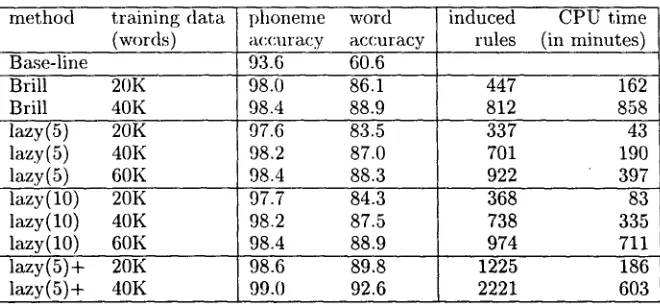
To improve the performance of our system, we used transformation-based learning (TBL) (Brill, 1995). Training d a t a are obtained by aligning the output of the hand-crafted finite state transducer with the correct phoneme strings. These d a t a can then be used as input for TBL, provided that suit- able rule templates are available. We performed sev- eral experiments, in which the amount of' training data, the algorithm (Brill's original formulation and 'lazy' variants (Samuel et al., 1998)), and the num- ber of rule templates varied. The best experiment (40K words, using a 'lazy' strategy with a large set of rule templates) induces over 2000 transformation rules, leading to 92.6% word accuracy and 99.0% phoneme accuracy. This result, obtained using a relatively small set of training data, compares well with that of other systems.
2
F i n i t e S t a t e C a l c u l u s
As argued in Kaplan and Kay (1994), K a r t t u n e n (1995), K a r t t u n e n e t al. (1997), and elsewhere, many of the rules used in phonology and morphol- ogy can be analysed as special cases of regular ex- pressions. By extending the language of regular ex- pressions with operators which capture the interpre- tation of linguistic rule systems, high-level linguis- tic descriptions can be compiled into finite state au- t o m a t a directly. Furthermore, such a u t o m a t a can be combined with other finite state a u t o m a t a perform- ing low-level tasks such as tokenization or lexical- lookup, or more advanced tasks such as shallow pars- ing. Composition of the individual components into a single transducer may lead to highly efficient pro- cessing.
The system described below was implemented us- ing FSA Utilities, 1 a package for implementing and manipulating finite state automata, which provides possibilities for defining new regular expression oper-
[]
[R~,..., R,,]
{R1,... ,Rn}
R -i g n o r e (A,B) A x B
identity(A)
T o U
m a c r o (Term, R)
the empty string concatenation disjunction optionality
ignore: A interspersed with elements of B cross-product: the transducer which maps all strings in A to all strings in B.
identity: the transducer which maps each element, in A onto itself.
composition of the transducers T and U.
use Term as an abbreviation for R (where Term and R may contain variables).
Figure 1: A fragment of FSA regular expression syntax. A and B are regular expressions denoting recognizers, T and U transducers, and R can be either.
ators. T h e part of FSA's built-in regular expression syntax relevant to this paper, is listed in figure 1.
One particular useful extension of the basic syn- tax of regular expressions is the replace-operator. K a r t t u n e n (1995) argues that many phonological and morphological rules can be interpreted as rules which replace a certain portion of the input string. Although several implementations of the replace- operator are proposed, the most relevant case for our purposes is so-called 'leftmost longest-match' re- placement. In case of overlapping rule targets in the input, this operator will replace the leftmost target, and in cases where a rule target contains a prefix which is also a potential target, the longer sequence will be replaced. Gerdemann and van Noord (1999) implement leftmost longest-match replacement in FSA as the o p e r a t o r
replace(Target, LeftContext,RightContext),
where Target is a transducer defining the actual re- placement, and LeftContext and RightContext are regular expressions defining the left- and rightcon- text of the rule, respectively.
An example where leftmost replacement is use- ful is hyphenation. Hyphenation of (non-compound) words in Dutch amounts to segmenting a word into syllables, separated by hyphens. In cases where (the written form of) a word can in prin- ciple be segmented in several ways (i.e. the se- quence a l f a b e t can be segmented as a l - f a - b e t , a l - f a b - e t , a l l - a - b e t , or a l f - a b - e t ) , the seg- mentation which maximizes onsets is in general the correct one (i.e. a l - f a - b e t ) . This property of hy- phenation is captured by leftmost replacement:
m a c r o ( h y p h e n a t e ,
r e p l a c e ( [ ] x - , s y l l a b l e , s y l l a b l e ) ) .
Leftmost replacement ensures t h a t hyphens are in- troduced 'eagerly', i.e. as early as possible. Given a suitable definition of s y l l a b l e , this ensures that
wherever a consonant can be final in a coda or initial in the next onset, it is in fact added to the onset.
The segmentation task discussed below makes cru- cial use of longest match.
3
A f i n i t e s t a t e
m e t h o d for
g r a p h e m e to p h o n e m e
c o n v e r s i o n
Grapheme to phoneme conversion is implemented as the composition of four transducers:m a c r o ( g r a p h 2 p h o n ,
s e g m e n t a t i o n 7, segment t h e i n p u t
o m a r k _ b e g i n _ e n d 7, add ' #'
o c o n v e r s i o n 7. a p p l y r u l e s o c l e a n _ u p ) . Z remove m a r k e r s
An example of conversion including the in- termediate steps is given below for the word
aanknopingspunt
(connection-point).
input: aanknopingspunt
s: aa-n-k-n-o-p-i-ng-s-p-u-n-t-
m: #-aa-n-k-n-o-p-i-ng-s-p-u-n-t-#
co: # - a + N + k - n - o - p - I + N + s - p - } + n - t - #
cl: aNknopINsp}nt
T h e first transducer (segmentation) takes as its input a sequence of characters and groups
these into segments. The second transducer (mark_begin_end) adds a marker ( ' ~ ' ) to the be- ginning and end of the sequence of segments. T h e third transducer ( c o n v e r s i o n ) performs the actual conversion step. It converts each segment into a sequence of (zero or more) phonemes. T h e final step (clean_up) removes all markers. T h e o u t p u t is a list of phonemes in the notation used by CELEX
(which can be easily translated into the more com- mon SAMPA-notation).
3.1 S e g m e n t a t i o n
level of representation for the actual grapheme to phoneme conversion rules.
While there are many letter-combinations which are realized as a single phoneme (ch, ng, a a , bb,
.. ), it is only rarely the case that a single letter is mapped onto more than one phoneme (x), or that a letter receives no pronunciation at all (such as word- final n in Dutch, which is elided if it is proceeded by a schwa). As the number of cases where multiple letters have to be mapped onto a single phoneme is relatively high, it is natural to model a letter to phoneme system as involving two subtasks: segmen- tation and conversion. Segmentation splits an input string into graphemes, where each grapheme typ- ically, but not necessarily, corresponds to a single phoneme.
Segmentation is defined as:
m a c r o ( s e g m e n t a t i o n , r e p l a c e (
[ i d e n t i t y ( g r a p h e m e s ) , ) .
[] x - ] , [ ] , [ ] )
The macro graphemes defines the set of graphemes. It contains 77 elements, some of which are:
a, aa, au, ai, aai, e, ee, el, eu, eau, eeu, i, ie, lee, ieu, ij, o, oe, oei,..
Segmentation attaches the marker ' - ' to each grapheme. Segmentation, as it is defined here, is not context-sensitive, and thus the second and third arguments of replace are simply empty. As the set of graphemes contains many elements which are substrings of other graphemes (i.e. e is a substring of e i , eau, etc.), longest-match is es- sential: the segmentation of b e i a a r d i e r
(caril-
lon player)
should be b - e i - a a - r - d - i e - r - and notb - e - i - a - a - r - d - i - e - r - . This effect can be ob- tained by making the segment itself part of the tar- get of the replace statement. Targets are identi- fied using leftmost longest-match, and thus at each point in the input, only the longest valid segment is marked.
The set of graphemes contains a number of ele- ments which might seem superfluous. The grapheme aa±, for instance, translates as a j , a sequence which could also be derived on the basis of two graphemes aa and ±. However, if we leave out the segment aa±, segmentation (using leftmost longest match) of words such as waaien
(to blow)
would lead to the segmentation w - a a - i e - n , which is unnatural, as it would require an extra conversion rule for ±e. Us- ing the grapheme a a i allows for two conversion rules which always map a a i to aj and ±e goes to ±.Segmentation as defined above provides the in- tuitively correct result in almost all cases, given a suitably defined set of graphemes. There are some
cases which are less natural, but which do not nec- essarily lead to errors. The grapheme eu, for in- stance, almost always goes to ' l ' , but translates as ' e , j , } ' in (loan-) words such as museum and p e t r o l e u m . One might argue that a segmentation e - u - is therefore required, but a special conver- sion rule which covers these exceptional cases (i.e. eu followed by m) can easily be formulated. Simi- larly, ng almost always translates as N, but in some cases actually represents the two graphemes n - g - , as in a a n e e n g e s l o t e n
(connected),
where it should be translated as NG. This case is harder to detect, and is a potential source of errors.3.2 T h e C o n v e r s i o n R u l e s
The g2p operator is designed to facilitate the formu- lation of conversion rules for segmented input:
macro(g2p(Target,LtCont,RtCont), replace([Target, - x + ] ,
[ignore(LtCont,{+,-}), {-,+}], ignore(RtCont,{+,-})
) ).
The g2p-operator implements a special pro:pose ver- sion of the replace-operator. The replacement of the marker '-' by ' + ' in the target ensures that g2p- conversion rules cannot apply in sequence to the same grapheme. 2 Second, each target of the g2p- operator must be a grapheme (and not some sub- string of it). This is a consequence of the fact that the final element of the left-context must be a marker and the target itself ends in '-'. Finally, the ig- nore statements in the left and right context imply that the rule contexts can abstract over the potential presence of markers.
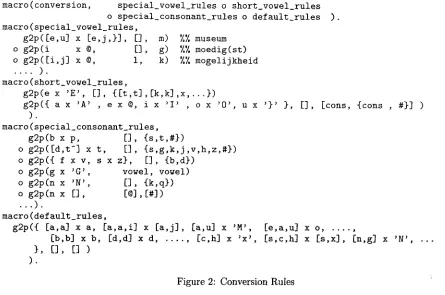
An overview of the conversion rules we used for Dutch is given in Figure 2. As the rules are ap- plied in sequence, exceptional rules can be ordered before the regular cases, thus allowing the regular cases to be specified with little or no context. The
special_vowel_rules deal with exceptional trans- lations of graphemes such as eu or cases where i or i j goes to '©'. The s h o r t _ v o w e l _ r u l e s treat sin- gle vowels preceding two consonants, or a word final consonant. One problematic case is e, which can be translated either as ' E ' or ' ~ ' . Here, an ap- proximation is attempted which specifies tile con- text where e goes ' E ' , and subsumes the other case under the general rule for short vowels. Tile s p e c i a l _ c o n s o n a n t _ r u l e s address devoicing and a few other exceptional cases. The d e f a u l t _ r u l e s supply a default mapping for a large number of
graphemes. T h e target of this rule is a long disjunc- tion of grapheme-phoneme mappings. As this rule- set applies after all more specific: cases have been dealt with, no context restrictions need to be speci- fied.
Depending somewhat on how one counts, the full set of conversion rules for Dutch contains approxi- mately 80 conversion rules, more than 40 of which are default mappings requiring no context. 3 Compi- lation of the complete system results in a (minimal, deterministic) transducer with 747 states and 20,123 transitions.
3.3 T e s t r e s u l t s a n d d i s c u s s i o n
The accuracy of the hand-crafted system was evM- uated by testing it on all of tile words wihtout di- acritics in the CELEX lexical database which have a phonetic transcription. After several development cycles, we achieved a word accuracy of 60.6% and a phonenle accuracy (measured as the edit distance between the phoneme string produced by the sys- tem and the correct string, divided by the number of phonemes in the correct string) of 93.6%.
T h e r e have been relatively few a t t e m p t s at devel- oping grapheme to phoneme conversion systems us- ing finite state technology alone. Williams (1994) re- ports on a system for Welsh, which uses no less than 700 rules implemented in a rather restricted environ- ment. T h e rules are also implemented in a two-level system, PC-KIMMO, (Antworth, 1990), but this still requires over 400 rules. MSbius et al. (1997) report on full-fledged text-to-speech system for German, containing around 200 rules (which are compiled into a weighted finite state transducer) for the grapheme- to-phoneme conversion step. These numbers suggest t h a t our implementation (which contains around 80 rules in total) benefits considerably from the flexibil- ity and high-level of abstraction made available by finite state calculus.
One might suspect t h a t a two-level approach to grapheme to phoneme conversion is more appropri- ate than the sequential approach used here. Some- what surprisingly, however, Williams concludes that a sequential approach is preferable. T h e formulation of rules in the latter approach is more intuitive, and rule ordering provides a way of dealing with excep- tional cases which is not easily available in a two- level system.
While further improvements would definitely have been possible at this point, it becomes increasingly difficult to do this on the basis of linguistic knowl- edge alone. T h a t is, most of the rules which have to be added deal with highly idiosyncratic cases (of- ten related to loan-words) which can only be discov-
3It s h o u l d be n o t e d t h a t we only c o n s i d e r e d w o r d s w h i c h do n o t c o n t a i n diacritics. I n c l u d i n g t h o s e is u n p r o b l e m a t i c in principle, b u t w o u l d lead to a slight increase of t h e n u m b e r of rules.
ered by browsing through the test results of previ- ous runs. At this point, switching from a linguistics- oriented to a data-oriented methodology, seemed ap- propriate.
4 T r a n s f o r m a t i o n - b a s e d g r a p h e m e t o p h o n e m e c o n v e r s i o n
Brill (1995) demonstrates t h a t accurate part-of- speech tagging can be learned by using a two-step process. First, a simple system is used which as- signs the most probable tag to each word. T h e re- sults of the system are aligned with the correct tags for some corpus of training data. Next, (context- sensitive) transformation rules are selected from a pool of rule patterns, which replace erroneous tags by correct tags. The rule with the largest benefit on the training d a t a (i.e. the rule for which the number of corrections minus the number of newly introduced mistakes, is the largest) is learned and applied to the training data. This process continues until no more rules can be found which lead to improvement (above a certain threshold).
Transformation-based learning (TBL) can be ap- plied to the present problem as well. 4 In this case, the base-line system is the finite state transducer de- scribed above, which can be used to produce a set of phonemic transcriptions for a word list. Next, these results are aligned with the correct transcrip- tions. In combination with suitable rule patterns, these d a t a can be used as input for a T B L process.
4.1 Alignment
T B L requires aligned d a t a for training and testing. While alignment is mostly trivial for part-of-speech tagging, this is not the case for the present task. Aligning d a t a for grapheme-to-phoneme conversion amounts to aligning each part of the input (a se- quence of characters) with a part of the o u t p u t (a sequence of phonemes). As the length of b o t h se- quences is not guaranteed to be equal, it must be possible to align more than one character with a single phoneme (the usual case) or a single character with more than one phoneme (the exceptional case, i.e. 'x'). T h e alignment problem is often solved (Du- toit, 1997; Daelemans and van den Bosch, 1996) by allowing 'null' symbols in the phoneme string, and introducing 'compound' phonemes, such as 'ks' to account for exceptional cases where a single charac- ter must be aligned with two phonemes.
As our finite state system already segments the input into graphemes, we have adopted a strategy where
graphemes
instead of characters are aligned with phoneme strings (see Lawrence and Kaye (1986) for a similar approach). T h e correspondence4 H o s t e et al. (2000b) c o m p a r e T B L to C5.0 ( Q u i n l a n ,
macro(conversion, special_vowel_rules o short_vowel_rules o special_consonant_rules o default_rules macro (special_vowel_rules,
g 2 p ( [ e , u ] x [ e , j , } ] , [ ] , m) o g 2 p ( i x ©, [ ] , g) o g 2 p ( [ i , j ] x @, 1, k)
. . . . .
macro ( s h o r t _ v o w e l _ r u l e s ,
g 2 p ( e x ' E ' , [ ] , { [ t , t ] , [ k , k ] , x , . . . } ) g 2 p ( { a x ' h ' , e x 0, i x ' I ' , o x ' 0 '
) .
macro (special_consonant_rules, g 2 p ( b x p, [ ] , { s , t , # } )
o g2p([d,t ~] x t , [], {s,g,k,j,v,h,z,#}) o g2p({ f x v, s x z}, [], {b,d})
o g2p(g x 'G', vowel, vowel) o g2p(n x 'N', [], {k,q}) o g 2 p ( n x [ ] , [ © ] , [ # ] )
. . . ) .
macro ( d e f a u l t r u l e s ,
%% m u s e u m %% moedig(st) %% mogelijkheid
.
, u x ' } ' }, [ ] , [ c o n s , {cons , #}] )
[image:5.612.75.520.79.374.2] [image:5.612.319.549.388.458.2]g 2 p ( { [ a , a ] x a , [ a , a , i ] x [ a , j ] , [ a , u ] x 'M', [ e , a , u ] x o . . . ,
[ b , b ] x b, [ d , d ] x d . . . [ c , h ] x ' x ' , [ s , c , h ] x I s , x ] , [ n , g ] x ' N ' , }, [2, [] )
) .
Figure 2: Conversion Rules
between graphemes and phonemes is usually one to one, but it is no problem to align a g r a p h e m e with two or more phonemes. Null symbols are only intro- duced in the o u t p u t if a grapheme, such as word-final
' n ' , is not realized phonologically.
For T B L , the input actually has to be aligned b o t h with the system o u t p u t as well as with the correct phoneme string. T h e first task can be solved triv- ially: since our finite state system proceeds by first segmenting the input into graphemes (sequences of characters), and then transduces each g r a p h e m e into a sequence of phonemes, we can obtain aligned d a t a by simply aligning each g r a p h e m e with its con'e- sponding phoneme string. T h e input is segmented into graphemes by doing the segmentation step of the finite state transducer only. The corresponding phoneme strings can be identified by applying the conversion transducer to the segmented input, while keeping the b o u n d a r y symbols '-' and ' + ' . As a con- sequence of the design of the conversion-rules, the resulting sequence of separated phonemes sequences stands in a one-to-one relationship to the graphemes. An example is shown in figure 3, where GR represents the g r a p h e m e segmented string, and sP the (system) phoneme strings produced by the finite state trans- ducer. Note t h a t the final sP cell contains only a b o u n d a r y marker, indicating t h a t the g r a p h e m e 'n' is translated into the null phoneme.
For the alignment between graphemes (and, idi-
Word aalbessen (currants)
GR a a - 1 - b - e - s s - e - n - sP a + 1- b - @ + s + ~@+
cp a 1 b E s @
Figure 3: Alignment
rectly, the system output) and the correct phoneme strings (as found in Celex), we used the 'hand- seeded' probabilistic alignment procedure described by Black et al. (1998) ~. From the finite state conver- sion rules, a set of possible grapheme --+ phoneme se-
quence mappings can be derived. This allowables-set
was extended with (exceptional) mappings present in the correct data, but not in the haml-crafted sys- tem. We c o m p u t e d all possible aligmnents between (segmented) words and correct p h o n e m e strings li- cenced by the allowables-set. Next, probabilities for all allowed mappings were estimated on the basis of all possible alignments, and the d a t a was parsed again, now picking the most probable alignment for each word. To minimize the n u m b e r of words t h a t could not be aligned, a m a x i m u m of one unseen m a p - ping (which was assigned a low probability) was al- lowed per word. With this modification, only one out of 1000 words on average could not be aligned. '~ These words were discarded.The aJigned phoneme
method training data phonenm word induced CPU time (words) accuracy accuracy rules (in minutes)
Base-line 93.6 60.6
Brill 20K 98.0 86.1 447 162
Brill 40K 98.4 88.9 812 858
lazy(5) 20K 97.6 83.5 337 43
lazy(5) 40K 98.2 87.0 701 190
lazy(5) 60K 98.4 88.3 922 397
lazy(10) 20K 97.7 84.3 368 83
lazy(10) 40K 98.2 87.5 738 335
lazy(10) 60K 98.4 88.9 974 711
lazy(5)+ 20K 98.6 89.8 1225 186
lazy(5)+ 40K 99.0 92.6 2221 603
Figure 4: Experimental Results using training d a t a produced by graph2phon
string for the example in figure 3 is shown in the b o t t o m line. Note t h a t the final cell is empty, rep- resenting the null phoneme.
4.2 T h e e x p e r i m e n t s
For the experiments with T B L we used the # - T B L -
package (Lager, 1999). This Prolog implementation of T B L is considerably more efficient (up to ten times faster) t h a n Brill's original (C) implementa- tion. T h e speed-up results mainly from using Pro- log's first-argument indexing to access large quanti- ties of d a t a efficiently.
We constructed a set of 22 rule templates which replace a predicted phoneme with a (corrected) phoneme on the basis of the underlying segment, and a context consisting either of phoneme strings, with a maximum length of two on either side, or a context consisting of graphemes, with a maximal length of 1 on either side. Using only 20K words (which corresponds to almost 180K segments), and Brill's algorithm, we achieved a phoneme accuracy of 98.0% (see figure 4) on a test set of 20K words of unseen data. 6 Going to 40K words resulted in 98.4% phoneme accuracy. Note, however, that in spite of the relative efficiency of the implementation, CPU time also goes up sharply.
The heavy computation costs of T B L are due to the fact t h a t for each error in the training data, all possible instantiations of the rule templates which correct this error are generated, and for each of these instantiated rules the score on the whole training set has to be computed. Samuel et al. (1998) there- fore propose an efficient, 'lazy', alternative, based on Monte Carlo sampling of the rules. For each er- ror in the training set, only a sample of the rules is considered which might correct it. As rules which correct a high number of errors have a higher chance
6The statistics for less t i m e c o n s u m i n g experiments were obtained by 10-fold cross-validation and for the more expen- sive e x p e r i m e n t s by 5-fold cross-validation.
of being sampled at some point, higher scoring rules are more likely to be generated t h a n lower scoring rules, but no exhaustive search is required. We ex- perimented with sampling sizes 5 and 10. As CPU requirements are more modest, we managed to per- form experiments on 60K words in this case, which lead to results which are comparable with Brill's al- goritm applied to 40K words.
Apart from being able to work with larger d a t a sets, the 'lazy' strategy also has the advantage t h a t it can cope with larger sets of rule templates. Brill's algorithm slows down quickly when the set of rule templates is extended, but for an algorithm based on rule sampling, this effect is much less severe. Thus, we also constructed a set of 500 rule templates, con- taining transformation rules which allowed up to three graphemes or phoneme sequences as left or right context, and also allowed for disjunctive con- texts (i.e. the context must contain an ' a ' at the first or second position to the right). We used this rule set in combination with a 'lazy' strategy with sampling size 5 (lazy(5)+ in figure 4). This led to a further improvement of phoneme accuracy to 99.0%, and word accuracy of 92.6%, using only 40K words of training material.
[image:6.612.179.509.75.227.2]method training data phoneme word induced CPU time (words) accuracy accuracy rules (i n minutes)
Base-line 72.9 10.8
lazy(5) 20K 97.3 81.6 691 133
lazy(5) 40K 98.0 86.0 1075 705
Figure 5: Experimental results using data based on frequency.
is much higher now, and thus cPu-requirements also increase substantially.
5 C o n c l u d i n g r e m a r k s
We have presented a method for grapheme to phoneme conversion, which combines a hand-crafted finite state transducer with rules induced by a transformation-based learning. An advantage of this method is that it is able to achieve a high level of accuracy using relatively small training sets. Busser (1998), for instance, uses a memory-based learning strategy to achieve 90.1% word accuracy on the same task, but used 90% of the CELEX data (over 300K
words) as training set and a (character/phoneme) window size of 9. Hoste et al. (2000a) achieve a word accuracy of 95.7% and a phoneme accuracy of 99.5% on the same task, using a combination of ma- chine learning techniques, as well as additional data obtained from a second dictionary.
Given the result of Roche and Schabes (1997), an obvious next step is to compile the induced rules into an actual transducer, and to compose this with the hand-crafted transducer. It should be noted, how- ever, that the number of induced rules is quite large in some of the experiments, so that the compilation procedure may require some attention.
R e f e r e n c e s
Evan L. Antworth. 1990. PC-KIMMO : a two-level
processor for morphological analysis. Summer In-
stitute of Linguistics, Dallas, Tex.
R. H. Baayen, R. Piepenbrock, and H. van Rijn. 1993. The CELEX Lexical Database (CD-ROM).
Linguistic Data Consortium, University of Penn- sylvania, Philadelphia, PA.
Alan Black, Kevin Lenzo, and Vincent Pagel. 1998. Issues in building general letter to sound rules. In
Proceedings of the 3rd ESCA/COCSADA Work-
shop on Speech Synthesis, pages 77-81, Jenolan
Caves, Australia.
Eric Brill. 1995. Transformation-based error-driven learning and natural language processing: A case study in part-of-speech tagging. Computational
Linguistics, 21:543-566.
Bertjan Busser. 1998. TreeTalk-D: a machine learn- ing approach to Dutch word pronunciation. In
Proceedings TSD Conference, pages 3-8, Masaryk
University, Czech Republic.
W. Daelemans and A. van den Bosch. 1996. Language-independent data-oriented grapheme- to-phoneme conversion. In Progress in Speech
Synthesis, pages 77-90, New York. Springer Ver-
lag.
Thierry Dutoit. 1997. An Introduction to Tezt-to-
Speech Synthesis. Kluwer, Dordrecht.
Dale Gerdemann and Gertjan van Noord. 1999. Transducers from rewrite rules with backrefer- ences. In Proceedings of the Ninth Conference o/ the European Chapter of the Association for Com-
putational Linguistics, pages 126-133, Bergen.
Veronique Hoste, Walter Daelemans, Erik Tjong Kim Sang, and Steven Gillis. 2000a. Meta-learning of phonemic annotation of corpora. ms., University of Antwerp.
Veronique Hoste, Steven Gillis, and Walter Daele- mans. 2000b. A rule induction approach to mod- elling regional pronunciation variation, ms., Uni- versity of Antwerp.
Ronald Kaplan and Martin Kay. 1994. Regular models of phonological rule systems. Computa-
tional Linguistics, 20(3).
L. Karttunen, J.P. Chanod, G. Grefenstette, and A. Schiller. 1997. Regular expressions tbr lan- guage engineering. Natural Larl.'u, age Engineering,
pages 1-24.
Lauri Karttunen. 1995. The replace operator. In
33th Annual Meeting o/ the Association/or Com-
putational Linguistics, pages 16-23, Boston, Mas-
sachusetts.
Torbj6rn Lager. 1 9 9 9 . The #-TBL System: Logic programming tools for transformation- based learning. In Proceedings of the Th, ird In- ternational Workshop on Computational Natu-
ral Language Learning (CoNLL '99), pages 33-42,
Bergen.
S. C. G. Lawrence and G. Kaye. 1986. Alignment of phonemes with their corresponding orthography.
Computer Speech and Language, 1(2):153 -165.
Bernd MSbius, Richard Sproat, Jan van Santen, and Joseph Olive. 1997. The Bell L~0~s German text- to-speech system: An overview. In Proceedings of the European Conference on Speech Communica-
tion and Technology, pages 2443-2446, Rhodes.
J. R. Quinlan. 1993. C4.5: programs for machine
learning. Morgan Kaufmann Publishers, San Ma-
[image:7.612.141.478.73.133.2]Emmanuel Roche and Yves Schabes. 1997. Deter- ministic part-of-speech tagging with finite-state transducers. In Emmanuel Roche aml Yves Sdl- abes, editors, Finite state language processing,
pages 205-239. MIT Press, Cambridge, Mass. Ken Samuel, Sandra Carberry, and K. Vijay-
Shanker. 1 9 9 8 . Dialogue act tagging with transformation-based learning. In Proceedings of the 17th International Con]erence on Computa-
tional Linguistics (COLING-ACL '98), Montreal.
Briony Williams. 1994. Welsh letter-to-sound rules: rewrite rules and two-level rules compared. Com-