Flotation Behavior of Arsenopyrite and Pyrite, and Their Selective Separation
Kyuhyeong Park, Junhyun Choi, Allan Gomez-Flores and Hyunjung Kim
+Department of Mineral Resources and Energy Engineering, Chonbuk National University, 567, Baekje-daero, Deokjin-gu, Jeonju, Jeonbuk 556-756, Republic of Korea
This study investigated the effect of pH and pulp potential (EH) on thefloatability of arsenopyrite and pyrite, which are single minerals, in Hallimond tube, by using xanthate as a collector. On this basis, the study further investigated the selectivity index of arsenopyrite and pyrite, using a mixed sample of arsenopyrite and pyrite. To examine theflotation behavior of each mineral by pH change,flotation was carried out at pH 4 and pH 10. The test results showed arsenopyrite had higher floatability at pH 4, regardless of the potassium ethyl xanthate (PEX) concentration. This is because xanthate ion was oxidized to be stable dixanthogen, which was well adsorbed onto arsenopyrite surface, due to the highEHof pulp. Meanwhile, arsenopyrite had relatively lowerfloatability at pH 10 than at pH 4, which was because the dixanthogen remained unstable, and was not adsorbed onto the arsenopyrite surface, due to the relatively lowEHof pulp. Pyrite had lowfloatability at both pH 4 and pH 10. Just as for arsenopyrite, the result for pH 10 was caused by the lowEHof pulp. Yet, interestingly enough, different from the case of arsenopyrite, pyrite at pH 4 had lowfloatability, despite its highEH. FTIR analysis was performed, to examine the reason for such contradictory behavior. The analysis result showed that this was caused by poor adsorption with xanthate, due to sulfate ion (SO42¹) that was generated by the oxidation of pyrite surface in reaction with oxygen in pulp at pH 4. To further investigate the selectivity index (i.e., the pyrite recovery/ arsenopyrite recovery ratio) of arsenopyrite and pyrite, additionalflotation tests were carried out on mixed sample of the two minerals. Different from theflotation behavior of single minerals, the results showed that the recovery of arsenopyrite was lower than that of pyrite, and the selectivity index of arsenopyrite and pyrite was the highest when the PEX concentration was the lowest. Such a different trend inflotation behavior of the mixed sample from theflotation behavior of the single minerals was because the surface oxidation reaction of arsenopyrite, which was more affected byEHamong the mixed arsenopyrite and pyrite, generated ferric arsenate, a hydrophilic compound, on the surface of arsenopyrite, resulting in poor adsorption with xanthate; in turn, this depressed thefloatability of arsenopyrite.
[doi:10.2320/matertrans.M2014369]
(Received October 17, 2014; Accepted January 6, 2015; Published February 13, 2015)
Keywords: flotation, arsenopyrite, pyrite, selective separation
1. Introduction
Arsenic in sulfide minerals (arsenopyrite, arsenian-pyrite, etc.), sulfosalts minerals (tennantite, enargite, etc.), and arsenates minerals (scorodite) causes serious environmental pollution, if it is exposed to nature by acid mine drainage; and if it is exposed to human, it damages lung, liver and kidney, causing skin cancer.15)Thus, it is classified as a toxic element. As such arsenic is a penalty element having a harmful effect on the environment and human, refineries strictly restrict the arsenic contents in concentrate to 0.2 0.3 mass%.6)To satisfy such regulation, arsenic is in general removed through a metallurgical process (e.g., hydrometal-lurgy or pyrometalhydrometal-lurgy).7,8)However, such methods require additional treatment cost, resulting in financial loss.7,8) So, there are active studies on the selective separation of arsenic at the flotation process, a previous stage of the metallurgical process.919)
There are previous studies in which arsenic sulfide was selectively separated in the flotation process, with xanthate as a collector.919) Of these, the majority used a selective depression method of arsenic sulfide. For example, several studies reported that magnesia mixture could be used as a depressant to inhibit xanthate adsorption onto arsenic sulfides, by forming hydrophilic compound, such as AsO4NH4Mg·6H2O, on the surface of arsenic sulfide.9,10)In other methods, Menacho et al. (1993), Huch (1994) and Fornasiero et al.(2001) performed oxidation at the pre-conditioning stage to selectively separate arsenic,1113) and Huch (1994) reported the separation of chalcocite (Cu2S)
from enargite (Cu3AsS4), using hydrogen peroxide (H2O2), which was an oxidizing agent.12) According to the above results, in the flotation process, oxidation of the mineral surface is very important in sulfide mineral separation; and oxide or hydroxide layers that are formed by the oxidation of mineral surface inhibited xanthate adsorption, which indi-cated the depression of arsenic sulfide in flotation. Mean-while, existing studies that selectively separated arsenic sulfide by controlling pulp pH employed a different principle of oxidation of arsenic sulfide surface by the change of pulp pH. For instance, Kantar (2002) reported that elemental sulfur (S0) formed on enargite surface by surface oxidation within the range of acidic pH, which increased natural floatability.14) Lopez (2006) reported that, at alkali pH, arsenic oxide, such as arsenate anions (H2AsO4¹, HAsO42¹), formed on the surface of arsenopyrite (FeAsS), and such arsenic oxide inhibited the adsorption of xanthate on arsenopyrite surface, which resulted in the depression of arsenopyrite.15)
Although much effort has been devoted to separating arsenic sulfide using theflotation process, it is known to be difficult to separate arsenic sulfide from sulfide that does not contain arsenic using flotation, due to their similar surface properties.16,17) In particular, as the surface properties of arsenopyrite and pyrite (FeS2) are very similar, it is difficult to simply separate them usingflotation. Only a few studies, to the best of our knowledge, focused on the separation of arsenopyrite and pyrite in an arsenopyrite-pyrite or an arsenopyrite-pyrite-quartz system.18,19) For example, Sirkeci (2000) carried out bench-scale flotation tests using hexyl thioethylamine as a collector in an arsenopyrite-pyrite-quartz system, and it was found that the selectivity obtained by +Corresponding author, E-mail: kshjkim@jbnu.ac.kr
using hexyl thioethylamine was greater than that by potassium amyl xanthate (PAX) and that maximum selectiv-ity index was about 4.2.18)Taply and Yan (2003) conducted a series of bench-scale flotation tests using an arsenopyrite-pyrite mixture to find an optimum condition for maximum selectivity where a magnesia mixture was used as a depressant, and they reported the maximum selectivity index of 2.1.19) Such studies, however, more likely focused on practical aspect (i.e., performance of aflotation process, such as recovery and grade) and less on mechanistic understanding of the process. Since the information on flotation chemistry (e.g., minerals’ surface chemistry, pulp chemistry) is very critical to further improve the selectivity and/or better control the process in an arsenopyrite-pyrite system, more study on this is required.
Therefore, our study was designed to gaining insight on the effect of pH and pulp potential (EH) on thefloatability of arsenopyrite and pyrite, which are single minerals, in a well-controlled system (i.e., Hallimond system) by using xanthate as a collector, and further to finding the optimum condition for maximum selectivity in an arsenopyrite-pyrite system based on the information obtained using single minerals. For this purpose, surface characterization analyses (e.g., FTIR, XRD) as well as a Hallimond system were employed to investigate the relationship between the change of surface properties of each mineral, and theirflotation behavior.
2. Materials and Methods
2.1 Materials and reagents
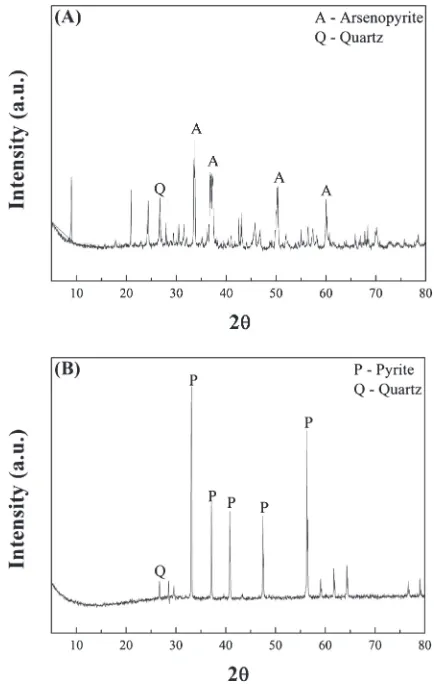
The natural specimens of arsenopyrite (FeAsS) and pyrite (FeS2) used in this study were purchased from Hong Yuan Industry & Trade in China. Inductively Coupled Plasma (ICP) (Optima 5300PV, PerkinElmer Inc., USA) and X-ray Diffraction (XRD) (X’pert Pro, PANalytical, Netherlands) were employed to analyze the chemical composition and mineralogy of each sample (Fig. 1). The results of ICP analysis showed the chemical composition of arsenopyrite had a composition ratio of Fe 27.79 mass%, As 35.11 mass%, and S 16.17 mass%; and the chemical composition of pyrite had Fe 40.86 mass%, and S 46.02 mass%. XRD analysis results were consistent with those from ICP analysis. Here, it should be noted that although the peak of quartz was observed for both minerals, the effect of minimal amount of silica on the present study is negligible due to the unfavorable interaction between quartz and xanthate as supported by many previous studies.20,21)To perform theflotation experi-ment, arsenopyrite and pyrite were crushed under 8 mesh (2.36 mm, Tyler Standard) using a jaw and cone crusher, and a single disc mill was used to grind it to have a particle size distribution of ¹105+150 mesh (106150 µm, Tyler Standard). To prevent mineral surface oxidation, the sample was preserved at freezing status. The collector used in this study was potassium ethyl xanthate (C2H5OCS2K, Sigma-Aldrich) with 96% purity level, and it was mixed with deionized (DI) water (DO level=³7.8 mg/L, Milli-Q, Plus, Millipore Ltd., UK) to prepare stock solution that was diluted for use in the desired experiments. To minimize natural degradation of the xanthate solution, new stock solution was prepared on the date of the test. Fisher Scientific’s 0.1 M
hydrochloric acid (HCl) and 0.1 M sodium hydroxide (NaOH) were used as a pH regulator.
2.2 Xanthate adsorption and measurement of pulp potential (EH) and pH
To investigate the effect of surface property change of arsenopyrite and pyrite on the flotation efficiency, each sample of 1 g was mixed with DI water to prepare a suspension, and then the pH of the suspension was controlled for 15 min as 4 and 10, using 0.1 M hydrochloric acid (HCl) or sodium hydroxide (NaOH). Afterwards, for adsorption tests, the concentration of potassium ethyl xanthate (PEX) was fixed to 10¹6, 10¹5, and 10¹4M, and 1 h conditioning was performed to achieve equilibrium condition. After conditioning, the pH and pulp potential (EH) of each suspension was measured by pH electrode (Orion Triode pH/ATC Comb Ag/AgCl Electrode, Thermo Science) and redox electrode (Orion Sure-flow Comb Redox Electrode, Thermo Science). The EH value was presented on the Standard Hydrogen Electrode (SHE) scale.
2.3 FTIR measurements
[image:2.595.317.534.69.411.2]suspension was adjusted to 4 and 10. PEX was then added to keep the background concentration of 1©10¹6M. The mixture was agitated for 1 h. After agitation, the samples were filtered, using cellulose acetate membrane filter (ADVANTEC, Toyo Roshi Kaisha, Japan) with pore size 0.45 µm, and the separated particles were dried at room temperature (25°C) for 24 h. Afterwards, samples were mixed with potassium bromide (KBr) pellets, and IR analysis was carried out in the 4000400 cm¹1 range, using an FTIR analyzer (Spectrum GX, Perkin-Elmer, USA).
2.4 Microflotation tests
To evaluate the flotation behavior of arsenopyrite and pyrite, the PEX concentration was changed to 10¹6, 10¹5, and 10¹4M, and microflotation tests were carried out under pH 4 and 10. Mineral samples were adsorbed with PEX for 1 h at each test condition. After adsorption, the suspension was filtered to remove the remaining PEX, and then microflotation tests were performed on 1 g samples. Mean-while, for the mixed sample of arsenopyrite and pyrite, the microflotation test was carried out on the 1 g sample mixed from two samples of 0.5 g each, by changing the PEX concentration to 5©10¹7, 10¹6, and 10¹5M. Mineral sample preparation for the mixed sample microflotation test was the same as for the single sample case. The microflotation test conditions are as below. 1 g of samples and 150 mL of DI water were injected into the Hallimond tube, and mixed at 340 rpm using a magnetic stirrer bar during the experiment. Nitrogen gas of 99%or higher purity was injected at a speed of 30 mL/min, and theflotation time wasfixed at 3 min. All experiments were carried out at room temperature (25°C), using an in-house Hallimond tube.22) To determine the flotation efficiency, each floated and unfloated sample was filtered, and dried at room temperature for 12 h. For the single minerals, the weights of floated and unfloated samples were measured to determine the floatability, and to obtain the flotation efficiency and selectivity index (i.e., pyrite recov-ery/arsenopyrite recovery ratio) of the mixed mineral sample. The metal contents were analyzed in thefloated and unfloated samples, using ICP.
3. Results and Discussion
3.1 Flotation behavior of arsenopyrite and pyrite
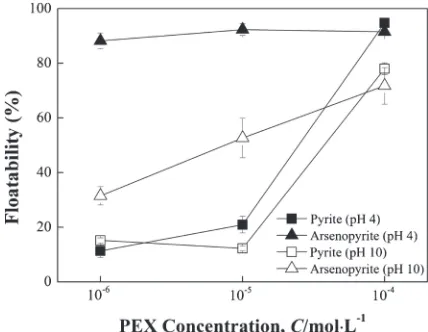
To investigate the individual flotation behavior of arsenopyrite and pyrite, flotation tests were carried out by the change of xanthate concentration (1©10¹61©10¹4M) under pH 4 and 10, and Fig. 2 shows the results. The results show that the floatabilities of arsenopyrite and pyrite at pH 4 were relatively higher than those at pH 10. When the floatabilities of arsenopyrite and pyrite at the same pH were compared, arsenopyrite had relatively higherfloatability than pyrite. Specifically, the floatability of arsenopyrite at pH 4 was 88% at a PEX concentration of 1©10¹6M, 92% at 1©10¹5M, and 91% at 1©10¹4M. The floatability of pyrite at pH 4 was 11% at a PEX concentration of 1© 10¹6M, 20%at 1©10¹5M, and 94%at 1©10¹4M. From the result of the flotation separation test, the floatability of arsenopyrite at pH 10 was 31% at a PEX concentration of 1©10¹6M, 52% at 1©10¹5M, and 71% at 1©10¹4M.
The floatability of pyrite at pH 10 was 15% at a PEX concentration of 1©10¹6M, 12% at 1©10¹5M, and 78% at 1©10¹4M. In previous study, Gaudin (1957) performed flotation tests of arsenopyrite using xanthate as a collector, in which acidic pH at pH 5 had the highest floatability.23) Sutherland and Wark (1955) reported that the critical pH above whichflotation did not occur was 8.4 for arsenopyrite, and 10.5 for pyrite.24) Tapley (2003) reported that the floatability of arsenopyrite and pyrite at low pH was higher than that at high pH, which showed a similar trend with the observed test results in the present study.19)
According to previous researches, in sulfideflotation using xanthate as a collector, the oxidation of xanthate ion in aqueous solution played an important role in thefloatability, and the process of oxidation of xanthate ion into dixanthogen was greatly affected by the pH and EHof pulp.19,25) Thus, to fully understand the flotation behavior of arsenopyrite and pyrite in the present study, the pulp potential (EH) was measured of pulp including arsenopyrite and pyrite at the same condition of flotation test (i.e., PEX concentration= 1©10¹61©10¹4M, pH=4 and 10).
3.2 Analysis of correlation between the change of pulp potential (EH) andflotation
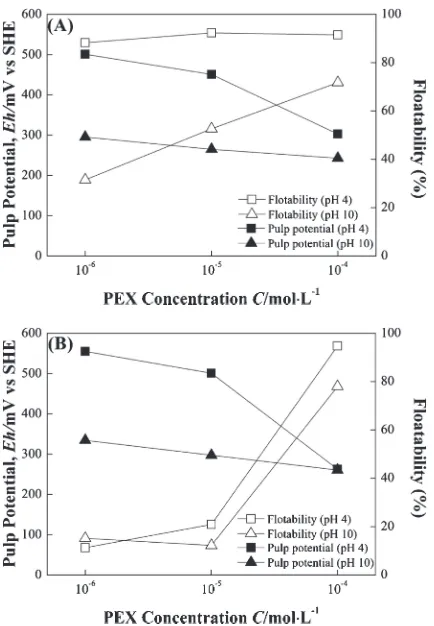
[image:3.595.319.533.70.236.2]and 1©10¹5, the E
Hvalues of arsenopyrite pulp measured 500.8 and 450.7 mV (vs SHE), which represents a stable range of dixanthogen as reported in a previous study,14) resulting in the highfloatability of arsenopyrite. However, in contrast, under pH 10 condition, when the PEX concen-trations were 1©10¹6 and 1©10¹5M, the EH values of arsenopyrite pulp were 295.3 and 264.9 mV (vs SHE), which was beyond the range of stable existence of dixanthogen.27) As such, the floatability of arsenopyrite at pH 10 was relatively lower than that at pH 4.
As Fig. 3(B) shows, similar to the arsenopyritefloatability result (Fig. 3(A)), the pyrite floatability was highest at a PEX concentration of 1©10¹4M, regardless of the pH and
EH value. Meanwhile, under pH 10 condition, when the PEX concentrations were 1©10¹6 and 1©10¹5M, theE
H values of pyrite pulp were 334.3 and 297.3 mV (vs SHE), respectively. As these values are beyond the stable scope of dixanthogen, as with the test result of arsenopyrite, the floatability was low. But, the interesting result is that despite the highEHvalue at pH 4 (i.e., despite the stable formation of dixanthogen), this shows that the pyritefloatability was low, which was not consistent with the observed trend of test results with arsenopyrite. To explain the reason for different trends of floatability of pyrite and arsenopyrite under a similar condition (i.e., a similarEHrange of stable formation of dixanthogen), surface analysis was carried out using FTIR spectroscopy of arsenopyrite and pyrite that were adsorbed with PEX 1©10¹6M under pH 4. Figure 4 shows the results. For pyrite at pH 4, it was confirmed that an SO42¹
peak (strong peak at 1080 cm¹1 and medium peak at 595 cm¹1)9,28) appeared clearly; but there was almost no SO42¹ peak for arsenopyrite. The trend is likely due to the difference of mineralogical structure of the two minerals. Specifically, according to the previous researches, sulfide ions on the surface of arsenopyrite and pyrite reacted with oxygen in pulp during agitation, and formed an SO42¹ layer on the mineral surface that inhibited adsorption with xanthate.29,30) Based on the results from the previous study and the present study, the pyrite floatability was low because of poor adsorption with xanthate, since pyrite with simple minera-logical structure likely formed SO42¹layer easily, via surface oxidation. In contrast, arsenopyrite with complicated min-eralogical structure had relatively low surface oxidation that did not form an SO42¹ layer.9) Thus, the adsorption with xanthate was effective, and the floatability was higher than that of pyrite.
3.3 Selectiveflotation of arsenopyrite and pyrite
When the correlations between the floatability and EH of single minerals (i.e., arsenopyrite and pyrite) were examined, high EH values appeared at low pH and low PEX concentration, and under the same condition, there was a high difference in floatability between arsenopyrite and pyrite. In order to further examine the flotation behavior of mixed sample (i.e., mixture of arsenopyrite and pyrite), flotation tests were performed with the mixed sample, by changing the PEX concentration (5©10¹7, 10¹6, and 10¹5M). The mixed ratio of the two minerals wasfixed at 1 : 1, and the pulp pH was fixed at pH 4. The selectivity indices (i.e., pyrite recovery/arsenopyrite recovery ratio), as well as the recoveries of arsenopyrite and pyrite were determined, and Fig. 5 presents the results. At 5©10¹7M PEX, the recoveries of arsenopyrite and pyrite were 9%and 61%, respectively; at 10¹6M PEX, the recoveries of arsenopyrite and pyrite were 22% and 71%, respectively; and at 10¹5M PEX, the recoveries of arsenopyrite and pyrite were 63%and 84%, respectively. Meanwhile, the selectivity indices of the two minerals were 1.33 at 10¹5M PEX, 3.16 at 10¹6M PEX, and 6.4 at 5©10¹7M PEX. The results indicate that the selectivity index value increased with Fig. 3 Change of pulp potential (solid) and floatability (blank) of
(A) arsenopyrite, and (B) pyrite, according to the PEX concentration, at pH 4 (square) and 10 (triangle). All experiments were conducted at 25°C.
[image:4.595.62.279.67.380.2] [image:4.595.314.535.69.241.2]decreasing PEX concentration. Although it may not be directly comparable due to the difference in a scale of the system tested, it is still worth pointing out that the maximum selectivity index value (³6.4) from the present study was found to be greater than the greatest value (³4.2)18)reported so far for similar mineral mixture. A previous study reported that arsenic sulfide was more affected by EH than other sulfides without arsenic, when the flotation process was performed.14) Based on the previous work, we also hypothesized that at high EH, arsenic oxide was formed on the surface of arsenopyrite, resulting in poor adsorption with xanthate. To confirm the hypothesis, XRD analysis was performed with a mixed sample under 5©10¹7M PEX condition, in which the selectivity index was the highest, and Fig. 6 presents the results. Figure 6(A) shows the XRD pattern of mixed sample of arsenopyrite and pyrite. For the purpose of comparison, the XRD patterns of raw pyrite and raw arsenopyrite are also presented in Figs. 6(B) and (C). No peak corresponding to ferric arsenate (denoted as F)31) was observed for raw pyrite (Fig. 6(B)) and arsenopyrite (Fig. 6(C)), but, as for the mixed sample treated with 5©10¹7M PEX at pH 4, a peak of ferric arsenate was observed (Fig. 6(A)). According to the previous researches, through the oxidation reaction of arsenopyrite, arsenate anion (AsO43¹) and ferric hydroxide (Fe(OH)3) were initially formed, and then ferric arsenate was formed on the arsenopyrite surface, by the reaction between these oxide materials.3234) In particular, ferric arsenate is hydrophilic arsenic oxide, and has a very stable crystal structure at high
EH.15) Therefore, the low floatability of arsenopyrite is believed to result from poor adsorption of xanthate onto arsenopyrite, due to the ferric arsenate layer that forms on the arsenopyrite surface.
4. Conclusions
In the present study, the effects of pH and pulp potential (EH) on theflotation behavior of arsenopyrite and pyrite were systematically investigated, by using xanthate as a collector, and the following conclusions were drawn:
(1) For theflotation of a single mineral, thefloatabilities of arsenopyrite and pyrite in the acidic pH range were relatively higher than in the alkali condition.
(2) The reason for higher floatability of arsenopyrite in acidic pH than alkali pH was that stable dixanthogen was adsorbed on the arsenopyrite surface, due to the high EHvalue of pulp. Conversely, at alkali pH range, the arsenopyrite floatability was low, as dixanthogen was unstable, due to the lowEHvalue of pulp. (3) The pyritefloatability was low at both acidic and alkali
pHs. At alkali pH range, the floatability was low, as dixanthogen was unstable, which resulted in poor adsorption of xanthate onto the pyrite surface, due to the lowEHvalue of pulp. For the acidic pH condition, despite the highEHvalue, adsorption with dixanthogen did not properly occur, due to the SO42¹ layer that formed on pyrite surface, via the reaction with oxygen in pulp.
(4) When flotation tests were performed by mixing arsenopyrite and pyrite at 1 : 1, the lowest PEX concentration had the highest selectivity index of arsenopyrite and pyrite. This was because ferric arsenate, a hydrophilic compound, created by the oxidation of arsenopyrite surface as arsenopyrite, was affected by theEHmore than was pyrite.
Acknowledgements
Both Kyuhyeong Park and Junhyun Choi equally con-tributed to this manuscript. This work was in part supported by the Korea Institute of Geoscience and Mineral Resources Fig. 5 Recovery and selectivity index for mixed sample of arsenopyrite
and pyrite, according to the PEX concentration. The mixed ratio of arsenopyrite and pyrite was 1 to 1, and all experiments were carried out at pH 4 and 25°C. The selectivity index is defined as the ratio of pyrite recovery and arsenopyrite recovery.
[image:5.595.318.532.67.341.2] [image:5.595.64.277.69.220.2](KIGAM) funded by the Ministry of Knowledge Economy of Korea and the Global Ph.D Fellowship Program through the National Research Foundation of Korea (NRF) funded by the Ministry of Education (2014H1A2A1020346).
REFERENCES
1) J. C. Ng, J. P. Wang and A. Shraim:Chemosphere52(2003) 1353 1359.
2) P. Lattanzi, S. D. Pelo, E. Musu, D. Atzei, B. Elsener, M. Fantauzzi and A. Rossi:Earth Sci. Rev.86(2008) 6288.
3) G. Long, Y. Peng and D. Bradshaw:Miner. Eng.3638(2012) 179 186.
4) P. L. Smedley and D. G. Kinniburgh:Appl. Geochem.17(2002) 517 568.
5) A. H. Smith, C. Hopenhaynrich, M. N. Bates, H. M. Goeden, I. Hertzpicciotto, H. M. Duggan, R. Wood, M. J. Kosnett and M. T. Smith:Environ. Health Persp.97(1992) 259267.
6) G. Morizot and P. Ollivier:Miner. Eng.6(1993) 841856.
7) P. C. Wilson and C. Chanroux: Cost Estimation Handbook for the Australian Mining Industry, ed. by M. Noakes and T. Lanz, (The Australian Institute of Mining and Metallurgy, 1993) pp. 325368. 8) L. K. Smith and W. J. Bruckard:Int. J. Miner. Process.84(2007) 15
24.
9) A. M. Abeidu and A. M. Almahdy:Int. J. Miner. Process. 6(1980) 285302.
10) W. T. Yen and J. Tajadod: Selective depression of enargite and chalcopyrite, Proc. of XXI Int. Miner. Process. Cong., Rome, ed. by P. Massacci, (2000) pp. 4955.
11) J. M. Menacho, W. Aliaga, R. Valenuela, V. Ramos and I. Olivares: Minerals48(1993) 3339.
12) R. O. Huch: Method for achieving enhanced copper-containing mineral concentrate grade by oxidation andflotation. U.S. Patent 5,295,585, (1994).
13) D. Fornasiero, D. Fullson and J. Ralston:Int. J. Miner. Process. 61 (2001) 109119.
14) C. Kantar:Colloid. Surface A210(2002) 2331.
15) A. López Valdivieso, A. A. Sánchez López, C. Ojeda Escamilla and M. C. Fuerstenau:Int. J. Miner. Process.81(2006) 2734.
16) X. Ma and W. J. Bruckard:Int. J. Miner. Process.93(2009) 8994. 17) G. W. Poling and J. V. Beattie: Selective depression in complex
sulphideflotation, Principles of Mineral Flotation, ed. by M. H. Jones and J. T. Woodeock, (The Australian Institute of Mining and Metallurgy, Melbourne, 1984) pp. 137146.
18) A. A. Sirkeci:Int. J. Miner. Process.60(2000) 263276. 19) B. Tapley and D. Yan:Miner. Eng.16(2003) 12171220.
20) A. López Valdivieso, C. O. Escamila, S. Song, I. L. Baez and I. G. Martínez:Int. J. Miner. Process.69(2003) 175184.
21) J. Choi, K. Park, J. Hong, J. Park and H. Kim:Meter. Trans.54(2013) 22912296.
22) J. Choi, J. Hong, K. Park, G. Kim, Y. Han, S. Kim and H. Kim:Mater. Trans.55(2014) 13441349.
23) A. M. Gaudin: Flotation, (McGraw-Hill, New York, N.Y., 1957) p. 552.
24) K. L. Sutherland and I. W. Wark:Principles of Flotation, (Australian Institute of Mining and Metallurgy, Melbourne, 1955) p. 117. 25) R. Woods: Flotation of Sulfide Minerals, Reagents in Mineral
Technology, Surfactant Science Series 27, ed. by P. Somasundaran and B. M. Moudgil, (Marcel Dekker Inc., New York, 1998) 3978. 26) H. Guo and W. Yen:Miner. Eng.18(2005) 605612.
27) W. J. Bruckard, I. Kyriakidis and J. T. Woodcock: Int. J. Miner. Process.84(2007) 2532.
28) R. G. White:Handbook of Industrial Infrared Analysis, (Plenum Press, New York, N.Y., 1964) 178218.
29) A. N. Buckley and R. Woods:Appl. Surf. Sci.27(1987) 437452. 30) A. P. Chandra and A. R. Gerson:Adv. Colloid Interface Sci.145(2009)
97110.
31) M. J. V. Beattie and G. W. Poling:Int. J. Miner. Process.20(1987) 87 108.
32) Y. Jia, L. Xu, X. Wang and G. P. Demopoulos:Geochim. Cosmochim. Acta71(2007) 16431654.
33) M. B. M. Monte, A. J. B. Dutra, C. F. R. Alburqueque, L. A. Tondo and F. F. Lins:Miner. Eng.15(2002) 11131120.