Finding Synonyms Using Automatic Word Alignment and Measures of
Distributional Similarity
Lonneke van der Plas & J¨org Tiedemann Alfa-Informatica
University of Groningen P.O. Box 716 9700 AS Groningen
The Netherlands
{vdplas,tiedeman}@let.rug.nl
Abstract
There have been many proposals to ex-tract semantically related words using measures of distributional similarity, but these typically are not able to distin-guish between synonyms and other types of semantically related words such as antonyms, (co)hyponyms and hypernyms. We present a method based on automatic word alignment of parallel corpora con-sisting of documents translated into mul-tiple languages and compare our method with a monolingual syntax-based method. The approach that uses aligned multilin-gual data to extract synonyms shows much higher precision and recall scores for the task of synonym extraction than the mono-lingual syntax-based approach.
1 Introduction
People use multiple ways to express the same idea. These alternative ways of conveying the same in-formation in different ways are referred to by the term paraphrase and in the case of single words sharing the same meaning we speak ofsynonyms. Identification of synonyms is critical for many NLP tasks. In information retrieval the informa-tion that people ask for with a set of words may be found in in a text snippet that comprises a com-pletely different set of words. In this paper we report on our findings trying to automatically ac-quire synonyms for Dutch using two different re-sources, a large monolingual corpus and a multi-lingual parallel corpus including 11 languages.
A common approach to the automatic extrac-tion of semantically related words is to use dis-tributional similarity. The basic idea behind this is
that similar words share similar contexts. Systems based on distributional similarity provide ranked lists of semantically related words according to the similarity of their contexts. Synonyms are ex-pected to be among the highest ranks followed by (co)hyponyms and hypernyms, since the highest degree of semantic relatedness next to identity is synonymy.
However, this is not always the case. Sev-eral researchers (Curran and Moens (2002), Lin (1998), van der Plas and Bouma (2005)) have used large monolingual corpora to extract distribution-ally similar words. They use grammatical rela-tions1 to determine the context of a target word.
We will refer to such systems as monolingual syntax-basedsystems. These systems have proven to be quite successful at finding semantically re-lated words. However, they do not make a clear distinction between synonyms on the one hand and related words such as antonyms, (co)hyponyms, hypernyms etc. on the other hand.
In this paper we have defined context in a mul-tilingual setting. In particular, translations of a word into other languages found in parallel cor-pora are seen as the (translational) context of that word. We assume that words that share transla-tional contexts are semantically related. Hence, relatedness of words is measured using distribu-tional similarity in the same way as in the mono-lingual case but with a different type of context. Finding translations in parallel data can be
approx-1One can define the context of a word in a non-syntactic
monolingual way, that is as the document in which it occurs or then words surrounding it. From experiments we have
done and also building on the observations made by other researchers (Kilgarriff and Yallop, 2000) we can state that this approach generates a type of semantic similarity that is of alooserkind, an associative kind,for exampledoctorand
disease. These words are typically not good candidates for synonymy.
imated by automatic word alignment. We will refer to this approach as multilingual alignment-based approaches. We expect that these transla-tions will give us synonyms and less semantically related words, because translations typically do not expand to hypernyms, nor (co)hyponyms, nor antonyms. The wordapple is typically not trans-lated with a word forfruitnorpear, and neither is
goodtranslated with a word forbad.
In this paper we use both monolingual syntax-based approaches and multilingual alignment-based approaches and compare their performance when using the same similarity measures and eval-uation set.
2 Related Work
Monolingual syntax-based distributional similar-ity is used in many proposals to find semanti-cally related words (Curran and Moens (2002), Lin (1998), van der Plas and Bouma (2005)).
Several authors have used a monolingual par-allel corpus to find paraphrases (Ibrahim et al. (2003), Barzilay and McKeown (2001)). How-ever, bilingual parallel corpora have mostly been used for tasks related to word sense disambigua-tion such as target word selecdisambigua-tion (Dagan et al., 1991) and separation of senses (Dyvik, 1998). The latter work derives relations such as synonymy and hyponymy from the separated senses by applying the method of semantic mirrors.
Turney (2001) reports on an PMI and IR driven approach that acquires data by querying a Web search engine. He evaluates on the TOEFL test in which the system has to select the synonym among 4 candidates.
Lin et al. (2003) try to tackle the problem of identifying synonyms among distributionally re-lated words in two ways: Firstly, by looking at the overlap in translations of semantically similar words in multiple bilingual dictionaries. Secondly, by looking at patterns specifically designed to fil-ter out antonyms. They evaluate on a set of 80 synonyms and 80 antonyms from a thesaurus.
Wu and Zhou’s (2003) paper is most closely re-lated to our study. They report an experiment on synonym extraction using bilingual resources (an English-Chinese dictionary and corpus) as well as monolingual resources (an English dictionary and corpus). Their monolingual corpus-based ap-proach is very similar to our monolingual corpus-based approach. The bilingual approach is
dif-ferent from ours in several aspects. Firstly, they do not take the corpus as the starting point to re-trieve word alignments, they use the bilingual dic-tionary to retrieve multiple translations for each target word. The corpus is only employed to as-sign probabilities to the translations found in the dictionary. Secondly, the authors use a parallel corpus that is bilingual whereas we use a multi-lingual corpus containing 11 languages in total. The authors show that the bilingual method out-performs the monolingual methods. However a combination of different methods leads to the best performance.
3 Methodology
3.1 Measuring Distributional Similarity
An increasingly popular method for acquiring se-mantically similar words is to extract distribution-ally similar words from large corpora. The under-lying assumption of this approach is that seman-tically similar words are used in similar contexts. The contexts a given word is found in, be it a syn-tactic context or an alignment context, are used as the features in the vector for the given word, the so-called context vector. The vector contains fre-quency counts for each feature, i.e., the multiple contexts the word is found in.
Context vectors are compared with each other in order to calculate the distributional similarity between words. Several measures have been pro-posed. Curran and Moens (2002) report on a large-scale evaluation experiment, where they evaluated the performance of various commonly used meth-ods. Van der Plas and Bouma (2005) present a similar experiment for Dutch, in which they tested most of the best performing measures according to Curran and Moens (2002). Pointwise Mutual Information (I) andDice†performed best in their
experiments. Diceis a well-known combinatorial measure that computes the ratio between the size of the intersection of two feature sets and the sum of the sizes of the individual feature sets. Dice†
is a measure that incorporates weighted frequency counts.
Dice†= 2
P
fmin(I(W1, f), I(W2, f))
P
fI(W1, f) +I(W2, f)
,wherefis the feature
3.2 Weighting
We will now explain why we use weighted fre-quencies and which formula we use for weighting. The information value of a cell in a word vec-tor (which lists how often a word occurred in a specific context) is not equal for all cells. We will explain this using an example from mono-lingual syntax-based distributional similarity. A large number of nouns can occur as the subject of the verb have, for instance, whereas only a few nouns may occur as the object of squeeze. Intu-itively, the fact that two nouns both occur as sub-ject ofhavetells us less about their semantic sim-ilarity than the fact that two nouns both occur as object of squeeze. To account for this intuition, the frequency of occurrence in a vector can be re-placed by a weighted score. The weighted score is an indication of the amount of information car-ried by that particular combination of a noun and its feature.
We believe that this type of weighting is benefi-cial for calculating similarity between word align-ment vectors as well. Word alignalign-ments that are shared by many different words are most probably mismatches.
For this experiment we used Pointwise Mutual Information (I) (Church and Hanks, 1989).
I(W, f) =log P(W, f) P(W)P(f)
,where W is the target word
P(W) is the probability of seeing the word P(f) is the probability of seeing the feature
P(W,f) is the probability of seeing the word and the feature together.
3.3 Word Alignment
The multilingual approach we are proposing relies on automatic word alignment of parallel corpora from Dutch to one or more target languages. This alignment is the basic input for the extraction of thealignment contextas described in section 5.2.2. The alignment context is then used for measuring distributional similarity as introduced above.
For the word alignment, we apply standard tech-niques derived from statistical machine transla-tion using the well-known IBM alignment mod-els (Brown et al., 1993) implemented in the open-source tool GIZA++ (Och, 2003). These mod-els can be used to find links between words in a source language and a target language given sen-tence aligned parallel corpora. We applied
stan-dard settings of the GIZA++ system without any optimisation for our particular input. We also used plain text only, i.e. we did not apply further pre-processing except tokenisation and sentence split-ting. Additional linguistic processing such as lem-matisation and multi-word unit detection might help to improve the alignment but this is not part of the present study.
The alignment models produced are asymmet-ric and several heuristics exist to combine direc-tional word alignments to improve alignment ac-curacy. We believe, that precision is more cru-cial than recall in our approach and, therefore, we apply a very strict heuristics namely we compute the intersection of word-to-word links retrieved by GIZA++. As a result we obtain partially word-aligned parallel corpora from which translational context vectors are built (see section 5.2.2). Note, that the intersection heuristics allows one-to-one word links only. This is reasonable for the Dutch part as we are only interested in single words and their synonyms. However, the distributional con-text of these words defined by their alignments is strongly influenced by this heuristics. Problems caused by this procedure will be discussed in de-tail in section 7 of our experiments.
4 Evaluation Framework
In the following, we describe the data used and measures applied.
The evaluation method that is most suitable for testing with multiple settings is one that uses an available resource for synonyms as a gold standard. In our experiments we apply auto-matic evaluation using an existing hand-crafted synonym database, Dutch EuroWordnet (EWN, Vossen (1998)).
above 4 for which the systems under comparison produce output.
The drawback of using such a resource is that coverage is often a problem. Not all words that our system proposes as synonyms can be found in Dutch EWN. Words that are not found in EWN are discarded.2. Moreover, EWN’s synsets are not
exhaustive. After looking at the output of our best performing system we were under the impression that many correct synonyms selected by our sys-tem were classified as incorrect by EWN. For this reason we decided to run a human evaluation over a sample of 100 candidate synonyms classified as incorrect by EWN.
5 Experimental Setup
In this section we will describe results from the two synonym extraction approaches based on dis-tributional similarity: one using syntactic context and one using translational context based on word alignment and the combination of both. For both approaches, we used a cutoffnfor each row in our
word-by-context matrix. A word is discarded if the row marginal is less thann. This means that
each word should be found in any context at least
ntimes else it will be discarded. We refer to this
by the termminimum row frequency. The cutoff is used to make the feature space manageable and to reduce noise in the data. 3
5.1 Distributional Similarity Based on Syntactic Relations
This section contains the description of the syn-onym extraction approach based on distributional similarity and syntactic relations. Feature vectors for this approach are constructed from syntacti-cally parsed monolingual corpora. Below we de-scribe the data and resources used, the nature of the context applied and the results of the synonym extraction task.
5.1.1 Data and Resources
As our data we used the Dutch CLEF QA cor-pus, which consists of 78 million words of Dutch
2Note that we use the part of EWN that contains only
nouns
3We have determined the optimum in F-score for the
alignment-based method, the syntax-based method and the combination independently by using a development set of 1000 words that has no overlap with the test set used in eval-uation. The minimum row frequency was set to 2 for all alignment-based methods. It was set to 46 for the syntax-based method and the combination of the two methods.
subject-verb cat eat
verb-object feed cat
adjective-noun black cat
coordination cat dog
apposition cat Garfield
[image:4.595.346.490.179.295.2]prep. complement go+to work
Table 1: Types of dependency relations extracted
grammatical relation # pairs
subject 507K
object 240K
adjective 289K coordination 400 K apposition 109K prep. complement 84K
total 1629K
Table 2: Number of word-syntactic-relation pairs (types) per dependency relation with frequency>
1.
newspaper text (Algemeen Dagblad and NRC Handelsblad 1994/1995). The corpus was parsed automatically using the Alpino parser (van der Beek et al., 2002; Malouf and van Noord, 2004). The result of parsing a sentence is a dependency graph according to the guidelines of the Corpus of Spoken Dutch (Moortgat et al., 2000).
5.1.2 Syntactic Context
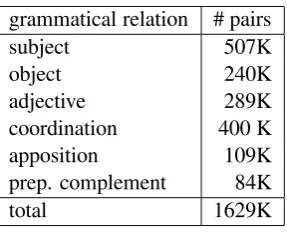
We have used several grammatical relations: subect, object, adjective, coordination, apposi-tion and preposiapposi-tional complement. Examples are given in table 1. Details on the extraction can be found in van der Plas and Bouma (2005). The number of pairs (types) consisting of a word and a syntactic relation found are given in table 2. We have discarded pairs that occur less than 2 times.
5.2 Distributional Similarity Based on Word Alignment
5.2.1 Data and Resources
Measures of distributional similarity usually re-quire large amounts of data. For the alignment method we need a parallel corpus of reasonable size with Dutch either as source or as target lan-guage. Furthermore, we would like to experiment with various languages aligned to Dutch. The freely available Europarl corpus (Koehn, 2003) includes 11 languages in parallel, it is sentence aligned, and it is of reasonable size. Thus, for acquiring Dutch synonyms we have 10 language pairs with Dutch as the source language. The Dutch part includes about 29 million tokens in about 1.2 million sentences. The entire corpus is sentence aligned (Tiedemann and Nygaard, 2004) which is a requirement for the automatic word alignment described below.
5.2.2 Alignment Context
Context vectors are populated with the links to words in other languages extracted from automatic word alignment. We applied GIZA++ and the in-tersection heuristics as explained in section . From the word aligned corpora we extracted word type links, pairs of source and target words with their alignment frequency attached. Each aligned target word type is a feature in the (translational) context of the source word under consideration.
Note that we rely entirely on automatic process-ing of our data. Thus, results from the automatic word alignments include errors and their precision and recall is very different for the various language pairs. However, we did not assess the quality of the alignment itself which would be beyond the scope of this paper.
As mentioned earlier, we did not include any linguistic pre-processing prior to the word align-ment. However, we post-processed the alignment results in various ways. We applied a simple lem-matizer to the list of bilingual word type links in order to 1) reduce data sparseness, and 2) to facilitate our evaluation based on comparing our results to existing synonym databases. For this we used two resources: CELEX – a linguistically annotated dictionary of English, Dutch and Ger-man (Baayen et al., 1993), and the Dutch snow-ball stemmer implementing a suffix stripping al-gorithm based on the Porter stemmer. Note that lemmatization is only done for Dutch. Further-more, we removed word type links that include non-alphabetic characters to focus our investiga-tions on ’real words’. In order to reduce alignment
noise, we also applied a frequency threshold to re-move alignments that occur only once. Finally, we restricted our study to Dutch nouns. Hence, we extracted word type links for all words tagged as noun in CELEX. We also included words which are not found at all in CELEX assuming that most of them will be productive noun constructions.
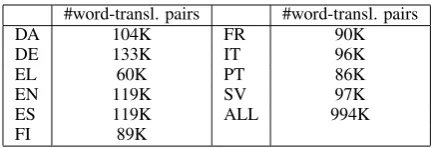
From the remaining word type links we popu-lated the context vectors as described earlier. Ta-ble 3 shows the number of context elements ex-tracted in this manner for each language pair con-sidered from the Europarl corpus4
#word-transl. pairs #word-transl. pairs
DA 104K FR 90K
DE 133K IT 96K
EL 60K PT 86K
EN 119K SV 97K
ES 119K ALL 994K
[image:5.595.308.524.236.310.2]FI 89K
Table 3: Number of word-translation pairs for dif-ferent languages with alignment frequency>1
6 Results and Discussion
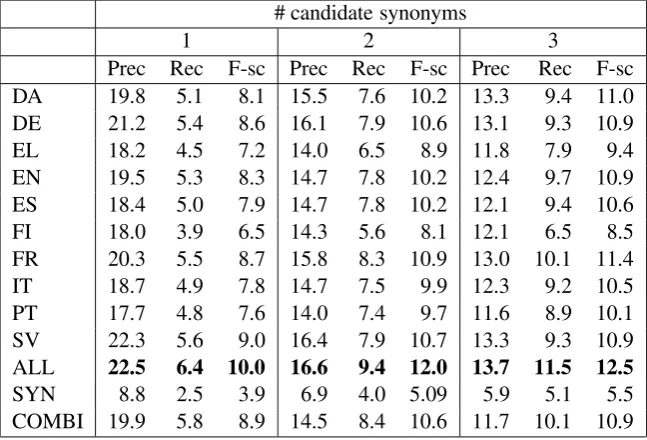
Table 4 shows the precision recall en F-score for the different methods. The first 10 rows refer to the results for all language pairs individually. The 11th row corresponds to the setting in which all alignments for all languages are combined. The penultimate row shows results for the syntax-based method and the last row the combination of the syntax-based and alignment-based method.
Judging from the precision, recall and F-score in table 4 Swedish is the best performing lan-guage for Dutch synonym extraction from parallel corpora. It seems that languages that are similar to the target language, for example in word or-der, are good candidates for finding synonyms at high precision rates. Also the fact that Dutch and Swedish both have one-word compounds avoids mistakes that are often found with the other lan-guages. However, judging from recall (and F-score) French is not a bad candidate either. It is possible that languages that are lexically different from the target language provide more synonyms. The fact that Finnish and Greek do not gain high scores might be due to the fact that there are only a limited amount of translational contexts (with a frequency > 1) available for these language (as
is shown in table 3). The reasons are twofold.
# candidate synonyms
1 2 3
Prec Rec F-sc Prec Rec F-sc Prec Rec F-sc DA 19.8 5.1 8.1 15.5 7.6 10.2 13.3 9.4 11.0 DE 21.2 5.4 8.6 16.1 7.9 10.6 13.1 9.3 10.9 EL 18.2 4.5 7.2 14.0 6.5 8.9 11.8 7.9 9.4 EN 19.5 5.3 8.3 14.7 7.8 10.2 12.4 9.7 10.9 ES 18.4 5.0 7.9 14.7 7.8 10.2 12.1 9.4 10.6 FI 18.0 3.9 6.5 14.3 5.6 8.1 12.1 6.5 8.5 FR 20.3 5.5 8.7 15.8 8.3 10.9 13.0 10.1 11.4 IT 18.7 4.9 7.8 14.7 7.5 9.9 12.3 9.2 10.5 PT 17.7 4.8 7.6 14.0 7.4 9.7 11.6 8.9 10.1 SV 22.3 5.6 9.0 16.4 7.9 10.7 13.3 9.3 10.9 ALL 22.5 6.4 10.0 16.6 9.4 12.0 13.7 11.5 12.5
[image:6.595.137.461.63.283.2]SYN 8.8 2.5 3.9 6.9 4.0 5.09 5.9 5.1 5.5 COMBI 19.9 5.8 8.9 14.5 8.4 10.6 11.7 10.1 10.9
Table 4: Precision, recall and F-score (%) at increasing number of candidate synonyms
Firstly, for Greek and Finnish the Europarl corpus contains less data. Secondly, the fact that Finnish is a language that has a lot of cases for nouns, might lead to data sparseness and worse accuracy in word alignment.
The results in table 4 also show the difference in performance between the multilingual alignment-method and the syntax-based alignment-method. The mono-lingual alignment-based method outperforms the syntax-based method by far. The syntax-based method that does not rely on scarce multilingual resources is more portable and also in this exper-iment it makes use of more data. However, the low precision scores of this method are not con-vincing. Combining both methods does not result in better performance for finding synonyms. This is in contrast with the results reported by Wu and Zhou (2003). This might well be due to the more sophisticated method they use for combining dif-ferent methods, which is a weighted combination. The precision scores are in line with the scores reported by Wu and Zhou (2003) in a similar ex-periment discussed under related work. The re-call we attain however is more than three times higher. These differences can be due to differences between their approach such as starting from a bilingual dictionary for acquiring the translational context versus using automatic word alignments from a large multilingual corpus directly. Further-more, the different evaluation methods used make comparison between the two approaches difficult. They use a combination of the English
Word-Net (Fellbaum, 1998) and Roget thesaurus (Ro-get, 1911) as a gold standard in their evaluations. It is obvious that a combination of these resources leads to larger sets of synonyms. This could ex-plain the relatively low recall scores. It does how-ever not explain the similar precision scores.
We conducted a human evaluation on a sample of 100 candidate synonyms proposed by our best performing system that were classified as incor-rect by EWN. Ten evaluators (authors excluded) were asked to classify the pairs of words as syn-onyms or non-synsyn-onyms using a web form of the format yes/no/don’t know. For 10 out of the 100 pairs all ten evaluators agreed that these were syn-onyms. For 37 of the 100 pairs more than half of the evaluators agreed that these were synonyms. We can conclude from this that the scores provided in our evaluations based on EWN (table 4) are too pessimistic. We believe that the actual precision scores lie 10 to 37 % higher than the 22.5 % re-ported in table 4. Over and above, this indicates that we are able to extract automatically synonyms that are not yet covered by available resources.
7 Error Analysis
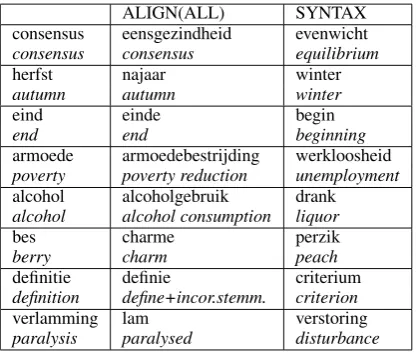
In table 5 some example output is given for the method combining word alignments of all 10 for-eign languages as opposed to the monolingual syntax-based method. These examples illustrate the general patterns that we discovered by looking into the results for the different methods.
syntax-ALIGN(ALL) SYNTAX consensus eensgezindheid evenwicht
consensus consensus equilibrium
herfst najaar winter
autumn autumn winter
eind einde begin
end end beginning
armoede armoedebestrijding werkloosheid
poverty poverty reduction unemployment
alcohol alcoholgebruik drank
alcohol alcohol consumption liquor
bes charme perzik
berry charm peach
definitie definie criterium
definition define+incor.stemm. criterion
verlamming lam verstoring
[image:7.595.78.287.61.237.2]paralysis paralysed disturbance
Table 5: Example candidate synonyms at 1st rank and their translations in italics
based method often finds semantically related words whereas the alignment-based method finds synonyms. The reasons for this are quite obvious. Synonyms are likely to receive identical transla-tions, words that are only semantically related are not. A translator would not often translate auto
(car) withvrachtwagen(truck). However, the two words are likely to show up in identical syntactic relations, such as being the object ofdriveor ap-pearing in coordination withmotorcycle.
Another observation that we made is that the syntax-based method often finds antonyms such as
begin(beginning) for the wordeinde(end). Expla-nations for this are in line with what we said about the semantically related words: Synonyms are likely to receive identical translations, antonyms are not but they do appear in similar syntactic con-texts.
Compounds pose a problem for the alignment-method. We have chosen intersection as align-ment method. It is well-known that this method cannot cope very well with the alignment of com-pounds because it only allows one-to-one word links. Dutch uses many one-word compounds that should be linked to multi-word counterparts in other languages. However, using intersection we obtain only partially correct alignments and this causes many mistakes in the distributional simi-larity algorithm. We have given some examples in rows 4 and 5 of table 5.
We have used the distributional similarity score only for ranking the candidate synonyms. In some cases it seems that we should have used it to set a threshold such as in the case ofberryandcharm.
These two words share one translational context : the article el in Spanish. The distributional sim-ilarity score in such cases is often very low. We could have filtered some of these mistakes by set-ting a threshold.
One last observation is that the alignment-based method suffers from incorrect stemming and the lack of sufficient part-of-speech information. We have removed all context vectors that were built for a word that was registered in CELEX with a PoS-tag different from ’noun’. But some words are not found in CELEX and although they are not of the word type ’noun’ their context vec-tors remain in our data. They are stemmed using the snowball stemmer. The candidate synonym
definie is a corrupted verbform that is not found in CELEX. Lamis ambiguous between the noun reading that can be translated in English withlamb
and the adjectivelamwhich can be translated with
paralysed. This adjective is related to the word
verlamming (paralysis), but would have been re-moved if the word was correctly PoS-tagged.
8 Conclusions
Parallel corpora are mostly used for tasks related to WSD. This paper shows that multilingual word alignments can be applied to acquire synonyms automatically without the need for resources such as bilingual dictionaries. A comparison with a monolingual syntax-based method shows that the alignment-based method is able to extract syn-onyms with much greater precision and recall. A human evaluation shows that the synonyms the alignment-based method finds are often missing in EWN. This leads us to believe that the precision scores attained by using EWN as a gold standard are too pessimistic. Furthermore it is good news that we seem to be able to find synonyms that are not yet covered by existing resources.
syntax-based and the alignment-based methods.
Acknowledgements
This research was carried out in the project
Question Answering using Dependency Relations, which is part of the research program for Inter-act ive Multimedia Information ExtrInter-action, IMIX,
financed byNWO, the Dutch Organisation for
Sci-entific Research.
References
R.H. Baayen, R. Piepenbrock, and H. van Rijn. 1993. The CELEX lexical database (CD-ROM). Lin-guistic Data Consortium, University of Pennsylva-nia,Philadelphia.
Regina Barzilay and Kathleen McKeown. 2001. Ex-tracting paraphrases from a parallel corpus. In Meet-ing of the Association for Computational LMeet-inguis- Linguis-tics, pages 50–57.
Peter F. Brown, Stephen A. Della Pietra, Vincent J. Della Pietra, and Robert L. Mercer. 1993. The mathematics of statistical machine translation: Pa-rameter estimation. Computational Linguistics, 19(2):263–296.
K.W. Church and P. Hanks. 1989. Word association norms, mutual information and lexicography. Pro-ceedings of the 27th annual conference of the Asso-ciation of Computational Linguistics, pages 76–82. J.R. Curran and M. Moens. 2002. Improvements in
automatic thesaurus extraction. InProceedings of the Workshop on Unsupervised Lexical Acquisition, pages 59–67.
Ido Dagan, Alon Itai, and Ulrike Schwall. 1991. Two languages are more informative than one. In Meet-ing of the Association for Computational LMeet-inguis- Linguis-tics, pages 130–137.
Helge Dyvik. 1998. Translations as semantic mirrors. InProceedings of Workshop Multilinguality in the Lexicon II, ECAI 98, Brighton, UK, pages 24–44. C. Fellbaum. 1998. Wordnet, an electronic lexical
database. MIT Press.
A. Ibrahim, B. Katz, and J. Lin. 2003. Extract-ing structural paraphrases from aligned monolExtract-ingual corpora.
A. Kilgarriff and C. Yallop. 2000. What’s in a the-saurus? InProceedings of the Second Conference on Language Resource an Evaluation, pages 1371– 1379.
Philipp Koehn. 2003. Europarl: A multilin-gual corpus for evaluation of machine trans-lation. unpublished draft, available from
http://people.csail.mit.edu/koehn/publications/europarl/.
Dekang Lin, Shaojun Zhao, Lijuan Qin, and Ming Zhou. 2003. Identifying synonyms among distribu-tionally similar words. InIJCAI, pages 1492–1493.
Dekang Lin. 1998. Automatic retrieval and clustering of similar words. InCOLING-ACL, pages 768–774.
Robert Malouf and Gertjan van Noord. 2004. Wide coverage parsing with stochastic attribute value grammars. InIJCNLP-04 Workshop Beyond Shal-low Analyses - Formalisms and stati stical modeling for deep analyses, Hainan.
Michael Moortgat, Ineke Schuurman, and Ton van der Wouden. 2000. CGN syntactische annotatie. In-ternal Project Report Corpus Gesproken Nederlands, see http://lands. let.kun.nl/cgn.
Franz Josef Och. 2003. GIZA++: Training of statistical translation models. Available from
http://www.isi.edu/˜och/GIZA++.html.
P. Roget. 1911. Thesaurus of English words and phrases.
J¨org Tiedemann and Lars Nygaard. 2004. The OPUS corpus - parallel & free. In Proceedings of the Fourth International Conference on Language Re-sources and Evaluation (LREC’04), Lisbon, Portu-gal.
Peter D. Turney. 2001. Mining the Web for synonyms: PMI–IR versus LSA on TOEFL. Lecture Notes in Computer Science, 2167:491–502.
Leonoor van der Beek, Gosse Bouma, and Gertjan van Noord. 2002. Een brede computationele grammat-ica voor het Nederlands. Nederlandse Taalkunde, 7(4):353–374.
Lonneke van der Plas and Gosse Bouma. 2005. Syntactic contexts for finding semantically similar words. Proceedings of the Meeting of Computa-tional Linguistics in the Netherlands (CLIN).
P. Vossen. 1998. Eurowordnet a multilingual database with lexical semantic networks.