L e x i c a l i z e d C o n t e x t - F r e e G r a m m a r s
Y v e s S c h a b e s a n d R i c h a r d C . W a t e r s M i t s u b i s h i E l e c t r i c R e s e a r c h L a b o r a t o r i e s
201 B r o a d w a y , C a m b r i d g e , M A 02139 e - m a i l : s ( ; h a b e s @ m e r l . c o m a n d d i c k ( ( ~ m e r l . c o i n
Lexicalized context-free grammar (LCFG) is an attractive compromise between the parsing ef- ficiency of context-free grammar (CFC) and the elegance and lexical sensitivity of lexicalized tree- adjoining grammar (LTAG). LCFC is a restricted form of LTAG that can only generate context- free languages and can be parsed in cubic time. However, LCF(I supports much of the elegance of LTAG's analysis of English and shares with LTAG the ability to lexicalize CF(I;s without changing the trees generated.
Motivation
Context-free grammar (CFG) has been a well ac- cepted framework for computational linguistics for a long time. While it has drawbacks, including the inability to express some linguistic constructions, it has the virtue of being computationally efficient, O(n3)-time in the worst case.
Recently there has been a gain in interest in the so-called 'mildly' context-sensitive formalisms (Vijay-Shanker, 1987; Weir, 1988; Joshi, Vijay- Shanker, and Weir, 1991; Vijay-Shanker and Weir, 1993a) that generate only a small superset of context-free languages. One such formalism is lex- icalized tree-adjoining grammar (LTAG) (Schabes, Abeill~, and Joshi, 1988; Abeillfi et al., 1990; Joshi and Schabes, 1992), which provides a number of attractive properties at the cost of decreased efficiency, O(n6)-time in the worst case (Vijay- Shanker, 1987; Schabes, 1991; Lang, 1990; Vijay- Shanker and Weir, 1993b).
An LTAG lexicon consists of a set of trees each of which contains one or more lexical items. These elementary trees can be viewed as the elementary clauses (including their transformational variants) in which the lexical items participate. The trees are combined by substitution and adjunction.
LTAC supports context-sensitive features that can capture some language constructs not cap- tured by CFG. However, the greatest virtue of LTAG is that it is lexicalized and supports ex-
tended domains of locality. The lexical nature of LTAC is of linguistic interest, since it is believed that the descriptions of many linguistic phenom- ena are dependent upon lexical data. The ex- tended domains allow for the localization of most syntactic and semantic dependencies (e.g., filler- gap and predicate-argument relationships).
A fllrther interesting aspect of LTAG is its ability to lexicalize CFCs. One can convert a C F C into an LTAG that preserves the original trees (Joshi and Schabes, 1992).
Lexicalized context-free grammar (LCFG) is an attractive compromise between LTAG and CFG, that combines many of the virtues of LTAG with the efficiency of CFG. LCFC is a restricted form of LTAG that places further limits on the el- ementary trees that are possible and on the way adjunction can be performed. These restrictions limit LCFG to producing only context-free lan- guages and allow LCFC to be parsed in O(n3) - time in the worst ease. However, LCFC retains most of the key features of LTAG enumerated above.
In particular, most of the current LTAG gram- mar for English (Abeilld et al., 1990) follows the restrictions of LCFG. This is of significant practi- cal interest because it means that the processing of these analyses does not require more computa- tional resources than CFGs.
In addition, any CFG can be transformed into an equivalent LCFC that generates the same trees (and therefore the same strings). This re- sult breaks new ground, because heretofore ev- ery method of lexicalizing CFCs required context- sensitive operations (Joshi and Schabes, 1992).
L e x i c a l i z e d C o n t e x t - F r e e G r a m m a r s
Like an LTAG, an LC'FG consists of two sets of trees: initial trees, which are combined by substi- tution and auxiliary trees, which are combined by adjunction. An L C F G is lexicalized in the sense t h a t every initial and auxiliary tree is required to contain at least one terminal symbol on its fron- tier.
More precisely, an L C F G is a five-tuple
(Z, NT, I, A, ,5'),
where ~ is a set of terminal sym- bols,N T
is a set of non-terminal symbols, I and A are sets of trees labeled by terminal and non- terminal symbols, and ,5' is a distinguished non- terminal s t a r t symbol.Each initial tree in the set I satisfies the fol- lowing requirements.
(i) Interior nodes are labeled by non- terminal symbols.
(ii) T h e nodes on the frontier of the tree consist of zero or more non-terminal symbols and one or more terminal sym- bols.
(iii) T h e non-terminal symbols on the frontier are marked for substitution. By convention, this is a n n o t a t e d in dia- g r a m s using a down arrow (l).
Each auxiliary tree in the set A satisfies the following requirements.
(i) Interior nodes are labeled by non- terminal symbols.
(ii) T h e nodes on the frontier consist of zero or more non-terminal symbols and one or more terminal symbols.
(iii) All but one of the non-terminal sym- bols on the frontier are marked for sub- stitution.
(iv) T h e remaining non-terminal on the frontier of the tree is called the
foot.
T h e label on the foot must be identical to the label on the root node of the tree. By convention, the foot is indicated in diagrams using an asterisk ( . ) .(v) the foot must be in either the leftmost or the rightmost position on the frontier.
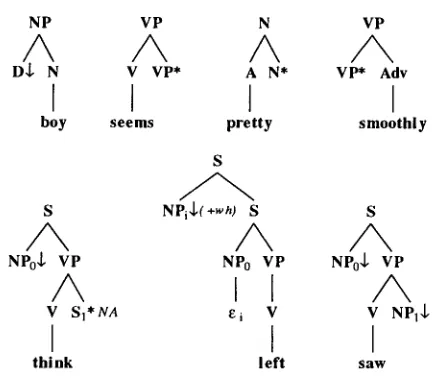
Figure 1, shows seven elementary trees t h a t might a p p e a r in an L C F G for English. T h e trees containing ' b o y ' , 'saw', and 'left' are initial trees. T h e remainder are attxiliary trees.
Auxiliary trees whose feet are leftrnost are called
left recursive.
Similarly, auxiliary trees whose feet are rightrnost are calledrighl recursive
auxiliary trees. T h e p a t h from the root of an aux- iliary tree to the foot is called thespine.
NP VP N VP
A
/k
A
/ X
D$ N V VP* A N* VP* Adv
I
I
I
i
boy seems pretty smoothly
S
S NPi,~(+wh) S S
NPo$ VP NP o VP NPo$ VP
A
I [
V SI*NA £i V V NPI$
I
I
I
think left saw
Figure 1: Sample trees.
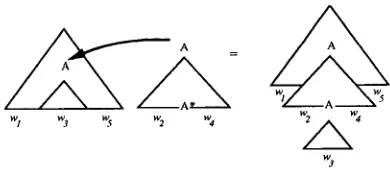
In LCF(I, trees can be combined with substi- tution and adjunction. As illustrated in Figure 2, substitution replaces a node marked for substitu- tion with a copy of an initial tree.
Adjunction inserts a copy of an auxiliary tree into a n o t h e r tree in place of an interior node t h a t has the same label as the foot of the auxiliary tree. T h e subtree t h a t was previously connected to the interior node is reconnected to the foot of the copy of the auxiliary tree. If the auxiliary tree is left re- cursive, this is referred to as left recursive adjunc- tion (see Figure 3). If the auxiliary tree is right recursive, this is referred to as right recursive ad- junction (see Figure 4).
Crucially, adjunction is constrained by requir- ing t h a t a left recursive auxiliary tree cannot be adjoined on any node t h a t is on the spine of a right recursive auxiliary tree and a right recursive auxiliary tree cannot be adjoined on the spine of a left recursive auxiliary tree.
An L C F G derivation must s t a r t with an initial tree rooted in S. After that, this tree can be re- peatedly extended using substitution and adjunc- tion. A derivation is complete when every frontier node is labeled with a terminal symbol.
T h e difference between L C F G and LTAG is
Figure 2: Substitution.
[image:2.612.328.544.52.242.2] [image:2.612.345.526.604.681.2]/ AA
A
Figure 3: Left recursive adjunction.
~ A * =
"A
%
Figure 4: Right recursive adjunction.
t h a t LTAG allows the foot of an auxiliary tree to a p p e a r anywhere on the frontier and places no limitations on the interaction of auxiliary trees. In this unlimited situation, adjunction encodes string wrapping and is therefore more power- ful than concatenation (see Figure 5). However, the restrictions imposed by LCFG guarantee t h a t no context-sensitive operations can be achieved. T h e y limit the languages t h a t can be generated by L C F G s to those t h a t can be generated by CFGs.
C o v e r a g e of L C F G a n d LTAG
T h e power of L C F G is significantly less than LTAG. Surprisingly, it turns out t h a t there are only two situations where the current LTAG gram- m a r for English (Abeilld et al., 1990) fails to satisfy the restrictions imposed by LCFG.
T h e first situation, concerns certain verbs t h a t take more than one sentential complement. An ex- ample of such a verb is
deduce,
which is associated with the following auxiliary tree.S
NPo$ VP
V Sl* PP
I
A
deduce P Sz,I,
I
from
Since this tree contains a foot node in the cen- ter of its frontier, it is not part of an LCFG. Hav- ing the foot on the first sentential c o m p l e m e n t is convenient, because it allows one to use the stan- dard LTAG wh-analyses, which depends on the
w2 ~
W4
%
Figure 5: Adjunction in LTAG.
existence of an initial tree where the filler and gap are local. This accounts nicely for the pair of sen- tences below. However, other analyses of wh ques- tions may not require the use of the auxiliary tree above.
(1) J o h n deduced t h a t Mary watered the grass f r o m seeing the hose.
(2) W h a t did J o h n deduce t h a t Mary wa- tered f r o m seeing the hose.
T h e second situation, concerns the way the current LTAG explains the ambiguous attach- ments of adverbial modifiers. For example, in the sentence:
(3) John said Bill left yesterday.
the a t t a c h m e n t of
yesterday
is ambiguous. T h e two different LTAG derivations indicated in Fig- ure 6 represent this conveniently.Unfortunately, in L C F G the high a t t a c h m e n t of
yesterday
is forbidden since a right auxiliary tree (corresponding toyesterday)
is adjoined on the spines of a left auxiliary tree (corresponding toJohn said).
However, one could avoid this prob- lem by designing a mechanism to recover the high a t t a c h m e n t reading from the low one.Besides the two cases presented above, the current LTAG for English uses only left and right recursive auxiliary trees and does not allow any
S
NP
. . ~ ",~ ...
I
John V S* . . . . . VP
"-::.
Asaid S ." "'° / \ ,~t o- VP* ADV
NP VP I
I I yesterday
Bill V I
left
[image:3.612.329.524.56.141.2] [image:3.612.76.268.60.268.2] [image:3.612.320.535.547.672.2]interaction along the spine of these two kinds of trees. This agrees with the intuition t h a t most English analyses do not require a context-sensitive operation.
LCFG. However, as shown below, combining ex- tended substitution with restricted adjunction al- lows strong lexicalization of C F G , without intro- ducing greater parsing complexity than C F G .
L e x i c a l i z a t i o n o f C F G s
T h e lexicalization of g r a m m a r formalisms is of in- terest from a n u m b e r of perspectives. It is of in- terest from a linguistic perspective, because most current linguistic theories give lexical accounts of a n u m b e r of p h e n o m e n a t h a t used to be considered purely syntactic. It is of interest f r o m a c o m p u t a - tional perspective, because lexicalized g r a m m a r s can be parsed significantly more efficiently than non-lexicalized ones (Schabes and Joshi, 1990).
Formally, a g r a m m a r is said 'lexicalized' (Sch- abes, Abeill~., and Joshi, 1988) if it consists of: ,, a finite set of elementary s t r u c t u r e s of finite size,
each of which c, ontains an overt (i.e., n o n - e m p t y ) lexical item.
• a finite set of operations for creating derived structures.
T h e overt lexical item in an elementary struc- ture is referred to as its anchor. A lexicalized g r a m m a r can be organized as a lexicon where each lexical item is associated with a finite n u m b e r of structures for which t h a t item is the anchor.
In general, C F G s are not lexicalized since rules such as ,5' --* N P V P t h a t do not locally introduce lexical items are allowed. In contrast, the well- known Creibach Normal Form ( C N F ) for C F C s is lexicalized, because every production rule is re- quired to be of the f o r m A --+ ac~ (where a is a terminal symbol, A a non-terminal symbol and a a possibly e m p t y string of non-terminal symbols) and therefore locally introduces a lexical item a.
It can be shown t h a t for any C F G (.7 (that does not derive the e m p t y string), there is a C N F g r a m - m a r (.7 ~ t h a t derives the s a m e language. However, it m a y be impossible for the set of trees produced by (7 ~ to be the s a m e as the set of trees produced by G.
Therefore, C N F achieves a kind of lexicaliza- tion of CFGs. However, it is only a weak lexical- ization, because the set of trees is not necessarily preserved. As discussed in the motivation section, strong lexicalization t h a t preserves tree sets is pos- sible using LTAG. However, this is achieved at the cost of significant additional parsing complexity.
Heretofore, several a t t e m p t s have been m a d e to lexicalize C F C with formalisms weaker than LTAG, but without success. In particular, it is not sufficient to merely extend substitution so t h a t it applies to trees. Neither is it sutficient to rely solely on the kind restricted adjunction used by
T h e o r e m I f G = ( ~ , N T , P , S ) is a finitely ambiguous CFG which does not generate the empty .string (¢), then there is an L C F G (7 ~ = (~, N T , I, A, S) generating the same language and tree set as (7. Furthermore (7' can be chosen .so that it utilizes only lefl-recursive auxiliary trees.
As usual in the above, a C F G (.7 is a four- tuple, (E, N T , P, S), where N is a set of terminal symbols, N T is a set of non-terminal symbols, P is a set of production rules t h a t rewrite non-terminal symbols to strings of terminal and non-terminal symbols, and S is a distinguished non-terminal symbol t h a t is the s t a r t symbol of any derivation. To prove the theorem we first prove a some- what weaker theorem and then extend the proof to the flfll theorem. In particular, we assume for the m o m e n t t h a t the set of rules for (.7 does not contain any e m p t y rules of the f o r m A ~ e.
S t e p 1 We begin the construction of (7 ~ by con- structing a directed graph L C G t h a t we call the left corner derivation graph. P a t h s in L C G cor- respond to leftmost paths f r o m root to frontier in (partial) derivation trees rooted at non-terminal symbols in (1.
L(TG contains a node for every symbol in E U N T and an arc for every rule in P as follows. For each terminal and non-terminal symbol X in G create a node in L C G labeled with X. For each rule X --+ Y a in G create a directed arc labeled with X ~ Y a f r o m the node labeled with X to the node labeled Y.
As an example, consider the e x a m p l e C F G in Figure 7 and the corresponding L(TG shown in Figure 8.
T h e significance of L ( ; G is t h a t there is a one- to-one correspondence between paths in L C G end- ing on a non-terminal and left corner derivations in G. A left corner derivation in a C F G is a partial derivation s t a r t i n g from any non-terminal where every expanded node (other t h a n the root) is the leftmost child of its parent and the left corner is a non-terminal. A left corner derivation is uniquely identified by the list of rules applied. Since G does not have any e m p t y rules, every rule in (7 is rep- resented in L(;'G. Therefore, every p a t h in L C G ending on a terminal corresponds to a left corner derivation in (7 and vice versa.
S - - - + A A ,5' --+ B A A - - + B B B--+ A S B ----+ b
Figure 7: An example g r a m m a r .
S ---~ B A
S -~.A A
S ~- A B
B--+ A S
B--+b
b
Figure 8: T h e L C ( ; created by Step 1.
S t e p 2 T h e set of initial trees I for G' is con- structed with reference to L(TG. In particular, an initial tree is created corresponding to each non- cyclic p a t h in L ( / G t h a t starts at a non-terminal symbol X and ends on a terminal symbol y. (A non-cyclic p a t h is a p a t h t h a t does not touch any node twice.)
For each non-cyclic p a t h in L C G from X to y, construct an initial tree T as follows. Start with a root labeled X. Apply the rules in the p a t h one after another, always expanding the left corner node of T. While doing this, leave all the non-left corner non-terminal symbols in T unexpanded, and label t h e m as substi- tution nodes.
Given the previous example g r a m m a r , this step produces the initial trees shown in Figure 9. Each initial tree created is lexicalized, because each one has a non-terminal symbol as the left corner element of its frontier. There are a finite number of initial trees, because the n u m b e r of non- cyclic paths in L C G must be finite. Each initial tree is finite in size, because each non-cyclic p a t h in L C G is finite in length.
Most importantly, T h e set of initial trees is the set of non-recursive left corner derivations in (,'.
S
A AS
B B$ B AS B B$
I
I
I
b b b
Figure 9: Initial trees created by Step 2.
S t e p 3 This step constructs a set of left- recursive auxiliary trees corresponding to the cyclic p a t h segments in L(TG t h a t were ignored in the previous step. In particular, an attxiliary tree is created corresponding to each minimM cyclic p a t h in L C G t h a t starts at a non-terminM sym- bol.
For each minimal cycle in L C G from X to it- self, construct an auxiliary tree T by s t a r t i n g with a root labeled X and repeatedly expand- ing left, corner frontier nodes using the rules in the path as in Step 2. When all the rules in the path have been used, the left corner fron- tier node in T will be labeled X . Mark this as the foot node of T. While doing the above, leave all the other non-terminal symbols in T unexpanded, and label t h e m all substitution nodes.
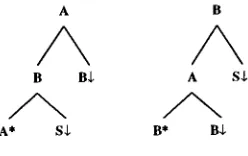
T h e L C ( ; in Figure 8 has two minimal cyclic paths (one from A to A via B and one f r o m B to B via A). This leads to the the two auxiliary trees shown in Figure 10, one for A and one for B.
T h e attxiliary trees generated in this step are not, necessarily lexicalized. There are a finite num- ber of auxiliary trees, since the n u m b e r of minimal cyclic paths in G must be finite. Each auxiliary tree is finite in size, because each minimal-cycle in L C G is finite in length.
T h e set of trees t h a t can he created by corn- biding the initial trees f r o m Step 2 with the auxil- iary trees f r o m Step 3 by adjoining auxiliary trees along the left edge is the set of every left corner derivation in (,'. To see this, consider t h a t ev- ery p a t h in L ( ; G can be represented as an initial non-cyclic p a t h with zero or more minimal cycles inserted into it.
T h e set of trees t h a t can be created by corn- biding the initial trees from Step 2 with the auxil- iary trees from Step 3 using b o t h substitution and adjunction is the set of every derivation in G. To see this, consider t h a t every derivation in G can be decomposed into a set of left corner derivations in G t h a t are combined with substitution. In par- ticular, whenever a non-terminal node is not the leftmost child of its parent, it is the head of a sep-
A B
B B$ A S$
A* S $ B* B$
[image:5.612.91.252.65.215.2] [image:5.612.93.254.135.210.2] [image:5.612.68.268.588.681.2] [image:5.612.365.489.605.683.2]arate left corner derivation.
S t e p 4 This step lexicalizes the set of auxiliary trees built in step 3, without altering the trees t h a t can be derived.
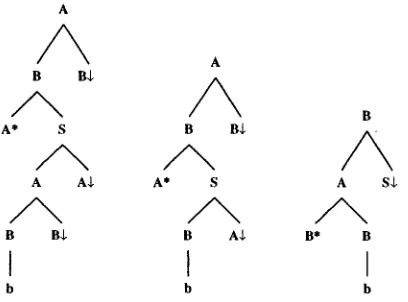
For each auxiliary tree T built in step 3, con- sider the frontier node A just to the right of the foot. If this node is a terminal do nothing. Otherwise, remove T from the set of auxiliary trees replace it with every tree t h a t can be constructed by substituting one of the initial trees created in Step 2 for the node A in T.
In the case of our continuing example, Step 4 results in the set of auxiliary trees in Figure 11.
Note t h a t since G is finitely ambiguous, there must be a frontier node to the right of the foot of an attxiliary tree T. If not, then T would corre- spond to a derivation
X:~X
in G and 6' would be infinitely ambiguous.After Step 4, every auxiliary tree is lexicalized, since every tree t h a t does not have a terminal to the right of its foot is replaced by one or more trees t h a t do. Since there were only a finite n u m b e r of finite initial and auxiliary trees to s t a r t with, there are still only a finite n u m b e r of finite attxiliary trees.
T h e change in the auxiliary trees caused by Step 4 does not alter the set of trees t h a t can be produced in any way, because the only change t h a t was m a d e was to m a k e substitutions t h a t could be m a d e anyway, and when a s u b s t i t u t a b l e node was eliminated, this was only done after every possible substitution at t h a t node was performed.
Note t h a t the initial trees are left anchored and the auxiliary trees are ahnost left anchored in the sense t h a t the leftmost frontier node other than the foot is a terminal. This facilitates effi- cient left to right parsing.
A
A
B B$
A* S B B$
A AS A* S A S$ B B$ B AS B* B
I
I
I
b b b
Figure 1 l: Auxiliary trees created by Step 4.
T h e procedure above creates a lexicalized g r a m m a r t h a t generates exactly the same trees as G and therefore the s a m e strings. T h e only re- maining issue is the additional assumption t h a t G does not contain any e m p t y rules.
If (; contains an e m p t y rule A ~ e one first uses s t a n d a r d m e t h o d s to transform (; into an equivalent g r a m m a r H t h a t does not have any such rule. When doing this, create a table showing how each new rule added is related to the e m p t y rules removed. Lexicalize H producing H ' using the procedure above. Derivations in H ' result in elements of the tree set of H . By means of the ta- ble recording the relationship between (; and H, these trees can be converted to derivations in G.
[]
A d d i t i o n a l i s s u e s
T h e r e are several places in the algorithm where greater freedom of choice is possible. For instance, when lexicalizing the auxiliary trees created in Step 3, you need not do a n y t h i n g if there is any frontier node t h a t is a terminal and you can choose to expand any frontier node you want. For in- stance you might want to choose the node t h a t corresponds to the smallest n u m b e r of initial trees. Alternatively, everywhere in the procedure, the word 'left' can be replaced by ' r i g h t ' and vice versa. This results in the creation of a set of right anchored initial trees and right recursive auxiliary trees. This can be of interest when the right cor- ner derivation graph has less cycles t h a n the left corner one.
T h e n u m b e r of trees in G ' is related to the n u m b e r of non-cyclic and m i n i m a l cycle paths in L C G . In the worst case, this n u m b e r rises very fast as a function of the n u m b e r of arcs in
LCG,
(i.e., in the n u m b e r of rules in G). (A fully con- nected graph of n 2 a r c s between n nodes has n!
acyclic paths and n! m i n i m a l cycles.) However, in the typical case, this kind of an explosion of trees is unlikely.
J u s t as there can be m a n y ways for a CF(~ to derive a given string, there can be m a n y ways for an LCFG to derive a given tree. For m a x i m a l efficiency, it would be desirable for the g r a m m a r G ' produced by the procedure above to have no a m b i g u i t y in they way trees are derived. Unfortu- nately, the longer the m i n i m a l cycles in
LCG,
the greater the tree-generating a m b i g u i t y the proce- dure will introduce in G ' . However, by modifying the procedure to make use of constraints on what attxiliary trees are allowed to adjoin on what nodes in which initial trees, it should be possible to re- duce or even eliminate this ambiguity.All these issues are discussed at greater length
[image:6.612.87.291.532.683.2]in Schabes and Waters (1993).
P a r s i n g L C F G
Since LCFG is a restricted case of tree-adjoining g r a m m a r (TAG), standard O(nG)-time TAG parsers (Vijay-Shanker, 1987; Schabes, 1991; Lang, 1990) can be used for parsing LCFG. Fur- ther, they can be straightforwardly modified to re- quire at most O(n4)-tirne when applied to LCFG. However, this still does not take fifll advantage of the context-freeness of LCFC.
This section describes a simple I)ottom-up recognizer for LCFG that is in the style of the CKY parser for (IT(I;. T h e virtue of this algo- rithm is that it shows in a simple manner how the O(n3)-time worst case complexity can be achieved for LCFG. Schabes and Waters (1993) describes a more practical and more elaborate (Earley-style) recognizer for LCFC, which achieves the same bounds.
Suppose that G = (E, NT, I , A , S ) is an LCFG and that a l ' " a , ~ is an input string. We can assume without loss of generality 1 that every node in I U A has at most two children.
Let 71 be a node in an elementary tree (identi- fied by the name of the tree and the position of the node in the tree). The central concept of the al- gorithrn is the concepts of spanning and covering. 71 spans a string ai+l . . . a j if and only if there is some tree derived by ('; for which it is the case that the fringe of the subtree rooted at 71 is ai+l "" "aj.
In particular, a non-terminal node spans aj if and only if the label on the node is aj. A non-terrninal node spans ai+ 1 . . . a j if and only if ai+l . . . a j is the concatenation in left, to right order of strings spanned by the children of the node.
• If 7 / does not subsume the foot node of an aux- iliary tree then: 71 covers the string ai+ 1 . . . a j if and only if it spans a i + l " . a j .
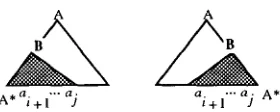
• If 7 / is on the spine of a right recursive auxiliary tree T then: 71 covers ai+l." .aj if and only if 7 / spans some strin~ that is the concatenation of ai+l - . . a j and a string spanned by the foot of T. (This situation is illustrated by the right drawing in Figure 12, in which 7 / is labeled with
B.)
• If 71 is on the spine of a left recursive auxiliary tree T then: 71 covers ai+] " .aj if and only if 71 spans some string that is the concatenation of a string spanned by the foot of T and ai+l . . . a j . (This situation is illustrated by the left drawing in Figure 12, in which 71 is labeled with B.)
lit can be easily shown that by adding new nodes
('4 "~
any L ,F(., can be transformed into an equivalent LC, FG satisfying this condition.
A , ai+l-.- aj ai+l.., aj A*
Figure 12: Coverage of nodes on the spine.
T h e algorithm stores pairs of the form (71, pos) in an n by n array C. In a pair, pos is either t (for top) or b (for bottom). For every node 7l in every elementary tree in (;, the algorithm guarantees the following.
• ('l,b) e C[i,j] if and only if,I covers ai+l . . . a j . • ('l,t) E C[i,j] if and only if ('l,b} E C,[i,j] or
ai+l . . . a j is the concatenation (in either order) of a string covered by 7 / and a string covered by an auxiliary tree that can be adjoined on 71 .
The algorithm fills the upper diagonal portion of the array C[i, j] (0 < i < j _< n) for increasing values of j - i. T h e process starts by placing each foot node in every cell C'[i,i] and each terminal node 71 in every cell C[i, i + 1] where 71 is labeled a i + l •
T h e algorithm then considers all possible ways of combining covers into longer covers. In particu- lar, it fills the cells C[i, i + k] for increasing values of k by combining elements from the cells C[i, j] and C [ j , i + k] for all j such that i < j < i + k. There are three situations where combination is possible: sibling concatenation, left recursive con- catenation, and right recursive concatenation.
Sibling concatenation is illustrated in Fig- ure 13. Suppose that there is a node 7/0 (labeled B) with two children 711 (labeled A) and 712 (labeled A'). If (711 , t) E C[i, j] and ('12, t} E (7[j, i + k] then ('1o, b) E C[i, i + k].
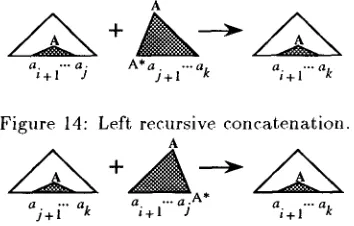
Left recursive concatenation is illustrated in Figure 14. Here, the cover of a node is combined with the cover of a left auxiliary tree that can be adjoined at the node. Right recursive concatena- tion, which is shown in Figure 15 is analogous.
For simplicity, the recognizer is written in two parts. A main procedure and a subpro- cedure Add(node, pos, i,j), which adds the pair (node, pos) into C[i, j].
[image:7.612.356.496.55.111.2] [image:7.612.321.530.636.684.2]P r o c e d u r e r e c o g n i z e r begin
;; foot node initialization ( ,[z, i]) for i = 0 to n
for all foot node 71 in A call Add0/, b, i, i)
;; terminal node initialization ((;[i, i + 1]) f o r i = 0 t o n - l
for all node 71 in A U I labeled by ai+l call A d d 0 / , t, i, i + 1)
;; induction (G'[i, i + k] = (;[i, j] + (:[j, i + k]) for k = 2 to n
for i = 0 to n - k f o r j = i + 1 t o i + k - 1
;; sibling c o n c a t e n a t i o n if (711 , l) 6 C,[i, j] and (712, t) e C[j, i + k] and r/1 is the left sibling of 7/2
with c o m m o n parent 71o then Add(710 , b, i, i + k)
;; left recursive c o n c a t e n a t i o n if {71, b) E C[i, j]
and (p, t} e (,'[/, i + k]
and p is the root node of a left recursive auxiliary tree t h a t can adjoin on rl then A d d 0 j , t, i, i + k)
;; right recursive c o n c a t e n a t i o n if {'l, b) e (;[j, i + k]
and (p, t) E C[i, j]
and p is the root node of a right recursive auxiliary tree t h a t can adjoin on 7 I then Add(r/, t, i, i + k)
if (7/, z) e c[0, 7q
and 71 is labeled by ,5'
and 71 is the root node of an initial tree in I then return acceptance
otherwise return rejection end
Note t h a t the sole purl)ose of the codes t and b is to insure t h a t only one auxiliary tree can adjoin on a node. T h e procedure could easily be mod- ified to account for o t h e r constraints on the way derivation should proceed such as those suggested for LTAGs (Schabes and Shieber, 1992).
T h e procedure A d d puts a pair into the array C. If the pair is already present, n o t h i n g is (lone. However, if it is new, it is added to (7 and other pairs m a y be added as well. T h e s e correspond to cases where the coverage is not increased: when a node is the only child of its parent, when the
A
/2.,+
/2...
ai+l... ~ A * a . J + l ...a k ai+l'"ak
Figure 14: Left recursive c o n c a t e n a t i o n .
A
/2.,
. . . . A * ... ak
aj+i., a k ai+ 1 aj ai+ 1
Figure 15: Right recursive c o n c a t e n a t i o n .
node is recognized w i t h o u t adjunction, and when s u b s t i t u t i o n occurs.
Procedure A d d ( r / , pos, i, j ) begin
P u t (rl, pos) in C,[i, j]
if pos = t and r I is the only child of a parent It call A d d ( # , b, i, j )
if pos = t and r is the root node of an initial tree, for each s u b s t i t u t i o n node p at which 71 can s u b s t i t u t e call Add(p, t, i, j )
;; no a d j u n c t i o n if pos = b
if the node 7/does not have an OA constraint call Add(r/, t, i, j )
end
T h e O ( n 3) complexity of the recognizer fol- lows f r o m the three nested induction loops on k, i and j. ( A l t h o u g h the procedure A d d is defined recursively, the n u m b e r of pairs added to (7 is b o u n d e d by a c o n s t a n t t h a t is i n d e p e n d e n t of sen- tence length.)
By recording how each pair was i n t r o d u c e d in each cell of the array C, one can easily e x t e n d the recognizer to p r o d u c e all derivations of the input.
C o n c l u s i o n
L C F G combines much of the power of LTAG with tile c o m p u t a t i o n a l efficiency of C F G . It s u p p o r t s most of the same linguistic analysis s u p p o r t e d by LTAC. In particular, most of the current LTAG for English falls into L C F G . In addition, L C F C can lexicalize C F G w i t h o u t altering the trees pro- duced. Finally, L C F G can be parsed in O(n3)- time.
T h e r e are m a n y directions in which the work on L C F G described here could be extended. In
[image:8.612.355.532.59.172.2]particular, one could consider stochastic exten- sions, LP~ parsing, and non-deterministic LR pars- ing.
Acknowledgments
We thank John Coleman who, by question- ing whether the context-sensitivity of stochastic LTAG was actually being used for English, trig- gered this work. We thank Aravind Joshi, Fer- nando Pereira, Stuart Shieber and B. Srinivas for valuable discussions.
R E F E R E N C E S
Abeilld, Anne, Kathleen M. Bishop, Sharon Cote, and Yves Schabes. 1990. A lexicalized tree adjoining grammar for English. Technical Re- port MS-CIS-90-24, Department of Computer and Information Science, University of Penn- sylvania.
Joshi, Aravind K. and Yves Schabes. 1992. Tree- adjoining grammars and lexicalized gram- mars. In Maurice Nivat and Andreas Podel- ski, editors, Tree Automata and Languages.
Elsevier Science.
Joshi, Aravind K., K. Vijay-Shanker, and David
Weir. 1991. The convergence of mildly
context-sensitive grammatical formalisms. In Peter Sells, Stuart Shieber, and Tom Wasow, editors, Foundational Issues in Nalural Lan- guage Processing. MIT Press, Cambridge MA. Lang, Bernard. 1990. The systematic construc- tions of Earley parsers: Application to the production of O(n 6) Earley parsers for Tree Adjoining Grammars. In Proceedings of the Ist International Workshop on Tree Adjoining Grammars, Dagstuhl C, astle, FRG, August. Schabes, Yves, Anne Abeill6, and Aravind K.
Joshi. 1988. Parsing strategies with 'lexical- ized' grammars: Application to tree adjoining grammars. In Proceedings of the 12 th Interna- tional Conference on Computational Linguis- tics (COLING'88), Budapest, Hungary, An- gust.
Schabes, Yves and Aravind K. Joshi. 1990. Pars- ing with lexicalized tree adjoining grammar. In Masaru Tomita, editor, C, urrent Issues in Parsing Technologies. Kluwer Accademic Publishers.
Schabes, Yves and Stuart Shieber. 1992. An al- ternative conception of tree-adjoining deriva- tion. In 20 th Meeting of the Association for
(,'omputational Linguistics (A CL '92).
Schabes, Yves and Richard C. Waters. 1993. Lex- icalized context-free grammar: A cubic-time parsable formalism that strongly lexicalizes
context-free grammar. Technical Report 93- 04, Mitsubishi Electric Research Laboratories, 201 Broadway. Cambridge MA 02139. Schabes, Yves. 1991. The valid prefix prop-
erty and left to right parsing of tree-adjoining grammar. In Proceedings of the second Inter- national Workshop on Parsing Technologies,
Cancan, Mexico, February.
Vijay-Shanker, K. and David Weir. 1993a. The equivalence of four extensions of context-free grammars. To appear in Mathematical Sys- tems Theory.
Vijay-Shanker, K. and [)avid Weir. 1993b. Pars- ing some constrained grammar formalisms.
To appear in Computational Linguistics.
Vijay-Shanker, K. 1987. A Study of Tree Adjoin- ing Grammars. Ph.D. thesis, Department of Computer and Information Science, Univer- sity of Pennsylvania.
Weir, David J. 1988. Character-