Deep Read: A Reading Comprehension System
Lynette Hirschman • Marc Light • Eric Breck • John D. BurgerThe M I T R E Corporation 202 Burlington Road Bedford, M A USA 01730 { l ynette, light, ebreck, j o h n } @ mitre.org
Abstract
This paper describes initial work on Deep Read, an automated reading comprehension system that accepts arbitrary text input (a story) and answers questions about it. We have acquired a corpus of 60 development and 60 test stories of 3 rd to 6 th grade material; each story is followed by short-answer questions (an answer key was also provided). We used these to construct and evaluate a baseline system that uses pattern matching (bag-of-words) techniques augmented with additional automated linguistic processing (stemming, name identification, semantic class identification, and pronoun resolution). This simple system retrieves the sentence containing the answer 30-40% of the time.
1 Introduction
This paper describes our initial work exploring reading comprehension tests as a research problem and an evaluation method for language understanding systems. Such tests can take the form o f standardized multiple-choice diagnostic reading skill tests, as well as fill-in- the-blank and short-answer tests. Typically, such tests ask the student to read a story or article and to demonstrate her/his understanding o f that article by answering questions about it. For an example, see Figure 1.
Reading comprehension tests are interesting because they constitute " f o u n d " test material: these tests are created in order to evaluate children's reading skills, and therefore, test materials, scoring algorithms, and human performance measures already exist. Furthermore, human performance measures provide a more intuitive way o f assessing the capabilities o f a given system than current measures o f precision, recall, F-measure, operating curves, etc. In addition, reading comprehension tests are written to test a range o f skill levels. With proper choice of test material,
it should be possible to challenge systems to successively higher levels o f performance.
For these reasons, reading comprehension tests offer an interesting alternative to the kinds of special-purpose, carefully constructed evaluations that have driven much recent research in language understanding. Moreover, the current state-of-the- art in computer-based language understanding makes this project a good choice: it is beyond current systems' capabilities, but tractable. Our
Library of Congress Has Books for Everyone (WASHINGTON, D.C., 1964) - It was 150 years ago this year that our nation's biggest library burned to the ground. Copies of all the wriuen books of the time were kept in the Library of Congress. But they were destroyed by fire in 1814 during a war with the British.
That fire didn't stop book lovers. The next year, they began to rebuild the library. By giving it 6,457 of his books, Thomas Jefferson helped get it started.
The first libraries in the United States could be used by members only. But the Library of Congress was built for all the people. From the start, it was our national library.
Today, the Library of Congress is one of the largest libraries in the world. People can find a copy of just about every book and magazine printed.
Libraries have been with us since people first learned to write. One of the oldest to be found dates back to about 800 years B.C. The books were written on tablets made from clay. The people who took care of the books were called "men of the written tablets."
1. Who gave books to the new library? 2. What is the name of our national library? 3. When did this library burn down? 4. Where can this library be found?
5. Why were some early people called "men of the written tablets"?
Figure 1: Sample Remedia T M Reading
simple bag-of-words approach picked an appropriate sentence 30--40% of the time with only a few months work, much of it devoted to
infrastructure. We believe that by adding
additional linguistic and world knowledge
sources to the system, it can quickly achieve primary-school-level performance, and within a few years, "graduate" to real-world applications.
Reading comprehension tests can serve as a testbed, providing an impetus for research in a number of areas:
• Machine learning of lexical information,
including subcategorization frames, semantic relations between words, and pragmatic import of particular words.
• Robust and efficient use of world knowledge
(e.g., temporal or spatial relations).
• Rhetorical structure, e.g., causal relationships
between propositions in the text, particularly
important for answering w h y and h o w
questions.
• Collaborative learning, which combines a
human user and the reading comprehension computer system as a team. If the system can query the human, this may make it possible
to circumvent knowledge acquisition
bottlenecks for lexical and world knowledge. In addition, research into collaboration might lead to insights about intelligent tutoring.
Finally, reading comprehension evaluates systems' abilities to answer ad hoc, domain- independent questions; this ability supports fact retrieval, as opposed to document retrieval, which could augment future search engines - see Kupiec (1993) for an example of such work. There has been previous work on story
understanding that focuses on inferential
processing, common sense reasoning, and world knowledge required for in-depth understanding of stories. These efforts concern themselves with specific aspects of knowledge representation, inference techniques, or question types - see
Lehnert (1983) or Schubert (to appear). In
contrast, our research is concerned with building systems that can answer ad hoc questions about arbitrary documents from varied domains.
We report here on our initial pilot study to
determine the feasibility of this task. We
purchased a small (hard copy) corpus of development and test materials (about 60 stories
in each) consisting of remedial reading materials for grades 3-6; these materials are simulated news stories, followed by short-answer "5W" questions:
w h o , what, when, where, and w h y questions, l We developed a simple, modular, baseline system that uses pattern matching (bag-of-words) techniques and limited linguistic processing to select the sentence from the text that best answers the query. We used our development corpus to explore several alternative evaluation techniques, and then evaluated on the test set, which was kept blind.
2 Evaluation
We had three goals in choosing evaluation
metrics for our system. First, the evaluation
should be automatic. Second, it should maintain comparability with human benchmarks. Third, it should require little or no effort to prepare new
answer keys. We used three metrics, P&R,
H u m S e n t , and AutSent, which satisfy these constraints to varying degrees.
P & R was the precision and recall on stemmed content words 2, comparing the system's response at the word level to the answer key provided by
the test's publisher. H u m S e n t and A u t S e n t
compared the sentence chosen by the system to a list of acceptable answer sentences, scoring one point for a response on the list, and zero points otherwise. In all cases, the score for a set of questions was the average of the scores for each question.
For P & R , the answer key from the publisher
was used unmodified. The answer key for
H u m S e n t was compiled by a human annotator,
I These materials consisted of levels 2-5 of "The 5 W's" written by Linda Miller, which can be purchased from Remedia Publications, 10135 E. Via Linda #D124, Scottsdale, AZ 85258.
z Precision and recall are defined as follows:
p = #ofmatchinscontent words # content words in answer key R = #ofmatchingcontent words
# content words in system response
Repeated words in the answer key match or fail together. All words are stemmed and stop words are removed. At present, the stop-word list consists of
forms of be, have, and do, personal and possessive
pronouns, the conjunctions and, or, the prepositions to,
in, at, of, the articles a and the, and the relative and
demonstrative pronouns this, that, and which.
Query: What is the name of our national library? Story extract:
1. But the Library of Congress was built for all the people.
2. From the start, it was our national library. Answer key: Library of Congress
Figure 2: Extract from story
who examined the texts and chose the sentence(s) that best answered the question, even where the sentence also contained additional (unnecessary) information. For AutSent, an automated routine replaced the human annotator, examining the texts and choosing the sentences, this time based on which one had the highest recall compared against the published answer key.
For P & R we note that in Figure 2, there are
two content words in the answer key (library and
congress) and sentence 1 matches both of them, for 2/2 = 100% recall. There are seven content words in sentence 1, so it scores 2/7 = 29% precision. Sentence 2 scores 1/2=50% recall and 1/6=17% precision. The human preparing the list of acceptable sentences for H u m S e n t has a problem. Sentence 2 responds to the question, but requires pronoun coreference to give the full
answer (the antecedent of it). Sentence 1
contains the words of the answer, but the sentence as a whole doesn't really answer the
question. In this and other difficult cases, we
have chosen to list no answers for the human
metric, in which case the system receives zero points for the question. This occurs 11% of the
time in our test corpus. The question is still
counted, meaning that the system receives a penalty in these cases. Thus the highest score a system could achieve for H u m S e n t is 89%. Given that our current system can only respond with sentences from the text, this penalty is appropriate. The automated routine for preparing the answer key in A u t S e n t selects as the answer key the sentence(s) with the highest recall (here
sentence 1). Thus only sentence 1 would be
counted as a correct answer.
We have implemented all three metrics.
HumSent and AutSent are comparable with
human benchmarks, since they provide a binary score, as would a teacher for a student's answer. In contrast, the precision and recall scores of P & R lack such a straightforward comparability.
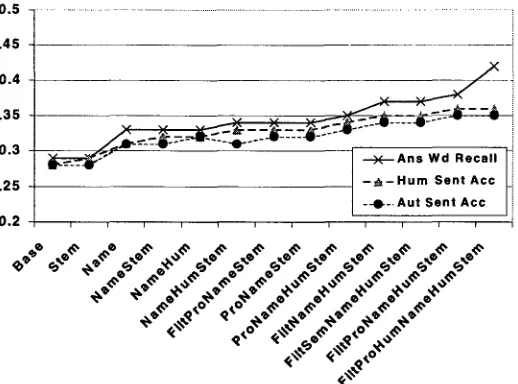
However, word recall from P & R (called
AnsWdRecall in Figure 3) closely mimics the
scores of H u m S e n t and AutSent. The correlation coefficient for A n s W d R e c a l l to H u m S e n t in our test set is 98%, and from H u m S e n t to A u t S e n t is
also 98%. With respect to ease of answer key
preparation, P & R and A u t S e n t are clearly
superior, since they use the publisher-provided answer key. H u m S e n t requires human annotation for each question. We found this annotation to be
of moderate difficulty. Finally, we note that
precision, as well as recall, will be useful to evaluate systems that can return clauses or phrases, possibly constructed, rather than whole sentence extracts as answers.
Since most national standardized tests feature
a large multiple-choice component, many
available benchmarks are multiple-choice exams. Also, although our short-answer metrics do not impose a penalty for incorrect answers, multiple- choice exams, such as the Scholastic Aptitude Tests, do. In real-world applications, it might be important that the system be able to assign a
confidence level to its answers. Penalizing
incorrect answers w o u l d h e l p guide development in that regard. While we were initially concerned that adapting the system to multiple-choice questions would endanger the goal of real-world applicability, we have experimented with minor changes to handle the multiple choice format. Initial experiments indicate that we can use essentially the same system architecture for both short-answer and multiple choice tests.
3 S y s t e m A r c h i t e c t u r e
The process of taking short-answer reading comprehension tests can be broken down into the following subtasks:
Extraction of information content of the question.
• Extraction of information content of the
document.
• Searching for the information requested in the
question against information in document.
performance, we tried to keep this initial implementation as simple as possible.
3.1 B a g - o f - W o r d s A p p r o a c h
Our system represents the information
content of a sentence (both question and text sentences) as the set of words in the sentence. The word sets are considered to have no structure
or order and contain unique elements. For
example, the representation for (la) is the set in (lb).
la (Sentence): By giving it 6,457 of his books, Thomas Jefferson helped get it started.
lb (Bag): {6,457 books by get giving helped his it Jefferson of started Thomas}
Extraction of information content from text, both in documents and questions, then consists of tokenizing words and determining sentence boundary punctuation. For English written text, both of these tasks are relatively easy although not trivial--see Palmer and Hearst (1997).
The search subtask consists of finding the best match between the word set representing the question and the sets representing sentences in the document. Our system measures the match by size of the intersection of the two word sets. For example, the question in (2a) would receive an intersection score of 1 because of the mutual
set element books.
2a (Question): Who gave books to the new library?
2b (Bag): {books gave library new the to who}
Because match size does not produce a complete ordering on the sentences of the document, we additionally prefer sentences that first match on longer words, and second, occur earlier in the document.
3.2 Normalizations and Extensions o f the W o r d S e t s
In this section, we describe extensions to the extraction approach described above. In the next section we will discuss the performance benefits of these extensions.
The most straightforward extension is to
remove function or stop words, such as the, of, a,
etc. from the word sets, reasoning that they offer
little semantic information and only muddle the signal from the more contentful words.
Similarly, one can use s t e m m i n g to remove
inflectional affixes from the words: such
normalization might increase the signal from contentful words. For example, the intersection
between (lb) and (2b) would include give if
inflection were removed from gave and giving.
We used a stemmer described by Abney (1997). A different type of extension is suggested by
the fact that who questions are likely to be
answered with words that denote people or
organizations. Similarly, when and where
questions are answered with words denoting temporal and locational words, respectively. By using name taggers to identify person, location,
and temporal information, we can add semantic
class symbols to the question word sets marking
the type of the question and then add
corresponding class symbols to the word sets whose sentences contain phrases denoting the proper type of entity.
For example, due to the name Thomas
Jefferson, the word set in (lb) would be extended by :PERSON, as would the word set (2b) because
it is a who question. This would increase the
matching score by one. The system makes use of the Alembic automated named entity system (Vilain and Day 1996) for finding named entities. In a similar vein, we also created a simple
common noun classification module using
WordNet (Miller 1990). It works by looking up all nouns of the text and adding person or location classes if any of a noun's senses is subsumed by the appropriate WordNet class. We also created a filtering module that ranks sentences higher if they contain the appropriate class identifier, even though they may have fewer matching words, e.g., if the bag representation of a sentence does not
contain :PERSON, it is ranked lower as an answer
to a who question than sentences which do contain
:PERSON.
Finally, the system contains an extension which substitutes the referent of personal pronouns for the pronoun in the bag representation. For example, if the system were to choose the sentence
He gave books to the library, the answer returned
and scored would be Thomas Jefferson gave books
to the library, if He were resolved to Thomas Jefferson. The current system uses a very simplistic pronoun resolution system which
0 . 5 ...
0 . 4 5
0 . 4
0 . 3 5
0 . 3
0 . 2 5
0 . 2
)( Ans Wd R e c a l l / - ~ - H u r n Sent Ace ]_ - - o - . A u t Sent Acc
i i i i t = i i i i ~ i
[image:5.612.171.430.79.271.2]f f + d -" " P d " " ~," . " ~"
Figure 3: Effect of Linguistic Modules on System Performance
matches he, him, his, she and her to the nearest
prior person named entity.
4 E x p e r i m e n t a l Results
Our modular architecture and automated scoring metrics have allowed us to explore the effect of various linguistic sources of information on overall system performance. We report here on three sets of findings: the value added from the various linguistic modules, the question- specific results, and an assessment of the difficulty of the reading comprehension task.
4.1 Effectiveness o f Linguistic M o d u l e s
We were able to measure the effect of various
linguistic techniques, both singly and in
combination with each other, as shown in Figure 3 and Table 1. The individual modules are indicated as follows: N a m e is the Alembic named tagger described above. N a m e H u m is
hand-tagged named entity. Stem is Abney's
automatic stemming algorithm. Filt is the
filtering module. P r o is automatic name and
personal pronoun coreference. P r o H u m is hand-
tagged, full reference resolution. Sem is the
WordNet-based common noun semantic
classification.
We computed significance using the non- parametric significance test described by Noreen
(1989). The following performance
improvements of the AnsWdRecall metric were
statistically significant results at a confidence level
of 95%: Base vs. NameStem, N a m e S t e m vs.
FiltNameHumStem, and FiltNameHumStem vs. F i l t P r o H u m N a m e H u m S t e m . The other adjacent
performance differences in Figure 3 are
suggestive, but not statistically significant.
Removing stop words seemed to hurt overall performance slightly--it is not shown here. Stemming, on the other hand, produced a small but
fairly consistent improvement. We compared
these results to perfect stemming, which made little difference, leading us to conclude that our automated stemming module worked well enough.
Name identification provided consistent gains. The Alembic name tagger was developed for
newswire text and used here with no
modifications. We created hand-tagged named
entity data, which allowed us to measure the performance of Alembic: the accuracy (F- measure) was 76.5; see Chinchor and Sundheim (1993) for a description of the standard MUC scoring metric. This also allowed us to simulate perfect tagging, and we were able to determine how much we might gain by improving the name tagging by tuning it to this domain. As the results indicate, there would be little gain from improved
name tagging. However, some modules that
When used in combination with the filtering module, these also seemed to help.
Similarly, the hand-tagged reference
resolution data allowed us to evaluate automatic
coreference resolution. The latter was a
combination of name coreference, as determined by Alembic, and a heuristic resolution of personal pronouns to the most recent prior named person. Using the MUC coreference scoring algorithm (see Vilain et al. 1995), this had a precision of 77% and a recall of 18%. 3 The use of full, hand- tagged reference resolution caused a substantial increase of the AnsWdRecall metric. This was because the system substitutes the antecedent for all referring expressions, improving the word- based measure. This did not, however, provide an increase in the sentence-based measures.
Finally, we plan to do similar human labeling experiments for semantic class identification, to determine the potential effect of this knowledge source.
4.2 Q u e s t i o n - S p e c i f i c A n a l y s i s
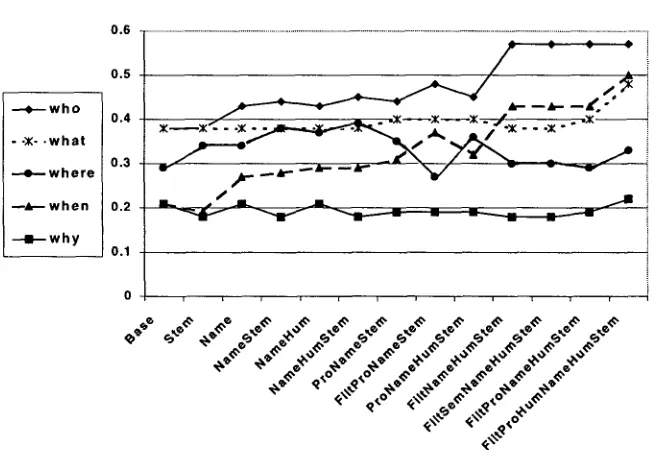
Our results reveal that different question- types behave very differently, as shown in
Figure 4. Why questions are by far the hardest
(performance around 20%) because they require understanding of rhetorical structure and because answers tend to be whole clauses (often occurring as stand-alone sentences) rather than phrases embedded in a context that matches the query
closely. On the other hand, who and when
queries benefit from reliable person, name, and
time extraction. Who questions seem to benefit
most dramatically from perfect name tagging combined with filtering and pronoun resolution.
What questions show relatively little benefit from the various linguistic techniques, probably
because there are many types of what question,
most of which are not answered by a person, time
or place. Finally, where question results are quite
variable, perhaps because location expressions often do not include specific place names.
3 The low recall is attributable to the fact that the heuristic asigned antecedents only for names and pronouns, and completely ignored definite noun phrases and plural pronous.
4.3 Task Difficulty
These results indicate that the sample tests are an appropriate and challenging task. The simple techniques described above provide a system that finds the correct answer sentence almost 40% of the time. This is much better than chance, which would yield an average score of about 4-5% for the sentence metrics, given an average document
length of 20 sentences. Simple linguistic
techniques enhance the baseline system score from the low 30% range to almost 40% in all three metrics. However, capturing the remaining 60% will clearly require more sophisticated syntactic, semantic, and world knowledge sources.
5
Future Directions
Our pilot study has shown that reading comprehension is an appropriate task, providing a reasonable starting level: it is tractable but not trivial. Our next steps include:
• Application of these techniques to a
standardized multiple-choice reading
comprehension test. This will require some minor changes in strategy. For example, in preliminary experiments, our system chose the answer that had the highest sentence matching score when composed with the question. This gave us a score of 45% on a small multiple- choice test set. Such tests require us to deal with a wider variety of question types, e.g.,
What is this story about? This will also provide an opportunity to look at rejection measures, since many tests penalize for random guessing.
• Moving from whole sentence retrieval towards
answer phrase retrieval. This will allow us to
improve answer word precision, which
provides a good measure of how much extraneous material we are still returning.
• Adding new linguistic knowledge sources.
We need to perform further hand annotation experiments to determine the effectiveness of semantic class identification and lexical semantics.
• Encoding more semantic information in our
representation for both question and document sentences. This information could be derived from syntactic analysis, including noun chunks, verb chunks, and clause groupings.
Parameters Ans Wd Acc Hum Sent Acc Hum Right Aut Sent Acc Aut Right
Base 0.29 0.28 84 0.28 85
Stem 0.29 0.29 86 0.28 84
Name 0.33 0.31 92 0.31 93
NameStem 0.33 0.32 97 !0.31 92
NameHum 0.33 0.32 96 0.32 95
NameHumStem 0.34 0.33 98 0.31 94
FiltProNameStem 0.34 0.33 98 0.32 95
ProNameStem 0.34 0.33 100 0.32 95
ProNameHumStem 0.35 0.34 102 0.33 98
FiltNameHumStem 0.37 0.35 104 0.34 103
FiltSernNameHumStem 0.37 0.35 104 !0.34 103
FiltProNameHumStem 0.38 0.36 107 0.35 106
FiltProHumNameHumStem 0.42 0.36 109 0.35 105
Table 1: Evaluations (3 Metrics) from Combinations of Linguistic Modules
#Q
300
300
'300
300
300
300
300
300
300
300
300
;300
300
• w h o
- .X- . w h a t
- - e - - w h e r e
~ & - - w h e n
--It--why
0 . 6
0 . 5
0 . 4
0 , 3
0 . 2
0.1
* /
/
/
/
/
/
/
/
/
/
[image:7.612.141.468.401.626.2]Cooperation with educational testing and content providers. We hope to work together with one or more major publishers. This will provide the research community with a richer collection of training and test material, while also providing educational testing groups
with novel ways of checking and
benchmarking their tests.
6 Conclusion
We have argued that taking reading
comprehension exams is a useful task for developing and evaluating natural language understanding systems. Reading comprehension uses found material and provides human- comparable evaluations which can be computed automatically with a minimum of human annotation. Crucially, the reading comprehension task is neither too easy nor too hard, as the performance of our pilot system demonstrates. Finally, reading comprehension is a task that is sufficiently close to information extraction applications such as ad hoc question answering, fact verification, situation tracking, and document summarization, that improvements on the reading
comprehension evaluations will result in
improved systems for these applications.
7
Acknowledgements
We gratefully acknowledge the contribution of Lisa Ferro, who prepared much of the hand- tagged data used in these experiments.
References
Abney, Steven (1997). The SCOL manual version
0.lb. Manuscript.
Chinchor, Nancy and Beth Sundheim (1993). "MUC-
5 Evaluation Metrics," Proc. Fifth Message
Understanding Conference (MUC-5). Morgan Kaufman Publishers.
Kupiec, Julian (1993). "MURAX: A Robust
Linguistic Approach for Question Answering Using
an On-Line Encyclopedia," Proceedings of the 16th
Intl. ACM SIGIR Conf on Research and Development in Information Retrieval (SIGIR-93).
pp. 181-190, Pittsburgh, PA.
Lehnert, Wendy, Michael Dyer, Peter Johnson, C.J. Yang, and Steve Harley (1983) "BORIS--an
Experiment in In-Depth Understanding of
Narratives", Artificial Intelligence, vol. 20, no. 1.
Miller, George (1990). "WordNet: an On-line lexical
database." International Journal of Lexicography.
Noreen, Eric (1989). Computer Intensive methods for
Testing Hypotheses. John Wiley & Sons.
Palmer, David and Marti A. Hearst (1997). "Adaptive Multilingual Sentence Boundary Disambiguation."
Computational Linguistics, vol. 23, no. 2, pp. 241- 268.
Schubert, Lenhart and Chung Hee Hwang (to appear). "Episodic Logic Meets Little Red Riding Hood: A
Comprehensive, Natural Representation for
Language Understanding", in L. Iwanska and S.C.
Shapiro (eds.), Natural Language Processing and
Knowledge Representation: Language for Knowledge and Knowledge for Language, MIT/AAAI Press.
Vilain, Marc and David Day (1996). "Finite-State
Parsing by Rule Sequences." International
Conference on Computational Linguistics (COLING- 96). Copenhagen, Denmark, August. The
International Committee on Computational
Linguistics.
Vilain, Marc, John Burger, John Aberdeen, Dennis Connolly, Lynette Hirschman (1995). "A Model-
Theoretic Coreference Scoring Scheme." Proc. Sixth
Message Understanding Conference (MUC-6).
Morgan Kaufman Publishers.