University of Warwick institutional repository: http://go.warwick.ac.uk/wrap
This paper is made available online in accordance with
publisher policies. Please scroll down to view the document
itself. Please refer to the repository record for this item and our
policy information available from the repository home page for
further information.
To see the final version of this paper please visit the publisher’s website.
Access to the published version may require a subscription.
Author(s): Clari Searle
Article Title: Process versus product? Personal reflection and
experimentation in task-based learning with the Hiroshima Teacher
Trainees 2008
Year of publication: 2008
Process versus product? Personal reflection and experimentation
in task-based learning with the Hiroshima Teacher Trainees 2008
Clari Searle
Introduction
In my ten years of teaching, I’ve spent a considerable amount of time devising the best ways to teach linguistic elements, such as grammar or pronunciation targets. Increasingly it seems to me that this vantage could be fundamentally flawed, as it focuses too heavily on product rather than process. Here, I’m thinking of classes where teachers strive to develop ‘authentic’ practice situations that require the use of certain targets or products. Their lesson plan focuses on the target and the learners are encouraged to do the same with practice activities. It begs the question, wouldn’t it be more authentic to start with the process? To start with the task and see what kind of linguistic structures this engenders?
This dichotomy between product and process can be seen everywhere. It’s mirrored in the words of John Lennon when he famously mentions that life happens while you’re busy making plans, the process of life happens and the plans (or the product) are irrelevant. It’s also well known in painting that it’s important to concentrate on the process and that to concentrate on the desired product is ultimately disastrous. You tighten up, you become afraid and any creative skill just fades away. Chomsky (1957) describes language learning as ‘a process of free creation’. If this is the case, could it be similarly disastrous for language learners to fixate on the product? Would it be more authentic to start with the process, rather than to start with a preconceived grammar product? If so, how could we encourage learners (and indeed language teachers) to approach language learning as a process?
In order to further consider this contention between product and process, I experimented with process and Task-Based Language Learning (TBL) this year at Warwick University. In this paper I’ll describe the tasks, the students’ feedback, reflect on potential advantages, disadvantages, professional teacher development and finally consider the process versus product conundrum.
Experimentation in TBL with practical examples
from Hiroshima University who studied at Warwick University for 15 weeks. I attempted to follow a task-based syllabus according to Feez’ (1998) key assumptions (see Appendix A) and similar to that suggested by Nunan:
real-world tasks, which are designed to practice and rehearse those tasks that are found to be important in a needs analysis and turn out to be important and useful in the real world. (Nunan 1989, as cited in Richards and Rodgers 2001: 231)
Consequently we did an assortment of needs analysis such as a writing task where the trainees listed their aspirations for the course, learner styles testing for visual, auditory and kinaesthetic preferences, and multiple intelligence testing based on Howard Gardner’s work. Along with this needs analysis I worked closely with the students to develop the programme and was keen for the students to be highly involved in the organisation of the course to heighten motivation.
Together we developed a programme of tasks, largely based around their interests, styles and aspirations for the future. For our module Introduction to the Teaching Profession and Linguistics, the trainee teachers expressed a strong desire to visit British schools and this became the starting point for three tasks of increasing challenge:
1. A field research project, where the students visited a local comprehensive school (Tile Hill Wood School and Language Centre, Coventry) and considered one element of teaching to research and write about. For example, projects explored lesson planning, student motivation, and class dynamics.
2. Trainees became Teaching Assistants to the Japanese teachers in the school over several weeks.
Chaplin, William Blake and even Banksy) or they chose to teach a topic related to their own professional development. Here they tended to choose topics that they felt would be useful for all their futures, such as: Strategies for Teaching Large Classes, How to Train your Brain, and an
Introduction to Dogme.
Each task generated different kinds of interaction, initially with me in the setting up of tasks and then both within groups and with native speakers outside the classroom. The Hiroshima students had a pact to only speak English on British soil and this meant that TBL was especially beneficial for them as they constantly struggled to express their ideas, opinions and feelings, no matter what the task or situation,
it is the effort of composing new utterances which...drive learners to form new hypotheses about target language syntax, and to try them out.
(Swain on her Output Hypothesis, cited in Mitchell & Myles 1998: 127)
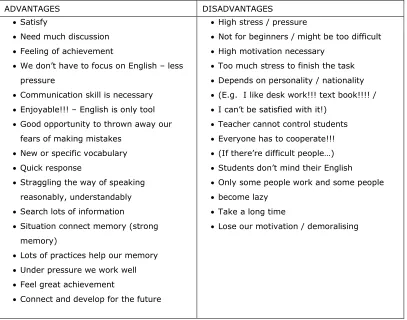
The Hiroshima trainees spent hours together discussing and organising their lesson plan and making materials for their workshops. They were completely involved in the process of fulfilling the task and motivated to the point of working together on it evenings and weekends and even being slightly sleep-deprived as the day of the workshops approached. At the time, the students were oblivious of the potential benefits of their huge (and reportedly at times heated!) discussions and it was only in the final couple of weeks of the course that we looked at TBL as a teaching approach in class. At this point, I asked the students to brainstorm advantages and disadvantages from their own experience of TBL (see Table 1):
(Please note: I haven’t corrected their English, for fear of losing their original meaning, as a result there are mistakes, some repetition and a lot of exclamation marks.)
ADVANTAGES DISADVANTAGES
Satisfy
Need much discussion Feeling of achievement
We don’t have to focus on English – less pressure
Communication skill is necessary Enjoyable!!! – English is only tool Good opportunity to thrown away our
fears of making mistakes New or specific vocabulary Quick response
Straggling the way of speaking reasonably, understandably Search lots of information
Situation connect memory (strong memory)
Lots of practices help our memory Under pressure we work well Feel great achievement
Connect and develop for the future
High stress / pressure
Not for beginners / might be too difficult High motivation necessary
Too much stress to finish the task Depends on personality / nationality (E.g. I like desk work!!! text book!!!! / I can’t be satisfied with it!)
Teacher cannot control students Everyone has to cooperate!!! (If there’re difficult people…) Students don’t mind their English Only some people work and some people become lazy
Take a long time
[image:3.595.99.506.393.713.2]Lose our motivation / demoralising
Advantages of TBL
It’s interesting to note that many of the students’ layman style responses link directly to more academic expressions of similar ideas by researchers and theorists. For example, the comments ‘straggling (sic) the way of speaking / under pressure we work well’brings to mind Swain’s Output Hypothesis and ‘Good opportunity to thrown (sic) away or fear of making mistakes’elicits Rogerian notions or the lowering of Krashen’s Affective Filter. Other potential advantages could include intrinsically motivated learners, achievement motivation, increased student autonomy, authentic elicitation of lexis, highly student-centred and increased opportunity for student interaction. It’s clear that the students overall found TBL beneficial for their language learning and there is also a strong implication of professional development (‘Feel great achievement’ /‘Connect and develop for the future’) which I’ll enlarge on during the section on Professional Teacher Development.
Disadvantages of TBL
Many of the disadvantages mentioned often don’t apply to our trainees directly but regard possibilities for other future hypothetical classes and groups. However, a disadvantage that is important and potentially pertinent to the process versus product debate is ‘Quick response / students don’t mind their English’. Here, I think learners are hinting at a fear of losing accuracy because of the time pressures of interaction, an idea that is expounded by Skehan in his ‘trade-off theory’, i.e. the trade-off between cognitive processing and focus on form, where fluency may develop at the expense of accuracy (Skehan 1998: 97). Does this trade-off necessitate a focus on form in TBL classes? Does it suggest that process is not enough for successful language learning?
Skehan himself prescribes that tasks shouldn’t be too difficult in order to enable learners to tackle both fluency and accuracy at the same time. He also suggests that tutors can also help learners to notice by channelling attention:
channelled use might be towards some aspect of the discourse, or accuracy, complexity, fluency in general, or even occasionally, the use of particular sets of structures in the language. (Skehan 1998: 97–98)
Such channelling or noticing seems to suggest a necessary focus on form or product. Still, the TBL classroom is potentially an excellent environment for encouraging learners to notice language in an
negotiations to help comprehension such as paraphrasing, repetition and reorganization, learners have many opportunities to notice features of the target language implicitly as part of the process:
environmental contributions to acquisition are mediated by selective attention and the learner’s developing L2 processing capacity, and that these resources are brought together most usefully, although not exclusively, during
negotiation for meaning. (Long 1996: 414) However, many theorists and researchers also believe that noticing is essential for acquisition (e.g. Schmidt & Frota 1986, Schmidt 1990, Gass 1991, 1997, Gass and Varonis 1994, Sharwood Smith 1993), so perhaps it’s too important to be left to the vagueness of implicit comprehension.
Schmidt and Frota’s study (1986) seems to support this assertion as it noted that forms that were present in comprehensible input did not appear in output until they had been noticed. It appears that for noticed input to be acquired, the learner needs to notice the gap between the noticed items and their own production. This is potentially a very important discovery for language learning, but nevertheless requires more supportive data to confirm its veracity. Still the likely benefits of noticing are clearly worth an investment of class time and suggest that a focus on language or product is desirable.
In Willis’ framework for TBL the language focus is an essential part of the lesson plan. In this part, language is analysed, developed and practised (Willis and Willis 1996: 56–57). In many ways, this procedure seems like the traditional ‘PPP’ (Presentation / Practice / Production) lesson reversed, as the language input comes at the end of the cycle rather than the beginning:
TBL Lesson (CLT) / PPP Reversed
The pre-task (=intro to
topic and task) Production The task cycle (=task,
planning & report) Practice The language focus
(=analysis & practice) Presentation of TL
excellent opportunity for the teacher to provide informational input with a comparison between native and non-native versions of the original task. The Willis’ version of a TBL lesson also automatically provides language review, as once learners have analysed native-speaker versions, they practise relevant language in similar tasks and they could also redo the original task with the new and improved language. This should hopefully lead to a ‘restructuring’ of language knowledge, where learners refit or restructure old language knowledge with the new knowledge and improve their speaking ability or performance.
To return to the tasks given to the Hiroshima Trainee Teachers, they naturally engendered the need for certain kinds of structures, which I provided at different stages or upon request. For example, for the teaching tasks, the trainees required clarification checks for their own students and we looked at structures such as:OK, so far? Are you with me? Is that clear?The trainees absorbed such necessary structures and restructured their own language systems surprisingly quickly in order to progress better with the tasks.
Professional teacher development
I’d like to now go beyond language learning benefits to the potential benefits of teacher development through the TBL tasks. Given that tasks increased in challenge during the course, trainees had ample opportunity to reflect on their experiences and enhance their skills for following tasks. The teaching of Japanese culture workshops took place over several weeks and students had the chance to teach the same workshop to two or three different groups of British students. The trainees decided independently to hold discussion sessions after workshop days to share constructive feedback and to hone their skills. For my part, I was amazed by these workshops, which were brilliantly designed and thoughtfully executed. Trainees however tended to be overly self-critical and there was little need for me to provide further feedback, other than enthusiastic encouragement, as their own discussions provided a perfect forum for self-reflection and feedback.
Nevertheless, I did design simple reflection forms that students completed both for themselves and for each other. This information I collated into a final form of both trainee and tutor comments which was later emailed to the trainees. I decided not to include self-analysis comments, as they were often surprisingly and unnecessarily self-critical. Conversely they were clearly impressed by their peers’ workshops and offered many positive
comments and some constructive advice. The examples of their comments provided in Appendix B not only illustrate this, but also the trainees’ natural use of teaching terminology that came up during Teaching Profession classes and discussions, such as realia, TPR and even a reference to Krashen’s comprehensible input formula ‘i + 1’.
The final teaching reflection we did rather informally in the student common room over lunch where we watched films that I’d made of their teaching at Tile Hill Wood School. Once again, students were cheerful and positive about each others’ performances, yet silently and stonily fascinated by their own.
At the end of the course the trainee teachers were asked to anonymously complete feedback forms on the teaching programme. Feedback regarding TBL tasks was gratifyingly superlative and the Teaching Profession module clearly became the highlight of the programme. The teaching tasks were described as practical, useful, helpful, a great opportunity and confidence boosting. Many students even described how the tasks helped to strengthen their determination and resolve to become teachers:
I can make sure my dream to become a teacher again.
Other comments are more pertinent to the direct relevance of TBL (the English remains unchanged):
Everything was new for me and I became able to think about how to teach English more logicaly, objectively and deeply.
The most brilliant part of this course is that students can learn not only English itself but also usefull skills to be an ELT.
Conclusions
than product. Process is where both living and learning happen. People learn by doing and by being immersed in the process; language learners learn to speak by speaking and teachers to teach by teaching. Educator John Holt describes this clearly when he describes the desired outcome (or product) of playing the cello:
Not many years ago I began to play the cello. Most people would say what I am doing is ‘learning to play’ the cello. But these words carry into our minds the strange idea that there exists two very different processes: (1) learning to play the cello, and (2) playing the cello. They imply that I will do the first until I have completed it, at which point I will stop the first process and begin the second. In short, I will go on ‘learning to play’ until I have ‘learned to play’ and then I will begin to play. Of course this is nonsense. We learn to do something by doing it. There is no other way. (1993: 129)
References
Chomsky, N. 1957. Syntactic Structures. The Hague: Mouton de Gruyter.
Feez, S. 1998. Text-Based Syllabus Design. Sydney: National Centre for English Teaching and Research. Gass, S. M. 1991. ‘Grammar instruction, selective attention and learning processes’. In R. Phillipson, E. Kellerman, L. Selinker, M. Sharwood Smith and M. Swain (eds), Foreign/Second Language Pedagogy Research (pp.134–141). Clevedon: Multilingual Matters.
Gass, S. M. 1997. Input, Interaction, and the Second Language Learner. Mahwah, NJ: Erlbaum.
Gass, S. M. & E. M. Varonis. 1994. ‘Input, interaction, and second language production’.Studies in Second Language Acquisition16: 283–302.
Holt, J.1993. ‘We learn by doing’. In J. Canfield & M. V. Hansen (compiled by),Chicken Soup for the Soul: 101 Stories to Open the Heart and Rekindle the Spirit
(p.29). Deerfield Beach, FL: HCI.
Long, M. H. 1996. ‘The role of the linguistic environment in second language acquisition’. In W. C. Ritchie & T. K. Bhatia (eds),Handbook of Second Language Acquisition (pp.413–468). San Diego, CA: Academic Press.
Mitchell, R. & F. Myles. 1998. Second Language Learning Theories. London: Arnold.
Nunan, D. 1989. Designing Tasks for the Communicative Classroom. New York: Cambridge University Press. Richards, J. C. & T. S. Rodgers.2001.Approaches and
Methods in Language Teaching. Cambridge: Cambridge University Press.
Schmidt, R. 1990. ‘The role of consciousness in second language learning’.Applied Linguistics11: 17– 46.
Schmidt, R. & S. N. Frota. 1986. Developing basic conversation ability in a second language: A case study of an adult learner of Portuguese. In R. Day (ed.),Talking to Learn: Conversation in Second Language Acquisition (pp.237–326). Rowley, MA: Newbury House.
Sharwood Smith, M. 1993. ‘Input enhancement in instructed SLA: theoretical bases. Studies in Second Language Acquisition15: 165–179.
Skehan, P. 1998. A Cognitive Approach to Learning Language. Oxford: Oxford University Press.
Willis, J. & D. Willis.(eds) 1996.Challenge and Change in Language Teaching. Oxford: Macmillan Heinemann.
APPENDIX A
Key Assumptions of Task-Based Learning
The key assumptions of task-based instruction are summarised by Feez (1998, cited in Richards and Rodgers 2001: 224) as:
- The focus is on process rather than product.
- Basic elements are purposeful activities and tasks that emphasize communication and meaning. - Learners learn language by interacting communicatively and purposefully while engaged in the
activities and tasks.
- Activities and tasks can be either:
those that learners might need to achieve in real life:
those that have a pedagogical purpose specific to the classroom.
- Activities and tasks of a task-based syllabus are sequenced according to difficulty.
APPENDIX B
Microteaching Feedback for Task 4 Topic: Charlie Chaplin
(Note: teaching terminology is in bold)
Students’ Comments Good Points:
Good volume! Gesture! Speed!! Good smile
Moe, you’re a pretty actress Feedback– many vocab Good introduction TPRinteresting (x2) I love this TPR activity
The words Moe picked up was‘i + 1’(some unknown words and known words) Exciting / interesting
Explanation …very easy to understand No pressure
Nice feedback
The voice is good tone, pace Good time management VAKbalance (x2) Class dynamics Excellent!! Good film choice Enjoyable activity
We can learn new vocabulary from funny Chaplin film (-unforgettable way of memorizing words!!) (x3) Good lesson plan (watching film, vocabulary, practicing words with gestures is great, role play) I enjoyed very much (x3)
We could acquire a lot of words in one time Balance ofTTT or STTis good (x2) New words with gesture – pretty good Tempo is perfect
Also good smile, fantastic gesture, voice (x2) PPPmade us very clear and enjoyable
Costumes made us excited /Realiamakes students excited Useful vocabulary
Activity itself is also interesting, because not so talk the target words but after all we can understand and use the words
Possible Improvements:
How about using different character in each group (for example, shy woman and hysteric woman)? Pronunciation check would have been good.