Explaining trade missions: the role of program characteristics
in explaining trade mission’s outcomes.
University of Twente
Master Thesis: MSc Business Administration Author: Stefanie Broek
ABSTRACT
This study examines to what extent trade mission (TM) program characteristics contribute to explain government initiated TM’s intangible and tangible outcomes. Firms participate in TMs in order to internationalise and its international success depends on a firm’s internal capabilities and competences. Therefore, the intangible outcomes are based on the International Business Competence (IBC); comprehending intangible capabilities that are extremely important for organisations in international business.On the other hand, the tangible outcomes include the contracts caused by the TM and to what extent the firm’s objective investment in the foreign market has been achieved. For this study the case of the Netherlands has been used. Hence, the sample consists of TMs organised by the Dutch government and executed in the period February 2014 till March 2015. Data from publicly available evaluations (factsheets), documents, reports and interviews were used to conduct this study. Findings suggest that participating firms are not completely satisfied about achieving their objectives. Also, the findings indicate that the TM program characteristics are less than optimal integrated in program components. Furthermore, the TM program characteristic “market exploration” has a positive effect on the capability “international orientation”. Characteristic “business culture exploration” positively affects the capabilities “international orientation, “international marketing skills” and the score on the objective investment in foreign market. Moreover, the characteristic “networking during program” positively influences the capabilities “international orientation”, “international innovativeness”, “international market orientation” and the score on the objective investment in foreign market. There is no supported link between the TM program characteristics and contracts in response to the TM. Concluding, it can be stated that the TM program characteristics “market exploration”, “business culture exploration” and “networking during the program” could influence the IBC and investment in foreign market. Also, additional findings do suggest a connection between the intangible and tangible outcomes.
Supervisors: Dr. H.J.M. Ruël
2
INTRODUCTION 1.1 Problem Statement
Globalisation is one of the major business and trade buzzwords since the end of the 20th century (OECD, 1998). Commercial diplomacy plays an important role in this ongoing process of globalisation (Kostecki & Naray, 2007). Annually, the KOF presents the globalisation index of the 100 most globalised countries. The top five of 2016 were the Netherlands, Ireland, Belgium, Austria and Switzerland (KOF, 2016). Besides, the Netherlands are the most globalised country, they are also one of the largest exporters in the world.
Today’s global economy is dominated by emerging economies. This is one of the reasons for governments of developed countries to support the home country’s business to expand across borders. As emerging economies most likely retain their global economic weight in the foreseeable future, governments of developed economies should encourage commercial diplomacy (Ruël & Zuidema, 2012). During the past years the EU member states have already changed their strategy to focus more on commercial and economical diplomacy. For instance, in 2011 the Netherlands shut down seven embassies mainly in African countries, but they extended their embassies with an important one in China (Volkskrant, 2011). Furthermore, in the final report ‘Modernisering van de Diplomatie’ of a governmental advisory committee, economic and commercial diplomacy are considered to be at the core of the Dutch foreign policy and diplomacy (Ministerie van Buitenlandse Zaken, 2014).
Commercial diplomacy is mostly described in the context of export promotion. The fact that exporting is becoming increasingly important results in a rapid growth of the number of bilateral and multilateral trade agreements. Therefore, economic globalisation leads not only to new opportunities but also to new challenges for companies. Expanding internationally is a major decision for many firms. Consequently, increasing international trade is not that easy. Many firms are reserved of entering foreign markets due to an unclear perspective of these markets. Furthermore, especially small and medium sized enterprises (SMEs) are not able to succeed in foreign markets because they lack motivation, capabilities and resources (Freixanet, 2012; Seringhaus & Rosson, 1991). Therefore, public and private initiatives offer services to help firms in the internationalisation process. The facilities are called export promotion programs (EPPs) and have a continuously growing share in governments’ budgets.
3
the market is still limited”, were not that frequently organised (Spence, 2003, p.83). The access
to participants of a TM is limited and the data is often confidential. Therefore, less information is available about this export promotion tool. Nevertheless, since the changed strategy, the Netherlands organise TMs all year round based on a strategic travel agenda.
Even though, TMs are a well-known instrument to increase trade and export, research on its outcomes and effectiveness is relatively new. Besides, the existing studies that focused on the effectiveness of TMs do not provide clarifying answers (Ruël, 2013). A major explanation is the fact that TMs were treated as a ‘black box’. Deeper research into different TM aspects is really scarce. For instance, questions dealing with the role of preparation and follow-up, the program content etc. are still unanswered. To explain outcomes of TMs and its effectiveness, all aspects of the TM should be understood and TMs should not be seen as “standardised” concept. First, studies should focus on the TM itself. Components of TMs need to be examined in depth to open up that ‘black box’. The most important aspect of a TM is the program, which can consist of diverse activities such as match making, seminars and company site and event visits. Therefore, this study focuses on the role of TM program characteristics on TM outcomes.
1.2 Research Purpose
TMs are often organised events in order to increase the export of a country. As well in the Netherlands, TMs are frequently organised and part of strategic travel agenda. Besides the governmental aim to increase the export rate, firms participate in a TM in order to internationalise. To expand across borders, firms have to possess certain resources. Therefore, this study explains the participation of firms in a TM from a Resource Based View (RBV). This approach can be used to explain competitive advantage. Though, not only the possession of essential resources but also a correct use is crucial. Therefore, a firm needs specific capabilities in order to use the resources properly. Knight & Kim (2009) created four intangible capabilities that are essential in international business. These four capabilities are conceptualised as the “International Business Competence” (IBC). The IBC can be seen as intangible, overarching firm resource that results in superior performance internationally.
4
the components of TM programs are related to certain characteristics. Therefore, the main goal of this study is to increase the understanding of the role of the characteristics of government initiated TM programs in order to explain outcomes of government initiated TMs. Besides the development of intangible competences on firm level such as the IBC, the more tangible outcomes like the business contracts in response to the TM and the achievement of the investment objective are also indicators of TM’s outcomes. Based on this aim the following central question is formulated:
To what extent do TM program characteristics contribute to explain government initiated TM outcomes in particular the international business competence, contracts and investment?
1.3 Theoretical & Practical Contribution
Until this moment TMs have been treated as a ‘black box’ due to a lack of insight in the procedure and structure (Polattan, 2014). Therefore, it is hard to measure the effectiveness of these missions. International business becomes more and more important in our nowadays globalised world and governments organise more missions each year. However, the available literature about TMs is still extremely limited. Most studies have focused on the entire TM aspect instead of splitting it into more detailed pieces (e.g. Head & Ries, 2010). Also, these studies mostly describe TMs as just one element of export promotion programs (e.g. Freixanet, 2012; Wilkinson & Brouthers, 2000). In the first place, this study theoretically contributes to open this so called ‘black box’. Therefore, it is important that TMs will be clarified in more detail. A specific focus on the most important part of the TM; its program would lead to new insights related to the role of the program characteristics and the impact on the outcomes. Also, before the effectiveness of TMs can be noticed a deeper understanding of the diverse aspects is needed. Moreover, the existing literature does not explain TMs by a theory like for instance the internationalisation process. To examine TMs in a same context, other findings could be perceived in order to explain the effectiveness. A start with a study focused on the program components a TM will definitely generate options for follow-up research concerning the topic.
5
will be more successful when firms can benefit from the the participation. Subsequently, the national trade will increase. Therefore, more research into this topic could affect the export rates, because TMs can be organised more effectively which could lead to better outcomes for firms as well as the government.
LITERATURE REVIEW
This study starts with a literature review, which is an objective, in-depth summary and critical study of the relevant, available research and non-research literature on the topic being studied (Hart, 1998). Basically, it is about mapping out the existing literature about the context. This chapter describes the existing literature of the core concepts of this study, started from the broadest aspect: commercial diplomacy. Then, export promotion an important part of commercial diplomacy related to international business will be described. When the broader picture is clear, the main concept; TMs will be addressed. This section will be divided in the elements, definitions, programs and outcomes. Finally, the participation of firms in TMs will be explained by a theory and afterwards a model will be conceptualised.
2.1 Commercial Diplomacy
Diplomacy can be defined as: “the main instrument of foreign policy enabling the management of external relations of a state by communication with foreign authorities and publics, as well as through the process of negotiations and networking” (Kostecki & Naray, 2007, p.1).
Diplomatic activities occur on international level and within the host state. Mercier (2007) states that commercial diplomacy is often confused with economic diplomacy. However economic and commercial diplomacy have some covering economic objectives, commercial diplomacy is more explicit. Ruël, Lee & Visser (2013) describe that diplomacy usually “involves information gathering, lobbying, advocacy, and the representation of interests in a negotiation” (p.14). However commercial diplomacy focuses, besides all these activities, on
negotiations around commercial deals.
6
Commercial diplomats perform activities related to negotiating business deals that involve public and private commercial interests. Commercial diplomat’s actors are for instance the head of state, prime minister, minister, ambassador or specialised diplomatic representatives (Naray, 2008). However, staff members of trade promotion organisations and investment promotion agencies can also be seen as commercial diplomats (Kostecki & Naray, 2007). The best definition of commercial diplomacy comes from Naray (2008) he defines it as “an activity conducted by public actors with diplomatic status in view of business promotion between a home and a host country. It aims at encouraging business development through a series of business promotion and facilitation activities” (p.2).
Many commercial diplomacy activities are related to promote and facilitate international business (Ruël & Zuidema, 2012). International business often affects the export of countries. Therefore, most studies describe commercial diplomacy in the context of export promotion.
2.2 Export Promotion
Exporting firms are likely to perform better than companies that are not participating in businesses overseas (Wikinson & Brouthers, 2000). However, not all SMEs are enthusiastic about entering new international markets, most SMEs are hesitant due to more risks and not having the relevant knowledge and abilities. Factors such as perceiving competitive advantage and having internationally oriented managers could encourage SMEs to develop business worldwide (Spence, 2003). Therefore, governments created export promotion programs to help SMEs expand internationally.
Export promotion activities are part of commercial diplomacy. Several authors provide a classification of commercial diplomacy activities. For example, Kostecki & Naray (2007) divide the activities in primary and supporting activities. The primary activities are related to “trade and FDI, research and technology, tourism and business advocacy” (p. 7). On the other
7
would be provided through for example TMs and trade shows. Ruël & Zuidema (2012) cluster the most important activities, based on the different classifications made in diverse studies, as following: intelligence; assistance with fairs, TMs and networking; problem solving and assistance with trade disputes; and partner search and negotiation.
Trade shows and TMs are two of the most popular activities initiated by the government. The impact of trade shows is extensively examined, however there is less information available about a TM and its impact (Spence, 2003). Therefore, the focus of this study is on TMs as export promotion instrument.
2.3 Trade Missions
This literature section about TMs will be divided in two parts. The first part will be an extension of Wild’s (2013) literature review in order to present the new material written about TMs. The second part is independent of this updated literature review and will describe the main concepts of TMs related to this study.
2.3.1 Review Approach and Searching the Literature based on Wild (2013)
Obviously, a deeper understanding of the subject TMs is necessary. Wild (2013) chose a “scoping review” approach to review the literature on TMs. This approach’s aim is to map out the subject of interest in order to determine what is already known about it and to find knowledge gaps that can provide input for future research (Jesson, Matheson, & Lacey, 2011). For this approach is no prescribed systematic method available, it is up to the reviewer to decide how review the literature. To ensure a replicable and transparent review process Wild (2013) used a systematic review approach. “The review plan, identification of studies, selection of studies, quality assessment of studies, analysis and synthesis of studies will all underlie predetermined criteria” (Wild, 2013, p. 11).
8 Table 1 from Wild (2013) Literature Search Results
2.3.2 An Updated Review of the Trade Mission Literature
Since Wild (2013) reviewed the literature till 2012, this update will contain all relevant studies since 2013/2013. Table 2 shows the results found after 2012 and table 3 presents an overview of the new literature.
Table 3; An Updated Literature Review
PURPOSE LEVEL OF
ANALYSIS
UNITS OF ANALYSIS
METHODOLGY DISCIPLINARY
PERSPECTIVE
CONCLUSION
Silva (2015) Investigating if
SMEs benefit from the large companies participating in a TM.
Firms: Portugese
Comparing TMs with and without participation of large companies. Qualitative, inductive, interviews. Export performance.
SMEs do not directly benefit from interaction with large companies. However, networking has much more potential.
Cassey (2015)
Creating a model that accounts for the frequency and destination of TMs and predicts a positive relationship between missions and exports by destination. Governor-led U.S. TMs Destinations of organised TMs. Quantitative, publicly available data, introducing government to a Melitz / Chaney model, regression analysis.
TM destinations. Mission destinations are qualitatively consistent with the model.
Sousa (2015) Investigating
potential biases and best practices regarding TMs. Firms (SMEs): Portugese Analysing how SMEs should proceed when and while enrolled in a TM.
Qualitative, case study, interviews.
TM performance / effectiveness.
Potential biases identified, mostly related to internal attribution (behaviour of firm). Best practices regarding
preparing and follow-up.
Manly (2016) Exploring the experiences of SME representatives participating in a TM to South Africa.
Firms (SMEs): U.S. Exploring the strategies required to export goods after a TM.
Qualitative, interviews, document sources, inductively and deductively coded. Export performance after a TM; RBV.
Came up with five
recommended actions that leaders of firms can employ to strengthen their TM outcomes.
Creusen & Lejour (2013)
Analysing the role of economic diplomacy
Firms: Dutch Starting and incumbent exporters.
Data from Statistics Netherlands, use a model that explains
Foreign market entry.
10 on the export market
entry decisions.
the probability of a firm to enter a market in a period by firm and market characteristics.
government TMs stimulate Dutch firms to enter export markets in these countries.
Kanda & Mejía-Dugand & Hjelm (2015) Assessing the awareness, participation and perceived effectiveness of governmental initiatives to promote exports. Firms: Swedish (environment al technology sector). Discussing the awareness of governmental initiated export promotion programs. Empirical study, data base building and depuration, internet survey.
Export promotion effectiveness.
Respondents show a high export orientation, however they were unaware of governmental initiatives that could fit their needs. The firms that were aware showed a high level of participation in such initiatives, but only a few could relate it to its actual exports. Ayob & Freixanet
(2014)
Evaluating the impact of public export promotion programs. Firms (SMEs): Malaysia Examining three indicators according to a firm’s export status: level of awareness, frequency of use, and perception of usefulness. Cross-sectional survey data collected from SME Corporation Malaysia’s database 2012.
Impact of export promotion programs.
Exporters perceive TMs as more useful and use them more frequently than non-exporters. Both exporters and non-exporters suggest programs related to export
info/knowledge are more useful. The frequency of use and the perception of
2.3.3 Trade Mission: Defining Trade Missions
TMs are a popular and commonly used commercial diplomacy tool (Ruël, 2013). However, general definitions of the concept TMs are rather rare. Jaramillo defines it as stated in Wilkinson & Brouthers (2000) as follows: “the arrangement, made by export promotion professionals, of individual or group meetings between buyers and sellers at appropriate overseas locations” (p.731). According to Seringhaus (1987), TMs provide a “first-hand assessment of market opportunities, establishment of direct contacts and a high profile in a target market, assistance in seeking representation or indeed prospective customers, and contact with other participants: in sum, a learning experience in export marketing”(p.249). TMs allow potential exporters to
learn how business is conducted over seas, what kind of services and products are available, the receptivity of potential buyers, the extent of the commitment and resources necessary to sell in overseas markets, and the answers to questions about foreign markets and the process of exporting (Seringhaus & Rosson, 1989, p. 176). Therefore, TMs are considered to be most effective for companies that are non- and new exporters. Moreover, Ruël (2013) states that TMs “facilitate the internationalization process of companies and brings home country
entrepreneurs and multinational corporations into contact with companies in potentially interesting markets”(p.29+30). Spence (2003) refers to Young’s (1995) perspective of a TM,
which is an activity that supports participants to acquire knowledge of a foreign country’s culture through contact with local firms, business people and governments. It gives insight in the market potential and local networks.
Heuts & Poel (2010) explain the perception of both TMs organisers and TM participants. The organisers’ aim is to familiarise participating firms with potential markets and business partners, which hopefully result in more foreign orders. Besides, organisers of TMs bring the participating firms in contact with each other in order to exchange knowledge and experiences. For participants, TMs include acquiring business contacts, exploring foreign markets and creating awareness about market opportunities, networking and strengthen the (international) position. Concluding, the existing literature about TMs does not provide a clear and general definition. Based on the available definitions and purposes of organised EPPs the following definition of a government initiated TM will be used in this study: Government initiated TMs are travel events, led by a minister and/or government official, with the aim to strengthen the relation between home – and host country and to increase the export. The TM has an encouraging purpose for participants to enter or expand into foreign countries. Therefore, the TM’s program facilitates in activities focused on market exploration, business
12 2.3.4 Trade Mission Programs
TMs are often organised by commercial diplomats and other export promotion specialists. These organisers help companies to overcome the obstacles concerning the internationalisation process by introducing them in foreign markets. Although, the content and setting of a TM program can vary. Some TMs are for instance led by government officials or a head of state. Nitsch (2007) argues that participants benefit from TMs led by these influential officials, they provide a mission a certain status what sometimes lead to more opportunities.
According to Heuts & Poel (2010), TMs consist of different activities for participating firms, such as network meetings, seminars, workshops and company visits. Match making is one of the most important aspects of a TM program. The quality of this match making process is considered a crucial factor in the successfulness of such a program. The preparation done by the organisers of TMs as well as the participants and the selection procedure are key factors in succeeding high-quality match making. Heuts & Poel also state that the presence of government officials, the existence of embassies and consulates in host countries, the investment of firms in the follow up and a limited amount of participating companies have an influence on the quality of the match making.
Oudalov (2013) states that depending on the focus of a mission a broad range of activities can be organised during a TM. Based on the results of his study, he makes a distinction between business oriented, informational and networking activities. Oudalov (2013) also highlights the importance of business-to-business meetings, or match making events because meeting potential partners is a main goal for many firms joining a TM. In cases that large companies are participating in a mission, they may have the opportunity to have institutional meetings with the host country’s government. The more informational activities, particularly for fact-finding companies, are seminars, workshops and site visits. The networking activities are more casual events such as informal drinks or a trade dinner. During these moments firms connect with local companies, business people and officials. Consequently, the firms connect with each other, which also have an important impact on a TM’s success.
13 2.3.5 Trade Mission Outcomes and Effectiveness
Although the TM as a tool to increase trade and support export is not new, research on the effectiveness and outcomes of the TM is only from latest years. Since the end of last century researchers started studying the effectiveness of TMs (e.g. Wilkinson and Brouthers 2000a; Spence 2003; Nitsch 2007; Cassey 2010; Head & Ries 2010; Heuts & Poel 2010; Creusen & Lejour 2011). In general these studies indicate a positive influence depending on the perspective, but there is no clear-cut answer to the question if TMs do increase trade (Ruël, 2013).
Head & Ries (2010) found insignificant effects related to Canadian TMs. Findings of Wilkinson & Brouthers (2000a) show a negative association with high-tech growth exports. However, the model of Cassey (2010) predicts a positive connection between TMs and export. TMs can be very successful in attracting inward FDI for states with relatively more FDI (Wilkinson & Brouthers, 2000b). According to Moons & van Bergeijk (2011) TMs are not the most effective export promotion activity, although their results show a significant positive effect.
Heuts & Poel (2010) and Creusen & Lejour (2011) studied the effect of TMs organised for Dutch firms. The first studied the effect of TMs through user research. The results show that participation in a TM may lead to the following advantages: extending a firms’ (international) network, understanding the targets country’s market, exchanging knowledge and improving the image of a company and sector in which it is operating. Most firms experience benefits through their participation in a TM. The remaining companies accuse the quality of match making, their own preparation and the possibilities to connect to foreign companies as most important fail factors. Creusen & Lejour (2011) found “that the presence of support offices and trade missions in destination countries, particularly middle income countries, stimulate the entry of new exporters and export growth”(p.1).
14 2.3.6 Trade Missions and Competitive Advantage
There are multiple theories that contribute to explain the participation of firms in a TM. The social network theory, for instance, focuses on relationships between and among entities (Butts, 2008; Wassermann & Faust, 1994), whereas networks are extremely important for all companies. In terms of TMs, these entities can be organisations, authorities etc. TMs are often used to build and strengthen relationships in order to extend the network. Another theory, such as the transaction cost theory or transaction cost economics, implies that transaction costs arise when making an economic exchange (Coase, 1937; Williamson, 1989). Transaction costs are for example incurred costs due to; searching for partners, suppliers and customers, and all facets dealing with the contract. Hence, participation in a TM possibly leads to less transaction costs. Moreover, “the institutional theory attends to the deeper and more resilient aspects of social structure. It considers the processes by which structures, including schemas, rules, norms, and routines, become established as authoritative guidelines for social behaviour. It inquires into how these elements are created, diffused, adopted, and adapted over space and time; and how they fall into decline and disuse”. It can be seen as the rules of the game and difficult to change (Scott, 1987). Decisions, choices and actions made by firms are determined by their organisational field, leading to more similar firms (DiMaggio & Powell, 1991). Considering TMs with an institutional focus, can refer to international business comparing foreign countries, communities and markets based on rules, laws and institutions.
The most significant theory for this study that explains the participation of firms in TMs is the Resource Based View (RBV). It is an approach that could lead to achieve competitive advantage (Barney, 1991; Wernerfelt, 1984). This view argues that sources on the inside of the firm lead to competitive advantage instead of the external environment (Barney, 1991).
Wernerfelt (1984) defines resources as “those (tangible and intangible) assets which are tied semi permanently to the firm” (p.172). Tangible resources (e.g. buildings, machinery)
are physical and can easily be bought in the market. These resources are simple to copy by competitors and do not lead to competitive advantage on the longer term. Intangible resources on the other hand, are everything else that is not physical. These resources usually stay in the organisation and are difficult to copy for the competition. Therefore, intangible resources are the main source of competitive advantage.
15
resources do not move from company to company. Consequently, firms cannot copy each other’s resources and implement the same strategy. Many intangible resources are usually immobile. Although having heterogeneous and immobile resources is not enough to achieve a sustained competitive advantage. Besides, not all firm resources have the potential to achieve a sustained competitive advantage. Barney (1991) identified four attributes that a resource must have in order to have this potential. Resources should be valuable, rare, inimitable and non-substitutable. Resources are valuable when a firm can use them to implement strategies to improve the efficiency and effectiveness. Besides resources should be valuable, they need to be rare, otherwise competitors can easily adopt the same bundle of resources to execute a similar strategy. If a firm possesses valuable and rare resources it could at least obtain temporary competitive advantage. In addition, the resources should be imperfectly imitable for one or more of the following reasons: “the ability of a firm to obtain a resource is dependent upon unique historical conditions, the link between the resources possessed by a firm and a firm’s sustained competitive advantage is causally ambiguous, or the resource generating a firm’s
advantage is socially complex” (Barney, 1991, p.107). Finally, the resources may not be able to be substituted, using a similar resource that enables it to implement similar strategies. Organisational capabilities and overall performance are dependant of the differential endowment of resources (Barney, 1991; Wernerfelt, 1984).
Capabilities and Competences
16
The RBV contributes to explain how knowledge and subsequent organisational competences, hence capabilities are developed within organisations. Knowledge and organisational competences provide advantages that help to entry international markets (Knight & Kim, 2009). The IBC is difficult for competitors to imitate because it is embedded in organisational processes and hard to observe. It is not mobile across firms and not available for purchase in the market. The IBC is developed within a firm over time. Therefore, IBC is an important source of sustainable competitive advantage.
2.4 Towards a Conceptual Model
The available literature generally agrees that the internationalisation process is associated with risks and barriers. Most SMEs lack the resources necessary to internationalise. The findings of Oudalov (2013) suggest that the outcomes of TMs depend on the objectives of participating firms. Present study focuses on the idea that firms participate in a TM to acquire resources, competences and capabilities. Without those it is impossible for a firm to internationalise. Kim & Knight (2009) characterised the key intangible capabilities as dimensions of IBC as following:
International Orientation (IO): Firms with a strong international orientation are considered to have managerial vision and a proactive organisational culture in order to develop specific resources needed to achieve their objectives in foreign markets. For firms, it means active exploration of new businesses overseas.
International Marketing Skills (IMS): It refers to the ability of a firm to create value for the customers in foreign markets. Segmentation, targeting and international marketing activities contribute to creating value and need to enable differentiation from the competition.
International Innovativeness (II): The capacity to develop and introduce new processes, products, services and ideas to foreign markets. Openness to innovation is important. R&D and market intelligence are the two most significant sources resulting in innovation. Market intelligence seems to be a crucial factor for presenting innovations abroad.
17
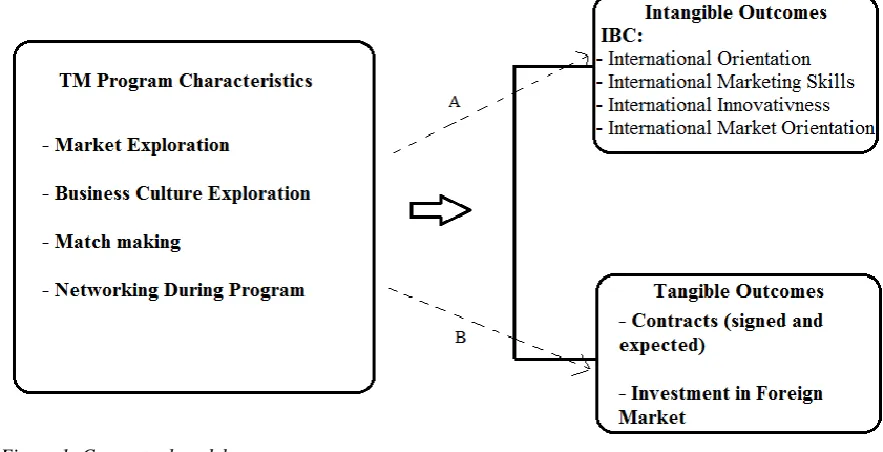
[image:17.595.71.513.327.553.2]This study focuses on the effects of the TM program characteristics on TMs outcomes. In the first place, this study claims that a TM program is based on four characteristics: market exploration, business culture exploration, match making & networking during program components. Then, these four characteristics have an influence on the TM’s outcomes. The first assumption is related to the influence of the program characteristics on the intangible firm competences; IBC (indicated with “A” in the model below). The second assumption indicates the influence of the program characteristics on the tangible outcomes such as contracts and investment (indicated with “B”). As a result, this study states that when the TM program characteristics are inserted in its program components facilitate in developing the four capabilities of the IBC have better intangible outcomes and, thus are more successful. Also, TMs that have its program components integrated with the four characteristics have better tangible outcomes. Figure 1 below shows the above mentioned assumptions.
Figure 1: Conceptual model
METHODOLOGY
The following chapter describes the methodology used to conduct this study. The elements research design, data collection and data analysis will be discussed in this section taken the TM policy of the Netherlands as case for this study. Therefore, the first paragraph will outline the context of this research.
3.1 Case of the Netherlands
18
globalised country of the world. They are closely followed by Ireland and their southern neighbours Belgium. Besides the fact that the Netherlands are in the top 5 of exporting countries, only 18 percent of the companies is involved in international business (CBS, 2016). The Netherlands are dependent on international business; import and export. Therefore, the Dutch ministry uses diverse instruments to stimulate international business. Economic diplomacy is basically the use of governmental resources to strengthen economic relationships with foreign countries (MinisterieVanBuitenlandseZaken, 2016). For instance, economic missions; TMs, are a commonly used instrument by the government. The Dutch government organises around 20-25 economic missions a year (RVO, 2016). The aim of these missions is to intensify the bilateral relationships, creating business contacts for Dutch firms and institutions, promotion of trade and investments, and Holland branding (RVO, 2016).
3.2 Research Design
Creswell (2009) argues that there are three types of research methods: qualitative, quantitative and mixed methods. The minor role of multiple methods as research strategy is underlined in certain reviews of international business related studies in which the mixed method approach is ignored as alternative method. All empirical studies should be classified as either qualitative or quantitative (Hurmerinta-Peltomäki & Nummela, 2006). However, international business is a “multi-faceted area of research, crossing national, cultural, organizational and personal boundaries, and inspiring quite complicated research questions” (Hurmerinta-Peltomäki & Nummela, 2006, p. 440). The complex context of international business makes sure that only a minor part of the reality would be disclosed when using one narrow methodological method. International business is still a relatively new research interest. It offers many ways to explore this research field. Therefore, international business researchers call for the use of multiple research methods (Hurmerinta-Peltomäki & Nummela, 2006). However, in comparison with the single-method approach, the multiple method is still under-used in this field of research.
19
interpretive, naturalistic approach to the world. This means that qualitative researchers study things in their natural settings, attempting to make sense of, or to interpret, phenomena in terms of the meanings people bring to them” (p.3). Bryman (2004) concludes that quantitative research can be seen as a research strategy that focuses on quantification in the collection and analysis of data. This method has a deductive emphasis, instead of the inductive character of qualitative studies. A combination of methods based on words and numbers can lead to a more complete picture of the subject (Creswell, 2009).
Besides the term mixed methods, there are many other names used to indicate this concept. A frequently used term is triangulation. However, the degree of triangulation can vary from extremely easy to highly complex research designs. The degree of triangulation depends on the purpose of using mixed methods. It relates to what the researcher wants to achieve with this strategy. At first, a mixed method use can have an instrumental role, which means the quantitative method facilitates the qualitative part of the research or vice versa (e.g. Bryman, 2004). Another reason to apply mixed methods is the improvement of the validity of the study (e.g. Bryman, 2004; Creswell, 2009). Starting the research process with a qualitative part aimed at getting familiar with the topic and context, increases the validity. Finally, the use of mixed methods will acquire a deeper understanding of the research topic (Jick, 1979).
3.3 Data Collection
The data that will be used for the qualitative part of the study is secondary data, which is publicly available. In short, secondary data is data that is collected by someone else (Boslaugh, 2007). The Dutch Ministry of Foreign Affairs has published online documents and reports of many TMs organised by them. The reports contain information about the TMs objective(s), program components, involved parties, Corporate Social Responsibility (CSR) & human rights, results and follow-up. Moreover, the RVO has given presentations about Dutch TMs, this information will also be used. These documents and the literature will be used to assess the characteristics of TMs.
Moreover, three months after the TM each participated firm is asked to fill in an evaluation form. The results of these individual evaluations are combined in one sheet per TM, these evaluation sheets are called factsheets by the Dutch MFA. The terms evaluation and factsheet can be used interchangeably in this study.
20
of the firms will be random. All the available lists with participants are merged into one list. Every 10th company will be selected. The existing factsheets presenting the TM’s outcomes are short-term based (three months after the TM). The interviews on the other hand, will be executed at least one year after the firm has participated in the TM. The interviews will be executed by phone and will have a duration of approximately 15-20 minutes. Contacts of the selected companies are found via Linked-in. In cases no one comes across, the firm is eliminated. Otherwise the CEO or export manager will receive an email or a message with the request to participate in an interview. Afterwards an appointment for the execution of the interview is scheduled. The firms mentioned in the table below will be interviewed during the data collection phase.
INTERVIEWED FIRM TM DESTINATION
1 TECH NORTH GERMANY DENMARK
2 CONTRACTING VIETNAM
3 PEPPER JAPAN & SOUTH KOREA
4 FLOAT NORTH GERMANY
5 M&O JAPAN & SOUTH KOREA
6 TOUR DENMARK
7 PORT SOUTH KOREA
8 MEDIC SOUTH KOREA
9 GREEN POLAND
10 ENERGY JAPAN & SOUTH KOREA
11 ARCHITECT VIETNAM
12 MARITIME (e.g.) GHANA & NIGERIA, ANGOLA, POLAND
13 DIABETES JAPAN
14 HEALTH CARE INDIA
15 GREENHOUSE JAPAN & SOUTH KOREA
16 AVIATION POLAND
17 WESTLAND JAPAN & SOUTH KOREA
18 I&C DENMARK
19 SUSTAIN TECH CHINA
20 EXPORT INSURANCE GHANA & NIGERIA
21 I&C CHINA
21
23 OFFSHORE ENGINEER JAPAN & SOUTH KOREA
24 R&D NORTH GERMANY
[image:21.595.68.511.69.135.2]25 WASTE INDIA
Table 4: List of interviewed firms and the TM destination
The interviews will be standardised, so structured. Each interview is offered with the same questions which will be asked in the same order (McLeod, 2014). The questions will be created prior the interview and there is less room for variation in responses. However, the interviews consist of a couple open-questions. Therefore, the interviews should be called semi-structured. Because of the standardisation of the interviews, many interviews can be conducted within a short period of time. The open-questions will be based on the overall experience, TM program components, missing elements and the delegation in order to get a deeper understanding. This also increases the validity of the study (Creswell, 2009). In order to keep all the interviewees’ details confidential, the organisation names mentioned in this study are derived from the real organisation name or the branch where the firm operates in.
The phone conversations will be recorded and the answers will be filled in on the question form in order to store the data for the analysis. Moreover, a member check, also called as member validation is part of the data collection process. This includes that “the provisional report (case) is taken back to the site and subjected to the scrutiny of the persons who provided information” (Lincoln & Guba, 1985, p. 236). In this process the participant can comment on
the report to improve the accuracy. Lincoln and Guba (1985) describe the member check as a method to assess the validity of qualitative studies, e.g. interviews. Therefore, the interview member check will increase the validity of this study.
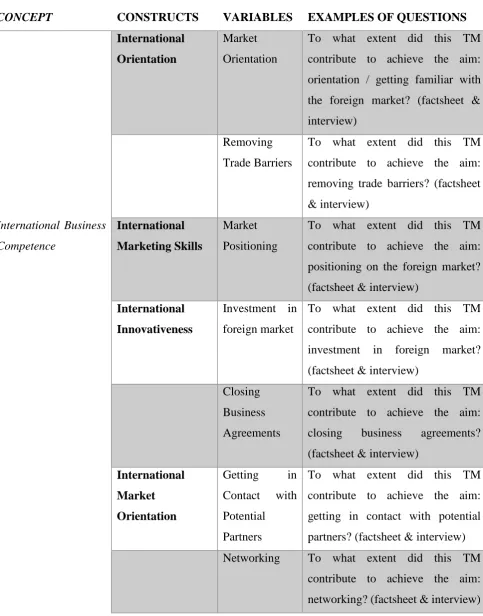
3.4 Operationalisation of Concept IBC
22
CONCEPT CONSTRUCTS VARIABLES EXAMPLES OF QUESTIONS
International Orientation
Market Orientation
To what extent did this TM contribute to achieve the aim: orientation / getting familiar with the foreign market? (factsheet & interview)
Removing Trade Barriers
To what extent did this TM contribute to achieve the aim: removing trade barriers? (factsheet & interview)
International Business Competence
International Marketing Skills
Market Positioning
To what extent did this TM contribute to achieve the aim: positioning on the foreign market? (factsheet & interview)
International Innovativeness
Investment in foreign market
To what extent did this TM contribute to achieve the aim: investment in foreign market? (factsheet & interview)
Closing Business Agreements
To what extent did this TM contribute to achieve the aim: closing business agreements? (factsheet & interview)
International Market Orientation
Getting in Contact with Potential Partners
To what extent did this TM contribute to achieve the aim: getting in contact with potential partners? (factsheet & interview) Networking To what extent did this TM
[image:22.595.80.564.61.678.2]contribute to achieve the aim: networking? (factsheet & interview)
23 3.5 Data Analysis
After the data is collected, it has to be analysed. Since the first section of this study has a qualitative approach, a qualitative data analysis (QDA) has to be executed. This process is mainly about extracting meaningful information out of the collected data (Babbie, 2015). The first step is extracting the important characteristics of a TM’s program out of the literature, secondary documents and interview data. Secondary data analysis implies analysing data that is collected by someone else and initially for other purposes (Boslaugh, 2007). A major implication is that secondary data often does not connect completely with the research question of present study. Moreover, since this data is collected by someone else, it is important to get familiar with it. The analysis of the first part concerning the data of the Dutch Ministry can be seen as document analysis. Bowen (2009) describes document analysis as “a systematic procedure for reviewing or evaluating documents material” (p.27). Document analysis implies examining and interpreting data with the aim to extract meaning, obtain understanding and expand the empirical knowledge (Corbin & Strauss, 2008).
Subsequently, the collected interview data will be analysed based on a summarised written transcript of each interview. This analysis starts with identifying the themes emerging from the data, sometimes named “open coding” (Straus & Corbin, 1990). During this process categories will be identified and named. The aim is to create a preliminary framework for the analysis based on the conceptual categories. Words and phrases that seems similar to each other will be grouped together in one category. This framework is conceptualised as a matrix per subject, see appendix E. The words or phrases of a particular category are visible in colours the summarised interviews in appendix D.
Moreover, the evaluations or factsheets will be analysed. By the use of SPSS 23, a statistical software tool, the data of all (existing) factsheets of the economic TMs organised by the Dutch Ministry will be merged in order to gain a proper perspective of the accomplished TMs. Mainly averages will be compared in order to draw conclusions. Moreover, some of the factsheet questions are asked once again during the interviews. These averages will be compared with the results after the factsheet analysis as well.
24
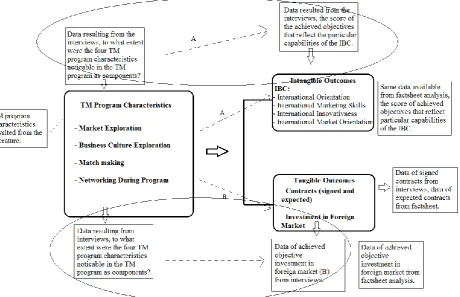
For the analysis of part “A”, Kendall’s tau correlation should be used because of the small data set and many tied ranks (Field, 2013). For part “B”, a Kendall’s tau correlation test is used for the TM program characteristics and the achieved objective investment in foreign market. For the TM program characteristic and the score of firms that signed contracts a point-biserial is used, because of the dichotomous variable signed contracts (yes/no) (Field, 2013).
[image:24.595.86.547.259.556.2]The figure below is an extended model to clarify which data will be used for which analysis in order to examine the conceptual model from chapter 2.4. In this figure the diverse data sources are included. Interview data will be used to examine part “A” and “B” of the model.
25 RESULTS
This chapter will present the results following from the analysis of the data. The first section describes the characteristics of TMs resulting from the literature, secondary data (document analysis) of the Dutch MFA and the interviews. The next section outlines the outcomes of the factsheet analysis (publicly available), which are the evaluations of participants three months after the TM. Per TM the evaluations are combined in one overview (factsheet). Subsequently, the results of the interviews will be presented and compared with the outcomes after the factsheet analysis. The last section of this chapter will present the results of the analysis of part “A” and “B” of the model, followed by some additional findings.
4.1 Trade Mission Program Characteristics
This section will give a description about Dutch TMs program characteristics. The documents in the table below are used to examine the characteristics of a TMs program.
SOURCE DOCUMENT
RVO, February 2016 Power point presentation TM
Dutch MFA, 2014 Reports TM, April – December 2014
Dutch MFA, 2015 Reports TM, the first half of 2015 Dutch MFA, 2014 – 2015 Factsheets, April 2014 – March 2015 Table 5: Used documents secondary data
The Rijksdienst voor Ondernemend Nederland (RVO) organises around 20-25 TMs each year. This study uses the following definition of a government initiated TM that was presented earlier in chapter 2.3.3:
“Government initiated TMs are travel events, led by a minister and/or government official, with
the aim to strengthen the relation between home – and host country and to increase the export. The TM has an encouraging purpose for participants to enter or expand into foreign countries. Therefore, the TM’s program facilitates in activities focused on market exploration, business
culture exploration, match making and networking.”
26
and/or the prime minister. The TMs organised by the RVO consist of the same basic components. These TMs have a program for the participating firms, a program for the minister/high representative and a program for both together. The components that are offered in each program organised by Dutch Ministry are mentioned in table 6 below.
Moreover, the Minister of Foreign Trade and Development Cooperation; Liliane Ploumen reports about the TMs organised by the MFA. The minister writes a letter to the House of Representatives / Parliament of the Netherlands with enclosed reports about the executed TMs. These reports consist of the following themes: TMs objective(s), program components, involved parties, Corporate Social Responsibility (CSR) & human rights, results and follow-up. The reports of Minister Ploumen (2015) indicate that most TMs start with a participants meeting in the Netherlands. Mostly, during these meetings the possibilities and challenges with regard to CSR will be addressed. To illustrate this, the following quote is deducted from the randomly chosen report of the TM to Nigeria & Ghana from June 16 till June 19 2014:
“During the participants meeting prior the TM, the participants are informed about challenges concerning CSR in Nigeria and Ghana.”
The reports of the Minister present per TM the important program components. Frequently mentioned program components are seminars, network meetings, site visits, trade dinners and match-making activities. For example: the TM to Nigeria & Ghana had a couple seminars in the program that were organised in both countries. Minister Ploumen (2014) described it as follows:
Participating Firms Minister Together / Combined
Match-making Meeting with Ministers / Governors / Mayors
Trade Dinners / Reception
Seminars Seminars Special events (e.g. signing
contracts, openings)
Workshops Workshops Debriefings
Site / Company visits (i.e. Dutch companies)
Company visits (i.e. Dutch companies)
Informal drinks
Opportunities for press
27
“Especially, the seminar in Lagos (Nigeria) about sustainable housing and urban planning managed to link the Dutch expertise and the Nigerian needs. Urbanisation is one of the major challenges in Lagos. The agriculture issues are partially linked to that - food supply for the fast growing population.”
Besides the rest of the TM program in Nigeria & Ghana consisted of participation in seminars, match making, company visits and networking events for the participating firms.
The presentation of the RVO from February (2016) as well as the reports describe that signing contracts and MoUs are a key component of the TM program. This importance shows up in many reports. As an example: the following quote comes from the TM to Morocco, Tunisia and Algeria from 2 until 5 February 2015:
“In Morocco, I spoke with the Minister of Transport and Logistics, regarding this conversation Havenbedrijf Amsterdam and the Moroccan National Harbour Authority signed a MoU as confirmation for their cooperation.”
Another example: the next quote is deducted from the report of the TM to Germany from 26 until 27 May 2014:
“In Dortmund, a MoU about digitalising the logistic was signed by DINALOG and the German Effiziencluster.”
28
The interviews resulted in the following program components: meetings, trade dinners, match making, site and company visits, congresses, seminars etc. For example, HEALTHCARE listed the following elements as main components of a TM:
“collective visits, individual match making, relevant conferences, networking receptions and networking dinners”.
Besides these components, the interviewees stressed the importance of local and national government visits as well as to visit the Dutch Embassy. Another main component that is mentioned is the possibility of networking between the Dutch participants. Finally, visiting Dutch firms that already operate in the host country appears to be an important program component.
Based on these important program components, the following characteristics of TMs can be distinguished: market exploration, business culture exploration, match making and networking. The literature and documents mostly stress the importance of networking within the host country with potential partners and customers, however the interviewees emphasise the importance of networking within the Dutch participants group. Therefore, the networking characteristic should be seen in a wider perspective, not just the networking aspect between the foreign market and the participants but also within the Dutch participants group.
The mentioned program components from all sources can be translated to the stated four program characteristics. These results are drawn in table 7 below.
Table 7: Program components translated to characteristics. Market
Exploration
Business Culture Exploration
Match making Networking
Seminars Seminars Match-making
events (one to one meetings e.g.)
Trade Dinners / Reception
Workshops Workshops Company Visits Informal Drinks Company / Site
visits
Company / Site visits
Briefing
Briefing Briefing Networking with
participants Visit local and
29 4.2 Factsheet analysis
Three months after the TM, the participating firms are asked to fill in an evaluation form, it is a short questionnaire developed by the Dutch Ministry. Each TM has combined the results per TM in one factsheet. To analyse the TMs organised in the period April 2014 until March 2015, all these factsheets concerning this period are taken together. The following section will present the results after analysing these factsheets, starting with three general characteristics: doing business in foreign/host country before the TM, expectation of business contracts after the TM and the way of participation in the TM. Afterwards the objectives will be presented, to which extent the TM has contributed to accomplish the initial objective(s) to join a TM.
4.2.1. Results factsheets general characteristics
Doing business in host country before TM
It appears that 63,35 percent already did business within the TMs host country before participating in the TM. The other 36,65 percent of the firms were not doing business in the host country at the time of the TM.
ALREADY DID BUSINESS BEFORE TM PERCENTAGE
YES 63,35
NO 36,65
Table 8: Business before TM
Expectation of contracts
It also appears that 48,52 percent of the participants did not expect to sign any contract in response to the TM. A percentage of 46,09 of the firms was expecting to sign a contract in response to the TM. The remaining 5,39 percent could not tell whether they did or did not expect to sign a contract.
Table 9: Expectation of contracts
EXPECTS BUSINESS AGREEMENTS PERCENTAGE
YES 46,09
NO 48,52
30 Participation in TM as individual or as group
Moreover, it appears that the majority took part in the TM as individual firm, with almost 81 percent. The remaining 19,35 percent participated as collaboration in the TM.
PARTICIPATED AS… PERCENTAGE
INDIVIDUAL 80,65
COLLABORATION 19,35
Table 10: Participated as..
Interpretation:
Basically, almost 64 percent already did business within the host country before the TM was executed. However, for instance Seringhaus & Rosson (1989) describe that TMs allow potential exporters to learn about the exporting process and foreign markets. Therefore, TMs are mostly considerate for non- and new exporters. Also, organisers of TMs as export promotion programs help companies to overcome the obstacles concerning the internationalisation process by introducing them into foreign markets (Spence, 2003). Nevertheless, the majority of the firms that participate in a TM seems already active in doing business in the “introduced” market.
The almost 49 percent that do not expect to sign a contract in response to the TM seems in similarity with the literature. As market orientation is frequently seen as goal of going on a TM (Seringhaus, 1987) and TMs are most effective for only non- and new exporters, it appears to be difficult to sign a contract during and directly after the TM. However, as said above, most participants are already doing business within the host country. Therefore, this reasoning is not logical. Expected would be more contracts, due to a larger network and more knowledge of the market.
A large percentage of almost 81 percent took part in the TM as individual firm, while only 19,34 percent joined the TM as collaboration. This means that most participating firms do not join the TM as kind of strategic partnership. For small (individual) firms it appears to be difficult to enter developed countries, such as Japan (Osborn & Hagedoorn, 1997).
4.2.2 Results factsheets objectives
31 Market orientation:
Interpretation: As can be seen, almost 70 percent reflect on this TM as good or very good concerning the achievement of the aim market orientation. Although, before starting doing business in a host country, firms need to be orientated on the foreign market. The RVO considers their TMs as suitable for new exporters it is important that this aim will be accomplished because of participation in the TM. However, market orientation is a main goal for participants (Seringhaus, 1987), approximately 26 percent is not positive of achieving this objective.
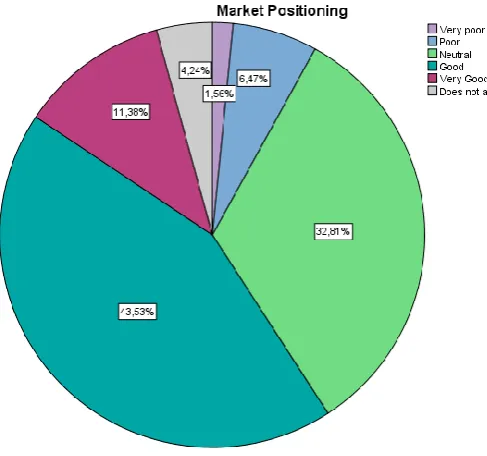
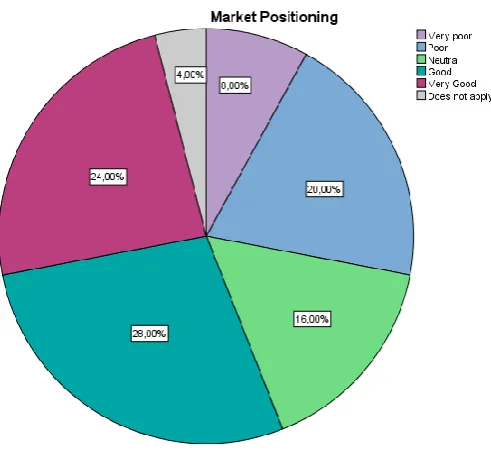
Market positioning:
[image:31.595.325.570.88.311.2]Interpretation: Remarkable is the group of 32,81 percent that reflect on market positioning as neutral, which cannot be seen as good or bad. However, it is evident that 40 percent is not positive about accomplishing this objective. According to the RVO (2014, 2015), this is one of their established main objectives. However, according to the participants, only 55 percent perceives this objective as achieved. Clearly, these outcomes cannot be seen as good for the TM organising party.
Figure 2: Objective Market Orientation
[image:31.595.325.569.367.595.2]32 Getting in contact with potential (foreign) partners: Interpretation: As can be seen, approximately
70 percent, which is the majority, reflect on the aim getting in contact with potential (foreign) partners as good or very good. Oudalov (2013) and Wild (2013) also state that TMs are considered to be very helpful as networking events with match making opportunities, which can result in e.g. finding potential partners that can help to operate in the foreign market. Nevertheless, 27 percent responded with “neutral”, “poor” or “very poor” whether they had reached this objective. This could mean that the match making focused on finding potential partners did not turn out as expected.
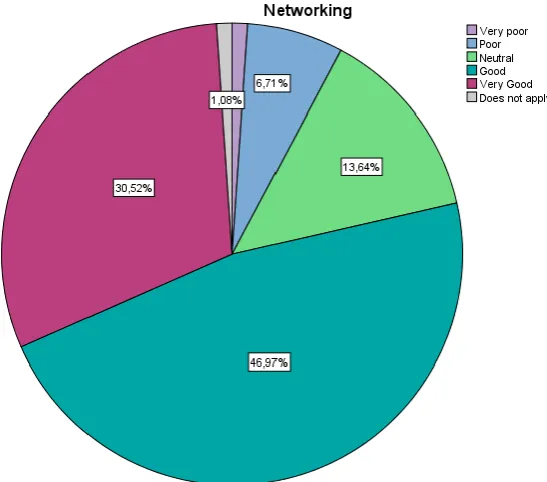
Networking:
Interpretation: Notable is the 77,49 percent that is highly positive about achieving the objective networking. The RVO explains in the presentation of February 2016 that their TMs are perfect for experienced exporting firms in order to expand their network. Considering the percentage of 63,35 that is already doing business in the host country before the TM, it appears to be a good networking tool. Also, Wild (2013) and Oudalov (2013) describe the TM as useful networking tool. It appears that the outcomes in practice are consistent with the literature.
[image:32.595.305.567.94.328.2]Figure 4: Objective Getting in contact with potential (foreign) partners
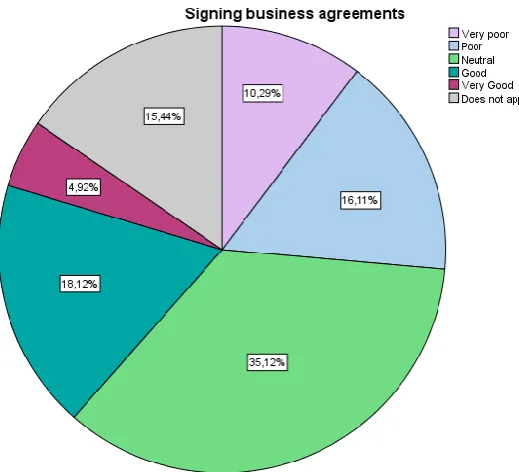
[image:32.595.300.574.429.670.2]33 Signing business agreements:
Interpretation: Noticeable is the fact that 26,40 percent rated the objective signing business agreements as “poor” or “very poor”. However, the Dutch Ministry considers signing business agreements and MoUs as highly important and in their eyes should be seen as a characteristic of the TM program (RVO, 2016). Moreover, the group that reflected on this objective as “neutral” is also rather large with 35,12 percent. Evident is that most participants did not achieve their objective signing business agreements because of the TM. Outstanding is small group of 23 percent that indicated signing contracts as “good” or “very good”. The remaining is not positive or it does not apply to them.
Remove trade barriers:
[image:33.595.304.564.91.327.2]Interpretation: Around 19 percent scored the statement: the TM contributed to the remove the trade barriers as “good” or “very good”. Expected is that this percentage (in line with the literature) will contain new exporters. Most participants use a TM for market entry and therefore still deal with trade barriers. Ruel (2013) argues that TMs are organised to help firms in order to overcome barriers to internationalise by introducing them to potential partners in foreign markets. Nevertheless, around 60 percent reflect on this aim as “very poor”, “poor” or “neutral”, which is not in line with the fact that 63,35% already did business before the TM.
Figure 6: Objective Signing Business Agreements
[image:33.595.304.560.448.678.2]34 Investment in foreign market:
Interpretation: Notable is the 47,32 percent that score this objective as “neutral”. Another approximately 11 percent of the participants indicate that the TM did not help to accomplish the objective investment in foreign market. This could be in line with the literature, that participation in TMs is mainly for starting exporters and firms in the orientation phase (Seringhaus, 1987). Also, investment in the foreign market caused by a first market visit is rather rare; it is not easy, takes time and more (follow-up) visits (Spence, 2003).
4.3 Interview results
This subchapter will present the results after analysing the interviews. Three months after the TM the Ministry has evaluated the TM. The interviews executed for this study will give insight in the effects of the TMs at least one year after the execution of the TMs. For this section, 25 randomly selected firms are interviewed. The interview questions are based on the factsheets. Besides, some open- evaluation questions were added.
[image:34.595.305.565.89.317.2]This section will be divided in two parts. The first subsection presents the outcomes after the analysis of interview questions identical to the factsheet analysis. The following subsection presents the outcomes to what extent the four characteristics were represented in the program as components. Then, the outcomes on the open-ended interview questions illustrated with quotes will be presented. Finally, the quantitative results of the interviews will be compared with those of the factsheets in order to compare the differences three months after the TM and at least one year after the TM.
35
4.3.1 Results interviews general characteristics and objectives
This subchapter starts with presenting the outcomes of the two general characteristics: doing business in foreign country before the TM and the expectation of contracts after the TM. Afterwards the same objectives as in the factsheets will be presented. To what extent the TM has contributed to achieve the following objectives: market orientation, market positioning, contact potential (foreign) partners, networking, closing business agreements, remove trade barriers and finally investment in foreign market, at least one year after the TM.
General characteristics
Doing business in host country before TM
It appears that 62,5 percent of the interviewed firms were already doing business in the host country/countries before the TM was executed. Note: because some of TMs had multiple destinations the total frequency of visited countries is 32. Remaining 37,5 percent of the interviewed firms were not yet active on the foreign market.
ALREADY DID BUSINESS BEFORE TM
FREQUENCY PERCENTAGE
YES 20 62,5
NO 12 37,5
Table 11: Business before TM
Signed contracts
It also appears that 52 percent of the interviewed companies did not sign a contract even one year after the TM. The other 48 percent did sign (a) contract(s) in response to the TM. However, not all interviewed firms can clearly say that this is a direct result of participating in the TM.
DID SIGN CONTRACT IN RESPONSE TO THE TM
FREQUENCY PERCENTAGE
YES 12 48,0
NO 13 52,0
Table 12: Signed contracts
Interpretation:
36
markets before the TM. Probably, these firms do not participate the TM for market orientation. Moreover, 13 firms have not sign a contract in response to their participation in the TM. Although, the Dutch Ministry sees this component as an important characteristic of the TM, which also can be seen in subchapter 4.1. Nevertheless, in the eyes of this study almost half of the interviewed firms (48 percent) have signed (a) contract(s) at least on year after the TM which is not a bad score at all.
Objectives to participate in TM
This section presents the outcomes of the achieved objectives resulting from the analysed interviews. The interviewees were asked to what extent the TM had contributed to accomplish the following objectives: market orientation, market positioning, contact potential (foreign) partners, networking, closing business agreements, remove trade barriers and finally investment in foreign market. Directly after the TM this was also asked, so this section will present the findings at least one year after the TM. The results will be shown in a figure with percentages and per objective an interpretation will be given.
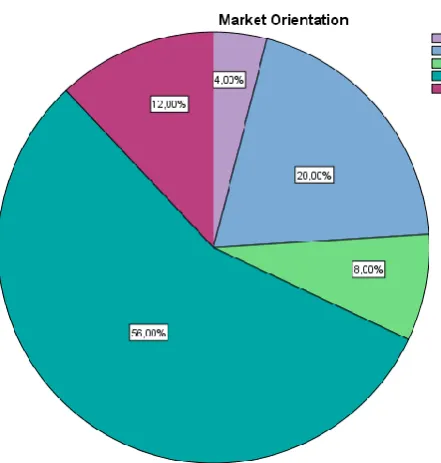
Market orientation:
Interpretation: As can be seen 68 percent of the firms perceive the TM as “good” or “very good” for market orientation at least one year after the TM. Moreover, another 32 percent is not positive about achieving this objective because of the TM. However, this conflicts with the statement of the RVO (2016) that their organised TMs are an effective method to get acquainted with a new market. Also, TMs are considered as very helpful for market entry (Seringhaus, 1987), expected would be a higher positive percentage of market
[image:36.595.325.546.403.635.2]