Author:
B.J.S. Vlaming BSc
Master Student Industrial Engineering and Management
University of Twente
Proposing a method to
reduce technical downtime
at Quaker Oats
April 2019
Supervisors:
University of Twente:
Dr. M.C. van der Heijden
Dr. A.J.J. Braaksma
I Author information:
Name: B.J.S. Vlaming
Study: Industrial Engineering and Management Specialization: Production, Logistics and Management Supervisory committee:
External supervisor: Dhr. J. Bruil Company: Quaker Oats B.V. Rotterdam Internal supervisor 1: dr. M.C. van der Heijden Internal supervisor 2: dr. A.J.J. Braaksma Company: University of Twente
Quaker Oats Rotterdam Brielselaan 7
3081 AA Rotterdam Nederland
II
Management summary
This research project is conducted at Quaker Oats as a master thesis for the study named Industrial Engineering and Management. The research project is written in the technical department (TD). The task of the TD is to maintain the machines at Quaker Oats. The TD has to cope with machines that fail, due to technical problems, more frequent than wanted. Machines breakdown for 3,5% of the time instead of 2,2%. This technical downtime results in an interruption of the production process of Quaker Oats. This frustrates personnel and management and limits the output of the product. The general thought is that, due to the efficiency of the machines of 50-80%, the output can be increased by 20% once maintenance is optimal. The goal of the research is therefore to reduce the technical downtime by improving maintenance. We focus on downtime resulting from technical causes such as damaged bearings, this means not human or material related downtime errors.
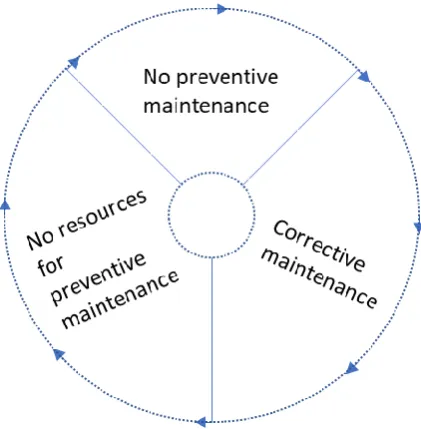
We therefore determined various ways to reduce the technical downtime, i.e. transition towards preventive maintenance. It was soon discovered that the TD is stuck in a vicious circle; there is a lack of preventive maintenance (PM), 98% of the work orders are corrective and there are no resources for PM such as data which makes it difficult to start a PM plan. We proposed a way to determine the maintenance needs of machines and create a maintenance concept for maintenance of a machine and therefore increase the resources for PM. A maintenance concept (concept for short) is defined as information, policies and procedures for the optimal maintenance of a machine. We create a maintenance concept as a pilot such that we can test it and create awareness for determining maintenance needs and execution maintenance tasks. We do not focus on the planning of maintenance tasks and argue that to plan tasks, the TD first needs to have a plan and expected results of the plan. This is necessary to convince people of the need for maintenance. To reach the goal, an extensive analysis of the current situation is conducted. We based the analysis of the current situation on interviews, analysis of maintenance tasks in the SAP and Excel database and working with operators and engineers. We concluded that, in order of importance:
- The TD lacks functioning concepts for its machines, as can be seen by the lack of a concept for most machines and the missing detail like argumentation and durations of tasks;
- The TD execution of reactive maintenance, solving breakdowns without further analysis; - 40% of the breakdowns could have been prevented by performing preventive maintenance,
the rest by improving material quality, operator skills and machine use;
- The maintenance database is of limited use for maintenance analysis, missing information like causes, effect, damage, accurate duration, etc.;
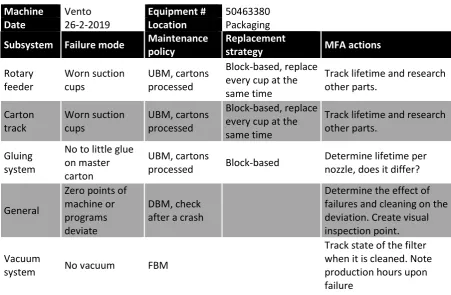
III We expect that the concept will reduce the technical downtime by 10% (two hours per month) for the pilot machines. We created the concept as a pilot on a packing machine, the machine which has the most technical downtime. The concept consists of five tasks with a maintenance policy, strategy and MFA for every failure mode, see Table 1.
Table 1: Maintenance tasks with MFA
Machine Vento Equipment # 50463380
Date 26-2-2019 Location Packaging
Subsystem Failure mode Maintenance policy
Replacement
strategy MFA actions
Rotary feeder Worn suction cups UBM, cartons processed Block-based, replace every cup at the same time
Track lifetime and research other parts. Carton track Worn suction cups UBM, cartons processed Block-based, replace every cup at the same time
Track lifetime and research other parts.
Gluing system
No to little glue on master carton
UBM, cartons
processed Block-based
Determine lifetime per nozzle, does it differ?
General
Zero points of machine or programs deviate
DBM, check after a crash
Determine the effect of failures and cleaning on the deviation. Create visual inspection point. Vacuum
system No vacuum FBM
Track state of the filter when it is cleaned. Note production hours upon failure
The initial concept should be further extended on the packing machine and created for other machines. Due to timing reasons, we created a general concept for one machine that includes tasks and when to execute those tasks, but not a detailed task description. For the created tasks, an inspection list and documentation on how to replace the parts must be created. We created an implementation plan to determine the steps to create a concept for other machines. It also considers the evaluation and improvement of a created concept.
We also propose a plan to improve the data registration of Quaker Oats. This way, the concept can be supported by quantitative data in the future which further optimise the concept. Not only the concept will see the benefits of better data registration, other analysis performed at Quaker Oats will also benefit. Breakdowns and its causes can be better analysed as well as costs and time distribution. The plan consists of:
- Structuring Quaker Oats its machines in SAP by rebuilding the machine and submachine functional locations to ensure data can be stored and is stored in the right place;
- Speeding up the order process and removing the barrier for engineers to register data by creating time for registration and removing certain steps of the process like redundant SAP transactions;
IV - Motivate and train people to use SAP such that data is registered by showing users the effect
of the concept and the improvement potential determined during the MFA.
Based on this research, Quaker Oats plans to implement the proposed maintenance concept, extend it and create maintenance concepts for other machines. We recommend further research in:
- The planning of maintenance actions. This is a process in which both Maintenance and Production should be involved. There are opportunities such as changeovers, but they are unused amongst others due to a lack of communication.
V
Preface
This report is the result of my graduation project to acquire my master’s degree in Industrial Engineering and Management, with the specialization Production, Logistics and Management.
I would like to thank Jacob for the opportunity to do my thesis at Quaker Oats in the Technical Department. I would also like to thank all my colleagues from Quaker Oats for supplying me with information and the nice working sphere. Special thanks go out to Frank Zeeman for his limitless support, readiness to start a discussion and sharing of information. During my time I have learned a lot, for which I am grateful.
Furthermore, I would like to thank my first supervisor Matthieu for his critical view on the project and useful feedback and support. The monthly meetings and feedback helped me progress during the project and gave me new motivation to go further. I would also like to thank my second supervisor, Jan Braaksma, for his critical view on the subject and useful feedback.
I would also like to thank the co-interns at Quaker Oats for the nice time we had together. Finally, I would like to thank my friends and family for the support and discussions during my complete study and my girlfriend for believing in me and the project.
Bryan Vlaming
VI
List of used figures
Figure 1: Quaker its machines (simplified) ... 13
Figure 2: Problem cluster ... 14
Figure 3: Structure of the maintenance department ... 21
Figure 4: Vicious circle of Quaker Oats' maintenance ... 22
Figure 5: Maintenance policy decision tree ... 36
Figure 6: Downtime distribution 2018 ... 43
Figure 7: Example cost justification from PepsiCo (PepsiCo, 2011) ... 49
Figure 8: Maintenance policy decision tree for Quaker Oats ... 52
Figure 9: 'License plate' of the CMK9 ... 60
Figure 10: Part of the SAP layout of Verpakkingslijn 2 ... 61
Figure 11: Part of the new layout ... 61
Figure 12: Identifying machines with your phone... 63
Figure 13: An average hand-made notification ... 66
Figure 14: Roadmap of the maintenance concept and data improvement plan ... 71
VII
List of used tables
Table 1: Maintenance tasks with MFA ... III
Table 2: Division of completed orders ... 29
Table 3: Causes of breakdowns ... 30
Table 4: Performance measures... 43
Table 5: Systems of the machines ... 44
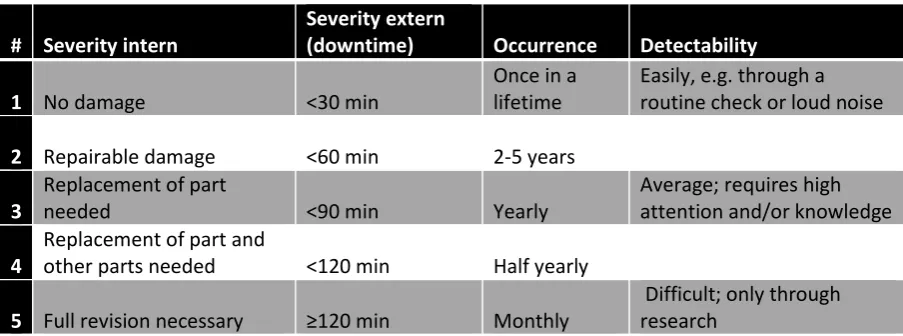
Table 6: Rating scales ... 47
Table 7: FMECA with failure mode on which we focus ... 48
Table 8: Chosen actions for the failure modes ... 53
Table 9: FMECA with MFA steps... 56
Table 10: Proposed maintenance concept with MFA ... 74
VIII
Abbreviations
AM Autonomous maintenance
BCM Business-centred maintenance
CBM Condition-based maintenance
CM Corrective maintenance
D Detection
DOM Design out maintenance
OEE Overall equipment effectiveness
FBM Failure based maintenance
FLM Front line manager
FMEA Failure mode and effect analysis
FMECA Failure mode, effect and criticality analysis
LBM Load-based maintenance
LCC Life cycle cost
MCC Most critical components
MIS Most important systems
MFA Maintenance feedback analysis
MTBF Mean time between failure
MTTR Mean time to repair
NASA National Aeronautics and Space Administration
PM Preventive maintenance
O Occurrence
OEM Original equipment manufacturer
RBM Risk-based maintenance
RCM Reliability centred maintenance
RPN Risk priority number
S Severity
SET Site expert trainer
TBM Time-based maintenance
TD Technical Department
TPM Total productive maintenance
UBM Usage-based maintenance
IX
Table of Contents
Management summary ... II Preface ... V List of used figures ... VI List of used tables ... VII Abbreviations ... VIII
1. Introduction ... 13
1.1 Quaker Oats ... 13
1.2 Context of the problem ... 14
1.2.1 Planning and executing maintenance ... 15
1.2.2 What does Quaker Oats want? ... 15
1.2.3 Why is reducing the downtime important? ... 16
1.3 Availability of data ... 16
1.4 Research objectives and questions ... 17
1.4.1 Research questions and research activities ... 17
1.5 Scope of the research ... 19
1.6 Planning and report structure ... 19
2. Current Situation ... 21
2.1 Involved people and their roles ... 21
2.1.1 The maintenance department ... 21
2.1.2 OEMs (external parties) ... 23
2.1.3 Execution of production ... 24
2.1.4 Production planning ... 25
2.1.5 Quality ... 25
2.2 Machines involved ... 26
2.3 Input of the planning ... 26
2.3.1 Reactive ... 27
2.3.2 Preventive ... 27
2.4 Maintenance planning process ... 28
2.5 Conclusion ... 30
3. Theoretical framework ... 32
3.1 Planned maintenance and downtime ... 32
3.2 What types of maintenance are there? ... 33
3.2.1 Repair ... 33
3.2.2 Prevent/retain ... 34
X
3.3 How to choose between the types of maintenance? ... 35
3.4 Replacement strategies ... 36
3.5 Maintenance concepts ... 37
3.5.1 Developing a maintenance concept ... 37
3.6 The framework ... 39
3.7 Conclusion ... 40
4. Model construction ... 42
4.1 Identification of objectives and resources ... 42
4.2 Technical analysis ... 43
4.2.1 Systems of the machines ... 43
4.2.2 FMECA ... 44
4.3 Maintenance policy decision and parameter optimisation ... 49
4.4 Performance measurement ... 54
4.5 Continuous improvement ... 55
4.6 Verification and validation ... 57
4.6.1 Verification of the maintenance concept ... 57
4.6.2 Validation of the maintenance concept ... 57
4.7 Difference from the current concept ... 57
4.8 Conclusion ... 58
5. Improving the data ... 60
5.1 Machine structure ... 60
5.2 Order registration ... 62
5.2.1 The order process ... 62
5.2.2 Order quality ... 64
5.3 SAP usage ... 67
5.3.1 Operators ... 67
5.3.2 Engineers ... 67
5.4 Conclusion ... 67
6. Implementing the maintenance concept ... 69
6.1 Conclusion ... 70
7. Conclusions and recommendations ... 72
7.1 Conclusions ... 72
7.1.1 How is maintenance currently done for the machines at Quaker Oats? ... 72
XI 7.1.3 What improvements are needed to close the gaps between the current situation and the
literature? ... 73
7.1.4 How can we verify and validate the maintenance concept? ... 74
7.1.5 What are the necessary steps to come to a maintenance concept? ... 74
7.2 Further research ... 75
7.3 Discussion ... 75
Bibliography ... 77
Appendix A ... 81
Appendix B ... 82
Appendix C ... 83
TPM ... 83
RCM ... 83
13
1. Introduction
In this thesis, a framework is suggested to determine the maintenance needs for machines and set out corresponding actions for a machine in the factory of Quaker Oats. This Chapter discusses the background of the research. It describes Quaker Oats and its problem. Section 1.1 gives a description of the company, which helps to bring the problem in context. Section 1.2 describes the context of the problem which will be studied. Section 1.3 describes what data is available for the research. Section 1.4 explains the objective of the research, states relevant questions, how the questions are going to be answered and what the deliverables are. Section 1.5 outlines the scope of the research. In Section 1.6 the steps are set out how to answer the research questions. Section 1.6 also states how the thesis is structured.
1.1 Quaker Oats
Quaker Oats is a production company which makes breakfast cereals and is situated in Rotterdam. Quaker Oats is established in 1888 by the seven big oat producers in America (Quaker Oats, 2018). Since 1896 a sales office is opened in Rotterdam and a manufacturing facility has opened in Rotterdam since 1935 (Quaker Oats, 2018). Breakfast cereals are still produced nowadays in the facility built in 1935. There are three production lines consisting of multiple machines like an oven, dosing machine and packaging machine, as shown in Figure 1. The factory is divided into sections, orange blocks are part of the process section and from there it is called packaging. The green block indicates the scope of the research. Two lines (line one and two) produce the standard sack-in-box product, while the third line (line three) produces sacks. The sacks do not go into a consumer box, which is why the packing machine is skipped. For line 3 to function, line 1 must be stopped since they use the same bagmaker. Resources enter the facility as oats, wheat, barley, spelled, rye and additives like sugar, honey, chocolate, etc. Part of these resources are crushed, mixed and cooked. Ingredients like chocolate, raisin or other fruits are later added to the mix. The mix is placed in sacks and boxes for line 1 and 2, placed in a transport box, set on a pallet and sent to shops. Quaker Oats has eight different basic product mixes and 31 additives (nuts, fruit, chocolate, etc.). Besides the mixes, there are ten different package sizes.
[image:14.595.69.528.269.659.2]14 capacity to fulfil all demand because of its size. That is why there is also a co-packer of Quaker active in Poland, which supplies surrounding countries.
1.2 Context of the problem
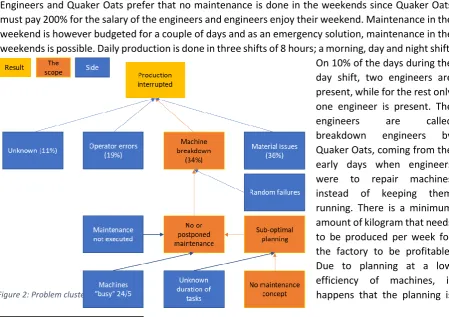
Quaker Oats has the problem that machines fail too often during production, 3,5% of the time instead of 2,2%. The machines are planned for production and cleaning, while the time for maintenance can be requested. Engineers complain that seldom time is made free for maintaining the machines, which is according to them the main cause that maintenance cannot be executed and as a result, machines break down during production. The main causes of the technical downtime are shown in Figure 2 and will be worked out in Chapter 2 of the thesis. The percentages are an indication of how much downtime, expressed in a percentage of the total downtime, is related to certain causes and are based on the 60 most recent breakdowns. The main contributor to downtime seems to be material issues, with a close second being machine error. Material issues are being solved by other parties. Operator errors are not further analysed such that we can narrow the scope of the research. When we look at the amount, instead of time, of orders related to production interruptions, see Table 3 in Section 2.4, machine downtime is the main contributor. There are multiple reasons for this of which the focus lies on the absence of a maintenance concept1 in which the tasks and frequencies are described. A many
heard complaint from engineers about why maintenance is postponed is that they cannot work when machines are running. But maintenance is also not executed due to the priorities of the TD. During the shifts, machines are running or standing still during cleaning or a changeover. The TD does not prioritize tasks on the than waiting machines. The tasks are too general to specify a time for, which makes it difficult to plan and execute the tasks. Per week roughly a full shift is used on downtime caused by the machines.
The machines are producing 24 hours a day for five days a week, there is no production in the weekend. Engineers and Quaker Oats prefer that no maintenance is done in the weekends since Quaker Oats must pay 200% for the salary of the engineers and engineers enjoy their weekend. Maintenance in the weekend is however budgeted for a couple of days and as an emergency solution, maintenance in the weekends is possible. Daily production is done in three shifts of 8 hours; a morning, day and night shift. On 10% of the days during the day shift, two engineers are present, while for the rest only one engineer is present. The engineers are called breakdown engineers by Quaker Oats, coming from the early days when engineers were to repair machines instead of keeping them running. There is a minimum amount of kilogram that needs to be produced per week for the factory to be profitable. Due to planning at a low efficiency of machines, it happens that the planning is
[image:15.595.71.521.425.742.2]1 A maintenance concept is defined as information, policies and procedures for the optimal maintenance of a machine
15 finished before the planned end. In this case, the remaining time will be used for cleaning, maintenance or other non-production tasks. Most of the time the factory is planned to produce its maximum capacity and there is no time for preventive maintenance because of the high level of corrective maintenance. The position of the Maintenance department is not strong enough to convince other departments of the need for maintenance because they lack an argued maintenance plan and cannot estimate the impact of maintenance due to missing data.
1.2.1 Planning and executing maintenance
The maintenance activities are planned by the work planner. He plans the maintenance in accordance with the maintenance plan made by the maintenance specialist. For most machines, there is no maintenance plan. The engineers of the Technical Department (TD, from the Dutch words Technische Dienst) or an external party executes the maintenance. Quaker Oats has service contracts with original equipment manufacturers (OEMs). These contracts include a yearly check, the OEM has a checklist and Quaker Oats can point out extra checks, and service of the machines. Quaker Oats has engineers that have the expertise to partly service the machines. Maintenance tasks that cannot be executed by the engineers, because of for instance the skill level required, are done by the OEMs once a year per production line. To inspect and execute (preventive) maintenance on the machines, Quaker Oats has two weeks per year in which no production is planned, only maintenance. It seems that outside these two weeks not much preventive maintenance is executed on the machines because of the lack of a clear plan and time. Maintenance is mostly planned based on experience and adjusted (by Quaker Oats) with information from the manufacturer (based on calendar time/operating hours), while breakdowns are reported by people working with the machines (operators) and solved directly or planned if they can wait, since not all breakdowns directly influence the production process.
Around 22% of the maintenance on the packing machines is planned, this can be viewed quite broadly. Planning can also mean that a task is planned to happen the next day or week and the part is already defective, but the production can continue without the part. Planned maintenance does not result in technical downtime since only breakdowns cause technical downtime. Technical downtime is the time that a machine is not producing during production which is caused by mechanical errors. The maintenance that is executed by external parties is difficult to plan since they work with their own time schedule. Quaker Oats needs to plan up front when the revision weeks take place. Other challenges when planning maintenance are the diversity of machines, the time pressure created by the production planning, the availability of people, lack of reliable data to estimate durations and poor communication. This makes it important to know what to service and when such that a clear plan can be communicated and people and materials can be planned accordingly. Quaker Oats wants to use a condition monitoring program to keep track of the state of machines, but Quaker Oats is a long way from actively using condition monitoring to improve the uptime of the machines. Inspections are not executed as planned or skipped and when faults are seen, they are seldom communicated. When they are communicated, tasks are set out to replace the soon to fail parts. Machine stops, like changeovers, cleaning and early stops caused by overproduction, may be moments for maintenance. This is not used yet because of the unavailability of people, parts, lack of knowledge about maintenance tasks and lack of communication.
1.2.2 What does Quaker Oats want?
16 has a maximum downtime of 1,50%. This means that 1,50% of the total production time, the packaging machines are allowed to stand still due to technical faults. On average in 2018 the technical downtime for the process is 0,86% and for the packaging 2,64%. Calculated to Euros, this costs roughly €100.000,- per year. Most of the technical downtime is caused by the packing machines, which will therefore be the focus of the thesis. A breakdown of a packing machine usually results in an hour of technical downtime, while it takes the engineer on average half an hour more to solve the issue. Solving the hour usually takes longer because of cleaning, testing and registering data. Sometimes breakdowns can easily be fixed, although the core problem is not solved. Quaker Oats aims to reduce the technical downtime to its target values and transition to a sustainable environment where breakdowns are prevented.
1.2.3 Why is reducing the downtime important?
The factory in Rotterdam is the biggest factory that supplies Cruesli in Europe and therefore it is important that the machines are reliable. Besides the fact that technical downtime reduces the availability and reliability of the machines, it also results in lost sales or overtime, idling labour, material waste and unplanned maintenance costs. It is estimated that corrective maintenance (CM) is three times as expensive as preventive maintenance (PM) (Mobley, An Introduction to Predictive Maintenance, 1990). The technical downtime is a problem because of the costs resulting from this and the production being interrupted.
1.3 Availability of data
17 frequency of failures, type of failures and duration. We also made a distinction between failures caused by humans, protocol, material and the machine. More and more attention was paid to correctly fill in SAP. Unfortunately, the data quality is still far from optimal. To cope with missing data or incorrect data, meetings with the engineers and work planner are carried out and a proposal to correctly fill in SAP is submitted to the engineers. After the proposal, an increase in data quality is visible, although not as much as wanted, which is why in Chapter 5 more research is done to improve the data. It was not possible to further increase the quality of data during the thesis due to other priorities of engineers and management.
Both datasets are not perfectly reliable but in this thesis SAP is mainly used because it has all the maintenance orders, while the TD log focusses on corrective orders, SAP is better to perform analysis with since the TD log only has information about how long something takes and what the cause was and the log is more a notepad than administrative tool. So, SAP has more details about the work activity and the data in SAP is linked to maintenance requests made by the operators. Sometimes data is missing in SAP, like how problems are tackled, this is then gathered from the TD log if available. Roughly 95% of the orders in the TD log are also in SAP.
1.4 Research objectives and questions
The machines of Quaker Oats cause too much downtime during production. This downtime negatively influences the execution of the planning and costs money. The goal of this research is to decrease the technical downtime by creating a maintenance concept and therefore determining the maintenance needs of machines. We expect that this will result in an increase in production time and benefit the execution of the planning since the maintenance concepts are set up to prevent failures. Quaker Oats wants to have a maintenance concept that indicates when and what maintenance to do. This concept should be a pilot and later Quaker Oats should be able to make the same steps to create a maintenance concept for other machines and continuously improve the maintenance concept(s). The concept should minimize technical downtime and makes sure that Quaker Oats efficiently and effectively makes use of its resources, this is done by doing maintenance tasks preventive instead of reactive. It should consider that maintenance can be done when machines are (unexpectedly) not operating and therefore tasks need to be listed with the expected amount of work. It is therefore important to know what maintenance should be done and when maintenance should be executed to reduce the interruptions of the production process. For that reason, the maintenance activities and planning should be well fit for the machines. This research will focus on the maintenance concept. This means determining maintenance needs and making choices between maintenance policies and strategies. This can be achieved by answering certain research questions, which are listed below. The planning when the questions will be answered and the steps to answer the question are discussed in Section 1.6.
1.4.1 Research questions and research activities
The first step is a thorough analysis of the current maintenance concept and the causes of technical downtime. It serves as input for question two, so we know what to look for in the literature. The goal of this step is creating insight in what tasks exist, how they are performed, planned, what the result of the tasks is in terms of technical downtime and what the causes are of the downtime. All to determine where the potential for improvement lies. The first question is therefore:
1. How is maintenance currently done for the machines at Quaker Oats?
18 engineers do. The same question will be asked to different people to validate the answers and not bias the research. A complete background analysis is performed where for instance information about the distribution between planned and unplanned maintenance, the different causes of downtime are gathered and what is done in terms of PM.
The second step is to find out what the literature says about methods to perform and plan maintenance and creation of a maintenance concept. The goal of this step is to find improvements for the current situation of Quaker Oats and choose the right method to improve the current situation. The question matching this is:
2. What are the requirements for the design of a maintenance concept based on literature research?
To answer this question, literature research is performed where it will be researched how to plan maintenance in the situation that Quaker Oats is in. Different techniques, methods and information about maintenance are collected and compared to come up with the best method. This is necessary to improve the current way maintenance is done. Academic articles, theses and books about maintenance approaches will be used to research methods to improve the situation.
In the third step, the gap between the situation according to literature and the current situation is analysed and a method that reduces the technical downtime is developed for Quaker Oats. From question one the cause of the technical downtime is known, question two proposes a method to reduce the downtime. The method following from question two needs to be developed for Quaker Oats. The goal of step three is to develop a method that reduces the technical downtime. This leads to the following question:
3. What improvements are needed to close the gaps between the current situation and the literature?
To answer this question, both qualitative and quantitative data about technical downtime and the production schedule of past years are used. This data will be used for the methods to reduce the breakdowns which cause the technical downtime. From question two data of methods to reduce the technical downtime is gathered, from question one information about the maintenance on the machines, their downtime, the planning and realization of the production planning is gathered. The maintenance concept will be made based on the literature and should consider the production and maintenance stakeholders. This concept also needs to be verified and validated by discussing it with multiple engineers.
The next step is thus to verify and validate the maintenance concept from question three. The goal of this step to make sure that the proposed approach has the desired result and can indeed be used to improve the situation. The question that belongs to this step is:
4. How can we verify and validate the maintenance concept?
To answer this question experts are consulted about the proposed maintenance activities. This involves multiple departments.
The last step is to start the implementation of the maintenance concept for all the machines. The goal of this step is to implement the concept and create a concept for more machines. Otherwise, the concept would have no effect. This is where question five comes into place:
19 To answer this question, we analyse case studies and use our own experience and involve the TD. Question five helps Quaker Oats to implement the maintenance concept and give Quaker Oats a guideline to implement the maintenance concept.
1.5 Scope of the research
The scope is limited to two packing machines that account for the most technical downtime. It is advised to first develop a maintenance concept as a pilot to educate involved persons (Waeyenbergh & Pintelon, 2009), which is what we will do. The machines are the CMK9, which is part of line two, and the Vento, which is stationed at line one. The two machines account for one-third of all the downtime and Quaker Oats finds the need to improve the reliability of the machines important. These machines serve as an example to show what is possible with an improved maintenance method and for validation of the maintenance concept. These machines are described in Appendix A. We assume that the failure behaviour of machines in the future will be the same as in the past although this is not true (Pham & Wang, 1996; Tinga, 2010). However, even with this assumption, great improvements can be made. Due to timing constrictions, we analyse two machines, but create a basic maintenance concept for one machine. We will not focus on the planning of people, materials and tasks, but on what is necessary for the machines to work. Part of the focus will also lie on getting the rest of the company, like the management and production team, on board for the maintenance concept so it does not stay with a plan, but it is also possible to execute the plan. This means that insight into the effect of maintenance needs to be created. It is assumed that when a machine runs, it has the technical capability to run at maximum performance, this means that a machine is either working perfectly or is not working at all. A result of this is that the state of the machine, and therefore the TD, only influences its ability to operate or not. We also assume that work orders registered in SAP that do not have actual work hours are cancelled instead of completed.
1.6 Planning and report structure
The five research questions are answered during the graduation assignment. In Section 1.4 it is stated what should be done. A global planning with the necessary steps is discussed in this section. At the end of every chapter, a conclusion of the chapter can be found in which the most important points of the chapter are listed and explained.
Question one describes the current situation and is handled in Chapter 2 Information from interviews is gathered, as well as data from the TD log and from SAP. Most interviews take half an hour to an hour. The task is then to process and check the information and gather missing data. The questions that arise when processing the interviews, can be answered with a follow-up interview and/or with data analysis. Engineers are followed on their working shift and the operating team, people that operate and oversee the production, to check certain findings and gather more information from different angles. The data from SAP and the TD log is used to determine the seriousness of the problem and where and when the problem occurs. Steps needed to answer this question are:
- Interview preparation; - Interview TD;
- Interview people from Finance, Production and Quality; - Interview the process, maintenance and packaging specialist; - Interview operators;
- Process interviews;
20 - Analyse data from TD log and SAP;
Question two is answered after that and is discussed in Chapter 3. It consists of literature research where sources like PhD theses, academic articles and books are analysed. The literature is (made) fit for Quaker Oats’ situation. Literature is used to find methods to improve the current situation. Multiple methods are found while a method needs to be chosen to continue with. Steps needed to answer are:
- Determine what to look for; - Find appropriate literature; - Study the found literature; - Find improvement methods; - Choose an improvement method.
Question three and four are answered in Chapter 4, while question three is answered from a different perspective in Chapter 5. The framework from the literature research is worked out in Chapter 4 and steps on how to validate the maintenance concept following from the framework is given. The steps to answer these questions are:
- Determine the goals of the framework; - Create a decomposition of the machines;
- Analyse one machine using a failure mode, effect and criticality analysis; - Determine the maintenance tasks, policies and strategies;
- Verify and validate the maintenance concept;
- Advice how to measure the performance of the maintenance concept; - Determine what is necessary to improve the maintenance concept;
Once the maintenance concept is finished, a plan to implement the maintenance concept needs to be made. This is done by answering question five. To implement the maintenance concept, tasks in SAP must be created. The plan can be tested on the machine to check the effect of good maintenance, this plan should later be created for multiple machines in Quaker Oats. Steps needed to answer this question are:
- Creating a plan to implement the maintenance concept; - Implement the maintenance concept on the machines;
21
2. Current Situation
In this chapter, the current situation of Quaker Oats will be described and we introduce the two machines which will be analysed. The goal is to know how maintenance on these two machines is performed and why. In Section 2.1 the departments who are involved with maintenance are discussed. Section 2.2 describes the machines that the research will focus on and gives and some information about technical downtime. In Section 2.3 the input of the planning for OEMs and Quaker Oats’ engineers is given and it is described how maintenance activities end up in the task list of engineers. Section 2.4 describes the process of planning maintenance. Section 2.5 concludes Chapter 2 with conclusions from all the sections and answers research question one.
2.1 Involved people and their roles
Multiple departments and people are involved in the planning and execution of maintenance. To give an idea of how the processes in Quaker Oats are executed and planned, the departments will be introduced. The departments have maintenance related issues, which we state here. The TD obviously has a crucial role, but also OEMs, the Production and Quality department have an influence on the maintenance that is planned and executed. They will all be discussed in this section, starting with the Maintenance department of which the TD is a part.
2.1.1 The maintenance department
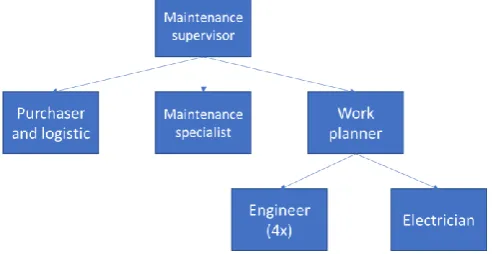
[image:22.595.70.320.557.684.2]22 need to be done by certain engineers. The engineers and electrician take care that the planned work is executed and they respond to breakdowns. According to total productive maintenance techniques (TPM) (Chan, Lau, Ip, Chan, & Kong, 2005) engineers should:
- restore deterioration thoroughly and accurately, using inspections, condition monitoring and overhaul;
- clarify operating standards by tracing design weaknesses and making appropriate improvements;
- enhance maintenance skills for check-ups, condition monitoring, inspections, and overhaul. Unfortunately, most of these tasks are not performed due to lack of resources, like a maintenance concept that fits the needs of the machine and time, not executing preventive maintenance and the focus on corrective maintenance. Engineers react to breakdowns and there is no research performed on faults or inspections on machines if they are close to failure.
During the day there is one engineer that is part of the working shift, this engineer needs to respond to breakdowns and perform maintenance. On roughly 10% of the working days, the fourth engineer works as a second engineer on one of the shifts. His task is to do maintenance instead of reacting to breakdowns. Due to sickness and off days, the fourth engineer usually replaces the sick or off engineer instead of being a second engineer in the shift. This creates the wish of the TD for another engineer, so he can solely focus on condition monitoring and preventive maintenance. We see two things: the first being that moments for preventive maintenance, like changeovers and early finishes, are uncommunicated between Production and Maintenance and therefore unused. The second engineer could be more effectively utilized if those moments were used and priorities were set to maintain machines that usually operate, we will later elaborate this. The second thing we see is that engineers spend ±75% of their time fixing breakdowns and ±4% on preventive maintenance and the rest is not registered. Their time could be more efficiently used if they did not have to spend so much time on CM and helping operators and spend more time on PM. It would help engineers if they knew their tasks and used the opportunities to execute the tasks. It is difficult to work on some machines, since they operate non-stop and engineers can be interrupted by a breakdown when they perform PM. The last reason is the main reason according to the engineers that maintenance is not executed during production.
[image:23.595.75.286.528.743.2]23 the machine needed a reset and what happened close before the reset. In other words, the TD fights the symptoms, not the cause(s).
During a breakdown, when the complete line behind the machine is usually waiting for products, and when there is a second engineer available, no other maintenance is executed. There is no priority for maintenance on machines that normally cannot be serviced when they are running. Tasks that can be done when machines are running are equally important as tasks that can only be done when machines stand still. This while standstill is a perfect opportunity for maintenance. Another point why these opportunities are not used is because engineers do not take the initiative and the work planner is not informed.
The maintenance department is briefed about the past 24 hours at the start of the day. The engineers brief each other during a change of shift. Two times a week during the briefing it happens that an engineer did not know what the previous engineer did. The explanation of tasks in the TD log and in SAP is insufficient, see Section 1.3. The data that is filled in, is filled in at the end of the shift. This creates error, which can be minimized by recording the information during or shortly after the time of the breakdown (Christer & Whitelaw, 1983). Another issue is that people never had correct training with SAP and lack the motivation to train themselves since they do not see the added benefit of a maintenance database. A result of this is that SAP is not correctly set up and filled in correctly by the engineers and operators. During the briefing, the focus lies on solving breakdowns and discussing them instead of preventing breakdowns, partly because the information about failures is not as complete as it needs to be. During the briefings it became clear that of all the orders engineers execute, 25% of them are operator tasks, changing machine settings like speeds and positions of parts. This is mainly due to the inferior quality of materials, for instance, due to deviations in the height of the master carton. Because of this, the machine needs to deviate from standard settings.
2.1.2 OEMs (external parties)
When the engineers and/or electrician of Quaker Oats cannot perform the required maintenance due to skills, it is more efficient to involve an external party or when design changes are necessary, an external party is involved. This is supposed to be two times a year during a so-called revision week; At the beginning of the year line one goes out of production for a week and at the end of the year line two goes offline for a week. Another week for line three is not necessary since most of the time line three is not used. Line three can only make a certain product that does not have enough demand to keep the line producing for a prolonged time. See Section 1.1 and/or Appendix B for a description of the lines. The period after maintenance is done by the OEM is followed by a period of increased failures due to not testing the machine with products. During the revision period, there is no production and it is often decided not to test with real products because of the related costs. Not testing the new parts and software updates with real products, result in breakdowns. It is required that the machines are calibrated and tested. When production starts, the OEM is on site to perform the final adjustments, but this obviously slows down production. For the CMK9 all the revisions are done by Quaker Oats’ engineers throughout the year. A former employee of the manufacturer of the CMK9 works at Quaker Oats and can perform the maintenance. For the OEMs to know what maintenance to execute in the revision week, checks are executed.
24 the cause of problems. As the OEM points out, the machine might not be at fault, but the material is out of its specifications, see Section 2.1.5. Things the OEM notices are that the machine is not cleaned and regular maintenance from the user manual of the machine is not performed. A difficulty when planning the OEM maintenance is that they need to be planned roughly three weeks in advance, this is however only necessary for problems that do not directly have to be solved or revision related maintenance. The OEM could further improve the machine such that there is less stand still, but there is a lot of variation in the input of the machines, see Section 2.1.5.
2.1.3 Execution of production
The production team works in the same shifts (teams) as the engineers. The team consists of operators, site expert trainers (SETs), an engineer and a frontline manager (FLM). The operators operate, set up and clean the machine. They, especially the temporary workers, have received technical training of machines neither is technical knowledge a requirement to work with the machines. This is a choice to keep costs of operators low. This results in limited knowledge about the machines. Operators also do not seem to feel responsible for the correct state of the machine as can be seen by the lack of will to learn from engineers and rough handling. Opportunities for operators to learn about the machine, when an engineer is repairing the machine, are seen as coffee breaks. These two things make it difficult for them to deviate from standard settings to cope with variation in materials and determine if the settings or the functioning of the machine is the problem. Because of this, engineers are called quite often to fix problems that operators have caused or could have solved by adjusting machine settings. Besides their knowledge, the TD prefers that operators do not touch the machine when it breaks down. The TD wants to see for themselves what went wrong so they can solve the problem more easily. This seems contrary to the earlier statement that engineers do not note down why the machine breaks down and what happened before the breakdown, but there is a distinction between solving the problem and the administrative task.
Cleaning by operators is done insufficiently, since there is little time and procedures are impossible to fulfil in the given time, but also because the focus lies on producing as quickly as possible instead of cleaning as good as possible. Following the standard operating procedure takes way more time than available. Every time an (external) engineer comes to fix the machines, the first complaint is that the machines are dirty. To limit the scope of the research, we did not further investigate this. In 2019 the plan is that operators should be able to do first line maintenance; clean, lubricate, inspect and tighten. According to total productive maintenance techniques, operators should (Chan, Lau, Ip, Chan, & Kong, 2005):
- maintain basic equipment conditions (cleaning, lubrication, bolting); - maintain operating conditions (proper operation and visual inspection);
- discover deterioration, through visual inspection and early identification of signs of abnormalities during operation;
- enhance skills such as equipment operation, set-up, and adjustment, as well as visual inspection.
25 responsibility for equipment (Jostes & Helms, 1994; Ben-Daya & Duffuaa, 1995; Lawrence, 1999; Chan, Lau, Ip, Chan, & Kong, 2005).
A SET supervises and helps the operators, is an expert in the processes that take place and can train people. He also makes sure that standards are followed and communicates the way of work with the FLM. In the future SETs should be able to solve basic breakdowns and maintenance tasks and repairs, however the SETs also lack technical knowledge. The reason for this is that people are not trained for it and have never done it. SETs or operators should call the TD in case of a (soon to happen) defect on a machine, too often operators do not notify the TD about these defects or do not notify the coming defects at all. The FLM is the team leader of the shift and has the responsibility that the production planning is met. A FLM aids when making the production planning, manages the team and has contact with the management. While SETs are busy with daily tasks, the FLM focusses on the longer term.
2.1.4 Production planning
The long and medium-term production planning is made in England at PepsiCo. The short-term schedule of the lines is made at Quaker Oats in Rotterdam. The line scheduler in Rotterdam is given a number of kgs that needs to be produced in the coming eight weeks. The planning from England is based on the capacity the line scheduler passes on to England. The capacity is predefined but can be adjusted. The capacity is influenced by the quality and amount of the product (raw product to Cruesli with additions) and the quality of materials. Capacity reductions, like planning a line for maintenance, need to be announced eight weeks in advance so the external planner can incorporate it in the medium-term production planning. The execution of the planning is solely the responsibility of the FLM. It happens that lines are not producing. This can either be planned or unplanned. Opportunities to do maintenance, like changeovers, are not known by the TD.
The line scheduler schedules the lines in such a way that changeover and cleaning times are minimized while still planning the requested amount. The line scheduler discusses with the FLM and work planner of the TD how the production schedule looks like. The line scheduler creates the schedule without buffers, although line 3 usually stands still and when line 3 is running, line 1 is not running (since they share the bagmakers). This happens a couple of days per month. Once a week the planning for the next week is discussed with the TD. Time for maintenance activities can be requested and discussed at this meeting. During the meetings, there are few maintenance requests from the work planner, because of the lack of clear and correct maintenance tasks. The line scheduler then denies or approves the request and passes it on for further approval. Sometimes “unplanned” maintenance opportunities are announced during the meeting, this is however too late for the TD to react. They do not have a clear plan of what to do in what time in terms of machine maintenance and planning one week ahead is usually too late to involve external parties in maintenance activities. One of the reasons why there is no clear plan is that almost no inspections are performed and the maintenance concept, if any, lacks (details). It lacks tasks (descriptions), estimated time and documentation of how the maintenance concept was created. Planning maintenance during changeovers based on the production schedule is difficult since there is much deviation from the planning, this means that the moment when a new batch starts, and thus when changeovers occur, cannot be planned at a certain time. Sometimes the production is seven hours behind or ahead on the planning. During certain changeovers, the two packing machines can stand still for more than an hour. Due to the poor communication between the TD, operations, FLM and planning, opportunities are known late.
2.1.5 Quality
26 responsibility that cleaning is correctly executed by the cleaning service and the operators. The department makes standard operating procedures which need to be followed. Machines do not operate during cleaning. This might be a good moment to do maintenance (since not all machines are cleaned at the same time but all stand still). However, it needs to be considered that machines cannot be cleaned and maintained at the same time. Cleaning happens at changeovers and at the end of the week when production stops.
As said in Section 2.1.4 the quality of materials is also a point. Cartons must acclimatize after transport depending on the temperature difference and should be stored at a certain humidity (Canon Nederland N.V.). Cartons are not stored at a certain temperature or humidity at Quaker Oats. There are a lot of problems with the carton and as a result, machines need to be adjusted to the cartons. Machine OEMs sometimes will not help Quaker Oats with the argument that it is not their machine at fault but the input materials.
2.2 Machines involved
The Quaker Oats factory in Rotterdam is a small plant, as stated in Section 1.1. There are two machines in the scope of this thesis. Figure 1 in Section 1.1 shows the simplified version of all the machines that are operating at Quaker Oats and in Appendix B the function of the machines is described. The thesis focusses on the two packing machines.
The factory is divided into two sections, process and packaging, see Section 1.1. Most of the technical downtime comes from the section packaging. The percentage of technical downtime for packaging is 2,62% and 2,27% for 2017 and 2018 respectively. The machines in our scope are accountable for 1,5% of the total technical downtime. The machines account for the most technical downtime of all machines. The percentage of technical downtime is calculated using Equation 1.
Equation 1: Calculating technical downtime
𝑇𝑒𝑐ℎ𝑛𝑖𝑐𝑎𝑙 𝑑𝑜𝑤𝑛𝑡𝑖𝑚𝑒 (ℎ𝑜𝑢𝑟𝑠)
𝐴𝑣𝑎𝑖𝑙𝑎𝑏𝑙𝑒 ℎ𝑜𝑢𝑟𝑠 ∗ 100%
The average duration of the technical downtime for the packing machines is an hour. There are two packing machines, called the CMK9 and Vento which cause the most downtime. There is a slight difference of 10 minutes in the average downtime between 2017 and 2018, the average downtime is lower in 2018. Between 2017 and 2018 no major changes in terms of maintenance have taken place, but in 2018 the registration of maintenance tasks is improved. The overall downtime is much higher than the 2,27% because the TD does not integrate downtime created by quality issues or operator aspects in the calculation of the technical downtime. The materials the machine must process and how the machine is set-up and used determines its maintenance needs and therefore indirectly contribute to technical downtime. The machines are subject to a variable use and loads due to the input quality. The speed ranges from 100 cartons per minute to 150 cartons per minute all with different cartons in terms of quality and weight. This variable use makes it more difficult to predict the maintenance needs than on a constant load.
2.3 Input of the planning
27 the engineers from Quaker Oats is discussed here. The planning is divided into two parts, reactive and preventive.
2.3.1 Reactive
When machines break down, the procedure is that operators should reset the machine to standard settings, try to solve the issues themselves and otherwise call the engineer for help. The operator then makes a notification of the breakdown in SAP. This is not correctly done, sometimes orders are not or later created and the description of the breakdown is to brief to use for analysis. This is partly because SAP is not correctly set up and because operators (and partly engineers and management) do not care about the registration, only about a working machine. This seems strange, since with good registration, for instance when noting the cause and what the machine was doing, a breakdown can be prevented next time. Registration in SAP needs to be improved by operators and by engineers.
Machines deviate from standard settings due to wear and input variabilities. In the past operators had to follow a procedure to try and fix the machine. This was done by changing its settings, but this did not work out because the problems kept occurring and engineers blamed operators for the faults. This resulted in lost time and frustrations. Some of the breakdowns should not be a breakdown but become one because the TD is not informed about the run-up to a fault. This has two reasons. One is that the operators do not communicate with the TD when they notice something different or do not notice it. As said in Section 2.1.3, operators do not receive technical training and are not selected on their technical knowledge. Effective communication between the operator and engineer is key to solve certain issues efficiently and guarantee a good production performance. The second reason is that engineers and operators do not spend their time to carry out checks on the machines. The fact that checks are not carried out is also a reason a breakdown occurs. Due to postponed maintenance and no knowledge about the state of the machines, the machines require CM instead of PM.
2.3.2 Preventive
Input for the offline planning of engineers consists of automatically generated work orders based on the maintenance concept and work orders originating from notifications coming from work orders that do not require immediate action.
28 not incorporated in the maintenance concept and differ from breakdowns. Repair orders can relate to preventive maintenance, but also corrective maintenance. For instance, when a part of the machine is bent but the machine is still functioning, this is planned, but the machine is already damaged. Repair orders can also be a result of a PM inspection, so before the part is damaged. The notification for the repair order is checked and planned by the work scheduler in SAP. In September 52 work orders were created based on these notifications, only with four of the orders no action is taken.
2.4 Maintenance planning process
The maintenance planning heavily relies on the production planning (Cassady & Kutanogly, 2005). For the plant to have a right to exist, it needs to be cheap, otherwise, the plant has a risk to be closed. The plant's price is among others expressed in Euro per kg of Cruesli. For Quaker Oats, this means producing as much as possible with the materials and labour they have, reduces the kilo price. The long and medium-term (16 weeks and longer) planning is made in England. England has contact with the markets and creates the planning based on the capacity of Quaker Oats. Capacity is based on the speeds of the machines and planned availability. Process machines operate on their max while packaging machines are planned at 85% of their capacity. The packaging machines do not have to operate at 100% of their capacity since they are quicker than the process machines. Another factor is the reduced wear on the machines when they run slower than their maximum capacity and that leaves some room for breakdowns. The 85% is based on experience and is a rough estimate. In certain weeks the estimate is far from the real value and we see the machines finishing the play 3-6 hours too early or late. Quaker Oats determines the production capacity and can therefore lower it temporarily. Lowering can happen by removing a shift, planning a line for maintenance or an improvement process. This needs to be announced eight weeks in advance, which seems difficult to plan due to the lack of a maintenance concept. Reducing capacity for maintenance usually results in temporarily reducing the capacity by roughly 50% since one of the two lines must be shut down. Consequently, reducing capacity should carefully be done, especially since the plant must produce as much as possible to be competitive.
The TD plans the maintenance per week based on received maintenance requests, the rest comes from the maintenance concept and are automatically generated. In a very generic way it is specified what to do, but not when and how long it takes. The tasks are added to a to-do list, but this is not looked at because there is the feeling that there are no opportunities for maintenance. As said before, these opportunities are there, but they remain unused because of the lack of communication and planning. Generic tasks and no hourly planning result in nescience among engineers since they themselves must find opportunities. Because the duration is unspecified and nothing is planned in terms of at what time to perform the maintenance, the breaks between production are not (effectively) used. There is no estimated duration because engineers do not reliably fill in their work hours and no time has been spent on determining estimated durations. Even if there is an estimated duration, it is based on experience and feeling instead of data. A pitfall when using experience is that you tend to remember the most current events instead of the complete picture. For engineers, it is not clear what to do since they do not check their planning in SAP. The week planning of maintenance ignores the production planning and vice versa. It might be that there is no time for some maintenance activities, this is however not measurable because of the lack of an estimated duration. Sometimes maintenance is executed in the weekends to remove the difficulty of planning and executing maintenance during production days.
29 and preventive. Of the completed orders, 1-2% is preventive. The few completed preventive orders do not mean that no tasks are planned. There are preventive tasks planned, but not executed. Around 11-16% is planned based on repair orders and 82-88% is due to breakdowns. The percentage of breakdowns shows an increase. This is because more breakdowns are registered since they are necessary for engineers to register their hours. The amount of repair and preventive orders does not significantly change. Since breakdowns are unwanted, Quaker Oats strives to increase the completion of PM and repair orders such that the state the machines are in improves and downtimes are reduced. The downtime is the measure of how well the TD performs. According to Wireman (1998), the effectiveness of preventive maintenance can be expressed using multiple indicators, we will use the percentage of time spent on breakdowns and PM compliance. The data for the indicators is available and can be related to CM to determine the impact of PM. Table 2 indicates that the time spent on PM is far from the rule of thumb that more than half of the orders should be PM (Wireman, 1998; Faccio, Persona, Sgarbossa, & Zanin, 2014). The reason to have more PM is costs savings, increased availability and prevention of collateral damage. For the compliance only 8% of PM orders (only 12 PM orders in total) are executed, this is way below the goal of 100%. Of the 340 work orders in 2018, only 12 are based on the maintenance concept. Preventive orders can be checks, which are also a starting point of a repair order. To reduce the CM, the wish of Quaker Oats, PM must be executed (Pham & Wang, 1996), but since there is no maintenance concept for all machines and the task duration of maintenance activities is not available, maintenance is very difficult to plan. Breakdowns result in technical downtime, which brings costs with it. These costs consist of labour, lost production and wasted resources. It is estimated that every hour a line is not producing, 3200 kg of Cruesli is not produced and €700, - of labour and electricity is wasted.
Table 2: Division of completed orders
Order type % of completed orders 2017
% of
completed orders 2018
% of time spent on orders 2017
% of time spent on orders 2018
Breakdown 82% 88% 72% 84%
Preventive 2% 1% 7% 4%
Repair 16% 11% 21% 12%
Per week for breakdowns, PM and repair orders respectively 5,6, 0,06 and 0,7 work orders are executed, which shows the great number of breakdown orders compared to repair and preventive order. It can be argued that there are not so many preventive orders necessary and that the size of the order determines its frequency. However, these numbers give a realistic view of the division of maintenance is executed. Hour registration has improved in 2018 compared to 2017, which explains the difference between the time spent on orders in 2017 and 2018. Per order, preventive maintenance takes more time than breakdowns and repair orders, but it is assumed that the time it takes to execute a preventive order is less than coping with the breakdowns resulting from not executing the preventive order. Unexecuted preventive maintenance from the maintenance concept turns into breakdowns and repair orders. This is mostly due to insufficient planning, unavailability of engineers and not using opportunities, like changeovers.
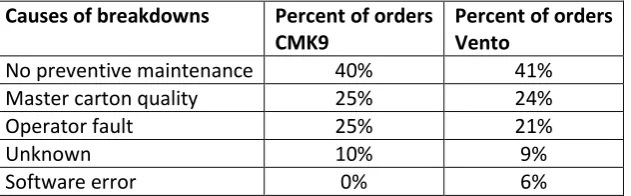
30 breakdowns and discussed within the TD how these breakdowns could be prevented and what caused the breakdowns. Table 3 shows the causes of breakdowns. As can be seen in Table 3, PM could prevent roughly 40% of the breakdown orders, but there is also a lot of improvement possible by training the operators and improving the quality of materials, on which we will not focus because no amount of maintenance will provide a reduction for these two causes (Christer & Whitelaw, 1983).
Table 3: Causes of breakdowns
Causes of breakdowns Percent of orders CMK9
Percent of orders Vento
No preventive maintenance 40% 41%
Master carton quality 25% 24%
Operator fault 25% 21%
Unknown 10% 9%
Software error 0% 6%
In SAP Quaker Oats’ engineers place the type of failure in predefined categories like mechanical failures due to wear. For roughly 65% of the orders, this is registered. Most failures are due to a lack of maintenance actions.
2.5 Conclusion
This Chapter described the current situation of maintenance at Quaker Oats. All involved parties are analysed and the process of executing and planning maintenance is described. The first research question can be answered.
How is maintenance currently done for the machines at Quaker Oats?
Maintenance is executed on a corrective basis. Most orders are corrective (±98%) and can be divided into critical orders (breakdowns, ±85%) and non-critical orders (repair orders, ±13%). The biggest reduction in corrective maintenance can be achieved by preventive maintenance. This way 40% of the orders could have been prevented. PM takes time but creates less hindrance than corrective maintenance and is quicker than CM due to the preparation. The division of orders has multiple reasons:
- Quaker Oats does not have a maintenance concept for its machines;
- Quaker Oats does not have the resources to plan and perform preventive maintenance; - The Maintenance department has little authority towards other departments.
A maintenance concept forms the basis of maintenance. It states the maintenance needs of the machines and maintenance tasks follow from the concept. The current maintenance concept does not prevent orders because the maintenance tasks are vague and not argued. Without a concept, no tasks are argued and planned. This is the main reason for the focus on and execution of CM, the department does not know what maintenance the machines need. Hence, a maintenance concept needs to be created. Only 8% of the maintenance orders originating from the maintenance concept are executed, 3,5% of the orders come from a maintenance concept. Maintenance concepts are incomplete, not well set-up and lack detail, like task description and estimated time which makes it difficult to execute and plan the orders. Some maintenance concepts are created to fill the system to fulfil the demands of PepsiCo. This creates an incorrect maintenance concept. Maintenance concepts help to reduce the technical downtime and costs by determining the maintenance actions on forehand.