MASTER THESIS
BOOTERS (BLACK)LIST
Justyna Joanna Chromik
FACULTY OF ELECTRICAL ENGINEERING, MATHEMATICS AND COMPUTER SCIENCE (EWI)
CHAIR: DACS (DESIGN AND ANALYSIS OF COMMUNICATION SYSTEMS)
EXAMINATION COMMITTEE
Prof. dr. ir. Aiko Pras, Dr. Anna Sperotto, José Jair C. Santanna, M.Sc.
Abstract
History has taught us: never underestimate the amount of money, time, and effort someone will expend to thwart a security system. It’s always better to assume the worst. Assume your adversaries are better than they are. Assume science and technology will soon be able to do things they cannot yet. Give yourself a margin for error. Give yourself more security than you need today. When the unexpected happens, you’ll be glad you did.
C
ONTENTS
1 Introduction 5
1.1 Goals . . . 5
1.2 Structure . . . 6
1.3 Contribution . . . 6
2 Background 8 2.1 What is a Booter? . . . 8
2.1.1 Stress testing websites . . . 11
2.1.2 Booters vs stressers and a box of matches. . . 12
2.2 Existing mitigation methods of Booters . . . 13
2.2.1 Blacklisting Booters . . . 15
2.3 Characterizing a website . . . 16
2.3.1 Purpose and approach . . . 16
2.3.2 Classification of websites . . . 17
2.3.3 Features . . . 18
2.4 Concluding remarks . . . 19
3 The crawler and the dataset 20 3.1 The crawler . . . 20
3.2 Dataset characteristics . . . 23
3.2.1 URL analysis . . . 23
3.2.2 IP address analysis . . . 23
3.2.3 Website structure analysis . . . 23
3.2.4 WHOIS analysis . . . 25
3.2.5 Website content analisys . . . 26
3.3 Most significant features of Booters . . . 27
3.4 Extending the dataset . . . 28
3.5 Keeping list up to date . . . 29
3.6 Concluding remarks . . . 29
4 Feature analysis 30 4.1 Similarity measure . . . 30
4.2 Classifying Booters using unweighted score approach . . . 34
4.3 Classifying Booters using score with weights . . . 35
4.4 Comparison and proposed classification . . . 36
4.5 Decision tree . . . 37
4.6 Concluding remarks . . . 38
5 Conclusions 39 5.1 Additional contributions . . . 40
5.2 Future work . . . 40
5.3 Limitations . . . 41
A Booter websites characterization: Towards a list of threats 44
B Manually classified Booters 59
C Booters used in the thesis 60
C
HAPTER
1
I
NTRODUCTION
Distributed Denial of Service (DDoS) attacks are considered number one operational threat on the Internet [1]. DDoS attacks aim to make a target machine, service or network unavailable to its intended users, using distributed sources, such as infected computers or servers. For many industries, such as gaming, e-commerce, online financial services, a DDoS attack could be especially devastating, since they use the online services as the one and only way of sales or customer communication [2]. The consequences of these attacks are for example revenue losses in case of online businesses, reputation damage, customer attrition [2, 3].
Within a year, the amount of reported DDoS attacks has increased with 57%, compared to 2013 [4]. One of the reasons for this increase is the effectiveness, simplicity and availability of websites that provide DDoS attacks as a paid service, called Booters [4]. These websites offer attacks for a very cheap price, for instance, less than 5 USD [5], powerful enough to put offline most of small and medium-sized companies’ websites [6]. Booters are especially popular among online gamers - to knock their opponents offline in order to win a game [7]. However, small gaming websites and private servers are becoming a popular target too [6]. DDoS offered as a commercial service via a website was already described by Lackey in 2010 [8]. From then on Booters are flourishing: they evolve, acquire new customers but also new Booters appear on the Internet. Booters are available for anyone - this means that DDoS attacks are no longer associated with hackers with knowledge. Since anyone can currently use or make those websites, it is crucial to investigate what can be done to decrease the amount of DDoS attacks performed by means of Booters.
There are three areas where Booters can be mitigated: at access, infrastructure, and target level [9]. This thesis focuses on the access level, since it was not yet investigated and has a huge potential to tackle the problem of Booters, because it treats the origin of the attacks. For such this thesis proposes to create a blacklist of Booters. Four challenges have to be addressed when proposing a blacklist. First of all, blacklisting websites bringsobjections, since in the era of net neutrality any website filtering gains its opponents. Although a benign URL or IP address could be accidentally blocked, blacklisting is still widely used for filtering spam messages, phishing websites or websites used for spreading malicious software. Second, because the mentioned phenomena are dynamic, these lists need to be automati-cally generated in order to save time and resources. Third, in order to use a list for filtering, blacklists used in the mentioned areas need to beaccurate. This means that a list of filtered websites has to contain no benign websites, in order to avoid overblocking. Finally,maintenanceof such list means not only to add the new examples of Booters, but also to remove old entries. In other words, maintenance keeps the list up-to-date.
Knowing the problem and proposed solution, the remaining of this introduction describes the goals of this thesis in Section 1.1, highlights the contributions in Section 1.3 and explains the structure of the thesis in Section 1.2.
1.1 Goals
The goal of this thesis is to create an accurate and automatically retrieved list of Booter websites. There-fore, to drive this research the following main research question (RQ) is used.
RQ: How to classify a website as a Booter?
website. Therefore, to address the main research question and the challenges imposed, a set of sub research questions is defined as following:
• RQ.A What is the state-of-the-art of Booters and their mitigation? • RQ.B What are the proper search terms for searching for Booters?
• RQ.C What are the characteristics of Booter websites?
• RQ.D What is the set of features that could be used to classify a website as a Booter?
The next section will explain the approach which was taken in order to answer the questions above.
1.2 Structure
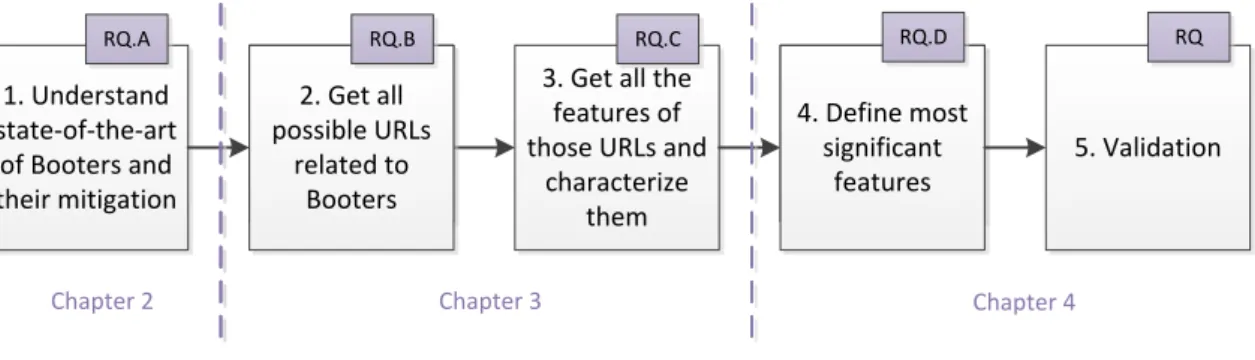
In order to answer the questions stated above, the research was conducted as depicted in Fig. 1.1. First, step 1 provided the state-of-the-art of Booters, their mitigation, but also the set of features that can be used to classify any website. This will be covered in Chapter 2. Secondly, Chapter 3 explains the way to retrieve as many URLs related to Booters as possible (step 2) and all the necessary information that could be used to classify a website (step 3). Based on the found websites, the most significant characteristics were defined in step 4. This will be explained in Chapter 4, as well as validated (step 5).
1. Get all possible URLs
related to Booters
3. Get all the features of those URLs and
characterize them 2. Get all
possible URLs related to
Booters 1. Understand
state-of-the-art of Booters and their mitigation
4. Define most significant characteristics 4. Define most
significant features
5. Validation
Chapter 2 Chapter 3 Chapter 4
RQ.A RQ.B RQ.C RQ.D RQ
Figure 1.1: The approach to classify a website as a Booter.
The thesis is concluded in Chapter 5 together with suggestions for future work. Finally, it is wrapped up with some reflections and acknowledgements, after the conclusions.
Next section highlights the contributions of this thesis.
1.3 Contribution
This thesis addresses the four main questions asked in Section 1.2 and the additional challenges men-tioned at the beginning of this introduction. As a result, the following contributions can be listed as an outcome of this thesis:
• To avoid the objections against blacklisting Booters, the problem of those websites is explained and the state-of-the-art of Booters is researched. It showed that both types of websites offering DDoS-As-a-Service and stress testing can be used for similar purposes - performing DDoS attacks - and should be considered a threat;
• By careful investigation of websitescharacteristics, a set of properfeaturesto classify a website as a Booter is defined;
• A framework to classify a website as a Booter is proposed based on the previously mentioned features. The goal of the proposed solution is to be asaccurateas possible.
Beside this thesis, as a deliverable of this research a paper was written“Booter website
charac-terization: Towards a list of threats”, and submitted to the 33rd Brazilian Symposium on Computer Networks and Distributed Systems Conference (SBRC) 2015 in Brazil1. The conference takes place in
May 2015, and the further notice about the conference will be given in March 2015. The paper submitted for the conference is attached in Appendix A.
C
HAPTER
2
B
ACKGROUND
To understand the subject of Booters, this chapter investigates what is the state-of-the-art of Booters mitigation. This is done by analysing currently available literature about Booters, as well as blogs of security experts, and hacker forums. Based on such input, Booters are defined, and the existing methods for their mitigation is investigated. Section 2.1 gives a definition of a Booter, and explains the difference between a Booter and stress testing website. Section 2.2 explains the known mitigation methods that could be applied in tackling the problem of Booters. With the idea of characterizing a Booter website, this chapter is closed with a review on possible methods and features used to classify a website in Section 2.3.
2.1 What is a Booter?
Karami and McCoy [5] refer to Booter services as the low-cost “DDoS-as-a-Service” phenomenon. San-tanna et al. [9] considers Booters to be the front-end to access and launch DDoS-as-a-Service attacks. A security specialist, Krebs [10], refers to Booters as services hired to knock Websites and individual Internet users offline. Booter services are also mentioned in reports of leading DDoS protection compa-nies, such as Akamai [4]. Such services are defined there as part of the DDoS-for-hire market allowing low-level, non-technical actors to threaten organizations without DDoS protection [4]. The main mes-sage in all the mentioned sources is that DDoS attacking is available to everyone nowadays. In the past, in order to perform a DDoS attack one needed to have specialized knowledge and resources to perform it. Booters made it easy - without any knowledge, for just 1 USD [11] anyone can perform a DDoS attack. In this thesis, name “Booter” means the following:
Booter website(Booter): a website which provides means for performing DDoS attacks for money.
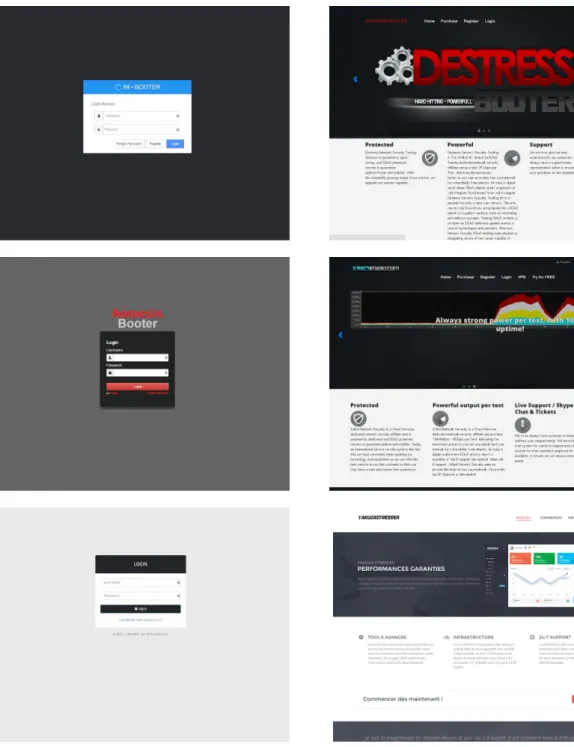
a) Simple login page examples of Booters. b) Booters with extended interface.
Figure 2.1: Examples of Booter websites.
In Figure 2.1 it can be noticed that Booters look a lot alike: in the left column, Fig. 2.1a) the main page of Booters is quite simple: they are built only from a login screen. In the right column, Fig. 2.1b) more information can be noticed, such as explaining that servers used are protected to ensure 100% time availability, or that the service they offer is powerful.
the attacked host continue working [12]. Among the attacks of layer 3 and 4 attacks offered by Booters, the following are the most common:
• SYN flood attack- where attacker sends a series of SYN requests to the target in order to exhaust the server resources. Due to many half open sessions, the target will be not able to process new requests, which could come from a legitimate source. The source IP sent by the machines is often spoofed, what makes it almost impossible to block the source machine. This attack comes under different names, what Booters list as e.g. TCP attack, SSYN (Spoofed SYN), ESSYN.
• UDP flood attack- where the victim target receives a lot of UDP packets, which it has to respond with many ICMP packets. As a result it will be overloaded and not able to receive more requests. The source IP can be as well spoofed, thus the name SUDP (Spoofed UDP) is also used.
• DRDoS (Distributed Reflection Denial of Service) - a special type of SUDP attacks. In this attack, forged requests are sent to large number of computers, which will reply to such request. By changing (spoofing) the sender address to the victim address, all the response is sent to the that system, exhausting the bandwidth. Those attacks are additionally amplified. Amplification is done due to fact that with short in size request, such a server can provide a long in size response. This is possible with the protocols like DNS (Domain Name Server), NTP (Network Time Protocol), Chargen (Character Generator), or SSDP (Simple Service Discovery Protocol). In case of DNS protocol, using open DNS resolvers, the request can be amplified with up to 179 times [13], while using NTP servers, with 556,9 times [14].
• UDP lag - which is mostly an amplified UDP attack, that does not send the traffic constantly. Instead, it makes some breaks, e.g. sending the traffic for 3 seconds and then 1 second break. The goal of such attack is to slow down (“lag”) the victim’s system instead of blocking it entirely.
Especially the DRDoS attacks are one of the most powerful attacks nowadays. Among others, they were used in the 300Gbps attack on SpamHaus in 2014 [15]. Although the attack on SpamHaus was not done by means of Booters it just gives the idea of their potential. The amount of NTP reflection attacks has increased 181% within the last quartile of 2014, and is confirmed that a source of the attacks were Booter websites [4]. As said before, Booters also offer attacks on the application layer, such as:
• GET attack- an HTTP based attack, based on a large number of GET requests, usually sent via proxies.
• POST attack - an HTTP based attack. The POST attack is based on sending complete HTTP POST headers with specified size of the message body following. That message is then sent at an extremely low rate in order to slow down the system.
• Slowloris- an HTTP based attack, tries to keep many connections to the victimized web server opened for as long as possible. Connections to the target system are opened, and a partial request is sent. Once in a while, it sends a new HTTP header, which adds up to the request, but which is never completed. This attack can be compared to SYN flood but on the application layer.
• RUDY (R-U-Dead-Yet?) attack- similar to Slowloris, but makes the sessions halt by using never ending POST requests and sending large value of header.
• ARME attack- exhaustion of SWAP memory on Apache Web servers. Once out or SWAP mem-ory, the machine will kill all the processes.
There are more attacks listed among Booters, however, most of them repeat – they are just listed under different names. Overall, although there are many types of offered attacks, not all of them are always achievable. For instance, [11] shows that not all of the Booters deliver the requested service, e.g. among 14 Booters analysed in that paper, 5 did not provide the bought service, out of which 3 did not provide anything at all. On the other hand, 9 of them delivered DRDoS (DNS-based and CHARGEN-based) attacks, while UDP attacks were bought.
and market of Booters is not known. The paper by Karami and McCoy reveals the infrastructure used by the one specific Booter, named TwBooter. Although in this case 15 distinct servers were used, it is a common practice that Booters use a number of compromised machines (e.g. botnet and Web-shells), and misuse UDP servers (e.g. DNS or NTP) for the DRDoS attacks [9]. More light is brought by Santanna et al. [16], where databases of 15 distinct Booters were analysed. As compared with research of Karami and McCoy [5], this was the only case where dedicated servers were used. All the other 14 analysed Booters had their infrastructure based onWeb-shells, that are scripts hosted on some machines, which could be compromised.
The literature emphasizes that anyone can perform attacks by means of Booters [5, 11]. It is possi-ble, because Booters additionally offer the following services:
• Skype resolver, to resolve the IP address of your game opponent, whose Skype login is known.
• IP address resolver, to resolve the IP address of a website URL, in case some website is the target.
• Cloudflare resolver, to resolve the real IP address of the website protected by a DDoS Protection Service (DPS) company.
• Live Chat Support, to guide the potential customers through their services.
Using Booters means that users intentionally attack a third party service, against the will of the victimized system. However, as pointed in the literature, Booters publicly name themselves as “stress testing websites” or shortly “stressers”. Using stressers would mean the attacks performed are delib-erate. Since the difference between the two is not clear, the next section investigates the difference between “stressers” and “booters”.
2.1.1 Stress testing websites
This section addresses the difference between websites named Booters and websites offering stress testing - stressers. This will be addressed by comparing the goal, target, infrastructure used for attack, and methods of advertising of both. First, stressers will be defined, and then the results of search in Google Search engine for “Booters” and “stressers” will be compared.
Stress testing is a form of intentional thorough testing of a given system. Its goal it to test such entity beyond regular operational capacity up to the limits of the given system, to observe the results. The goal of such testing is, among others, to determine the safe usage limits, verify the specifications of a system or learn how the system fails [17]. One of the goals of stress testing is to check the resistance to DDoS attacks [18] and the most important characteristics is that it is deliberate and done in a test lab (so it does not affect other entities). This implies that stress testing websites should make use of a dedicated infrastructure for the provided services. In this thesis the name “stresser” means the following:
Stresser website (stresser): a website by means of which it possible to deliberately perform a thorough test of a system under test.
Although there are many stress testing websites, they do not ensure any identity verification of the person requesting the attacks. As mentioned before, Booters officially claim to offer stress testing, however, as the reviewers and bloggers point out, this is only to avoid legal aspects [8, 19, 20]. Truth is, technically they perform the same resource exhaustion actions as the stress testers, however, main difference is: the action done using Booters’ service is unauthorized by the target.
Moreover, the resources of Booters (advertising themselves as stressers) used for attack do not belong to a test lab, as often open DNS resolvers or NTP servers are used, as mentioned in Section above. Also, Booters recommend not to target own infrastructure [9]. If a customer would like to perform stress testing on their system, this would be required. This requirement would imply a need for some verification, but this is currently not done among the Booters or stress testing websites.
2.1.2 Booters vs stressers and a box of matches.
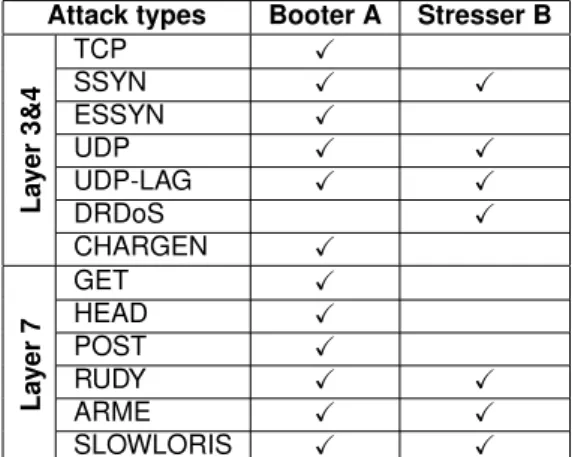
Since many Booters and stressers are available on the Internet, the comparison was be done using just one result of search queries for each search word. This result can be thus biased by that result. To make the comparison, the top one result for the search terms “booter” and “stresser” is analysed. The URL/names of the Booter and the stresser are anonymized to avoid legal or ethical implications (the URLs are revealed in the Appendix C). Table 2.1 shows the findings. Please note that although attacks such as TCP, SSYN and ESSYN, or CHARGEN and DRDoS are technically the same as it was explained in Section 2.1, the table shows how the attacks were advertised in the websites.
Attack types Booter A Stresser B
La
yer
3&4
TCP X
SSYN X X
ESSYN X
UDP X X
UDP-LAG X X
DRDoS X CHARGEN X La yer 7 GET X HEAD X POST X
RUDY X X
ARME X X
SLOWLORIS X X
Table 2.1: Services offered by a Booter and a stresser
Looking at the Table 2.1, three observations can be done. The first observation is that technically the Stresser B offers the same attack types as Booter A. The second observation is that both offer most of the known types of DDoS attacks, which target the Layers 3&4 and the application layer. The third observation is that although Booter A does not explicitly offer Distributed Reflection Denial of Service (DRDoS), CHARGEN is a type of DRDoS. Therefore, both Booter A and Stresser B offer the strongest type of DDoS attacks reported nowadays.
Notice that the Booter A offers more attack types, but as often it is mentioned in reviews [21], behind different names the same type of attacks are hiding. For instance, as already pointed out, TCP, SSYN, ESSYN are all the same type of attack. In other words, Booter A would like to be “more appealing” by offering more options, while the truth is, only one or two types of attack are possible by means of this Booter.
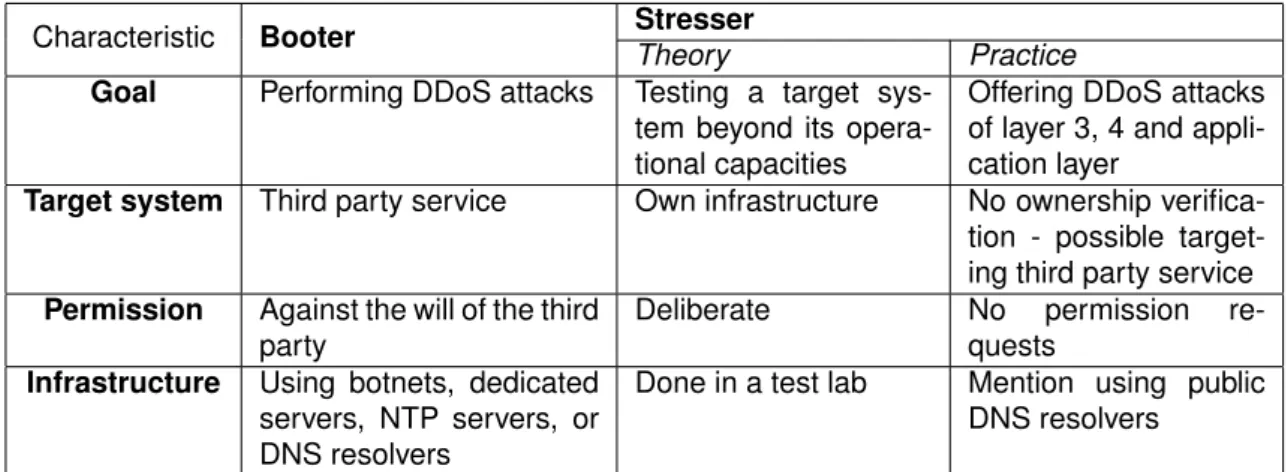
To fully answer the question, whether there is a difference between stressers and Booters, additional characteristics are gathered in the Table 2.2. By manually checking Booter A and Stresser B more information about the target and used infrastructure was gathered. It was noticed that Stresser B has no restriction in relation to the target of “stress test”. Given this freedom, the customers can perform attacks against third party services.
The characteristics gathered in Tab. 2.2 suggest that there is no technical difference between Booter and stresser. Both types of websites are in practice used for performing DDoS attacks, do not verify the ownership of targeted system, do not request any permission for performing the attacks. Moreover, the infrastructure used for the attacks in both cases does not differ. Either Booter or stresser can be (mis)used as an alternative for the same purposes - since they provide service of DDoS attacks, they will be considered as a threat. All these observations lead to a conclusion that all the stressers will be considered Booters in the rest of this thesis.
Characteristic Booter Stresser
Theory Practice
Goal Performing DDoS attacks Testing a target sys-tem beyond its opera-tional capacities
Offering DDoS attacks of layer 3, 4 and appli-cation layer
Target system Third party service Own infrastructure No ownership verifica-tion - possible target-ing third party service
Permission Against the will of the third party
Deliberate No permission
re-quests
Infrastructure Using botnets, dedicated servers, NTP servers, or DNS resolvers
Done in a test lab Mention using public DNS resolvers
Table 2.2: Comparison of characteristics of Booters and stressers: in theory and in practice
parts of ToS found on Booters. It gives example of three different Booters, which are named below as C, D and F, and piece of text included in their Terms of Service. As neither the ethical nor the legal aspects of Booters are clear, they are also anonymized1.
Terms of Service statements
Booter C “We are not responsible for how ever you use this stresser”
Booter D “Illegal activity which occurs in your account is [...] associated to you” Booter E “Anything you do while on Booter E is your own responsibility”
Table 2.3: Examples of text included in Terms of Service
Table 2.3 shows that some Booters clearly do not take any legal responsibilities for users’ actions, although their core business is to offer DDoS attacks against anyone and anything connected to the Internet. This type of action can be metaphorically compared to a parent leaving a 4 year old child in a stable filled with hay, giving it a box of matches and saying: “Whatever you do with these matches is up to you. I do not take care the responsibility for how you use these matches”. Replace the stable with the internet and hay with all the hosts connected to it, the child with the attacker and the matches with Booters, and you will understand the business model of a Booter.
The legal aspect of Booters is a nudging subject, which requires attention, but will be out of the scope of this research. From technical point of view it can be concluded that stressers are/can be used as Booters.
As mentioned above, for the purpose of this thesis all stress testing websites and Booters are treated equally as a mean for performing DDoS attacks. Because they provide such possibility, they could be misused, and due to that, they require attention. Due to that, the next section will address the possible methods of mitigating Booters.
2.2 Existing mitigation methods of Booters
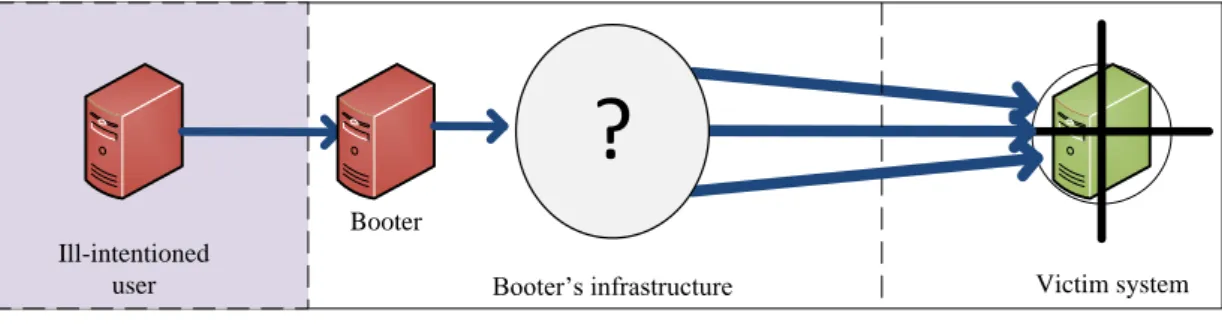
This section reviews the existing methods that are or could be used to mitigate Booters. There are several levels where, in general, DDoS-As-a-Service phenomenon could be mitigated [9]. Figure 2.2 shows the basic work of a Booter. As depicted, ill-intentioned user is accessing Booter to attack the victim system. The Booter uses its infrastructure, which can consist of, for example, dedicated servers, botnets, open DNS resolvers etc. [6], depending on the type of the attack which was requested by a customer. By means of this infrastructure, an attack is performed to exhaust the resources of the victim system.
Reducing the impact of the attacks caused by Booters could be done on several levels, such as (i) the access level, (ii) the infrastructure (command control) level, and (iii) the target level. In the Fig. 2.2
the access level is depicted as the part between the ill-intentioned user and the Booter, symbolizing all the interactions between the user and the Booter. The infrastructure level, is symbolized by the Booter website and the controlled systems - depending on Booters. Target level is shown by the victim - where the traffic from earlier mentioned systems is reaching its destination. The following paragraphs will describe in a reversed order how Booters can be mitigated per level.
Ill-intentioned
user Booter’s infrastructure
Access level
Infrastructure level
Target level
Victim system Booter
?
Figure 2.2: Mitigation areas of Booters.
• Target levelAmong the three mentioned levels of mitigating the impact of Booters, the generic DDoS defence mechanisms done at the target are already widely researched [25, 26]. In case of the large attacks they are however not effective [15]. A very neat overview of the defence mechanisms is described by Mirkovic and Reiher [12]. In brief, two main approaches are defined:
preventive and reactive. Preventive mechanisms are all the actions taken beforehand in order to prevent an attack from happening. It could be, for instance, keeping the software up to date, patching the servers to avoid the known possibilities of misconfiguration. Reactive mechanisms are all the actions taken to stop an existing attack, after detecting it. The detection can be done either by detecting a pattern of an attack, or an attack can be concluded as an anomaly from the regular behaviour of e.g. the traffic. The actions taken to stop such an attack are for instance, rate-limiting or filtering out the malicious traffic. The DDoS mitigation mechanisms at the target level could be also outsourced to a third party, that is, a DDoS Protection Service (DPS) company such as CloudFlare2or Incapsula3.
At the target level it is not possible to differentiate whether the attack was caused by means of a Booter or by a hacker with advanced knowledge, unless the attacks were launched deliberately. The IP address of sending machine belonging to the Booter’s infrastructure may be spoofed, that means, the IP address of sending machine can be changed to any IP address, so it would not known where the attack comes from, or who sent the packet. The reason why this area is so popular is that, especially in case of the volumetric attacks, it is the area where the attack is detected in the easiest way. Since the sources of traffic are distributed, the traffic generated around them has not as high load. However, the closer to the destination, the higher load of the traffic, thus, the easier is it to detect it.
• Infrastructure levelThe mitigation of Booters on the infrastructure level is the most difficult, be-cause of vague information about it. Analysis of this level was done by few researchers [5, 16] respectively by investigating the infrastructure of 1 and 15 Booters, based on leaked databases. In order to propose a mitigation method for this level a good understanding on the infrastructure is needed. However, in the findings of Karami et al. [5], the authors mention that in the period of 23rd January till 15th of March 2013 15 distinct servers were used, not all at the same time. Since only three servers were active throughout the whole period, this means that the infrastructure of Boot-ers is varying, and because of that, hard to address. However, the Booter explained by Karami et
2https://www.cloudflare.com/ 3
al. is apparently an exception when it comes to the used infrastructure: most Booters base their core onWeb-shells[16], which are scripts hosted on machines and are accessed via HTTP/GET or HTTP/POST. Those machines can be compromised (or not), and the HTTP requests specify details of an attack, e.g. the targeted host, duration time, or a type of an attack. To avoid being dependent on a leaked database of a Booter, this research will not address this level of Booter mitigation.
• Access level Since one of the reasons for the popularity of Booters is that they are available via a user-friendly website, this could be a possible way of mitigating them. It was decided to investigate the known methods used for limiting access to websites, namely, blacklists. Blacklisting is a popular solution for blocking some machine or website, on DNS or application level. There has been quite some research done in area of generating blacklists and using blacklists for blocking the spam, phishing websites and websites with illegal content, such as child pornography [27, 28, 29, 30], however there is no research done about using them in blocking the access to Booters.
Due to the reasons mentioned above, the rest of this thesis will focus only on the blacklist of Boot-ers as a possible mitigation method. For that the next section will explain the goal, drawbacks and advantages of a blacklist.
2.2.1 Blacklisting Booters
Main idea behind a blacklist is that an attacker willing to boot some website will not be able to do it in simple way, because he or she would not be able to access a Booter. Another idea is that instead of blocking the website entirely, a warning could be generated, saying e.g. “The website you are about to access is associated with use for illegal purposes.”, what could make the person change his mind. However, blacklists come with some challenges. Below four challenges are listed and explained followed by a counter argument in favour of blacklists.
First of all, blocking websites would require a list that is correct and up-to-date. In case a list is not accurate, then the entities are either wrongly classified as Booters, or wrongly classified as non-Booters. In first case, such list would block benign websites, in the latter case the ill-intentioned users would still be able to access Booters, but not all of them. Also, if the list is not up-to-date, URL which used to belong to a Booter may not be a Booter anymore, yet it would still be blocked. All those cases lead to overblocking, which is one of the arguments of opponents of blacklists. Moreover, blacklists are a reactive mechanism for blocking access to a website. This means, if a blacklist is not updated fast enough, an attacker has time to still use the website, before he cannot access it anymore. The mentioned challenges should be addressed in the method of generation of the blacklist and very often it is: it is possible to create blacklists automatically with a high precision as it is done in case of spam, phishing websites, websites spreading malicious software, etc. For example, researches show that the precision of generating a blacklist automatically comes with up to 99% precision [28], and also there are proactive methods of creating a blacklist [29].
Second of all, a person who would like to use a Booter could simply use a VPN or proxies to connect to it. This cannot be avoided, but requires some knowledge from the ill-intentioned user. This means, that using blacklists at least the not advanced users of Booters would be eliminated from the list of potential customers. As the research by Santanna et al. shows [16], there are many users that access a Booter using their original IP, so it can be concluded that there are many not advanced users of Booters.
Thirdly, nowadays Web filtering aspects bring a lot of objections from Net Neutrality adepts and is considered unlawful [31]. Somehow the problem of filtering spam or phishing websites is silent in the media. On the other hand, issue of filtering websites with child pornography requires assurance that such content is on such a website, otherwise it is considered illegal to block such website. Still, it is obvious - phishing, so identity theft is a crime, but so is DDoS and DDoS attempts, e.g. in the EU law [32]. This suggests that blocking websites allowing to perform DDoS attacks may be in future allowed.
the problem will remain the same: although the number attempts to connect to Booter websites can be monitored, it cannot concluded whether this way a DDoS attack was successfully prevented from happening. However, despite problems with measuring the effectiveness of a blacklist, it has to be memorized that no security system is ever built of single type of protection. It can be said that security systems have to be like onions - have to be built of layers. Of course, despite filtering, some spam still reaches the mailbox of a victim, or some people still access phishing websites. However, this would be much more common if spam or phishing websites were not filtered.
Summarizing, despite the arguments against blacklisting, it is still a promising way of mitigating Booters. However, in order to use a blacklist, a verified list of such websites is needed in the first place. Currently there is no freely available list of Booters for the research purposes. Such list would be a great help for future research, for example, by monitoring the traffic coming to such website. For this reason, although the main idea of this thesis was to use a list of Booters as a blacklist, it is decided to change the title to “Booters (black)list”. The brackets suggest that the primary goal of this list is not to blacklist Booters, but to generate a list, which could potentially be used as a blacklist.
The list of Booters will keep changing, since Booters change their names, and new ones appear on the Internet. To get an idea if such list can be generated automatically for Booters, the next section will provide an overview on the current methods to characterize a website, in order to automatically classify it.
2.3 Characterizing a website
The question addressed in this section is: what are the existing methods for characterising a website? First, a literature review on website features is done. The purpose of such classification is also analysed, as well as the approach taken by the researches and the method the classification. Next, the features used in the literature are explained.
2.3.1 Purpose and approach
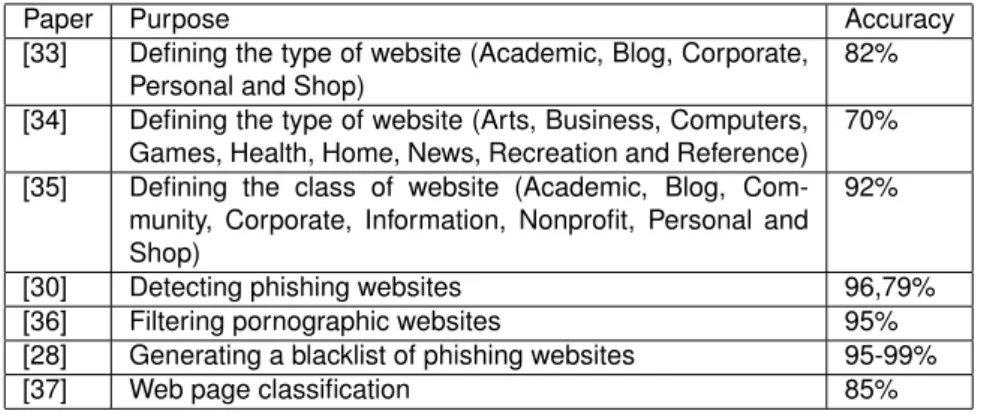
To characterize Booters, first a review on how to characterize websites in general is done. A literature survey on website features, gave an overview of website elements that could be used for classification. The papers discussing the features of websites have different purposes, which are gathered in Tab. 2.4. Note that this survey is not complete: there is much more work done in website classification, however the used features repeat. Due to that this thesis focuses on few main ideas, where some website features are used to distinguish a website.
Paper Purpose Accuracy
[33] Defining the type of website (Academic, Blog, Corporate, Personal and Shop)
82%
[34] Defining the type of website (Arts, Business, Computers, Games, Health, Home, News, Recreation and Reference)
70%
[35] Defining the class of website (Academic, Blog,
Com-munity, Corporate, Information, Nonprofit, Personal and Shop)
92%
[30] Detecting phishing websites 96,79%
[36] Filtering pornographic websites 95%
[28] Generating a blacklist of phishing websites 95-99%
[37] Web page classification 85%
Table 2.4: The purpose, approach and accuracy of classifying websites.
In the Table 2.4 the purpose of classifying websites varies: mostly the goal is to classify the subject or type of a website [33, 34, 35, 37], some of them used the features for website filtering [30, 36], or use the features for blacklist generation [28].
to “Academic”, “Blog”, etc. categories). Based on a set of features of those websites, a classifier is trained, to later use it to define what class does a new website belong to. Most popular machine learning algorithm among the papers listed in Table 2.4 is Naive Bayes algorithm [33, 34, 35, 28]. In the set of papers presented in Tab. 2.4 it reaches the highest accuracy (99%). Another possible approach is creating a decision tree [36] or calculating a disparity measure of the actual website and the fake website [30].
In either way, any method of classification requires a reference dataset in order to define whether the decisions done either by machine learning classifier, or by the decision tree etc. are correct or not. For this such set has to be proposed in this thesis. To understand properly what is understood by correctness of decisions based on the datasets, the next section will explain the idea behind classifying websites.
2.3.2 Classification of websites
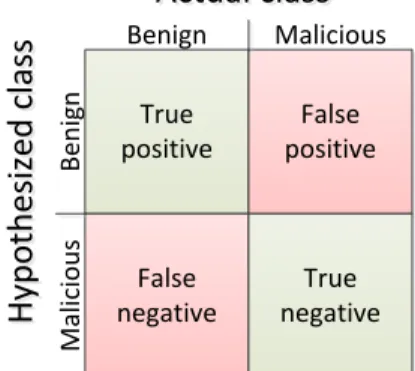
Any of the mentioned algorithms lead to correct and wrong results. Verification of such result is done by calculating the sensitivity and specificity rates. Provided a set of websites belonging to a set of classes, the hypothesized class is compared with the actual one. In case such classification is used for filtering websites, imagine the scenario: a website can be classified as malicious and be filtered out, or as benign and by allowed to be accessed by the user. Thus, the hypothesized class of a website is malicious or benign. This gives four possibilities, as shown in Fig. 2.3 aserror orconfusion matrix. These possibilities are explained below:
True positive False positive False negative True negative
Actual class
Actual class
H
yp
o
th
es
iz
ed
c
la
ss
H
yp
o
th
es
iz
ed
c
la
ss
Benign MaliciousB en ig n M al ic io u s
Figure 2.3: Confusion matrix
• True positive- when the website is classified as benign and it actually is so.
• True negative- when a malign website is blocked.
• False positive - when the website is benign and is classified as malign. This is called a Type I error.
• False negative- when the website is classified as malign, however it is benign. This is called a Type II error.
Note, that in order to calculate the accuracy, the analysed URLs need to be compared to a reference list. In case of the papers mentioned above, the authors use existing databases where the websites are classified by some communities. For example, in case of classifying phishing websites, databases such as PhishTank [30, 28] or Spamscatter [28]. In case of classifying the type or subject of a website, DMOZ Open Directory Project [33, 34, 35], WebKB and BankSearch [37]. However, in case of Booter websites, such manually verified list does not exist. The possible reasons for that are: Booter phenomenon is relatively new, Booters are so far not clearly defined, and the constant change of name and number of Booters. This means that the chosen approach for classification of Booters will have to take onto account that all the URLs will need to be manually classified.
The next subsection describes the features of websites which are used for classification.
2.3.3 Features
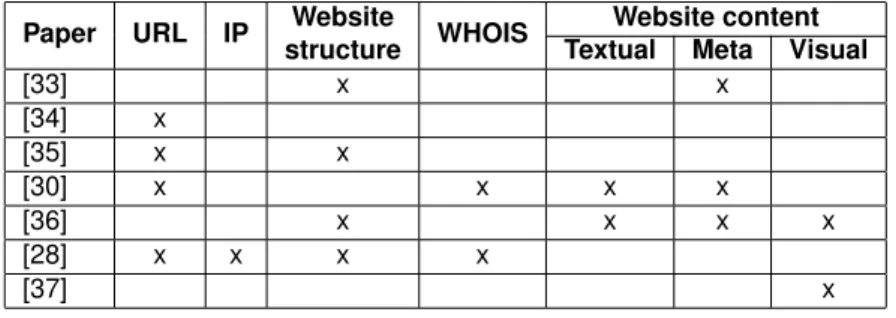
The literature referenced in Table 2.5 refer to different elements of a website. Below the table it is explained how the mentioned features are used in different approaches.
Paper URL IP structureWebsite WHOIS TextualWebsite contentMeta Visual
[33] x x
[34] x
[35] x x
[30] x x x x
[36] x x x x
[28] x x x x
[37] x
Table 2.5: Website features used to characterize websites.
As it can be seen in Table 2.5, the listed papers were mentioning properties of the URL, IP address, the structure of the website, WHOIS information of the domain and the textual content of the website. Below each of them is briefly explained:
1. URL: this feature discloses the overall composition of a URL. Usually a URL is composed of three elements: (i) network application protocol, (ii) the URL host name, and (iii) the URL path name. For example, inhttp://www.domainname.tld/path/to/the/article.html, ‘http://’ is the protocol, ‘www.domainname.tld’ is the host name, and ‘/path/to/the/article.html’ is the path name. In the literature the URL is used as a feature because it can be obfuscated, or plain IP address can be used instead of a domain name [30]. The websites could also be using certain string in the URL [34, 28], the presence of digits in the URL can be a feature [35].
2. IP address: this feature can provide the following information: (i) the IP address could be already blacklisted or (ii) the geographical information - where the website is hosted [28].
3. Website structure: is a feature that reveals, among others, two aspects: (i) the URL depth level and (ii) the number of known pages of a website [33, 35]. The former is a terminology defined by us that analyses the number of slashes (’/’) a URL path has. For example, the URL
http://www.domainname.tld/path/to/the/article.htmlhas depth level ’4’, because the slashes in the protocol (‘http://’) are not counted. The latter aspect is the number of indexed webpages that have the same host name and are reached by Google Search engine. For example, the number of indexed pages is 2 if Google Search returns 2 pages that contain a samewww.domainname.tld, such aswww.domainname.tld/1.htmlandwww.domainname.tld/2.php. Additionally, the literature suggests that e.g. number of dots (‘.’) to be significant [38] or the hyperlinks within the page [36].
such as (i) the registration date, (ii) the owner, (iii) the nameservers related to that domain name, and (iv) the entity responsible for the domain registration (i.e., registrar) [28], or it could be poorly maintained (missing data) or even not retrievable [30], what also can be a feature of Booters.
5. Page content: is a feature that reveals the elements of a website such as (i) the textual descrip-tion, (ii) the meta data, and (iii) the visual content, (e.g., buttons, tables, and figures). Websites are often classified based on text - they are compared according to frequency of a word in a site - in a”bag-of-words” approach. It could be either text of the content [40, 36] or of the meta data [33, 36]. The visual content of websites is compared either by analysis of pictures on the website [36] or by analysing e.g. forms, buttons, tables, which and their position on a website [37].
When comparing the Table 2.4 with Table 2.5 it can be noticed that if the purpose of classification is website classification, the features such as IP address or WHOIS information do not play important role. However, features such as the URL or website structure are interesting in both cases. Moreover, the papers with most analysed features [28, 30, 36] reached the highest accuracies. This suggests that it is worth to investigate many different features in the classification for better precision.
As shown above, there are many features of websites which could be possibly used to classify a website. Depending on the goal of the classification, or specific characteristics of classified websites, different features play more important role. As shown in Section 2.3.1, the websites can be classified with up to 99% accuracy. Important message from this section is that such classification is possible and done with satisfactory accuracy. In characterising Booters precision is also important, so as many features as possible have to be investigated in order to determine if Booters can be characterized in a general way.
2.4 Concluding remarks
As the background research showed, the state-of-the-art of Booters mitigation is vague and requires some attention both from legal and scientific point of view. This was described in Section 2.1. Leaving out the legal point of view, it was shown that Booters are a threat and do not have any dedicated miti-gation methods so far, as it was explained in Section 2.2. When analysing the mitimiti-gation areas it was suggested that the possible way of addressing Booters mitigation would be by means of blacklisting. However, in order to propose such technique, a comprehensive, up-to-date list of Booters is needed. Such a list is currently not available for research purposes 4. Moreover, as it was also explained in Section 2.1, Booters constantly change, because of what such list would have to be generated auto-matically. Such automatically generated lists are existing and are used for blacklisting spam or phishing websites.
Section 2.3 provided an overview on the features of websites used in approaches for automatic classification of websites. Those features, such as URL structure, IP address origin, website structure and its content, can help to indicate whether a website is a Booter. To find out how the mentioned features can make it possible, the next chapter describes (i) how they were collected, and (ii) what are the main characteristics of websites manually classified as Booters.
C
HAPTER
3
T
HE CRAWLER AND THE DATASET
Previous chapter explained what a Booter is and why is it important to mitigate them, described possible areas of Booter mitigation and provided a literature study on the methods for website classification. The goal of this chapter is to characterize Booters, in order to see whether it is possible to distinguish them from benign websites. This chapter explains the methods taken to retrieve the required information and the data set that it was decided to focus on. Section 3.1 explains the crawler which was developed in order to retrieve the features mentioned in previous chapter. Section 3.2 explains the findings about the Booter websites: what were the most significant characteristics of those websites. Section 3.4 explains the rest of the gathered data: the set based on which the classification is validated in the following chapter.
3.1 The crawler
In order to find a list of search terms, with which Booter websites can be retrieved, the most obvious term: “booter” was used in the beginning. With such term many URLs related to the word“stresser”
were found. In section 2.1.1 it was explained why both types of websites: “booters” and “stressers” will be considered in this thesis as the same type of websites. To find other terms Google was queried for materials related to Booters and stressers. Through an extensive literature study other two terms were found: “ddos-for-hire” [4, 41] and“ddoser” [42]. Finally, the set of search terms is closed with the term“ddos-as-a-service” [5], as mentioned in Section 2.1. Note that the reference on the side of earlier mentioned terms is not necessarily the first to use/define these terms, but the place that they were found.
Having the five search terms (“booter”, “stresser”, “ddos-for-hire”, “ddoser”, and “ddos-as-a-service”) defined, this section describes the approach to retrieve a list of URLs related to Booters and the ad-ditional information needed to classify them. To achieve this feature retrieval in an automated way, a crawler that fulfils the following requirements is developed:
1. Retrieve as many URLs related to Booters as possible based of the list of search terms. These retrieved URLs are called in this thesis as “potential Booters”.
2. Extend the URLs retrieved in the previous requirement to include all known pages related to those URL domain names.
3. Retrieve the WHOIS information of the URL domain names.
4. Download the Booter website content.
1) Google Search: search terms
2) Google Search: site: potential-booter.com
3) WHOIS: potential-booter.com
4) Download content: potential-booter.com
Figure 3.1: Crawler workflow.
The draft concept of the information retrieval is presented in Fig. 3.1, and more detailed it is pre-sented in Algorithm 1. Below it is described how the earlier mentioned requirements were achieved.
websites to be easily searchable. Moreover, it is assumed that most of the users of Booters have no knowledge about DDoS attacks, and Google Search engine would be first place to look for this service. Finally, deciding on one method of searching for URLs will save time for analysing the returned results. To crawl Google automatically for the URLs, a python search script is used [43]. This approach was chosen over other approaches [44, 45, 46] because it is not limited on the amount of results able to retrieve (e.g., 24 URLs). The script scrapes all the URLs which are returned in Google Search queries. In standard approach, the script returns all the URLs and also lists some subpages of the website, e.g. when looking for “cat” it would return URLs of all the green marked hyperlinks in Figure 3.2 (numbered 1-5). This means that a lot of hostnames will repeat. For purpose of this research it is more important to receive as many distinct URLs in the search part (that would mean URLs 1 and then 6 in Fig. 3.2). The adjustment was done with newer version of the Google Search function on 30th November 2014.
Figure 3.2: URLs scraped with the Google Search function
The method of searching for Booters has limitations, since it depends a lot on the possibility of Google to index those pages. Moreover, another drawback of this method was the time it took to crawl Google - it was required to make random pauses before requesting the pages from Google, otherwise the crawler was blocked. For this reason the overall time of search was long (e.g. one hour for one search word). However, for the purpose of this thesis it is sufficient, since the goal is to classify the website as a Booter, not to focus just on the extensive search. This will be a part of the future works (see Sec. 5.2).
To find all indexed web pages related to a website (second requirement) the Google Search with operator “site:” is used. This operator returns as result only URLs within the domain requested, for example the output of“site:name-of-potential-booter.tld” is a list of pages (URL paths) in the domain
“name-of-potential-booter.tld”.
To retrieve the WHOIS information (third requirement) pythonwhois package [47] is used. Although such library is able to return more than 20 different pieces of information about a domain name, in this WHOIS analysis only 4 of them are used, ones most likely to be retrieved: (i) the creation date, (ii) the registrar of the domain name, (iii) the nameservers that the domain is pointing to, and (iv) the contacts of the domain administrator. Often the data in WHOIS records is poorly maintained, so this will also be noted.
To fulfil the last requirement and download the content of Booter websites, first, it was decided that the identity of the used system should be kept anonymous. This precaution was taken because a security specialist was successively attacked after starting investigating Booters [48]. Therefore, The Onion Router (TOR) network was used. It enables online anonymity by encrypting and bouncing the traffic through networks and open relays severs. There was a drawback of this approach. It was noticed that a lot of websites are not returning the content of it. Since, as it was pointed out in [11], a lot of websites are protected by a DDoS Protection Service (DPS) company, using TOR network made it impossible to automatically retrieve the content of the website. DPS companies generate CAPTCHA challenge if the IP address that the request comes from has a bad reputation1, as nodes of TOR. Bad reputation of a website means that the IP address that a website is hosted on may be a source of e.g.
https://support.cloudflare.com/hc/en-us/articles/200170116-What-do-the-Threat-Scores-mean-spam or malicious software. There are many companies which track this kind of behaviour and create a reputation list of the IP addresses. The TOR nodes very often have a bad reputation2, so the crawler
usually gets a CAPTCHA challenge issued instead of getting the first page. It was decided to attempt to fetch those pages after disconnecting from TOR network.
Another requirement discovered when trying to download the potential Booters’ websites is to sup-port JavaScript. Since the hosts can determine it in different ways, sometimes looking at the setting in the header of HTTP request:’X-JAVASCRIPT-ENABLED’: ’True’, and sometimes looking at the USER-AGENT field in that header, requesting it was decided to use a ready browser emulator. In this crawler, the Selenium browser3was used, which is a library that emulates a generic Web browser and therefore
is able to support JavaScript. In order to run, Selenium needs to launch a browser. With no display on the used machine, the browser was launched using a fake display using Xvfb4. Xvfb is a display server allowing to perform graphical operations in memory, without showing any output on the screen.
The Algorithm 1 shows how the data was retrieved: provided the set of search words K and the functions for Google Search and WHOIS search. First, for the set of key words it returns the set of URLs of websites which are potential Booters (lines 1–3). In the next step for the set of mentioned URLs, it uses the pre-defined functions for Google Search and WHOIS search and returns the requested features of websites (lines 4–16). Retrieving the website is first done using TOR (lines 7–9), however, in case the website is not retrieved, the same operation is done after disconnecting from TOR (lines 10–14). This happens when the website protected by Cloudflare does not return the content of the website, but is redirected to a CAPTCHA challenge site.
Algorithm 1Booter Crawler
Require:
K={k1, k2, ..., k5} set of search words search(word)the google search function
whois(url)whois function on a url
W ={ω1, ω2, ..., ωn} set of URLs of websites 1: forkinKdo
2: ω...=search(k) 3: end for
4: forωinW do 5: search(site:ω) 6: whois(ω)
7: start TOR, start Browser 8: get(ω)
9: stop Browser, stop TOR
10: ifget(ω) =∅then 11: start Browser
12: get(ω) 13: stop Browser
14: end if 15: end for
16: return F ={f1, f2, ..., f9} set of features for eachω
The search and information retrieval script was running on a Virtual Machine with Debian OS. The information was stored in a relational database on this Virtual Machine. The decision to store the infor-mation was made due to the fact that the websites were changing what was influencing the results. In summary, this crawler was built to attend the requirements to analyse Booters. Although specific libraries and APIs are used, those were examples of decisions on how to fulfil the requirements. There-fore other libraries can be used. Note that the crawler can be extended to perform an automated clas-sification of Booter websites, but first the characteristics of the website features should be analysed.
2 https://support.cloudflare.com/hc/en-us/articles/203306930-Does-CloudFlare-block-Tor-3
http://www.seleniumhq.org
3.2 Dataset characteristics
Using the crawler explained in previous section, a search was performed on 15th September 2014. This data set consists of 1238 distinct URLs. Below this set is characterized.
3.2.1 URL analysis
First of all, the URL composition of the 1238 URLs is analysed, as it was suggested in the review done in Section 2.3.3. Table 3.1 shows a summary of the types of URLs found.
URL Type URL # URL retrieved
1 potential-booter.com 71
2 potential-booter.com/login.php
1167
3 www.domain.com/potential-booter
4 potential-booter.domain.com
Table 3.1: Examples of retrieved URLs
In Table 3.1 four different types of URLs can be observed: with only a host name (type 1), with host name and path (type 2), where Booter is a page of a website (type 3), and where a Booter is a subdomain of a domain name (type 4). The goal is to focus on the URL type that has the highest probability to be a Booter. Note that often URLs type 2 are subpages of URLs type 1. Thus, it is decided to analyse only the type 1. Although URLs type 3 and 4 can potentially contain Booters, it was noticed that it is more likely that they provided information about Booters, not the websites themselves. In the analysed set, only 71 were of Type 1. All the 71 URLs were accessed manually to decide whether the accessed website is a Booter. Out of the 71 URLs Type 1, 42 were Booters, what is almost 60% of the URLs Type 1. This means that Booters are indeed easy searchable using Google Search and are majority of URLs Type 1. The remaining 29 websites were classified as non-Booters. The analysis will further focus only on the mentioned 71 websites: 42 Booters and 29 non-Booters.
3.2.2 IP address analysis
It was already mentioned in the literature that Booters use the services of DDoS Protection Service (DPS) companies [11]. The IP analysis was done in two aspects: (i) the geographical location of the IP addresses was verified and (ii) it was checked whether the IP address belonged to a blacklist already. The analysed location was verified using the database of IP2Location provider in an online tool [49] and it did not turn out to be a characteristic of Booters: most of all of the URLs of both Booters and non-Booters were hosted in the United States. When analysing the geographical location, something else seemed more interesting: the hosting provider. Since it is often so, that the name servers remain unchanged and are dependent on the hosting provider, it will be later analysed what name servers are the URLs pointing to.
Regarding the presence on a blacklist, it was verified if the name of the potential Booter’s URL is on a domain name blacklist (such as’.dbl.spamhaus.org’,’.multi.surbl.org’,’.multi.uribl.com’), or if the IP address of the host is on one of the following blacklists: (’.srnblack.surgate.net’,’.psbl.surriel.com’,
’.ubl.unsubscore.com’,’.dnsbl.sorbs.net’,’.cbl.abuseat.org’,’.bl.spamcop.net’,’.zen.spamhaus.org’,’.sbl.spamhaus.org’,
’.xbl.spamhaus.org’,’.pbl.spamhaus.org’). As a result it was observed that more of the non-Booter web-sites (5/29) belong to a blacklist than Booters (1/42). This could be due to the following reasons: Booters actually pretend to be a legitimate business, whereas when searching for Booters, a lot of web-sites recommending and describing Booters can be related to some hacker forums which have a bad IP reputation.
3.2.3 Website structure analysis
1710 indexed pages were found for this dataset. This number would be bigger, but it was predefined not to crawl for more than a 100 pages. From this amount, 239 pages were found for 42 Booters and 1471 were found for the 29 non-Booters. Figure 3.3 summarizes the findings.
0 0.2 0.4 0.6 0.8 1
0 1 2 3 4 5 6 7
CDF
Maximal number of slashes in the URLs 92%:
2 slashes
55%: 2 slashes
booters non-booters
(a) Depth of URL.
0 0.2 0.4 0.6 0.8 1
0 10 20 30 40 50 60 70 80 90 100
CDF
Number of pages
90%: 10 pages
booters non-booters
(b) Indexed pages.
Figure 3.3: CDF of website structure aspects.
In Figure 3.3, graphs of the Cumulative Distribution Function (CDF) of the website structure are shown. While Figure 3.3(a) shows the CDF of depth level of these 71 website, Figure 3.3(b) shows the CDF of the known pages. Both graphs show the results for Booters and non-Booters (classified manually). It can be observed in Figure 3.3(a) that 92% of Booters have their website depth up to 2 levels, whereas only 55% of non-Booters have the same depth. Considering Figure 3.3(b), it can be noticed that 90% of Booters have 10 or less pages. In addition, Booter websites never exceed 50 known pages, what is an interesting observation that can be used to eliminate non-Booters from a set of URLs (that in this analysis is almost 50%).
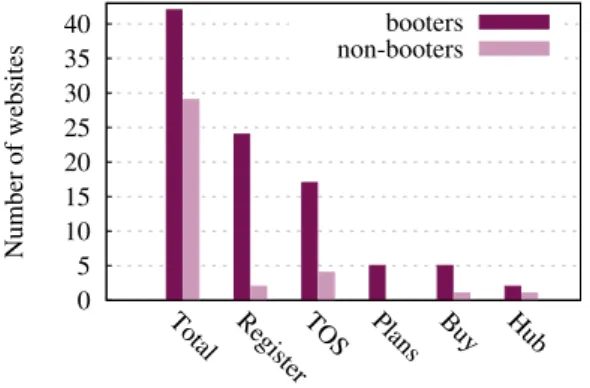
By in depth analysis of the indexed subpages of 71 potential Booters, it can be noticed that some page names appear more than once, such as “register”, “ToS”, “plans”, “buy”, and “hub”. The number of times those pages were observed is shown in Figure 3.4. Pages such as Terms of Service (ToS) and “registration” are more often appearing when analysing Booters. Almost 60% of Booters have a registration page (24/42) and around 40% of Booters have ToS page (17/42).
0 5 10 15 20 25 30 35 40
Total Register TOS Plans Buy Hub
Number of websites
booters non-booters
Figure 3.4: Page names analysis.
3.2.4 WHOIS analysis
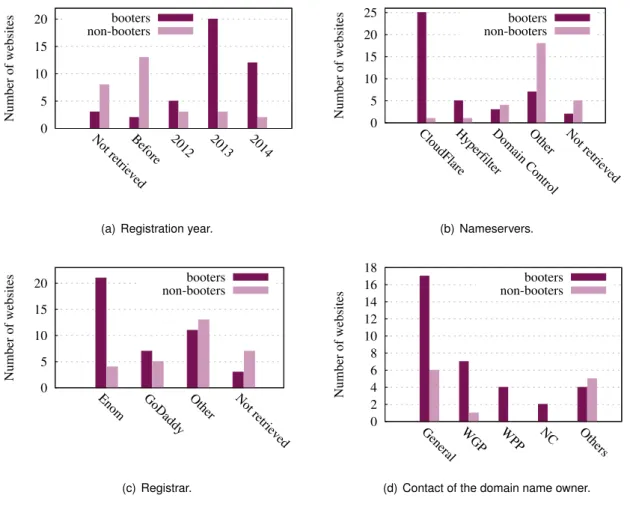
Next step is to analyse the WHOIS information of the 71 potential Booters retrieved by the crawler. The findings are presented in Figure 3.5.
0 5 10 15 20
Not retrievedBefore 2012 2013 2014
Number of websites
booters non-booters
(a) Registration year.
0 5 10 15 20 25
CloudFlareHyperfilterDomain ControlOther Not retrieved
Number of websites
booters non-booters (b) Nameservers. 0 5 10 15 20
Enom GoDaddy Other Not retrieved
Number of websites
booters non-booters (c) Registrar. 0 2 4 6 8 10 12 14 16 18
General WGP WPP NC Others
Number of websites
booters non-booters
(d) Contact of the domain name owner.
Figure 3.5: WHOIS information.
In Figure 3.5 four different types of information related to WHOIS are presented. From the first one, in Figure 3.5(a), it can be observed that more than 88% of the Booter domain names (37/42) were registered in 2012 (5), 2013 (20), and 2014 (12), whereas a bit less than half of the non-Booter websites were registered before 2012 (13/29). Overall, it shows that most of the Booters returned by the crawler are relatively new. By analysing the namesevers of the retrieved Booter domain names, showed in Figure 3.5(b), it is not surprising to observe that almost 60% of Booters (25/42) are associated to CloudFlare. It was already pointed out in [11] that Booter subscribe services from CloudFlare to be protected against DDoS attacks from the competitors (other Booters). However, a new company offering DDoS protection is observed, Hyperfilter. It is the first time that this company is observed in this phenomenon. Also in Figure 3.5(b), it can be confirmed that majority of non-Booters have more variety in nameservers (18/29).
3.2.5 Website content analisys
The website content can be analysed following several aspects: the textual content, the meta data, and the visual content. Below the mentioned aspects are analysed or commented on.
Website - textual content: Booters provide either scant login page with no other text than “user-name”, “password” and “login”, or they provide more detailed information about themselves. In the first case, the textual analysis seems not appealing: there is simply not much text to analyse. In the anal-ysed set more than half of Booters (22/42) provided such simple screen. Moreover, the textual content is usually analysed in order to determine the subject of the website [33, 34, 35]. This means, that choosing for text analysis, it would be possible to classify a website as a website about Booters, but not as a Booter itself. These two discouraging findings were not in favour of investigating the textual content, because of what this analysis was skipped.
Website - meta content: Looking into the meta data within the Booter websites, almost 62% (26/42) has neither description nor keywords, showed in Figure 3.6. This result is very similar and consistent with the simplicity of Booters visual interface (described in the previous section).
0 5 10 15 20 25
Without With
Number of websites
booters non-booters
Figure 3.6: Meta data.
It was also investigated what is the content of the meta fields of the websites which had either meta description or meta keywords (the remaining 16/42 Booters and 11/29 benign websites). The meta data was searched with regular expressions for words related to:
• Stress testing - e.g.stresser,stress testing,server stresser
• DDoS - e.g.ddos,attacks,rudy
• Gaming - e.g. xbox,ps3,minecraft
The keywords related to categories listed above did not distinguish Booters, e.g. only 13 Booters showed words related to stress testing, but also 5 of the non Booters had this kind of words. The same followed for DDoS category. Gaming-related words were more popular among benign websites. This shows again: that a lot of websites of similar subject have this type of meta data, like it was suspected it would be in case of textual content.
Concluding, it cannot be defined whether Booters or non-Booters tend to use meta data, and it cannot be said that Booters tend to use specific key words within the meta data. Therefore, although the meta data can help on the understanding the purpose of a website, because of insufficient information, this feature cannot be used to define if a website is a Booter or not.
Note that in theory meta data is fundamental to have a better positioning in search engines, such as Google Search. Therefore it is interesting to correlate the popularity of a Booter with the existence or not of meta data. To do so, the Alexa’s Rank5is used to get information about the 42 Booter webpages. By doing so, in general it could be observed that Booters with meta data have a higher ranking, for example in Table 3.2 two Booters are shown. Booter E that has meta data was ranked around the 273k
position, while Booter F had a thousand times lower position. Note that the highest Alexa’s Rank value is 1 (that usually has Google or Facebook).
Name Description KeywordsMeta data Alexa’sRank
Booter E Powerful and Affordable
Stress Testing
stresser, denial of service, dos, ddos, drdos, syn, ssyn, udp, sudp, udp-lag, rudy, slowloris, arme
272.979
Booter F -None- -None- 2.580.782
Table 3.2: Examples of Booter meta data and their popularity
Of course, meta data is not the only determining factor to have a higher ranking in the Internet. However, it is a positive surprise to observe a clear relation between both factors.
Website - visual content: As it was mentioned in Section 2.1, Booters tend to look alike. Among the 42 Booters described in this Section, the same notice was taken: that they have only two completely different types of first page: or (i) a very simple first page containing a simple login interface, for example showed in Figure 3.7(a), or (ii) a verbose page full of textual content and appealing advertisements, for example shown in Figure 3.7(b). For both types Booters provide a very simple and user-friendly interface. The most remarkable finding related to the visual interface was that while more than a half of Booters (22/42) has a “login” button in their main page only 1 non-Booter has such button.
(a) Booter F - login page. (b) Booter E - login page.
Figure 3.7: Examples of login pages.
The dataset explained in this section provided valuable information about Booter websites: what are the characteristics of these websites that could be used in order to automatically classify a website as a Booter. This manually classified set was used as a training dataset, and will be further validated on a larger dataset. The next section will summarize the most significant features describes in this section.
3.3 Most significant features of Booters
interface with a login button. Through those observations it is decided that the main features of Booter websites are:
1. Number of pages - less than 50.
2. Depth level of the website - maximum 2.
3. Presence of registration page.
4. Presence of terms of service page.
5. Domain creation time - 2012 and later.
6. Obfuscated WHOIS data.
7. Protected by a DPS.
8. Specific registrar - Enom.
9. Login button on page.
Using the mentioned features, a comparison of Booters and non-Booters will be done in the following sections, starting with similarity measure in the next chapter. The next section explains the dataset that these features were validated on.
3.4 Extending the dataset
The dataset used for validation is described in this section and was collected through the time: 15 November 2014 and 7 January 2015. The goal of these two sets is to have two disjoint sets, where the validation will not be biased by the “training” set. The data set used for validation consists of 31942 distinct URLs. This dataset will be used in Chapter 4 for validation. The amount of found URLs per search word was more or less the same through the whole time, as it can be observed on Fig. 3.8.
50
100
150
200
250
300
350
400
15-Nov
18-Nov
24-Nov
25-Nov
29-Nov
02-Dec
04-Dec
07-Dec
09-Dec
10-Dec
12-Dec
15-Dec
17-Dec
19-Dec
22-Dec
24-Dec
26-Dec
29-Dec
31-Dec
02-Jan05-Jan07-Jan
# of URLs
Date
Number of found URLs per search word
booter stresser ddosser ddos-for-hire ddos-as-a-service
Figure 3.8: The number of found URLs using Google Search function between 15 November 2014 and 7 January 2015