University of Warwick institutional repository: http://go.warwick.ac.uk/wrap
This paper is made available online in accordance with
publisher policies. Please scroll down to view the document
itself. Please refer to the repository record for this item and our
policy information available from the repository home page for
further information.
To see the final version of this paper please visit the publisher’s website.
Access to the published version may require a subscription.
Author(s): Davide Marenduzzo, Cristian Micheletti and Peter R. Cook
Article Title: Entropy-Driven Genome Organization
Year of publication: 2006
Link to published version:
Entropy-Driven Genome Organization
Davide Marenduzzo,* Cristian Micheletti,
yand Peter R. Cook
z*Mathematics Institute, University of Warwick, Coventry, United Kingdom;yInternational School for Advanced Studies (SISSA) and Istituto Nazionale Fisica della Materia (INFM), Trieste, Italy; andzSir William Dunn School of Pathology, University of Oxford, Oxford, United Kingdom
ABSTRACT
DNA and RNA polymerases active on bacterial and human genomes in the crowded environment of a cell are
modeled as beads spaced along a string. Aggregation of the large polymerizing complexes increases the entropy of the system
through an increase in entropy of the many small crowding molecules; this occurs despite the entropic costs of looping the
intervening DNA. Results of a quantitative cost/benefit analysis are consistent with observations that active polymerases cluster
into replication and transcription ‘‘factories’’ in both pro- and eukaryotes. We conclude that the second law of thermodynamics
acts through nonspecific entropic forces between engaged polymerases to drive the self-organization of genomes into loops
containing several thousands (and sometimes millions) of basepairs.
INTRODUCTION
Specific interactions between monomers (e.g., H-bonds) are
known to mediate biomolecular assembly. Paradoxically,
nonspecific entropic forces can also drive self-assembly.
Thus, the environment within a living cell is crowded, with
20–30% of the volume occupied by macromolecules (1,2);
then, aggregation of the largest particles can lower the free
energy of the system through an increase in entropy of the
many smaller particles (3). In Fig. 1
A
, the centers of mass of
the small spheres can access the yellow volume, but not the
gray volumes surrounding each large sphere or abutting the
perimeter wall. When one large sphere approaches another,
these excluded volumes overlap (Fig. 1
A
,
overlap volume 1
)
and this allows the small spheres to access a greater volume.
The resulting increase in entropy of the many small spheres
generates what has been called a ‘‘depletion attraction’’
between the large ones. The attractive energy at contact is
;
3/2(
D
/
d
)
n k
BT
, where
D
and
d
are the diameters of the
large and small spheres,
n
is the volume fraction of the small
spheres,
k
Bis the Boltzmann constant, and
T
is the absolute
temperature (3). The attraction falls to zero at a distance
d
between the two large spheres. A related attraction drives
a large sphere to the surrounding wall (Fig. 1
A
,
overlap
volume 2
). Enough is known about these attractions that they
are being used to model the formation of helices in proteins
(4) and position particles within man-made nanostructures
(5). The free-energy gains can be several
k
BT
, which can be
compared with the energy associated with a single van der
Waals interaction (
;
0.1
k
BT
), a single H-bond (
;
1.5
k
BT
, or
;
1 kcal/mol), and a covalent bond (10–100
k
BT
).
Here we describe how this depletion attraction might drive
genome organization. (For various models of genome
struc-ture, see Manuelidis (6), Cook (7), Sachs et al. (8), Marshall
et al. (9), Munkel and Langowski (10), Belmont (11),
Ostashevsky (12), and Kleckner et al. (13).) When DNA is
replicated or transcribed, the resulting polymerizing
com-plexes are large enough relative to the crowding agents that
they will tend to aggregate. We consider a range of different
complexes in bacteria and man, and in almost every case,
the depletion attraction is sufficient to explain the observed
organization—the clustering of active DNA and RNA
poly-merases into ‘‘factories’’ to form loops that may be several
millions of basepairs in length (14–17).
METHODS
The depletion attraction
We first review the original formulation of the entropic depletion attraction. Consider two hard (chemically noninteracting) spheres of diameter D dispersed in a solution of hard spheres of diameterd(usually the cased,D is considered). The center of mass of the small spheres is excluded from a shell surrounding the large spheres (Fig. 1 A). As one large sphere approaches the other, these excluded volumes overlap (Fig. 1A, overlap volume 1) and the small spheres can access a greater volume; there is a net free-energy gain due to the increase in the entropy of the small spheres. The minimum of this potential is attained when the two large spheres are in contact, and is given by Asakura and Oosawa’s formula (3)
D
F
gain¼
nk
BT
1
1
3
D
2
d
;
(1)
wherenis the volume fraction of small spheres,kBthe Boltzmann constant, andTthe absolute temperature. Eq. 1 is an approximation and applies to values ofnup to;30%; it then becomes less reliable untilDFchanges sign. If the two spheres are moved apart, the attraction declines progressively as the overlap volume falls. For values of Dand dused here, the average attraction in the range of full to zero overlap is approximately half that given by Eq. 1.
We now generalize to different and arbitrary shapes. The scale of the free energy gain depends significantly on the shape of the large objects. For Submitted November 12, 2005, and accepted for publication January 27,
2006.
Address reprint requests to P. R. Cook, Sir William Dunn School of Pathology, University of Oxford, South Parks Rd., Oxford, OX1 3RE, UK. Tel.: 44-0-1865-275528; Fax: 44-0-1865-275515; E-mail: peter.cook@ path.ox.ac.uk.
Ó2006 by the Biophysical Society
0006-3495/06/05/3712/10 $2.00 doi: 10.1529/biophysj.105.077685
example, Eq. 1 can be generalized to two different large spheres (3) with diametersD1andD2, whereD1.D2:
D
F
gain¼
nk
BT
1
1
3
D
1D
2d
ð
D
11
D
2Þ
:
(2)
A special case is that of a wall, in whichD1¼N; the overlap volume is larger than that with another sphere (Fig. 1A, compareoverlap volumes 1and2), so the resulting attraction is larger and given by
D
F
gain¼
nk
BT
1
1
3
D
2d
:
(3)
DFgainis even larger with a convex wall like a bacterial cell membrane (18). Most biological interactions involve nonspherical objects like ligands that fit snugly into irregularly shaped receptors. In the most general case, theory (3) predicts that the free-energy gain for irregular objects is
D
F
gain¼
6
p
nk
BT
V
overlapd
3;
(4)
whereVoverlapis the increase in volume available to the small objects. We approximate proteins and RNA here as spheres as they usually fold into globular structures.
‘‘Soft’’ beads
[image:3.603.59.290.57.284.2]Most situations we discuss involve interactions between polymerases bound to DNA, and individual enzymes are modeled as hard spheres. However, we also discuss interactions between two clusters of polymerases where each cluster contains many enzymes (e.g., DNA polymerases in replication factories). In such cases, the biology suggests that individual enzymes intermingle when the two clusters come into contact; we call these clusters ‘‘soft,’’ and allow individual hard spheres in one cluster to intermingle on contact with their counterparts in the other. The result is one large cluster with the combined volume of the two original ones. This problem is complicated by the large number of possible arrangements of individual spheres within a cluster, and of one cluster relative to the other. Therefore, we restrict analysis to simple limiting cases. At the coarsest level, each cluster can be treated as one macrosphere with volume (or surface) cor-responding to the total of all individual spheres. This approach is used for the ‘‘hard’’ gains in Fig. 2, rows 9–13. However, for Fig. 2, rows 3, 4, and 14 (hard gains), all polymerases are attached to DNA and a better model is obtained by considering the cluster ofNpolymerases as a linear (straight) succession of Nclosely packed beads; then, the free energy gained by putting two such clusters in longitudinal contact isNtimes the gain for two
FIGURE 1 The depletion attraction. (A) The schematic shows a suspen-sion of large and small spheres in a box. The shaded regions around the four large spheres are excluded to the center of masses of the small spheres. When one large sphere contacts another, their excluded volumes overlap (overlap volume 1) to increase the volume available to the small spheres (increasing their entropy); then, aggregation of the large spheres paradox-ically increases the entropy of the system. An analogous effect is found when a large sphere contacts the wall (2). The attraction can also be viewed as an osmotic phenomenon; small spheres cannot enter excluded volumes, and a force equivalent to their osmotic pressure acts on each side of the two touching large spheres to force them together (or on one side of the large sphere at the wall to force it to the wall). (B) Spheres bound to each end of a string will also tend to aggregate or associate with the wall, to loop the connecting string (which has an associated entropic cost). The type of overlap involved is indicated.
[image:3.603.322.538.288.643.2]individual beads. This holds if the polymer is very stiff (i.e., its persistence length is larger thanNtimes the diameter of a polymerase). If, on the other hand, the polymer is flexible, so that the cluster diameter is much larger than the persistence length (or if there are many individual spheres in one cluster), we allow individual spheres in one cluster to intermingle freely with their counterparts in the other (with the gain as in Eq. 5, below). This approach is used for the soft gains in Fig. 2, rows 3 and 9–14.
If the two clusters of large spheres (total diameter of each cluster¼D) are soft and can fuse to give one larger sphere of size 21/3D(i.e., with conservation of volume), the entropic gain is proportional to the gain in volume excluded to the small macromolecules. This gain is given by
D
F
gain¼
nk
BT
2
ð
D
1
d
Þ
3ð
2
1=3D
1
d
Þ
3d
3"
#
:
(5)
If spheres in the two clusters are allowed to intermingle, the overlap volume is considerable and the entropic gain now depends onD2/d2(Eq. 5); this compares withD/dfor hard spheres (Eq. 1).
Two beads on a string
We now come to the central case of interest here (Fig. 1B), which has not yet been analyzed: two large spheres threaded on a connecting (genomic) string. We assume the tethering string can be modeled as a polymer in a good solvent (19). Whether there is a net attraction between spheres depends on the balance betweenDFgain andDFloss, whereDFgainis the entropic attraction between spheres (given by Eq. 1 or 5 for hard or soft spheres, respectively) andDFlossis the entropic penalty that must be paid to loop the string. This loss arises due to the tethering constraint, and is well ap-proximated by (20,21):
D
F
loss¼
ck
BT
log
l
L
K1
D
F
r0:
(6)
The constant c has been the subject of debate between theoretical physicists (see Hanke and Metzler (20) and references therein) and depends on loop conformation; it typically increases with string density from 1.5 for an ideal random walk or freely jointed chain, through 2.2 for the ‘‘four-legged’’ loop as in Fig. 1B(22), to higher values if the density is very high (below).lis loop length, andLKis the (statistical) Kuhn length of the string.
DFr0is a constant that is independent of loop length; it is physically related to the dimensions of the overlap volume (and so to the diameter of the small spheres), and to the ranger0of (short) distances between the two beads that we consider sufficient to form a loop. DFr0 for self-avoiding walks is generally estimated by simulation and can be significant in the cases we consider. Note that we consider the looping costs of both a freely jointed chain (in bacteria) and a self-avoiding loop (in eukaryotes); costs for the latter have not been determined previously.
The entropic attractions between two free or tethered spheres differ qualitatively in an important respect. The most probable state for two untethered spheres is to lie apart as they diffuse in three-dimensional space, and the fraction of spheres that do pair—fpairing—can be found using the van’t Hoff relation (neglecting three and higher body interactions):
f
pairing¼
1
1
2
K
eqC
bffiffiffiffiffiffiffiffiffiffiffiffiffiffiffiffiffiffiffiffiffiffi
4
K
eqC
b1
1
p
2
KC
b;
(7)
whereKeqis the equilibrium constant of the reaction andCb is the con-centration of unbound large spheres. In contrast, two spheres threaded on a string can often be together if the interaction is large enough. Treating the thread as a freely jointed chain, we can calculate semianalytically the (‘‘looping’’) probability of finding the two within the overlap volume (Fig. 3A). This probability is found by weighing the probability of the two spheres being at a distancerthrough the depletion attraction (3). Even if the attractive interaction cannot bring the two spheres permanently together, it
can still ensure that the two pair for at least some finite time (tpairing, see below). This qualitative distinction can lead to large quantitative differences. For example, of the;8000 molecules of RNA polymerase (diameter;10 nm) in anEscherichia colicell (volume;0.8mm3(23)), we calculate (24) that only 2% are paired (i.e., fpairing¼0:02); this compares with the
essentially complete pairing of two sets of 70 threaded polymerases (Results and Discussion).
Examples
TheE. coligenome is modeled as a freely jointed chain—a succession of infinitely thin penetrable segments, each of lengthLKof 0.3 kbp (calculated assuming a persistence length forBDNA of 50 nm (25)). The eukaryotic chromatin fiber is modeled (26) as a self-avoiding tube (persistence length 40 nm or;3.6 kbp, assuming a packing of 1 kbp/11 nm). Note that the volume fraction,n, is known in bacteria but not in eukaryotes, whereas local DNA structure is known in eukaryotes but not in prokaryotes. As zig-zagging models have supplanted those involving 30-nm solenoids (27), tube diameter is set at 20 nm in eukaryotes to reflect a wider zig-zagging fiber that can interpenetrate to some extent.
[image:4.603.324.532.54.345.2]We model pro- and eukaryotic genomes differently mainly because the thickness/persistence length ratios are so different. In bacteria, there is no evidence of proteins bound stably to DNA, and DNA diameter (;2.5 nm) is FIGURE 3 Dependence of looping on attractive energy, chain length, and sphere diameter. Cartoons illustrate forms existing under different condi-tions. See Methods for details. (A) Probability of forming loops at different attractive energies (inkBT). Structures modeled are two large beads (D¼ 10 nm) connected by freely-jointed chains of different lengths; a loop is considered to exist if sphere surfaces lie within 5 nm. Sharp transitions between unbound (unlooped) and bound (looped) states occur within;5 kBT. (B) Effects of minimum diameter (D) of large spheres and length of freely-jointed chain on looping; lines mark transitions between unlooped and looped forms for hard and soft spheres.
3714 Marenduzzo et al.
smaller than persistence length (;50 nm); therefore, it seems appropriate to neglect thickness and use the analytically tractable freely jointed chain. In eukaryotes, we know that DNA is folded first into nucleosomes and then into higher-order structures; as a result, diameter (20 nm) is a significant fraction of persistence length (40 nm) and it seems more appropriate to use the tube model (which includes self-avoidance, but is less tractable analytically). Self-avoidance is included by ensuring that all circles going through any triplet of points taken along the tube center-line have radii larger than half the tube thickness (26). Calculation of looping costs requires Monte Carlo simulations, as existing theory does not enable us to computeDFr0 analytically. To calculate the looping probability, we adapt the method used previously to determine the probability that a point on a loop attached to one sphere might bind to a specified binding zone on the surface of that sphere (26). Here, we have two beads attached to each end of a flexible tube. We fix the position of the center of one bead, divide the surrounding volume into concentric shells of increasing radii, and compute for each pair of contiguous shells the conditional probability that the other end of the tube is found in the inner of these two shells, given that it is constrained to lie within the outer of the two shells.
In Fig. 2, values forDFlossinE. colifor equivalent structures tend to be higher than those for man. This arises for two reasons. First, bacterial DNA is less compact (above), so loops are longer (giving a higher entropic cost); if it proves to be more condensed, values forDFlosswill be smaller. Second, the beads tend to have smaller diameters in bacteria, so values for
[image:5.603.327.531.55.321.2]DFr0—which depend on the range of distances between the two beads considered sufficient to form a loop—tend to be larger; they were 5.7kBTin Fig. 2, rows 3–5 and 7 (calculated assuming a depletion attraction in the range 10–15 nm between sphere centers), 3.2kBT, 3.5kBT, and 3.5kBT (assuming a range of 43–48 nm, 37–42 nm, and 37–42 nm) in Fig. 2, rows 6, 8, and 9, respectively. In Fig. 2, rows 11–17, we assumed interaction in the range between sphere centers of 30–35, 30–35, 75–80, 25–30, 25–30, 40–45, and 25–30 nm, respectively, and calculated the entropic loss via Monte Carlo simulations (26).
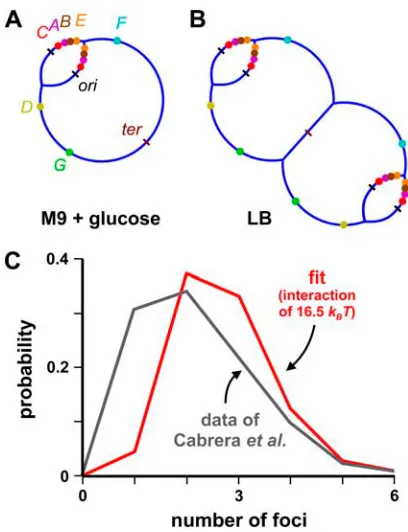
For Fig. 2, rows 3 and 4, the distance betweenrrnoperons is genome length (i.e., 4.6 Mbp) divided by operon number (i.e., 7). In LB, there are ;70 polymerases per operon (23), andDFgainis calculated assuming either that 70 closely packed impenetrable spheres lie in straight lines at each end of a 650-kbp thread (for hard), or that each one of the 70 hard spheres at one end can intermingle with any other sphere (for soft). These two extremes correspond to very stiff and very flexible threads, respectively, and the real situation is likely to lie in between. In contrast to other cases, here the gain given by the soft cluster (which is proportional to the number of polymerases exposed to the solvent on the surface) is smaller than that given by hard polymerases. For Fig. 4C, we consider the topology in Fig. 4B, and calculate the probabilities that different operons cluster together intoffoci (wherefis between 1 and 22). To make the problem tractable, we assume the following. 1), An observable focus corresponds to one operon (or more), with each associated with 70 polymerases tagged with green fluorescent protein (GFP) (note that 70% polymerases are engaged onrrnoperons (23)). 2), Neighboring operons cluster first, the next nearest neighbor is then added to the cluster, and so on. 3), We compute the separate probabilities of having fifoci for the four arms in the network (i.e., two arms containingrrnC, A,B,E,F,G,D and two with rrnC,A,B,E). Via the convolution of these quantities, we can find the probabilities of the whole system havingffoci. 4), Operons are connected by a freely jointed chain (asDFr0can be calculated exactly). We also assume a not-further-specified interaction between active operons, calculate the probability of observingffoci (withf¼0–6 (28)), and adjust the interaction to fit the data. We have repeated the calculation assuming that two operons must be in the same site to be detected as a focus and found a slightly smaller value for the interaction (i.e., 13kBTinstead of 16.5 kBT). For Fig. 2, rows 5–8, average spacings between active polymerases are from M. Bon, S. McGowan, and P. R. Cook (unpublished). For Fig. 2, rows 5 and 7, a gain of 0.8kBTis nevertheless sufficient to increase the time spent together by 30%; the gain also doubles if transcripts are included as 10-nm hard spheres. If we model each polymerase,
transcript, plus associated ribosomes as one 10-nm hard sphere (the poly-merase) plus coplanar contacting hard spheres (diameter 21 nm) repre-senting ribosomes, the gain increases by 1.46 kBTfor each ribosome (estimated by considering the configuration where the two planar clusters are stacked in register so that equal-sized spheres are in contact).
For Fig. 2, row 9, we consider slowly growing cells with only two forks (as in Fig. 4A); the entropic cost of looping is given by
D
F
loss¼
3
=
2
k
BT
log
l
ð
L
l
Þ
2
L
l
;
(8)
wherelandL(expressed in Kuhn lengths) denote distance between forks and total genome length, respectively. The cost in Eq. 8 is that to make one loop, as joining the two forks only creates one extra loop. Eq. 8 is valid for 1lL, and has been derived by first writing down the probability that three distinct freely jointed chains (of lengthl,l, andL2l) have the same initial and final point, which we call~xand~yrespectively, and then by taking the limit~/x ~yof this quantity.
same volume as the 25 spheres. The gain is given by the maximum over hin the range [0,D] of the function:
f
ð
h
Þ ¼
3
nk
BT
D
22
h
2
3
D
33
h
d
2:
(9)
On the other hand, confining one of the forks in the topology of Fig. 4A to a distancex0from the wall costs some entropy, which if the chain is a freely jointed chain reads (lL, and bothLandlare much larger than 1, with erf denoting the error function):
n
¼
l
ð
L
l
Þ
2
L
l
;
(11)
wherex0,l, andLare all measured in Kuhn lengths. To arrive at Eq. 10, we calculated the probability of having a network of freely jointed chains with the topology in Fig. 4 A, integrating over the intermediate points and requiring that this freely jointed network is rooted at a point. (The axes are such that the bacterial surface lies atz¼0.) The exact entropic cost in Fig. 2, row 10, is computed assuming that the network is displaced fromx0¼250
nm (the center of the cell) to within the range of the entropic attraction to the surface. The calculations leading to Eq. 10 are cumbersome but straight-forward and are omitted here.
For Fig. 2 rows 14–17,DFgainis found as for rows 3–8. For row 17, we model each polymerase, transcript, and spliceosome as three coplanar contacting hard spheres (a 15-nm polymerase, 20-nm transcript plus bound proteins, and 24-nm spliceosome). The free-energy gain is estimated by considering the configuration where the two planar clusters are stacked in register (so that equal-sized spheres are in contact). For rows 15–17, the entropy gain is less than the loss due to looping, and so is insufficient to ensure that the two transcription units are always together. However, the interaction is sufficient to drive a temporary association, which keeps the two together for a time,tpairing, which can be estimated using Kramer’s theory (25) applied to the potential resulting from the radial integration of the entropy depletion interaction (3), complemented with a Morse potential that forbids the two large spheres to interpenetrate more than 0.1 nm. The resulting expression is
t
pairingt
0exp
D
F
gaink
BT
:
(12)
For large spheres with a diameter of 10–20 nm,t0is typically;5ms. This estimate is based on the assumptions that the friction experienced obeys Stokes’ law and the viscosity of the cell interior (h) is;10 centipoise (29,30). Applied to the case in Fig. 2, row 17, Eq. 12 provides an estimate for
tpairingof 0.3 ms. We now consider cooperative effects as three large spheres
cluster (Fig. 5C). It appears natural to assume that the activation free energy leading to the breaking of the cluster involves the loss of two contacts at a cost of;8kBT. The estimated lifetime for the cluster is therefore;0.1 s. Since the viscosity of the cell interior grows rapidly with particle size.;25 nm (29,30), this estimate (based on a nominal value forh) provides a lower bound for pairing time. We conclude that pairing lasts for a nonnegligible fraction of the;5 min it takes to transcribe a typical human gene (31).
For Fig. 5,AandB, we model each mRNA-producing complex as three coplanar, contacting, hard spheres (a 15-nm polymerase, 20-nm transcript plus bound proteins, and 24-nm spliceosome), although each triplet is represented as one bead in the figure. The simulation began with a linear string, the (final) attraction between any two triplets is modeled as a two-body square well with a width of 5 nm and minimum equal to 4kBT(Fig. 2, row 17). In Fig. 5B, the string was first compacted using an initial interaction of 8kBT.
RESULTS AND DISCUSSION
The small crowding molecules in the cell have diameters (
d
)
of
;
5 nm, and a volume fraction (
n
) of
;
0.2; these
[image:6.603.126.550.203.317.2]commonly accepted values (1,32) will be used throughout,
except for one extracellular case—the 100-mers (below). In
Fig. 2, various cases are listed according to their complexity;
FIGURE 5 Cooperative effects. See Methods for details. (AandB) Monte Carlo simulations of 21 beads (green, terminal beads;red, internal ones) threaded every 20 kbp along a (self-avoiding) 0.4-Mbp chromatin fiber (blue). Each bead represents three spheres (15-nm RNA polymerase II, 20-nm transcript, 24-nm spliceosome). Starting with a linear string, fiber segments are allowed to diffuse while being subjected to an attraction between any two beads of 4kBT(Fig. 2, row 17). In panelB, the string was first compacted using an initial interaction of 8 kBT. After reaching equilibrium, typical structures are visualized using RasMol software. The numbers of beads in each cluster are indicated, which in both panelsAandB is more than the approximately five expected in the absence of cooperative effects (from Fig. 2,row 17, calculated as for Fig. 3 A). (C) Trade-off between entropic gains and losses. When two complexes pair, the entropic gain involves one overlap volume (Fig. 1A) relative to the cost of forming one loop. Adding a third involves two more overlap volumes but only one more looping cost; adding a fourth involves three more overlap volumes but only one more looping cost. Adding more beads is progressively less favored as crowding increases the looping cost; moreover, entanglement becomes significant with more than around eight beads (52), and this limits the maximum number of beads in a cluster.
exp
ð
D
F
lossÞ ¼
erf
x
0ð
2
n
=
3
Þ
1=2!
1
exp
x
201
n
n
ð
L
l
Þ
2erf
x
0n
1=2ð
2
=
3
Þ
1=2ð
L
l
Þ
!
1
exp
x
201
n
n
2
l
1
L
l
erf
x
0n
1=2ð
2
=
3
Þ
1=22
l
1
L
l
!
:
(10)
3716 Marenduzzo et al.
[image:6.603.315.544.356.504.2]each example is accompanied by an estimate (the ‘‘gain’’) of
how much the free energy is lowered upon contact of the
large spheres.
Sphere/sphere interactions
Actin
To put our analysis in context, we first consider a simple
example—the polymerization of two actin monomers. The
major energy source driving actin polymerization comes
from ATP hydrolysis; however, calculation shows that the
depletion attraction makes a contribution even though it
cannot provide directional assembly (which must be
deter-mined by other factors). Modeling monomers as
noninter-acting hard spheres (
D
¼
5 nm) in the presence of many
small spheres (
d
¼
5 nm,
n
¼
0.2) gives an entropic gain (i.e.,
D
F
gain) of
;
0.5
k
BT
(Fig. 2,
row 1
), compared to a measured
free-energy change of 1–2
k
BT
(33,34). We conclude that the
depletion attraction adds to other specific ones between
molecules, and we will argue that the same is true of the
cases discussed below. We can then calculate (using
Kramer’s theory) that monomers remain paired for three
times longer in the presence of crowding molecules (see
Methods).
Prebiotic RNA genomes
We now consider two of the simplest genomes. Current
theories for the evolution of life involve RNA molecules able
to catalyze their own synthesis (35,36). But in this ‘‘RNA
world’’ lacking cell membranes, how are the critical
compo-nents prevented from diffusing apart to maintain the high
local concentrations necessary for continued evolution?
Possible solutions include binding to charged surfaces, and
capture within a confined space (e.g., a hydrothermal vent, a
puddle on a charged surface). However, the depletion
attraction could contribute. Thus, modeling two 100-mers
of RNA as 4-nm spheres in a crowded solution of smaller
molecules (
d
¼
1 nm,
n
¼
0.2) gives an attraction (gain) of
;
1.4
k
BT
(Fig. 2,
row 2
). Here, too, pairing lasts roughly three
times longer than in the absence of the depletion attraction.
Two beads threaded on a string
We now turn to the central case of interest here, where the
two large spheres are threaded on a string; the spheres
represent active polymerases and the string hydrated DNA
(in prokaryotes) or a chromatin fiber (in eukaryotes). It is
well known that specific interactions between spheres can
drive genome looping. Thus, if two DNA-binding proteins
present at
;
1 nM interact together with a
K
dof 10
7M
(values typical for nuclear proteins),
,
1% will be complexed
together in the absence of DNA (37). But if they bind to the
same DNA molecule at sites 10 kbp apart, the resulting local
concentration ensures that two-thirds will be in the complex
to loop the connecting DNA (37). Our central thesis here is
that the nonspecific depletion attraction can also make a
sig-nificant contribution in the crowded cell (Fig. 1
B
). Whether
aggregation occurs depends on the balance between the
de-pletion attraction (i.e.,
D
F
gain; Eq. 1 in Methods) and
D
F
loss(the entropic penalty that must be paid to loop the connecting
string). This loss is well approximated by
ck
BT
log(
l/L
K)
1
D
F
r0(Methods). The constant
c
depends on loop
conforma-tion; it typically increases with string density from 1.5 for an
ideal random walk or freely jointed chain, through 2.2 for the
four-legged loop as in Fig. 1
B
(22), to higher values if the
density is high.
l
is loop length, and
L
Kthe Kuhn length (a
measure of string stiffness). Notice that we include
self-avoidance in the case of the thick eukaryotic string (i.e., no
two segments of the fiber are allowed to occupy the same
volume).
D
F
r0is a constant that is independent of loop
length; it is physically related to the dimensions of the
over-lap volume and the range
r
0of distances between the two
beads considered sufficient to form a loop (in our case
#
5
nm). In the cases modeled here, the spheres are polymerases
that remain irreversibly bound to their templates while
active.
Two free (untethered) spheres in a crowded cell will
diffuse in three-dimensional space and spend little time
together, and the extent of the small paired fraction can be
determined using van’t Hoff’s relation (Eq. 7 in Methods). If
the two spheres are tethered to each other, the inevitable high
local concentration plus depletion attraction ensure that
the paired fraction is greater. The (looping) probability of
finding the two spheres close enough together for their
excluded volumes to overlap is illustrated in Fig. 3
A
, which
gives results for a freely jointed chain. (Similar results (not
shown) are found for self-avoiding and worm-like chains
(which differ by the presence of a nonzero stiffness
pa-rameter (25)).) Sharp transitions are seen between the
unbound (unlooped) and bound (looped) states with chains
of different lengths. The diameter of the large spheres (
D
)
and length of connecting string are important determinants of
whether or not a loop forms (Fig. 3
B
); above the upper
(
orange
) line, two spheres will eventually come together to
form a loop. As before, the time the two spend together can
be estimated using Kramer’s theory (Methods).
‘‘Soft’’ beads
one cluster to intermingle on contact with their counterparts
in the other. The result is one large cluster with the combined
volume of the two original ones. Intermingling ensures that
the overlap volume is considerable, and the entropic gain
now depends on
D
2/
d
2(Eq. 5 in Methods), compared to
D
/
d
for hard spheres (Eq. 1 in Methods). As a result, soft clusters
are more likely to come together to form a loop, and smaller
diameters are needed to ensure looping (Fig. 3
B
,
lower red
line
). These two cases (hard and soft) represent extremes;
true values are likely to lie between the two, and
(conser-vatively) we generally consider here the former.
Tunable interactions
The transition to the looped form occurs over a narrow
free-energy range of
;
10
k
BT
(Fig. 3
A
), roughly equivalent to
;
7 H-bonds. It then might be advantageous for the cell to
ensure that DNA-binding complexes are of a size that can
exploit this transition (e.g., by creating or destroying only a
few H-bonds). The depletion attraction puts an upper limit on
the size of complexes that permit such tuning; if too large
(i.e., with diameters of
;
100 and 40 nm for hard and soft
clusters, respectively), Fig. 3
B
shows that there is a good
chance they will always aggregate to give loops. As we shall
see, Nature seems to set diameters so that the resulting
depletion attraction lies in this tunable range.
This prompts the question: why do not all complexes in
the cell—whether tethered or not—end up in one aggregate?
(The fraction in the aggregate can be found using Eq. 7 and
Fig. 3 for untethered and tethered components, respectively.)
We suggest that they will do so if the concentration of
com-ponents is high enough—for example, with hemoglobin S in
the red cells of patients with sickle cell anemia (38), and with
over-expressed proteins in bacteria (which sometimes form
inclusion bodies). Where both the concentration and scale of
the depletion effect are large enough to form aggregates, but
where experimental observations yield no evidence of
ag-gregation, it also seems likely that energy from other sources
must be spent to prevent aggregation.
Examples
Bacterial rrn operons
The genome of
E. coli
encodes 7
rrn
operons separated on
average by
;
650 kbp (Fig. 4
A
). In Luria broth (LB)—a rich
medium supporting division every 30–45 min—demand for
rRNA is high;
;
70% of the RNA polymerase in the cell
transcribes one or other of these operons, and each
rrn
operon is associated with
;
70 active enzymes (23). As an
origin (
ori
) often fires and refires before genome segregation,
a cell typically has a genome structure like that in Fig. 4
B
,
with
;
22 active
rrn
operons (23). Treating each polymerase
as a hard sphere (
D
¼
10 nm), and each operon as a linear
string of 70 closely packed spheres, we find that the entropic
attraction (i.e.,
D
F
gain) between two operons significantly
exceeds the penalty that must be paid to loop the
interven-ing DNA (i.e.,
D
F
loss; Fig. 2,
row 3
). (Including nascent
transcripts (average length
;
2500 nucleotides, or half the
length of the completed transcript) as spheres (
D
¼
10 nm)
attached to polymerases ensures that the attraction is even
higher (not shown).) This suggests that entropy depletion
in-evitably drives two active operons together.
In a nutrient-poor media like M9
1
glucose, cells divide
every 90–170 min and biosynthetic capacity switches away
from ribosome genesis; the genome structure is like that in
Fig. 4
A
, and each
rrn
operon now associates with only about
four polymerases (23). As a result, the loss due to looping
outweighs the gain (Fig. 2,
row 4
), and
rrn
operons are
unlikely to be together.
These results are consistent with experimental data (28).
Tagging with the GFP reveals that in LB the polymerases (and
so the
;
22 operons to which
;
70% are bound) are clustered
in one to six foci that disappear on transfer to M9
1
glucose.
The distribution of foci in LB (28) can be fitted assuming that
there is an attractive interaction of
;
16.5
k
BT
between each
operon (Fig. 4
C
); this compares with the value we calculate
for the (maximum) attraction of 31-56
k
BT
(Fig. 2, row 3).
Bacterial open reading frames
Engaged RNA polymerases are scattered every
;
24 and
;
8.6
kbp along the bacterial genome in LB and M9, respectively
(M. Bon, S. McGowan, and P. R. Cook, unpublished). If we
include only the polymerase, the gain is insufficient to
over-come the cost and so unlikely to bring two lone and adjacent
polymerases together (Fig. 2,
rows 5 and 7
). However,
trans-lation occurs cotranscriptionally, so
;
10 (in LB) or 6
ri-bosomes (in M9 (23))—each with a diameter of
;
21 nm—are
typically attached to the nascent transcript (length
;
500
nucleotides, equivalent to half that of a typical mRNA); this
increases the gain so it now roughly equals the cost (Fig. 2,
rows 6 and 8
), and adjacent polymerases are likely to be
together much of the time. (Treating ribosomes as soft spheres
and including cooperative effects (below) increases
clus-tering even further.) Unfortunately, we currently lack
exper-imental data to confirm this prediction.
Bacterial replication factories
GFP-tagging shows that active DNA polymerases in living
bacteria are concentrated in discrete factories containing at
least 25 polymerases often associated with the cell
mem-brane (39,40). We model a cluster of 25 polymerases at a
fork as one 37-nm hard sphere. Soon after initiation in a poor
medium (when little intervening DNA has been replicated),
the gain (2.4
k
BT
) is greater than the loss due to looping (not
shown), and we would expect the two forks to be together.
But as replication generates more DNA between forks, the
loss increases to a maximum of 15.5
k
BT
(Fig. 2,
row 9
),
when we would expect the two forks to have separated. It has
3718 Marenduzzo et al.
been shown experimentally that the two forks do indeed
separate when
;
30% of the genome has been replicated
(40), and we calculate that a looping cost of 11
k
BT
balances
the gain at this stage. This lies between values predicted for
hard and soft spheres (i.e., 2.4 and 16.9
k
BT
), so the depletion
attraction can alone account for the observed dynamics with
reasonable accuracy. It can also force spheres to associate
with the membrane for some time (Fig. 2,
row 10
).
There-fore, it provides a good explanation of why the two forks
separate when they do, and their location. However, we would
also expect that later the forks would aggregate again as they
converge toward the terminus (when looping costs decrease);
this is not observed experimentally (40), presumably because
the segregation machinery prevents it.
Human replication factories
Replication begins at origins scattered every 50–100 kbp
along a human chromosome, and several pairs of the resulting
replication forks are clustered in small replication factories
(diameter
;
75 nm); on passage through S phase, these
facto-ries grow into enormous structures (diameter
;
1000 nm)
containing thousands of forks (14). As in bacteria, the entropic
gain is greater than the loss immediately after initiation, when
little replicated DNA lies between forks (not shown), so forks
will be together (Fig. 2,
row 11
). Again as before, the loss due
to looping increases to a maximum as more DNA is replicated
(Fig. 2,
row 11
); therefore, forks are likely to separate. Even
so, the gain is still sufficient to allow dynamic interactions
lasting seconds (Methods). Moreover, if the clusters at forks
are soft, they should remain together as the gain exceeds the
loss (Fig. 2,
row 11
). The same applies to two origins that have
just fired (Fig. 2,
row 12
), and to two distant factories (Fig. 2,
row 13
). We conclude that the depletion attraction is sufficient
to bring together forks, active origins, and even factories
sep-arated by 1 Mbp—as is seen. Moreover, as more origins fire,
we would expect them to aggregate with existing clusters—as
they do.
Human rDNA genes
Each of the 10 loci encoding rRNA in the diploid human
genome contains
;
80 tandem repeats, each with an
;
13-kbp transcription unit and an
;
30-kbp ‘‘spacer’’;
;
100
RNA polymerase I complexes transcribe each active unit in
the array. Active
rDNA
genes—but not inactive ones—
aggregate to form nucleoli (41). As the cluster of active
polymerases is so large and the spacer so short, the entropic
gain due to the depletion attraction far outweighs the loss due
to looping, and adjacent transcription units will inevitably
aggregate (Fig. 2,
row 14
). Once again, the attraction can
account for the organization seen.
Human open reading frames
RNA polymerase II transcribes most human genes. In a HeLa
cell, the active enzyme is concentrated in nucleoplasmic
factories, each containing about eight active enzymes
engaged on a different transcription unit (14,15). As RNA
processing occurs cotranscriptionally (42), each
mRNA-producing complex typically contains a polymerase
(diam-eter
;
15 nm), a nascent transcript (average length of
;
8400
nucleotides (43)) with compacted diameter
;
14 nm plus its
bound proteins, and attached capping, splicing (one
sub-complex has dimensions of 27
3
22
3
24 nm (44)) and
polyadenylation machineries. Modeling such complexes as
25- or 40-nm hard spheres gives a
D
F
gainslightly less than
D
F
loss(Fig. 2,
rows 15 and 16
), so they will be paired
between 1% and 5% of the time (Methods). Modeling the
polymerase, transcript, and spliceosome as three hard spheres
(a 15-nm polymerase, 20-nm transcript plus bound proteins,
and 24-nm spliceosome) ensures that they are paired 12% of
the time. Thus, this simple model (in which the size of the
polymerizing complex is almost certainly underestimated)
also explains why active genes tend to cluster.
Many beads on one string: cooperative effects
We now consider 21 beads (each representing one
mRNA-producing complex) threaded every 20 kbp along a 0.4 Mbp
of an active region of the human genome. Using Monte Carlo
methods (Methods), we model an attraction of 4
k
BT
between
beads (Fig. 2,
row 17
); simulations yield two populations
with energy minima depending on the approach used. Starting
with a linear string, segments diffuse to give structures with
;
30% beads in clusters (Fig. 5
A
). If the string is first
com-pacted (a more likely representation of what happens in
vivo),
;
80% are in clusters (Fig. 5
B
). This compares with
the
;
12% found above. We attribute most of the extra
clus-tering to cooperative effects arising from the nonlinear
in-crease in number of overlap volumes as more and more beads
join a cluster (Fig. 5
C
). Two factors may further increase
clustering: the mRNA-producing complex is probably larger
than we model, and—once such large structures come
together—the high nucleoplasmic viscosity will slow
diffu-sion apart (Methods). These results reinforce the idea that the
depletion attraction contributes to the observed clustering
and looping; moreover, similar cooperativity should be seen
with all other strings discussed.
CONCLUSIONS
(e.g., involving H-bonds, electrostatic interactions) that also
position monomers precisely.
Our results help explain several aspects of genome
organization. First, we predict that active (but not inactive)
genomes will inevitably be looped, and they are (14,15,17).
For example, old evidence shows that loops are present in
active cells (from bacteria to man) but not in inactive ones
(e.g., chicken erythrocytes, human sperm); moreover, loops
are lost progressively as active chicken erythroblasts mature
into inactive eythrocytes (45). Recent evidence also shows
that three mouse genes spaced
;
10 kbp and
;
15 Mbp apart
on the genetic map are attached to one factory when
transcribed (with consequential looping), but not when
inactive (46). Moreover, inhibiting transcription in living
pro- and eukaryotes disperses their DNA (47–49),
presum-ably by releasing loops. Second, we can explain why
bacterial replication forks initially lie together before
sepa-rating (40), and why bacterial and eukaryotic replication
complexes tend to be found at the cell membrane or in
factories (14,39). Third, we can predict the fraction of
bacterial
rrn
operons found together in transcription factories
(28) with reasonable accuracy, and why—in eukaryotes—
active RNA polymerases I and II cluster in nucleoli and
nucleoplasmic factories (Cook, 1999). (It is likely that
energy must be spent to prevent polymerase I factories from
aggregating with polymerase II factories.) These results are
consistent with a model for genome organization in which
active RNA polymerases cluster to loop the intervening
DNA (15).
Our approach can readily be extended to other aspects of
genome and cellular organization. For example, the
inter-actions discussed here occur independently of scale. Then
we can model local effects (e.g., the aggregation of hard
nucleosomes into a soft cluster to form a chromatin fiber,
with the depletion attraction augmenting electrostatic
inter-actions (50)) as well as global ones (e.g., the aggregation of
heterochomatic clumps as chromosomes condense during
mitosis). Moreover, we deliberately consider only one string
here to simplify analysis; nevertheless, it is easy to imagine
that the depletion attraction drives the formation of nucleoli
and chromocenters (as active
rDNA
genes or centromeric
heterochromatin on different chromosomes aggregate), as
well as the pairing of meiotic chromosomes (as homologous
transcription complexes aggregate (51)). Finally, the
deple-tion attracdeple-tion probably contributes to the formadeple-tion of many
other large structures in cells (e.g., inclusion bodies,
inter-chromatin granule clusters), and—where large structures
like the cytoskeleton do exist—energy must be spent to
counteract the attraction from driving them into one large
aggregate.
We thank Michae¨l Bon and Ngo Toan for help.
We thank the Engineering and Physical Sciences Research Council for financial support.
REFERENCES
1. Ellis, R. J. 2001. Macromolecular crowding: obvious but underappre-ciated.Trends Biochem. Sci.26:597–604.
2. Minton, A. P. 2001. The influence of macromolecular crowding and macromolecular confinement on biochemical reactions in physiological media.J. Biol. Chem.256:10577–10580.
3. Asakura, S., and F. Oosawa. 1958. Interactions between particles suspended in solutions of macromolecules. J. Polym. Sci. [B]. 33: 183–192.
4. Snir, Y., and R. D. Kamien. 2005. Entropically driven helix formation. Science.307:1067.
5. Yodh, A. G., K. H. Lin, J. C. Crocker, A. D. Dinsmore, R. Verma, and P. D. Kaplan. 2001. Entropically driven self-assembly and interaction in suspension.Philos. Trans. R. Soc. Lond. A.359:921–937. 6. Manuelidis, L. 1990. A view of interphase chromosomes. Science.
250:1533–1540.
7. Cook, P. R. 1995. A chromomeric model for nuclear and chromosome structure.J. Cell Sci.108:2927–2935.
8. Sachs, R. K., G. van den Engh, B. J. Trask, H. Yokota, and J. Hearst. 1995. A random-walk/giant-loop model for interphase chromosomes. Proc. Natl. Acad. Sci. USA.92:2710–2714.
9. Marshall, W. F., J. C. Fung, and J. W. Sedat. 1997. Deconstructing the nucleus: global architecture from local interactions.Curr. Opin. Genet. Dev.7:259–263.
10. Munkel, C., and J. Langowski. 1998. Chromosome structure predicted by a polymer model.Phys. Rev. E.57:5888–5896.
11. Belmont, A. S. 2002. Mitotic chromosome scaffold structure: new approaches to an old controversy. Proc. Natl. Acad. Sci. USA. 99: 15855–15857.
12. Ostashevsky, J. 2002. A polymer model for large-scale chromatin organization in lower eukaryotes.Mol. Biol. Cell.13:2157–2169. 13. Kleckner, N., D. Zickler, G. H. Jones, J. Dekker, R. Padmore, J. Henle,
and J. Hutchinson. 2005. A mechanical basis for chromosome function. Proc. Natl. Acad. Sci. USA.101:12592–12597.
14. Cook, P. R. 1999. The organization of replication and transcription. Science.284:1790–1795.
15. Cook, P. R. 2002. Predicting three-dimensional genome structure from transcriptional activity.Nat. Genet.32:347–352.
16. Chambeyron, S., and W. A. Bickmore. 2004. Does looping and clustering in the nucleus regulate gene expression?Curr. Opin. Cell Biol.16:256–262.
17. West, A. G., and P. Fraser. 2005. Remote control of gene transcription. Hum. Mol. Genet.14:R101–R111.
18. Roth, R., B. Go¨tzelmann, and S. Dietrich. 1997. Depletion forces near curved surfaces.Phys. Rev. Lett.83:448–451.
19. Marko, J. F., and E. D. Siggia. 1997. Polymer models of meiotic and mitotic chromosomes.Mol. Biol. Cell.8:2217–2231.
20. Hanke, A., and R. Metzler. 2003. Entropy loss in long-distance DNA looping.Biophys. J.85:167–173.
21. Carlon, E., E. Orlandini, and A. L. Stella. 2002. Roles of stiffness and excluded volume in DNA denaturation. Phys. Rev. Lett. 88: 198101.
22. Metzler, R., A. Hanke, P. G. Dommersnes, Y. Kantor, and M. Kardar. 2002. Equilibrium shapes of flat knots.Phys. Rev. Lett.88:188101. 23. Bremer, H., and P. P. Dennis. 1996. Modulation of chemical
composition and other parameters of the cell by growth rate. In Escherichia coliandSalmonella typhimurium: Cellular and Molecular Biology, 2nd Ed. F. C. Neidhardt, R. Curtiss, E. C. C. Lin, K. Brooks Low, B. Magasanik, W. S. Reznikoff, M. Riley, M. Schaechter, and H. E. Umbarger, editors. ASM Press, Washington, DC. 1553–1569. 24. Atkins, P. W. 1999. Physical Chemistry. Oxford University Press,
Oxford, UK.
25. Daune, M. 1999. Molecular Biophysics: Structures in Motion. Oxford University Press, Oxford, UK.
3720 Marenduzzo et al.
26. Bon, M., D. Marenduzzo, and P. R. Cook. 2006. Modeling a self-avoiding chromatin loop: relation to the packing problem, action-at-a-distance, and nuclear context.Structure.14:197–204.
27. Woodcock, C. L., and S. Dimitrov. 2001. Higher-order structure of chromatin and chromosomes.Curr. Opin. Genet. Dev.11:130–135. 28. Cabrera, J. E., and D. J. Jin. 2003. The distribution of RNA polymerase
inEscherichia coliis dynamic and sensitive to environmental cues. Mol. Microbiol.50:1493–1505.
29. Seksek, O., J. Biwersi, and A. S. Verkman. 1997. Translational diffusion of macromolecule-sized solutes in cytoplasm and nucleus. J. Cell Biol.138:131–142.
30. Luby-Phelps, K. 2000. Cytoarchitecture and physical properties of cytoplasm: volume, viscosity, diffusion, intracellular surface area.Int. Rev. Cytol.192:189–221.
31. Kimura, H., K. Sugaya, and P. R. Cook. 2002. The transcription cycle of RNA polymerase II in living cells.J. Cell Biol.159:777–782. 32. Hall, D., and A. P. Minton. 2004. Effects of inert volume-excluding
macromolecules on protein fiber formation. II. Kinetic models for nucleated fiber growth.Biophys. Chem.107:299–316.
33. Sept, D., and J. A. McCammon. 2001. Thermodynamics and kinetics of actin filament nucleation.Biophys. J.81:667–674.
34. Dickinson, R. B., L. Caro, and D. L. Purich. 2004. Force generation by cytoskeletal end-tracking proteins.Biophys. J.87:2838–2854. 35. Orgel, L. E. 1998. The origin of life–a review of facts and speculations.
Trends Biochem. Sci.23:491–495.
36. Benner, S. A., A. Ricardo, and M. A. Carrigan. 2004. Is there a common chemical model for life in the universe?Curr. Opin. Chem. Biol.8:672–689.
37. Rippe, K. 2001. Making contacts on a nucleic acid polymer.Trends Biochem. Sci.26:733–740.
38. Jones, C. W., J. C. Wang, R. W. Briehl, and M. S. Turner. 2005. Measuring forces between protein fibers by microscopy.Biophys. J. 88:2433–2441.
39. Lemon, K. P., and A. D. Grossman. 1998. Localization of bacterial DNA polymerase: evidence for a factory model of replication.Science. 282:1516–1519.
40. Bates, D., and N. Kleckner. 2005. Chromosome and replisome dynamics inE. coli: loss of sister cohesion triggers global
chromo-some movement and mediates chromochromo-some segregation. Cell. 121: 899–911.
41. Grummt, I. 2003. Life on a planet of its own: regulation of RNA polymerase I transcription in the nucleolus. Genes Dev. 17:1691– 1702.
42. Maniatis, T., and R. Reed. 2002. An extensive network of coupling among gene expression machines.Nature.416:499–506.
43. Jackson, D. A., F. J. Iborra, E. M. M. Manders, and P. R. Cook. 1998. Numbers and organization of RNA polymerases, nascent transcripts and transcription units in HeLa nuclei. Mol. Biol. Cell. 9:1523– 1536.
44. Jurica, M. S., D. Sousa, M. J. Moore, and N. Grigorieff. 2004. Three-dimensional structure of C complex spliceosomes by electron micros-copy.Nat. Struct. Mol. Biol.11:265–269.
45. Jackson, D. A., S. J. Mc, S. J. Cready, and P. R. Cook. 1984. Replication and transcription depend on attachment of DNA to the nuclear cage.J. Cell Sci. Suppl.1:59–79.
46. Osborne, C. S., C. Chakalova, K. E. Brown, D. Carter, A. Horton, E. Debrand, B. Goyenechea, J. A. Mitchell, S. Lopes, W. Reik, and P. Fraser. 2004. Active genes dynamically co-localize to shared sites of ongoing transcription.Nat. Genet.36:1065–1071.
47. Mascarenhas, J., M. H. Weber, and P. L. Graumann. 2001. Specific polar localization of ribosomes inBacillus subtilisdepends on active transcription.EMBO Rep.2:685–689.
48. Haaf, T., and D. C. Ward. 1996. Inhibition of RNA polymerase II transcription causes chromatin decondensation, loss of nucleolar structure, and dispersion of chromosomal domains. Exp. Cell Res. 224:163–173.
49. Chubb, J. R., S. Boyle, P. Perry, and W. A. Bickmore. 2002. Chromatin motion is constrained by association with nuclear compart-ments in human cells.Curr. Biol.12:439–445.
50. Muehlbacher, F., C. Holm, and H. Schiessel. 2005. Controlled DNA Compaction within Chromatin: The Tail-Bridging Effect. ArXiv: q-bio.MB/0503007.
51. Cook, P. R. 1997. The transcriptional basis of chromosome pairing. J. Cell Sci.110:1033–1040.