1
Frederieke Markerink
Master Thesis Communication Studies
University of Twente
May 2016
2
A pattern based approach to examine the value of social CRM: an exploratory study
Author:
Frederieke Markerink
Master Thesis Communication Studies | Marketing Communication
University of Twente
Faculty of Behavioural, Management and Social Sciences Drienerlolaan 5
7522 NB Enschede
Graduation Committee
1st supervisor : Dr. S.A. de Vries 2nd supervisor : Dr. E. Constantinides
Date
3
Acknowledgements
This research represents the last part of the master program Communication Studies with the specialization Marketing Communication. This research could not be completed without the tireless efforts of some people. I would like to express my special thanks to these people.
I would like to thank my first supervisor Sjoerd de Vries for his valuable advice, feedback and finding focus for my master thesis. I also want to thank my second supervisor Efthymios Constantinides for his advice, help and feedback.
Special thanks go to the participants of this research. Without their valuable input it was impossible to complete this research.
Last but not least I want to thank my sister Marleen and my friends Marije, Marijke and Carmen for their advice, support and the distraction they offered. They are always there for me.
4
Management summary
Research motives and goals
Social media offer businesses new opportunities to maintain and develop customer relationships. The relative new concept “social CRM” has become an important marketing instrument for various kinds of businesses. Social CRM is focused on interaction and holding conversations with customers. Though, there is little known about the value of social CRM. The aim of this study is to (1) gain insight into current social CRM use among retail businesses and (2) to gain insight into the value of social CRM. This study applies the pattern approach (Alexander, 1979) to the concept of social CRM. This approach gives insight into the usage process and it gives directions for actions that can be initiated in a certain situation. Therefore, patterns are also very suitable to use in practice.
Research methods
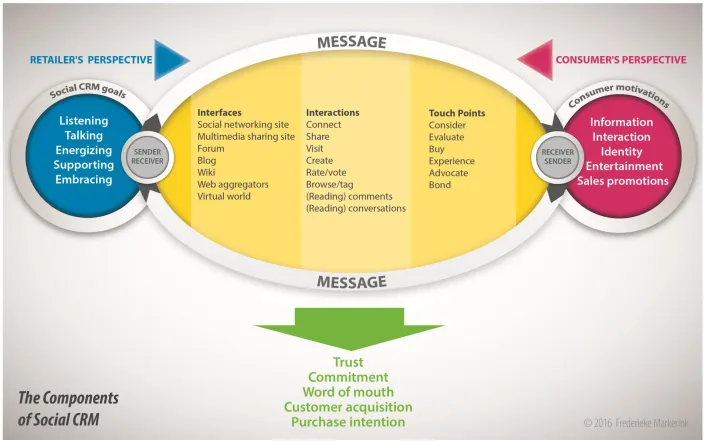
Two different studies are conducted to determine the value of social CRM. First, a content analysis is conducted. The content analyses gave a first answer to the research question “what social CRM patterns are used among retail businesses, what is the expected value of the social CRM patterns?”. In the first study 150 Facebook messages of 10 Enschede’s retail businesses are examined. The messages are analyzed by means of the social CRM model. This social CRM model is comprised of the components (1) social CRM goals (2) interfaces, (3) interactions, (4) touch points, (5) consumer motivations and (6) values. By means of the social CRM model various social CRM patterns could be identified and distinguished. Subsequently, the value of the various patterns could be determined. The value of the social CRM patterns is based on several customer relationship values. For this study the values trust, commitment, word of mouth, customer acquisition and purchase intention are chosen.
After the first study is an in-depth study conducted. In the second study 15 marketing professionals from various companies from the region east Netherlands are interviewed. The second study is conducted to confirm the findings of the first study and to determine the value of the various social CRM patterns. Research results and conclusions
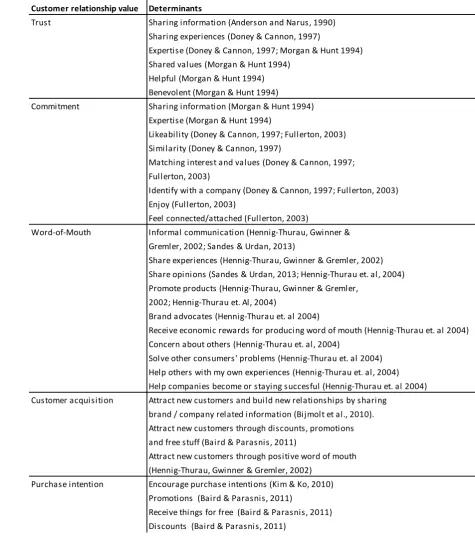
The first study, the content analysis, has identified 3 talking patterns; “products”, “expertise” and “have a nice day wishes”, 2 energizing patterns; “like, share and win promotions” and “sale, discounts and sales promotions” and 1 embracing pattern; “opinions and ideas”. Values are assigned to these patterns based on the theory (Morgan & Hunt, 1994; Doney & Cannon, 1997; Fullerton, 2003; Hennig-Thurau, Gwinner & Gremler, 2002; Hennig-Thurau et. al, 2004; Baird & Parasnis, 2011).
5
Table of contents
1.
INTRODUCTION ... 8
1.1 Context of the study ... 8
1.2 Research questions ...10
1.3 Relevance of the research ...11
1.4 Research process ...12
1.5 Outline of the research ...12
2. THEORETICAL FRAMEWORK ... 14
2.1 The pattern approach ...14
2.1.1 Definition of patterns ... 14
2.1.2 Pattern structure ... 14
2.2 Social media patterns ...14
2.2.1 Social media context ... 15
2.2.2 Social media goals ... 15
2.2.3 Social media touch points ... 19
2.2.4 Social media interactions ... 23
2.2.5 Social media interfaces ... 25
2.3 CRM ...28
2.4 Social CRM ...30
2.4.1 Social CRM goals ... 31
2.5 Customer relationship values ...33
2.5.1 Trust ... 34
2.5.2 Commitment ... 35
2.5.3 Word-of-mouth ... 36
2.5.4 Customer acquisition ... 37
2.5.5 Purchase intention ... 37
2.6 Overall conclusion ...40
2.7 Descriptive model ...40
2.7.1 Operationalization of the descriptive model ... 42
2.8 Conceptual model ...45
3. METHODOLOGY ... 46
3.1 Context of the research ...46
6
3.3 Study 1: content analysis social CRM ...47
3.3.1 Research method ... 47
3.3.2 Case selection ... 47
3.3.3 Procedure ... 47
3.3.4 Analysis ... 47
3.4 Study 2: in-depth interviews ...48
3.4.1 Research method ... 48
3.4.2 Participants ... 48
3.4.3 Procedure ... 48
3.4.4 Analysis ... 48
4.
RESULTS ... 50
4.1 Results study 1: content analysis social CRM ...50
4.1.1 Talking patterns ... 50
4.1.2 Energizing patterns ... 54
4.1.3 Supporting patterns ... 57
4.1.4 Embracing patterns ... 57
4.1.5 Summary of the results of study 1 ... 58
4.2 Results study 2: in-depth interviews ...58
4.2.1 Characteristics of the participants ... 58
4.2.2 Explanation of the values ... 59
4.2.3 Value of the talking patterns ... 59
4.2.4 Value of the energizing patterns ... 63
4.2.5 Value of the supporting patterns ... 66
4.2.6 Value of the embracing patterns ... 68
4.2.7 Summary of the results of study 2 ... 69
4.2.8 Concluding remarks ... 69
5.
CONCLUSION ... 72
5.1 Current social CRM use ...72
5.2 The value of social CRM ...72
6.
DISCUSSION ... 73
6.1 Theoretical implications ...73
6.1.1 Limitations ... 74
6.1.2 Future research ... 75
6.2 Practical implications ...75
6.2.1 Recommendations for creating trust ... 75
6.2.2 Recommendations for creating commitment ... 76
6.2.3 Recommendations for creating word of mouth... 77
6.2.4 Recommendations for customer acquisition ... 77
6.2.5 Recommendations for encouraging purchase intentions of consumers ... 78
7
APPENDIX A – ENSCHEDE’S RETAIL BUSINESSES ... 83
APPENDIX B – INTERVIEW QUESTIONS ... 84
APPENDIX C – EXAMPLE CONTENT ANALYSIS ... 90
APPENDIX D – MATRIX STUDY 1 ... 93
APPENDIX E – MATRICES STUDY 2 ... 99
8
1. Introduction
This chapter will introduce the research. The first paragraph presents the context, the actuality and the aim of the study (1.1). In the next paragraph the research questions will be formulated (1.2). This paragraph also argues the subjects that have to be discussed in the theoretical framework of chapter 2, which will also be the fundament of the empirical research. Thereafter, both the scientific and practical relevance of this study will be discussed (1.3). Then the research process (1.4) will be described. This paragraph briefly describes the content of the various chapters of this report. Finally, the outline of the thesis will be discussed (1.5). It gives a clear overview of the structure of the report.
1.1 Context of the study
“Retailer discovers the Internet”, it is the title of an article in the newspaper TC Tubantia of 5 January 2015. An increasing number of retail businesses in Twente and Achterhoek (The Netherlands) have found their way to the internet. This does not only apply to national retail chains, but also to local retail businesses (Bengevoord & Huinink, 2015). The internet and particularly social media offer retail businesses new opportunities to maintain and develop their customer relationships. Today, retailers don’t have to restrict themselves any longer to their own shop window to attract the attention of consumers. They can, just as large retail organizations, benefit from the use of social media and meet their (potential) customers online. It is obvious that they cannot longer stay behind in the world of social media. On social media platforms retailers are, as they say, trying to create “a feeling, mood and ambiance”, in a manner that catches customers’ attention, so that they become followers and are starting to share messages (Bengevoord & Huinink, 2015). Except creating feelings, they give away gifts. Followers who share messages have a chance to win a pair of shoes, a scarf or a nice shirt. This is much cheaper than advertising in newspapers or magazines (Bengevoord & Huinink, 2015). Besides that, companies provide service to their customers, dispelling misunderstandings or enhance their reputation. Social media platforms make it possible, that instead of 2 people, thousands are talking about a company. So, with a sophisticated marketing strategy and a clever use of social media retail businesses are able to increase the value of their customers.
Today, social media is part of our everyday lives. Over the past few years, social media usage has been booming. The figures of December 2013 show that Facebook is the most popular social media platform. It has about 1.23 billion active users worldwide. That is an increase of 1.27 million compared with 2012. Facebook has worldwide about 757 million users who are daily active on the platform (Sedghi, 2014). In 2013 almost all the Dutch between 15 and 39 years make use of social media. The Dutch average social media use is 86%. The most popular social media platforms are Facebook (8.9 million users), YouTube (7.1 million users), LinkedIn (4.1 million users), and Twitter (3.5 million users). The Netherlands has 7.9 million Facebook users in 2013. In 2014 there was an increase to 8.9 million users (+13%). Daily use of Facebook shows also an increase of 22% (Oosterveer, 2014). So, people seek their social contacts, which they already had in their lives, also on electronic societies. Millions of people have profiles on social networking sites, and others are writing blogs or wiki´s. Businesses feel obligated to be where their customers are and therefore link in on the social media platforms. Social media give companies new potential and opportunities to get closer to their customers, promote their goods, and facilitate services to the outside world (Baird & Parasnis, 2011; Bagó, 2012).
9 companies had control over the customer relationships the ownership now has shifted to customers. Customers publicly chat about companies and they discuss companies without participation of the companies in any way (Greenberg, 2009). Greenberg (2009) mentions two social factors that are responsible for how people nowadays interact. The first factors Greenberg (2009) mentions are the corporate and financial scandals of 2001-2008. These scandals destroyed the trust that people had in companies. The second factor is the entrance of Generation Y, also called the Millennials. This generation actively uses technologies like internet, social media, and smartphones for their everyday communication. These social factors changed the way how customers thought about doing business. Consumers do not have to rely anymore on information provided by companies or sales people. Nowadays they can also rely on the information stored on the web. Through networked conversations and new formations of social organization knowledge exchange occurs. Thereby, markets are getting smarter, transparent, more informed and more organized. Information that is communicated by companies is taken less seriously by consumers. Consumers have found out that they get much better information from other consumers than from salesman.
The web has become a primary source for consumers where they can converse, reveal their thoughts, and find required information or experiences from other consumers. When companies are acting smart, they can use this all as valuable information where they can learn from. And they can use this to engage with their customers. Thus, social media gives companies new input. Companies can use all these free available information for their CRM purposes (Greenberg, 2009).
Social CRM; an innovation or an illusion?
In 2013, 69.3% of the Dutch companies use social media as means of communication. This number is still rising. Companies find it important (47%) to very important (23%) to use social media, but recent research of Pondres (2013) show that only 33% of the companies use a strategy. The 4 most used social media platforms by companies are Facebook, Twitter, LinkedIn and YouTube. An increasing number of companies are trying to get in touch with their customers on social media platforms. Companies use social media for different purposes, e.g. for increasing brand awareness, customer engagement, public relations, service, obtaining customer insight, generate traffic to the company website, higher rankings in search engines, to be seen as an expert, provide product information and sales.
But what drives consumers to follow companies on social media? Several researchers (Van den Bergh, 2014; Kucherenko, 2011; Belleghem, 2012; Baird & Parasnis, 2011) have listed consumers’ motivations to follow companies on social media. They state that consumers follow brands in order to get e.g. news and (exclusive) information about products, service and support, discounts and free stuff, and consumers want to help companies by means of co-creation to improve products. One company is more interesting to follow than another. More than 60% of the social media users follow at least 1 brand. The fashion and luxury goods branch is one of the most followed branches (48%), together with media and entertainment (51%) and food and retail (48%). Customers follow in general 6.4 companies on social media. Generation Y follows more brands on social media than older generations (Van den Bergh, 2014).
10 themselves. Nowadays people are placing so much content on the internet that businesses are no longer able to control the customer relationships themselves. Social media has capabilities for reach, access and immediacy that other channels do not have (Baird & Parasnis, 2011). Customers are creating conversations and discussions on social media, and this can exceed companies marketing, sales, and service efforts with an unequalled speed and reach. Companies have to adopt these changes with the new strategy called social CRM (Baird & Parasnis, 2011).
Social CRM is a new customer relationship management perspective. This perspective focuses on getting closer to customers and increasing customer engagement with the use of social media. It is based on two-way conversations with customers. This strategy focuses on interactions with customers and holding dialogues with them, thereby creating meaningful conversations and qualitative relationships. Social CRM encourages customers to share their opinions and subsequently companies can interact with them by responding (Baird & Parasnis, 2011; Bagó, 2012). According to Askool and Nakata (2011) is being customer centric the main rule of social CRM. With this statement they mean that companies have to focus on their customers and the relationships with them. According to (Baird & Parasnis, 2011) this strategy is therefore also well suited for customer cooperation.
Concluding, figures of the last few years show that social media cannot be ignored anymore from our daily life. Companies always want to be where their customers are, so companies meet their customers on the social media platforms. Social CRM use by companies shows an increase the last years, despite the fact that there is little unknown about the value of this. For practitioners it is helpful if they have guidelines they can use for practicing social CRM. They should develop strategies to use the social media platforms right in order to get benefits from it (Baird & Parasnis, 2011). The social CRM field is still largely unexplored by both scientists and practitioners. On the internet you can find many statements about the value of social media for business purposes such as “the use of social media by companies will give customers feelings like trust and engagement” (Dutchcowboys, 2013, 2014; Koster 2012). A good substantiation and solid research is often missing. So, not enough research has been done into this topic. Therefore, it is necessary to empirically examine what the value is of social CRM.
The aim of this study is to:
Gain insight into current social CRM use among retail businesses
Gain insight into the value of social CRM
Patterns will be used to examine and to gain insight into social CRM. The theory of patterns (Alexander, 1979) enables to analyze, describe and explain social media with the use of traditional media theories. In this study this approach will be used to identify social CRM patterns. When connecting the several patterns with each other finally a social CRM model arises.
1.2 Research questions
Taking the aforementioned into consideration, the following research question can be formulated. The research question serves the 2 objectives of this study.
Research question: What social CRM patterns are used among retail businesses, what is the expected value of the social CRM patterns?
11 1. What is the pattern approach?
This question arises in the introduction of this report. Chapter 2 shows the theoretical background of patterns, what they are, and how they can be applied.
2. What are social media?
This question derives from the introduction of this report. Chapter 2 describes the most important social media theories. Social media patterns are described to explain this concept and to make this concept understandable.
3. What is CRM?
Chapter 1 introduces the term CRM. In chapter 2 customer relationship management will be described in detail. A short history, definitions and strategies will be explained.
4. What is social CRM?
Chapter 1 gives a short introduction about social CRM. Chapter 2 will give a deeper understanding about this subject. A social CRM model will be developed to make things understandable and recognizable. In the empirical part of this report the results of the data collection will show typical social CRM patterns.
5. What are customer relationship values?
This question arises in the introduction of this study. This study examines whether social CRM efforts are of any value. To answer this question, first theories about customer relationship values have to be discussed. Thereafter, the customer relationship values will be examined in the empirical part of this study.
1.3 Relevance of the research
This study has both scientific and practical relevance. Both will be described in this paragraph.
Scientific relevance
In the past few years there has been a rise in scientific articles about social media marketing (Constantinides, 2008; Constantinides & Fountain, 2008; Kaplan & Haenlein, 2010; Lorenzo-Romero et. al, 2012; Hoffman and Fodor, 2010). Most studies are about applications, use and possibilities of social media. In the extension thereof, research has been done about social CRM (Greenberg, 2009; Baird & Parasnis, 2011; Li & Bernoff, 2011; Faase et al., 2011; Bagó, 2012), but there is still little known about the outcomes and results of social CRM use. Businesses can measure quantitative effects, like the number of followers, friends, reactions, messages about the company, etc. This study does not only want to focus on the above mentioned quantitative indicators. Therefore, this study is interesting for science, because it wants to examine outcomes, such as values, that can be evoked by certain actions on social media. This will be achieved by examining how retail businesses use social CRM in practice and by exploring the values of the social CRM efforts of retail businesses. Besides, this study is especially interesting for science, because it is based on the pattern approach (Alexander, 1979). The pattern approach makes it possible to develop a framework that gives insight into processes and values. Finally, patterns are not only interesting for science. They are also very suitable to use in practice.
Practical relevance
12 can be used by businesses as a guideline. The obtained insights can help stakeholders by predicting, implementing, and adjusting their social CRM efforts. By studying current social CRM use and the expected values, the social CRM activities of business can better be adapted to the needs of both company and customer. The creation of desired values or the absence of desired values can better be estimated. The findings of this study can help businesses in developing social CRM strategies. This research can be used by companies for evaluating their (current) social CRM use, it can help companies making decisions and developing the right strategies for their social CRM activities.
1.4 Research process
This report has a classical structure. It is structured in 7 parts; (1) introduction, (2) theoretical framework, (3) methodology, (4) results, (5) conclusions, (6) discussions and (7) references. Chapter 1, the introduction, describes what this research is about. The research problem, aim of the study, justification and the process are discussed in this part. Chapter 2 presents the theoretical framework. This chapter contains a review of various theories about customer relationships management, social media, social CRM and CRM values. Also, a descriptive and conceptual model regarding all those elements will be presented. In chapter 3 the research methodology will be described. This chapter describes how the theory is examined. The methods and procedures that are used for data collection are discussed here. Chapter 4 presents the results of the two studies. Conclusions can be drawn when the data is analyzed. Subsequently, an answer to the research questions will be formulated. These conclusions are presented in chapter 5. Chapter 6 presents the discussion. The chapter contains a critical reflection to this research. It also presents suggestions for further research and recommendations for retailers. Finally, the references used for this study are enumerated. The following paragraph will give a schematic view of the research process.
1.5 Outline of the research
13
1. Introduction
•Context of the research
•Aim of the research and research questions •Relevance of the research
2. Theory
•Review of the literature
•Descriptive and conceptual model
3. Methodo-logy
•Research procedures
4. Results
•Analysis of the data
5. Conclusions
•Answering the main research question •Conclusions
6. Discussion
•Critical reflection
7. References
•Enumeration of references used for this study
[image:13.595.92.508.39.447.2]14
2. Theoretical framework
In this chapter, an answer is given to the sub questions. The literature review provides the basis for this chapter. Various theories and definitions about patterns, social media, social CRM, and customer relationship values are described in this chapter. These concepts form the foundation of this research. The 1st paragraph presents the pattern approach. The 2nd paragraph presents social media patterns. Needs and motives of both company and customer are discussed. As well as social media use, touch points, interactions and interfaces. The 3rd paragraph presents the CRM concept. The 4th paragraph presents the social CRM concept. In this paragraph social CRM activities and goals are discussed. The 5th paragraph presents the CRM values. The 6th paragraph includes an overall conclusion. The 7th paragraph shows the descriptive model and finally the 8th paragraph presents the conceptual model.
2.1 The pattern approach
As explained in the introduction the pattern approach (Alexander, 1979) is applied in this study, because this approach enables to analyze, describe, identify and explain social media and social CRM patterns. Traditional media theories will be applied to explain current social media usage. In the following paragraphs various social media and social CRM patterns will be described. Finally, when connecting the different patterns, a social CRM model is created.
2.1.1 Definition of patterns
According to Alexander (1979) a pattern is a “re-usable solution to address a frequently occurring (architectural) problem”. According to Alexander (1979) a pattern language is a ‘’network of patterns that call upon one another and help us remember insights and knowledge about design and can be used in combination to create solutions’’. Individual patterns are the foundation of a pattern language. “A pattern is in short a thing, which happens in the world, and the rule which tells us how to create that thing, and when we must create it. It is a description of the process which will generate that thing” (Alexander, 1979). Patterns are designed to give direction for interpreting and acting on processes. Patterns are very suitable to use in practice, because they give suggestions about actions that could be undertaken in a certain situation (Schuler, 2008). The pattern approach enables to develop a framework wherewith problems and solutions can be described and wherewith they finally can be connected with each other.
2.1.2 Pattern structure
A pattern shows a relation between three mandatory parts, (1) context, (2) problem and (3) solution (Alexander, 1979). A pattern represents a solution to an occurring problem in a certain context (Alexander, 1979). In which problems refers to a recurring problem in a specific context, i.e. a certain system of forces. And in which solutions refers to the manner in which the problem should be solved (Rossing, De Vries & Vollenbroek, 2012).
2.2 Social media patterns
According to Rensen (2013) a social media pattern is composed of five pattern levels. The five social media pattern levels will be explained below.
15
Social media pattern levels
1. Context of social media activities : refer to the context and the problem part of a pattern. 2. Goal level
3. Touch point level 4. Interaction level 5. Interface level
: refer to the solution part of a pattern.
Table 2.1: social media pattern levels (Rensen, 2013)
The context level refers to the domain, setting, environment or situation in which social media is used. The goal level refers to the goal that has to be achieved when using social media in a certain context. The touch point level refers to the opportunity when companies and customers meet each other. The interaction level describes several manners how company and customer interact with each other. The interface level contains various types of social media platforms (Rensen, 2013). According to Alexander (1979) a pattern represents a solution to an occurring problem in a certain context. The context and the problem part of a pattern refer in this study to the social media activities of companies. The solution part in this study refers to the goal level, touch point level, interaction level, and interface level related to the context. A social media pattern will be formed when from each social media pattern level an element is chosen. So, a social media pattern can be defined as: “a social media pattern is a description of a marketing usage process, comprised of context, goal, touch points, interaction and interfaces, and in which processes are characterized by context, goal, touch point and interface factors” (Rensen, 2013). The following subparagraphs will give a deeper understanding of the social media pattern levels.
2.2.1 Social media context
The context level is the first element of the social media pattern levels. The context level describes a domain, a setting, an environment or a situation in which the pattern appears (Schuler, 2008). Companies can use social media for business use in very different manners. To find out what kind of social media use is effective for companies, it would be useful to study the context in which the social media is used. Two things are important with regard to the context or in this case: the dynamic and the complexity of the context. A context is perceived as more dynamic when it is highly subject to change. A context is perceived as more complex when many different stakeholders have to be taken into account (Jägers et. al, 1995).
In this study the context encloses on a general level the social media use of companies for business purposes. In this context different stakeholders should be taken into account. Therefore, it is a complex context. The stakeholders can be divided in internal and external stakeholders. The internal stakeholders are the companies or marketers. The external stakeholders are the customers of the company. The context is also dynamic, because of the real-time updates and messages that can be spread very fast in a given network. On a more specific level the context in this study refers to the occurring problem. The problem part of a pattern can be explained in this study as the challenge that companies have to achieve their stated social media goals. The goal level of a social media pattern will be explained in the next subparagraphs.
2.2.2 Social media goals
16
Company’s goal to use social media
When formulating social media goals, the focus should not be on traditional business ROI objectives as for instance increasing market share, reduce costs, etc. Companies should think about what marketing goals (e.g. engagement) are satisfied when they are using social media. Companies should also think about why their customers would visit their social media pages (e.g. to get informed) and what behaviors they are engaged in (e.g. writing reviews). Therefore, companies should not always measure there ROI in money, but they should seek it in customer behavior (Hoffman & Fodor, 2010).
Hoffman and Fodor (2010) have identified three social media goals; (1) brand awareness; i.e. the extent to which consumers can identify (recall or recognize) a brand, (2) brand engagement; i.e. the attachment (rational or emotional connection) between consumers and brand, (3) word of mouth; i.e. when consumers are aware of and engaged in a company, they could spread, positive or negative, opinions and experiences about the company.
With the use of Web 2.0 companies also try to form, confirm or change the attitudes, opinions, emotions and intentions of customers, which also called responses (Miller, 2002). Companies try to form, confirm or change the responses of customers not only in real life, but also on social media. According to Miller (2002) there are three persuasive manners to influence consumers. Companies can shape, reinforce or change the responses of consumers. (1) Shape; i.e. when communicating to consumers companies can form their responses. (2) Reinforce; i.e. communication can confirm a response. The response does not always have to be changed. (3) Change; i.e. when communicating to consumers companies can change their responses (Miller, 2002).
Consumer goal to use Web 2.0
Every consumer has his own needs and motivations to use social media. Katz, Blumler and Gurevitch (1973) state that people have many reasons for using media. The same media content can be used by very different people to fulfil very different needs, values and purposes. People are not forced to use social media. They decide to use it themselves, so when people are using social media they want to gratify specific needs. The uses and gratifications theory (McQuail, 1987) can explain why people use social media.
According to McQuail (1987) there are four motivational needs for using media. The four categories include several subcategories. People can for instance use media for entertainment purposes. They can watch videos, visit social networking sites or listen to audio. When doing this they can pass time, relax or enjoying themselves. Media content can provide information to people. People can obtain new knowledge or advice. They can also learn from the information. Media can help people to reflect, reinforce or contrast their personal identity. Media content can assist people to obtain insight into their own personality or it can help them to evolve their own attitudes and opinions. People can compare and reflect their own personality with the personalities represented in a video. For instance, they watch videos of Dr. Phil seeing others having relationships problems or they can read blogs about how to dress yourself. People use media also for their personal relationships and social interaction. People can make connections with family and friends. Media content let people talk with others who have similar interests. People can also watch videos with others to create a strong bond.
17
Need Motivations
Entertainment To relieve boredom (Lin, 2002)
Enjoyable activity (LaRose et. al, 2001, Baird & Parasnis, 2011;
Smock et. al, 2011)
Fun (Schmidt & Wilber, 2005) Exciting (Lin, 1999)
Relaxing (McQuail, 1983) It is a habit (Smock et. al, 2011)
For novelty (Lorenzo-Romero et. al, 2012)
Information To inform and be informed (Bowman & Willis, 2003)
Share practical information, knowledge, opinions or skills with others (Lenhart & Fox, 2006)
Seek advice from practical issues, choices and opinions (McQuail, 1983) Curiosity and satisfy general interest (McQuail, 1983)
Learning (McQuail, 1983)
Enhance intellectual growth (Lin, 2003)
Create a sense of security through knowledge (McQuail, 1983) Get access to experts (Baird & Parasnis, 2011)
Personal identity Identify with others (McQuail, 1983; Barker, 2009) Feeling of belonging (McQuail, 1983)
Insight into itself (McQuail, 1983) Status seeking ( Lee et al., 2011)
Gain status or build reputation in a given community (Bowman & Willis, 2003) Express yourself creatively (Lenhart & Fox, 2006)
Commitment to the organization (Brown et al., 2005) Find support for personal values (McQuail, 1983) Find models for behaviour (McQuail, 1983)
Own opinions and comments (influence others) (Nardi et al., 2004) Everyone is doing it (Smock et. al, 2011)
Interaction Finding a basis for conversation and social interaction (McQuail, 1983) To create connections with others who have similar interests
(Bowman & Willis, 2003)
Develop and maintain relationships (social contact to family, friends, and others) (Baird & Parasnis, 2011, Nardi et al., 2004; Lorenzo-Romero et. al, 2012)
To stay in touch with friends and family (Lenhart & Fox, 2006) Express feelings and emotion (Nardi et al., 2004)
Social empathy (McQuail, 1983)
Group Sense experience (McQuail, 1983)
Document one´s life (share personal experiences with others) (Nardi et al., 2004, Lenhart & Fox, 2006)
Share practical knowledge or skills with others (Lenhart & Fox, 2006) Share opinions (Baird & Parasnis, 2011)
Other I was invited (Lorenzo-Romero et. al, 2012)
Receive discounts, promotions and free stuff (Baird & Parasnis, 2011)
[image:17.595.92.529.104.786.2]promotions and free stuff as one of the important drivers to use social media (Baird & Parasnis, 2011). The following table gives more insight in the needs and its related motivations.
18 Social media users Description
Creators Creators are the most active social media users.
They create for instance blogs, upload self-created videos and audio. They write articles or stories and publish them on the web.
Conversationalists Conversationalists are mainly active on social networking sites like Facebook and Twitter. They want to show themselves through status updates. Through these status updates they want to profile themselves or start a conversation.
Critics Critics react on status updates, forums, blogs, etc.
They post product and service reviews and they contribute to wiki’s. This category is essential for creators and conversationalist to maintain interaction.
Collectors Collectors want to aggregate information.
They can use for instance RSS feeds to collect information. Joiners Joiners visit social networking sites.
They maintain their profile and their friendships, but they are less active than the categories above.
Spectators Spectators are more beholding present.
They obtain information, but only to gather more knowledge.
They read for instance blogs, reviews, and forums or they watch videos. Inactives Inactives are not active on social media.
Motivations (McQuail, 1987)
Entertainment Consumption : enjoy a social media campaign
Information Creation : share knowledge, writing comments
Personal Identity Control : share uncensored thoughts Interaction Connections : share with friends and others
Motivations - 4 C's (Hoffman & Fodor, 2010)
[image:18.595.66.491.342.626.2]Hoffman and Fodor (2010) categorized consumer motivations to use social media in particular. The four key motivations, also called the 4 C’s, are (1) connections, (2) creation, (3) consumption, and (4) control. The key motivations give marketers a better understanding why consumers use social media with the aim to make sure that their social media efforts are appropriate and effective. The four motivations have similarities with the four motivational needs of McQuail (1987).
Table 2.3: customer key motivations to use social media (McQuail, 1987; Hoffman & Fodor, 2010)
19 2.2.3 Social media touch points
The third social CRM pattern level is the touch point level. The touch point is the point when consumer and company meet each other and consumers’ shopping behavior can be influenced best. The touch point level has two dimensions. The first dimension of the touch point level consists of the consumer decision journey. The second dimension of the touch point level consists of a marketer’s response. The dimensions of the touch point level will be explained in the next two subparagraphs.
The consumer decision journey
The first dimension of the touch point level is the consumer decision journey. Marketers want to influence consumers during their decision process. At touch points consumers are most open to influence. Formerly, consumers started with a large number of brands in their mind and then they reduce the number to one brand they would buy. After the purchase the relationship between customer and brand typically focuses on the use of the product or service of the brand itself (Edelman, 2010). The relationship between the company and customer often weakens or dilutes after purchase. The following figure shows the traditional purchase funnel (Court et al., 2009), including the different phases of the purchase process.
Figure 2.1: the traditional purchase funnel. Adopted from “The consumer decision journey,” by D. Court, D. Elzinga and O.J. Vetvik, 2009, McKinsey Quarterly.
The traditional model can help companies in answering questions like how many consumers consider the brand, how many consumers have heard of the brand, how many consumers have tried the brand and how many would buy it again. But, current research has shown that consumers, instead of systematically reducing their brand choices according the traditional funnel, now add and subtract brands from a group during an extended evaluation phase. The difference with the past is that today consumers after their purchase end up in an open-ended relationship with the brand and subsequently share their experiences online.
20 Figure 2.2: the consumer decision journey. Adopted from “Global Digital Diaries, Part 2: Three phases of the Consumer Decision Journey in action”, By M. Elling, J. Forsyth and B. Salsberg, 2009, McKinsey Quarterly.
21
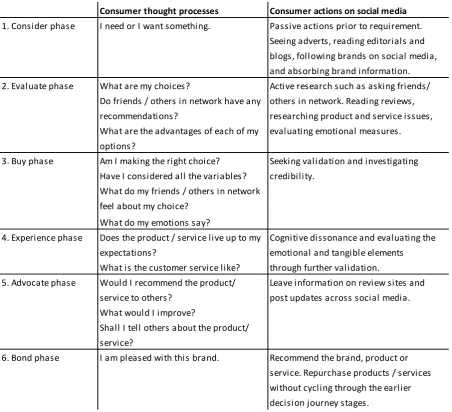
Consumer thought processes Consumer actions on social media 1. Consider phase I need or I want something. Passive actions prior to requirement.
Seeing adverts, reading editorials and blogs, following brands on social media, and absorbing brand information. 2. Evaluate phase What are my choices? Active research such as asking friends/
Do friends / others in network have any others in network. Reading reviews, recommendations? researching product and service issues, What are the advantages of each of my evaluating emotional measures.
options?
3. Buy phase Am I making the right choice? Seeking validation and investigating Have I considered all the variables? credibility.
What do my friends / others in network feel about my choice?
What do my emotions say?
4. Experience phase Does the product / service live up to my Cognitive dissonance and evaluating the
expectations? emotional and tangible elements
What is the customer service like? through further validation.
5. Advocate phase Would I recommend the product/ Leave information on review sites and service to others? post updates across social media. What would I improve?
Shall I tell others about the product/ service?
6. Bond phase I am pleased with this brand. Recommend the brand, product or service. Repurchase products / services without cycling through the earlier decision journey stages.
Sutton (2011) has described the actions that consumers make on social media during their decision journey. The actions are elaborated in the following table.
Table 2.5: consumer actions on social media during the Consumer Decision Journey (Edelmann, 2010; Sutton, 2011)
Marketers’ reaction
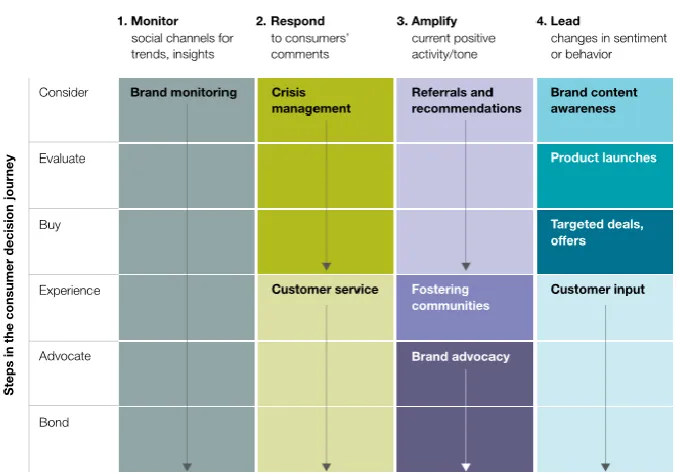
The second dimension of the touch point level is the marketers’ reaction. Marketers can influence consumers during their decision journey. They can reach them at the touch points. Social media is a unique instrument to use for influencing consumers during their decision journey, because this kind of marketing instrument can reach consumers during every phase.
[image:21.595.93.546.123.535.2]22
1.Monitor 2.Respond 3.Amplify 4.Lead
Passive Reactive ---> Proactive
[image:22.595.101.440.509.746.2]behavior. For instance, marketers can use social media for obtaining ideas and insights about products, services, and development.
Table 2.6: marketer’s reaction (Divol, Edelman & Sarrazin, 2012)
Social media marketing responses
23 Figure 2.3: social media marketing responses at touch points along the consumer decision journey. Adopted from “Demystifying social media,” by R. Divol, D. Edelman and H. Sarrazin, 2012, McKinsey Quarterly.
2.2.4 Social media interactions
The next social media pattern level is the interaction level. Interaction is a term used in various scientific disciplines, therefore it has different meanings. Interaction can be explained as exchange, interplay or mutual influence (Jensen, 1998). From a sociology perspective interaction can be defined as “the relationship between two or more people who, in a given situation, mutually adapt their behavior and actions to each other” (Jensen, 1988, p. 189). Or according to Wagner (1994) interaction is defined as “reciprocal events that require at least two objects and two actions, these objects and events mutually influence one another”. From a marketing perspective interaction can be defined as “the degree to which one’s business has permeated into one’s life” (Feuer, 2004). In addition it is also good to know the difference between interaction and interactivity. Interaction is about the behavior of individuals and groups and interactivity is about the extent to which technology is able to exchange content (Wagner, 1994). With the arrival of social media businesses have another medium which they can use to interact with their customers.
High interaction levels
Rossing (2012) has identified 9 high level interaction patterns that occur on social media. These interaction patterns are characterized as high level, because they have strategic characteristics. The high level interaction patterns are general social media functionalities and they occur on various platforms.
(1) Connect; means that a social media user engages in, and makes relationships with other users on social media. For instance, liking a fan page on Facebook or following a company on Twitter.
(2) Create content; means that social media users post new sharable content on social media. The emphasis is here on the initiative of the users. For instance, they can take the initiative to create a video on YouTube or posting photo’s on a Facebook page.
(3) Share content; means that users share and distribute photos and videos on social media with friends and followers. For instance, social media users retweet a post on Twitter or they share a photo on Facebook.
(4) Visit; means that you visit content that is shared to you by one of the users you follow on social media. For instance, visit a news article which is shared to you by another user on Facebook.
(5) Commenting; means that users leave a response to a specific piece of content. For instance, users can comment on a YouTube video, they can comment on a specific topic on a forum, or comment on a tweet. Commenting makes shared content richer, because more meanings and information are shared about a specific topic.
24 (8) Reading conversations; means that users read the conversations hold by others without taking part in it. For instance, users can read a discussion in the comment section under a post on Twitter, Facebook or YouTube.
(9) Rate / vote; means that users rate content or products on social media. For instance, they can use the like or dislike button on YouTube.
(10) Tag; means that users can add keywords, making a descriptive tag cloud. For instance, users can use hashtags on Twitter for specific items.
(11) Browse using tag; means that social media users use the tags in order to find information related to a specific item. For instance, users can click on a tag on Instagram and then the tag links the users to all the other posts which also include the specific tag.
Low interaction levels
Besides the high level interaction patterns, there are low level interaction patterns. The low level interaction pattern describes general functionalities of social media platforms (Rensen, 2012). These low level interactions can also be described as platform specific functionalities (Rensen, 2012). Rensen (2012) identified 8 general social media functionalities on a low level.
(1) Finding; this function is used for searching and finding people, companies, events and specific topics.
(2) Following; this function is used for following people, companies and other authorities. When a social media user makes use of the following function, then he or she get notifications and is able to follow the actions and posts of companies and people.
(3) Analysis; this function gives for instance information about the social media users that follow you and the amount of users that follow you. The function gives the user raw data. The function shows for instance where users are coming from, what kind of topic they like and the types of responses.
(4) Controlling; this function is about the privacy concerns of users. Users can choose to share their messages publicly or they can keep it private and share it only with friends. So users can control the extent to which they want to share information, public, private or something in between.
(5) Posting and adding; this function is about how to share content. Users should consider if they want to share just text, photos, symbols, videos or a combination of them. The possibilities to share all the content vary for de various platforms. Therefore, social media users should consider the richness of the social media platform when sharing content.
(6) Choosing; this function is used for choosing the amount of content (i.e. the extent of text, photos and/or videos), choosing the message type (i.e. direct message or private message) and with whom (i.e. friends, family, everyone, etc.) the content should be shared.
(7) Sorting; this function is used for sorting information. For instance, friends can be divided into groups and messages can be placed and saved in folders.
(8) Searching; this function is used for searching information. For instance, the search function is used to search for friends, (company-) pages or topics.
Interactivity
25
Human to Computer Human to Content Human to Human
Searching Rate/Vote Comment
Analysis Tag Connect
Sorting Visiting shared content Share
Controlling Reading comments Conversing
Create Finding Choosing
Task features Human to human features
Co presence Real time
Asynchronous Synchronous
Low richness High richness
Low self-presentation High self-presentation
Interactivity level
(1) Human to computer interactivity; i.e. this interactivity allows users to exercise control over a medium, through e.g. searching, sorting, controlling, etc.
(2) Human to content interactivity; i.e. this interactivity allows users to exercise control over the content of a medium, through e.g. creating content, finding, voting, etc.
(3) Human to human interactivity; i.e. this interactivity allows users to communicate with other users. Users can communicate and connect with other users, e.g. through placing comments.
The following figure shows the general social media functionalities related to the 3 kinds of interactivity.
Figure 2.4: characteristics of interaction patterns. Adopted from “Social Media Marketing Activity Pattern language,” by J. Rensen, 2013, Master thesis, p. 28.
2.2.5 Social media interfaces
The last social media pattern level is the interface level. The Internet has always been about connecting people. It is an interactive environment, but due to new possibilities and technologies usage has changed (Faase et al., 2011). The evolution of the World Wide Web started with Web 1.0. In this stage the web was an information and transaction medium. It was mainly centered round commerce. Users could use Web 1.0 for viewing webpages (Barsky & Purdon, 2006; Faase et al., 2011; Askool & Nakata, 2011). Through new developments the World Wide Web came into a new stage: Web 2.0.
26
Social media categories Description
Social Networking Site Users can create their own personal profile on a social networking site (e.g. Facebook, LinkedIn). Thereafter, they can share and exchange personal information with other users. They can expand their social network by adding new contacts to their network. Users can share content like photos, images, videos, links, thoughts, activities and opinions. The relationships that can be found on social networking sites are for instance with friends, family members, companies, opinion leaders or others who are important for the user. Relationships can be strengthened with the use of the “like button” or by “tagging”.
Multimedia Sharing Site These websites enable users to attain and publish media. Users can share for instance:
a. Videos (e.g. Youtube)
b. Photos (e.g. Instagram, Pinterest)
c. Podcasts: digital streaming or downloadable topics via radio or video
Forum A forum is a website where users can exchange their ideas and information about specific topics (e.g. Epinions).
Blog A blog is an abbreviation for web log. A blog is like an online journal. Readers can often post comments on a blog. Another phenomenon is micro blogging. The best known micro blogging website is Twitter. It offers real-time updates. Users can posts messages of maximal 140 characters.
Wiki Wiki's are websites were users can add or edit content (e.g. the online encyclopaedia Wikipedia).
Web aggregator An aggregator selects web content from various web 2.0 services, thereby customizing the selection the user wishes to see. The user can see this selection at one location. The technique that is often used for this is also known as Real Simple Syndication (RSS). An RSS document, which is also called a feed, will be automatically sent to subscribers
with summarized updates of various social media (e.g. Netvibes). Virtual world A virtual game world is a three dimensional gaming
environment where users can interact using a personal avatar. A virtual social world allows users to interact in a three dimensional social platform, similar to the real life.
Table 2.7: Web 2.0 categories (Constantinides & Fountain, 2008; Faase et al., 2011; Bagó, 2012; Kaplan & Haenlein, 2010).
[image:26.595.53.518.80.599.2]27
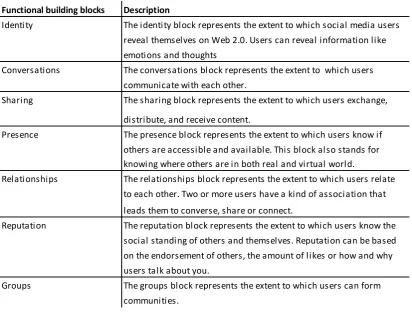
Functional building blocks Description
Identity The identity block represents the extent to which social media users reveal themselves on Web 2.0. Users can reveal information like emotions and thoughts
Conversations The conversations block represents the extent to which users communicate with each other.
Sharing The sharing block represents the extent to which users exchange,
distribute, and receive content.
Presence The presence block represents the extent to which users know if others are accessible and available. This block also stands for knowing where others are in both real and virtual world.
Relationships The relationships block represents the extent to which users relate to each other. Two or more users have a kind of association that
leads them to converse, share or connect.
Reputation The reputation block represents the extent to which users know the social standing of others and themselves. Reputation can be based on the endorsement of others, the amount of likes or how and why users talk about you.
Groups The groups block represents the extent to which users can form communities.
The growing popularity of Web 2.0 has also changed the customer behavior and company-customer relationships (Faase et al., 2011; Bagó, 2012). Customers unite in communities (Bagó, 2012). They already did in their normal lives, but today this is also possible online. Social media offer companies possibilities to build their social presence and give companies the opportunity to be where their customers are. The position of the customer is moving more to the producer side, e.g. through co-creation (Faase et al., 2011; Bagó, 2012; Askool & Nakata, 2011). This changes the way how companies have to communicate with their customers. It has not been determined whether the evolution of the Web has changed customer behavior or vice versa, but it is obvious that companies need to pay attention to these changing customer behaviors and the virtual environment if they want to retain and attract customers.
[image:27.595.93.506.337.649.2]Now the social media categories and their typical features are described, the Honeycomb Framework of Kietzmann, Hermkens, McCarthy and Silvestre (2011) show more insight into the functionalities of social media. Kietzman et al. (2011) developed the following seven building blocks which explain the different functionalities of social media. Some social media websites are more focused on relationships, others on reputation, etc., but none of the social media websites is solely focused on just one functionality block. According to Smith (2007) social media websites have the tendency to concentrate on three to four of the functionality blocks.
Table 2.8: the 7 functional building blocks of social media (Kietzmann et al., 2011)
28
Social media website Functional blocks of social media
Facebook Relationships, Presence, Conversation, Identity, Reputation LinkedIn Identity, Relationships, Reputation
YouTube Sharing, Conversations, Groups, Reputation Foursquare Presence, Identity, Relationships
Twitter Conversations, Sharing
Social media category Interaction patterns
Social networking site Connect, share, comment, reading, visiting, create, converse, rate, tag, browse Multimedia sharing site Connect, share, comment, reading, visiting, create, converse, rate, tag, browse Forum Comment, converse, reading
Blog Visiting, share, create, comment, reading, converse
Wiki Create
Web aggregator Browse using tag
Virtual world Connect, comment, conversations
Table 2.9: social media websites linked to the functional blocks of social media (Kietzmann et al., 2011)
When using the same method of Kietzmann et al. (2011), the interaction patterns can be linked to the different social media categories. The following figure shows the links between the social media categories and the interaction patterns.
Table 2.10: social media categories linked to the interaction patterns (Rensen, 2013)
Conclusion
In this section the sub questions “what is the pattern approach” and “what are social media?” are answered. In this section the concept of social media is discussed based on the pattern approach. Patterns are helpful for gaining insights about a certain subject. Several patterns can be combined and can be used to create solutions (Alexander, 1979). Social media has an interactive character. Companies use social media for promoting their business, products and services and they use it to get in touch with consumers. Theories about social media are structured and subsequently five social media patterns are distinguished, (1) the context level, (2) the goal level, (3) the touch point level, (4) the interaction level, and (5) the interface level. The context level describes in which context social media is applied. The goal level describes the goals that companies and consumers have for using social media. Companies and consumers have different goals for using social media. The touch point level describes the moments when company and customer get in touch with each other. For all these moments specific marketing actions can be applied. The interaction level describes several interactions that appear on social media. These interactions vary from following companies, to sharing content. The interface level describes seven social media platforms. The characteristics of each social media platform are discussed in this section. Overall, the social media patterns describe all the possibilities social media has for companies and their business purposes. Therefore, these social media patterns are very helpful for companies when applying actions on social media. The next paragraphs go deeper into the use of social media for CRM purposes.
2.3 CRM
29 2003). Customer relationship management (CRM) is derived from the relationship marketing (RM) perspective in the 1980s. According to Stone, Woodcock and Machtynger (2000) the RM concept focuses only very deeply on the customer, while CRM goes further by integrating RM concept with other companies’ activities with the aim of increasing customer loyalty and retention. CRM has brought the relation marketing to a new level. With CRM companies can analyze customer behavior and obtain a notion of the needs and wants of their customers. Customers are the most essential element of CRM. CRM takes the customer in every process into account in order to build lucrative and durable relationships (Bagó, 2012).
There is little uniformity about a clear definition of CRM. CRM can be examined from different perspectives. Some researchers think CRM is a marketing strategy, others believe it is a business strategy or an IT process, but there is some consensus (Askool & Nakata, 2011). Generally CRM places the demand of the customer central into the operations of the company, but with the aim to contribute to the profitability of the company and the satisfaction of the customers (Bagó, 2012). According to Bull (2003) CRM is a complex combination of technological and business factors to store customers’ information, improve interactions with customers, and thereby building and maintaining effective business relationships. Bose (2002) has made the following definition of CRM: “CRM is an integration of technologies and business processes used to satisfy the needs of a customer during any given interaction. More specifically, CRM involves acquisition, analysis and use of knowledge about customers in order to sell more goods or services and to do it more efficiently”. This research focuses on the domain of customer behavior, customer relationships, and business use of social media, therefore the following definition of CRM will be used. According to Faase et al. (2011) “CRM creates an understanding of the market and customer behavior and aims to improve the customers’ lifetime value through customer interaction.”
The change in marketing approach from a production concept to a holistic concept evokes also the importance of interactivity in customer relationships (Bagó, 2012). Interaction can be both customer-to-company and company-to-customer. These interactions are about having contact with customers, using different channels like phone, e-mail, intranet, social media, etc., for instance for discussing products and services (Faase, Helms & Spruit, 2011; Stone et al. 2000). The success of CRM depends on the implementation of the right marketing approach and philosophy (Bagó, 2012). In order to increase the lifetime value it is fundamental to keep customers engaged and interested in the company.
30 CRM when they accumulate their customers’ data. Thus, CRM is only interesting for companies if they have customers who will return to the company and thereby building long relationships. This also declares why companies that have customers with a short lifetime value will benefit less from CRM activities (Faase et al., 2011).
2.4 Social CRM
“Social CRM combines the features of Web 2.0 and social networking with the current CRM system” (Mohan, Choi & Min, 2008). Social CRM is not really a CRM system with a set of technologies, but rather a company specific strategy. Social CRM has the aim of getting closer to customers, creating customer engagement, holding conversations with customers and building stronger customer relationships with the use of social media in order to create mutually beneficial value for both company and customer (Faase et al., 2011). Social CRM wants to achieve this through creating two-way interactions between company and customer and thereby giving customers ownership over the conversation (Greenberg, 2009).
Social CRM does not replace a traditional CRM system, but it is an addition to the traditional CRM system. Traditional CRM technologies still has to be used by companies for daily processes and for developing strategies, but social CRM can enrich the sales, marketing and customer service departments. Social media provides companies with extra sources of information. Thereby, it can complement other marketing and sales tools. Besides that, it also creates mutual benefits for both company and customer. With use of social media companies can communicate with customers and they can obtain more knowledge of them (Greenberg, 2009; Faase et al., 2011). Interaction between companies and customers enables companies to collect deeper customer insights and it enables customers to take part in the life of the company. This also results in a transparent and trusted business environment (Greenberg, 2009). The social CRM strategy implies that companies are open to customers and be visible to them. It gives customers space and information to make decisions on how they want to interact with companies (Greenberg, 2009). Social CRM is a marketing solution based on holding dialogues with customers supported by social media. Selling is not priority number one, but it is just important to know what happens inside the mind of the customers. It is meaningful for companies to know why consumers like products, why they are dissatisfied, what kind of problems are occurring and how companies can keep them satisfied (Bagó, 2012). If customers have an opinion about a company they probably will share it with other members of the community they are living in. People discuss their positive and negative experiences in their real life, but at the present also virtual on the Internet. So, companies should not only focus on company-customer relationships, but they should also pay attention to the customer-customer relationships. Social CRM can help companies analyze and monitor customer opinions (Bagó, 2012).
31 stimulate collaboration between companies and customers in order to improve knowledge sharing. Companies don’t need to use questionnaires or other marketing tools to acquire information about their customers. Much free information appears on social media and companies only have to obtain it. When companies go a stage further in their social CRM strategies, they encourage social media users to provide content by themselves. Besides, companies can engage in conversations with a personal touch so that customers get the feeling that they are taken seriously (Bagó, 2012). Bagó (2012) describes in his study some examples of social CRM strategies. One of them is the well-known example of Dell. A famous blogger wrote a negative story about Dell. This encouraged other unsatisfied customers also to write about their experiences with Dell. Dell noticed this and set up their own website where customers could exchange their experiences. Another example is mystarbucksidea.com. Consumers could describe their ideas on this website with the aim of improving their coffee-time experience at Starbucks. Another part of a social CRM strategy could be a CEO who writes a blog to inform customers and to keep customers engaged (Faase et al., 2011). Customers think in terms of social media nowadays, so that is what companies also need to do. Companies that want to utilize Social CRM should publish relevant content on social media. Social CRM is also about listening to what customers are saying and react in accordance. This all has to be done in a manner in which engagement and involvement will be encouraged. Social CRM is the use of social media in a CRM environment, and thence there is not one particular social CRM product available (Faase et al., 2011; Askool & Nakata, 2011). By understanding social CRM goals and the various social media functionalities companies can develop social CRM strategies. When companies make use of a social CRM strategy this will result in mutual benefits. Companies can obtain more knowledge about customers, and customers feel more involved in the company (Faase et al., 2011). According to Askool and Nakata (2011) social CRM will make companies more successful than when they only use a traditional way of information sharing.
2.4.1 Social CRM goals
Bernoff and Li (2008) and Li and Bernoff (2011) have examined the social media use of hundreds of companies and they have identified five primary activities to handle the Groundswell: “the social trend in which people use technologies to get the things (i.e. information, support, or negotiation power) they need from each other, rather than from traditional institutions like corporations”. These five primary activities of Li and Bernoff (2011) can help companies making social CRM strategies and measure the social CRM efforts. Therefore, they are called social CRM goals in this research. The five social CRM goals are linked to traditional CRM functions. Using the five social CRM goals ensure that companies are more engaged with customers and more communication takes place, particularly communication between customers. The five primary activities of Li and Bernoff (2011) to handle the Groundswell are often used for scientific research and it seems to be a suitable approach for studying social media, online interactions and developing social CRM strategies. The activities are used e.g. for studying business cases (Poulsen & Fowler, 2012) or developing social media performance and revenue indicators (Madhave & Akbar, 2011; Dasgupta, 2011). In the following subparagraphs the five social CRM goals will be explained.
Listening