warwick.ac.uk/lib-publications
A Thesis Submitted for the Degree of PhD at the University of Warwick
Permanent WRAP URL:
http://wrap.warwick.ac.uk/110757
Copyright and reuse:
This thesis is made available online and is protected by original copyright.
Please scroll down to view the document itself.
Please refer to the repository record for this item for information to help you to cite it.
Our policy information is available from the repository home page.
U n d e r s ta n d in g know ledge a s a m en ta l s ta t e in n o rm a l a n d a u tis tic c h ild ren
S ib e l K a z a k B S c., MSc.
S u b m itte d f o r th e d e g re e o f D o cto r o f P h ilo so p h y U n iv e rs ity o f W a rw ic k
TA BL E OF C O N T EN TS
List o f figures... I List o f ta b le s ... II Acknowledgements... IV Declaration...V Sum m ary...VI
1. C H A P T E R O N E : G en eral In tro d u c tio n ... 1
2 . C H A P T E R T W O : Introduction to a u tis m ... 5
2.1. W hat is a u tism ?...5
2.2. Is A sperger's Syndrome on a continuum w ith Kanner's Autism ? ... 7
2.3. Diagnosis o f autism to d ay ...12
2.4. W hat causes a u tis m ? ... IS 2.4.1. Genetic e v id e n c e ... 16
2.4.2. Pre- Peri- an d Neonatal factors... 17
2 .4 .3 . I n fe c tio u s D ise a se s... 18
2 .4 .4 . N e u ro p a th o lo g ic a l s tu d ie s ...18
2.4.5. Neuroradiological e vidence... 18
2 .4 .6 . N e u ro c h e m ic a l e v id e n c e ...18
2.4.7. Neurophysiological e vidence... 19
2.5. S u m m ary ... 19
3. C H A P T E R T H R E E : Cognitive approaches to a u tism ... 21
3.1. Cognitive explanations pre-dating "theory o f m in d " ... 21
3.2. Introduction to the "theory o f mind" account o f autism ... 26
4. C H A P T E R F O U R : Theoretical approaches to the theory o f "theory o f m in d "...28
4.1. W hat is "theory o f m ind"?... 28
4.2. Theoretical view s on the ch ild's "theory o f m ind"...30
4 .2 .1 . P e r n e r ...30
4.2.1.1. Definition o f representations... 30
4.2.1.2. Children's understanding o f representational levels... 33
4.2.1.3. C hildren's understanding o f m ind... 39
4.2.2. Leslie's M etarepresentational theory o f preten ce... 43
4.2.3. W ellm an ’s view o f theory o f m in d ... 46
4.3. A lternative to the theory o f "theory o f m ind"... 52
4.3.1. Harris's proposal: Mental sim ulation...52
4.4. S u m m a ry ... 56
5. C H A P T E R FIV E: Em pirical evidence on the autistic child's "theory o f m ind"...58
5.1. D o autistic people lack the theory o f m ind ability?...58
5.1.1. Failure to attribute false b e lie f ...59
5 .1 .2 . F a ilu re to d e c e iv e ...62
5.1.3. Failure to attribute knowledge and ignorance... 63
5.2. D o autistic people have a delay in their theory o f mind ab ility ?...65
5.2.1. Failure to attribute second order b e lie fs... 65
5.3. Understanding of the appearance-reality distinction in a u tis m ...66
5.4. P re te n d play in a u tis m ... 68
5.5. A b ility to understand n o n -m ental represen tatio n s... 70
5.6. Visual perspective taking in autism ... 71
5.7. P re cu rso rs for a th eo ry o f m in d ... 73
5.7.1. U n d erstanding m en ta l-p h y sic a l d istin c tio n ... 74
5.7.2. J o in t attention b e h a v io u rs in a u tism ...75
5.7.3. Spontaneous m ental term production in autism ... 78
5.8. Factors contributing to the autistic child's performance on theory o f mind t a s k s ... 80
5.9. Understanding the expression o f emotions in a u tism ...81
6. C H A P T E R SIX: How d o th e theoretical accounts explain a lack o f "theory of mind" in A utism ?...86
6.1. Accounts in favour o f theory o f m ind...86
6.1.1. P e m er’s v iew ... 86
6.1.2. L eslie's acco u n t...87
6.1.3. W ellm an's account... 88
6.2. A c c o u n ts against th eo ry o f m in d ...89
6.2.1. Harris: Autism as a failure to adjust default settings... 89
6.2.2. Hobson: Autism as a social affective d e fic it...90
6.3. Autism as an affective and cognitive disturbance... 92
7. C H A P T E R SEVEN: N orm al children's understanding o f know ledge and their understanding o f mental term s... 94
7.1. C hildren's production and comprehension o f mental term s...94
7.1.1. Observational stu d ies...95
7.1.2. Experim ental studies... 96
7.2. C hildren's understanding o f knowledge as a m ental state...100
7.2.1. Understanding perception as a source o f know ledge... 101
7.3. Chapter sum m ary... 104
Normal children's ability to differentiate "know" an d "guess" with reference to self
and o th ers... 105
8.1. Introduction... 106
8.2. M ethod... 109
8.2.1. S u b je cts... 109
8.2.2. M aterial...109
8.2.3. P ro ced u re... 109
8.2.3.1. "Own" condition... 109
8.2.3.2. "Other" con d itio n ...110
8.2.4. S co rin g ...112
8.3. R esults... 112
8.3.1. Comparison o f "own" and "other" conditions...113
8.3.2. Age effe c ts...114
8.4. Discussion... 115
9. C H A P T E R N IN E: Experim ent 2... 122
Autistic children's ability to attribute "knowing" and "guessing" to themselves and to o th e rs ... 122
9.1. Introduction... 123
9.2. M ethod... 128
9.2.1. S u b je cts... 128
9 .2 .2 . M a te r ia ls ... 130
9.2.3. P ro ced u re... 130
9.2.3.1. T a s k ... 132
9.2.4. Sco rin g ...134
9.3. R esu lts... 134
9.3.1. Hobson - Lee E f fe c t...141
9.3.2. Possible effect o f the range o f BPVS scores o n the correlations... 143
9.4. Discussion... 152
10. C H A P T E R TEN : Experim ent 3...161
Testing the replicability o f the findings from experiment 2 using a different task ... 161
10.1. Introduction...162
10.2. M eth o d ... 162
10.2.1. Subjects...162
10.2.2. M aterial...163
10.2.3. Procedure...163
1 0 .2 .3 . S c o r in g ...166
1 0 .3 . R e s u lts ... 167
Normal children's ability to differentiate "know" and "guess" with reference to self
and o th e rs ...105
8.1. In tro d u c tio n ...106
8.2. M ethod...109
8.2.1. S u b je c ts ... 109
8.2.2. M aterial...109
8.2.3. P ro c e d u re ... 109
8.2.3.1. "O w n" condition...109
8.2.3.2. "O ther" co n d itio n ... 110
8.2.4. S c o rin g ...112
8.3. R e su lts...112
8.3.1. Com parison o f "own" and "other" conditions... 113
8.3.2. Age e ff e c ts ... 114
8.4. D iscu ssio n ... 115
9. C H A P T E R N IN E: Experim ent 2 ...122
Autistic children's ability to attribute "knowing" and "guessing" to themselves and to o th e r s ...122
9.1. In tro d u c tio n ... 123
9.2. M ethod...128
9.2.1. S u b je c ts ... 128
9 .2 .2 . M a te r ia l s ... 130
9.2.3. P ro c e d u re ... 130
9.2.3.1. T a s k ... 132
9.2.4. S c o rin g ...134
9.3. R e su lts...134
9.3.1. Hobson - Lee E ffe c t...141
9.3.2. Possible effect o f the range o f BPVS scores on the correlations... 143
9.4. D iscu ssio n ... 152
10. C H A P T E R T EN : Experim ent 3...161
Testing the replicability o f the findings from experiment 2 using a different task ... 161
10.1. In tro d u ctio n ... 162
10.2. M e th o d ... 162
10.2.1. S u b je cts...162
10.2.2. M a te ria l...163
10.2.3. P ro c ed u re ... 163
1 0 .2 .3 . S c o r in g ... 166
1 0 .3 . R e s u l ts ... 167
10.3.2. Comparison o f perform ance for "own" and "other" responses with chance
levels...170
10.3.3. Analysis o f v ariance...172
10.4. D iscussion...174
11. C H A P T E R E L E V E N : E x p erim en t 4 ...178
Is it more difficult for autistic an d normal children to refer to one's m ental state if the experimental question involves a mental term ?... 178
11.1. Introduction...179
11.2. M eth o d ... 181
11.2.1. Subjects...181
11.2.2. M aterials... 183
11.2.3. Procedure... 183
11.2.4. T a sk s... 183
11.2.4.1. False belief t a s k ... 183
11.2.4.2. The "know" task attributing know ledge and ignorance... 184
11.2.4.3. The "help" task -using "could help" instead o f "know "...186
1 1.3. R e s u lts ... 189
11.3.1. Performance on the "help" task versus performance on the "know" task...189
11.3.2. Performance on the "know " and "help" tasks compared with chance l e v e ls ...191
11.3.3. Com parison o f referen ce to self versus reference to the o th er...193
11.3.4. A comparison o f p o sitiv e versus negative q uestions... 195
11.3.5. False Belief T a s k ... 196
11.3.6. Are the normal and th e autistic children's performance on the 'know' and 'help' tasks related to their v erbal ability, their non-verbal ability, and to their perfo rm an ce on th e fa ls e b e lie f task ?... 197
11.3.7. C h ildren's u n d e rsta n d in g o f v isual a c ce ss... 200
11.4. D iscussion... 202
12. C H A P T E R T W E L V E : G eneral d isc u ssio n ... 212
12.1. Can the theory o f m ind account explain a u tism ?... 212
12.2. Investigating the role o f language ability... 213
12.3. Cognitive d y sfu n c tio n an d social im pairm ent... 218
12.4. W hat factors need to be controlled in studying theory o f mind ability in a u tis m ? ...219
1 2.5. C o n c lu s io n s ... 221
REFERENCES...223
A P P E N D IC IE S ...241
Appendix 1. Materials o f "Hidden object task"...242
Appendix 3. Materials o f "Which is the present" ta s k ...246
Appendix 4. McNemar's exact (binominal) T ests experiment 2 ...247
Appendix 5. M aterials o f "Anim al h id in g " task... 252
Appendix 6. M aterials o f "Know" and "H elp" tasks...253
Appendix 7. Raw data for experiment 1...254
LIST O F FIGURES
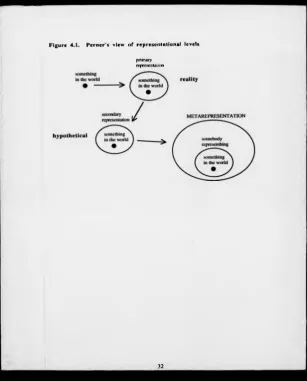
F ig u re 4.1. Pem er's view o f representational le v e ls ...32
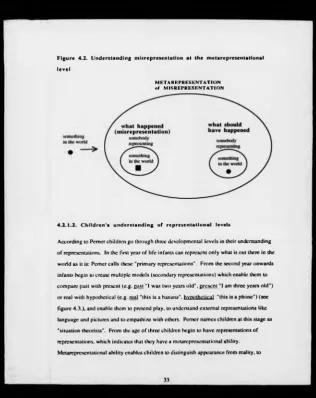
F ig u re 4.2. Understanding misrepresentation at the m etarepresentational level... 33
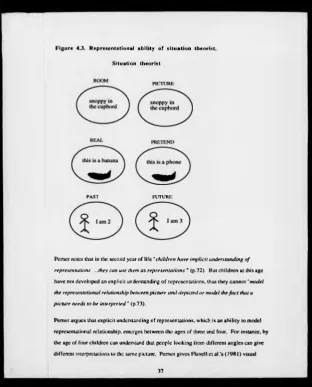
F ig u re 4.3. Representational ability o f situation theorist...37
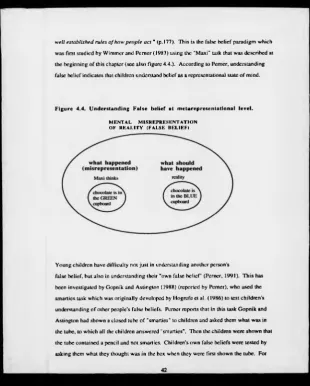
F ig u re 4.4. Understanding False belief at metarepresentational le v e l... 42
F ig u re 8.1. The percentages o f the subjects' correct responses in th e "own" and "other" conditions... 114
F ig u re 8.2. The representational skills required in experiment 1...120
F ig u re 9.1. The percentages o f correct differentiation o f "know" a n d "guess" in the "own" and "other" conditions for the five groups: low language level autistic children, high language level autistic children, four-year-old and five-year-old normal children, and children with Down’s syndrome...137
F ig u re 9.2. Plot o f BPVS age equivalencies in months for a u tism group for the conditions o f "own" and "other"... 146
F ig u re 9.3. Plot o f BPVS age equivalencies in months for n orm al children for the conditions o f "own" and "other"... 147
F ig u re 9.4. Plot o f BPVS age equivalencies in months for the au tistic group for the conditions o f "own" and "other" after excluding five children w ith the highest BPVS scores... 148
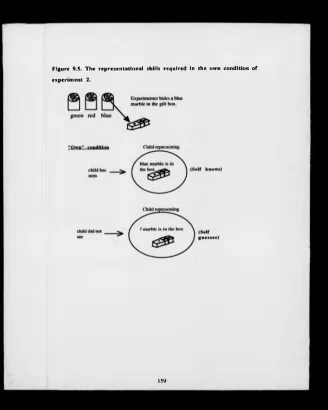
F ig u re 9.5. The representational skills required in the own c o n d itio n o f experiment 2...159
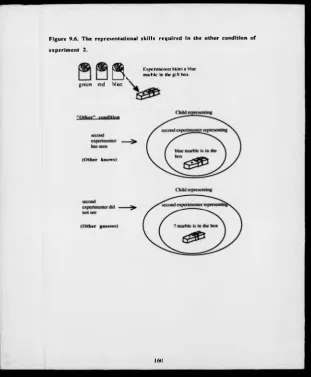
F ig u re 9.6. The representational skills required in the other c o n d itio n o f experiment 2...160
F ig u re 10.1. The percentage o f correct differentiation o f "know " an d "guess" for the ow n and other responses for five groups: low language level autistic children, high language level autistic children, four-year-old and five-year-old normal children, and children with Down's syndrome... 169
F ig u re 10.2. Representational skills required in experim ent 3 ... 176
F ig u re 11.1. Bar chart o f the m ean scores for the "know" and "help" tasks for four groups o f ch ildren...190
F ig u re 11.2. Bar chart o f the m ean scores for the "know" task com pared with chance lev el... 192
F ig u re 11.3. Bar chart of the m ean scores for the "help" task c o m p ared with chance level... 192
F ig u re 11.5. B ar chart o f the mean num bers o f correct answers to the positive and negative questions for the four groups of children... F ig u re 11.6. Representational skills required in experiment 4 ...
196 208 L IS T O F T A B LES
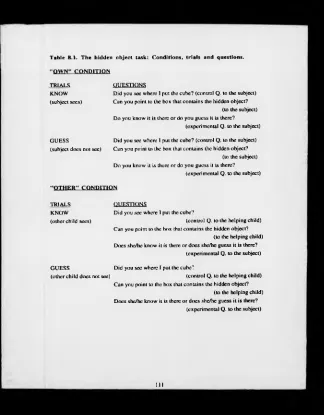
T a b le 2.1. Diagnostic criteria for a u tism ... 12 T a b le 8.1. T h e hidden object task: Conditions, trials and questions... I l l T a b le 8.2. T h e percentages o f the children's correct responses in the "own" an d "other" conditions for the different age groups... 114 T ab le 9.1. M eans and the ranges o f the language scores o f five experimental g roups on B P V S, RENFR EW and T R O G ... 131 T a b le 9.2. "W hich is the present?" task: Conditions, trials and questions...133 T a b le 9.3. Correct differentiation o f "know" and "guess" in the own and o th er conditions in percentages and the num ber o f children w ho passed and f a ile d ... 136 T ab le 9.4. Point Biserial correlations between the different language scores and the pass/fail dichotomy for own and other conditions for the groups o f autistic, normal and Down's syndrome children...138 T a b le 9.5. Pearson correlation coefficients between BPVS, TROG and
RENFREW INFORMATION and GRAM M AR scores for the groups o f autistic, normal and Down's syndrome children...139 T a b le 9.6. M eans for the emotional and non-emotional items passed for norm al and autistic children, with means adjusted for the effects o f covariates... 142 T ab le 9.7. A tw o way repeated measures analysis o f variance table... 142 T ab le 9.8. M aximum, minimum, m ean, range and standard deviations o f the language test scores for the normal, Down's syndrome children and for the autistic children before and after the exclusion o f five children who had very high scores on the BPVS...145 T a b le 9.9. Point biserial correlations between the different language scores an d the pass/fail dichotomy for the own and other conditions for the autistic, norm al and Down's syndrome groups before and after excluding five children from the autistic sample w ho had very high scores on the BPVS... 150 T a b le 9.10. Pearson correlation coefficients between BPVS, TROG and
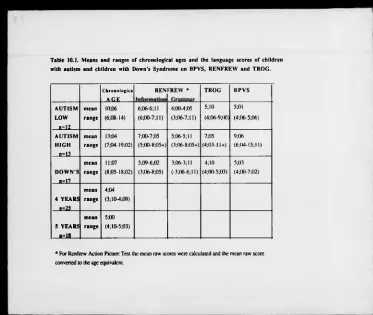
Table 10.1. Means and the ranges o f the language scores o f children with autism and children with Down's Syndrome on BPVS, RENFREW and TROG...163
Table 10.2. Animal hiding task: trials and questions...166
T ab le 10.3. Number o f children, and percentage o f each group, who correctly differentiated "know" and "guess" in the own and other conditions...168
Table 10.4. The num ber o f children w ho showed tw o the types o f response bias in e a c h g ro u p ... 171
T ab le 10.5. Mean scores for the own and other responses for five groups o f children...173
Table 11.1. Means and ranges o f chronological age, verbal MAs and nonverbal scores for the four groups... 182
T ab le 11.2. Trials, control and experimental questions for the "know" task...185
T ab le 11.3. Trials, control and experimental questions for the "help" task...188
Table 11.4. Mean scores for the "know" task and for the "help" task for the four groups o f children...190
T ab le 11.5. Mean num bers o f questions passed with reference to self and others for four groups o f children...194
Table 11.6. Mean num bers correct answers to the positive and negative questions by the four groups o f children...195
Table 11.7. Numbers and percentages o f children passing the false belief task, for the four g roups... 197
Table 11.8. Pearson correlation coefficients between BPVS, TROG and RAVEN scores and the "know" and "help" tasks for the autistic and normal children...198
Table 11.9. Point Biserial correlations between the pass/ fail dichotomy on the false belief task and the "know" and "help" tasks for the normal and the autistic ch ildren... 199
T able 11.10. Pearson correlation coefficients between BPVS, TROG and
RAVEN scores for the groups o f autistic and normal c h ild ren ...199
T able 11.11. Num bers and percentages o f children in each group passing the visual access and the experimental questions in the 'know' and 'help' task s...201
Table 11.12. Percentages o f children passing the false belief task, the 'know' and 'help' tasks...204
A C K N O W L E D G E M E N T S
This thesis would n o t have been possible w ithout the support and encouragement of certain people who I would like to thank and acknowledge. I am grateful to D r Glyn Collis and Dr Vicky Lewis for being excellent supervisors, for their unfailing advice, patience, guidance and support. Thanks also to the Turkish Education Ministry for financial support. I am indebted to all the teachers and the parents o f the children who took part in the experiments in this thesis, for their cooperation and help. 1 am grateful to all the children from the following schools: Whitnash Nursery, Moreton Morrell junior and Infant School, Sydenham First School, Woodloes First School, St. Pauls First School, Springfield House Special School, Baskerville School, Uffculme School, Vale o f Evesham Special School, Blythe Special School, Tyntesfield Special School, Brooke Special School, Mario Comelli Special School, Ridgeway Special School, Round Oak Special School, Tiverton Special School, Reynald C ross Special School, W ellesboum e First School, St Mary's Play Group, W alnuts School, A bbey Hill Unit, St Nicholas C ounty First School The Resource Unit. I would also like to thank to Roslyn Hill, Theresa Hatton, Allan Skelly, Nerys Mullings, Amanda Jay and Sue Hotson for acting as second experimenters. Thanks to Greg Milligan, Jim Brockbank, Andrew Barnacle and Martin Aldred for their technical support. I would like to thank to Chris Richley, Lynda W illiams and Amanda Ashton for office support.
I am grateful to A ndrew, "Robot" and Sue for reading the various chapters o f this thesis for English sense and grammar.
I would like especially to thank my close friends; Sue for her patience, understanding, support and sense o f humour; and Laura for her encouragement, advice, support and continuous optimism. I am indebted to Andrew for his unfailing support, understanding, patience, encouragement and his love.
I would like to thank to my brothers Ufuk and Um it for their encouragement and support Finally. I am grateful to my mother, for being a great loving mother, for her constant encouragement, advice, support and her prayers, despite the thousands miles between us. Thanks.
D eclaration
The w ork contained in this thesis has been carried out entirely by the author. None o f the material contained in this thesis has been used or submitted for a degree o r similar purpose before.
Sum m ary
This thesis examines the cognitive-psychological theory o f autism, specifically the "theory o f mind" account. According to this theory, autistic people lack the ability to attribute mental states to other people and this underlies their social communication difficulties. In the introductory chapters, autism is described, followed by a consideration o f different theoretical accounts o f the normal child's theory o f mind and empirical evidence on the autistic child's theory o f m ind. Finally, the introduction discusses w hether the different theoretical accounts can explain autism.
A series o f experiments are then described which investigated normal and autistic children's ability to understand knowledge as a mental state. Experiment 1 established a baseline for the subsequent experiments and included three groups o f normal children with mean ages o f four years nine months, five years nine m onths and six years nine months. In this experiment the children's ability to differentiate the cognitive m ental terms "know" and "guess" with reference to their own and another person's mental states was examined. Results o f this experiment indicated that all three groups o f children could differentiate "know" and "guess" in reference to their own and another person's m ental state. Experiments 2 and 3 compared the ability to differentiate "know" from "guess" with reference to their own and another persons mental state o f high language level autistic children, low language level autistic children, children with D own's syndrome, four-year- old and five-year-old normal children. Results o f these experiments showed that the high language level autistic children were able to refer to their and another person's mental state o f knowledge. In addition the results were related to a number o f measures o f language ability.
Experiment 4 compared the ability to attribute knowledge and ignorance to themselves and another person o f high language level autistic children, low language level autistic children, four-year-old and five-year-old normal children. In one task the experimental question involved the mental term "know", in another task, the term "could help" was used. Results o f this experiment showed that all four groups o f children performed significantly better in the "know" task than in the "help" task. Performances on the tasks w as again related to the children's language skills.
The thesis reaches tw o m ain conclusions. First that autistic children d o not totally lack a theory o f mind, since high language level autistic children were able to refer to their and another person's knowledge state. Second, autistic children's language level is a strong predictor o f their performance on theory o f m ind tasks. The thesis concludes by discussing a num ber o f issues involved in autism research and indicating future directions for research.
1. C H A P T E R O N E
General Introduction
Arthur S. Reber (1985) defines psychology as:
. .what scientists and philosophers o f various persuasions have created to try to fu lfil the need to understand the minds a n d behaviours o f various organisms fro m the most primitive
to the most co m p lex. As a distinct discipline it finds its roots a mere century o r so back in
the faculties o f medicine and philosophy. From medicine it took the orientation that
explication o f that which is done, thought and fe lt ultimately must be couched in biology
and physiology, fro m philosophy it took a class o f deep problems concerning mind, will and knowledge. Since then, it has been variously defined as "the science o f m in d ," "the
science o f mental life," "the science o f behaviour " (underlining added to emphasize,
P-593).
Psychological research can contribute greatly to our knowledge and understanding o f some conditions which m ay still be a puzzle to medicine. One such condition is autism w hich is recognized by severe social communication difficulties and abnormal language patterns. Understanding the underlying cause or causes would have practical implications for the treatment and education o f people with autism. While biological research aims to investigate what causes the autistic condition, and asks questions such as "Is it a hereditary condition?" "Do autistic people have an abnormal brain structure?" "Do autistic people have an abnormal brain chemistry o r physiology?" etc., psychological research aims to investigate which cognitive mental processes are deviant in people with autism, and also to investigate whether any cognitive malfunctioning, which is specific to autism, can underlie the social communication difficulties of autistic children.
According to the current cognitive theory of autism which is known as "theory o f mind", autistic children's inability to attribute mental states to themselves and others might be an underlying factor for their social communication difficulties (Baron-Cohen et al. 1985,
1986). T he theory of mind account o f autism proposes that if a child is unable to understand other people's m ental states such as, what they know, think, believe etc., he/she will not be able to predict how other people will behave. In o ther words,
the social world would seem chaotic, confusing a nd may be therefore even frightening. A t
worst this m ight lead one to withdraw fro m it completely, but at the very least it might lead
to very o d d attempts at interaction with people, treating them as lacking 'minds', and therefore behaving towards them in a similar nutnner to the way one approaches inanimate
objects. . .the behaviour o f people with autism is often described in these terms ." (Baron- Cohen. 1990b, p.83).
Thus it seems that an investigation o f the different aspects of the theory o f mind ability in autism, m ay provide a better understanding o f this condition. This thesis is an attempt to contribute further to our knowledge about autistic people and also to o u r understanding of normal children's development. Specifically, it focuses on autism, and involves the investigation of both autistic and normal children's understanding o f knowledge as a mental state. In a series of experiments it aims to investigate, whether autistic children and adolescents can differentiate mental terms such as "know" from "guess", and "know" from "not know ", in referring to their own and others’ mental states.
Since this thesis is primarily about the theory o f mind explanation o f autism, in the following five chapters firstly, autism will be described, then the theoretical approaches to the child's "theory of mind" will be reviewed, and finally in the light o f empirical evidence, how these accounts explain autism will be discussed. The content of the five chapters is as follows:
Following this introductory chapter the second chapter, will familiarize the reader with autism. This chapter begins with a section on "W hat is autism?". This section explains how and who first recognized the autistic condition. The following section considers the question "Is Asperger's Syndrome on a continuum with Kanner's Autism ?", discussing whether autism and Asperger's syndrome are different conditions, o r alternatively whether
autism is a continuum and Asperger's Syndrome falls at the top end o f this continuum. It seems important to report this recent dispute -whether the difference between the two conditions o f autism and A sperger's Syndrome is qualitative or quantitative- since some of the autistic subjects included in the experiments in this thesis, were highly able autistic children and adolescents and therefore possibly Asperger's Syndrome.
A num ber o f diagnostic criteria arc available which researchers could use to define their autistic sample. In the next section which is "Diagnosis o f autism today”, the most frequently referred diagnostic criteria for autism will be reported. Then in the "What causes autism?" section the findings from biological research which strongly suggest that autism is a biologically caused condition will be considered briefly.
In chapter three, the cognitive psychological explanations o f autism will be outlined. The first section reminds reader o f the important advances in the understanding o f autism with the progressing psychological research up to now. Then in the following section the current cognitive psychological theory of autism, the "theory of mind" account will be introduced.
In chapter four, the different theoretical approaches to the theory of "theory of mind" will be outlined. Firstly the term "theory of mind" is defined, then the outline o f theory o f mind research with normal children is given. Then, in the following three sections, theoretical accounts due to Pemer, Leslie and Wellman which agree on the view that children develop a theory o f mind, will be explained. Next the theoretical accounts o f Harris and Hobson, which argue against the theory o f "theory o f mind", will be reported.
The m ajor part o f chapter five considers the empirical evidence on w hether autistic children lack a "theory o f mind", and in the final part o f this chapter the research on autistic children's understanding o f em otions will be reported.
In this thesis, in order to investigate autistic children's understanding o f knowledge as a mental state, their differentiation o f mental terms "know" and "guess" is tested. Thus, in chapter seven firstly, normal children's production and comprehension o f cognitive mental terms will be explained, followed by a discussion o f when normal children begin to understand knowledge as a mental state.
The following four chapters (8-11) report four experiments which were carried out to investigate firstly at what age normal children can differentiate "know" from "guess” with reference to their and to other people's mental states, and then whether autistic children are able to differentiate these mental terms with reference to their own and to other people's mental states.
Finally, chapter twelve discusses the findings (from a total of 33 autistic children across the experiments) in relation to the theory of mind account of autism and the various methodological issues o f the research in this area.
2. C H A P T E R T W O
Introduction to autism
2 .1 . W hat is autism ?
A utism is a developmental disorder which was first defined by Kanner (1943) who identified a peculiar pattern o f behaviours. He presented case studies o f 11 children and argued that despite the individual differences in these cases, they all had common characteristics distinctive from children with mental handicap or with childhood schizophrenia. These characteristics were as follows:
language - some o f these children had no speech, or if speech was developed, they were unable to use it communicatively;
excellent rote memory -they could memorize numbers, poems, lists o f names, and nursery rhymes;
delayed echolalia -they repeated the utterances they heard and stored in the previous days;
literalness -they had an inability to use words other than as originally used;
personal pronouns repeated as heard -they were unable to use personal pronouns according to the changing speaker;
inability to relate themselves to other people -they showed an inability to develop relationships with other people, they seemed to be unaware or ignorant o f other people;
extreme autistic aloneness -they had a tendency to ignore anything coming from outside w hich could threaten self preservation;
cognitive potentialities -they had an intelligent facial appearance;
physically -they had norm al physical appearance.
A year after Kanner's paper was published, Asperger published very similar account. Asperger (1944)1 provided detailed case descriptions and discussed the common features o f these cases. Like Kanner, Asperger also argued that although there were individual differences, all these cases had strongly distinct features which w ere present from the second year of life. T h ese characteristics were as follows:
autistic intelligence -these children were not able to follow what w as required from school for learning; on the o th er hand they might show excellent m emory skills and be very good or knowledgeable in the area that they developed exceptional interest; they displayed superb abstraction abilities; they could spontaneously invent original expressions or words which were well suited to th e situation;
physical appearance a n d expressive characteristics -the use o f gaze for communication appeared to be absent in these children, although they might show stereotypic movements they did not display an y facial or bodily gestures and they avoided looking at people, their use o f language seem ed to be odd and unnatural as if they were not speaking to people but to space;
social relationships -they showed an inability to develop normal relationships with people, they tended to ignore o ther people and other activities, but appeared engrossed in their own activities;
drive and affect -they might comply with their sexual or sadistic urges regardless o f the acceptability o f these acts, and they were unable to show any affection to people;
1 Translated by Uta Frith (1991)
relation to objects their relations to objects appeared to be odd too, they might ignore toys totally but develop an obsession with one object. Asperger called the existence o f these distinct features autistic psychopathy or autistic personality type.
Kanner (1943) and Asperger (1944) both listed distinctive behavioural features w hich they observed over the years in tw o groups o f children, which were comm on within each group despite the individual differences. They both emphasized as main features o f autism an inability to develop normal relationships with other people, communication difficulties, unawareness or ignorance o f outside world but exceptional interests and superior skills. However there seem to be som e differences between the two accounts. W hile Kanner stated that some children had no speech, or if speech had been acquired these children displayed delayed echolalia and reversal o f personal pronouns, A sperger reported the presence o f odd and unnatural language but did not mention any case without any speech. Although Kanner (1943) and Asperger (1944) are both recognized now a s the pioneers of autism, for a long time researchers have referred to Kanner's work but not to Asperger's (Frith, 1989). Today, after the revisions o f their accounts by the original authors and by other researchers there is an ongoing debate w hether the Asperger Syndrom e is different from autism, or whether autism is a continuum and Asperger Syndrome is the top end of this continuum. This issue is important in the evaluation o f research in autism because if there is a qualitative difference between the two conditions, than autistic samples included in autism research should be clearly defined. In the next section the reviews and the studies which argue the similarities and differences between autism and Asperger's Syndrome will be reported.
2.2. Is Asperger's S y nd rom e on a continuum with K anner's A u tism ?
major differences as follows: early infantile autism is present by the age o f one; a child with autism has none or retarded speech and fails to use language communicatively; he/she starts walking before he/she starts speaking; a child with autism displays poor eye contact which is due to his/her autistic aloneness, and their social impairment show poor prognosis. In contrast autistic psychopathy is a personality trait and not present before the age of three, a child with autistic psychopathy starts speaking before he/she can walk and m akes attempts to communicate even if it is not appropriate, and their social impairment shows good prognosis. Furthermore Szatmari et al. (1986) argued that the available evidence is not sufficient to conclude that autism and Asperger's Syndrome are the same entities. They suggested that the term Asperger’s Syndrome should be m aintained until studies prove that autism and Asperger's Syndrome have comparable "etiology, prognosis, and response to treatm ent" (p.517).
Other studies have looked closely at the similarities and differences between autism and Asperger's Syndrome, and have suggested that these two entities should be seen as on the same continuum. For instance Bowman (1988) reported a family o f four brothers and a father who all displayed features o f autism or A sperger's Syndrome and suggested that the difference between autism and Asperger's Syndrom e "could be explained on the basis o f severity " (p.381). Further, Bowman (1988) argued that looking at the diagnostic criteria o f autism today (Rutter, 1978), Asperger's original features (Asperger, 1944), and W ing’s (1981) diagnostic criteria for Asperger's Syndrome, it does not seem that there is a clear- cut difference between autism and Asperger's Syndrome.
Similarly, Tantam (1988) highlighted the close relationship between the infantile autism and Asperger's Syndrome. He regarded the two conditions as falling into the autistic spectrum, and suggested that it would be right to use the term Asperger's Syndrome to refer to autistic children who a) are willing to be social but unable to develop relationships with people, b) are clumsy c) are unable to change their language "to f it different social contexts o r the needs o f different listen er", d) are impaired in their use o f non-verbal expressions like facial, gestural and posture and e) who have odd obsessive interests.
Gillberg & Gillberg (1989) conducted an epidomological study in G öteborg in 1977 and screened all 6 year old children who did not have mental retardation. They found 14 children showing m otor clumsiness and attention perception deficits. T hey followed up these children and found that 8 of the 14 children showed autistic type behaviours at the age o f 7 ,4 children had all the diagnostic criteria for Asperger’s Syndrome and th e remaining four children fulfilled either three or four o f these criteria. In the light of these results Gillberg & Gillberg (1989) suggested a hypothetical continuum from severely mentally retarded "triadpatients " at one end (Wing, 1981b, cited by Gillberg & G illb erg , 1989), then Kanner's autism, then Asperger's Syndrome and then children with attention, perception deficits.
In a recent book on autism and Asperger's Syndrome edited by Frith (1991), G illberg described six cases o f Asperger's Syndrome and argued that all six cases had features which are common to autism. These characteristics were: inability to attribute mental states o f thinking and feeling to other people, showing difficulties in the areas o f pragmatics, semantics and comprehension of language and having stereotypic motor m ovem ents in childhood but later they learn to control these behaviours. He emphasised th e motor clumsiness as the m ain differentiating feature between autism and Asperger's Syndrome. In conclusion Gillberg noted that there is a close link between the two entities. Some children demonstrate features of autism in their childhood, but later in life th eir condition might change so that they then fulfil the criteria for Asperger's Syndrome. A lso some children with autism could be initially diagnosed as having Asperger's Syndrom e. However there are some cases o f Asperger’s Syndrome which do not fulfil the features of infantile autism or autistic disorder.
impairment but characterised, at least in the earlier years o f childhood, by somewhat
differing profiles o f cognitive, language a n d motor functions " (Wing, 1991, p. 115). Wing (1991) further noted that while the intelligence o f a person with Asperger's Syndrome ranges from mildly retarded to superior, a person with Kanner's autism displays severe retardation on general intelligence scales but their non-verbal intelligence would be in the range o f mildly retarded to superior. In addition she argued that although some more able autistic children in their adult life may show features similar to Asperger's Syndrome, retaining the term Asperger's Syndrome in the autism continuum, rather than referring to it as high functioning autism, would lead to further research to investigate the underlying causes.
W ing (1991) argued for the practical advantages of keeping the term Asperger's Syndrome. She noted that the term autism could be thought of as the severe form of the condition, for some families it would be easier to accept that their child has a condition called Asperger's Syndrome which is towards the top end o f autistic continuum. Secondly, the use of Asperger's Syndrome among other professionals like psychiatrists, may bring about an understanding that even though a child is not diagnosed as autistic later in their life, they may be referred for special help with autistic like deficits. However Scopler (1985) suggested that the term Asperger's Syndrome should not be used since there is not enough evidence to support a clear difference between Asperger's Syndrome and high functioning autism. Similarly Volkmar et. al. (1985) argued that existing evidence was not sufficient to differentiate autism from Asperger's Syndrome clearly.
There is further evidence to suggest that high functioning autism is not different from Asperger's Syndrome. To investigate the role o f familial psychopathology for the etiology o f autism, DeLong & Dwyer (1988) collected the family histories of 51 people who had autism or pervasive developmental disorder. They concluded that high and low functioning autism have different etiologies. Low functioning autistic people tend to show neurological pathology, whereas high functioning autistic people have familial etiology. They further argued that high functioning autistic people could be diagnosed as having Asperger's
Syndrome, thus high functioning autism and Asperger's Syndrome are basically the same entities both with familial etiology.
Recently some studies have compared people with high functioning autism to people with Asperger's Syndrome, in order to investigate whether the two entities could be clearly differentiated. Szatmari et al. (1989, cited by Ozonoff, Rogers and Pennington , 1991) found that Asperger's Syndrome people differed from the high functioning autism group not only in their early histories but also in their outcome. People with Asperger's Syndrome showed less impairment in communication, social responsiveness and circumscribed interests, furthermore their need for special education was less than high functioning autistic people. In a further study by Szatmari et al. (1990, cited by Ozonoff, Rogers and Pennington , 1991), the differences between the two groups on intelligence, neuropsychological and achievement tests were not marked enough to conclude that autism and Asperger's Syndrome are different entities.
However, Ozonoff, Rogers and Pennington (1991) found significant differences between people with high functioning autism and those with Asperger's Syndrome. High functioning autistic people were inferior to people with Asperger's Syndrome on theory of m ind and verbal memory tests. However executive function, which is defined by Ozonoff Pennington and Rogers (1991) as “the ability to maintain an appropriate problem solving se t fo r attainment o f a future goal " (p. 1083), w as a deficit shared by both high functioning autism and Asperger's Syndrome groups. Ozonoff, Rogers and Pennington (1991) argued that the reason for the Asperger's syndrome children's ability to pass theory o f mind tasks w as that they might be using different strategies to solve these tasks, and the authors noted that more sensitive tasks should be developed to test the theory o f mind ability. Ozonoff, Rogers and Pennington (1991) further suggested that perhaps executive function and theory o f mind deficits are primary to the autism continuum.
idea o f an autistic continuum and they seem to see Asperger's Syndrome as a subgroup of autism which includes more able autistic people. In addition, while some researchers want to retain the term "Asperger's Syndrome", others argue that there is no need for this term. To date, the evidence does not seem to be sufficiently clear to justify any conclusions. M ore neuropsychological and medical research is needed, to clarify whether the difference between the Asperger's Syndrome and autism is qualitative or quantitative.
In the next section, the international criteria for the diagnosis of autism will be described.
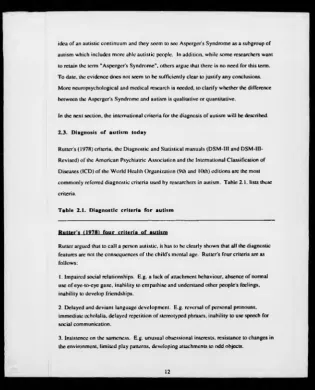
2.3. D iagnosis o f au tism today
Rutter's (1978) criteria, the Diagnostic and Statistical manuals (DSM-III and DSM-III- Revised) of the American Psychiatric Association and the International Classification of Diseases (ICD) of the W orld Health Organization (9th and 10th) editions are the most commonly referred diagnostic criteria used by researchers in autism. Table 2.1. lists these criteria.
T ab le 2.1. D iagnostic criteria fo r autism * 1 2 3
R utter’s (1978) fo u r criteria o f autism
Rutter argued that to call a person autistic, it has to be clearly shown that all the diagnostic features are not the consequences of the child’s mental age. Rutter's four criteria are as follows:
1. Impaired social relationships. E.g. a lack of attachment behaviour, absence of normal use o f eye-to-eye gaze, inability to empathise and understand other people's feelings, inability to develop friendships.
2. Delayed and deviant language development. E.g. reversal o f personal pronouns, immediate echolalia, delayed repetition o f stereotyped phrases, inability to use speech for social communication.
3. Insistence on the sameness. E.g. unusual obsessional interests, resistance to changes in the environment, limited play patterns, developing attachments to odd objects.
[image:27.365.20.336.28.419.2]4. Age of onset before 30 months.
D iagnostic criteria o f in fa n tile autism--- P S M -III (APA . 1S>80. p.SSHMD
In DSM-III infantile autism is classified under the general category of pervasive developmental disorders which w ere identified with the deficiencies o f attention, perception and motor movements.
A. Age of onset before 30 months.
B. Pervasive lack o f interest and responsiveness to other people. C. Gross deficits in language development.
D. If speech present, peculiar speech patterns such as immediate and delayed echolalia, metaphorical language, pronominal reversal.
E. Bizarre responses to various aspects of the environm ent, e.g., resistance to changes in the environment, attachment to o dd objects, peculiar interests.
F. Absence o f schizophrenic symptoms. 1 2 3 4 5
D iagnostic criteria o f au tistic disorder___ D S M -lll-R (A PA . 1987. p.38-39)
In the revised version o f DSM-III, due to invalidation o f age of onset, the two categories of Infantile Autism and Childhood Onset Pervasive Developmental Disorder were combined into one category o f Autistic disorder under more general category o f Pervasive developmental disorders.
A. Qualitative impairment in reciprocal social interaction as manifested by at least two o f the following features:
1. marked lack o f awareness o f the existence or feelings o f others; 2. no or abnormal seeking o f com fort at times o f distress; 3. no or impaired imitation;
4. no or abnormal social play;
5. gross impairment in ability to m ake peer friendships.
1. no mode o f communication, such as communicative babbling, facial expression, gesture, m ime, o r spoken language;
2. markedly abnormal nonverbal communication, as in the use of eye-to-eye gaze, facial expression, body posture, or gestures to initiate or m odulate social interaction; 3. absence o f imaginative activity, such as play-acting o f adult roles, fantasy characters, or animals; lack o f interest in stories about imaginary events;
4. marked abnormalities in the production of speech, including volume, pitch, stress, rate, rhythm, and intonation;
5. marked abnormalities in the form or content of speech, including stereotyped and repetitive use o f speech;
6. marked impairment in the ability to initiate or sustain a conversation with others, despite adequate speech.
C. Markedly restricted repertoire o f activities and interests, as manifested by at least one of the following features:
1. stereotyped body movements e.g.hand flicking;
2. persistent preoccupation with parts of objects or attachment to objects; 3. marked distress over changes in trivial aspects o f environment; 4. unreasonable insistence on following routines in precise detail;
5. markedly restricted range of interests and preoccupation with one narrow interest. D. Onset during infancy or childhood.
D iagnostic criteria o f childhood autism ---IC P -1 0 (W HO. 1987)
1. Qualitative impairments in reciprocal social interaction; 2. Qualitative impairments in communication;
C. Restricted, repetitive, and stereotyped patterns o f behaviour, interests and activities; D. Developmental abnormalities must have been present in the first 3 years for the diagnosis to be made (quoted from Gillberg, 1990, p.103).
Although these different sets of criteria for autism seem to differ in terms of details, they all emphasize impairments in social relationships with people, qualitative impairment in language and communication, and stereotypic patterns o f behaviours and interests as the
m ain features o f autism. The only difference between the DSM-III-R and the other diagnostic criteria is the criterion about the age of onset. In DSM-III-R age o f onset is not restricted to the first 3 years o f life.
2 .4 . W hat causes autism ?
Other authors have proposed that it is an interaction between abnormalities (vulnerability) autistic children already have and environmental factors which cause the autistic condition (Wing, 1983). For instance. Wing (1983) reports that Tinbergen and Tinbergen (1972) argued that, like every infant, an autistic child has a fear o f others; if the parents of an autistic child are not sensitive to the needs o f their child and fail to protect him/her from too much exposure to strangers, this chronic fear could lead to autism. However, this proposal lacks any experimental evidence and it is highly unlikely that chronic fear could lead to a condition characterized by qualitative language impairment, stereotyped behaviour as well as social communication difficulties.
In sum, early theories suggesting that autism had psychological causes -such as parental abnormalities (parents are cold, detached, formal, unsociable and belonging to a higher social class); or abnormal child rearing practices; or parental pathology - cannot be supported from the available evidence (Wing, 1983). On the contrary, it has been accepted by the m ajority o f authors that autism is a disorder with multiple biological causes (Gillberg, 1990; Frith, 1989; Folstein & Rutter. 1988).
2.4 .1 . G en etic evid en ce
The role o f genetic factors in autism has been shown by recent studies. One of the difficulties in genetic studies of autism is that it is very rare for autistic people to have children. For this reason, working with the siblings o f autistic children appears to be the best way to investigate the possibility o f familial inheritance in autism (Silliman et. al., 1989). A study of an autistic twin population included twin pairs where at least one of the twins m et the criteria for autism which was “a serious impairment in the development o f social relationships, delayed o r deviant language development, and also stereotyped
repetitetive o r ritualistic play and interests " (Folstein & Rutter, 1977, p.299). The results o f this study has shown that in monozygotic pairs the concordance rate o f autism was 36% whereas in dizygotic pairs it was 0%. In addition in monozygotic twins the concordance rate for general cognitive abnormalities was 82% whereas in dizygotic pairs it was 10%
Folstein & Rutter (1977) concluded that the difference of concordance rate between the monozygotic and dizygotic twin pairs indicate the role of genetic factors in the aetiology.of autism. Furthermore it has been argued that more general disorders such as low intelligence and language and reading problems seem to have higher rates o f occurrence in the families o f autistic people (Bartak et al., 1975, cited by Folstein & Rutter, 1988 ; Folstein & Rutter, 1977). Folstein and Rutter (1988) suggested that if the m ore general language and intellectual deficit is inherited, that could explain the relation between the birth complications and the occurrence of autism. They suggested that since among the monozygotic twins who were not concordant for autism, the twins who had autism tended also to have birth complications, whereas their co-twin who had a general cognitive deficit did not have birth complications. Thus perhaps the inheritance of a general language- cognitive deficit combined with birth complications leads to autism.
Among the other genetic factors, single gene disorders have been suggested to be related to autism. For instance, fragile-X syndrome, tuberous sclerosis, neurofibromatosis, phenylketonuria (reported by Folstein & Rutter, 1988; Silliman et. al.,1989 and Steffenburg & Gillberg, 1989) have been implicated.
2.4.2. P re- Peri* and Neonatal factors
available evidence is far from suggesting that there is single path between these complications and the incidence o f autism.
2 .4 .3 . In fectio u s D isea ses
It has been suggested that congenital rubella, congenital cytomegalovirus and herpes may be associated with autism. However further extensive research is necessary to establish a cause-effect relationship (reported by Frith. 1989; Tsai, 1989 and Steffenburg & Gillberg, 1989).
2 .4 .4 . N eu ro p a th o lo g ica l stu d ies
Very few neuropathological studies have been reported. The most important one seems to be a single case study o f a 29 year old autistic man compared to an age and sex matched person by Bauman & Kemper, 1985 (cited by Golden, 1987). They found increased cell picking in the amygdala, reduced size of neurons, a lamina desicans in the entorhinal cortex, and a loss o f Purkinje and granule cells in the cerebellum. T he loss o f purkinje cells in the cerebellum in autistic people has been found also by Ritvo et. al. (1986, cited in Tsai, 1989).
2 .4 .5 . N eu ro ra d io lo g ica l evid en ce
Studies using computerized tomographic (CT) scanning have not being able to detect consistent abnormalities which were not related to other neurological diseases. However studies using midsagittal magnetic resonance imaging (MRI), found that the fourth ventricle was larger and the brain stem was smaller in autistic people. In addition MRI scanning showed that in comparison to normal people, high functioning autistic people had neocerebellar damage (reported by Tsai. 1989 and Steffenburg & G illherg, 1989).
2 .4 .6 . N eurochem ical ev id en ce
At present the neurochemical evidence does not seem to be sufficient to come to any conclusions about the etiology o f autism. However there are some studies indicating that
autistic people are significantly different from control samples "in platelet serotonin uptake, fre e blood trytophan, urinary HVA -creatinine ratio, circulating antibodies to 5H T 1A
receptors or myelin basic protein ” (p.277, Y uwiler & Freedman, 1987). Further research is needed in order to understand the role o f neurochemical factors in autism.
2 .4 .7 . N e u ro p h y sio lo g ica l ev id en ce
Neurophysiological research in autism seems to suggest dysfunction both at the brainstem and at the cortical level. Results of EEG studies appear to indicate that autistic people have abnormal cerebral lateralization which supports the cortical-dysfunction hypothesis of autism (Tsai, 1989). In addition it has been found that autistic people have smaller P3b responses (indicating cognitive responses to stimuli) in comparison to controls. (P3b is "a component occurs 300-900 ms after stimulus which represents purely cognitive Junctions " , Tsai, 1989, p.94). Tsai, (1989) argued that all these findings indicate "a diminished or altered capacity fo r selectively channeling information fo r further internal attention and
processing, as well a s that differential hemispheric involvement in the attentional deficits " (p.95) in autistic people. Furthermore studies o f vestibular function, autonomic responses, and auditory brainstem responses seem to support, the hypothesis o f brain stem dysfunction in autism (reported by Tsai, 1989 and Steffenburg & G illberg, 1989). In sum, present evidence seem to suggest that a number o f factors: neurobiological, genetics, pre- perinatal complications, infectious diseases, appear to play some role in the causation of autism. Although it is clear that autism has definite biological causes not psychogenic, it is not possible to suggest a single cause which leads to the autistic condition.
2 .5 . Sum m ary
Finally, the evidence from biological research have been m entioned briefly. The evidence strongly suggests that autism has biological causes. However, whatever the cause (or causes), it is effecting certain brain systems which may be responsible for the autistic behavioural features o r m ore specific cognitive ability. For instance, recent cognitive psychological research indicate that autistic people are impaired in their theory of mind ability -the ability to attribute mental states to oneself or to others, which has been suggested as the possible reason for autistic people's communication difficulties. In the next chapter firstly, the cognitive psychological explanations o f autism prior to the theory of mind account will be reported. Then a brief outline o f the theory o f mind explanation of autism will be given.
3. C H A P T E R T H R E E
C ognitive app ro a ch es to autism
3.1. C ogn itive explanations pre*dating theory o f m ind
Since the first recognition o f autism by Kanner 1943 our understanding o f this condition has greatly expanded. With the increase in empirical research into autism and also into normal child development, researchers have increasingly sought a cognitive understanding o f autism. Thinking has changed from a view that psychological factors, such as cold parents, are the primary underlying cause o f autism, to a view which proposes cognitive impairments as the primary underlying factor.
Researchers who have taken the cognitive approach to autism have emphasized various cognitive impairments as the primary basis o f the social impairment o f autistic people. These areas include, general intellectual skills, language, information processing skills, memory, coding processes and symbolic use.
The use o f standardized intelligence tests in the investigation of autistic children's general cognitive functioning, seems to be important in two ways. First, the general intelligence tests measure two types o f cognitive functioning, information storage and cognitive processes, so autistic children's performance on the specific subtests indicate the nature of their impairment (Sigman et al., 1987). Second, the relationship between general cognitive ability and social functioning should indicate, whether or not general cognitive functioning is the primary underlying factor in autism.
scales of comprehension, vocabulary and similarities subtests. Non-autistic mentally retarded children had similar scores on the verbal and performance scales (reported by Sigm an et al., 1987).
Several studies have indicated both that the social impairment in autism can not account for the impairment in general intellectual skills, and that the general cognitive deficit can not cause the impairment in social skills, since there are autistic children with normal intellectual abilities and there arc mentally handicapped children, such as children with Dow n's Syndrome who do not show the social impairments characteristic o f autism (Rutter & Lockyer, 1967; DeMyer e t al., 1974 cited by Rutter, 1983). However the general cognitive abilities o f autistic children do seem to predict the level o f social impairment. For instance, Bartak & Rutter (1976) (cited by Shah & Wing, 1986) found that autistic children who had nonverbal IQs below 70, displayed severe social impairm ent in comparison to the autistic children with IQs above 70. Other studies have found sim ilar results, reporting that overall IQ was the best predictor of autistic children's social adaptation level (DeMeyer, 1976; Rutter, 1970; Lotter, 1974; Dawson & Everard, 1984, cited by Shah & W ing, 1986 and Rutter, 1983). Epidemlogical study by Wing & Gould (1979) (cited by Shah & Wing.
1986) showed that autistic children's varying levels o f cognitive abilities were related to their communication and social adaptation levels. However the sam e study also showed that this relation was applicable to other mentally retarded children. In addition Shah & W ing, (1986) reports W ing’s (1981a) suggestion that differing degrees of overall intelligence was related to qualitatively differing degrees of social adaptation. For instance, while severely mentally handicapped autistic children were "completely aloof and indifferent to others and who really could be described as "treating people like objects
(p.155), intellectually normal autistic children were willing to socialize with people, were aware o f the social environment but had subtle social cognitive problems, ”... shown in the naive and one-sided approaches made to others and a tendency to talk on and on about a
lim ited range o f special interests ” (p.155), and autistic children with mild mental retardation showed differing degrees of social impairment, they "passively accepted, and
quite enjoyed, social approaches made by others, b u t" they "rarely o r never initiated approaches themselves " (Shah & Wing,1986, p.155).
In sum, findings from several studies seem to suggest that there is a relation b etw een the severity o f autism and general cognitive ability, but this does not indicate a cause-effect relationship. In other words, general cognitive impairment cannot be the u n derlying factor in autism.
The commonality o f language deficiencies among autistic children led some researchers to hypothesize that perhaps faulty cognitive processes related to language and u n d erlay the impaired social characteristics of the autistic condition. Researchers such as R u tte r (1965) and Churchill (1972) (cited by Prior, 1984) emphasized the similarities betw een developmental dysphasic children and autistic children. While Rutter (1965) suggested that
"an aphasic-type disorder is probably a central element in the development o f m a n y cases o f
appropriate language in a given context (Tager-Flusberg, 1981 cited by Shah & Wing, 1986).
In sum, it appears that receptive language impairment can not account for autistic social impairment, it is clear that autistic children's impaired language is qualitatively different than dysphasic children’s. Research findings suggest that language impairment is an essential part of autism, even if autistic children develop certain level of spoken language, they still seem to fail to have conversations which require pragmatic as well as language skills. However one thing still seems to be unknown whether language impairment specific to autism has any underlying effect on the social impairment o f these people. Information processing skills is another important area which has been investigated in autism research. Hermelin and O'Connor (1970) compared autistic, normal and mentally handicapped children in series of experiments, and reported that although autistic children's performance in these experiments was related to their intellectual level, autistic children showed perceptual abnormalities especially in response to auditory stimuli. They also displayed shorter fixation tim es to visual stimuli. In other experiments these authors presented the three groups o f children with lists o f words which were either randomly or non-randomly ordered. They found that autistic children did equally well in recalling these lists while normal and mentally retarded children did better if the list was not random but meaningful. Hermelin and O'Connor (1970) suggested "the inability o f autistic children to encode stimuli meaningfully a s their basic cognitive deficit " (p. 129).
Furthermore Hermelin (1983) argued that it is not the selective perceptual impairment but an impairment in the processes involved in storing the information independently from its modality which appears to be central to autism. She noted that autistic children show good short term memories but that what seems to be missing is the processing and coding o f this information in these children. If the child cannot code and store incoming information, with an increasing amount o f information the short term memory system would break down and may cause inappropriate behaviour. In sum, Hermelin (1983) concluded that.
"This cognitive pathology seems to consist largely o f an inability to reduce information
through the appropriate extraction o f crucial features such as rules and redundancies. The impairment in these processes imposes well remembered, stereotyped and restricted
behaviour patterns, which become increasingly inappropriate as the requirements fo r
complex, flexible codes increase. It is in the areas o f language development and social
interaction, which are governed by such complex and flexible rules, that the autistic child's cognitive impairment becomes m ost evident " (p. 167-168).
Another area o f cognitive research is discrimination learning. It has been shown that autistic children are unable to solve problems which involved two-dimentional symbolic stimuli. However, when autistic children were presented with concrete three dimensional stimuli they were able to solve the problems. The conclusion w as that autistic children had problems with symbolic material which differentiated them from the mentally handicapped children (Prior, 1977 and Prior & M cGillivray, 1980 reported by Prior, 1984). Further studies have shown that autistic children were also impaired in their symbolic play skills, which led researchers to conclude that autistic children with varying degrees of intellectual abilities, have "a syndrome-specific problem with symbolic m aterial " (Prior. 1984, p .l 1). In sum, evidence seem to suggest that autistic children show impairment in their information processing skills and discrimination learning. However one thing still seems to be unknown whether these impairments are specific to autism, and have any underlying effect on the social impairment o f these people. For instance, Hermelin and O'Connor (1970) found that autistic children's performance on the information processing tasks was related to their intellectual abilities which may suggest that there were some autistic children who could perform well on those tasks.
3.2. Introduction to the "theory o f mind" acco u n t o f autism
The theory o f mind account proposes that autistic children's inability to attribute mental states to themselves and others underlies their specific social communication difficulties. It is argued that: If a child is unable to understand other people’s mental states he/she will not be able to predict the social behaviour o f others and this could make the world a confusing place for the child (Baron-Cohen, 1990b).
The theory o f mind view of autism began with studies by Baron Cohen et al. (1985, 1986) which showed that autistic children were significantly worse than 4-year-old normal children and verbal MA matched Down's syndrome children, in their ability to attribute a false belief to a story character. Baron Cohen e t al. (1985) concluded that autistic children had a specific cognitive deficit in their theory o f mind. Several other studies have supported the findings of Baron-Cohen et al. (1985) that autistic children lack a "theory of mind" (Pem er et al., 1989; Leslie & Frith, 1988; Baron-Cohen, 1989a; Russell et al., 1991).
Around the same time Leslie (1987) formulated the theoretical model of a representation mechanism (decoupler). According to this model, the decoupler mechanism produces secondary representations which are representations o f representations - for this reason Leslie called them metarepresentations. Leslie (1987) emphasised that autistic children were impaired not only in their theory o f mind but also in pretend play which both require metareprcsentational skills. Thus the decoupler m echanism underlies both the child's theory o f mind and pretend play skills. In other words Leslie (1987) suggested that autistic children's specific cognitive deficit could be due to an impaired decoupler mechanism which is responsible for metarepresentational skills. This model will be explained in detail in chapter 4.
In summary, the theory of mind account of autism proposes that the impaired decoupler mechanism is the underlying factor for in autistic child's impaired theory o f mind which itself underlies the autism specific social communication difficulties.