
Evaluation of coal resource based cities transition in China
60
0
0
Full text
(2) ABSTRACT Sustainable development and energy restructuring has became corn concepts in recently decades. Coal industry and coal resource-based cities play an important role in the energy transition process. Most scholars studied industrial assistance and transition. This paper will further expand the research field, in addition to the industry, but also focus on the social and environmental issues of coal cities. This article firstly define the concept of the coal resource-based city and determine the scope of China's coal resource-based city, secondly summarizes the characteristics and classification of coal resource-based city. This paper introduces the obstacles which coal resource-based cities are facing in the process of urban development, summarizes the different strategies and model which are adopted by domestic coal resource-based cities and ground these model theories by case studies which are Huaibei, Fuxin and Erdos. On this basis, various domestic and foreign literature were collected and sorted out and summarized the successful cases of the transformation of foreign coal resource-based cities which including Ruhr(Germany), Kyushu(Japan) and Pittsburgh(U.S.). Based on the analysis of domestic and international transformation model, the paper provides corresponding suggestions from the following five dimensions: organizational specification, industry structure optimization, environmental improvement, regulation support and boost the development of science technology, to policy makers and relevant decision makers. Key word: coal resource-based city, urban transition, sustainable development. I.
(3) Table of content: ABSTRACT...............................................................................................................I Chapter One: Introduction..................................................................................... 1 1.1 The background and significance of the research....................................1 1.1.1 The realistic background of the transition of coal resource-based cities............................................................................................................... 1 1.1.2 The political back ground of coal-based cities transition..............2 1.1.3 The significance of coal resource based city transition.................4 1.2 Problem statement...................................................................................7 1.3 Research question and research method.................................................8 1.3.1 research question..........................................................................8 1.3.2 research method........................................................................... 9 Chapter Two.Coal resource-based cities in China:.................................11 2.1 Resource-based City............................................................................... 11 2.2 Coal resource-based city in China.......................................................... 16 2.2.1 The distinctions of coal resource-based cities in China.............. 17 2.2.2 the barriers of sustainable development of coal resource-based cities in context of energy transition............................................................19 Chapter 3 The transition of coal resource-based city.......................................... 24 3.1 Transition model in China.......................................................................24 3.2 International cases................................................................................. 32 3.2.1 Ruhr model:..............................................................................32 3.2.2 Kyushu mode:........................................................................... 34 3.2.3 Pittsburgh case:........................................................................... 38 3.3 ideal transition pattern...........................................................................39 Chapter 4: analysis and recommendation........................................................... 43 4.1 analysis of the transition strategies in China..........................................43 4.2 recommendation....................................................................................45 Chapter 5 conclusion............................................................................................50 Reference..............................................................................................................53. II.
(4) Chapter One: Introduction 1.1 The background and significance of the research 1.1.1 The realistic background of the transition of coal resource-based cities. In the process of human social development and progress, resources (especially non-renewable resources) play an irreplaceable role. Resource-based cities are existed or developed with the exploitation and processing of natural resources. The transformation of global climate and the development of renewable energy has become one of the hottest topics in the world. Economic growth and the development of global markets are highly dependent on energy support, which has led to a sharp increase in global energy demand and a huge pressure on energy supply.(Saez Martinez, Lefebvre, Hernandez & Clark, 2016) The intergovernmental panel on climate change (IPCC) fourth assessment report (AR4), points out that there is no doubt that observed global warming is caused by man-made greenhouse gas emissions, if left unchecked, emissions will lead to catastrophic earth's temperature rise with inevitable negative effects on the human society. In order to address this issue, the parties to the United Nations framework convention on climate change (UNFCCC) adopted the first/cp.21 decision of the Paris agreement. Today, China is undergoing unprecedented energy restructuring, and coal will gradually be replaced by other renewable energy sources. On the other hand, sustainable development of coal resource-based cities is an important part and prerequisite guarantee for sustainable and healthy development of national economy. For a long time, as an 1.
(5) important chemical raw material supplier and basic energy generator, coal resource-based cities made great contributions to the social and economic development of this country. But after decades of high-intensive resource exploitation, due to excessive emphasis on resource output, extensive mode of growth, the lack of overall planning, ignorance about the ecological environment protection, resource attenuation, lagging development mode, uncompleted market mechanism, insufficient financial system and resource taxation system construction and the lag of construction of social security and other reasons, coal resource based city has accumulated many contradictions and problems in the process of development, like injured ecological environment, unbalanced economic structure, weak alternative industry development, increasing unemployment and poverty population, the widen gap between rich and poor, fiscal operation difficulties, the pressure of maintaining social stability, etc. These problems seriously affect the increasingly into the mid to late periods of the life cycle of the sustainable development of resource-based cities. the cities which are facing resource depletion are in despairing dilemma and falling into the "resource curse" trap.. 1.1.2 The political back ground of coal-based cities transition In 2001, fuxin city in liaoning province was designated as the first pilot city for economic transition of resource-exhausted cities.In November 2002, the 16th national congress of the communist party of China (CPC) proposed to "support the development of sustainable industries in cities and regions dominated by resource 2.
(6) exploitation".In October 2003, the party central committee and the state council issued “the formal on several opinions about the implementation of the strategy of rejuvenating northeast China and other old industrial bases”, clearly put forward the driving support to the transformation of resource-based cities in northeast China. In 2007, "the northeast old industrial base revitalization plan," to accelerate the transformation of resource-exhausted cities as promote northeast revitalization of one of the major initiatives, pointed out the resources city sustainable development goals, direction and measures. The report of the 17th national congress of the communist party of China (CPC) clearly points out that we will help resource-exhausted areas achieve economic transition.In the same year, the state council issued the several opinions on promoting the sustainable development of resource-based cities, for the first time put forward a series of policies to establish compensation system of resources development and to aid declining industries, intensify general financial support. and. special. transition. payments,. and. determined. the. first. 12. resource-exhausted cities in 2008, then the second batch of 32, the third batch of 25 resource-exhausted cities respectively in 2009 and 2012. In 2013 the state council issued the "national resources city sustainable development plan (2013-2020), first define the 262 resource-based cities across the country, of which 69 are resource-exhausted cities, and the resources cities are divided into four kinds of types: growth, maturity, recession and rebirth. Determined different direction and key tasks of these cites’ urban development. In January 2018, the national development and reform commission issued the guiding opinions on strengthening classified guidance. 3.
(7) of the cultivation of new driving force of the transition and development process of resource-oriented cities. The state administration of taxation and the ministry of land and resources have also recently issued a notice on implementing preferential policies on resource tax reform. Many policy dividends will contribute to the transition and upgrading of China's resource-based cities. 1.1.3 The significance of coal resource based city transition 1>The transition of coal resource-based cities conforms to the demand of sustainable development Nowadays, sustainable development has become one of the common concerns of human society, and the right to protect the needs of the next generation while meeting the needs of the present has become a universal development principle. In order to realize the sustainable development of coal resource cities, circular economy has become one of the best choices for economic development. In order to achieve sustainable, low-carbon, resource-saving and competitive economic development, the development of social economy needs to gradually transfer from traditional linear economy to circular economy. In a circular economy system, the value of products, raw materials and natural resources is fully utilized as far as possible, meanwhile pollution and waste generation are minimized. In the past century, the demand of raw. 4.
(8) materials from the human society shows explosive growth, the world's population uses 34 times of material, 27 times of mineral, 12 times of fossil fuels, 3.6 times of the biomass compare to 1900(as shown in figure 1.1).. Figure 1.1 Material extraction in billions of tons 1900-2005 (Krausmann, et. al., 2009) This demand will continue to increase as the population grows and the economy prospers. In addition to higher environmental pressures, this has led to the growth of natural disasters, the depletion of natural capital, the loss of biodiversity and climate change. As a result, further increases in demand for raw materials will deepen environmental, climatic and other sustainability issues.(Rijksoverheid, 2016). On the other hand, with the constant innovation and development of new energy technology,. the dependence on fossil fuels of human society will reduce gradually,. and it is an inevitable. trend for coal resource-based cities facing the transition in the. external environment. The coal industry as one of the high carbon energy supplier, its smooth transition is beneficial to increase the proportion of non-fossil energy in our. 5.
(9) country, realize national commitments on the international conference and sustainable development goals. On the other hand, the difficulties and social problems which some coal resources cities facing have to be solved urgently, establish a complete sound transition system to speeding up the coal resource-based city transition has very important significance, also has provided valuable experience for the development of other types of cities. Two> The transition of coal resource-based cities conforms to the needs of China's economic transition. and upgrading. As an important part of China's cities, coal resource cities are of great significance to the country's overall economic structure. Since the establishment of the People’s Republic of China, the country’s economic construction has chosen to give priority to the development of heavy industry, which requires the development of mineral resources. Large-scale exploitation of resources is the main reason for the rise of resource-based cities in China, and also changed the evolution characteristics of regional economic spatial structure in China.China's resource-based cities have played a great role in promoting China's urbanization.During this period, through a series of effective measures to study and explore the sustainable development of resource-based cities, guide the urban construction and the medium and long-term regional development of these area, which would help speed up the urbanization process in China.(Wang, 2011) In 2017, the state council promulgated "opinions about support to further deepen the reform to promote the development of resource-based economy transition of. 6.
(10) Shanxi Province” explicitly put forward focus on industry transition and highlight the principle of ecological priority, ecological civilization construction has become the government's strategic level goals. Over the past decade, China's cultivated land resources are on the decline. Energy and mineral resources experienced continually rise in price. the increasing pressure of environment protection, the mode of economic development which highly rely on cheap resources, low-cost labor, and even environmental damage have brought increasingly serious economic and social problems, the economic transition and upgrading is badly needed. In order to realize the transformation and upgrading of China's economy, the government need to accelerate the system reform, especially to speed up the transition of government function, reduce the control of all sorts of factors of production such as land resources and mineral resources, further boost the market allocation of resources, reduce government micro intervention and control, to create a good environment, stimulate the vitality of entrepreneurship and innovation, promote the marketization of industrial structure and the liberalization in the interests of the current demands.(Zeng,2013) 1.2 Problem statement With the deepening of national energy structure adjustment and the continuous development of coal resources, China's coal resource cities are facing the urgent need of urban transition. These cities have accumulated many economic, social and environmental problems in the past. For economic aspects, these cities have. 7.
(11) imbalanced urban economic structure, highly rely on coal related industries for economic growth. Long-term extensive management on coal mining and exploitation lead to resource depletion and increasing mining costs. As pillar industries, coal mining and preliminary processing are facing overcapacity situation. Inefficient management and high mining cost lead to coal enterprise losses. As a direct result the local economy growth is moderated or even recessionary gradually; For social aspects, due to the behaviour of reducing coal production capacity, large numbers of mine closed and massive layoffs happened in coal enterprise which causing high unemployment rate. On the other hand, the unreasonable financial tax system, lagging unemployment relief and social insurance system and the widen gap between rich and poor in these areas are risky in damaging social stability; For environmental aspects, since the period of planned economy, the coal mining industry was lack of overall planning, ignored the ecological protection, which led to the serious damage to the ecological environment system: Firstly, a large number of land resources are wasted and destruction. The groundwater resources are wasted in the process of coal mining which causing land desertification. Secondly, coal mining causes the collapse of earth’s surface which destroyed cultivated land and buildings on the ground. Thirdly, the solid waste (mainly gangue) and waste gas produced by coal mining are not properly handled, resulting in environmental pollution and even accidents.(Liu, 2017) 1.3 Research question and research method 1.3.1 research question The purpose of this study is to further develop the knowledge of China's urban 8.
(12) transition, especially the urban transition of China's coal resource-based cities. The study aims to clarify the concept and scope of coal resource-based cities in China, define the core problem in their urban transition process, and give suggestions to the government and decision maker according to the transition cases from domestic and overseas. The main question of the research is What problems do coal based cities in China face and which strategies are feasible to mitigate/solve these problems? Sub questions are the following: 1. What are coal resource based cities and what are the core problems of such. cities in the context of the energy transition in China? 2. Which strategies do coal based cities in China apply to transform the coal. base of the city? 3. How do these strategies perform compared to international standards?. 4. Based on the answers of question 1-3, how can the transition process in coal. resource based cities in China be improved? 1.3.2 research method (1)Literature research Through consulting a large number of relevant domestic and foreign literature about the development of resource-based city, understand the theoretical front of relevant research issues, classify and sort out the literature, clarify relevant concepts, concentrate, summarize and enrich the theoretical basis of this research. 9.
(13) (2)A method combining theoretical research with case study. Based on. industrial structure optimization, choice of leading industry and the sustainable development theory, constructs the theoretical analysis framework of industrial transition of coal resource-based cities, this is to compare the construction and evaluation of the industrial transition process of coal resource cities and deepen the theoretical study about the selection of leading industries and the policy guarantee system. On the basis of theoretical analysis, the cases study of different cities from China and aboard, are carried out for analysis and verification, so as to combine relevant theoretical knowledge with practice. This article will be divided into five parts, the first part is the introduction about the background knowledge and research framework, this chapter describes the research main body of the article and the reason why this topic be selected and introduce the research questions as mentioned. The second part introduces the concept of coal resource-based cities and answer the sub-question 1. The third part illustrates the transition pattern and international cases which also directly respond to sub-question 2. The fourth part is analysis and suggestions, analyse the different transition model and make recommendations accordingly. The last part is a conclusion of the whole research.. 10.
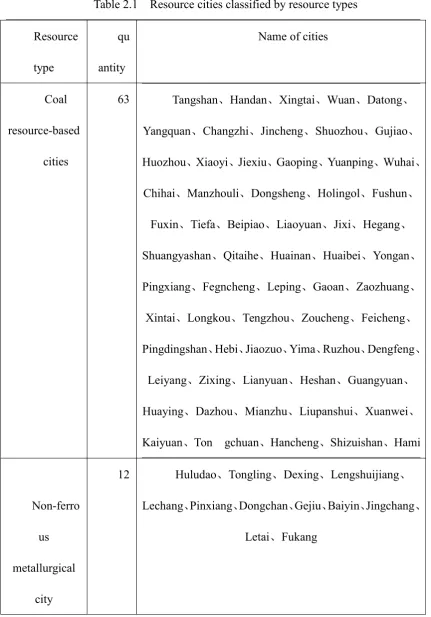
(14) Chapter Two.Coal resource-based cities in China: 2.1 Resource-based City Resource-based city is a type of city which grew and developed on the basis of exploitation of mineral or forest or other natural resources in the region, took resource-related industry as leading industry, mainly provided resource products and raw material products to the society. Their characteristics are obvious because of excessive dependence on resources.(Liu, 2016) According to the national resources city sustainable development planning (2013-2020) which issued and distributed by the state council in November 2013 , the definition of resource-based city is: the resource-based cities are cities taking minerals, forests, and other natural resources’ exploitation and processing as leading industry in the region. (including regional administrative level city, district and county, county and other county-level administrative region). This definition is relatively general, only qualitative description, lack of quantitative classification basis. In the previous studies on resource-based cities, the definition of resource-based cities is also diverse and different. In 1992, Yu defined resource-oriented cities as those cities whose total output value of mineral resources mining and primary processing industries exceeded 50% of the total industrial output value. Similarly, Fan (1993), Zhou (1994) gives a definition of resource-based city based on the proportion of mineral extraction and selection industry or excavating industry’s industrial output (cutting) of city (> 10%). As well 11.
(15) as using the single-factor definition method, Wang (2000) and Wu, Ye (2000), from the perspective of urban functions, delimited the definition scope of resource-oriented cities to employment ratio of relevant employees >40%.These definite methods mentioned above are mainly based on the subjective experience judgment of relevant scholars, which is too simple and lacks credible theoretical basis. Therefore, they are just provided for references in this study. On the basis of previous studies, defined a city with a mining population ratio greater than the arithmetic mean and standard deviation of the mining population ratio as a mining city. (Zhou, 1995) And Gao etc. (2010) step further using statistical methods defined the resource-based cities on a prefecture-level as when mining industry outweigh a city’s population than 10 percent or higher or mining output value as a percentage of GDP at 6 or higher, then the city has the remarkable characteristics of resource-based cities, we call this kind of city resources city. The accuracy and reliability of the definition standard is comparatively high, which is widely used in related studies. In addition to the single factor method for the definition, scholars also proposed methods based on multiple factors. Li used the following four indicators in defining the coal city: the coal mine worker which accounts for no less than 25% of the city's industrial workers, coal industry in the proportion of total industrial output value weigh not less than 15% and minimum not less than 2 million t/year of coal mine production capacity, coal industry development should be the main reason for the rise. 12.
(16) of the city.(1978) Liu(2006) from the functions of city community and the angle of the theory of urban genesis, estimated the definition standard: The city came out after mining industry, urban development highly relied on resources, and these cities which have being exist before the born of new China are being redeveloped because of resources as the scope of resource-based cities and defined the 63 resource-based cities according to the scope.(Gao, 2010) In 2002, the macroeconomic research institute of the state planning commission put foreword the definition of standard that meet the following four criteria: first, in terms of output, the value of extractive industries related to the natural resources account for more than 10% of the total output. Second, the output value of mining industry in county-level cities should be more than 100 million yuan, and that of prefecture-level cities should be more than 200 million yuan. Third, in terms of the number of people employed, more than 5 percent of the local workforce is engaged in mining. Fourth, for the number of workers engaged in the mining industry, this index should be more than 10,000 in county-level cities and 20,000 in prefecture-level cities. A total of 118 resource-based cities were identified. In 2013, the state council defined 262 cities above a municipal district as resource-based cities in the national plan for sustainable development of resource-based cities.(Yu, DE Jong & Cheng, 2016). 13.
(17) Table 2.1 Resource type Coal. Resource cities classified by resource types. qu. Name of cities. antity 63. resource-based. Tangshan、Handan、Xingtai、Wuan、Datong、 Yangquan、Changzhi、Jincheng、Shuozhou、Gujiao、. cities. Huozhou、Xiaoyi、Jiexiu、Gaoping、Yuanping、Wuhai、 Chihai、Manzhouli、Dongsheng、Holingol、Fushun、 Fuxin、Tiefa、Beipiao、Liaoyuan、Jixi、Hegang、 Shuangyashan、Qitaihe、Huainan、Huaibei、Yongan、 Pingxiang、Fegncheng、Leping、Gaoan、Zaozhuang、 Xintai、Longkou、Tengzhou、Zoucheng、Feicheng、 Pingdingshan、Hebi、Jiaozuo、Yima、Ruzhou、Dengfeng、 Leiyang、Zixing、Lianyuan、Heshan、Guangyuan、 Huaying、Dazhou、Mianzhu、Liupanshui、Xuanwei、 Kaiyuan、Ton 12. Non-ferro. gchuan、Hancheng、Shizuishan、Hami. Huludao、Tongling、Dexing、Lengshuijiang、 Lechang、Pinxiang、Dongchan、Gejiu、Baiyin、Jingchang、. us. Letai、Fukang. metallurgical city. 14.
(18) . 8. . Qianan、Benxi、Ma’anshan、Zhangping、Dazhi、 Bingzhou、Panzhihua、Linxiang. Black metallurgical city . Oil city. 9. Xilinhot 、Daqing、Panjin、Dongying、Puyang、 Qianjiang、Yumen、Karamay、Korla. Forest. 21. resource city. Yakeshi、Genhe、Arxan、Baishan、Dunhua、Huichun、 Huadian、Jiaohe、Songyuan、Shulan、Linjiang、Helong、 Yichun、Heihe、Wudalianchi、Tieli、Shangzhi、Hailin、 Ningan、Muling、Hulin. The other. 5. Laizhou、Zhaoyuan、Lingbao、Yunfu、Fuquan. cities (Research group of National institute of macroeconomics, 2002). The development of resource-based cities are usually rely on one or several kinds of natural resources. In the market economy system, resource benefits can drive economic development. However, due to the governments of China adopt a long-term inappropriate way of administrative intervention (such as unreasonable resource 15.
(19) pricing method, taxes, etc.), on allocation of natural resources, making the profit a lot of flow depth of resources and utilization of mineral resources area (e.g., coastal areas), resource-based city economic benefits greatly damaged, resource advantage does not translate into economic advantages. (Zhao,Wu&Rong, 2007) 2.2 Coal resource-based city in China According to the definition of resource-based cities, Coal resource-based cities is a type of city which grew and developed on the basis of exploitation of coal resources in the region, took coal-related industry as leading industry, mainly provided row coal materials and primarily processed coal products to the society. Their characteristics are obvious because of excessive dependence on coal resource. China's coal cities are mainly formed after the founding of the People's Republic of China. The development of coal industry has went through a process from planning to market, from concentration to decentralization to large-scale concentration.(Bai, 2015) Compare to the foreign resource-oriented cities which have limited scale, few connections between regions, and lack social and political organizations, China's coal resource-based cities have a large population and assume the functions of regional economic and political centers. These cities' population and size are growing.(Cao, 2013)In general, resource-based cities have the characteristics of single and primary industrial structure, and such characteristics change slowly. Single industrial structure has obvious fragility and instability, it makes the low elasticity and maneuver ability of urban economy, and strong influenced by resources reserves, development. 16.
(20) conditions and market demand. Once resources are exhausted or demand for resource-dominated products declines, the economic development under this structure will also face a crisis.(Liu,2002) 2.2.1 The distinctions of coal resource-based cities in China In detail, the distinctions of resource-based cities are summarized as follow: 1. From the historical perspective, coal cities developed rapidly, but their infrastructure construction was relatively weak. In the early days of the founding of the PRC, China needed a large amount of mineral energy and raw materials for national construction. The government successively launched a number of key industrial projects at the national level and provincial level, which promoted the emergence and rise of a large number of coal-based cities. Taking huainan as an example, the population of huainan was less than 287,000 in the first census in 1953, and by the third census in 1982, huainan had become a large city with a population of over one million and local legislative power.(National Bureau of Statistics, 1983) Although the extraordinary city construction speed, provides convenient conditions for the development and utilization of resources and production base, however, such blindly expansion is not optimized, which will inevitably lead to a series of problems including the lack of a comprehensive and overall planning for urban construction, population expansion, the lag of supporting infrastructure construction of cities such as housing and transportation, making the contradiction between production and life increasingly severe. 2. From the mechanism of enterprises, coal enterprises have a very important 17.
(21) status in these cities, there is a city-enterprization phenomenon. Due to the planed economy in the early ages, the state was responsible for the unified exploitation and allocation of resources for social and economic development in the beginning. The coal resource city in China is modeled after the "large-scale production complex" model of the former Soviet union. After entering into operation, coal enterprises occupy a monopoly position in the market, which is the main source of urban output value and employment, and also shoulder certain social affairs management. The planned system brings a high degree of division of labor to these cities, it also brings the small social function of mining area. If the state-owned economy is in trouble, it will be difficult to turn around and transform, and the city as a whole will decline. 3. From the social function perspective, the construction of coal city centers on the exploitation of coal resources and overemphasizes the function of energy supply. The development of resources has become the purpose and prerequisite of the development of these cities, it is the common feature of many coal resource cities and even other resource-based cities. Urban culture has no individual characteristics, and it is difficult to form features and city cultural landscape. The characteristics of resource distribution determine the urban layout, which lacks the multiple agglomeration effect of modern cities. The residents' entertainment and sports life are rather barren, and the construction of municipal integration also focuses on the allocation of resources exploitation. 4. From the national level, these cities have a homogenization of structure. Almost all the coal resource cities have the same industrial structure, which is based. 18.
(22) on mining, rough processing and simple transformation in the upper industrial chain. Almost all of the existing coal resource cities rely on local large coal enterprises to develop and expand. Compared with the resource industries such as oil and power, the coal industry has a higher degree of marketization but a lower degree of concentration. The products produced by various coal cities are similar, leading to serious internal competition. Market fluctuations tend to cause rapid deterioration of urban development and other phenomena. 2.2.2 the barriers of sustainable development of coal resource-based cities in context of energy transition Because of the exhaustibility and non-renewal of coal resources, coal production will inevitably reach maturity and decline at some stage. Therefore, coal resource-based cities must face the process of transition. Compared with other types of resource-based cities which rely on other resources as the main industry, the industrial recession of coal resource cities is more direct. They should not only solve the problem of resource depletion, but also face the overcapacity of the whole coal industry. The coal industry has also caused more serious damage to the ecological environment, and the level of difficulty in transition process is much higher. In this part, the barriers will clearly distinguished and analyzed in detail. 1. stark industrial structure and consequent economic development block, limited self-adjustment flexibility As a kind of old state-owned enterprises, most of the establishment of coal resource enterprises stems from the era of planned economy. There are a series of. 19.
(23) common disadvantages of old large state-owned enterprises, such as stereotyped management mechanism, the aged of inanimate equipment and excessive overstaffing. In addition, they also face some unique difficulties: first of all, some areas face different levels of resource depletion. For example, coal mining in beiba city, liaoning province has a history of more than 120 years. At present, there is basically no recoverable reserves. Some of them have certain reserves, but most of them are deep, poor quality, with complicated geological conditions and difficult to exploit. For example, although hegang city in heilongjiang province has nearly 2 billion tons of coal recoverable reserves, most of them are deep coal, with high mining costs, continuous losses, the product model can no longer be continued.(Qiu , 2011) Secondly, under the guidance of national policies, the replacement and upgrading of new resources, new materials and new energy to traditional coal and chemical raw materials leads to the contraction of the coal market. Affected by the international coal market price trend, cheaper imported coal has also eaten away part of the coal market. Thirdly, China has underpriced resource-based products for a long time, resulting in less accumulation of resource-based enterprises and their cities.(Ministry of Land and Resources, 2009) And last, due to the requirements of ecological protection, a large number of small coal enterprises with serious pollution were forced to close. All the above reasons add up to make most enterprises face unprecedented difficulties, specifically, shrinking production scale, increasing laid-off and unemployed workers, long-term losses, low efficiency in production and operation, difficulty in capital turnover and unsustainable operation.. Coal resource cities are formed and developed. 20.
(24) on the base of coal enterprises. Coal enterprises play an important role in these cities economy, and both of the investment capacity and consumption capacity of cities are closely related to the development of coal enterprises. At the same time, the slump of resource-based enterprises will form a "domino effect". In resource-based cities, a considerable number of enterprises directly or indirectly provide complementary products and service to large resource-based enterprises, in this case, whenever resource-based enterprises are trapped in difficulties, the relevant enterprises will also suffer damage, thus forming a comprehensive impact on the cities’ development and stability. Therefore, the trouble in production and operation of resource-based enterprises will directly affect the economic growth vitality of the city and city finances are bound to fall dramatically. Another important problem of coal resource city is unbalanced economic development and single industrial structure. Industrial and mining enterprises in resource-based cities are generally set up with a large amount of concentrated investment by the state, forming the abnormal weight of heavy industry and light weight of light industry and the abnormal weight of second industry and light weight of first and third industries in the three industries. In terms of industrial arrangement, the industrial structure dominated by resource exploitation, but the subsequent processing of resources often cannot keep up with it and cause extensive management. Besides, the excessive emphasis on the professional function of resource-based cities leads to single industrial structure, low level, weak correlation effect of leading industries in urban economy, and make it difficult to drive the development of urban. 21.
(25) economy. Meanwhile, the second industry is dominated by heavy industries such as coal mining and processing, coal chemical industry and thermal power generation but the development of high-tech industries such as light industry and electronics lags behind. 2. The contradiction between urban planning and construction and resource development In the early and middle stages of resource development, urban form is relatively vague, urban planning is missing or tend to be simple, and urban development layout is often decentralized due to the demand of coal mining, which make it difficult to form the centralized effect of urban construction and is not conducive to further urban development. In addition, the impact of coal resource development on urban environment is multifaceted. Coal cities face the following environmental problems in their long-term development and the first is environmental pollution. The discharge of waste gas and waste residue in industrial production process has seriously affected the urban living environment, especially in the past when China's environmental pollution control was relatively weak. The second problem is the occupation and destruction of land resources. Industrial production occupies a large amount of urban land, and large-scale coal mining causes ground cracks, deformation, collapse and pollution. The third problem is frequent occurrence of geological disasters. Geological disasters such as landslide, collapse and pit drainage not only damage the production, but also seriously affect the safety and environmental quality of the city.. 22.
(26) 3. The mismatching between the corporate and urban administrative systems Influenced by the historical administrative system of "integration of city and enterprise", coal mining enterprises play an important role in the coal resource-based cities and even dominate the local government. And due to the fragmentation of the previous planned economy, the coal enterprises and the government often proceed from their own interests and act independently, without necessary coordination and overall planning causing it is difficult to reach an agreement on a series of issues of urban construction. The government, on the other hand, relies heavily on coal companies for its revenue, and lacks the capital to develop other industries to ensure the sustainable development of the cities after coal runs out. Therefore, the inherent deficiency (urban layout) of coal cities and the lack of flexible successor industries make the recession of coal cities an inevitable trend. In other words, it is the imbalance between the development of coal industry and urban development which affects the transformation of coal cities. 4. Over-exploitation of resources and serious environmental pollution For many years, due to the mining technique itself, the system, the mechanism and some other reasons, driven by short term interest, our country's natural resources are under brutal. exploitation and. predatory. exploitation, causing serious. environmental pollution and ecological damage. Specifically, the environmental problems of coal cities can be summarized as following: I. The problem of land subsidence. Land resource is an important factor for the sustainable development of coal resource cities. However, as a result of underground. 23.
(27) coal mining, it leads to large areas of surface subsidence and causes various buildings, roads, Bridges and farmland damage. II. The second problem is the solid waste stacking, which mainly includes the stacking of coal shale and coal ash. Large piles of coal gangue produced in the coal production process not only occupy land, threaten production safety, but also cause pollution to urban environment. III. The problem of water resources destruction. In China's coal cities, the destruction and pollution of water resources is pretty serious. On one hand, much of urban water has been contaminated by industrial production, which has affected the water quality of drinking water sources. On the other hand, coal mining also causes serious damage to the underground water, because of the need of mine production, a large number of underground water resources are destroyed and the underground water level keeps falling.. Chapter 3 The transition of coal resource-based city 3.1 Transition model in China The concept of transition includes all aspects of the urban development and multiple levels, considering this study as a graduate student graduation thesis, paper length and research time and energy are limited, given that China is still a developing county which put economic development as the center and economic construction is still the first element of the development of coal - based cities, thus this study selects the most important economic transition in the transformation process as the key 24.
(28) research object. Similarly, in the research on the transition model of domestic resource-based cities, the economic transition and the industrial transition are the most widely studied. Many papers have mentioned that due to the concentration of industry adjustment contradictions and the limited ability of city self-regulation, completely relying on market mechanism to operate the transition will cause serious social problems.(Zhi, Jin, 2016) Wang(2008) constructed a relation model between the mining city industry internal structure, function and the sustainable development of urban economy, deeply analyzed the inherent mechanism among the element structure upgrade of mining cities, industry transition and to realize the sustainable development of mining cities economy, and put forward to speed up the city industry transition, to realize the sustainable development of mining city's economic strategy. According to the national situation of China, where labor is harder to move between regions than capital,the wise choice is to seek alternative and methodical inducement of industrial activities outside the region to resource-oriented cities in order to promote the resettlement of the region's Labour force and the optimization and upgrading of its industrial structure.(Zhang,&Chen, 2002) According to different classification principles and standards, the economic transition model of resource-based cities can be divided into different categories, as follows: The most widely recognized theories of industrial transition are distinguished by the different principles toward dominant industry: the industrial extension model, industrial renewal model and composite model proposed in 2001 (Zhang). The. 25.
(29) industrial extension mode is to develop the downstream processing industrial chain on the basis of the original resource development and establish the deep processing industrial cluster, also known as the "small transformation". Meanwhile, the industrial replacement model is a new industrial cluster which is basically independent of the original resources, using the funds, technologies and talents accumulated in resource development or through external forces, also known as the "great transformation". And the compound mode is a combination of the above two modes. Generally, the industrial extension is implemented at the initial stage of the transformation, and the dominant advantages of existing resource-based industries are brought into play. At the same time, emerging industries are actively cultivated and supported to gradually replace the resource-based industries, and the city evolves to a comprehensive direction.(Ren, 2008; Wu, 2010) According to the different choices of alternative industries in the transformation, it can be divided into the development of modern agriculture mode, the development of modern high-tech industry mode, the development of modern service industry and the comprehensive development mode of diversified industries.(Yu, Jiang,&Yu, 2008). Among them, the development of modern agriculture is to transfer the focus of urban economy from resource extraction industry to modern agriculture, and gradually cultivate modern agriculture into the leading industry and pillar industry of cities, such as fuxin city in Liaoning province is a typical case. Next, the development of modern high-tech industry model is to shift the city's economic center from resources mining industry to other secondary industries, mainly inclined to modern industry and. 26.
(30) high-tech industry.(Sun,&Ji, 2004) As for the development of modern service industry, it refers to the transition of urban economic center from resource extraction industry to tertiary industry, especially modern productive service industry. Then, multi-industrial comprehensive development model is the system integration of the above models.(Wang, 2003) Based on the resource life cycle theory, the industrial transition model of coal city can be divided into progressive, radical and evasive types.(Cao, 2013). According to this theory, the focus of the transition of coal city will shift with the residual resource stock and the existing industrial base in the different stages of the resource mining life cycle. Coal cities in the early stage need to further tap the potential of coal resources and make the transformation plan as soon as possible, that is, take evasive transformation. As for coal cities in middle age, it should achieve resource utilization and industrial diversification at the same time, that is, adopt gradual transformation. Furthermore, on the basis of resource and environmental protection, the aged coal city needs to introduce new economic growth and realize the transformation of the city, namely radical transformation. Gradual transition model: Gradual transition is a kind of transition with relatively low cost, and high allowance to the transition period. Generally, gradual transition is adopted in the mature and stable period of resource-based cities, which is also generally considered to be the best transition period. In the mature period of resource-based cities, the output of general resources is high and stable, and the resource industry has a strong. 27.
(31) ability to absorb labor. In the mature period, transition is also called multi-composite transition, that is, multiple industrial transition modes: by extending the resource-based industrial chain, improving the utilization rate of resources and export-oriented competitiveness, and giving play to the side-effect of leading industries to drive the development of production equipment and service industries such as machinery manufacturing, finance, commerce and trade, logistics transportation, etc.; Industrial innovation is carried out on the basis of resource-based industries, and the local industries with large potential and good foundation are selected for key support, as the reserve leading industry after resource exhaustion. Giving full play to the advantages of abundant reserves and strong urban influence, committing ourselves to transforming the mode of economic growth, and laying a foundation for the city to develop towards informatization and intensification by introducing new and high technologies and enterprises. improving the ability of comprehensive urban construction, using the accumulated funds of the resource industry in the mature period to solve urban environment, social security and personnel reemployment training and other problems, so as to transform the resource-based cities from an all-around perspective of economy, society and environment. Huaibei, as a representative of a middle-aged coal city, has produced over 1 billion tons of raw coal in the history of 50 years of construction. As a national circular economy pilot city, the pilot city transform from single industry in coal producing to multiple industries, promoting the transformation from traditional. 28.
(32) agriculture to modern agriculture, from traditional business to the modern commercial and trade services, from urban and rural dual structure to the integration structure of urban and rural, from industrial and mining city to ecological city and from the traditional government to service type government. On the one hand, Huaibei extends the coal industry chain, improves the ship industry's development with carbon fiber, graphene, diamond and other new carbon-based materials, and focus on the development of high-end carbon technology industry. On the other hand, the portion of the non-coal industry represented by food and machinery manufacturing industry increase from 19.6% at the end of the tenth five-year plan to 63.5% at the end of July 2012 and the total output from January to July reached 520.100 million yuan, accounting for 80.5% percent of the city's industrial growth ("Industrial transition from coal power industry to multi-industry in Huaibei Anhui", 2018). And jointly foster the formation of six leading industries which are coal, coal chemical, food, machinery manufacturing, textile and clothing, new building materials industries. At the same time, the development of urban-rural integration and ecological city is pretty effective, such as a number of livelihood projects and the rise of private township enterprises have kept the unemployment rate under 4% for a long time; high pollution and backward production capacity were gradually eliminated; energy consumption per unit of GDP and emissions of major pollutants have both fallen sharply. (Yang X, Cheng Z,2015) In this case, the comprehensive pollution control and green home project make Huaibei a national garden city. Radical mode:. 29.
(33) Radical transformation is a kind of transformation mode that should be carried out in a short period through the replacement of the leading industry with de-resourcization. The radical transformation is mainly aimed at the aging coal resource exhaustion cities. In the end of 20th century, the northeast coal city became the focus of attention in all aspects due to the decline of resources and the unemployment caused by the reform of state-owned enterprises, such as Liaoning fuxin which is one of the representatives. In December 2001, the Chinese government identified fuxin as the first resource-based city transformation pilot. According to the characteristics of abundant land resources and suitable climatic conditions in this area, fuxin city first selected the modern park agriculture which needs relatively less fixed investment as the continuous industry. The rural areas around the city, the waste mining areas and the sunken land are reconstructed and restored to build the agricultural park. Moreover, with the usage of market mechanisms such as attracting large private families, promoting the construction of villages and towns, and encouraging laid-off workers to raise funds by themselves, a large number of agricultural parks have been built and become a high-quality vegetable, flowers and livestock production base. At the same time of industrial transition, fuxin city actively invested in urban environmental protection and ecological restoration, and built yihaizhou coal mine, the largest open coal mine in Asia, into a theme park with grass and trees. Fuxin as a city with exhausted coal resources, relying on favorable natural conditions for agricultural development, it has successfully solved employment problem and the. 30.
(34) related social problems through short term adjustment and investment. However, on the other hand, in the process of industrial transition in this case, there is insufficient effort in the introduction of technology and innovation. Part of the reason is the limited quality of labor force and industrial foundation, late transition period and underdeveloped non-resource industries, which all affect the quality and prospect of industrial transition. Preventable mode: The thrust of preventable transformation is to do enough preventive transformation work in the formation and growth of cities. Urban planning, industrial layout and construction of public service facilities should take a long-term perspective and lay a solid foundation for coping with economic, social and environmental problems that may occur during the period of resource boom and decline. For newer coal cities such as ordos, where the coal industry is still in its infancy (rising),actions such as reforming the coal industry, extending the industrial chain and developing the non-coal industry, actively carrying out the preventive evasive transformation has played a very important role in the optimization of resource utilization and sustainable urban development. First of all, the coal mining industry should be rectified and improved, a large number of backward production capacity should be eliminated, mechanized mining level should be improved, industrial chain should be extended, and local conversion rate and product added value should be improved. Secondly, use the substantial capital resources and good transport conditions brought by coal mining to develop high-tech and modern industries. Accordingly, it has shaped a new. 31.
(35) direction for the comprehensive and rational use of coal resources, the enhancement of urban industrialization and the informationalized level , and actively prevented the risk of single industrial structure from the early stage, and avoided the decline of city caused by mining exhausted or high-cost transition. 3.2 International cases based on the generalization and summarization of the successful transition experience from the mining cities in developed countries, Ma&Wang divide the transition process into two categories: The government-led model represented by the European Union and Japan and the market-led model represented by Canada, the United States and Australia.(2006) The market-oriented economic transition mainly drove by the spontaneous regulation of market mechanism, it requires specific objective conditions such as smaller urban scale, smaller population and fewer relevant practitioner, earlier transition period etc, its reference value for China’s large-scale coal resources city is comparatively lower.(Du, 2013) Below, this article will emphatically introduce the government - led transformation cases. 3.2.1 Ruhr model: Ruhr area in Germany is an urban agglomeration area, which is bounded by the jurisdiction of regional association Ruhr, the highest planning agency in the region. It has a acreage of 4593 km2 which is one of the largest and most important industrial areas in Germany and Europe, this area started with the coal mining industry, also known as the "German industrial engine". Since the middle of the 19th century, the 32.
(36) Ruhr area has always accounted for more than 80% of the country's coal production and over 70% of the country's steel production in the following century. Like other coal resource-based cities, the salient feature of the industrial zone is coal, steel, chemical, machinery and other heavy industry as the core, and in the 1950 s began a structural crisis, slowing economic growth, leading industry decline, rising unemployment,. large number of population out-flowing, increasing environmental. pollution. Since the 1960s, the federal government has formulated a series of planning and policy measures for renovation and renovation, and achieved remarkable results. The first step is the establishment of a unified planning agency. 40% of the agency is made up of government representatives and together with the rest 60% from coal enterprise which on behalf of the regional association Ruhr, and it was given the power of the overall planning regulation and policy tilt through legislation.(Li, 2003) The second step is contracting and reform the traditional industry, and taking its advantage of abundant labor force, convenient transportation, strong research force and sufficient consumer market to attract external enterprise, adjusting the industrial structure and developing the tertiary industry. The third step is the diversification of traditional enterprises. Under the guidance of the development association, traditional heavy industry enterprises with high energy consumption and high pollution gradually transform to high-tech and high value-added industries through industrial innovation. In addition, take the science and technology advantage of many universities in the area, the ruhr carried out the reform and innovation, strengthen the scientific and economic cooperation, build a road of "technology" across the entire area from. 33.
(37) borussia Dortmund, Essen, Hagen until after bochum duisburg, connected the regional economic center with the research center, sped up the application of scientific research, and established a new "Ruhr district venture capital foundation” and several technology services company, provides the new technological enterprise with financial and consulting support. Finally, the improvement of supporting facilities and the establishment of labor unemployment insurance measures are also the key to the success of the transition. Traffic network is constantly improved, high amount of low-interest loans directly used to create jobs and reemployment training, and a number of environmental protection investment (totally 5 billion) effective guaranteed the vigorous development of the industrial district. 3.2.2 Kyushu mode: Japan's kyushu region is a famous coal-producing region in Japan. In the last century, with the rising energy prices in the international market, mining conditions at kyushu coal mine began to deteriorate, it also faces competition from cheap imported oil production. The Japanese government started to realize the non-renewal of coal resources and started importing a lot of coal from abroad. The domestic coal industry began to enter a phase of recession. Thus, kyushu's economy began to decline, and by 1969 kyushu's share of Japan's industrial output had fallen to 2.2%.(Hao, Wang, 2012) The government put forward the strategy of developing the industrial structure to a direction of energy-saving and deepen processing. A series of measures were taken as following: 1. Policy control leads to urban transition. The Japanese government has nine 34.
(38) revises of the coal industry development policy, gradually replace the domestic coal production by imported fossil fuels. At the same time, strengthening the construction of infrastructure of coal-producing areas and establish a batch of modern industrial development zone, a large number of enterprises outside the district were attracted to move to kyushu development zone and according to the new industrial policy, a number of new enterprises are set up in this area. Subsidies will be given to enterprises in the development areas for the placement of coal workers and their children for employment, and preferential and differential policies will be given according to the employment rate. 2.Establish a special administrative body. In order to revitalize the regional economy of coal production, a coal production regional revitalization enterprise was established in 1962 to start the economic revival of kyushu. In order to reduce the negative impact of mine closure on regional economy of mineral resources. Regional revitalization and rectification groups have played an important role in relocating and transferring the labor force in the coal industry, promoting the adjustment of declining industries and supporting new industries, and realizing the economic revitalization of coal regions.. 3.Develop new alternative industries and set up special zones for the development of new and high technology industries. Japan has six technology towns in kyushu, nearly a third of the whole country. The location with superior technology and special support policy have played a vital role in developing new products, new. 35.
(39) technologies and personnel training. Many domestic and international big companies, such as Hitachi of Japan and Texas instruments of the United States, have built integrated circuit factories in kyushu. At the same time, various preferential policies are offered for the construction of facilities and the attraction of foreign capital. The supporting preferential policies are also reflected in the reduction and exemption of local taxes. The policies are clear, and 80% of the local taxes reduced by the implementation of tax reduction and exemption policies for enterprises are supplied by the state.(Zeng,&Yue, 2007) At the same time, the Japanese government also stipulates that the central government and the government will each contribute one-third of the funds to subsidize small and medium-sized enterprises that are developing new technologies or products conducive to local development. 4.Focus on environmental restoration and give priority to the development of tertiary industry. In the middle of the last century, with the mining of mineral resources assets, including coal, kyushu area experience the environmental deterioration and serious ecological damage. In order to achieve environmental optimization and industry transition, the Japanese government put environmental restoration and development of circular economy in the first place, by formulating the pollution countermeasures for the basic law, clarified the environmental protection obligations and responsibilities for all levels of government and enterprise. Strict accountability system is also implemented. The environmental restoration and industrial adjustment are combined with territorial control. Through the establishment of ecological garden,attract tourists and investors from home and abroad with. 36.
(40) beautiful environment, to achieve the objectives about developing circular economy, improving ecologic environment and realizing industrial transition. In 1998, kyushu's environmental industry produced 2.3 trillion yen, accounting for 10.6% of similar industries in China. 5.Pay attention to job-transfer training and realize re-employment of personnel. With the transition of industries and the transformation of enterprises, many employees cannot adapt to new jobs and must be trained in order to realize re-employment. Japanese government hold fast to improve the level of worker’s skills, enhance the adaptability of the workers which will be the key of achieving industry transition and workers again obtain employment, meticulously focused on the training of coal mine workers who leave their posts from the beginning of the industrial transition. Japanese government clearly stipulates that, for re-employed coal workers, vocational training shall be carried out before re-employment. The training funds shall be borne by coal enterprises or receiving units, and corresponding subsidies shall be given to them by the government. At the same time, the government provides living allowances and job-hunting subsidies to laid-off workers, and rewards enterprises that accept laid-off workers. With the issuing and implementation of the series of effective policies, Effective ensured the resettlement of the unemployed in kyushu, for example, 80.7 percent of workers were re-employed, after the closure of the mitsui sanchi coal mine in fukuoka. Due to the implementation of these effective measures, at the end of 2002, fukuoka, kyushu area county (with li & fung building, three pools, fukuoka, three big. 37.
(41) coal mine) have built 96 industrial park, 521 enterprises have invested and built factories in these industrial areas, provides 5615 job opportunities. After transformation, the industrial structure and foreign trade of kyushu got obvious change, the third industry, including trade and tourism, became the main industry of kyushu which make it a window for Japan to communicate with China, the Korean peninsula and the rest of Asia. The structural transition of kyushu region has been realized and transformed from a traditional coal area into an important high-tech industrial area in Japan. This is a successful government-led model of urban transition by industry substitution. 3.2.3 Pittsburgh case: Pittsburgh was once a famous steel industry city in the United States. The steel and coal industries have made important contributions to its economic development. During the transformation of the world economy in the 1970s, Pittsburgh's over-reliance on the steel and coal industries left its economic structure too single and fragile. The urban renewal movement from the 1950s to 1970s focused on the relocation of declining heavy industries, such as steel, and encouraged low-density and suburbanization development. The industrial relocation and suburbanization of the city led to a large number of abandoned industrial land and many industrial workers lost their jobs. To tackle this, city leaders launched the Pittsburgh revitalization initiative, focusing on environmental improvements, central renewal and rail projects. The tertiary industry became the main target of urban development. However, the improvement of the environment has not brought a fundamental 38.
(42) improvement of the city's appearance, because the industrial structure is still dominated by steel and steel manufacturing industry, and the results of urban transition are not satisfactory.(Li, 2016) In the 1980s and 1990s, local traditional manufacturing industry gradually transformed into advanced manufacturing industry through technological upgrading. Pittsburgh, at the same time, pay more attention and strength of support to the high-tech industry, health-care, education and culture industry. Through these efforts, the city set up a new urban image, to strengthen the competitiveness of the city. At the same time in developing tertiary industry, the government has assisted the survival and development of the traditional steel and coal industries through preferential tax policies for the traditional steel industry and preferential policies for land application, developed an innovation-centered urban transition model, took a diversified economic development model as the core, transformed the urban environmental structure, and achieved sustainable economic growth.(Zhao,&Shen, 2016) 3.3 ideal transition pattern In the research on the transition model of domestic resource-based cities, the economic transition and the industrial transition are the most widely studied. Many papers have mentioned that due to the concentration of industry adjustment contradictions and the limited ability of city self-regulation, completely relying on market mechanism to operate the transition will cause serious social problems. Wang(2008) constructed a relation model between the mining city industry internal. 39.
(43) structure, function and the sustainable development of urban economy, deeply analyzed the inherent mechanism among the element structure upgrade of mining cities, industry transition and to realize the sustainable development of mining cities economy, and put forward to speed up the city industry transition, to realize the sustainable development of mining city's economic strategy. According to the national situation of China, where labor is harder to move between regions than capital,the wise choice is to seek alternative and methodical inducement of industrial activities outside the region to resource-oriented cities in order to promote the resettlement of the region's Labour force and the optimization and upgrading of its industrial structure. (Zhang,&Cheng, 2002)The most widely recognized theories of industrial transition are the industrial extension model, industrial renewal model and composite model proposed in 2003 (Zhang,&Kong). Luo pointed out in 2015, due to being different development stage and facing various problems, resource-exhausted cities’ industry transition have different path and choice of mode, namely the transition of resource-based cities have no unified the best or most comfortable pattern. In the same year, Wang points out that the transition of resources cities cannot be treated in the same way, physical conditions including the natural resources exploitation conditions, industrial bases and population resources and urban scale should be took into consideration when choosing adjustment measures and planning transition pattern; Secondly, implementing economic diversification and getting rid of the dependence on single resources is the fundamental and goal of the successful transition of various resource cities. What is. 40.
(44) different is that different cities fit in different substitute industries. Finally, the transition of resource-based cities is rarely carried out solely by means of market economy. Therefore, macro-policy control and detailed institutional guarantee are indispensable conditions for the transition of resource-based cities. As mentioned in the previous part (2.3), the ability to conduct industrial transition by relying on the ability of spontaneous regulation of market rules requires higher objective conditions. Foremost, these coal towns in successful cases have a very limited population scale, (thousands to tens of thousands), their coal industry is mainly dominated by energy companies, with high population mobility, abundant resource reserves and a better overall early warning mechanism and migration program. The coal resource-cities at the county and city level concerned by this paper do not have such characteristics. In a market economy, although competition can promote the adjustment of industrial structure, but in the intense periods of structural changes, if measures. are not taken to weaken the influence of certain sectors of the. economy or the impact to the local area, it will bring a series of economic and social problems, and even affect the social stability, the process of structural adjustment also will be blocked.(Wang, 1996) According to "the national resource-based city sustainable development planning", the indicators of the transition of resource-based city, a total 17 of them, are divided into four aspects, including economic development, improvement of people's livelihood, resource protection and environmental protection. According to the “plan”, the ideal resource-oriented city transition model should reach the follows:. 41.
(45) The economy is booming. Resource products have more added value, alternative industry become a pillar industry, the added value of GDP proportion increased by 6%, obviously improve the developmental level of service industry, comprehensively set up a diverse industry system and industrial competitiveness has improved significantly. The reform of state-owned enterprises basically completed, and the non-public sector of the economy and the small and medium-sized enterprises develop rapidly, creating a new situation of equal competition and common development for economies of various forms of ownership. The human settlement environment is beautiful and comfortable. Mine geological environment get effectively protected, the recovery and treatment rate of geological environment problems in mines left over by history are greatly improved, land damaged by mining can be fully reclaimed and used meanwhile the newly built production and mining areas will no longer damage the environment. The total emission of major pollutants has been greatly reduced and heavy metal pollution has been effectively controlled. Ecological functions in key areas have been significantly restored.Urban infrastructure has been further improved, comprehensive services have been strengthened, and the quality of the ecological environment has been significantly improved. A number of landscape garden cities and ecologically livable cities can be formed. Social harmony and progress. The employment scale continued to expand, the basic public service system gradually improved. Social harmony and progress. The employment scale continually be expanded, the basic public service system gradually improved, social security, pension for the. 42.
(46) elderly, medical care, work-related injury, unemployment and other social insurance has been continuously improved, and the housing conditions have improved significantly. The increase in. incomes of urban and rural inhabitants is higher than. the national average, and the basic livelihood of low-income people is ensured. The cultural cause is prosperous and developing, and the precious spiritual and cultural wealth of mining areas and forest areas is protected and inherited.. Chapter 4: analysis and recommendation 4.1 analysis of the transition strategies in China From the information in the first three chapters, the following conclusions can be preliminarily concluded: China's coal resource cities are facing the urgent task of transition, and China's central government has adopted a series of measures and policies to guide the transition of coal resource cities. However, in general, China has a short history of industrialization, and the market economy has been fully open for less than 40 years. Under the constraint of many historical reasons and their own conditions, the coal resource cities, as the industrial grain supply base, are faced with many problems interleaving each other. Since 2001, when fuxin,Liaoning province was set as the first pilot city of transition, the transition process in the 21st century is still in the exploration stage. In terms of economic transition, the adjustment of industrial structure and the cultivation and introduction of new industries require strong policy and economic support. The resource development compensation mechanism and recession industrial 43.
(47) assistance mechanism that are being gradually improved can only help to realize orderly withdrawal of declining industries in the coal cities in distress and mitigate the negative effects of major industry declines. It is only the beginning of realizing the goal of industrial restructuring and economic transition. How to finance the transformation in all-directional, multi-level, multi-way and multi-channel is still one of the key tasks of the transition of coal city. As the locking effect in the long-term development of coal resource-based cities is difficult to break up spontaneously from inside to outside, the external favorable investment and financing policies and the encouragement of opening to the external are particularly important. In addition, the effectiveness and coordination of policy planning also play a decisive role in the success of the transition of coal-based cities. Unified and effective policy guidance and adequate economic support are the foundation of urban transition. In terms of the transition model, the radical model, which is dominated by industrial substitution, is mainly applicable to the coal city in the recession (old age).In the implementation process, this transition model is characterized by high cost and high risk due to time constraints. First of all, the coal industry has a huge amount of sunk costs in the long run. As technical constraints determine the coal industry has a strong locking nature, it is difficult for enterprises to transfer their fixed investment to other industries in the short term. Second, the economic benefit of the city at this stage has declined, and it cannot afford the necessary capital needed to transplant other industries to break the entry barriers of absolute scale. Meanwhile, the urban infrastructure built around the coal industry also makes it difficult for the. 44.
Figure

Related documents
Students in one core would experience a direct instruction model of teaching for the unit, receiving class instruction from a teacher at the front of the room and completing all
We propose a continuum approximation (CA) model for the reliable uncapacitated fixed charge facility location problem to determine optimal facility locations that minimize the one-
Multiple-Sequential Pulsing allows for cooling between pulses to safely remove hair on all skin types including darker skin and reduces the chance of skin damage in vascular
Economic & Community
This frontier is generated by solving equations (7) and (8) for changing levels of probability ( α) of failing to reach the threshold H. A higher expected return comes with a
Answer: The South East Asia Access Workshop on Cross-Cultural Studies is a 2 weeks long mission exposure trip outside of the country.. This is the second and last stage of the ACCESS
This thesis proposes a novel Social BPM framework in which social tagging is used to capture process knowledge emerging during the enactment and design of the
There is a need to develop appropriate training for medical practitioners in the use of opioids for CNMP, national guidelines for the management of CNMP in the general
