Maximum Sustainable Government Debt in the Overlapping Generations Model*
Neil Rankin Dept of Economics University of Warwick
Coventry CV4 7AL UK
Barbara Roffia Xerox S.p.A
Strada Padana Superiore, 28 20063 Cernusco S/Naviglio (MI)
Italy
Barbara [email protected]
January 1999
Abstract
The theoretical determinants of maximum sustainable government debt are investigated using Diamond’s overlapping-generations model. A level of debt is defined to be ‘sustainable’ if a steady state with non-degenerate values of economic variables exists. We show that a maximum sustainable level of debt almost always exists. Most interestingly, it normally occurs at a ‘catastrophe’ rather than a ‘degeneracy’, i.e. where variables such as capital and consumption are in the interiors, rather than at the limits, of their economically meaningful ranges. This means that if debt is increased step by step, the economy may suddenly collapse without obvious warning.
Keywords
maximum sustainable government debt, overlapping generations, catastrophes
JEL Classification
1. Introduction
Interest in the question of whether a given level of government debt is "sustainable" has grown significantly in recent years. One reason for this is the substantial increase in actual government debt levels in most OECD countries during the 1980's: this is documented, for example, by Blanchard et al. (1990). A second reason, applying to EU countries, is the 60% ceiling on the debt/GDP ratio imposed by the Maastricht Treaty and the subsequent ‘Stability and Growth’ Pact. The struggle of several governments to get under the ceiling in the second half of the 1990's has focused attention on government debt and deficits, and provoked debate about the need for such ceilings.
So far, most studies of the sustainability of fiscal policy have been especially concerned with government deficits. The usual worry has been that large and persistent deficits will cause the debt stock to follow an explosive path, leading to the possibility of default on the debt, and/or bad consequences for the rest of the economy. In the theoretical literature, the traditional approach (e.g. Christ (1979)) has been to explore the dynamics of the government budget constraint under various policy rules for government spending and taxation, and to seek conditions which ensure convergence of the debt stock. Thus, strictly speaking, it is 'instability' rather than 'unsustainability' which has been investigated. In the empirical literature (e.g. Blanchard et al. (1990)), an "unsustainable" fiscal policy has been defined as one which violates the government's intertemporal budget constraint. To evaluate whether or not particular countries are pursuing unsustainable fiscal policies, investigators make projections of the country's future spending and tax plans, and then compute measures of how much correction would be needed to avoid insolvency. The limitations of such studies are that they are mainly accounting exercises - they take no account of the effects which fiscal policy itself has on the economy through interest rates, output, etc.; and they rely on what are often subjective judgements about the future paths of spending and taxation.
variables may not exist. Relative to the standard theoretical literature, the question here is whether, despite the fact that a government has no deficit, it may be in an unsustainable situation just because it has too high a stock of debt. Relative to the standard empirical literature, we would like the analysis to incorporate the effects of debt on the economy, and not just to be an accounting exercise. We would also like it to identify the deeper, structural determinants of maximum sustainable debt, so as to free the conclusions from dependence on speculative forecasts of future spending or taxation. From this discussion it should be clear that our interest lies in ‘technical’, rather than ‘political’, sustainability. Quite a lot of recent work on government debt has examined the incentives which a government may have to default on its debt, or to reduce its real value through surprise inflation (e.g. Calvo (1988), Aghion and Bolton (1990)). These incentives are likely to increase as debt increases, which would imply the possible existence of a critical debt level above which the government will voluntarily choose to default. In practice, such a maximum may well be the one which is reached first as an economy becomes more indebted; however, we defend our present exercise on the grounds that, in any thorough analysis, the political maximum will surely depend on the technical maximum, and that we hence need to gain a good understanding of the latter first.
What sort of model is most appropriate for our investigation? The standard "Ramsey" model based on an infinitely-lived representative agent is not useful, because Ricardian Equivalence holds in such an economy, which implies that there is no limit to the amount of debt a government can issue.1 Instead the natural choice is the overlapping-generations model, where it has been known ever since the pioneering work of Diamond (1965) that debt can have real effects. So far there has not been, to our knowledge, a systematic attempt to investigate the theoretical determinants of maximum sustainable government debt in Diamond’s overlapping-generations model. This is hence what we try to provide in this paper. Diamond's model is of course unrealistically simple, but it is a very familiar model, and it enables us to explore the basic analytics easily and thoroughly. We see our exercise as a desirable precursor to a more sophisticated modelling exercise in which actual numbers could be inserted.
1
A fundamental objection, namely that the concept of maximum sustainable debt is meaningless, needs to be addressed straight away.2 This objection arises from the fact that in an overlapping-generations model government debt is well known to have equivalent resource-allocation effects to an unfunded social security or pension scheme, in which the government makes a lump-sum transfer from the young to the old in every period. It follows that an increase in debt accompanied by an appropriate reduction in the pension (allowing it to be negative if necessary) would leave the resource allocation unchanged, and thus that there is no limit to the amount of debt that can be issued. Although this is true, in practice it is very rare for periods in which government debt has increased to coincide with periods in which the pension has been reduced. Therefore we argue that it is reasonable and natural to take the sharing of the tax burden between young and old as given, when considering the effects of changing government debt. This is in general sufficient to make the maximum sustainable debt well defined. Its value will, indeed, depend on how the tax burden is shared, and in our analysis we will consider the effect of this parameter along with the effects of several other parameters.
The questions we will seek to answer are, first of all, is it true that a finite maximum sustainable level of debt exists? In a model where debt is non-neutral, we would in general expect the answer to be 'yes', although we will see that there can be exceptions. A second question then is, what exactly happens when maximum sustainable debt is reached? We will see that the maximum could in general be reached in one of two ways: (i) the value of a key variable such as the capital stock could become extreme, in the sense that it reaches the limit of its economically meaningful range (e.g. zero) - we will call this a 'degeneracy'; or (ii) the values of key variables might remain in the interiors of their economically meaningful ranges, but nevertheless a steady state suddenly ceases to exist - we will call this a 'catastrophe'. We would like to know, then, under what conditions there is a degeneracy and under what conditions a catastrophe.3 Catastrophes are more interesting, since they are situations in
2
The view that government debt is a meaningless quantity has been strongly put forward by Kotlikoff (1993). While we accept that this is true when it comes to obtaining empirical measures of the total redistribution between generations caused by governments, we do not accept that it is necessarily true in the theoretical context, so long as proper account is taken of other potential sources of redistribution.
3
which an unwary government could suddenly meet with disaster. They are also more likely to be empirically relevant than degeneracies, because the latter involve such extreme distortions of the resource allocation that the ‘politically feasible’ limit to government debt would almost certainly be reached first, whereas with catastrophes it is less obvious that this would happen. A third, and the most obvious, question is, how do the parameters of preferences, technology and policy affect the maximum sustainable debt level? A complication which arises here is that there is no single unambiguous measure of 'debt'. We can look at debt exclusive of interest or inclusive of interest, and we can also look at interest payments themselves: the answer turns out to depend on which of these three measures we look at. A last important question is, how does the type of debt instrument issued (or, what is equivalent, the type of rule used to manage the stock of debt over time) affect the stability of the economy at the maximum sustainable debt level? We will see that different debt instruments imply different stability properties.
are in different units), we can make interesting comparisons of the resource allocations which they bring about. Our third main finding concerns the stability of the economy at these three maximum sustainable debt levels. We consider policies of holding constant each of three different types of debt instrument: savings deposits, treasury bills and perpetuity bonds. In the case of savings deposits, only the steady state with the maximum sustainable level of interest-exclusive debt is stable, while with treasury bills, both this and the steady state with the maximum sustainable level of interest-inclusive debt are stable. With perpetuity bonds, all three steady states are stable. We thus obtain a ranking of the debt instruments in terms of the amount of stability they provide for the economy at maximal debt levels.
Despite the recent heightened interest in the question of fiscal sustainability, there do not appear to be any directly comparable exercises to ours in the published literature. As already noted, the related work focuses on deficits rather than on debt itself. Here one might mention contributions by Masson (1985), Nielsen (1992), Azariadis (1993), and Carlberg (1995). Moreover, several of these studies focus mainly on the case of “dynamic inefficiency”, i.e. the case where the interest rate is less than the growth rate - but this case is unlikely to be relevant to situations of very high debt. One phenomenon which arises in our analysis is that of the “poverty trap”: an economy might get “stuck” in this situation if the initial capital stock were sufficiently low, whereas if it had started with a higher capital stock, it would have grown to full size. Our paper does not dwell on this phenomenon, though there exist papers which do. Amongst these, there are one or two which highlight government debt as a potential source of the poverty trap: in particular, Azariadis and Reichlin (1996). However, Azariadis and Reichlin's focus is on how very small amounts of debt can cause the poverty trap, whereas we are interested in the effects of very large amounts of debt; hence their contribution is somewhat orthogonal to ours.
2. The Structure of the Economy
one).4 The majority of our attention will be devoted to the case of a closed economy, but we will subsequently comment on how extending the analysis to a small open version of the same economy affects the conclusions.
Households are endowed with one unit of labour time when young, but none when old. The typical agent has a Cobb-Douglas or – equivalently – log-linear utility function over her consumption levels when young and old (ctY,ctO+1):
u=βlnctY + −(1 β) lnctO+1 0< <β 1. (1)
Since there is no utility of leisure, she will choose to supply her labour endowment in full to the labour market, i.e. labour supply is exogenous and equal to one. This means that, since the labour market always clears, we can set lt = 1 in what follows.
The agent may transfer consumption between periods t and t+1 by saving an amount st,
receiving an interest rate rt+1. She is also subject to lump-sum taxes (τ τt , ) Y
t O
+1 in each period.
For the reasons explained in the Introduction, we assume that the total tax burden in period t,
τt, is shared in fixed proportions between young and old, so that τt γ τ Y
t
= −(1 ) , τtO γτ
t
= ,
with 0 ≤γ≤ 1. The consumer’s budget constraints are thus:
wt t ctY s r s c
t t t t t
O
− −(1 γ τ) = + , (1+ +1) −γτ = +1, (2)
where wt is the wage. By maximising (1) subject to (2), we may readily show that, at a
consumer optimum, the gross interest rate must be proportional to consumption growth:
1
1 1
1
+r+ = − +
c c t t O t Y β
β . (3)
From this and the budget constraints, the agent’s savings function can be found:
s w
r
t t t
t
t
= − − − +
+ +
(1 )( [1 ] )
1 1
β γ τ β γτ . (4)
4
Let us now consider the production sector. The technology employed is assumed to be of a Cobb-Douglas, constant-returns form:
yt =k ltα t1−α, 0< <α 1 (5)
where kt is the capital stock at the start of period t, and lt is labour input. The usual marginal
productivity conditions for factor rewards result from profit maximisation:
rt =αktα−1 1lt−α, wt = −(1 α)k ltα t−α. (6)
In addition, the goods market clears every period, and this requires:
yt =ctY +ctO +kt+1−kt. (7)
3. Debt Levels Associated with Particular Steady State Equilibria
In order to carry out the first part of our analysis, we must make sure that there exists a variable which is sufficient to ‘index’, i.e. uniquely identify, each possible steady state equilibrium. We know that y, k, r and w are uniquely and monotonically related by, respectively, the production function (5) and the marginal productivity conditions (6) (in all of which lt = 1). Hence the choice of a value for any one of these variables will determine the
values of the other three. From the goods market clearing condition (7) and the production function (5), we also know that in a steady state, where investment is zero:
kα = =y cY +cO
. (8)
Combining this with the consumer optimum (3) evaluated in a steady state, and again with the marginal productivity condition for r, we arrive at a relationship between k and cY:
1
1
1
+ =
−
−
−
α β
β
α α
k k c
c
Y
Y . (9)
A similar relationship can be derived between k and cO, though, unlike this one, it is not necessarily monotonic. Thus we see that there is a unique invertible relationship between any pair of the steady state variables (y,k,r,w,cY), and that moreover each such relationship is independent of government policy. From this it follows that any one of these variables is sufficient to act as the ‘index’ of a particular steady state equilibrium. In what follows, we shall treat k as our index.
In the next step, we vary k over its feasible domain [0,∞) and investigate how the value of government debt which would support the given k, varies with it. We will see that the relationship of the various debt measures to k depends partly on the tax-sharing parameter, γ. Rather than carry out the analysis for a general value of γ, we focus on the two special cases where γ = 0 (all the tax is on the young), and γ = 1 (all the tax is on the old).5 γ = 0 is assumed
5
in our 'basic' case. In the next sub-section, we study this basic case, which is also the case of the closed economy. In the following sub-section, we extend the basic analysis to consider how assuming γ = 1, and also how opening the economy, would alter the conclusions.
(i) A basic analysis
Now let the value of government debt at the start of period t, excluding the interest payments which are payable on it during period t, be denoted by bt. The government’s budget
constraint can then be written in terms of bt as:
bt+1 − =bt r bt t −τt. (10)
In a steady state where b is constant over time, clearly tax revenue must equal interest payments: τ = rb.
For the capital market to clear in period t, the supply of capital by young consumers, st,
must equal the demand for it. The latter comprises the demand for capital by firms, kt+1, and
the demand for capital by the government, bt+1, so that we need:
st = bt+1+ kt+1. (11)
To obtain the steady state relationship between b and k, we now set variables to their stationary values (indicated by dropping the time subscripts), substitute out st using (4) (in
which we set γ = 0), and then further substitute out τ as rb, and (w,r) using the marginal productivity conditions. After rearranging, this gives:
b k k
k
= − − −
+ − −
( )( )
( )
1 1
1 1 1
β α
β α
α
α . (12)
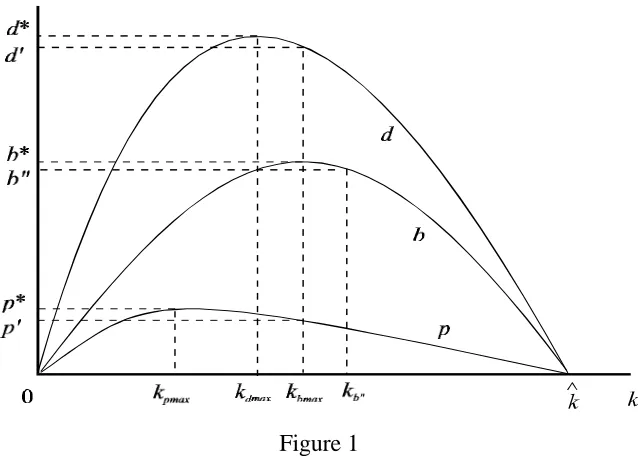
Figure 1
The b-curve is hump-shaped, cutting the horizontal axis at k = 0 and k = k$. These intersections obviously correspond to steady states of the model in the absence of government. Two basic points are revealed by the shape of this curve. First, a maximum sustainable value of b clearly does exist: the government cannot choose b to be greater than the finite value b*, and sustain that situation. Second, the maximum occurs at a ‘catastrophe’, i.e. in the interior of the feasible domain of k, rather than at a ‘degeneracy’ where k = 0.6 What would happen if, starting in a steady state where b = b*, the government tried permanently to raise b by some small amount ε? To answer this properly, we need to specify a particular debt management policy, so that the economy’s dynamics when it is not in a steady state are well defined. We will do this in Section 4; but it is already clear that, since no steady state with b = b*+ε exists, the economy would be bound to follow a divergent path. We would obviously expect this to be a path along which capital falls until it hits zero, i.e. along which the economy ‘implodes’.
b represents interest-exclusive debt, but it is not obvious that this is the only measure of
debt worth studying. We can also measure debt inclusive of interest payments. Let this be denoted as d ≡ (1+r)b. The relationship of d to k can be obtained by multiplying (11) by 1+r, or 1+αkα-1:
6
d k k k k
= + − − −
+ −
−
−
( )[( )( ) ]
( )
1 1 1
1 1
1
1
α β α
β α
α α
α . (13)
This has the same general shape as the curve for b, as Figure 1 illustrates. Hence it is also true that a maximum sustainable level of interest-inclusive debt exists, and that it occurs at a catastrophe rather than a degeneracy. However, for reasons we explain below, the level of k at d* is lower than the level of k at b*, indicating that the ‘crowding out’ of private capital is greater.7 In general we cannot sensibly compare d* directly with b* because they are in different units8; but the diagram shows that we can interestingly compare the effects which they have on the allocation of resources in the economy.
For completeness, we also consider how interest payments, p ≡ rb, vary with k. Although obviously not the same as debt itself, interest payments could be regarded as an indirect, ‘flow’ measure of the magnitude of the debt. Note that in a steady state they must in fact equal the tax burden imposed by debt, i.e. p = τ. Since p ≡ d - b, the relationship of p to k is easily found geometrically just by subtracting the two curves b and d. The resulting locus is clearly also hump-shaped, so that p too has a finite maximum. Like b* and d*, p* occurs at a catastrophe rather than a degeneracy. However the crowding out of capital is now greater than that at either b* or d*, for reasons explained below.
To understand intuitively why ‘catastrophes’ are generic, let us examine more closely what is happening in the capital market. Capital market equilibrium in a steady state with a stock of debt b requires:
k+ = −b (1 β)[(1−α)kα −τ( )]k . (14)
We can think of this equation as showing, on the left-hand side, the demand for capital, and, on the right-hand side, the supply of capital coming from the young consumer’s savings function. The supply of savings is the fraction 1-β of the net wage, where, as we know, the wage is in turn the share 1-α of output, kα; while taxation equals p, which we know can also be written as a function of k. As we increase k from 0 to k$ we trace out the curve for b, so
7
Note that in the absence of government, the capital stock is k$ (ignoring the degenerate steady state at zero), so that the extent of ‘crowding out’ at any k is just the horizontal distance k$-k.
8
(14) enables us to see that b is just the ‘excess supply’ of savings over the demand for physical capital, at each k. Maximum b therefore occurs at the k which maximises the excess supply of savings. Consider, then, why the excess supply of savings as a function of k must have an interior maximum. Note that as we increase k, the demand for and the supply of savings both rise.9 Initially, for k close to zero, the rise in supply is ‘faster’ than the rise in demand. This is because demand rises with k at a ‘speed’ which is identically equal to one, while (ignoring the unimportant coefficients) supply rises at basically the same speed as the wage, and thus at the same speed as output. Now, output’s rate of increase with k just depends on the marginal product of capital, which with Cobb-Douglas technology tends to infinity as k tends to zero. Thus the effect on supply is bound to dominate for low values of k. As we continue to increase k, the rate of increase of supply falls, owing to the diminishing marginal product of capital, but the rate of increase of demand is unchanged. Hence there comes a point at which the speed of demand increase overtakes the speed of supply increase, and here excess supply must peak, and thereafter start falling. This argument was made for b; but since d and p are just multiples of b (albeit with non-constant coefficients) the same basic mechanism is at work there, too.
Further, it is not hard to see intuitively why kpmax < kdmax < kbmax. Interest-inclusive debt,
d, is equal to b times 1+r. We know that r equals the marginal product of capital, αkα-1, which falls as k rises. Multiplying by 1+r thus slows down the rate of increase of the debt as k is raised from 0 to k$, and so causes the maximum for d to occur ‘sooner’ than the maximum for b. For example, at k = kbmax, b is locally unchanging with k, which implies that (1+r)b must be
falling at this point, and hence that the maximum of d has already been passed. Similarly, interest payments, p, are equal to d times r/(1+r). r/(1+r) is also falling as k rises. By an analogous argument, the p-curve must therefore peak before the d-curve.
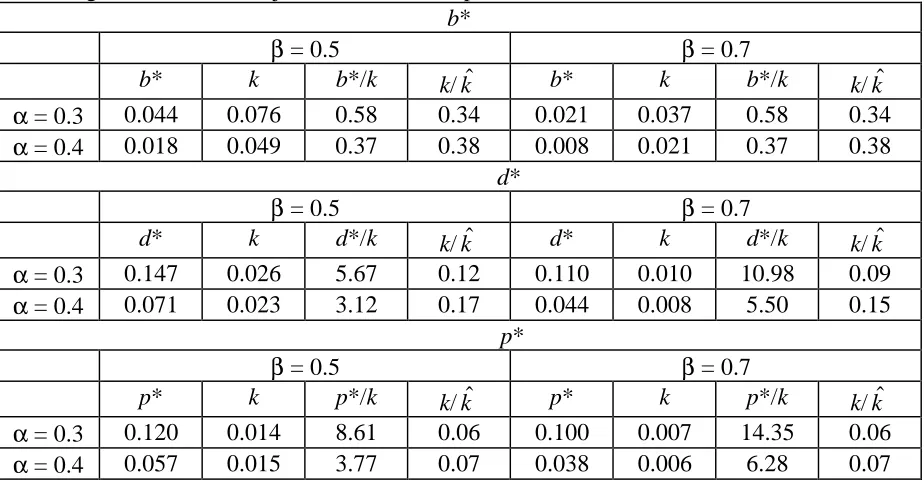
To illustrate how b*, d* and p* and their associated k values are affected by the parameters α and β, some numerical examples are presented in Table 1.10 The absolute values of (b*,d*,p*,k) are not very informative, but their changes in response to changes in α and β are of interest. As is standard, α is chosen in rough conformity with capital’s known share in
9
For present heuristic purposes, we neglect the effect of the rise in k on τ. 10
national income, while the values of 0.5 and 0.7 for β correspond to pure time preference rates of, respectively, zero and about 3% per year (if we take one period to be, say, 30 years). The main point to note is that higher α and β lower the maximum sustainable debt levels, and the associated capital stocks, in nearly all cases (the effect of α on k in the p* case constituting a minor exception). In the case of α, the reason is that higher α, by lowering the wage share and raising the profit share in income, shifts income from youth to old age and so lowers the incentive to save, thereby reducing the ability of the capital market to satisfy the government’s demand for capital. In the case of β, the reason is that higher β, by raising the preference for current over future consumption, similarly lowers the incentive to save. The table also gives maximum sustainable debt as a ratio to the capital stock, which provides one possible yardstick for gauging the size of the former. It also gives capital at the maximum sustainable debt level as a share of capital in the absence of debt (k$), which indicates the extent of crowding out which occurs just before ‘catastrophe’ strikes.
b*
β = 0.5 β = 0.7
b* k b*/k k/k$ b* k b*/k k/k$
α = 0.3 0.044 0.076 0.58 0.34 0.021 0.037 0.58 0.34
α = 0.4 0.018 0.049 0.37 0.38 0.008 0.021 0.37 0.38
d*
β = 0.5 β = 0.7
d* k d*/k k/k$ d* k d*/k k/k$
α = 0.3 0.147 0.026 5.67 0.12 0.110 0.010 10.98 0.09
α = 0.4 0.071 0.023 3.12 0.17 0.044 0.008 5.50 0.15
p*
β = 0.5 β = 0.7
p* k p*/k k/k$ p* k p*/k k/k$
α = 0.3 0.120 0.014 8.61 0.06 0.100 0.007 14.35 0.06
[image:15.595.68.530.382.624.2]α = 0.4 0.057 0.015 3.77 0.07 0.038 0.006 6.28 0.07
Table 1 The effects of α and β on maximum sustainable debt
amount of the transfer is ht = − τtO = τYt . We can use similar reasoning to before to plot the
steady state value of h as a function of k. It turns out that h as a function of k is identical to d as a function of k. Therefore the d curve in Figure 1 can equivalently be regarded as determining the value of the social security transfer which would support a given steady state equilibrium. It follows that there is indeed a maximum sustainable level of social security, and that it occurs at a 'catastrophe'. Moreover, the crowding out of capital which it causes is the same as that caused by the maximum sustainable level of interest-inclusive debt. Second, as an alternative to looking at debt or social security in isolation, Auerbach, Gokhale and Kotlikoff (1991) have proposed an all-encompassing measure of intergenerational redistribution, the 'generational account'. This is defined as the present value over an agent's lifetime of all his net payments to the government. Let it be denoted as n. We can carry out an analysis of the relationship of n to k just as we did for b, d and p. We find that n as a function of k turns out to be identical to p as a function of k. From the known properties of the p curve, we therefore deduce that a maximum sustainable value of the generational account exists, and that it too occurs at a catastrophe. The amount of crowding out of capital is the same as at the maximum sustainable level of interest payments.11
(ii) Extensions
We now consider changes to some of our maintained assumptions. A first change is to suppose that taxation falls on old rather than young agents (γ = 1 rather than γ = 0). A priori, we might expect that this would raise the maximum sustainable debt levels, because shifting taxation from the first to the second period of life increases agents' incentives to save, and therefore increases the supply of capital available to absorb government debt. In order to recalculate the curve for b, we repeat the procedure used to derive (12), but now set γ to 1, instead of to 0, in (4). The resulting expression turns out to be the same as (13). That is, the equation for the b curve when γ = 1 is the same as the equation for the d curve when γ = 0.
11
This shows that our conjecture that raising γ raises the maximum sustainable debt level (and also the associated amount of crowding out of capital) was correct. It also shows that a finite maximum sustainable level of b continues to exist, and that it continues to occur at a catastrophe.
In the cases of d and p, the effects are potentially more dramatic. The equation for d can obviously be derived by multiplying that for b by 1+r, and thus (13) by 1+αkα-1:
d k k k
k
= + − − −
+ −
−
−
( ) [( )( ) ]
( )
1 1 1
1 1
1 2
1
α β α
β α
α α
α . (15)
While this still tends to zero as k → k$, it is no longer necessarily true that it tends to zero as k
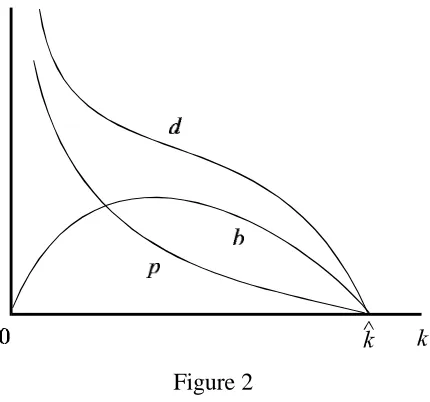
→ 0. Using L’Hopital’s Rule, we may show that the limit as k → 0 depends on α: if α > ½, the limit is zero, and the curve has the usual hump shape; but if α < ½, the limit is infinity. Since α has the interpretation of being capital’s share in national income, which empirically is known to be about 0.3, the relevant case is the second one. We then have the shape for the d curve seen in Figure 2:
[image:17.595.191.406.429.630.2]Figure 2
policy in which an increase in debt is accompanied by a reduction in social security - a policy which, as noted in the Introduction, would be ‘neutral’ in its resource allocation effects. Finally, the conclusions concerning p are similar to those for d, as can easily be seen by recalling that, in Figure 2, p is just the vertical distance between d and b.
We conclude that allowing some of the tax burden caused by debt interest to fall on the old does not fundamentally alter the conclusions about the existence and nature of the maximum sustainable debt level, except in the extreme case where the entirety of the burden is on the old. However, it does increase the level of the maximum sustainable debt, so that γ is a parameter no less important than β or α in determining the maximum sustainable debt.
A second change to our maintained assumptions which deserves consideration concerns the openness of the economy. So far we have supposed a closed economy. As should be evident by now, an important role in our results is played by the endogeneity of the interest rate. In an open economy which is also ‘small’ in the world capital market, the interest rate would instead be exogenous and equal to the world interest rate - r*, say. We might hence speculate that this feature would substantially modify the results. Here we will not work through the case of the small open economy in detail, but it is straightforward to do so.12 The main consequences for our conclusions can easily be summarised. First, we can immediately infer from the exogeneity of r that the capital stock will now be exogenous, since it will be determined via the marginal productivity condition (6). Hence output, too, will be exogenous. The only variables free to change, as the level of steady state debt varies, are the consumption levels of young and old. Note that these no longer have to add up to equal steady state output, because openness of the goods market means that a trade surplus or deficit can be run.13 The given interest rate means that the young’s and old’s consumption levels remain in constant ratio (cf. (3)), and simply rise or fall with the tax burden, and thus with the debt. In this situation, the limit to debt is reached where the tax burden becomes so great that the
12
See Pereira (1998). 13
consumption levels are driven to zero. Maximum sustainable debt thus occurs at a ‘degeneracy’ rather than a ‘catastrophe’.14
In the small open economy, then, a maximum sustainable debt level still exists15, but it is associated with an ‘extreme’ resource allocation, something which is not generally true in the closed economy. As we noted in the Introduction, this type of limit to debt is less likely to come as a surprise to a naive government, since it will be obvious that the resource allocation is becoming highly distorted as the limit approaches. The reason why we obtain a degeneracy rather than a catastrophe in the present case is fairly obviously the fixity of the interest rate. It is this which gives debt a linear relationship to the consumption of either young or old, whereas with an endogenous interest rate, the relationship of debt to the index of the resource allocation is, as seen, non-linear, and therefore potentially non-monotonic.16
4. Dynamics with Constant Stocks of Debt Instruments
So far we have reversed the usual logic of the model, and have asked what level of debt would be required to support a given steady state equilibrium. We now return to the more obvious way of studying the economy, by assuming a constant stock of a particular type of debt instrument and examining the equilibrium to which it gives rise. The main advantage of this method is that it reveals the dynamic behaviour. We will confine attention to our ‘basic’ case, i.e. the closed economy in which taxation falls only on the young.
First, suppose that the debt instrument is a 'savings deposit'. A private agent deposits bt+1 units of goods with the government in period t, and gets back bt+1(1+rt+1) units of
14
Notice also that the ‘crowding out’ which takes place here is not crowding out of physical capital (which remains unchanged) but of net foreign assets held by domestic residents.
15
The case of a degeneracy brings out the point that, to be mathematically correct, we should strictly talk about the ‘supremum’ of the sustainable debt level, rather than the ‘maximum’. This is because we defined a debt level to be ‘sustainable’ when a steady state with degenerate values of the variables exists. The set of non-degenerate values is an open interval (e.g. for cY, it is cY > 0), and therefore a maximum over it may not exist. 16
plus-interest in period t+1.17 The government's budget constraint is then as given by equation (10). Throughout this paper we are concerned with debt rather than deficits, and hence the policy rule we consider is one of holding constant the stock of savings deposits over time at some exogenous value b. This requires the tax variable to be determined residually, according to the rule:
b k b rt t
t
1
−
=
= α α
τ . (16)
Equilibrium in any period t can be expressed through the capital market clearing condition (11). Substituting into this the savings function (4) and τt as given by (16), we get:
kt+1+ = −b (1 β)[(1−α)ktα −αbktα−1]. (17)
This is a first-order difference equation in kt, which we can explain in words as follows. The
effect of an increase in kt is to raise the supply of savings, both because it raises the wage, and
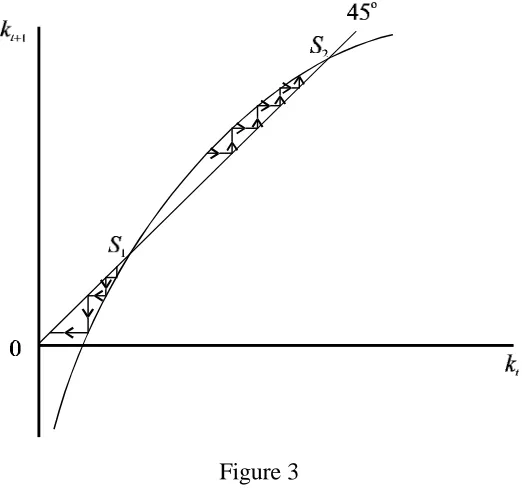
because it decreases the interest rate and thus the amount of tax revenue needed to service the debt. Given a completely inelastic demand for savings deposits, more resources are then available to be invested in kt+1. This positive relationship between kt+1 and kt is illustrated in
Figure 3 below.
The phase line in Figure 3 is unambiguously concave, with a slope which tends to zero as kt tends to infinity, and to infinity as kt tends to zero. When b = 0, there are two steady states:
a stable one at k > 0 and an unstable one at k = 0. As we raise b above zero, the phase line shifts down, resulting in the situation depicted in the diagram. The stable steady state, S2, now occurs at lower k and thus at higher r. This is the standard ‘crowding out’ effect of public debt on private capital. On the other hand, the unstable steady state, S1, is pushed off the origin and into the interior of the feasible domain of kt. It hence becomes possible to have paths
which start to the left of S1, along which the economy ‘implodes’. It may seem puzzling that an implosion can occur despite the fact that government debt remains constant. Such instability is not being caused by a fiscal policy which is itself unstable, so it must already be inherent in private sector behaviour. The explanation would seem to run as follows. Along an
17
imploding path, a given fall in current capital kt reduces future capital kt+1 by more than
one-for-one. The main reason for such a strong effect is that the marginal product of capital is very high when kt is very low, so that a given fall in kt reduces output, and hence the wage and
[image:21.595.168.429.346.594.2]savings, by a large amount. Notice that when debt is zero, this instability can only operate in the upwards direction, where it is eventually dissipated; but with positive debt, it can now operate in the downwards direction too. The result is that government debt creates a ‘poverty trap’, in which an economy with too little initial capital fails to converge to a non-degenerate steady state, even though one exists. This also shows that the sustainability of a given level of debt depends on the initial capital stock of the economy. Our own earlier definition of sustainability ignored initial conditions, which indicates that our Section 3 results should be considered as providing necessary, rather than sufficient, conditions for full sustainability.
Figure 3
As b is increased, it is clear that at a critical value of b - b, say - the phase line becomes exactly tangential to the 45° line and the two steady states merge into one. For b slightly greater than this, no steady state exists. Mathematically speaking, there is a ‘fold catastrophe' (or 'fold bifurcation') at this point.18 The debt level b is the dividing line between two qualitatively different types of dynamic behaviour. (Below, we will show that b as defined here also equals b* as defined in Section 3.) The main consequence of the existence of a finite
18
value of b is that a government which increased b by small amounts at infrequent intervals, and in between let the economy converge to its new steady state, would initially observe nothing dramatic happening: the capital stock would simply be ratcheted downwards by small amounts. When b was reached, however, one further small increase would produce a ‘catastrophe’ in which the economy would suddenly embark on a path of unchecked capital decumulation, terminating in a total collapse in which capital, output and consumption are all zero. Obviously, the government would eventually be forced to default on its debt.
We can calculate algebraically the level of k corresponding to b, by making use of the tangency condition.19 We find that such a level of k must satisfy:
(1−α α) [(1−β)kα−1 2] −α[(1−β)kα−1]− =1 0. (18)
It is natural to try to compare this with the level of k corresponding to b*, as studied in Section 3. The latter is easily found by differentiating (12) with respect to k and setting the result to zero. Doing this, we readily reproduce (18). This shows that the two levels of k are equal. Moreover, since (17) in its steady state version coincides (after rearrangement) with (12), it further follows that b = b*. We have thus arrived by a different method at the same maximum sustainable debt measure as in Section 3. To understand further the relationship between the two approaches, notice that, for a given value of b ≤ b*, the k values of the steady states (S1, S2) in Figure 3 are the same as the k values which can be read off from the b curve in Figure 1. Moreover, recall that, when b is increased, the phase line in Figure 3 shifts down, and the two steady states move closer together: the same clearly occurs in Figure 1. From this, we can now see that steady states on the downward slope of the b curve are stable under a policy of holding constant the stock of savings deposits, while steady states on the upward slope of the b curve are unstable. An implication is that steady states on the upward slope are not attainable under a policy of holding the stock of savings deposits constant: for an arbitrary initial k0, setting a given b will cause the economy either to implode (if b is too high and/or k0 is too low), or to converge to the steady state on the downward slope of the b curve. Steady
19
states on the upward slope may, however, be attainable under an alternative debt management policy, as we will see below.
Next, suppose that the debt instrument is a ‘treasury bill’. A treasury bill is a promise by the government of one unit of goods in period t+1, which is sold in period t at the price qt. qt is
thus related to the interest rate by rt+1 = 1/qt-1. Let dt be the number of treasury bills
outstanding at the start of period t. Then the government’s budget constraint is:
dt - τt = qtdt+1, (19)
and under a policy of holding the stock of treasury bills constant at d, we have:
τt t t
t
q d r r d
= − =
+
+
+
(1 ) 1
1
1
. (20)
The demand for savings in period t is now qtd, or d/(1+rt+1). Hence capital market
equilibrium, incorporating (20), requires:
k
k d k
k k d t t t t t + +− +− +− + + = − − − + 1 1 1 1 1 1 1 1
1 α 1 β 1 α 1
α α
α α
α
α
( ) ( ) . (21)
(21) determines kt+1 as an implicit function of kt. We can use it to draw a phase diagram as we
did in the case of Figure 3. However the diagram is qualitatively much the same, so we do not reproduce it here. In general, there are again two steady states: an unstable one at low k and a stable one at high k. An increase in d shifts the phase line down, until, at a critical value d , a tangency point is reached at which the two steady states merge.
We can find an equation for the value of k associated with d by exploiting the tangency condition, as we did in the case of b . The result is a cubic equation in kα−1:
(1−β) (2 1−α α) 3[kα−1 3] − −(1 β α β) [ (1−α)−α(1 2− α)][kα−1 2]
−α + −α β α− − =
(1 )k 1 1 0. (22)
the same. Since (21) in its steady state version is also the same as (13) (after rearrangement), it follows that d = d*. This, then, repeats the pattern of our finding for b. As we did in the case of b, we may further deduce that, in Figure 1, steady states on the downward slope of the d curve are stable, and those on the upward slope are unstable, under a policy of holding
constant the stock of treasury bills at a given value of d. This similarly means that, starting from some arbitrary k0, only steady states on the downward slope are ‘attainable’, under this policy.
Third, and finally, suppose that the debt instrument is a ‘perpetuity bond’. A perpetuity bond is a promise by the government of one unit of goods forever. If it sells for a price vt in
period t, then the relationship of the interest rate to the bond price is 1+rt+1 = (1+vt+1)/vt.
Letting the stock of perpetuity bonds at the start of period t be pt, the government’s budget
constraint is:
pt −τt =v pt( t+1− pt), (23)
and if the stock of perpetuity bonds is held constant at p, we have:
τt = p, (24)
i.e. tax revenue has to equal the exogenous amount of coupon payments. Capital market equilibrium in this case requires:
kt+1+v pt = −(1 β)[(1−α)ktα − p]. (25)
We now need a second equation to determine the evolution of vt. This is provided by:
vt+1 = +(1 αktα+−11)vt −1, (26)
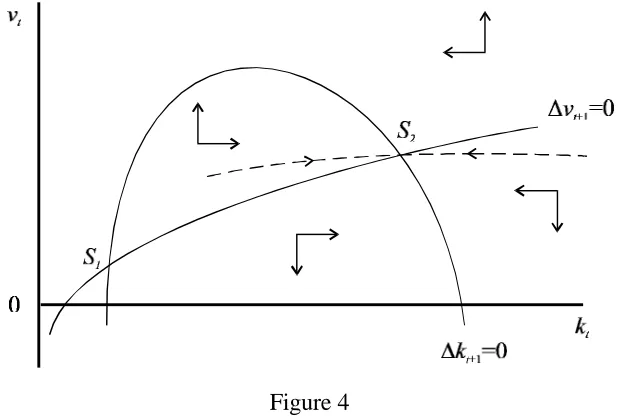
which comes from the bond price/interest rate relation and the marginal productivity condition. (25) and (26) constitute a pair of simultaneous implicit difference equations in (kt,vt). The dynamics here hence prove to be second-order. However, since vt is a
foresight solution, so that the equilibrium path is still in principle described by a first-order equation. (25) and (26) can be used to draw a phase diagram in (kt,vt) space, as in Figure 4:
[image:25.595.157.466.153.363.2]Figure 4
The diagram shows that there is again a pair of steady states, of which S1 is a source and S2 a saddle. Since saddlepoint stability is what is needed, we see that the same basic pattern
found with the other two debt instruments - namely, of an unstable steady state at low k and a stable steady state at high k - is repeated here. As p is increased, the locus ∆kt+1=0 moves
down, and there is a critical p at which the steady states merge, and beyond which none exists. As before, we can obtain an equation for the value of k at which this occurs by using the tangency condition, thus getting:
(1−α α) [(1−β)kα−1 2] −(2α− +2 1/ )[(α 1−β)kα−1]− =1 0. (27)
This is quadratic in (1-β)kα−1, with a single positive root. We can show that the implied k coincides with the k at which p* occurs, as found in Section 3.20 Thus, since the relationship of p to k found in Section 3 is the same as that implied by (25) and (26) in their steady state versions, it follows that p= p*. In Figure 1, we therefore have that, under a policy of holding constant the stock of perpetuity bonds, steady states on the upward slope of the p curve are unstable, and those on the downward slope are stable.
20
To sum up: we have looked at three different debt management rules, namely policies of holding constant over time the stocks of three different debt instruments. We have seen that each policy generally implies either two, or no, steady states. When there are two, the one associated with a higher capital stock is stable, whereas the one associated with a lower capital stock is unstable. It is clear that there is a natural correspondence between different debt instruments and different ‘measures’ of debt as investigated in Section 3: a given number of units of savings deposits implies a given amount of interest-exclusive debt; a given number of treasury bills implies a given amount of interest-inclusive debt; and a given number of perpetuity bonds implies a given amount of interest payments. Accordingly, we found that the maximum sustainable number of units of each debt instrument was the same as the maximum sustainable amount of the corresponding measure of debt, as calculated in Section 3. This is not so surprising; more interesting is what it reveals about steady states on the upward slopes of the b, d and p curves in Figure 1 - namely, that they are unstable under policies of holding constant the stock of the associated type of debt instrument. For this reason, these steady states are ‘unattainable’ under the stated policies: the economy can only end up there if it happens to start there.
We may now draw some conclusions about the relative merits of the three debt management policies. Referring again to Figure 1, we can see that it is possible to attain the steady state with the maximum sustainable level of interest-exclusive debt, b*, under any of the three policies (provided the initial capital stock is not ‘too low’). This is because, at kbmax,
all three curves are non-upward sloping. For example, under a policy of holding the stock of savings deposits constant, the government would issue exactly b* units of savings deposits. On the other hand, under a policy of holding the stock of treasury bills constant, the government would issue d’ units of treasury bills; or, under a policy of holding the stock of perpetuity bonds constant, it would issue p’ units of perpetuity bonds. All three policies would make the economy converge (though at different speeds) to kbmax, where b = b*. Next,
consider the steady state with the maximum sustainable level of interest-inclusive debt, d*. It is not possible to attain this under a policy of holding the stock of savings deposits constant,
to be b”, then instead of converging to kdmax, the economy would converge (always assuming
initial capital is not too low) to kb”, where d < d*. On the other hand, kdmax is attainable under
policies of holding the stocks of treasury bills or perpetuity bonds constant, because the d and p curves are non-upward-sloping at this value of k. Finally, by similar reasoning, it is not
possible to attain the steady state with the maximum sustainable level of interest payments, p*, under policies of holding the stocks of savings deposits or treasury bills constant, but it is possible under a policy of holding the stock of perpetuity bonds constant. These results enable us to rank the three debt management policies according to the number of maxima for sustainable debt (each corresponding to a different measure of debt) which they make it possible to attain. According to this criterion, a policy of holding constant the stock of perpetuity bonds is best, because it enables all three maxima to be attained; while a policy of holding constant the stock of savings deposits is worst, because it only makes one of the maxima attainable.21
The policies considered in this section are distinguished by the types of debt instrument which they assume. However, since there is no uncertainty in the model, it is clear that the three types of debt must be perfect substitutes from the point of view of a private investor. This suggests that it is not anything inherent in the type of debt instrument which is responsible for the different stability properties. Rather, it must be something in the implicit policy by which debt is managed in each case. We might surmise that the key feature of (for example) the policy of holding the stock of savings deposits constant over time, is that it holds the stock of interest-exclusive debt constant. This can be tested by assuming that only (for example) treasury bills are issued, but that their stock is managed so as to keep the amount of outstanding interest-exclusive debt constant. We do indeed find that the dynamic behaviour of the economy is then identical to that under a policy of holding constant the stock of savings deposits. It therefore needs to be emphasised that it is the policy rule, not the type of debt instrument per se, which is critical for dynamic behaviour.
21
5. Conclusions
References
Aghion, P. and Bolton, P. (1990) "Government Debt and Risk of Default: A Political-Economic Model of the Strategic Role of Debt", in Dornbusch, R. and Draghi, M. (eds.), Public Debt Management: Theory and Practice, Cambridge: Cambridge University Press
Auerbach, A.J. and Kotlikoff, L.J. (1987) Dynamic Fiscal Policy, Cambridge: Cambridge University Press
Auerbach, A.J., Gokhale, J. and Kotlikoff, L.J. (1991) “Generational Accounts: A Meaningful Alternative to Deficit Accounting”, in Bradford, D.F. (ed.), Tax Policy and the Economy, vol. 5, Cambridge, MA: MIT Press
Azariadis, C. (1993) Intertemporal Macroeconomics, Oxford: Blackwell
Azariadis, C. and Reichlin, P. (1996) "Increasing Returns and Crowding Out", Journal of Economic Dynamics and Control 20, 847-877
Blanchard, O.J., Chouraqui, J.C., Hagemann, R.P. and Sartor, N. (1990) "The Sustainability of Fiscal Policy: New Answers to an Old Question", OECD Economic Studies 15, 7-36 Calvo, G.A. (1988) “Servicing the Public Debt: The Role of Expectations”, American
Economic Review 78, 647-661
Carlberg, M. (1995) Sustainability and Optimality of Public Debt, Physica Verlag, Hamburg Christ, C. (1979) "On Fiscal and Monetary Policies and the Government Budget Restraint",
American Economic Review 69, 526-538
Diamond, P.A. (1965) "National Debt in a Neoclassical Growth Model", American Economic Review 55, 1126-1150
Kotlikoff, L.J. (1993) “From Deficit Delusion to the Fiscal Balance Rule: Looking for an Economically Meaningful Way to Assess Fiscal Policy”, Journal of Economics 7, Supp., pp. 17-41
Masson, P.R. (1985) "The Sustainability of Fiscal Deficits", IMF Staff Papers 32, 577-605 Nielsen, S.B. (1992) "A Note on the Sustainability of Primary Budget Deficits", Economics
Letters 14, 745-754
Pereira, F.M. (1998) Maximum Sustainable Government Debt in an Open-Economy Overlapping Generations Model, MSc dissertation, University of Warwick