Assessing value-in-use from an ethnographic
perspective: An Ethnographic Case Study
Author: Yasin Sahhar
University of Twente P.O. Box 217, 7500AE EnschedeThe Netherlands
ABSTRACT
Nowadays the concept of value-in-use has become increasingly important. Businesses are
continuously striving to capture their customer needs in order to attract future customers,
retain existing customers, and increase business performance through value delivery. In the
academic world, value-in-use is an uprising concept. Although there are efforts made
understanding value-in-use from an ontological point of view, there seems to be haziness
around the methodological and epistemological grounds of value-in-use. Consequently, there
has so far not been probed into the appropriate methods including the epistemological
consequences of studying value-in-use. Therefore, an ethnographic perspective is deployed to
clarify this omission by studying value-in-use in the context of amateur-level football on
artificial grass pitches. Obtrusive and unobtrusive data collection methods are used in order to
gather etic and emic knowledge. Patterns are identified that lead towards useful value-in-use
constructs. In short, this study demonstrates how and why an ethnographic perspective can
enhance and understand customer value and value-in-use.
Supervisors: Dr. R.P.A. Loohuis, MBA
First, University of Twente
Dr. M.L. Ehrenhard
Second, University of Twente
Keywords
Ethnography, Value, Value-in-use, Ethnographic Case Study, S-D logic.
Permission to make digital or hard copies of all or part of this work for personal or classroom use is granted without fee provided that copies are not made or distributed for profit or commercial advantage and that copies bear this notice and the full citation on the first page. To copy otherwise, or republish, to post on servers or to redistribute to lists, requires prior specific permission and/or a fee.
1.
INTRODUCTION
1.1
Framing the research problem
Companies are continuously striving to improve their way to create value for their customers and differentiate their service offerings in order to attract and retain customers as well as making profit (Shaw & Ivens, 2002). Prahalad and Ramaswamy (2004) point out that there appears to be a shift in involving the customer in the value creation process, in which value is “co-created”. More recently, Vargo and Lusch (2004) have developed a new perspective by introducing the concept of value-in-use. Where previously value was seen as a trade-off between cost and service quality, the new perspective focuses more on the serviceability of the products and the services firms offer. In this process, understanding (customer) value plays an important role. Also, throughout the existing literature it is clear that there is an increased understanding and recognition that value is created through the customer’s own process (Möller, 2006; Vargo & Lusch, 2004, 2008). Other authors (Payne, Storbacka, & Frow, 2008; C. Prahalad & Ramaswamy, 2008; Woodruff & Flint, 2006) accept this view in which they state that the customer is always a co-creator of value and value-in-use, as opposed to the previous view in which value is embedded in tangible goods at the factory gate (Macdonald et al., 2011). Value-in-use is defined by Macdonald’s et al. (2011, p. 167) as “a customer’s outcome, purpose or objective that is achieved through service”. Central in this view is that value arises in the customer’s or end-user’s space and through the usage process (Baines et al., 2007).
Recently, it has been pointed out that companies are facing challenges to understanding what it is that customers value (Macdonald et al., 2011). As Anderson & Narus (1998, p. 55) point out: “gaining a comprehensive understanding of the value of a market offering in a particular customer setting may appear monumentally difficult”. Knowing this, and keeping the shift (of how value is conceptualised nowadays) in mind, causes the rise of concepts like customer experience and usage (i.e. value-in-use). As various authors point out (Anderson & Narus, 1998; Ballantyne & Varey, 2008), it is of crucial importance for companies to involve their customers and end-users in the value-creation process since they are considered to be the “producers” and consumers who determine what is of value. This is also in line with the service-dominant logic (S-D logic) in which it is stated that every firm, whether it is a service or product firm, can be a service firm (Grönroos & Voima, 2013; Vargo & Lusch, 2004). In the reseach of Stauss et al. (2010), the customer-dominant logic (C-D logic) seems to be put in the forefront. The difference between the S-D logic and the C-D logic is subtle, but the latter focuses more on the customer only, instead of the service as a whole (Stauss et al., 2010). Therefore, the focus in this research will lie on the S-D logic. However, despite the emerging stream of literature emphasising the importance of understanding customer value from a value-in-use perspective, there is little common understanding about appropriate methods to capture value-in-use. Previously, some research was dedicated to the empircal assessment of value-in-use. For example, Macdonald et al. (2011) conducted a research to examine value-in-use through in-depth interviews. Also,
Gummerus and Pihlström (2011) conducted research trying to grasp value-in-use through face-to-face interviews.
Despite the efforts made to provide a solid ontological basis for the concept of value-in-use, there is little agreement about epistemelogical and methodological ramifications of grasping value-in-use empirically. This is in line with Grönroos and Voima (2013) and Stauss et al. (2010) who call for appropriate and novel methods in spite of the warning that there will be no universally valid method to capture value-in-use (Bruns & Jacob, 2014).
In responding to this call, we adopt an ethnographic perspective on grasping value-in-use in practice. Ethnography is by definition mainly concerned with the “lived experience” of human actors in everyday habitualized situations (Herbert, 2000; Van Maanen, 2011; Visconti, 2010) either through obtrusive data collection techniques or unobtrusive ones (Visconti, 2010). Researchers like Arnould and Wallendorf (1994) and Arnould and Price (2006) are known for their contribution in the marketing area using an ethnographic perspective. They describe approaches towards market-oriented ethnography on three different levels: macro, micro, and meso. This marketing-oriented ethnography (also known as market-oriented ethnography) refers to an ethnographic focus on the behaviour or people shaping a market for a product or service (Arnould & Wallendorf, 1994, p. 484). Also Kozinets (2002) conducted research on market-oriented ethnography in which they developed “netnography”, an online marketing technique for providing customer insight.
Although we acknowledge that there is not one best method to grasp value-in-use, we suggest that an ethnographic perspective comes closest to understanding and documenting the everyday practices of customers when using products and services of all kind. In other words, an understanding of value-in-use cannot be provided by relying on positivistic approach whose primary aim is to explain phenomena but requires probing into alternative research paradigms in qualitative research aimed to understand phenomena (Guba & Lincoln, 1994).
1.2
Goal
This research will be applied to artificial grass pitches for football in order to examine, through the value-in-use perspective, how football players experience artificial grass. As a results, a better understanding can be gained into the value-in-use perspective including its different categories leading to the case that companies can better comprehend and anticipate on customer value. Moreover, this reseach attempts to clarify the haziness around the methodology of measuring value-in-use. Hence, this research aims to build a proper methodology on how value-in-use can be assessed. This leads to the following research question:
In this research, implicitly the questions of “what is value?” and “what is value-in-use?” will be answered. Moreover, different research paradigms and the foundations of ethnography will be thoroughly explained. In the previous paragraphs, the research
problem was framed, the goals were set and the relevance will be pointed out. In the next chapter, a theoretical background will be handed out followed by the Ethnographic Case Study (ECS). Finally, a discussion will take place followed by a conclusion.
This research obtains an exploratory mind-set (Babbie, 2009) since it aims to develop a method on how a certain topic or phenomenon (in this case value-in-use) can be investigated. Moreover, the ECS process has been chosen because it is suitable for theory generation according to Visconti (2010).
1.2.1 Theoretical relevance
Several researchers have already highlighted the importance of value-in-use. For example, Vargo and Lusch (2008) implicitly states that the shift from the goods-dominant logic (G-D logic) towards the S-D logic indirectly means that the concept of value has become more important. Although the amount of literature devoted towards value-in-use and end-user needs is still lacking according to Gummerus and Pihlström (2011), this research more specifically focuses on the link between methodology and theory, in essence: how value-in-use can be measured and assessed. An ethnographic perspective will be taken in order to clear up the fuzziness around the methodology on how to investigate and assess value-in-use assuming that the existing paradigms do not properly fit value-in-use. This ethnographic perspective allows us to dig deep into the end-users’ world and experience. Knowing this, it can be stated that this research contains a high degree of theoretical relevance.
1.2.1
Practical relevance
Companies are continuously trying to understand their customers and end-users in order to meet their needs. Recent literature points out that the customer/end-user is always a co-creator of who co-creates value “in use” (Macdonald et al., 2011). Instead of “pushing” value towards the customer and end-user, firms are “providers” that make the value-in-use process of the customer/end-user possible. This is often not recognised by organisations, which contradicts with the marketing literature nowadays. At numerous of companies, it is the case that end-user needs are not clear and the concept of value-in-use is not recognised. In order to give firms a clear view of the end-user needs, it is of practical importance to investigate the value-in-use created by them. This is done through the lens of the S-D logic.
2.
THEORY
In this section of this paper, further will be elaborated on the different theories used in this research. Firstly, (customer) value will be described. Value will be seen through the lens of the G-D logic, but more importantly, through the S-G-D logic. Also, emphasis will be put on what drives value for customers and end-users. Secondly, the concept of value-in-use will be thoroughly described. Besides this, previous studies that attempted to measure value-in-use will be discussed. Finally, ethnography will be further explored.
2.1
Value
The importance of value can be clearly seen in the amount of literature that is devoted to it. As Woodruff (1997) and Ulaga
and Chacour (2001) stated, firms are looking for all kind of ways to deliver superior customer value. Knowing where customer value resides has become increasingly important because this results in greater levels of customer satisfaction, which has positive impact on all kinds of aspects: customer loyalty and retention, positive word-of-mouth, competitive position, and ultimately higher market share (Anderson & Narus, 1998; Ulaga & Chacour, 2001). Therefore, it is important to know how value is defined. However, because of the fact there are several research streams and different views, it is hard give one definition that captures the overall picture. Through the eyes of Zeithaml (1988), there are four basic definitions of what value comprises. Firstly, value is related to price: the lower the price, the higher the value. Secondly, value is achieved when every need or want is fulfilled by the purchase of a product. His third view of value is that it is a calculation of quality minus the price paid for the product or service. Finally, Zeithaml (1988, p. 13) states that “value is what I get versus what I give”. This last conceptualisation of value brought a further rise towards a multidimensional value concept that focuses more on actions and experiences (Babin & James, 2010). Researchers like Babin, Darden, and Griffin (1994) further explored this multidimensional approach in which they distinguished two types of value: utilitarian value and hedonic value. Utilitarian value is a consequence when a consumer evaluates a consumption activity as successful in the sense a desired end result is achieved (Babin & James, 2010). Hedonic value results from a customer’s experience of a consumption activity which is perceived as gratifying. Anderson and Narus (1998, p. 6) define value as “the worth in monetary terms of technical, economic, service, and social benefits a customer company receives in exchange for the price it pays for a market offering”. According to Woodruff (1997), value through the perspective of the customer is a subjective assessment of both positive and negative consequences of using a product or a service. On the other hand, Grönroos (2011, 2014) states that value means that “a customer/user “feels better off” after being supported by a given service provider”.
2.1.1
Value drivers
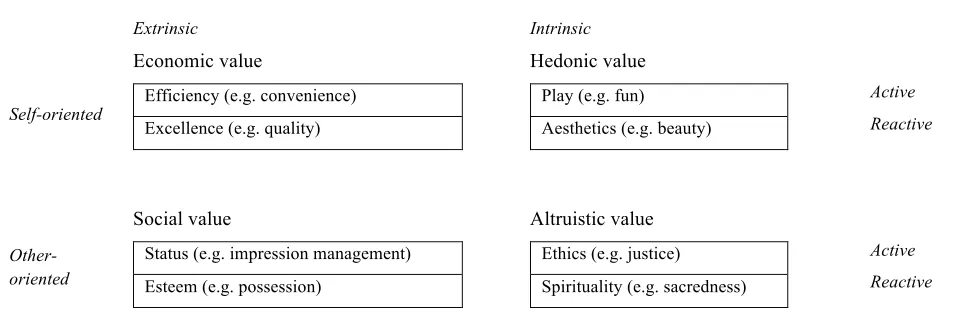
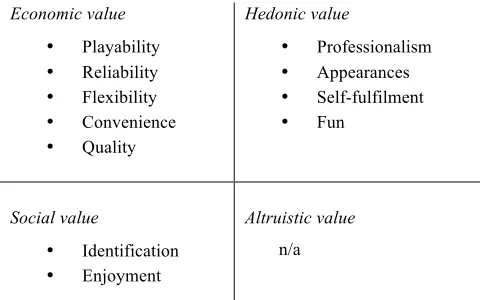
intrinsic value (where the product or service is being appreciated for its own sake). The second axis is divided into self-oriented value (meaning a product or service is being valued because it is has a positive effect on the person itself, or how he or she responds to it) and other-oriented value (meaning a product or service is being valued because it has a positive effect on others, or how they respond to it). Economic value is described by Holbrook (2006) when a product or consumption experiences that serve as a means to a consumer’s own objectives. Social value occurs when one’s own consumption behaviour serves as a means to shaping the responses of others, and hedonic value is seen as value that arises from someone’s own pleasure in the consumption experiences appreciated for his or her own well-being as end in itself (Holbrook, 2006). Finally, through Holbrook’s view, altruistic value entails a concern for how someone’s own consumption behaviour affects others in which this experience is viewed as a self-justifying end-in-itself. These sub dimensions will be used in this paper as a guidance in making distinctions in value.
Table 1 - Value drivers (Holbrook, 2006)
In the marketing literature, there are two main value perspectives, namely the goods-dominant logic (G-D logic) and the service-dominant logic (S-D logic). These will be discussed in the next section.
2.1.2
Dominant value perspectives
Previously, the value delivery was done through providing tangible resources to customers (Vargo & Lusch, 2004), which is in line with the G-D logic. This “old way of thinking” tends to only assess the customer value on the basis on what the company provides (Martinez et al., 2011). The main focus from the firm’s view is to maximise operational efficiency (Svensson & Grönroos, 2008). Recently, there appeared to be a shift from the G-D logic towards the S-D logic where value is being delivered through providing a service and through intangible resources. The latter, which is the “new way of thinking” according to Martinez et al. (2011), focuses more on the customer experience. Vargo and Lusch (2004) state that the S-D logic is more profound in the world nowadays since service is of greater importance to customers and end-users. This perspective puts value in the position of a firm doing something for the benefit of the customer, which results from a service
(James, 2012; Vargo & Lusch, 2004). Within this perspective, service is defined as the application of one’s resources for the benefit of another (James, 2012). Ballantyne and Varey (2008, p. 2) describe value as an interactive process of “doing something for someone” that is valued. This is also partly mentioned by Grönroos (2010) in which he stated that within the S-D logic, the supplier is a provider towards the customer in the sense they enable the customer to create value.
This shift in the concepts of marketing results in the case that customers are seen as both producers and consumers who determine what is of value (Ballantyne & Varey, 2008). A firm’s role is to provide the customer or end-user in the process of value creation through providing services and goods that deliver service. This process can be seen as an interactive process that is mainly managed by marketers. Within both perspectives of marketing, a distinction has been made between operant and operand resources. Where operant resources refer to the skills and knowledge a firm possesses in order to create
sustainable competitive advantage (SCA), operand resources are only of value when acted upon (via operant resources) to create something of superior value (James, 2012; Vargo & Lusch, 2008). The latter is more in line with the traditional G-D logic, which argues a firm can create SCA through the delivery of operand resources. On the other hand, the S-D logic mentions that a firm can only create SCA through their skills and knowledge they developed through the years. Knowing this, it can be stated that the shift in these two marketing perspectives is linked to the shift in the way of thinking related to operant and operand resources.
In this research, the S-D logic will be seen as the most dominant marketing perspective because it is in line with the concept of value-in-use and extensively recognised by researchers such as Vargo and Lusch. Further will be elaborated on value-in-use in the next section of this chapter.
2.2
Value-in-use
The importance of recognising and understanding the concept of value-in-use has been recognised by different researchers (Flint & Mentzer, 2006; Martinez et al., 2011; Vargo & Lusch, Self-oriented
Extrinsic Intrinsic
Economic value
Efficiency (e.g. convenience) Excellence (e.g. quality)
Hedonic value
Play (e.g. fun) Aesthetics (e.g. beauty)
Active Reactive
Other-oriented
Social value
Status (e.g. impression management) Esteem (e.g. possession)
Altruistic value
Ethics (e.g. justice) Spirituality (e.g. sacredness)
2004, 2008). The main reason why value-in-use arose is because of the rise of the S-D logic. Within the S-D logic, value is determined by the customer, based on value-in-use which results from the service (James, 2012). More specifically, the interaction between the firm and customer is most important. Firms are only able to develop and improve value propositions, but the actual value creation lies with the customer (Vargo & Lusch, 2004). This conceptualisation is at the heart of value-in-use.
There are different definitions and views of value-in-use. Firstly, Vargo and Lusch (2004, p. 7) state in their research that “value is perceived and determined by the consumer on the basis of “value in use”. Value results from the beneficial application of operant resources sometimes transmitted through operand resources”. As mentioned previously, Vargo and Lusch (2004) also state that firms can only make value propositions.
Secondly, Ballantyne and Varey (2006) agree with Vargo and Lusch (2004) in the sense that customers are co-producers of value. Operand resources cannot have embedded value because they only contain value to the extent they serve customers’ needs (Ballantyne & Varey, 2006).
Thirdly, Sandström, Edvardsson, Kristensson and Magnusson (2008) are in line with the view of Vargo and Lusch (2004). They emphasise the missing link between the experience and value-in-use. Hence, they define value-in-use as the following:
In their research, a framework has been developed that distinguishes two kinds of value proposition: functional and emotional. These propositions will influence the value-in-use experienced by the customer. Central in this frameworks stands how value-in-use is influenced and related to the service experience. Another definition of value-in-use is given by Martinez et al. (2011):
In this view, the customer is seen as the “co-creator” of value in which he/she creates value “in-use” (Macdonald et al., 2011; Woodruff & Flint, 2006). Firms should continuously optimise the usage process of customers through improving their value proposition and service offering. Value-in-use in this case bridges this gap between the firm’s service quality and the relationship outcome on the other according to Macdonald et al. (2011). In their research, the importance of the usage process is pointed out since it is a good indicator of the customer’s quality assessment and therefore crucial in this research.
A final definition is given by Macdonald et al. (2011):
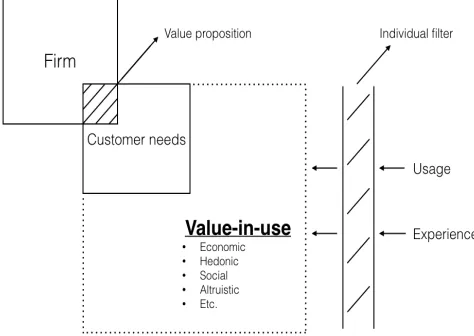
[image:5.595.311.548.328.496.2]It is clear there are different conceptions about value-in-use. The figure below shows how value-in-use is related towards firms and their value propositions. In this research, the value-in-use and its categories stand central and thus is where the emphasis lies. This framework is developed through several conceptualisations from existing literature. The different value drivers can be seen and also the factors that influence the value-in-use (usage and experience). As Sandström, Edvardsson, Kristensson, and Magnusson (2008) point out in their research, there is an individual filter that decides how individuals experience the usage and experience of the product or service. Often, firms only recognise customer needs. However, this is just “a tip of the iceberg”. Hence, as sketched in this figure below, value-in-use comprises the overall picture. This framework will be used as a tool throughout this research.
Figure 1 - Value-in-use framework
2.2.1
Previous studies
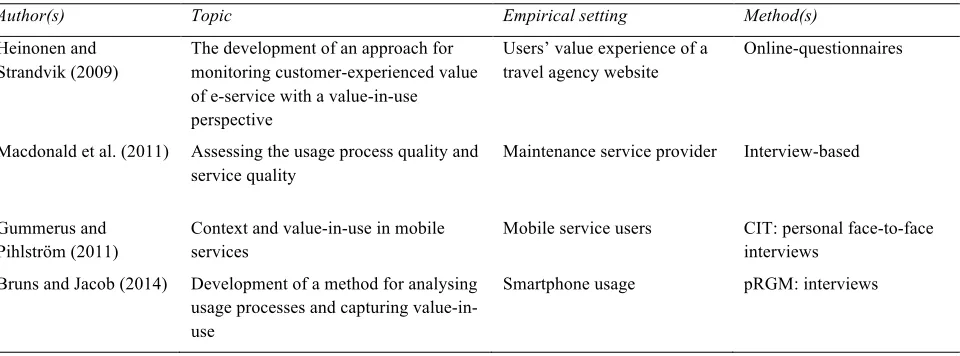
As mentioned previously, value-in-use is thoroughly studied to conceptualise it properly. Authors like Grönroos, Vargo and Lusch, Ballantyne and Varey investigated the concept of value-in-use. However, little research is being done in practice. Firstly, Heinonen and Strandvik (2009) examined the development of an approach for monitoring customer-experienced value of e-service with a value-in-use perspective. Through online questionnaires they attempted to investigate the users’ value experience on a travel agency website. Secondly, Macdonald et al. (2011) conducted a research trying to assess value-in-use by looking at the usage process and service quality. They investigated a maintenance service provider in which they conducted interviews to build a conceptual framework for the assessment of value-in-use. Later on, Gummerus and Pihlström (2011) focused on the context and value-in-use in their research. A total of 85 mobile service users were interiewed through the Critical Incident Technique (CIT), which is “a flexible set of principles which must be modified and adapted to meet the specific situation at hand” (Gummerus “Value-in-use is the evaluation of the service experience, i.e.
the individual judgment of the sum of all the functional and emotional experience outcomes. Value cannot be predefined by the service provider, but is defined by the user of a service during the user consumption” (Sandström et al.,, 2008, p. 120)
“Value-in-use is the value customers get through the experience, consumption and the use of the product or service. It determines the real value a customer receives and the key reasons why the customer is or could be retained” (Martinez, Lockett, & Toossi, 2011, p. 4)
& Pihlström, 2011, p. 525). In 2014, Bruns & Jacob looked at a method for analysing the usage processes and capturing the value-in-use. They adapted the Reperatory Grid Method (RGM), developed by Kelly (1955), which helps to capture the structure and content of subjective, complex perceptions in order to identify value dimensions which characterise value-in-use (Bruns & Jacob, 2014). Their own method, namely the Process-Related RGM (pRGM) focuses more on the S-D logic, value-in-use, usage processes, and value aspects. The traditional RGM method is more suitable for the G-D logic, according to Bruns and Jacob (2014). It is obvious that value-in-use has only been empirically investigated in the last five years. The following scheme, summarises the studies mentioned previously.
Table 2 - Previous studies value-in-use
2.3
Methodology for capturing value-in-use
2.3.1
Research paradigms
In the past, there were four general research streams known in qualitative inquiry which are positivism, postpositivism, critical theory and related ideological positions, and constructivism (also known as naturalism) (Guba & Lincoln, 1994). In their research, it is stated that research paradigms are dominant over research methods. A paradigm is defined as “the basic belief system or worldview that guides the investigator, not only in choices of method but in ontologically and epistemologically fundamental ways” (Guba & Lincoln, 1994, p. 105).
Guba and Lincoln (1994, p. 108) describe the different paradigms by answering each the following three questions for each paradigm:
1. “The ontological question: What is the form and nature of reality, and therefore, what is there that can be known about it?
2. The epistemological question: What is the nature of the relationship between the knower or would-be knower and what can be known?
3. The methodological question: How can the inquirer go about finding out whatever he or she believes can be known?”
Table 3 gives an overview of the different paradigms with their characteristics.
This research tries to grasp how value-in-use can be measured. The existing paradigms seem to be old-fashioned in the sense that building a theory or method on how to grasp value-in-use does not fit within the existing paradigms. Positivism as well as postpositivism both focus on explanation. This is in contradiction with this research in which there is a call for a method on how to measure value-in-use. Also, critical theory does not fully support this because of the fact it aims to reconstruct a topic based on previously held constructions (Guba & Lincoln, 1994). Furthermore, the inquirer should a priori understand what transformations are needed (Guba & Lincoln, 1994), which is not the case in this research. This research is new to the world, implying there is nothing yet to criticise about making it unsuitable for the critical theory. On
the other hand, the idea that inquiry should be value free (or not value free) (Guba & Lincoln, 1994) suits well with this research since the primary “thick descriptions” in this research are very broad and are not restricted by limitations. Constructivism seems to be most closely related since its inquiry aim is to understand a phenomenon. The hermeneutical basis of its methodology supports the idea that information could elicit only through the interaction between and among investigator and respondents (Guba & Lincoln, 1994). The relative powerless emic as well as the more powerful etic side of this interaction should be equal according to Guba and Lincoln (1994). They also state that the inquirer is seen as the facilitator of the inquiry process which seems to be in line with the data inquiry in this case. This promoting role of the researcher allows to gather first-order data and later on transform it to second-order data. Moreover, the idea that inquiry should be value free also accounts for constructivism. However, constructivism seems to mainly focus the understanding of existing topics. In this case, no certain method exists to assess value-in-use properly. So, the existing paradigms do not seem to be fully in line with the assessment of value-in-use. Hence, ethnography is chosen to clear things up since it sort of lies in the middle of constructivism and critical theory. It uses characteristics of both paradigms to frame the assessment of value-in-use. This perspective will be described in the next paragraph. In the last row of Table 3, the studies discussed in paragraph 2.2.1 are categorised into the different paradigms. The study of Bruns and Jacob (2014) is difficult to categorise
Author(s) Topic Empirical setting Method(s)
Heinonen and Strandvik (2009)
The development of an approach for monitoring customer-experienced value of e-service with a value-in-use perspective
Users’ value experience of a travel agency website
Online-questionnaires
Macdonald et al. (2011) Assessing the usage process quality and service quality
Maintenance service provider Interview-based
Gummerus and Pihlström (2011)
Context and value-in-use in mobile services
Mobile service users CIT: personal face-to-face interviews
Bruns and Jacob (2014) Development of a method for analysing usage processes and capturing value-in-use
but on the basis of the nature of knowledge, it is categorised within the critical theory paradigm. This because Bruns and Jacob (2014) build their research on historical knowledge, which are mainly the concepts developed by Vargo and Lusch (2004). The study of Heinonen and Strandvik (2009) is categorised within the constructivism paradigm because the focus lies on the “reconstruction” (Guba & Lincoln, 1994, p. 112) of a framework to capture customer-experienced value. The research of Gummerus and Pihlström (2011) and Macdonald et al. (2011) are also categorised into the constructivism because both studies aim to understand a certain phenomenon. This phenomenon refers in the case of Gummerus and Pihlström (2011) to the context within service use experience which generates value-in-use. Macdonald et al. (2011) investigated the usage process quality and service quality.
2.3.2
Ethnography
Ethnography is a well-known research perspective and there seems to be a growth of interest in it among research in different fields, both theoretical and practical (Hammersley & Atkinson, 1983). In this perspective, the focus lies on the development of theories through the observation of participants. Ethnographic researchers believe that if participants are being observed, they can learn about and dig deep into the (sub)culture of these participants and makes it therefore an efficient way to study a certain phenomenon (Krane & Baird, 2005). Through these observations, the world of the participants can be interpreted by the research in such a way that the researchers will get familiar with the participant’s world (Hammersley & Atkinson, 1983). The phenomenon will be studied in its natural setting and a description of cultures becomes the primary goal, according to Hammersley and Atkinson (1983). Ethnography is also perfectly suitable for companies to picture what people need and therefore gives them a competitive advantage (Reese, 2004).
Reese (2004, p. 54) states, ethnography’s literal meaning is “a study of/writing about culture”. Where “ethnos” refers to
people or folk, “grapho” means “I write”. He also points out that ethnography clearly reveals unarticulated needs in a vivid way through documenting and understanding what people actually do. In this process, two main components exist. Firstly, key is getting good field data and secondly, it should be analysed (Reese, 2004). Van Maanen (2011, p. 1) describes ethnography in the same way. He defines ethnography as: “…a written representation of a culture (or selected aspects of a culture)”. This is also in line with other researchers like Reese, Hammersley and Atkinson.
Researchers choose an ethnographic perspective if their aim is to understand the culture of a particular group from the perspective of the group members (Krane & Baird, 2005). This will lead to insight into the behaviours, values, emotions, and mental states of group members as Krane and Baird (2005) state
in their research. In order to achieve this, extensive fieldwork should be done and intense familiarity with a certain setting must be created (Tedlock, 2000). The process of ethnography starts with identifying an area of interest, followed by gaining entry, and finally creating a thick, rich ethnographic record of the group (Schensul, Schensul, & LeCompte, 1999). This record consists of emic and etic information. The etic approach can be comprehended as the “external view” of observers who observe from the outside, while the emic approach can be seen as the “internal view” of the observed who observe from within (Rosa & Orey, 2012, p. 867).
[image:7.595.58.535.272.487.2]Ethnography is used in this research to assess value-in-use. First of all because ethnography makes us understand the social setting through the perspectives of the participants (Krane & Baird, 2005). Secondly, researchers have a general sense at the beginning of an ethnographic study of what they want to investigate but precise questions may not exist (Krane & Baird, 2005). This is also the case in this research, in which we cannot be more precise beside stating that we try to investigate value-in-use through an ethnographic perspective. Interestingly,
Table 3 - Research paradigms and its characteristics (Guba & Lincoln, 1994, pp. 108, 112; Krane & Baird, 2005, p. 90)
Positivism Postpositivism Critical Theory et al. Constructivism Ontology naïve realism critical realism historical realism relativism Empistemology objectivist: findings
true modified objectivist: findings probably true subjectivist: value-mediated findings subjectivist: created findings Methodology/
Role of Theory
experimental: verification of hypotheses (mainly quantitative methods), deductive
modified experimental: falsification of hypotheses (may include qualitative methods), deductive & inductive
dialogic hermeneutical
Inquiry aim explanation: prediction, control and hypothesis testing
explanation: prediction
and control critique and transformation understanding of natural setting
Examples value-in-use research
Krane and Baird (2005) point out that ethnography is suitable for investigating sport settings, which is the case in this research. Through eliciting the lived experience and usage of the football player we hope to create a well-founded understanding of their culture. Finally, ethnography seems to be suitable since it does not just investigate what end-users say, but also aims to disclose their beliefs and culture (Lee, Saunders, & Goulding, 2005). This can be easily explained when looking at Figure 1, where customer needs (what the end-user points out) is just one part of the value-in-use (“the bigger picture”). Ethnography is known for is labour intensity (Lee et al., 2005). It involves extensive fieldwork meaning that the researcher should work with people in their natural settings as Lee et al. (2005) state. The result of this fieldwork should be a written end-product that is fluent and a readable narrative in which “the voice” of the customer is most prominent (Boyle, 1994; Muecke, 1994). In order to produce this written end-product, the data gathered by the fieldwork should be analysed. A search for patterns should take place while taking emic and etic interpretations into account (Lee et al., 2005). These patterns are formed by labelling the data into different categories. By doing this, different categories of value-in-use can also be identified. Unfortunately, there has not been any academic research specifically on value-in-use using an ethnographic starting point. Therefore, it can be stated that this research is new to the world.
Within value-in-use research, researchers try to trace what customers or end-users appreciate throughout their usage and experience process. To achieve this, extensive research must be done that focuses on these processes. In order to understand the value-in-use that lies with the end-user, researchers should empathise themselves with the end-user. This mainly takes place in the immersion stage as described by Visconti (2010). By following the total process of Visconti (2010), data can be gathered, the experience of the end-user can be understood, researchers can properly empathise with the subject’s world and thus are better informed. These steps will be further explained in the next chapter. Furthermore, a combination of first-order and second order data should allow the researcher to acquire a well-founded basis of the end-users’ experience.
Finally, Gioia and Chittipeddi (1991) mention five steps that helps a researcher to perform the second-order analysis: 1) qualitative content analysis of informants’ account to ascertain explanations for various events and activities that took place; 2) determining whether there appears to be a consistency or a change over time of the informants’ accounts; 3) analysis of data across different informants for significant patterns of convergence or divergence; 4) excerption of the theoretical explanations; 5) integrating these patterns into a theoretical framework. These steps are designed to provide a solid description of events (Gioia & Chittipeddi, 1991) and, therefore, will be used in the interpretation section.
3.
ETHNOGRAPHIC CASE STUDY
In the previous section, the concepts of value, value-in-use, and ethnography are discussed that serve as a solid basis for this research. In this chapter, the Ethnographic Case Study (ECS)
that has been chosen for this research will be intensively discussed according to the steps developed by Visconti (2010). Ethnographic Case Study research is defined as “the application of the ontological, epistemological and methodological features of ethnography to a theoretically selected set of business cases” (Visconti, 2010, p. 29). ECS is closely related to case study research as described by Eisenhardt (1989) as a research approach which focuses on understanding the dynamics present within a single setting. However, ECS is a revisited and structured combination of a case study with ethnographic methods (Visconti, 2010). Although ECS has considerable common ground with the traditional case study research, there are some distinctive features. Especially in marketing-oriented ethnography (which is the case in this research), ECS is stronger involved with the researched subjects (Visconti, 2010). Since value-in-use mainly focuses on the end-user, ECS seems to be a suitable choice for this research. Moreover, ECS helps “bridging the gap” between academic and the managerial communities and also overcomes the “positivistic” approach in the traditional case study research (Visconti, 2010). Finally, ECS contextualises and binds ethnography within the investigation of business cases (Visconti, 2010).
In the next paragraphs, further will be elaborated on the case study used in this research. This example will illustrate how value-in-use can be assessed using an ECS. More specifically, the following paragraphs will describe the consecutive stages goal setting, sampling, immersion, data collection, data interpretation, and reporting.
3.1
Goal setting
This study uses both unobtrusive and obtrusive data, in which further will be elaborated in paragraph 3.4, that serve as a foundation for revealing the players’ value-in-use. Moreover, both etic and emic information will be used. When approaching the informants for interviewing them, they are shortly and superficially informed about this research (in order to not create an experimental setting). They were told this research aims to investigate the players’ experiences on artificial grass.
3.2
Sampling
In this research, the focus is on amateur-level football. By means of purpose sampling (Babbie, 2009), a total of 70 football clubs in the region of Enschede – Zwolle (The Netherlands) were selected. In this sampling method, a sample is selected on the basis of knowledge of a population, its elements, and the purpose of the study (Babbie, 2009, p. 193). Football clubs have been selected on the basis of level, their geographical location, and whether or not they possess an artificial turf pitch. The selection of level is done to achieve a great level of diversity regarding the division football players are in. Junior players (mainly the elder youth) as well as senior players are researched, meaning this study has a diverse sampling group. So, the key informants in this study are the football players themselves. Through them, the valuable information for this study will be acquired.
information, which refers to the information collected directly from the football players themselves. This information is gathered through face-to-face interviews that are conducted after each training or match. These interviews were subdivided into different categories in order effectively elicit information. Categories mentioned in the face-to-face interviews were: 1) overall experience, 2) playability, 3) physical shape, 4) football-related characteristics, 5) enjoyment, 6) comfort, and 7) appearances. Of course, these categories only served as guidelines for the interviews of the players and did not have a dominant role in the players’ answers. Besides the emic approach, an etic approach is also used. Etic information is collected through the researcher’s view. By observing football players performing at practices or matches, the researcher retrieves information on how the players act and experience the usage of artificial grass. The setting in which the players perform is described in order to give a clear view of the circumstances they have to deal with.
Out of the 70 clubs in total, 25 clubs are being examined. These football clubs were also purposively selected on the basis of the following data: level, geographic information, and training schedule. Different levels within amateur football are selected (ranging from high to low: third division, fourth division, head league, first class, second class, third class, fourth class). The clubs are selected in such a way that they properly represent the Enschede – Zwolle region. Moreover, the training schedules of each club are used in order to make optimal use of the short time span of data collection.
3.3
Immersion
At this stage, the researcher is gradually being naturalised in the inquired culture (Visconti, 2010). Through this, the researcher will get more familiar with the culture of the natives over time. As known, observations and face-to-face interviews are used to achieve this. Linguistic skills, interpretative sensitivity, and behaviours that are meaningful to the observed culture are more effectively acquired over time (Visconti, 2010). As a result, within the immersion stage, the boundary between the observer and the observed gradually tends to blur. In this research, the researcher is not fully part of the context and therefore stays detached from the subjects’ world.
3.4
Data collection
In this section, first-order data, which is data generated by the field activity of observation and interviewing (Visconti, 2010), is collected. Participant observation is one source of data. In this study, the observation is “spectator-like”, meaning that the researcher is not participatory in the subject’s world. He or she only observes from a distance to investigate the activities that are related to the topic (Schensul et al., 1999). Participant observation is defined as “a process of learning through exposure to or involvement in the day-to-day activities of participants in the research setting” (Schensul et al., 1999, p. 91). Schensul et al. (1999, p. 73) point out several methods for collecting data, of which the following are used in this research.
• Listening
• Recording and understanding the meaning of the language used in the field setting
• Observing, recording, and interpreting behaviour In this, field notes are very important. These should contain a detailed description of what the ethnographer observes. Typical information field notes should contain are: behaviours, exact quotes, appearances, etc. (Schensul et al., 1999). Van Maanen (2011) states that field notes are an ongoing “stream-of-consciousness” commentary about what is happening in the research. Beside participant observation, this research also makes use of short face-to-face interviews. Subjects will be asked several questions in order to tap into their usage experience.
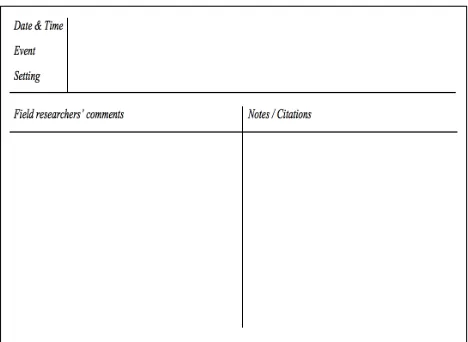
The figure below shows a clear template that will be used for recording field notes.
Figure 2 - Fieldnote recording form (partly adopted from Schensul et al. (1999, p. 117))
The two sources of information mentioned above are chosen because only observational data does not provide direct access to the perceptions, value and beliefs of the informants and reveal little about their internal state (Arnould & Wallendorf, 1994). Therefore, this data has to be complemented by forms of verbal accounts (in this case face-to-face interviews) that serve as an emic foundation (Arnould & Wallendorf, 1994). A total of 59 players were interviewed with a total vocal duration of 3 hours, 18 minutes and 35 seconds. In the next section, the data is interpreted and second-order data is generated. This data relates to the interpretations genuinely produced by the researcher on the basis of his/her first order data (Visconti, 2010). Moreover, a distinction can be made between unobtrusive and obtrusive data collection techniques (Visconti, 2010). Where unobtrusive data collection refers to the data collection through observation, obtrusive techniques are used in active elicitation (i.e. non-observational tools) (Visconti, 2010). The latter can take place in, for instance, interviews in which information located at the conscious level is disclosed by the respondent (Visconti, 2010). This distinction in data technique collection is also used in this research. Interviews are held (obtrusive) and observations of the football players are conducted (unobtrusive).
3.5
Data interpretation
[image:9.595.311.545.234.405.2]descriptions will be turned into useful patterns. ECS is not only concerned with first-order data. It involves the researcher’s personal elaboration of first-order data that will be rendered into second-order interpretations (Visconti, 2010). This process is also known as “second-order recounting”, as described by Rosen (1991). This procedure will be conducted with the help of the five steps of Gioia and Chittipeddi (1991) as described in chapter 2.
Looking at the field notes taken during the acquisition of data and the interviews that are held, several patterns can be seen. This is done by identifying whether there seems to be a consistency in the data. The questions in the interviews were subdivided into different categories in order to most efficiently tap into the players’ experiences. However, when analysing the data, two more categories than the existing seven could be identified: weather conditions and pitch diversity. In the next paragraphs each category will be discussed.
Interestingly, the majority of players compared artificial grass with natural grass in their comments about their experience on artificial grass. It seems to be that artificial grass pitches are judged most of the times in comparison to natural grass pitches. This should be borne in mind when discussing the different categories below.
3.5.1
Overall experience
The first question in the interviews tried to gather information about the players’ overall experiences with artificial grass. Remarkable in the answers given is that each player gave their individual opinion on artificial grass. Before digging deeper into subcategories, the players themselves already start to categorise information. Therefore, this question positively contributed in the data interpretation section. A typical example of a player’s overall experience on artificial grass is:
“Artificial grass has become better and better. Playing football on such a pitch is very enjoyable. Especially during the fall and winter season when the weather can be really bad. So, for example, now it is November and we are able to perform on a great pitch! This is the opposite of a natural grass pitch where the field is only properly playable at the beginning of the season, in the months of August and September. Previously, we had a normal grass pitch that we used every Saturday afternoon for matches. The problem was that when we reached October, with its rainfall, the pitch had changed dramatically. Thus, the playability on artificial grass pitches is enormously high and cancellations of matches is out of the question.”
The reaction of a respondent stated above represents the average opinion of players. Therefore, a couple of things can be stated: the development of artificial grass has improved over time, the overall experience is enjoyable and pleasant, and there seems to be a great difference playing on artificial grass versus natural grass. Moreover, and more importantly, artificial grass seems to be very reliable. This can be concluded from several aspects. Field notes indicated that the reliability on artificial grass is very high. For example, players do not have to anticipate as much on artificial grass as they need to do on natural grass. How passes will be retrieved by players, the ball’s bounce, the smoothness of artificial grass pitches, are all indicators of high reliability. Players want to play football (see
above comment: “… cancellations of matches are out of the question”), and in order to make this possible they need several facilities among others a good pitch.
Although the small number of players that indicated the following, it is worth mentioning. Some respondents stated that they prefer natural grass above artificial grass pitches. One player indicated:
“… But a natural grass pitch that is well maintained is the best case scenario! This is because of the total experience and all perceptions you have on normal grass: slidings and tackles are more pleasant, the scent of freshly mown grass in the morning… it just has to do with the overall perception of playing football.”
The overall perception of playing football seems to be important for some players. They want to “have a dirty shirt and shorts” (comment of an informant)after playing a match. Artificial grass does not promote this and therefore does not fully contribute to the players’ experience.
3.5.2
Playability
A great advantage for players is the fact that artificial grass is nearly always playable during all weather conditions. Players are very much aware of this:
“Of course, it is obvious that 9 times out of 10 artificial grass pitches are playable. Being a sportsman, I want to play sports, in my case football. I want to play football during the weekly practices and each Saturday with a match. Artificial grass enables this. In my opinion, cancellations due to bad weather conditions must be preventable.”
A different respondent gave another interesting comment: “… Nowadays, amateur football clubs cannot afford maintaining natural grass fields. Due to the rising members of our club, more practices and matches must be played. In the case of not having artificial grass pitches, the problem of capacity arises because natural grass cannot handle the burden of football teams playing from nine o’clock in the morning until five in the afternoon. From the perspective of a football club, I think artificial grass solves this problem and is much more sustainable!”
From this comment, it can be concluded that football clubs also profit from possessing artificial grass pitches. The playing capacity increases significantly which is a great advantage for players as well as football clubs. Another player indicated that playability of artificial grass pitches positively influences the shape and fitness level of the football players. In the quote below, this is clearly mentioned.
“The fact that artificial grass pitches are almost always available for playing football, is a great advantage. We are always able to train so we can stay in shape. On natural grass pitches it is a different story. In that case, when it is raining cats and dogs, we are obliged to “stay inside”: no football!”
3.5.3
Football-related characteristics
players take advantages of the predictability of the ball’s behaviour: its bounce, roll, and acceleration. However, these factors are heavily influenced by the weather conditions, on which further will be elaborated in section 3.4.8. Observations pointed out that the ball can be easily controlled by the players. Exercises in small areas, position games and short distance passes were performed very well. This indicated that the smoothness, speed, and predictability on artificial grass is perceived as positive for the players. On the other hand, the ball bounces quite high on artificial grass, especially on the outdated pitches where the infill material has been compacted. This compacting process negatively influences bounces and passes in the sense that passes keep bouncing and therefore are difficult to receive for players.
Interviews pointed out that nearly every informant was positive about artificial grass regarding football-related characteristics. Below, several players’ reactions are stated.
“Over here, everything is easier when talking about technique. If you are playing on a normal pitch, you must deal with the “real” grass that consists of bumps and other irregularities. On artificial grass, everything is flat and this is an important aspect you bear in mind when playing football…”
“Especially the short distance drills and quick combination exercises are perfect on artificial grass. If you are a team that wants to play position game football, artificial grass really promotes this. On the other hand, if we are obliged to play on a normal grass pitch, we are at a disadvantage so to say.”
“… Especially during the winter and autumn you have to bear in mind that the pitch has many unevenness patches and bumps. When you are playing at a certain level, the (natural) pitches are way off. With artificial grass you are assured of a stable surface without imperfections. This is, especially for technical well-developed players, a relief. With our team, we are able to play beautiful football in which position game and short combinations are key.”
It came to light that players appreciate artificial grass related towards football specific characteristics. More precisely, they acknowledge that the pace of playing football increases and it helps to play football well.
3.5.4
Physical shape
The physical shape of the players on artificial grass seems to be a known topic. Players have mixed opinions whether they are more prone to injuries. This can be seen in the players’ comments below, in which the reactions are different.
“It is not that specifically I am very prone to injuries, but I can definitely state that artificial grass increases the chance of getting injuries. Also, from team mates and other football players I often hear the same problem. Knee injuries are most common which is caused when your boot stays stuck in the pitch when turning your upper body.”
“…If you know that when performing a tackle or sliding, a skin abrasion will be the result, you will more prudent to perform a sliding next time. So in my opinion, the player adapts his game to this problem.”
“I was way more prone to injuries with the old fashioned artificial grass because these pitches did not have the cushioning the artificial grass pitches have nowadays. I used
to have many knee problems. Given the fact that I have a growth disorder in my knee, the chance of injuries increases significantly.”
“I do not think that artificial grass pitches make you more prone to injuries. In my opinion, the main problem is when you constantly have to switch from natural grass to artificial grass. This is because not every football association, although this applies to the minority of clubs, owns artificial grass pitches. We are sort of privileged to possess such a pitch, but still, when we must play an away match, we sometimes are obliged to play on natural grass pitches.” “No, not at all, it is quite the opposite! On a natural grass pitch, you must accept that there are patches of unevenness and irregularities. With a results, you will sprain your ankle more easily.”
Having a look at the comments above, respondents mention different aspects making it therefore difficult to draw hard conclusions. Some players indicate they suffer from knee, ankle, and groin injuries. Others indicate that the body’s recovery process after a practice match takes longer. On the other hand, players reveal they are more satisfied with artificial grass because of the evenness and flatness and therefore are less prone to injuries which positively affects their physical shape. Furthermore, field notes clearly specify that players suffer from skin abrasion: [player tries to tackle an opponent], afterwards he has to wipe away the infill that sticks to his knee. He leaves the pitch for a minute and needs treatment. Another observation was taken during an interview in which an informant tore his tights with a bruise underneath it. When he was asked how it happened, he replied: “this is a consequence of trying to recapture ball possession through a sliding tackle on artificial grass”. It can be concluded that the majority of the informants agree with the fact that sliding tackles are less pleasant when weather conditions seem to be a mediating variable that influences the severity of skin abrasions. When performing a sliding tackle on a wet pitch, players slide significantly more, reducing the friction they experience. With a dry or arid pitch, the abrasions seem to be the worst. This can be also concluded from a note taken at a practice with heavy rainfall: [one player tries to continue the game by doing a sliding tackle to keep the ball within the playing area. Almost clashes into the boarding]. This is contrary to a field note taken at a match with dry and cold weather: [player is pushed towards the ground, his knees bounced into the pitch and falls forward. Pitch is very dry, a lot of friction].
3.5.5
Enjoyment
Field notes clearly indicated that the central thing players desire is enjoyment. Players want to play football and do not want to be troubled by issues such as a pitch. Observing different practices indicate that players experience fun and enjoyment if drills work out well. This can be stimulated with artificial grass pitches where there is a high degree of playability and reliability.
“For technical players it is very pleasant and enjoyable, of course. The ball travels faster and does not bump. Therefore, you can do your thing!”
“… there are no rainouts or cancellations or so and thus we can always play football. I just want to play football and on artificial grass pitches this goes very well. The fields are flat and the ball rolls nicely. On natural grass pitches, you suffer from uneven patches which is not the case over here and thus you cannot blame the pitch anymore.”
“On artificial grass pitches, the whole game is easier and nicer to play. So in that respect… the game is more fluent and thus you will get in your flow more easily. On natural grass pitches, most often the game will be interrupted by the unevenness of the pitch and therefore it is more difficult to play a nice game.”
On the other hand, players mentioned that the “best-case scenario” is a natural grass pitch that is well maintained, flat and a little humid. This has to do with the total experience of football. As one player pointed out:
“If I were able to choose between a perfect natural grass field or a perfect artificial one, I would go for the natural one. …it has to do with the total experience of the game. It is something you grow up with, the fresh smell of just mown grass every Saturday morning is not replaceable by something else. However, not everybody has a pitch like FC Barcelona. An amateur club like ours, cannot maintain such a pitch and therefore artificial pitches are a proper solution. I must admit, even if my perfect picture is a natural pitch, everyone is able to get used to artificial grass pitches.” The overall enjoyment seems to be an important factor in the player’s experience. Despite the fact natural grass pitches possess some typical traditional characteristics (e.g. smell), artificial grass appears to be positively related towards the player’s enjoyment of performing football.
3.5.6
Comfort
The comfort of playing on artificial grass can be divided into different factors. Firstly, the majority of players indicated they encounter the hassle of too much rubber infill on pitches. Secondly, players gave the impression that the cushioning of artificial grass pitches significantly differ. Moreover, they insinuated that weather conditions influence the pitch’ scent. A notable field note was that players seems to be aware of the amount of rubber infill that is present on artificial grass pitches. During practices and matches, infill bounced into the air which gave the football game a particular look as a whole. With sliding tackles, as well as passes, rubber grains came off into the air. During a practice, the following observation took place: [player makes a sliding tackle, stops participating the game and removes shin pads in order to take out the rubber that is stuck between the sock and shin pad]. While playing a match, another player left the playing area and took a minute to shake the rubber infill out of his boot. These are all field notes that clearly indicate the trouble players perceive regarding the rubber infill during a practice or match.
While conducting the face-to-face interviews, informants appear to have the same conception. Some interesting comments are mentioned below.
[spectator asks player what his opinion is on artificial grass], player replies: “Too much rubber!”
“If the weather is sunny and really warm, you can literally smell the rubber infill. It feels very muggy so to say, when entering the pitch.”
“When playing football during warm and dense weather, you will get a dry mouth very easily. You can nearly taste the rubber!”
“… Sometimes some rubber grains remain in your clothes but I settle for that. Unfortunately, my mother is not happy with that because apparently it is bad for the washing machine [player laughs] …”
These comments clearly illustrate the trouble players experience with the rubber infill that is present on artificial grass pitches. Another interesting issue came to light when interviewing respondents, namely the cushioning of artificial grass pitches. This seems to differ significantly across different pitches. As one player perfectly illustrates this problem:
“You can easily recognise when entering the field whether you deal with an outdated pitch or a brand-new one. The yarns are totally flat when you have to deal with an old pitch. Also, it is less pleasant to play on because of the lack of cushioning. It really feels like a concrete pitch! … Within this region, there are some pitches that are “notorious” so to say. When we have to play on these pitches, you know a priori that you will end up having sore muscles and painful legs at the end of the match. This really has to do with the lack of cushioning.”
Further will be elaborated on pitch diversity in section 3.4.9, but it is important to bear in mind that players experience the cushioning of artificial grass pitches differently. Where new pitches seem to be very cushioning and comfortable, older pitches are less comfortable and very tough to play on. Players also indicated that they feel they are more prone to injuries when playing on old artificial grass pitches. Moreover, field notes evidently pointed out that the total experience of football is different if the cushioning is different. When playing on a pitch that has little cushioning, the ball bounces higher and more “unnaturally”. One field note was taken when observing a practice on an outdated pitch: [ball bounces differently than player anticipated. Player could not anticipate and the ball bounced higher than expected]. This issue repeatedly arose when observing such artificial grass pitches. An informant pointed out the following:
“… Two weeks ago we had to play a match at …, this pitch is very outdated and flat. It feels more like a hockey pitch than a football pitch. This is the worst you can play on in my opinion.”
It is clear that the comfort is related to other categories like weather conditions, pitch diversity, football-related characteristics and physical shape.