Original citation:
Hammond, Michael, 1956-. (2005) A review of recent papers on online discussion in teaching and learning in Higher Education. Online Learning (formally the Journal of Asynchronous Learning), Volume 9 (Number 3). ISSN 1092-8235
Permanent WRAP url:
http://wrap.warwick.ac.uk/66308
Copyright and reuse:
The Warwick Research Archive Portal (WRAP) makes this work of researchers of the University of Warwick available open access under the following conditions. Copyright © and all moral rights to the version of the paper presented here belong to the individual author(s) and/or other copyright owners. To the extent reasonable and practicable the material made available in WRAP has been checked for eligibility before being made available.
Copies of full items can be used for personal research or study, educational, or not-for-profit purposes without prior permission or charge. Provided that the authors, title and full bibliographic details are credited, a hyperlink and/or URL is given for the original metadata page and the content is not changed in any way.
A note on versions:
The version presented in WRAP is the published version or, version of record, and may be cited as it appears here.
A REVIEW OF RECENT PAPERS ON USING
ON-LINE DISCUSSION WITHIN TEACHING AND
LEARNING IN HIGHER EDUCATION
Michael Hammond
Centre for New Technologies Research in Education Institute of Education,
University of Warwick Coventry, CV4 7AL +44 [0]24 7657 2517
ABSTRACT
This paper presents a review of a sample of recent case studies on the use of asynchronous online discussion in higher education. These studies are analysed in terms of curriculum design; assumptions about teaching and learning; claims and reported conditions for using on-line discussion. The claims made for asynchronous online discussion are found to be frequently based on social constructivist principles, in particular the opportunities for interaction between learners, and permanent access to these interactions. Asynchronous online discussion is seen as offering additional value by providing learners with experience of computer communication tools and opportunities for taking part in group work. Several constraints on participation within on-line forums are described. These are discussed in relation to the nature of curriculum design; tutor support; learners’ attitudes and previous experience; software design. The conditions under which asynchronous online discussion may best support learning are set out and avenues for future research are suggested.
KEYWORDS
Asynchronous discussion, literature review, case studies
1. INTRODUCTION
The theme of this paper is teaching and learning through on-line discussion in higher education. The paper reports on case studies in which email lists or conferencing programmes such as First Class and WebBoard have been used to support learners registered with a higher education institution and, in most cases, following an accredited course. Asynchronous on-line discussion is used as a catch all to include widely used terms such as ‘computer mediated communication’ and ‘threaded discussion’ and to cover approaches such as co-operative computer supported learning, collaborative computer supported learning and on-line group work.
presence. In a similar vein Zhao and Rop [2] carried out a review of forums for teachers. Many of the forums fell outside the scope of the Wallace paper but interestingly the authors make a similar point that research needs to be more explicit in addressing learning gains associated with on-line discussion. It can be added that several of the case studies reviewed for this paper contain thorough overviews of existing literature, e.g. Anderson et al [3] on the tutoring role, Aviv [4] on social construction of knowledge, Brown [5] on conditions for learning and van Weert and Pilot [6] on curriculum design. Why then a further paper? The aim is to undertake a systematic review of a tightly sampled section of the literature to contribute to a more detailed picture of the part played by asynchronous on-line discussion in higher education and to specifically report on: models of curriculum design; theoretical perspectives on teaching and learning; evidence which supports the use of asynchronous on-line discussion; and reported conditions under which learners are most likely to participate.
A The research
Seven international journals were selected to provide a perspective on developments in asynchronous online discussion particularly those based in the UK and USA. Six of these journals are widely seen as the most influential in the UK ICT research community, the seventh, JALN was chosen because of its specialist concern with asynchronous networks and its greater coverage of initiatives in North America. The range was broad enough to enable worthwhile generalisations but many other well cited journals such as ‘Internet and Higher Education’, ‘Journal of Computer-Mediated Communication’ and ‘Australasian Journal of Educational Technology’ could also have been included. It is hoped that this paper will stimulate further reviews using a more internationally mixed range of publications, however a fully inclusive survey of the literature is impossible, so large has it become. The following criteria were used to identify relevant papers within the seven journals:
Case studies, usually a case study of a particular course but Anderson et al [3] report on more than one course in the same paper. However papers which conflate the findings of several case studies, or were empirical studies in which students attended different courses, were not included as they tended not to provide details of curriculum design
Based in higher education institutions and organised by academic staff
Focused on asynchronous on-line discussion – though in many cases on-line discussion ran alongside other learning events such as face to face meetings or other learning materials such as web resources and on-line lectures.
Focused directly on teaching and learning – for example papers which focused on implications for the institutions or predominately on methods for content analysis were not included.
Published between 2000 and 2004 – this was to provide an up to date view of the field with a consistent cut off point.
Wilson [41]. Two were published in ‘Education, Communication and Information’: Putz and Arnold [42], Swan, K. [43]. Six in ‘Education and Information Technologies’: De Abreu Moreira and Quintino Da Silva, [44], Hawkey [45], Hawkey [46], Lockhorst et al [47], van Weert and Pilot [6], White and Le Cornu [48]. Six in the ‘Journal of Computer Assisted Learning’: Chen, Wang, and Ou [49], Jones and Asensio [50], De Laat and Lally [51], Ritchie and Peters [52], Thomas [53], Weller [54]. Finally, ten papers appeared in ‘Technology, Pedagogy and Education’: Åhlberg et al [55], Brett [56], Clarke [57], Cook and Ralston [58], Galanouli and Collins [59], Mackinnon [60], Maor [61], Miller and Ewing [62], Seabrooks et al [63], Tsui and Ki [64].
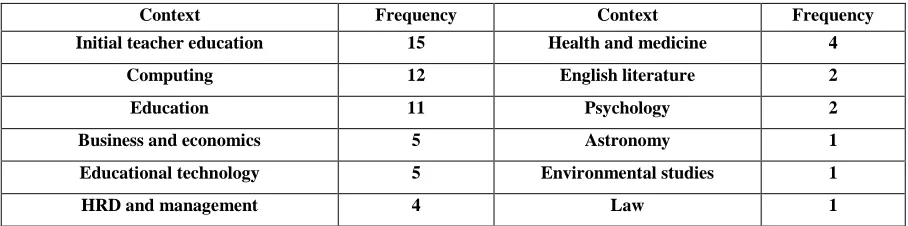
Each paper was categorised by journal, by discipline area, by country in which set and software used. The sample papers covered different subject areas (table 1) and were based in different countries (table 2) though heavily weighted towards North American and UK based initiatives within teacher education.
Context Frequency Context Frequency
Initial teacher education 15 Health and medicine 4
Computing 12 English literature 2
Education 11 Psychology 2
Business and economics 5 Astronomy 1
Educational technology 5 Environmental studies 1
HRD and management 4 Law 1
Table 1: the frequency with which papers reported on different subject disciplines (n = 63, Anderson et al [3] report on two different discipline areas)
Location Frequency Location Frequency
UK 19 New Zealand 2
USA 17 Taiwan 2
Australia 7 Austria 1
Canada 5 Brazil 1
Finland 2 Hong Kong 1
Holland 2 Ireland 1
[image:4.612.66.520.247.360.2]Israel 2
Table 2: the countries in which the forums in the case studies were located (n=62)
A wide range of software was used in the studies, there are specific references to twenty one separate programmes, with First Class, mentioned in eleven papers, the most frequently cited. Having established the nature of the sample, the papers were then further categorised by themes. Examples of focus questions associated with each of these themes are given below along with an example of the notes taken on a particular paper:
Curriculum design
contributions assessed? What content is accessed? Is there an explicit curriculum model? As an example, Putz and Arnold [42] describe a seminar format: twelve learners organised into smaller groups to critically review papers. The paper describes a loose structure albeit specific deadlines for introduction and reflections. Tutor and invited guests support but do not direct groups. There is extensive formative feedback on contributions and an end of unit assessment.
Theoretical assumptions about teaching and learning
Which theories of teaching and learning underpin the work e.g. community of practice, social constructivism? As an example, Aviv [4] extensively reviews literature and sees the social interdependence theory of learning as a key point of reference, research questions emerge from a review of the literature.
Claims made for asynchronous on-line discussion within the case study
How, if at all, do forums support learning? How strong are the claims? What are the key reported benefits? As an example, Vandergrift [22] describes a learning community and suggests ‘dramatic’ gains in personal learning through taking part in discussion, the background and willingness of students to communicate is seen as central to success rather than on-line forums per se. The study is recognised as exploratory raising questions for further investigation.
Conditions
What are the key conditions for asynchronous on-line discussion to make a contribution to student learning? What are the reported constraints on learners? As an example, Hawkey [45] highlights structure and direction as important and sees scope for peer review in assessment and evaluation, the paper recognises that the medium is challenging for some as text is public and permanent. Tutors need to help students understand the nature of the medium.
Comments made within each category were then analysed with key themes identified and described below.
II RESULTS
A Curriculum design
There were difficulties in categorising curriculum design as the exact nature of the activities with which learners were expected to engage, the role of assessment and the relationship of asynchronous on-line discussion to other parts of the course experience were not spelt out in all the papers. Some writers offered explicit curriculum models, e.g. Vandergrift [22], van Weert and Pilot [6], but many did not. Nonetheless three types of on-line discussion activity were identifiable, these were:
assessed.
Loosely structured forums in which learners were expected to complete certain tasks on an individual basis and send these for group discussion. For example in Angeli et al [24] learners were required to post a ‘case’ arising from their teaching placement and their participation, rather than performance, was assessed. In Collings and Pearce [26] learners were expected to produce a web site for peer evaluation and comment on those produced by their peers. Several studies described on-line seminars based around specific readings and events. Hawkey [45] described a loosely structured forum for trainee teachers based on the experience of a shared school visit and linked to preparation of a course assignment. This was followed up in a study of a more directed approach requiring trainee teachers to comment on each other’s work, Hawkey [46]. Putz and Arnold [42] and Kumari [13] provided a structure for discussion by using guest experts as participants within on-line seminars. In Morse [15] learners were provided with specific readings on which to comment. In these loosely structured forums summative assessment of participation was uncommon but Oliver [16] described a case study in which learners were given course credits for participation.
Cooperative / collaborative task based forums in which learners were expected to work in small teams in order to complete an assignment, e.g. Lockhorst et al [47] and Kear [35], with formative and often summative assessment built into on-line activity. Several of these studies were based around case based inquiry. For example in Martinez et al [38] pairs of learners proposed a best fit solution for a computer system in a simulated commercial setting, in Yang and Tang [23] learners worked in teams (usually three people) to prepare a case study on the implementation of a Management Information System. This required groups to set focus questions for other learners and respond to cases set by other teams. Peer review was undertaken in several studies, e.g. in De Abreu and Quintino Da Silva [44] there was a focus on giving feedback on the web sites other learners had designed, and Aviv et al [7] described and contrasted two approaches, one relatively open and one highly structured. In Jones and Asensio [50] and Aviv et al [7] group work tasks were interspersed with more independent activity.
B Theoretical assumptions about teaching and learning
Most papers began with an introduction to the growing importance of on-line learning in education and highlighted the importance of interaction between learners as the most important contribution of on-line forums to learning. In the majority of papers interactivity was linked to a theory of teaching and learning with which the authors wished to align themselves, or at least hypotheses about teaching and learning which they wanted to investigate. Hiltz et al [64] have made the point that research into the asynchronous on-line discussion may be situated within three fields: educational research, media analyses and social psychology and these are considered below. Definitions of these three fields are contested but they, respectively, differentiate between a focus on teaching and learning; on the impact of the media on individuals and groups; and on the behaviour of the individual within a group.
Educational research
and community of practice, all of which regularly appeared in the literature, belonged. A less frequently recurring concept was that of conversational learning based on references to Laurillard [66]. Thomas [53] for example used this term to highlight the importance of both internal and interactive dialogue within on-line learning environments and Kumari [13] discussed the conversational nature of learning in more general terms.
The terms cooperative and collaborative were not always used consistently within the papers but they did signpost varying levels of collaboration and structure. For example, Curtis and Lawson [10], citing earlier authors, made a distinction between cooperative and collaborativelearning. Cooperative learninginvolves the completion of a task by breaking it down into subtasks which team members solve independently. Collaborative learning involves team members working together to develop a joint solution to a problem. Collaborative learning suggests a higher order of interaction though it was not a distinction universally followed, for example Aviv et al [7] investigated the regulation of high level reasoning within a study of cooperative learning, citing like many other authors, the work of Johnson and Johnson [67] in which the term cooperative learning described a higher order collaborative process. Murphy [30] saw collaboration as a continuum involving progression along six processes ranging from acknowledging social presence to producing shared artefacts.
Many papers looked at the notion of community and learning within a community of practice, e.g. Vandergrift [22], Brown [5], Putz and Arnold [42], Tsui and Ki [64], van Weert and Pilot [6]. These terms were generally used to imply the presence of both reflective and reflexive discussion within the community. Putz [42] argued a community of practice needed to be small enough for learners to be acquainted, to share an understanding of purpose and conduct, and to facilitate entry of new members to the group and described five design dimensions which needed to operate within an on-line learning community. Clarke [57] drew on Lave and Wenger [68] to describe a community of practice as one in which learners evolve forms of mutual engagement, understand and ‘tune’ their enterprise and develop a repertoire, style and discourse. Meanwhile Anderson et al [3] described a community of inquiry model with three elements: cognitive presence, teaching presence and social presence – the paper in the sample reported on teaching presence.
Often linked to the idea of community of practice was that of problem based learning and team based cooperative learning. For example van Weert and Pilot [6] discussed three principles in on-line innovation: firstly task based learning within authentic or realistic learning situations; secondly team learning and thirdly the use of ‘groupware’. This approach was informed not only by the social and cognitive value of working with others but also by the need to provide a more authentic and more relevant professional preparation.
Other less frequently made references to learning theory included transactional distance, for example Vandergrift [22] used the term to draw attention to the communication gap between teacher and learners when separated by space and time; reflective practice, Salmon [31]; narratives in learning, Ritchie and Peters [52]; mentoring, Seabrooks et al [63]; and adult learning, Koory [12].
Media theory
of particular software within the literature, although a paper by Ross et al [19] was an exception in presenting a detailed discussion of tutors’ and learners’ priorities and behaviour in accessing and organising mailings within First Class conferencing software.
Social psychology
Few papers adopted social psychology as an explicit starting point except in the obvious sense that social psychology is a broad enough concept to take in educational theory. Distinctive social psychological perspectives became more obvious in discussions of social presence, e.g. Anderson et al [3], and more so when social networked analysis [SNA] was introduced, e.g. Aviv et al [7], Lockhorst et al [47] and Chen et al [49]. Aviv et al [7], defined SNA as a graphical analysis of actors within a network based on characteristics of cohesion, role groups, power of actors, range of influence and brokerage. SNA, it was argued, can be used to reveal the structure of networked learning and provide evidence for its effectiveness.
The cultural dimension of asynchronous on-line discussion was taken up by Biesenbach-Lucas [8] and Morse [15] in particular. Biesenbach-Lucas [8] looked at perceptions of native and non native trainee teachers and Morse [15] explored the feedback of learners with preferences for low and high context learning. Learning styles were discussed in several papers and Carswell et al [25] used the Honey and Mumford learning styles inventory (activists, reflectors, theorists and pragmatists) as a reference point for discussing differentiated responses within forums.
C The claims made for asynchronous on-line discussion within the case studies
Most papers were measured in their support for the use of asynchronous on-line discussion and highlighted the constraints on learners as well as the opportunities which asynchronous on-line discussion offered. Most stressed that they were reporting exploratory work, lessons were learnt and alternative approaches might be more successful in the future. The focus was often on improving curriculum design or tutor practice rather than establishing the value of asynchronous on-line discussion per se. Almost all papers had an action research element to them – though action research was not referred to explicitly - and there seemed an initial optimism about the use of asynchronous on-line discussion which had led researchers to undertake innovations in their teaching. Very few authors were prepared to make a statistical comparison between on-line and face to face discussion or to argue that on-line working was inherently better than face to face. However the majority concluded that asynchronous on-line discussion was potentially valuable or very valuable as a support for teaching. Three general arguments were used as evidence: Asynchronous on-line discussion provided opportunities for interaction between learners which contrasted with non-interactive, traditional or transmission models of teaching. In many cases, papers reported on interaction which could not otherwise easily take place as learners were at a distance from each other.
Many papers reported on relatively high rates of participation and evidence of learner presence and interactive learning styles. Many claimed that students had appreciated the use of asynchronous on-line discussion.
Many reported on learners’ appreciation of social support and found this a motivation to study.
The presence of higher order discussions and knowledge building within forums, e.g. Åhlberg et al [55], Aviv et al [7], Curtis and Lawson [10], Thomas [53] and Campos [9], though each paper contained some qualifications on the extent to which the construction of new knowledge was achieved. In addition Brown [5], Clarke [57], Putz and Arnold [42] and Vandergrift [22] argued that the presence of a community of learners and the development of an on-line community was both possible and desirable.
The permanent storage of messages providing support for reflection, e.g. Salmon [31], and expansion of available time for learning, e.g. Macdonald and Twining [29], Meyer [14].
Access to virtual guests to widen the experience of learners, e.g. Kumari [13] and Wearmouth [32]. The flexibility of the medium, e.g. Biesenbach-Lucas [8], Light et al [36] and Hawkey [46], and the
opportunity to create an environment to meet student and tutor needs.
Added value to the learners’ experience. Here a general theme was the development of ICT skills and greater understanding of the contribution ICT can make to learning, e.g. Galanouli and Collins [59]. Other writers drew attention to gains in self confidence through carrying out group activities, e.g. Miller and Ewing [62], Tsui and Ki [64]. Lindblom-Ylänne and Pihlajamäki [28] saw added value in using the medium of text to discuss essay writing, likewise Koory [12] saw the medium as especially ‘pertinent to a literature class’.
The relevance of on-line activity for professional learning, for example Collings and Pearce [26] described how on-line discussion enables trainee web designers to carry out usability trials of web sites, van Weert and Pilot [6] saw group based discussion as intrinsic to professional preparation.
D Conditions for asynchronous on-line discussion to take place
Most papers highlighted constraints on learners and nearly all papers drew attention to a range of issues which affected the impact and effectiveness of on-line discussion. These were apparent in skewed rates of participation and lack of evidence of interaction between writers of messages. Conditions for taking up asynchronous on-line discussion were discussed in reference to a set of interrelated issues in curriculum design, tutoring, software (including access and choices of programmes), and learners’ behaviour and attitudes.
Curriculum design issues
Curriculum design appeared as the most frequently discussed condition for group cohesion and participant engagement with asynchronous on-line discussion. Major issues here were structure, assessment and fitness for purpose. Several writers, notably Aviv et al [7], argued that a structured curriculum would lead to more cohesion. The implication was that learning activities should be timetabled and roles and responsibilities made explicit. Further structure may be provided by timetabling guest experts. Curriculum designers needed to build in opportunities for reflection and Salmon [31] and Koory [12] looked for curriculum design to address adult learning styles. Several papers reported on the importance of not overloading learners, curriculum designers needed to recognise the demands made on learners within an on-line environment, e.g. Meyer [14] and Collings and Pearce [26].
contributions to the process of group work not just group products. However, Oliver [16] argued that assessing contributions might increase the number of postings but not necessarily learners' intrinsic engagement.
Several papers suggested that some teaching and learning contexts were more suitable for asynchronous on-line discussion. Group based learning needed to be integral to course design and Parker and Gemino [17] argued that on-line discussion offered better support for conceptual learning rather than acquisition of skills or techniques. Putz and Arnold [42] suggested that on-line discussion was less likely to be of value if face to face meetings were easy to organise.
Tutor support
Curriculum design overlapped with discussion of tutor support in many of the practitioner accounts of introducing asynchronous on-line discussion, the term ‘tutor’ being used here, and throughout this paper, in the general sense of instructor or teacher. However some papers, e.g. Anderson et al [3], De Abreu Moreira and Quintino Da Silva [44], Hawkey [45], Miller and Ewing [62], Salmon [31] and Oliver and Shaw [16], had a specific focus on tutor presence. Anderson et al [3] made a distinction between teacher presence and teaching presence, but still recognised the special contribution of the course tutor even if other learners might take on quasi teaching roles. Left to themselves learners might be reluctant to disagree, challenge or even respond to others in the group and Galanouli and Collins [59] were alone in their sympathy for tutorless groups. Other writers felt that tutors needed to provide administrative, pedagogic and affective / pastoral support and signal their presence. Tutors needed to encourage divergence within the group, suggest roles and introduce ‘starter’ and ‘wrapper’ activities. Mackinon [60] and Chen et al [49] suggested that teachers need ways of recording and analysing discussion and provided tools for helping them do so.
Light et al [36] noted that teachers would inevitably draw on face to face teaching styles when tutoring on-line, but the transition to on-line tutor was not straightforward. Both Anderson et al [3] and Salmon [31] argued that tutors needed to develop strategies to compensate for lack of non verbal and paralinguistic clues. Difficulties in the tutor role were discussed. Hawkey [45], for example, saw the need for direction if student interaction was to develop beyond an exchange of information but this was a dilemma for a tutor wanting learners to take responsibility for their own learning and Maor [61] drew attention to the dual role of tutor as both co-learner and coordinator.
Learners
al [27] found some evidence that ‘imagers’ sent more messages but as important was to have a mix of learning styles within a group. Lindblom-Ylänne and Pihlajamäki [28], Tsui and Ki [64] and Wearmouth [32] noted that learners needed to be self confident if they were to make public and permanent contributions in forums, some would find this kind of disclosure too threatening though others boosted their self esteem once overcoming their initial inhibitions. Brett [56] saw an association between a learner’s level of activity and their confidence with the subject matter discussed within a forum and further found that levels of activity tended to vary little over an extended period of time. Graddy [11] explored the influence of gender hierarchy and argued that moderators had a role in identifying and addressing ‘gender based impediments’. Finding a different angle on participation, Galanouli and Collins [59] sought to understand online activity in terms of the information gap between learners, and their willingness to cross it, rather than the learning style or other characteristics of individual learners.
Software
As described earlier discussion of technology was largely focused on the permanent storage of threaded discussion rather than the characteristics of particular programmes. However Thomas [53] looked at the medium more critically and wondered if text based communication was appropriate for many types of learning as it leant itself to transactional rather than interactive exchange. Many papers did comment generally on the need for reliable access and user friendly tools, notably Shaw and Pieter [20], and several commented on the benefits of discussion forums over email lists. Ahlberg et al [55] saw valuable design features in knowledge forum software and Kear [35] argued that threading systems needed to provide users with a clear visual representation of messages. Lindblom-Ylänne and Pihlajamäki [28] found learners had difficulties sending attachments in their study, again the software needed to be intuitive to use. Ross et al [19] argued that tutors needed greater awareness of the patterns or routines learners developed when accessing forums.
III CONCLUSION
These papers give useful insight into the nature of, and claims made for, asynchronous on-line discussion, as well as the conditions under which learners are more likely to engage with each other. There is broad agreement that the argument for using asynchronous on-line discussion rests in a commitment to interaction between learners and adherence to a social constructivist approach to teaching and learning. Interactivity is seen as enabled by the permanent storage of text, accessible any time from anywhere. The literature looks at the implications for teaching and learning and largely rejects a technological determinism or technological romanticism. Most of the research avoids linking the use of the technology to easily quantifiable learning gains and much is describing a 'contribution' to teaching and learning. As such it is often reporting on learners’ perception of benefits and drawbacks in using asynchronous on-line discussion and it not surprising that these perceptions are difficult to describe and measure. It tends to avoid asking whether asynchronous on-line discussion is ‘a good thing’, but what are the difficulties in getting started and how can discussions best be conducted to support learning.
place. There is a broad, but not complete, consensus on the conditions in which learners will best engage with asynchronous on-line discussion and these are presented below:
Curriculum designers should: encourage formative peer assessment; provide summative assessment of process, and credit for participation; provide summative assessment of group products; make group work and problem based learning explicit in learning outcomes; require a minimum level of participation; set explicit tasks e.g. discussion of cases, readings, shared events; build in review of group work process; adjust work load to allow time for discussion; make conceptual learning and higher order reasoning explicit and appropriate learning outcomes; build in appearances of on-line guests; rotate roles within the group.
Tutors should: draw on past experience but appreciate unique features of on-line environment; show teaching presence but encourage critique and divergence; fade as appropriate; have an administrative role e.g. notification of assessment arrangements; have a pastoral role e.g. identify and support non participants; be aware of their pedagogic role e.g. respond where appropriate; encourage divergence, suggest activities and roles to generate debate; take responsibility for monitoring and nature and scope of discussion and group processes.
Learners should: have knowledge, experience and understanding of benefits of group work; be confident, and have some level of proficiency, in ICT; have access to ICT; not be able to easily meet face to face; be ready to critique the authority of the tutor; find text based communication suits preferred learning style; have proactively chosen to take part; be confident of contributing to public forums and ready to constructively critique other points of view; be proficient in language of the forum and fluent writers; be aware of an information gap and eager to cross it.
Software should: allow permanent storage and threading of messages; be robust and provide reliable access to messages; be intuitive, easy to use and offer good visual representation; enable files to be easily attached and downloaded.
Asynchronous on-line discussion, from this perspective, would seem to offer most to collaboratively minded learners, comfortable with ICT, studying a topic requiring conceptual understanding. These learners need to be supported by an experienced tutor aware of their responsibilities and roles. Asynchronous on-line discussion would seem to have least to offer independent minded learners who meet face to face. Participation is even less likely if these learners lack tutor support and are aiming to acquire essentially practical, non ICT related skills.
Directions for future research
The strengths of the literature discussed in this paper lie in its exploratory nature, its focus on teaching and learning and pragmatic consideration of opportunities for, and constraints on learners, but there are several areas for future case studies to address, four of the most pressing are described below.
Second, to clarify and take a more critical stance towards interaction between learners. Many
commentators take a strategic view of interactivity; it is often assumed that interaction assists learning and the more interaction the more successful the learning outcomes. Several papers try to measure learning outcomes associated with participation in forums though singling out one variable within a complex teaching and learning event is inevitably contentious in terms of methodology and results are capable of varied interpretation. In contrast few papers make the case for interaction between learners as an educational value in its own right and there is little critical comment on the limits of interaction or an appreciation of those who prefer not participate.
Third, the transferability of approaches to other settings.Many of the case studies are set in the context of initial teacher education, arguably a consequence of the imposition of ICT standards in teacher education in both USA and UK. The next most frequently occurring context is that of computing in which learners again are likely to have an intrinsic interest or requirement to explore the process of on-line collaboration. However, few papers directly address transferability from these to other contexts, particularly ones in which learners may have little interest in the process of on-line learning per se.
REFERENCES
1. Wallace, R. Online Learning in Higher Education: a Review of Research on Interactions among Teachers and Students, Education, Communication and Information, 3(2): 241 - 280, 2003.
2. Zhao, Y. and Rop, S. A Critical Review of the Literature on Electronic Networks as Reflective Discourse Communities for In-service Teachers, Education andInformation Technologies, 6(1): 81 - 94, 2001.
3. Anderson, T., Rourke, L., Garrison, R. and Archer, W. Assessing Teacher Presence in a Computer Conferencing Context, Journal of Asynchronous Learning Networks, 5(2): 1 - 17, 2001. 4. Aviv, R. Educational Performance of ALN via Content analysis, Journal ofAsynchronous Learning
Networks, 4(2): 53 – 72, 2000.
5. Brown, R. The Process of Community-building in Distance Learning Classes, Journal of Asynchronous Learning Networks, 5(2): 18 - 35, 2001.
6. van Weert, T. and Pilot, A. Task-Based Team Learning with ICT, Design and Development of New Learning, Education and Information Technologies, 8(2): 195 -214, 2003.
7. Aviv, R. Erlich, Z., Ravid, G., Geva, A. Network Analysis of Knowledge Construction in Asynchronous Learning Networks, Journal of Asynchronous Learning Networks, 7(3): 1- 23, 2003. 8. Biesenbach-Lucas, S. Asynchronous Discussion Groups in Teacher Training Classes: Perceptions
of Native and Non-native Students, Journal of Asynchronous Learning Networks, 7(3): 24- 46, 2003.
9. Campos, M. A Constructivist Method for the Analysis of Networked Cognitive Communication and the Assessment of Collaborative Learning and Knowledge-Building, Journal of Asynchronous Learning Networks, 8(2): 1-29, 2004.
10. Curtis, D. and Lawson, M. Exploring Collaborative Online Learning, Journal of Asynchronous Learning Networks, 5(1): 21 - 34, 2001.
11. Graddy, D. Gender and Online Discourse in the Principles of Economics, Journal of Asynchronous Learning Networks, 8(4): 2004.
12. Koory, M. Differences in Learning Outcomes for the Online and F2F Versions of an Introduction to Shakespeare, Journal of Asynchronous Learning Networks, 7(2): 18 - 34, 2003.
13. Kumari, D. Connecting Graduate Students To Virtual Guests Through Asynchronous Discussions, Journal of Asynchronous Learning Networks, 5(2): 53 – 63, 2001.
14. Meyer, K. Face To Face versus Threaded Discussions, the Role of Time and Higher Order Thinking, Journal of Asynchronous Learning Networks, 7(3): 55 – 65, 2003.
15. Morse, K. Does One Size Fit all? Journal of Asynchronous Learning Networks, 7(1): 37 - 5, 2003. 16. Oliver, M. and Shaw, G. Asynchronous Discussion in Support of Medical Education, Journal of
Asynchronous Learning Networks, 7(1): 56 – 67, 2003.
17. Parker, D. and Gemino, A. Inside On-line Learning Comparing Conceptual and Technique Learning Performance in Place-Based and ALN Formats, Journal of Asynchronous Learning Networks, 5(2): 64 – 92, 2001.
18. Picciano, A. Beyond Student Perceptions: Issues of Interaction, Presence, and Performance in an Online Course, Journal of Asynchronous Learning Networks,6(1): 21 – 40, 2002.
19. Ross, S. , Kukulska-Hulme, A. , Chappel, H. and Joyce, H. Taking E-Moderating Skills To the Next Level: Reflecting on the Design of Conferencing Environments, Journal of Asynchronous Learning Networks, 8(2): 115 – 137, 2004.
40 – 51, 2000.
21. Spiceland, D. and Hawkins, C. The Impact on Learning of an Asynchronous Active Learning Course, Journal of Asynchronous Learning Networks, 61, 68 – 75, 2002.
22. Vandergrift, K. The Anatomy of a Distance Education Course: A Case Study Analysis, Journal of Asynchronous Learning Networks, 6(1): 76 - 90, 2002.
23. Yang, H.and Tang, J. Effects of Social Network on Students’ Performance: a web Based Forum Study in Taiwan, Journal of Asynchronous Learning Networks, 7(3): 93 -107, 2003.
24. Angeli, C., Valanides, N. and Bonk, C. Communication in a web-based Conferencing System: The Quality of Computer-mediated Interactions, British Journal of Educational Technology, 34(1): 31-43, 2003.
25. Carswell, L., Thomas, P., Petre, M., Price, B. and Richards, M. Distance Education via the Internet: The Student Experience, BritishJournal ofEducational Technology, 31(1): 29 - 46, 2000. 26. Collings, P. and Pearce, J. Sharing Designer and User Perspectives of Web Site Evaluation: A
Cross-campus Collaborative Learning Experience, British Journal of Educational Technology, 33(3): 267 – 278, 2002.
27. Cunningham-Atkins H., Powell N., Moore D., Hobbs D., Sharpe S. The Role of Cognitive Style in Educational Computer Conferencing, British Journal of Educational Technology, 35(1): 69-80, 2004.
28. Lindblom-Ylänne, S. and Pihlajamäki, H. Can a Collaborative Network Environment Enhance Essay-writing Processes, BritishJournal ofEducational Technology, 34(1): 17-30, 2003.
29. Macdonald, J. and Twining, P. Assessing activity-based Learning for a Networked Course, British Journalof EducationalTechnology, 33(5): 603 - 618, 2002.
30. Murphy, E. Recognising and Promoting Collaboration in an Online asynchronous Discussion, British Journal of Educational Technology, 35(4): 421-431, 2004.
31. Salmon, G. Mirror, Mirror, on My Screen: Exploring Online Reflections, British Journal of Educational Technology, 33(4): 379 - 391, 2002.
32. Wearmouth J., Smith A.P. and Soler J . Computer Conferencing with Access To a ‘Guest Expert’ in the Professional Development of Special Educational Needs Coordinators, British Journal of Educational Technology, 35(1): 81- 93, 2004.
33. Hubscher-Younger, T. and Narayanan, N. Authority and Convergence in Collaborative Learning, Computers and Education, 41: 313 – 334, 2003.
34. Johnson, S., Suriya, C., Won Yoon, S., Berret J. and La Fleur, J. Team Development and Group Processes of Virtual Teams, Computers andEducation, 39: 379 – 393, 2002.
35. Kear, K. Following the Thread in Computer Conferences, Computers andEducation, 37: 81 – 99, 2001.
36. Light, P., Nesbitt, E., Light, V. and White, S. Variety Is the Spice of Life, Student Use of CMC in the Context of Campus Based Study, Computers andEducation, 34: 257-267, 2000.
37. MacDonald, J. Assessing Online Collaborative Learning: Process and Product, Computers and Education, 40: 377 - 391, 2003.
38. Matinez A., Dimitriades, Y., Rubia, B., Gomez, E. and De La Fuente, P. Combining Qualitative Evaluation and Social Network analysis for the Study of Classroom Interactions, Computers and Education, 41: 355 – 368, 2003.
39. Mazzolini, M. and Maddison, S. Sage, Guide Or Ghost? The Effect of Instructor Intervention on Student Participation in On Line Discussion Forums, Computers and Education, 40: 237 -253, 2003.
[CMC] Environments in University Teaching: a Review and a Case Study, Computers and Education, 34: 119 -140, 2000.
41. Wilson, E. Student Characteristics and Computer Mediated Communication, Computers and Education, 34: 67 - 76, 2000.
42. Putz, P. and Arnold, P. Communities of Practice: Guidelines for the Design of Online Seminars in Higher Education, Education,Communication andInformation, 1(2): 181 – 195, 2001.
43. Swan, K. Building Learning Communities in Online Courses: the Importance of Interaction, Education,Communication andInformation, 2(1):23 - 49, 2002.
44. De Abreu Moreira, D. and Quintino Da Silva, E. A Method to Increase Student Interaction Using Student Groups and Peer Review over the Internet, Education andInformation Technologies, 8(1): 47 – 54, 2003.
45. Hawkey, K. Asynchronous Text-based Discussion: A Case Study with Trainee Teachers, Education andInformationTechnologies, 8(2): 165 -177, 2003.
46. Hawkey, K. Assessing Online Discussions Working Along the Grain of Current Technology and Educational Culture, Education and Information Technologies, 9(4): 377 – 386, 2004.
47. Lockhorst, D., Admiraal, W., Pilot, A. and Veen, W. Design Elements for a CSCL Environment in a Teacher Training Programme, Education andInformationTechnologies 7(4): 377-384, 2002. 48. White, B. and Le Cornu, R. Email Reducing Stress for Student Teachers, Education and
InformationTechnologies, 7(4): 351 – 357, 2002.
49. Chen, G., Wang, C. and Ou, K. Using Group Communication to Monitor Web Based Group Learning, JournalofComputer Assisted Learning, 19: 401 – 415, 2003.
50. Jones, C. and Asensio, M. Experiences of assessment Using Phenomenography for Evaluation, Journal of Computer Assisted Learning, 17(3): 306 - 313, 2001.
51. De Laat, M. and Lally, V. It’s Not So Easy: Researching the Complexity of Emergent Participant Roles and Awareness in Asynchronous Networked Learning Discussions, Journal of Computer Assisted Learning, 20(3): 165- 171, 2004.
52. Ritchie, G. and Peters, S. Using Narratives in Conferences to Improve the CMC Learning Environment, Journal of Computer Assisted Learning,17(4): 376 -385, 2001.
53. Thomas, M.Thomas, M. Learning Within Incoherent Structures: the Space of Online Discussion Forums, Journal of Computer Assisted Learning, 18(3): 351 – 366, 2002.
54. Weller, M. Implementing a CMC Tutor Group for an Existing Distance Education Course, Journal of Computer Assisted Learning, 16(3):178 - 183, 2000.
55. Åhlberg, M., Kaasinen, A., Kaivola, T. and Houtsonen, L. Collaborative Knowledge Building To Promote In-service Teacher Training in Environmental Education, Technology, Pedagogy and Education, 10(3): 227 – 238, 2001.
56. Brett, C. Off-line Factors Contributing To Online Engagement, Technology, Pedagogy and Education, 13(1): 83- 95, 2004.
57. Clarke, L. Putting the ‘C’ in ICT: Using Computer Conferencing to Foster a Community of Practice among Student Teachers, Technology,Pedagogy andEducation, 11(2): 143 - 162, 2002. 58. Cook, D. and Ralston, J. Sharpening the Focus: Methodological Issues in analysing On Line
Conferences, Technology, Pedagogy and Education, 12(3): 361 – 376, 2003.
59. Galanouli, D. and Collins, J. Using Unmediated Computer Conferencing to Promote Reflective Practice and Confidence-building in Initial Teacher Education, Technology, Pedagogy and Education, 9(2): 237 – 254, 2000.
61. Maor, D. Teacher’s and Students’ Perspectives on Online Learning in a Social Constructivist Learning Environment, Technology, Pedagogy andEducation, 12(2): 201 – 217, 2003.
62. Miller, D. and Ewing, J. Beyond Knowledge Transmission? Computer-supported Learning in Teacher Education: Some Benefits in Terms of Stress, Control and Self-belief, Technology, Pedagogy and Education, 9(3): 363 - 376, 2000.
63. Seabrooks, J., Kenney, S. and LaMontagne, M. Collaboration and Virtual Mentoring: Building Relationships between Pre-service and In-service Special Education Teachers, Technology, Pedagogy and Education, 9(2): 219 – 236, 2000.
64. Tsui, A. and Ki, W. Teacher Participation in Computer Conferencing: Socio-psychological Dimensions, Technology,Pedagogy and Education, 11(1): 7 - 22, 2002.
65. Hiltz, R., Coppola, N., Rotter, N., Turoff, M., Benbunan-Fich, R. Measuring the Importance of Collaborative Learning for the Effectiveness of ALN, Journal ofAsynchronousLearning Networks, 4(2): 103 -125, 2000.
66. Vygotsky, L. Mind in Society, Harvard University Press, Cambridge, Mass. 1978.
67. Laurillard, D.Rethinking University Teaching: A Framework for the Effective Use of Educational Technology, Routledge, London, 1993.
68. Johnson, D. and Johnson, R. Learning Together and Alone : Cooperative, Competitive, and Individualistic Learning, Prentice-Hall, London, 1987.