HRM frames in different enterprises:
Congruence, consequences and context
Markus Gbur s1060570
Master Business Administration Human Resource Management
1st Supervisor: Dr. Tanya Bondarouk
2nd Supervisor: Dr. Huub Ruël
ABSTRACT
TABLE OF CONTENTS
INTRODUCTION ... 5
THEORETICAL BACKGROUND ... 7
Cognitive frames ... 7
Background of cognitive frames ... 7
Findings from prior research on frames ... 10
Findings from IT and change management ... 12
HRM frames ... 13
Congruence of HRM frames ... 15
METHOD ... 16
Sampling ... 17
Measures of HRM frames ... 17
Data collection ... 19
Data analysis ... 20
RESULTS ... 22
Organizational contexts ... 22
Electronic and health care equipment industry – the case of MedEquip ... 22
Airline industry – the case of Airways ... 23
Dairy products industry – the case of VealCo ... 23
Retail industry – the case of Fashion House ... 24
Perceptions of HR managers and line managers during HR change ... 24
HRM-as-intended ... 26
HRM-as-composed ... 28
HRM-in-use ... 29
HRM-in-integration ... 32
DISCUSSION ... 32
Possible contextual mechanisms ... 34
Future research implications and limitations ... 36
ACKNOWLEDGEMENT ... 38
EPILOGUE ... 38
APPENDICES ... 44
Appendix A. Interview guide for HR professionals and line managers ... 44
Appendix B. Table 1: Sample of organizations and interviewees participated in the study ... 45
Appendix C. Table 2: Codes and sub-codes of the domain HRM-as-intended ... 46
Appendix D. Table 3: Codes and sub-codes of the domain HRM-as-composed ... 49
Appendix E. Table 4: Codes and sub-codes of the domain HRM-in-use ... 51
Appendix F. Table 5: Codes and sub-codes of the domain HRM-in-integration ... 54
Appendix G. Table 6: Codes of the possible contextual mechanisms ... 55
INTRODUCTION
The last two decades showed that human resource management (HRM) is widely acknowledged as a vital tool for increasing firm performance and therefore became a hot topic for enterprises (Gabčanová, 2012). The devolution of many tasks formerly executed by human resource (HR) professionals to the line adds a further node in the top-down delivery of HR practices from the HR department to the employees, namely line managers (Bos-Nehles, 2010; Renwick, 2003). Institutionalizing HR policies and practices and sending messages throughout the enterprise can offer problems due to a higher number of people that send messages, receive and interpret them and subsequently send them further. In this respect Bowen and Ostroff (2004) introduced a new process-based approach of describing and explaining the link between HRM and organizational outcomes by stressing the importance of HRM strength, which can be described as “a linking mechanism that builds shared, collective perceptions, attitudes, and behaviors among employees” (Bowen, & Ostroff, 2004: 206).
This view differs from existing theories in that it argues that the success of HRM is not just dependent on its content. The success of HR practices and policies also depends on the way of how employees make sense of their current working situation, i.e. how they perceive and interpret their work. The theory argues that successful implementation of HRM systems requires the unambiguous distribution of messages through the whole organization and its different social groups. If this criterion is met, employees can share a mutual comprehension of expected behavior (Sanders, Dorenbosch, & de Reuver, 2008; Wright, & Nishii, 2013). The perception and interpretation of different social groups, like HR professionals or line managers, of the work of the HR department in this context can be called HRM frames.
framing are relevant factors (Hesselink, 2014). Social cognitive psychology further suggests that different social groups may have different perceptions, which applied to HRM, result in a situation where different social groups of an enterprise form and perceive different meanings of sent messages by the HR department. This happens because the sense making of organizational issues depends on mental frames of employees that are developed on the basis of perceived organizational processes (Hodgkinson, 1997).
In this regard Ridder, Piening and Baluch (2012) showed that there exists a gap in the interpretation of HRM practices that results from a difference between actual and perceived HR practices that in turn also affect perceptions and the behavior of employees. In another study it has been shown that attitudes towards HR practices and the corresponding behavior of employees can vary depending on what is intended by the HR department or what is implemented by the line, as a result of what the distinct groups of employees perceived and experienced (Kinnie, Hutchinson, Purcell, Rayton, & Swart, 2005).
These studies exemplify the importance of unambiguous messages by the HR department on the one hand and the relevance of shared frames for the implementation of HR practices and policies on the other hand. Researchers mainly agree on the point that a shared understanding of organizational issues among different social entities is generally beneficial (Kaplan, 2008). Incongruent frames on the other hand may lead to problems and conflicts around the implementation of new systems, such as misaligned expectations, contradictory actions, and unanticipated organizational consequences (Orlikowski, & Gash, 1994).
share such HRM frames because they have divergent knowledge, expectations and assumptions (Bondarouk, Looise, & Lempsink, 2009; Keegan, Huemann, & Turner, 2012).
Considering the importance of congruent HRM frames during the implementation of HRM systems it appears important to shed light on the process of framing, its consequences and antecedents. However, in a recent study, Hahn, Preuss, Pinkse and Figge (2014) expected personal, situational, and contextual factors to moderate the effects of cognitive frames in decision making. Therefore, the objective of this study is to explore the congruence of HRM frames of HR professionals and line managers and to find contextual mechanisms that might be affecting the congruence of HRM frames.
This study contributes to existing studies in at least two ways. First, it adds knowledge to literature on HRM as a process by exploring the importance of frames and suggesting contextual factors that influence this process. Second, it contributes to literature on HRM frames by applying HRM frames and building a model that explains how HRM frames evolve. This article is structured as follows: the next section will give an outline on what is known about frames in organizations in general and about HRM frames in particular. After that, the method will give detailed information on how the study was conducted, followed by the results section where the most important findings are presented. The paper ends with a critical discussion on the findings, future research implications and limitations of the study.
THEORETICAL BACKGROUND
Cognitive frames
Background of cognitive frames
(Kaplan, & Tripsas, 2008). This cognitive basis, later called “frames”, has its roots in the scholarly of cognitive psychology (Bandura, 1986) and can be defined as a “repertoire of tacit knowledge that is used to impose structure upon, and impart meaning to, otherwise ambiguous social and situational information to facilitate understanding” (Gioia, 1986: 56). This definition of frames already indicates that it is a complex cognitive process in which the actor actively makes sense of the environment. Individual cognitive frames consist of assumptions, expectations and knowledge that consequently direct the behavior of individuals. Matheiu, Goodwin, Heffner and Cannon-Bowers (2000) argue that the purposes of frames are threefold by enabling individuals to (1) describe, (2) explain and (3) forecast situations surrounding them that are symbolically expressed by the means of language, visual images, metaphors, and stories (Orlikowski, & Gash, 1994). In other words, frames are a vital tool for people to build up mental models that allow them to interact with their environment (Mathieu et al., 2000). Mental models serve as a cognitive lens with which individuals reduce complexity of situations and simplify it, so they are able to make context-specific interpretations, decisions and act accordingly (Goffman, 1974).
between these elements (Walsh, 1995). In sum thus, the content and structure of a frame direct the interpretation of certain events and consequently lead to certain (managerial) responses (Hahn et al., 2014; Tikkanen, Lamberg, Parvinen, & Kallunki, 2005).
Another functional distinction can be made between organizational sensemaking and sensegiving (Gioia, & Chittipeddi, 1991; Kezar, 2013; Weick, 1995). In the context of change management, sensemaking is the process of creating and recreating a meaningful framework in order to understand strategic change while sensegiving attempts to influence the sensemaking process of others in favor of a particular redefinition of strategy by influencing “the outcomes, communicating thoughts, about change to others, and gaining support” (Kezar, 2013: 763). Gioia and Chittipeddi (1991) thus see sensegiving as a tool for making others understand and Rouleau (2005: 1415) argues that “sensemaking and sensegiving are two sides of the same coin”. Although sensemaking and framing are related, they are not the same. Both, sensemaking and framing, are cognitive tools that construct the “raw form” of reality into cognitive maps, often using pre-fabricated vocabularies or schemas (Fiss, & Hirsch, 2005). Several authors (Fiss, & Hirsch, 2005; Neumann, 1990; Weick, 1995) argue that on the one hand, frames are composed of templates of interpretations that create meaning and interpretations to guide further action. On the other hand, sensemaking is an active process of individuals to arrange and reassemble prompts in order to provide structure and guidance in a constant procedure of enactment with reality.
Given that framing is a complex cognitive process consisting of assumptions, expectations and knowledge to give meaning to the observed environment, reduce complexity and forecast situations, cognitive frames can also result in biases. Managers do not have a full understanding of every single variable in their organizational environment and thus develop subjective representations (Hahn et al., 2014). Since framing is based on past learning and categorization, it is self-referring and retrospective. This can lead to a confirmation bias, which is the “tendency to take evidence that’s consistent with our beliefs more seriously than evidence inconsistent with our beliefs” (Gleitman, Gross, & Reisberg, 2010: 354). That is, when individuals attempt to test a hypothesis, they often tend to look for information that confirms the particular belief rather than information that might challenge it. In an organizational context, this leads managers to direct their attention towards cues that fit their own frames instead of signals that are inconsistent with the existing frame (Hahn et al., 2014; Palich, & Bagby, 1995). Thereby, frames can deteriorate the understanding of managers because according to Walsh (1995) it may have disadvantageous consequences like stereotypic thinking and inhibition of creative problem solving.
Findings from prior research on frames
identical, but related in structure (i.e., common categories of frames) and content (i.e. similar values on the common categories).” Specifically, congruence in frames of service teams and their leaders are found to have a positive effect on team performance, as a survey of 382 employees from different companies suggests (Benlian, 2013). This is in line with a survey among five companies in the medical sector that found incongruent frames to negatively affect team processes and performance (Gibson et al., 2009). One possible reason why incongruent frames lead to deteriorated team performance may be that such incongruent frames negatively affect the development of similar expectations and interpretations and thereby prevent change (Hodgkinson, & Johnson, 2011). This way of reasoning is in line with Tripsas and Kaplan (2008) who argue that inertia in technological progress can only be broken down to the extent that frames are rearranged.
Goodhew, Cammock and Hamilton (2005) found a relationship between the complexity of managers’ cognitive frames and their performance. Specifically, Goodhew et al. (2005) conducted a field study involving 30 branch managers in the financial sector, revealing that higher performing managers have considerably simpler frames, using fewer concepts and fewer linkages. The authors argue that these findings are due to clearly defined role demands and constraints that were clearly communicated to the managers in their research object. On the other hand, Laukkanen (1993) observed that in situations characterized by a complex and ambiguous environment, managers with more complex cognitive frames consequently performed better. This induces the assumption that complexity of managers’ cognitive frames has to fit the role demands within an organization for an optimal performance of individuals.
section will give an overview of the most important findings from these two domains with regard to cognitive frames.
Findings from IT and change management
In the field of IT, Orlikowski and Gash (1994) introduced the concept of technological frames, which is the individual examination of assumptions, expectations and knowledge about technology in organizations. As with frames in general, also technological frames are used by individuals to structure events and experiences, make interpretations and reduce complexity, however in the special context of technology in organizations. There are three domains within a frame that characterize its understanding and use: the nature of technology, technology strategy and technology-in-use (Davidson, 2002; Orlikowski, & Gash, 1994). Orlikowski and Gash (1994) conducted a thorough literature review combined with a case study and found that conflicts and problems can occur if stakeholders have different frames. Also the development and implementation of change policies tend to be more difficult in the case of incongruent frames. Finally, congruent frames were found to be related to higher organizational effectiveness (Orlikowski, & Gash, 1994). Congruent technological frames do not just have intra-organizational effects, because as observed, congruent technological frames also had a positive effect on the end-user satisfaction with technology (Shaw, Lee-Patridge, & Ang, 1997). Another example of framing effects outside of organizations are found by Kaplan and Tripsas (2008) who suggest that technology trajectories across the life cycle are at least partly influenced by technological frames inherent of stakeholders. The authors suggest that such frames are useful to explain the era of ferment, how a dominant design emerges as well as why incremental changes arise and the dynamics associated with discontinuities.
(1991: 446) argue that CEOs and the top management team “can be seen as architects, assimilators, and facilitators of strategic change” and ultimately are responsible for the success of certain changes within an organization by “making sense of, and giving sense about, the interpretation of a new vision for the institution” and thus constitute key steps in introducing and managing change. With this study in mind, it is reasonable to suggest that also HR changes are sensible of making and giving sense of different stakeholders, namely HR specialists and line managers. Therefore, the next section summarizes the theories and findings concerning frames within and about the HR department: HRM frames.
HRM frames
HR practices, an additional node in the implementation phase emerged. As HR specialists, with their own HRM frames, developed new HR practices, they implemented these practices themselves. Employees thus received unambiguous messages about HR practices because the messages came from the same group of people. Due to the devolution of HRM, today HR professionals develop practices and communicate these practices to line managers who in turn interpret these practices on their own with their specific HRM frames. Line managers then communicate the interpreted HR practices to the employees who finally make sense of the practices on their own (Gilbert, Winne, & Sels, 2011). Line managers thus build the bridge between HRM and employees. Research shows that in this process of implementation deviations emerge between HR practices as desired and HR practices as finally implemented because of diverse understandings of the different stakeholders (Wright, & Nishii, 2013). Academic literature further suggests that HR managers and line managers have different HRM frames, thus they interpret and understand HRM in different ways, which also affects their attitude toward and reaction to HR practices and changes regarding HRM (Guest, & Bos-Nehles, 2013; Bondarouk et al., 2009; Keegan et al., 2012).
Congruence of HRM frames
Considering the devolution of HR related tasks to line managers (Renwick, 2003), there are at least two social groups that are included in the development and implementation of HR practices. While HR professionals develop and administer HR processes, line managers often are responsible for the implementation of HR processes on the work floor (Hesselink, 2014). Bondarouk et al. (2009) found that these distinct groups of HR professionals and line managers tend to have different HRM frames and thus different knowledge and expectations regarding HRM, which make a collaboration of these two groups challenging. This in turn, may decrease the success of HRM implementations (Bos-Nehles et al., 2013).
the distinct social groups therefore become an important factor that eventually increases HR implementation effectiveness.
METHOD
The goal of this study is to explore the congruence of HRM frames of HR professionals and line managers and to find contextual mechanisms that might be affecting the congruence of HRM frames. As the relationship between different HRM frames and contextual factors that might affect the congruence of HRM frames is underrepresented in the academic literature yet, this research uses an explorative approach. This study draws on secondary data that a group of seven researchers (Arun, 2014; Falk, 2014; Hesselink, 2014; Horsthuis, 2014; Kremer, 2014; Polman, 2014a; Polman, 2014b) gathered by conducting in-depth studies in four companies of different industries. As a collaborative team of researchers, they conducted 94 semi-structured interviews in total (17 HR professionals; 76 line managers) that were analyzed and compared in the scope of this research. Data collection of each of the researcher lasted several months per researcher and organization, and has been conducted in 2014. The group of researchers decided for a case study design because few literature existed on the congruence of HRM frames. The current study will go one step further by examining and comparing the gathered data and relate it to contextual factors that have largely been left aside during the first round of analysis in which every researcher studied the own project. Table 1 summarizes the anonymized names of the four organizations that were research object of this study, the corresponding industry, the HRM innovation that was introduced, the number of interviewed HR professionals and line managers and finally the total amount of interviewing time per company.
Sampling
The researchers selected companies independently from each other by the means of purposive sampling, meaning that the researchers selected “units (e.g. individuals, groups of individuals, institutions) based on specific purposes associated with answering the research study’s question” (Teddlie, & Yu, 2007: 77). There were two criteria that built the basis for the selection of organizations that was suitable for serving as a research object: First, it had to be a big, preferably international company including “a clear well-established HRM system because this seems to significantly affect the role of HRM in organizations” (Hesselink, 2014: 5). Second, a sufficient number of HR professionals and line managers had to be engaged in the implementation process of a change within the HRM system to enrich the gathered data.
Sampling of interview respondents within the organization was also conducted by purposive sampling. In order to analyze congruence of HRM frames within and between HR and line managers, multiple participants per organization were selected who were familiar with the HRM sub-system in question.
Measures of HRM frames
This study adopts the distinction of HRM systems based on Lepak, Liao, Chung and Harden (2006) who argue that an HRM system consists of HRM philosophy, HR policies, and HR practices, gradually decreasing in its degree of abstraction. For the purpose of this study, the domains from Lepak et al. (2006) were slightly adjusted as follows:
(1) HRM-as-intended – the beliefs of the intended goal and managerial reasons for introducing the specific HRM sub-system;
(2) HRM-as-composed – the views of a set of guidelines that the HRM system is intended to deliver;
practices, to accomplish tasks and how the HRM system is organized in specific circumstances;
(4) HRM-in-integration – the beliefs of how the specific HRM sub-system is positioned in HRM within an organization.
The first domain, HRM-as-intended, describes goals as they were originally intended by HR department, their managerial relevance as well as their reason for the implementation of HR practices. It is defined by its underlying reasons and causes of HRM systems and specific purposes of HRM practices. The second domain, HRM-as-composed, includes the distinctive guidelines and parts of the HRM system. The third component, HRM-in-use, concerns the actual executive features of an HRM system and focuses on the question of how HR professionals and line managers believe HRM tools should be used in daily practice. The fourth domain, HRM-in-integration, is focused on the issue of how the distinct HRM sub-system is integrated and positioned within the HRM system, within the organization as a whole and how it is composed with HRM in general. In sum thus, the first two dimensions centralize the composition of HRM systems in general with regard to the intended use on a content level while the remaining two domains ask for the actual and intended use of the HRM system. On the basis of this framework, it is possible to assess the (in-) congruence of HRM frames of HR professionals and line managers qualitatively, by specifically asking for the interviewees’ knowledge, assumptions, and expectations towards the HRM system.
Data collection
The data of this study has been gathered by seven researchers independently of each other. In general, a multi-view approach was used to come up with data, meaning that data was obtained in different departments and by different social groups within the organization, namely HR professionals and line managers. In the original setting of the study, a mixed method approach was used in order to find the link between (in-) congruence of HR professionals and line managers and its relationship to trust of employees towards the work of the HR department (see for a detailed review of the original setting Arun, 2014; Falk, 2014; Hesselink, 2014; Horsthuis, 2014; Kremer, 2014; Polman, 2014a; Polman, 2014b). For this study however, only the obtained data concerning HRM frames and possible contextual factors were considered and analyzed. Therefore, this study made use of document analysis, field notes, and semi-structured interviews for the assessment of congruence of HR professionals and line managers. In general, document analysis and field notes were used for the examination of the context, while the interviews were used to assess congruence of HRM frames.
Document analysis included records and papers that were directly linked to the organization in question, e.g. annual reports, papers concerning policies, or internal communication tools like newsletters. The field notes were used to verify data obtained by the means of the interviews or to find additional data that otherwise would have left undetected. Whereas the document analysis was useful for investigating the intended HRM system, the interviews revealed an understanding of the perception of the HRM system by the different social groups.
Furthermore, HRM frames as a complex topic could be investigated in terms of opinions and perceptions of the interviewees. Finally, semi-structured interviews gave the interviewer the possibility to probe for questions and to ask for clarity or examples in order to gather more detailed information (Barriball, & While, 1994). In order to keep the interviews comparable, a consented interview guide was designed by the seven researchers (Emans, 2004). The interview guide had to be designed before conducting the interviews and was based on a thorough literature review (see Appendix A). Generally, the interview guide was divided into four parts, based on the adjusted domains by Lepak et al. (2006). Therefore, the four blocks included questions regarding HRM-as-intended, HRM-as-composed, use, and HRM-in-integration. Furthermore, short introductory questions concerning function, tasks and responsibilities of the interviewee and a closure including conclusive questions were added.
All interviews were recorded, which allowed the interviewer to fully concentrate on the interviewee (instead of constantly taking notes), so the interviewer could detect and react to both verbal and nonverbal articulations expressed by the interviewee during the conversation more attentively (Witzel, 2000). Another advantage of recording the interviews is that they can be transcribed afterwards, which enriches the analysis of interviews.
Data analysis
categories (Kvale, 1996) on the basis of the four blocks of intended, HRM-as-composed, HRM-in-use, and HRM-in-integration. Hereafter, the group of researchers worked in teams (where more than one researcher worked on the analysis of one company), to further analyze the data by independently finding themes and relevant issues concerning the domains of HRM frames. Through constant re-examination of the data, gradually a clear image of HRM frames emerged. With these data, the researchers went on to compare the HRM frames of the two groups of HR professionals and line managers. Whenever the researchers observed alignment of frames, they evaluated the frames to be congruent, and whenever the researchers observed differences in frames, this indicated incongruent HRM frames.
Using these independent analyses as a basis, transcripts were analyzed again for the purpose of this study. However, this time all interviews were included in one analysis. All interviews were originally conducted in Dutch. Therefore, the interviews were also analyzed in Dutch, in order not to lose relevant information in the translation process. Only those quotations presented in this paper were translated into English. Again open coding was used to reduce long statements of participants to find codes and sub-codes through reading and re-examination. The interviews were analyzed with Atlas.ti, a software package especially used in the field of analyzing complex qualitative data like interviews. The results of this analysis were compared
ex post with the work of the research group, and in case of significant differences between the research group and the analysis of this research was detected, the codes were reviewed again. This way, this analysis of the interviews was still in relation to the analysis of the research group, while it still acknowledged possible differences in the analyses (e.g. due to higher order categorization because of the bigger amount of comparative data).
with contextual factors that might influence congruence of HRM frames. This way a model was designed that shows the most important relationships between the domains (HRM-as-intended, HRM-as-composed, HRM-in-use and HRM-in-integration) and perceptual views that influence the specific domains.
RESULTS
Organizational contexts
Due to the comparative character of this study, the contexts of the different companies are described before the findings of the analysis of the interviews is presented. In general, HR professionals and line managers from four companies were interviewed as can be seen in Table 1, accumulating in a total interviewing time of 133 hours. The studied companies are operating in the following industries: electronics and health care equipment, airline, dairy products, and retail.
Electronic and health care equipment industry – the case of MedEquip
Airline industry – the case of Airways
Airways is a European company operating in the airline industry, which is characterized by constant change, globalization, and many competitors. Airways recently merged with another airline company, and thereby became one of the world’s biggest airline companies. About 87% of the several thousand employees work in the homeland of the company, however the company is faced with national and international regulations and is heavily institutionalized. Airways is influenced by impacts of works councils, trade unions and group divisions, which make the company a ‘machine bureaucracy’, having many managerial layers and tight and rigid procedures and policies. The highly institutionalized structure is also reflected in HRM. Due to the financial crisis in 2009 the five-year average net result was a loss of several hundred million Euros. On the other hand, Airways won several best employer awards in the past years.
The HRM innovation under investigation at Airways is a new e-HRM system implemented in 2012, which is more centralized than before. In the past the different divisions within the company had their own administrative HR departments. In order to become more centralized, Airways implemented a shared service center to increase the centrality of the new HR model.
Dairy products industry – the case of VealCo
because within VealCo the administration of absenteeism is one of the most time-consuming HR processes. Since the administration of absenteeism is such a problem at this company, a new absenteeism policy is introduced, which is also the HRM innovation under investigation in this study.
Retail industry – the case of Fashion House
The fourth company under investigation is internationally operating in the retail industry and is called Fashion House. The headquarter is located in Europe and the company produces and distributes its products very quickly, so Fashion House stays flexible, innovative and cost-effective. In order to stay efficient also in terms of their workforce, speed of executing tasks has highest priority. Therefore, the company closely monitors its employees with regard to improvement of efficiency and reduction of labor costs. This is realized with a control-based approach that imposes strict regulations and procedures, offering well-defined jobs and central decision making. Due to the emphasis on efficiency, speed and cost reduction, the HRM system under investigation is a new performance management of Fashion House.
Perceptions of HR managers and line managers during HR change
HRM-as-intended
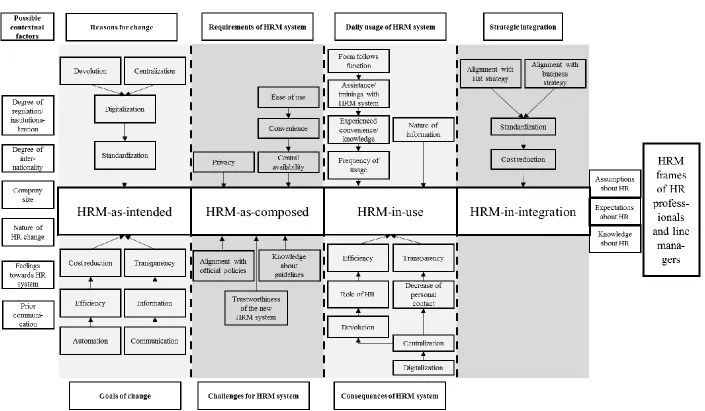
The model depicted in Figure 1 begins with the domain HRM-as-intended and is further split into the subdomains reasons for change, which are the perceived intended reasons of HR professionals and/ or top management for a change in the existing HRM system, and goals of change, which are the perceived intended goals of HR professionals and/ or top management for a change in the existing HRM system.
Within the first subdomain, reasons for change, one major reason is the standardization of HR-related tasks, which is mainly achieved by digitalizing such processes. This way the devolution of HR processes from the HR department to the line as well as the centralization of such processes are important. As an HR professional from Airways summarizes: “Also e-HRM is being discussed; […], more digitalizing of the processes and also to standardize these. I am certainly a proponent of this myself. I like it that this happens because within Airways there are relatively big differences in the processes in the different divisions” (P30, HR professional, Airways). A line manager from MedEquip adds that “the HR portal standardized all kinds of things and that everything is in one place” (P63, line manager, MedEquip). That centralization plays a pivotal role in this process is exemplified by a line manager from MedEquip stating: “I think it is most important and easiest that there is one system and that this works for everybody in the same way and also that data is being recorded that belong to a person and not that an executive has his notes locally. I think that this is a big advantage; a central data system” (P48, line manager, MedEquip).
operational HR functions certainly decreased by one fourth or one third or even a half. Therefore, it is a sheer cost-cutting exercise” (P2, HR professional, MedEquip), another HR professional is more enthusiastic about the new digitalized and cost-efficient processes: “I find the digitalization and automation especially fantastic. When I started [to work] here, everything still was done on paper” (P33, HR professional, Airways).
Next to cost reduction, the second stream of goals are more transparency with more information and better communication. HR professionals as well as line managers welcome the intended increased transparency and say that “I find the HR portal itself an ideal tool because there is everything that you want to know about HR” (P6, HR professional, MedEquip) and another adds that “I think that this will lead to clarity and transparency, because everybody then knows: this is the way we do it. For example reporting sick, we do not have this in the system yet, but in some departments you can send an e-mail or a Whatsapp and in other departments it is said that you only may inform the manager via telephone” (P30, HR professional, Airways). Also line managers see transparency as a goal of HR change: “I think that they [introduced a new e-HRM system] to make it more accessible and to make it more transparent. By the means of the HR portal it is easy to know what is expected from you” (P69, line manager, MedEquip). Summarizing, there is great consensus between HR professionals and line managers about the reasons and goals of HR change, overarching companies, company size and even HRM innovation itself, often resulting in the perception that most HR changes are attributed to cost reduction and efficiency as well as transparency. Table 2 comprises all codes and sub-codes including the respective definition of them.
HRM-as-composed
This domain is divided into the two subdomains requirements of the HRM system and
challenges for the new HRM system. There are basically two requirements of new HRM systems, namely privacy issues and the ease of use. Concerning privacy, especially sensitive data is a concern, e.g. one line manager states: “Also the authorization of people, that they can only see the things they have the rights for, I like that. Protection of personal data is very important; you just have to know what you are busy with. My boss knows everything of me and I in turn know everything of my colleagues, you just have to know what you are busy with. Privacy is the most important thing” (P61, line manager, MedEquip). Another prerequisite is the ease of use and related to this, the convenience of the new system as a line manager articulates: “User-friendliness is something, thus that it is easy to use. That it shows the right way itself. That it is not too complicated to search for things or to enter data. Within Airways we have a number of less user-friendly systems, so I think that this is important” (P89, line manager, Airways).
not only national and local rules but also ‘house rules’ that may differ from one site to another. Because the system is developed centrally and is available throughout the company, house rules cannot be implemented as one HR professional remarks that they “every subsidiary has house rules […]. You cannot determine these guidelines in one system” (P7, HR professional, MedEquip). In general however especially national and local rules were implemented in the systems properly. A final pitfall that emerged in the interview analysis was the perceived trustworthiness of the system, which means that the system itself does not only have to be reliable from a technical point of view but also people have to feel sure and confident with the system.
One HR professional summarizes the requirements of new HRM systems: “It has to be user-friendly, everywhere accessible, being good in terms of privacy and I think that another requirement is that as a HR manager the process has to be as simple as possible” (P31, HR professional, Airways). If these criteria are met, the new HRM system is more likely to be accepted by its stakeholders and HRM frames of HR managers and line managers tend to be more similar. The codes and sub-codes for this domain can be found in Table 3.
--- Insert Table 3 about here ---
HRM-in-use
operational part of HR is devolved to the line managers, also the personnel of HR decreased. The number of HR assistants reduced as well as the number of HR managers” (P3, HR professional, MedEquip). Finally, the transparency is a consequence of new HRM systems, paradoxically at the costs of less personal contact between HR managers and line managers but also among line managers. This paradox is explained by a line manager who says: “Indeed it brings more insights. Before somebody was sitting in the office and you had to go to this person. I have to admit that I found that very companionable. Due to the HR portal you have fewer contact with people, with line managers as well as HR, I really miss that contact” (P70, line manager, MedEquip). On the other hand, line managers still build the bridge between HRM and employees and they also emphasize that they appreciate the personal contact to their employees and the importance of personal contact. This is especially important for line managers from VealCo, which might be attributed to the HRM innovation of a new absenteeism policy, where personal contact is pivotal according to this respondent: “If we do not keep in touch with each other, we create a big gap between the employer and the employee, and I think that this is a bad thing” (P79, line manager, VealCo). Another line manager amplifies: “One guideline for me is also to have personal contact, communicate. Communicating is one of the things that I do a lot” (P75, line manager, VealCo). The devolution of HR-related tasks and the decrease of personal contact is mainly achieved by centralization and digitalization of HR processes as this HR professional links: “By digitalizing everything I get along with half of the people” (P7, HR professional, MedEquip). The codes and sub-codes for this domain can be found in Table 4.
HRM-in-integration
In this domain, especially line managers did not say much about the integration of the HRM innovation. However, the general message of respondents was that cost reduction by the means of standardization is one central integration of the new HRM system in the organization. One HR professional stated that “In general: The new HRM system makes processes more standardized within HR that is transparent and visible for everybody to give more clarity. Thus, within HR the new HRM system plays a big role” (P30, HR professional, Airways). The alignment of the HRM system in the strategy is represented by the quotation of a line manager: “I do think that the new HRM system should reach its goals in terms of reduction of costs. This is feasible, but on the long run. […] I believe that the new HRM system is functional, easy and practical. In the end a lot of processes will be integrated and it will take an important role [within HRM]” (P87, line manager, Airways). The codes and sub-codes for this domain can be found in Table 5.
--- Insert Table 5 about here ---
DISCUSSION
summarizing and simplifying model depicted in Figure 1 that shows the complex process of building HRM frames and which factors influence the specific stages of this process. Knowing these influences in advance of introducing a new HRM (sub-) system into the already existing HRM system can help for a better implementation. This can be done by considering these influences and work towards congruent HRM frames of the involved parties, e.g. HR professionals, line managers but also employees or top management. As literature already showed congruent frames play an important role in the implementation of new systems in organizations (e.g. Orlikowski, & Gash, 1994), a finding that also has been found for HRM frames in this study.
spreading e-mails to all stakeholders, writing articles in the company magazine, giving information at employee sessions and other ways. By the means of extensive sensegiving before the implementation, HRM frames of line managers can be influenced by HR professionals. This might increase the efficiency of the implementation of the HRM system.
The finding that especially HRM-in-integration is difficult to assess for many of the respondents can be attributed to the sequence of domains. Since the respondents had much more time for building HRM frames for the specific domain of HRM-as-intended, they had less time for building HRM frames concerning HRM-in-use, because HRM-in-use can only be assessed when the new HRM system is actually in use already. Only after respondents used the new HRM system frequently, they can assess how this new system is integrated into the broader image of the organization. Therefore, respondents had more difficulties to say something about the HRM-in-integration domain.
Possible contextual mechanisms
The second possible contextual factor is the degree of internationalization. As already indicated HRM frames partly consist of prior experience. Experience however is influenced by social, cultural and political background of individuals. Therefore the hypothesis regarding this contextual factor is that the more international a company is operating, the more diverse the HRM frames are because of divergent social, cultural and political backgrounds of stakeholders.
Similar to internationalization, the company size is regarded as a contextual factor that might influence HRM frames of employees. One respondent in this study wondered why the company the respondent was working for at the time of the data collection, did not introduce a certain HRM system earlier already. He did wonder about that point because he assumed that such a big company should adopt the HRM system earlier, because other competitors had similar systems already. This shows that certain expectations concerning HRM are influenced by the size of the company, indicating that bigger companies should adopt HRM systems early in order to stay up to date and competitive. However, company size might also influence HRM frames of different groups by its number of employees and thus its number of opinions. Therefore, is hypothesized that bigger companies tend to have more divergent HRM frames between but also within social groups due to the mere existence of more perceptions and opinions.
fundamentally incongruent, this effect is multiplied in even more divergent HRM frames of other employees when line managers implement the new HRM system with divergent HRM frames.
The fifth factor, feelings towards the old, existing HRM system, is of importance because it may frame the framing process itself. That is, if a line manager is very positive about the existing HRM system and a new system is about to be introduced, there might be skepticism about the necessity of a new system. This in turn might have an influence on different domains like HRM-as-intended (e.g. the line manager believes that the primary reason for a new system is pure cost reduction) or HRM-in-use (the line manager is unsatisfied with the product and uses the new system infrequently).
Finally, prior communication can also influence the HRM frames as indicated earlier already. It is hypothesized that more and better communication, especially between HR professionals and line managers concerning the new HRM system, leads to more similar HRM frames and therefore increases the efficiency of the implementation. Table 6 summarizes all potential contextual mechanisms including its definition and hypothesis.
--- Insert Table 6 about here --- Future research implications and limitations
generalizable findings across more settings than this study included. Although the current study already compared different industries, future studies should research more industries and also focus stronger on other contextual variables, like sex, age, job experience and others. Also the range of respondents might be extended to employees and top management with regard to HRM frames, e.g. researching the effect of congruence of HRM frames between HR professionals and line managers on other employees or investigating the effect and communication of top management on the congruence of HRM frames between HR professionals and line managers.
ACKNOWLEDGEMENT
My special thanks go to Tanya Bondarouk for her trust, her constant support, her valuable feedback and being an excellent mentor and supervisor. Her passion for her work, her profound knowledge about the topic discussed in this paper and her interconnected way of thinking inspired me regularly to think out of the box and to develop the presented model. I would also like to thank Huub Ruël for joining this project as my second supervisor and revising this thesis. I also would like to thank my friends and family, especially my parents, for their support and their trust in me during my whole study. Finally, my gratitude goes to my girlfriend for always encouraging and supporting me and cheering me up.
EPILOGUE
This paper is my master thesis, the final paper that I have written as a Master student of Business Administration with the track HRM at the University of Twente. It was a very challenging and demanding task, but seeing the gradual progress and finally completing it was a satisfactory experience. Working with dozens of interviews, analyzing all of them and now proudly presenting the final paper was worth every hour of work.
the perception of employees. It was very interesting to see that overall HR professionals speak the same language but that it also takes some effort to work with each other across departments. Looking at the process of my thesis, this was the most challenging paper I have worked on yet compared to all papers I have written during my study. It took some time until I could finally organize the mass of information from the interviews and to find a way to present it in the results section. It was especially challenging that I did not conduct the interviews myself, because this way I missed important cues and information, like gestures and comments from the interviewees. Only working with the transcriptions of interviews without the expression or pronunciation of the interviewee made it hard to go through every piece of information and to “read between the lines”. Therefore, if I had a chance to change anything about the process of this research, I would have liked to attend the interviews.
As already indicated, this research is based on secondary data gathered by a group of seven students prior to my thesis. Being present during the discussions about the process of their studies, e.g. the creation of the interview guide, would also have had a positive influence on my work and is thus a second aspect I would have changed afterwards. It would have clarified some points in advance and the reasons for choices they made in their studies.
REFERENCES
Arun, S. 2014. Congruence of HRM frames and trust in HRM: Results of an explorative case study at Zara. Master Thesis: University of Twente, received from http://essay.utwente.nl/66151/ on November, 23rd 2015.
Bandura, A. 1986. Social Foundations of Thought and Action: A Social Cognitive Theory.
Prentice-Hall, Englewood Cliffs, NJ.
Barret, M. I. 1999. Challenges of EDI adoption for electronic trading in the London insurance market. European Journal of Information Systems, 47(4): 523-549.
Barriball, K. L., & While, A. 1994. Collecting data using a semi-structured interview: A discussion paper. Journal of Advanced Nursing, 19(2): 328-335.
Bechky, B. A. 2003. Sharing meaning across occupational communities: The transformation of understanding on a production floor. Organization Science, 14(3): 312-330.
Bondarouk, T. 2006. Action-oriented group learning in the implementation of information systems: Results from three case studies. European Journal of Information Systems, 8: 83-104.
Bondarouk, T., Looise, J. K., & Lempsink, B. 2009. Framing the implementation of HRM innovation. Personnel Review, 38(5): 472-491.
Bos-Nehles, A. C. 2010. The line makes the difference: Line managers as effective HR partners. CPI Wöhrmann Print Service.
Bos-Nehles, A. C., van Riemsdijk, M., & Looise, J. C. 2013. Employee perceptions of line management performance: Applying the AMO theory to explain the effectiveness of line managers’ HRM implementation. Human Resource Management, 52(6): 861-877.
Bowen, D. E., & Ostroff, C. 2004. Understanding HRM-firm performance linkages: The role of “strength“ of the HRM system. The Academcy of Management Review, 29(2): 203-221. Caldwell, R. 2003. The changing roles of personnel managers: Old ambiguities, new
uncertainties. Journal of Management Studies, 40(4): 983-1004.
Davidson, E. J. 2002. Technological frames and framing: A socio-cognitive investigation of requirements determination. Management Information Systems Quarterly, 26(4): 329-358. Davidson, E. J. 2006. A technological frames perspective on information technology and
organizational change. The Journal of Applied Behavioural Science, 42(1): 23-39.
DeChurch, L. A., & Mesmer-Magnus, J. R. 2010. The cognitive underpinnings of effective teamwork: A meta-analysis. The Journal of Applied Psychology, 95(1): 32-53.
Emans, B. 2004. Interviewing: Theory, Techniques and Training. Groningen, The Netherlands: Stenfert Kroese.
Falk, L. M. 2014. Exploring the link between HR frames of line management and HR professionals and employee’s trust in the airline industry. Master Thesis: University of Twente, received from http://essay.utwente.nl/66632/ on November, 23rd 2015.
Fiss, P. C., & Hirsch, P. M. 2005. The discourse of globalization: Framing and sensemaking of an emerging concept. American Sociological Review, 70: 29-52.
Gabčanová, I. 2012. Human resources key performance indicators. Journal of Competitiveness, 4(1): 117-128.
Gibson, C. B., Cooper, C. D., & Conger, J. A. 2009. Do you see what we see? The complex effects of perceptual distance between leaders and teams. Journal of Applied Psychology,
94(1): 62-76.
Gilbert, C., Winne, S., & Sels, L. 2011. The influence of line managers and HR department on employees’ affective commitment. The International Journal of Human Resource Management, 22(8): 1618-1637.
Gioia, D. A., & Chittipeddi, K. 1991. Sensemaking and sensegiving in strategic choice initiation. Strategic Management Journal, 12(6): 433-448.
Gleitman, H., Gross, J., & Reisberg, D. 2010. Psychology, Eighth Edition. New York: W. W. Norton & Company.
Goffman, E. 1974. Frame Analysis: An Essay on the Organization of Experience, 2nd ed. (1986). Northeastern University Press.
Goodhew, G. W., Cammock, P. A., & Hamilton, R. T. 2005. Managers’ cognitive maps and intra-organisational performance differences. Journal of Managerial Psychology, 20(2): 124-136.
Gray, B., Bougon, M. G., & Donnellon, A. 1985. Organizations as constructions and destructions of meaning. Journal of Management, 11(2): 83-98.
Guest, D. E., & Bos-Nehles, A. 2013. HRM and performance: The role of effective implementation. In J. Paauwe, D. Guest, & P. Wright (Eds.), HRM and Performance: Achievements and Challenges. Chichester: 79-96. Cornwall, UK: Wiley.
Hahn, T., Preuss, L., Pinkse, J., & Figge, F. 2014. Cognitive frames in corporate sustainability: Managerial sensemaking with paradoxical and business case frames. Academy of Management Review, 39(4): 463-487.
Hesselink, X. 2014. HRM frames and trust in HRM: A case study in an international airline.
Master thesis: University of Twente, received from http://essay.utwente.nl/66410/ on November, 23rd 2015.
Hey, J. H. G., Joyce, C. K., & Beckman, S. L. 2007. Framing innovation: Negotiating shared frames during early design phases. Journal of Design Research, 1-2: 79-99.
Hodgkinson, G. P. 1997. The cognitive analysis of competitive structures: A review and critique. Human Relations, 50(6): 625-654.
Hodgkinson, G. P., & Johnson, G. 1994. Exploring the mental models of competitive strategists: The case for a processual approach. Journal of Management Studies, 31: 525-552.
Horsthuis, J. 2014. An explorative study into HRM frames and trust in HRM: Results of a case study at Royal Philips. Master thesis: University of Twente, received from http://essay.utwente.nl/66035/ on November, 23rd 2015.
Kaplan, S. 2008. Framing contests: Strategy making under uncertainty. Organization Science,
19(5): 729-752.
Kaplan, S., & Tripsas, M. 2008. Thinking about technology: Applying a cognitive lens to technical change. Research Policy, 37: 790-805.
Keegan, A., Huemann, M., & Turner, J. R. 2012. Beyond the line: Exploring the HRM responsibilities of line managers, project managers and the HRM department in four project-oriented companies in the Netherlands, Austria, the UK and the USA. The International
Journal of Human Resource Management, 23(15): 2085-3104.
Kinnie, N., Hutchinson, S., Purcell, J., Rayton, B., & Swart, J. 2005. Satisfaction with HR practices and commitment to the organisation: Why one size does not fit all. Human Resource Management Journal, 15(4): 9-29.
Kremer, L. 2014. The link between congruent frames and employees’ trust in the HRM system: An explorative study at Royal Philips Netherlands. Master thesis: University of Twente, received from http://essay.utwente.nl/66142/ on November, 23rd 2015.
Laukkanen, M. 1993. A computer method for comparative cognitive mapping. Paper presented at The International Workshop on Managerial and Organizational Cognition, Brussels. Lepak, D. P., Liao, H., Chung, Y., & Harden, E. E. 2006. A conceptual review of human
resource management systems in strategic human resource management research. Research
Leech, B. L. 2002. Asking questions: Techniques for semistructured interviews. Political Science and Politics, 35(4): 665-668.
Lin, A., & Silva, L. 2005. The social and political construction of technological frames.
European Journal of Information Systems, 14(1): 49-59.
March, J. G., & Simon, H. A. 1958. Organizations. New York: Wiley.
Mathieu, J. E., Goodwin, G. F., Heffner, T. S., & Cannon-Bowers, J. A. 2000. The influence of shared mental models on team process and performance. Journal of Applied Psychology,
85(2): 273-283.
Neumann, W. R. 1990. The threshold of public attention. Public Opinion Quarterly, 54: 159-176.
Okhuysen, G. A., & Eisenhardt, K. M. 2002. Integrating knowledge in groups: How formal interventions enable flexibility. Organization Science, 13(4): 370-386.
Orlikowski, W. J., & Gash, D. C. 1994. Technological frames: Making sense of information technology in organizations. ACM Transactions on Information Systems, 12(2): 174-207. Palich, L. E., & Bagby, D. R. 1995. Using cognitive theory to explain entrepreneurial
risk-taking: Challenging conventional wisdom. Journal of Business Venturing, 10: 425-438. Pandit, N. R. 1996. The creation of theory: A recent application of the Grounded Theory
Method. The Qualitative Report, 2(4): 1-15.
Polman, J. 2014a. Congruent HRM frames and employees’ trust in HRM: results of the case study at Philips. Master thesis: University of Twente, received from http://essay.utwente.nl/65942/ on November, 23rd 2015.
Polman, L. 2014b. A qualitative exploration into the link between congruent HRM frames and employees’ trust in HRM: A case study at VanDrie Group. Master thesis: University of Twente, received from http://essay.utwente.nl/65943/ on November, 23rd 2015.
Porac, J. F., & Thomas, H. 2002. Managing cognition and strategy: Issues, trends and future directions. In A. M. Pettigrew, H. Thomas, & R. Whittington (Eds.), Handbook of strategy and management: 165-181. London & Thousand Oaks, CA: Sage.
Reger, R. K., & Huff, A. S. 1993. Strategic groups: A cognitive perspective. Strategic Management Journal, 14: 103-124.
Rentsch, J. R., & Klimoski, R. J. 2001. Why do ‘great minds’ think alike?: Antecedents of team member schema agreement. Journal of Organizational Behavior, 22(2): 107-120.
Ridder, H.-G., Piening, E. P., & Baluch, A. M. 2012. Mind the intended-implemented gap: Understanding employee perceptions of HRM. Academy of Management, 6(11): 1-40. Renwick, D. 2003. Line managers’ involvement in HRM: An inside view. Employee Relations,
25(3): 262-280.
Rouleau, L. 2005. Micro-practices of strategic sensemaking and sensegiving: How middle managers interpret and sell change every day. Journal of Management Studies, 42(7): 1413–1441.
Sanders, K., Dorenbosch, L., & de Reuver, R. 2008. The impact of individual and shared employee perceptions of HRM on affective commitment: Considering climate strength.
Personnel Review, 37(4): 412-425.
Scott, W. A., Osgood, D. W., & Peterson, C. 1979. Cognitive structure: Theory and measurement of individual differences. New York: Wiley.
Shaw, N. C., Lee-Patridge, J. E., & Ang, J. S. 1997. Understanding end-user computing through technological frames. Proceedings of the Eighteenth International Conference on Information Systems: 453-459.
Sonnenberg, M., van Zijderveld, V., & Brinks, M. (2014). The role of talent-perception incongruence in effective talent management. Journal of World Business, 49(2): 272-280. Teddlie, C., & Yu, F. 2007. Mixed methods sampling: A typology with examples. Journal of
Tikkanen, H., Lamberg, J.-A., Parvinen, P., & Kallunki, J.-P. 2005. Managerial cognition, action and the business model of the firm. Management Decision, 43: 789-809.
Walsh, J. P. 1995. Managerial and organizational cognition: Notes from a trip down memory lane. Organizational Science, 6: 280-321.
Weick, K. 1995. Sensemaking in organizations. Thousand Oaks, CA: Sage.
Woodrow, C., & Guest, D. E. 2013. When good HR gets bad results: exploring the challenge of HR implementation in the case of workplace bullying. Human Resource Management Journal, 24(1): 38-56.
Wrigth, P. M., & Nishii, L. H. 2013. Strategic HRM and organizational behavior: Integrating multiple levels of analysis. In: J. Paauwe and P. Wright (eds), HRM and Performance: Achievements and Challenges: 97-110. Chichester: Wiley-Blackwell.
APPENDICES
Appendix A. Interview guide for HR professionals and line managers
Introductie notities en achtergrondinformatie
Belangrijkste vraag: Kunt u iets over uzelf vertellen (baan, verantwoordelijkheden, etc.)?
Controleren voor:
- Wat is uw functie? [Officiële titel]
- Wat houdt uw werk in? [Taken, activiteiten en verantwoordelijkheden] HRM-as-intended
1. Wanneer begonnen de eerste gesprekken over {HRM sub-system}? 2. Kunt u nog herinneren wanneer het systeem geïntroduceerd werd? 3. Hoe verliep de introductie? [Communicatie]
4. Voor welke doeleinden is het systeem ontworpen? [Doel]
5. Wat zijn volgens u de redenen dat het systeem in gebruik is? [Redenen management] 6. Wat zijn uw gevoelens erover?
7. Wat verwacht u van het systeem? HRM-as-composed
8. Wat denkt u dat de richtlijnen zijn die het gebruik van [dit systeem] waarborgen? [Richtlijnen, intenties]
9. Wat houdt het systeem in? 10.Kunt u het systeem beschrijven? HRM- in-use
11.Kunt u beschrijven hoe de salarisstrook werkt?
12.Kunt u beschrijven hoe het wijzigen van persoonsgegevens werkt? 13.Hoe gebruikt u {HRM sub-system} in de praktijk?
14.Wat zijn volgens u de consequenties van {HRM sub-system}? 15.Denkt u dat u het systeem geheel begrijpt?
16.Wat vindt u het leukst en het minst leuke aan {HRM sub-system}? 17.Is er iets wat u zou willen veranderen?
18.Hoe beïnvloedt {HRM sub-system} uw dagelijkse werkzaamheden? 19.In hoeverre denkt u dat {HRM sub-system} zijn doelen heeft bereikt? HRM-in-integration
20.Welke rol denk je dat [dit systeem] speelt in het gehele personeelsmanagement in uw bedrijf? [Positionering]
21.Heeft het een speciale plaats? Closure
- Hebben we de belangrijkste zaken besproken inzake {HRM sub-system}? Zijn er belangrijke dingen overgeslagen?
Appendix B. Table 1: Sample of organizations and interviewees participated in the study
Organization Industry HRM
innovation
Number of interviewed
HR professionals
Number of interviewed
line managers
Interviewing time
Airways Airlines Introduction
of an electronic HRM system
7 18 38 hours
MedEquip Electronics
& Health Care Equipment
Introduction of an electronic HRM system
8 36 62 hours
VealCo Dairy
Products
New absenteeism
policy
2 15 22 hours
Fashion House
Retail Performance management
Appendix C. Table 2: Codes and sub-codes of the domain HRM-as-intended
Code Definition Example (Dutch) Example (English translation)
Reasons for change
Perceived intended reasons of HR
professionals and/ or top management for a change in the existing HR system
Devolution Intention of devolution of HR-related tasks and processes to the line
En de verantwoordelijkheid eigenlijk te leggen bij waar het hoort. En dat is niet een aparte functie te hebben als het om mensen gaat, maar dat gewoon naar de lijn te brengen. (P8, HR professional, MedEquip)
And actually to put responsibility where it belongs. And this not to have a separate function if it is about people, but to bring it to the line. (P8, HR professional, MedEquip) Centralization Intention of centralization of HR-related
tasks and processes to a certain system or place
Ik denk dat het belangrijkste en makkelijkste is dat het één systeem is en dat voor iedereen op dezelfde manier werkt en ook dat daar de gegevens worden opgeslagen die bij die persoon horen en niet dat een leidinggevende lokaal zijn notities over die persoon heeft. Ik denk dat het een groot voordeel is; een centraal data systeem. (P48, line manager, MedEquip)
I think it is most important and easiest that there is one system and that this works for everybody in the same way and also that data is being recorded that belong to a person and not that an executive has his notes locally. I think that this is a big advantage; a central data system. (P48, line manager, MedEquip)
Digitalization Intention of digitalization of HR-related tasks and processes
Ik vind het een must in deze tijd. Voor [Airways] is het een grote kostenbesparing en dat je meer dingen digitaal doet. Ik sta er heel positief tegenover. Elk bedrijf zou eigenlijk een dergelijk systeem moet hebben. Het hoort bij deze tijd. (P28, HR professional, Airways)
Standardization Intention of standardization of HR-related tasks and processes
Daar werd ook gesproken over e-HRM; [...], meer digitaliseren van de processen en deze ook te
standaardiseren. Ikzelf ben daar alleen maar voorstander van. Ik vind het alleen maar fijn dat, dat gebeurt, omdat je binnen [Airways] bij diverse divisies redelijk grote verschillen ziet in de processen. (P30, HR professional, Airways)
Also e-HRM is being discussed; […], more digitalizing of the processes and also to standardize these. I am certainly a proponent of this myself. I like it that this happens because within [Airways] there are relatively big differences in the processes in the different divisions. (P30, HR professional, Airways)
Goals of change Perceived intended goals of HR
professionals and/ or top management for a change in the existing HR system
Automation Intention to automatize HR-related tasks and processes
Vooral het digitaliseren en
automatiseren vind ik fantastisch. Ik kwam hier en toen gebeurde alles nog op papier. Dat heb ik iedereen snel afgeleerd (inscannen/digitaal ondertekenen). Dus er is nog wel een weg te gaan, maar men begint er aan te wennen. (P33, HR professional, Airways)
I find the digitalization and automation especially fantastic. When I started [to work] here, everything still was done on paper. I broke everyone’s habit (scanning in/ signing digitally). Thus, there is still a way to go, but it is starting to get used to. (P33, HR professional, Airways)
Efficiency Intention to increase efficiency of HR-related tasks and processes
De redenen voor het management, wat je kunt met het tool is, je kunt ook sneller communiceren. Efficiency van alle kanten. Alle gegevens staan er. Je kunt vanuit die tool ook makkelijk reactie geven op je salaris of je mist nog iets, dus een soort kennisbank. (P89, line
manager, Airways)