Estimation of White Matter Fiber Parameters from
Compressed Multiresolution Diffusion MRI using
Sparse Bayesian Learning
Pramod Kumar Pisharadya,, Stamatios N Sotiropoulosb, Julio M
Duarte-Carvajalinoa, Guillermo Sapiroc,d, Christophe Lengleta
aCMRR, Radiology, University of Minnesota, Minneapolis, Minnesota, USA bFMRIB, John Radcliffe Hospital, University of Oxford, Headington, UK cElectrical and Computer Engineering, Duke University, Durham, North Carolina, USA
dBiomedical Engineering and Computer Science, Duke University, Durham, North
Carolina, USA
Abstract
We present a sparse Bayesian unmixing algorithmBusineX:BayesianUnmixing forSparseInference-basedEstimation of Fiber Crossings (X), for estimation of white matter fiber parameters from compressed (under-sampled) diffusion MRI
(dMRI) data. BusineX combines compressive sensing with linear unmixing and
introduces sparsity to the previously proposed multiresolution data fusion
al-gorithm RubiX, resulting in a method for improved reconstruction, especially
from data with lower number of diffusion gradients. We formulate the
estima-tion of fiber parameters as a sparse signal recovery problem and propose a linear
unmixing framework with sparse Bayesian learning for the recovery of sparse
signals, the fiber orientations and volume fractions. The data is modeled using
a parametric spherical deconvolution approach and represented using a
dictio-nary created with the exponential decay components along different possible
diffusion directions. Volume fractions of fibers along these directions define the
dictionary weights. The proposed sparse inference, which is based on the
dictio-nary representation, considers the sparsity of fiber populations and exploits the
spatial redundancy in data representation, thereby facilitating inference from
under-sampled q-space. The algorithm improves parameter estimation from
dMRI through data-dependent local learning of hyperparameters, at each voxel
and for each possible fiber orientation, that moderate the strength of priors
gov-erning the parameter variances. Experimental results on synthetic and in-vivo
data show improved accuracy with a lower uncertainty in fiber parameter
esti-mates. BusineX resolves a higher number of second and third fiber crossings.
For under-sampled data, the algorithm is also shown to produce more reliable
estimates.
Keywords: Sparse Bayesian learning, compressive sensing, linear unmixing ,
diffusion MRI, fiber orientation, sparse signal recovery
1. Introduction
1.1. White Matter Parameter Estimation
Multi-compartment models are used to represent the diffusion MR signal
from the brain white matter and to estimate microstructure features of the
im-aged tissue (Behrens et al., 2003; Panagiotaki et al., 2012; Daducci et al., 2015).
Estimation of orientations and volume fractions of anisotropic compartments in
these models helps infer the white matter fiber anatomy (Behrens et al., 2007).
Accurate estimation of these parameters is challenged by the relatively limited
spatial resolution of diffusion MRI (dMRI) data, which may lead to increased
partial volume artifacts. Advances in magnetic field strength have significantly
improved spatial resolution (Vu et al., 2015), although it may lead to increased
noise and scanning time. One effective way to mitigate the effects of noise is the
multiresolution data fusion approach introduced in RubiX (Sotiropoulos et al.,
2013), which combines high SNR characteristics of low resolution (LR) data with
high spatial specificity of high resolution (HR) data. It allows combining
im-ages with different diffusion contrast at different spatial resolutions and finding
the right trade-off between SNR and resolution. This method was further
ex-tended recently for fusion of data acquired at different magnetic field strengths,
combining the benefits of high spatial and angular resolutions (k / q-space
recent developments in compressive sensing (Ji et al., 2009; Otazo et al., 2015;
Paquette et al., 2015; Duarte-Carvajalino et al., 2014; Michael Lustig and Pauly,
2007; Seeger et al., 2010; Ramirez Manzanares et al., 2007) are effective ways to
deal with the increased scan time, which result in fewer measurements (diffusion
gradients) within a voxel.
Prior efforts in estimation of white matter fiber parameters include both
parametric approaches (Tuch et al., 2002; Behrens et al., 2003; Anderson, 2005;
Kaden et al., 2007; Sotiropoulos et al., 2008, 2013; Coupe et al., 2013;
Scher-rer et al., 2016) and non-parametric approaches (Tournier et al., 2004, 2007;
Ozarslan et al., 2006; Dell’Acqua et al., 2007; Aganj et al., 2010). These
meth-ods exploit multiple diffusion measurements with a large number of diffusion
gradients. Considering the fact that the number of crossing fiber bundles within
a voxel is limited, we propose a novel sparse signal recovery algorithm for
im-proved inference from data with under-sampled q-space (i.e., data acquired with
lower number of diffusion encoding directions). We introduce sparsity based
rep-resentation and inference into the data fusion approach of RubiX, combining the
benefits of regularized noise and reduced scan time.
1.2. Compressive Sensing and Sparse Bayesian Learning
Compressive sensing approaches exploit the sparsity for optimal
acquisi-tion and recovery of signals (Ji et al., 2009; Michael Lustig and Pauly, 2007).
Compressive sensing is used for reconstruction from accelerated imaging
tech-niques across different MRI modalities; in structural MRI (Otazo et al., 2015;
Michael Lustig and Pauly, 2007; Seeger, 2010; Seeger et al., 2010), functional
MRI (Zong et al., 2014), and dMRI (Duarte-Carvajalino et al., 2014; Ramirez
Man-zanares et al., 2007; Rathi et al., 2011; Tristan-Vega A, 2011; Aranda et al.,
2015). A comparison of sampling strategies and sparsifying transforms to
im-prove compressive sensing in diffusion spectrum imaging pointed out the
impor-tance of joint optimization of the sampling scheme and the sparsifying transform
(Paquette et al., 2015).
2001) using automatic relevance determination (ARD) (MacKay, 1994) provides
a framework for obtaining sparse solutions to regression and classification
prob-lems. The sparsity of parameters is enforced by selection of appropriate prior
probability distributions for the parameters to be estimated. Relevance
learn-ing is done in SBL by uslearn-ing a mixture of zero-mean Gaussian distributions with
individual hyperparameters for variance prior distributions. The
hyperparam-eters associated independently with every weight moderate the strength of the
prior and govern the variances of the Gaussian scale mixture, adapting to the
data. Considering the success of SBL for sparse signal recovery in fields such
as computer vision and machine learning (Wright et al., 2010), in this work we
use SBL for the recovery of sparse fiber parameters from dMRI.
1.3. Linear Unmixing
Data sample vectors are assumed to be composed of a mix ofendmembersin linear unmixing algorithms (Dobigeon et al., 2008). Linear unmixing algorithms
estimate both the number of endmembers and their individual contributions.
These algorithms are mostly used in the unmixing of component spectra of
hyperspectral imagery in remote sensing signal processing (Dobigeon et al., 2008;
Bioucas-Dias et al., 2012; Tang et al., 2015; Iordache et al., 2011; Pardo and
Sapiro, 2001; Castrodad et al., 2011).
In this work, we consider the multiple anisotropic components
(correspond-ing to fibers) and the s(correspond-ingle isotropic component in the diffusion model as the
endmembers in unmixing problem, and recover these endmembers using an
SBL based linear unmixing approach. Previous study (Daducci et al., 2014b)
has shown that l1 norm minimization based approaches for promoting
spar-sity, which are widely used in spherical deconvolution based methods, have the
drawback of inconsistency with the sum-to-one constraint (i.e., the physical
constraint that the volume fractions of anisotropic and isotropic compartments
within a voxel sum to unity) (Panagiotaki et al., 2012). They addressed the issue
using a constrained formulation between the data and a sparsity prior bounding
demonstrate that sparse Bayesian learning within a linear unmixing framework
is another way to address the sum-to-one and non-negativity (volume fractions
≥0) constraints, simultaneously promoting sparsity. The approach in SBL is
typically much sparser as it is based on the notion of setting weights to zero
(rather than constraining them to small values), and as it offers probabilistic
predictions without the need to set additional regularization parameters
(Tip-ping and Faul, 2002).
1.4. Proposed Method: Bayesian Unmixing for Sparse Inference-based
Estima-tion of Fiber Crossings (BusineX)
The above mentioned works on compressive sensing in dMRI utilized
basis-based transforms and exploited the sparsity in the basis representation. Our
approach in BusineX is different in several aspects. A major difference is the
Bayesian linear unmixing formulation with SBL based relevance learning. The
unmixing formulation makes the Bayesian inference hard, but it helps in
re-covering fiber parameters with better accuracy, especially when the number of
diffusion measurements are reduced. The SBL framework identifies relevant
fiber orientations by enforcing sparsity, and it further enhances accuracy in
estimation of multi-fiber volume fractions and orientations.
ARD has been used for data-adaptive estimation of fiber parameters (Behrens
et al., 2007), avoiding data unsupported model complexities. The relevance
learning in the proposed approach, which explicitly models sparsity, enhances
the relevance determination by tuning the variance prior hyperparameters
in-dividually and independently for each possible fiber orientation. The
non-negativity and sum-to-one constraints, which make the sparse representation
and inference challenging, are addressed using the linear unmixing framework.
The proposed BusineX algorithm exploits the spatial redundancy in data
rep-resentation, and it improves the estimation of fiber parameters. The number
of fibers that best fit the observed data is estimated by the automatic
detec-tion of number of endmembers using a reversible jump Markov chain Monte
case, the proposed algorithm is shown to produce reliable estimates from data
under-sampled in q-space, by a factor of up to four.
The results from a preliminary version of the proposed framework with linear
unmixing (without relevance learning using SBL) are presented in our prior work
(Pisharady et al., 2015). In this paper we extend the framework by introducing
SBL based relevance learning. The paper also presents detailed experimental
results and analysis, including comparisons of estimated fiber volume fractions
in addition to the fiber orientations and diffusivity.
2. Methods
This section details the proposed BusineX algorithm. The dictionary
repre-sentation of the HR data using compartment model (ball & stick) is described
in Subsection 2.1. The representation of LR data using a spatial partial
vol-ume model is briefly discussed in Subsection 2.2. The sparse Bayesian learning
approach and sparsity based linear unmixing algorithm are described in
Sub-sections 2.3 and 2.4 respectively. Subsection 2.5 explains the MCMC sampling
procedure.
2.1. Dictionary Representation of High Resolution Data
The HR data is represented using a dictionary containing exponential decay
component vectors in the compartment model of diffusion. The measured dMRI
signal at each HR voxel is first modeled using the ball & stick (1) model (Behrens
et al., 2003; Panagiotaki et al., 2012),
SHRk =S0HR
" 1−
N
X
n=1 fn
!
e−bkd+
N
X
n=1
fne−bkd(g
T kvn)2
#
(1)
where,
SHRk is the signal at HR voxel after application ofkthdiffusion-sensitizing gradient with directiongk and b-valuebk,
S0
HR is the HR signal without diffusion gradient applied,
fn is the volume fraction of anisotropic compartment with orientationvn, and
The measured signal at an HR voxel is the sum of the attenuation signal and
measurement noise (2),
yHRk =S
k HR
S0
HR
+ηHRk . (2)
Based on (1) and (2), the measured signal along all K diffusion-sensitizing
directions can be written in adictionary form (3) as
yHR=
e−b1d e−b1d(gT1v1)2 . . . e−b1d(gT1vN)2 ..
. ... . .. ...
e−bKd e−bKd(gKTv1)2 . . . e−bKd(gTKvN)2
f0 f1 .. . fN
+ηHR, (3)
where
f0= 1−
N
X
n=1 fn
!
, fn≥0.
Hence,
yHR= Ef +ηHR. (4)
In Equation (4),Erepresents the local dictionary matrix (5) for the HR diffusion data andf is the sparse vector representation of the HR data in this dictionary
E. The non-zero entries in f define the number and volume fractions of fibers (sticks) in a voxel.
E=
e−b1d e−b1d(gT1v1)2 . . . e−b1d(gT1vN)2 ..
. ... . .. ...
e−bKd e−bKd(gTKv1)2 . . . e−bKd(gKTvN)2
. (5)
The possible orientations of anisotropic components in the dictionary (second
column onwards) are pre-specified and formed using a 5th order icosahedral
tessellation of the sphere with 10242 points. The estimated orientation is
ap-proximated to the nearest pre-specified orientation during the dictionary update
process.
With the above dictionary formulation, the problem of finding the number of
sparse vectorf. The estimation of the sparse vectorf is detailed in Subsections 2.3 and 2.4. Another unknown parameter in the model, the apparent diffusivity
d, is estimated through the Bayesian inference that maximizes the joint posterior
probability of the HR and LR data, as per the multiresolution graphical model
in RubiX (Sotiropoulos et al., 2013), as detailed in Appendix A. The partial
volume model used to represent the LR data is discussed in the next Subsection
(Subsection 2.2).
2.2. Partial Volume Representation of Low Resolution Data
The significance of LR data is its high SNR, which is useful for regularizing
the noise in HR data, as in the RubiX framework (Sotiropoulos et al., 2013). In
the RubiX framework, the LR data and HR data are collected from the same
subject through two scans at different spatial resolutions (voxel sizes). The two
datasets are aligned (if necessary) using rigid body transformations. Once the
data is aligned, the LR data can be represented using corresponding HR data
(data that correspond to the same physical location, but at a different spatial
resolution grid), with a partial volume model (Sotiropoulos et al., 2013). The
model calculates attenuation signal at an LR voxel as a linear combination of
the signals at overlappingM HR voxels (6).
Sk LR
S0
LR
=
M
X
m=1 wm
Skm HR
S0m HR
, wm=e
−krm−r0k2
γ2 . (6)
The HR signal contributes to the LR signal via a discretized Gaussian distance
weighing function (DWF) with weightswmgiven by the normalized Euclidean
distance between the DWF center r0 at LR voxel and the spatial position of
each HR voxel rm, and the unknown standard deviation of the DWF, γ. γ
is same forM HR voxels overlapped by an LR voxel, but can be different for
different LR voxels.
2.3. Hierarchical Bayesian Inference and Sparse Bayesian Learning
The volume fractions and fiber orientations are estimated using a
sparse Bayesian inference dealing with constraints (Araki et al., 2009; Tipping,
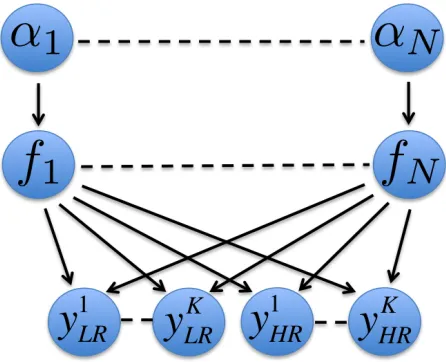
2001). A hierarchical Bayesian framework (Fig. 1) is utilized for the sparse
inference. In Bayesian inference, prior probability distributions, namelypriors,
are defined for constraining the parameters to be estimated (Jaynes, 1968). In
SBL a mixture of zero-mean Gaussian distributions with individual
hyperpa-rameters controlling the variances is used as the prior on the parameter to be
estimated (volume fractions here). Gamma distributions are used as
hyperpri-ors, which form the priors over the hyperparameters. The mixture of Gaussians
with hyperparameters associated independently with every weight was shown
equivalent to using a product of Student-t priors, once the hyperparameters are
integrated out (Tipping, 2001). This hierarchical formulation leads to a sparse
[image:9.612.194.417.342.523.2]solution.
Figure 1: The hierarchical Bayesian network used in BusineX.yk
LRandyHRk are the measured signals along diffusion gradient directionk, at LR and HR voxels respectively.fnis the n-th
component of the anisotropic volume fractions vector andαn is the hyper-parameter in the
prior distribution offn. The influence of the parameters on LR data is through the spatial
partial volume model (6).
Mathematically the prior over volume fractions is given by,
p(f|α) =
N
Y
n=1
where the hyper-parameter αn controls the variance of individual Gaussians.
The update procedure forαi (detailed in Subsection 2.4) is such that many of
theαare pushed to higher values, adapting to the data. The variance 1/α of
the corresponding Gaussians are pushed towards zero which forces the
corre-sponding weights to be zero (or negligibly small), leading to a sparse solution.
The proposed sparse approach and independent tuning of the
hyperparam-eters for each voxel and for each possible fiber orientation promote adaptation
of the estimated number of fibers to the data. Thus the complexity of fiber
patterns (single fiber vs. multiple fibers) at each voxel is decided better by the
data (refer to Section 4.1 for a discussion).
2.4. Sparsity based Bayesian Linear Unmixing Inference
Finding the volume fractions f in (4) with a large number of possible fiber orientations (N) is an ill-posed problem. We introduce sparsity in the dictionary
and estimation process, to propose an efficient algorithm for volume fraction and
fiber orientation estimations. The non-negativity and sum-to-one constraints of
volume fractions make the sparse representation and inference especially
diffi-cult. We fix the sparsity level (the number of fibers, which is the same as the
number of non-zero anisotropic components) to a small numbern0 (n0<< N).
The problem is then formulated as a linear unmixing inference where the
diffu-sion signals correspond to a mixture of the dictionary components with positive
weights f. We follow a semi-supervised hierarchical Bayesian linear unmixing approach (Dobigeon et al., 2008) for sparsity-based inference of fibers. The
method is semi-supervised because the dictionary is known for a given
diffusiv-ity, gradient directions, b-values, and possible fiber orientations, but we don’t
know the values of diffusivity, fiber orientations, or the volume fractions within
each compartment.
Assuming Gaussian noise1 the likelihood function of the HR data can be
1We implemented Rician noise model (Henkelman, 1985) as well, which provided identical
expressed as (8)
p yHR|f, α, σ2
=
1
2πσ2
K2 e−
kyHR−Efk22
2σ2 , (8)
where σ2 corresponds to the variance of the error in representation of yHR
using dictionary E and volume fractions f. Let f+ = [f
1, . . . , fn0]
T be the
volume fractions withn0 non-zero anisotropic components, thenf+ belongs to
a simplexS (9),
S= (
f+|fn>0,∀n= 1, . . . , n0, n0
X
n=1 fn≤1
)
. (9)
Once the prior and likelihood are defined, Bayesian inference proceeds by
calculating the posterior using Bayes’ rule. The generative model of RubiX is
adapted here with a novel inference algorithm for the volume fractions and fiber
orientations. The proposed algorithm introduces an additional layer of adaption
to the data adaptive ARD framework, to enhance the automatic detection of
the number of fibers, by tuning the volume fraction variance for each possible
fiber orientation and by explicitly modeling sparsity to improve the relevance
determination.
The volume fractions posterior is given by (10) (Tipping, 2001)
p f+, α, σ2|yHR
=p yHR|f
+, α, σ2
p f+, α, σ2
p(yHR)
. (10)
We cannot compute (10) as the normalizing integral (11) cannot be computed
analytically.
p(yHR) =
Z
p yHR|f+, α, σ2
p f+, α, σ2df+dα dσ2. (11)
Instead the posterior (10) is decomposed as
p f+, α, σ2|yHR=p f+|yHR, α, σ2p α, σ2|yHR, (12)
where
p f+|yHR, α, σ2=
p yHR|f+, σ2p(f+|α)
p(yHR|α, σ2)
. (13)
We can compute (13) as its normalizing integral (14) is a convolution of
Gaus-sians (Tipping, 2001),
p yHR|α, σ2
=
Z
p yHR|f+, σ2
p f+|α
df+. (14)
We now introduce the linear unmixing framework to the sparse inference.
Blind unmixing under positivity constraints was introduced by Moussaoui et
al. (Moussaoui et al., 2006). Dobigeon et al. (Dobigeon et al., 2008) further
extended this by including the sum-to-one constraint, attempting to resolve the
scale indeterminacy inherent in blind source separation problems. We
intro-duce these linear unmixing constraints to the posterior computation in (13), to
propose sparsity based linear unmixing inference (15),
p f+|yHR, α, σ2
∼e−(f+−µf) T
Λ−f1(f+−µf)1
S(f+), (15)
where
Λf =
h
σ−2 En+0−e0uT
T
En+0−e0uT
+Ai
−1
, (16)
and
µf =σ−2Λf En+0−e0u
TT
(yHR−e0), (17)
withuis a 1 xn0vector, [1, . . . ,1]T, andA=diag(α0, α1, ..., αN). En+0contains
the columns of E that correspond to n0 non-zero coefficients in f+ (effective
dictionary) and e0 is the column corresponding to the isotropic compartment
(ball in the HR model). 1S(f+) in (15) is 1 iff+∈S and 0 otherwise.
Each hyper-parameter αn in A are updated iteratively (Tipping, 2001) as
per (18),
αnewn =γn/µ2n, (18)
whereγn= 1−αn∗Λnn, and Λnn is thenthdiagonal element of the posterior
volume fractions covariance (16). The noise varianceσ2is updated as per (19),
(σ2)new=k(yHR−e0)−(E
+
n0−e0uT)µfk2
K−P
nγn
. (19)
The priors we used for volume fractions are a mixture of Gaussians with
We followed the rest of the parameter priors and the inference procedure2, in-cluding the estimation of diffusivityd, as in RubiX (Sotiropoulos et al., 2013).
The priors used forS0andσare unconditional and non-informative (uniform). Conditional priors are used for orientation and diffusivity and are defined as
a mixture of Watson distributions with non-informative hyper-parameter for
orientation and normal distribution with informative hyper-parameter for
dif-fusivity.
2.5. Hybrid Metropolis-Within, Reversible Jump Gibbs Sampler for Detecting
the Number of Fibers
The generation of samples according to (15-17) is accomplished using a Gibbs
sampler (Algorithm 1). It proceeds by repeated application of (18) and (19) and
the corresponding updates of posterior statistics Λf andµf from (16) and (17).
Each column in the effective dictionary E+n0 can be switched at random with another to test a different fiber orientation.
In order to find the number of fibers that best fits the data automatically we
used a metropolis-within reversible jump Gibbs sampler (Dobigeon et al., 2008)
whichkills orgenerates fibers as per the death and birth probabilities (Denison
et al., 2002), respectively (Algorithm 1). The following 3 cases can occur in
each iteration:
• CASE 1 - Add a new fiber through BIRTH move: The volume fraction
of the new fiber is drawn from a Beta distribution, Be(1, n0). The other
anisotropic volume fractions are scaled so that anisotropic and isotropic
volume fractions sum to one.
• CASE 2 - Remove a fiber throughDEATH move: The remaining anisotropic
volume fractions are scaled so that anisotropic and isotropic volume
frac-tions sum to one.
Algorithm 1Hybrid Metropolis-Within Reversible Jump Gibbs Sampler 1: procedureInitialization
2: InitializeE; %dictionary, using ball&stick model f itting(1) 3: Initializef+; %volume f ractions, using ball&stick model f itting(1) 4: Initialize prior probabilities;
5: Initializeα+;
6: end procedure
7: procedureIterations % we used 1,500 iterations 8: fori=1 to # iterations do
9: Calculate Λf andµf; %posterior covariance&mean, (16) & (17)
10: Updateα+; %variance of volume f ractions prior(18) 11: Updateσ2; %noise variance (19)
12: Switch(p) %p is random[0−1], cases p≤1/3, 1/3< p≤2/3, p >2/3 13: CASE 1: ProposeBIRTH move,n0=n0+ 1;
14: CASE 2: ProposeDEATH move,n0=n0−1;
15: CASE 3: ProposeSWITCH move,n0=n0;
16: End
17: Accept / RejectBIRTH / DEATH / SWITCH move;
18: propose newf+; %new volume f ractions proposal
19: end for
• CASE 3 - Maintain the number of fibers throughSWITCH move: Neither
a fiber is added nor removed. The inference is proceeded by switching the
fiber orientations, columns in the effective dictionaryEn+0 .
In our experiments, we limited3 the maximum number of anisotropic
compo-nents (the number of fibers), nmax
0 to 3. No BIRTH move is allowed when
n0=nmax0 and noDEATH move is allowed whenn0= 1. In all iterations, all
possible cases (from the above 3 cases) are kept equally likely, i.e. probability
of 1/3 when all the 3 cases are possible and 1/2 when only 2 cases are possible.
The update in the number of fibers is accepted or rejected based on the
move acceptance probability. The acceptance probability for aBIRTH moveρb
is given byρb=min{1, Ab}, whereAb is the acceptance ratio. The acceptance
probability for aDEATH moveρdis given byρd=min{1, Ad}, whereAdis the
rejection ratio (refer Appendix B for the derivation of Ab and Ad). SWITCH
moves are accepted or rejected using Metropolis sampling criterion.
3. Experiments and Results
We conducted experiments using 2 sets of synthetic data and one set of
in-vivo data. The datasets and the results are detailed in this section.
3.1. Synthetic Data from HARDI Reconstruction Challenge
The first synthetic data we used is simulated from the 2 structured field
phantoms used to evaluate algorithms in the HARDI reconstruction challenge
organized as part of theISBI 2012 conference (Daducci et al., 2014a). We used
this challenging dataset with complex fiber configurations to test the general
performance of the algorithm and to compare it with other existing methods.
We used 50 diffusion gradients to simulate the data, using a multi-Tensor model.
3We limited the maximum number of fibersnmax
0 to 3 to have a reasonable convergence time, and since more than 3 fibers is not expected. The algorithm is generic with respect to
nmax
Daducciet al. (Daducci et al., 2014a) reported the results of the challenge and
compared 20 algorithms used for recovering the intra-voxel fiber structures.
Here we compare the performance of BusineX using these reported results.
There are 2 phantoms in the structured field dataset, a simple one (the
dataset released with the challenge announcement, the training set, hereafter
called ISBI dataset-1) and a complex one (the dataset used to evaluate
algo-rithms to decide the winner, the testing set, hereafter called ISBI dataset-2).
Both phantoms had a size of 16×16×5 voxels. We copied the 5th slice of the
phantom and added it as an additional slice to generate the dMRI data with
an image size 16×16×6, using the simulation algorithm the challenge
organiz-ers released (http://hardi.epfl.ch/static/events/2012_ISBI/download.
html#testingdata). We added the 6th slice as we need to simulate the LR dataset with half the resolution with an image size 8×8×3, which we did by
down-sampling the HR data to LR image size (averaging the signals at groups
of 2×2×2 HR voxels). We report the average results from all the voxels (6
slices) making the comparisons fair with the average results (5 slices) reported
previously (Daducci et al., 2014a). The HR data is simulated at an SNR 10
(with Rician noise) (Daducci et al., 2014a). A factor of 8/√2 is maintained in
the ratio of SNR of LR to that of HR signal (Sotiropoulos et al., 2013).
Fig. 2 shows a visualization of the orientations and the sum of anisotropic
volume fractions (upper panels) estimated from ISBI dataset-1 (SNR=10), which
has the same sum of volume fractions (unity) at every voxel. The histograms of
corresponding sum of anisotropic volume fractions (lower left panel) and
orien-tation error (lower right panel) for all the voxels show the improved estimations
in BusineX.
We further evaluated and compared the performance of BusineX using 2
criteria, the correct assessment of the number of fiber populations expressed
withsuccess rateand the error in orientation estimation expressed withangular
precision (Daducci et al., 2014a). These measures are reported for the testing
Figure 2: Comparison showing volume fraction and orientation estimations from the ISBI
dataset-1. The SNR of the data is 10. Color coded orientation estimates from BusineX
(upper left panel) and RubiX (upper right panel) are shown with the corresponding sum of
anisotropic volume fractions in the background. Lower panels show the normalized histograms
of sum of anisotropic volume fractions (left) and orientation error (right) for both cases, for all
the 6 slices. The comparisons show the improved volume fraction and orientation estimations
3.1.1. Success Rate and Angular Precision
The success rate and angular precision is calculated as below (20 and 21)
(Daducci et al., 2014a).
Success Rate(SR) =
1−|Mtrue−Mestimated| Mtrue
× 100, (20)
whereMtrue andMestimated are, respectively, the true and estimated number of
fiber compartments inside a voxel.
Angular P recision(AP) = 180
π arccos(|dtrue·destimated|), (21)
where dtrue and destimated are a pair of true and estimated fiber orientation
vectors in a voxel.
The reported results are the mean SR and AP across all voxels and fibers
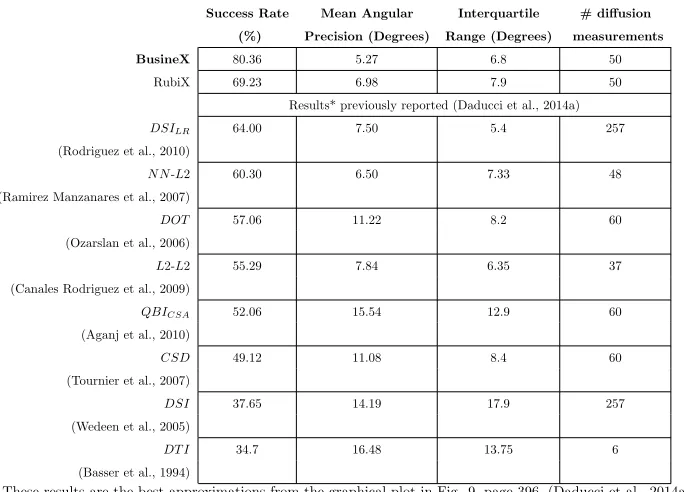
(Table 1). The better performance of BusineX is evident in these results. In
particular, for dataset-2 (the dataset used to evaluate algorithms to decide the
winner of the challenge), BusineX provided an SR of 80.36%, 11.13% better
than RubiX (69.23%) and 16.36% better than the algorithm reported as top
in SR (64%) (Rodriguez et al., 2010), in the comparison provided in (Daducci
et al., 2014a) (Refer Fig. 9, page 396). This shows the benefit of BusineX in
detecting fibers more accurately, which is made possible through the explicit
calculation of volume fractions posterior probability (15), as detailed in Section
2.4. Table 1 also reports the interquartile range representing the dispersion in
AP and also the number of diffusion measurements used by each method.
The results reported in Table 1 are obtained using the uncorrected SNRs
from (Daducci et al., 2014a). The SNR corrected for the variable echo-time
(TE) is 24.3 in our case (b-values 1500, see Table II in (Daducci et al., 2014a)).
We also did experiments with a corrected SNR of 24.3 (instead of 10). The
corresponding SR and AP are 82.99% and 4.88 degrees respectively.
In order to study whether the estimated fiber populations are close enough to
the real ones, we calculated the SR using thetolerance cone approach (Daducci
Table 1: Mean Success Rate and Angular Precision - ISBI dataset-2
Success Rate Mean Angular Interquartile # diffusion
(%) Precision (Degrees) Range (Degrees) measurements
BusineX 80.36 5.27 6.8 50
RubiX 69.23 6.98 7.9 50 Results* previously reported (Daducci et al., 2014a)
DSILR 64.00 7.50 5.4 257
(Rodriguez et al., 2010)
N N-L2 60.30 6.50 7.33 48
(Ramirez Manzanares et al., 2007)
DOT 57.06 11.22 8.2 60 (Ozarslan et al., 2006)
L2-L2 55.29 7.84 6.35 37 (Canales Rodriguez et al., 2009)
QBICSA 52.06 15.54 12.9 60
(Aganj et al., 2010)
CSD 49.12 11.08 8.4 60 (Tournier et al., 2007)
DSI 37.65 14.19 17.9 257 (Wedeen et al., 2005)
DT I 34.7 16.48 13.75 6 (Basser et al., 1994)
* These results are the best approximations from the graphical plot in Fig. 9, page 396, (Daducci et al., 2014a).
DT I- diffusion tensor imaging,DSI- diffusion spectrum imaging,DSILR- DSI Lucy-Richardson,DOT- diffusion
orientation falls within a tolerance cone of 20◦around the real fiber population.
This measure, which is reported as SR6 (Daducci et al., 2014a) is 70.95% for
BusineX and 63.86% for RubiX.
3.2. Synthetic Data Simulated using Camino
To study the effect of under-sampling and to have uniform ground truth
values for volume fractions, we simulated a second synthetic dataset using the
Camino toolbox (Cook et al., 2006). A Tensor-Cylinder-Sphere model is used
to simulate single and crossing fiber structures (with 2 and 3 fibers) with image
size 10×10×2 (LR) and 20×20×4 (HR), at different under-sampling factors.
The diffusivity value used to simulate the data is 1.7 x 10⁻⁹m2/s. To make
the fiber pattern in the image continuously varying, the orientation of fibers at
each HR voxel is selected such that it varies across each dimension by 1 degree
/ voxel. A minimum crossing angle of 45 degrees is maintained in this case.
Diffusion signals are simulated along 200 uniformly distributed directions, with
a b-value of 1500s/mm2. The noise free LR signal is created by down-sampling the HR data to LR image size (averaging the signals at groups of 2×2×2 HR
voxels). Rician noise is added to both LR and HR images by adding zero-mean
Gaussian signal in quadrature. A factor of 8/√2 is maintained in the ratio of
SNR of LR to that of HR signal (lower noise in LR data) (Sotiropoulos et al.,
2013). We simulated HR data with two SNRs, 15 and 25. Under-sampling of
diffusion directions is done by a factor of up to four to simulate acceleration in
image acquisition.
The algorithm performance is compared with the ball & stick model applied
to the HR dataset (usingBedpostX tool (Behrens et al., 2007) in FSL) and
Ru-biX (Sotiropoulos et al., 2013) applied to HR and LR datasets. Both RuRu-biX and
BusineX are applied to HR and LR datasets, with the first 100 measurements
forming theno-accelerationdata. This is done in order to approximately match
the acquisition time, making the comparisons fair (as BedpostX uses data at
only HR resolution). The 100 measurements are under-sampled again up to
Caruyeret al. (Caruyer et al., 2011) for under-sampling, which makes any first
N samples isotropic.
3.2.1. Fiber Orientation Estimation
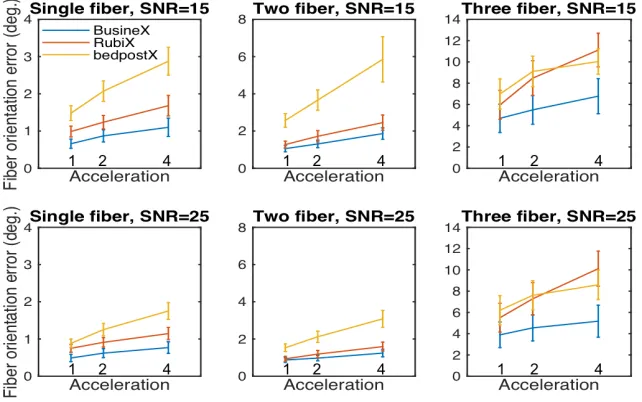
Fig. 3 shows the mean error and standard deviation in fiber orientation
estimation, and the variations with acceleration, for 1, 2, and 3 fiber cases,
with SNR 15 and 25. On comparison, BusineX provided better estimation
accuracy, at a slightly lower uncertainty. The variation in estimation error with
acceleration is lower in BusineX.
Figure 3: Comparison of fiber orientation estimation error (mean across 1600 voxels) and
its variation with acceleration factor (under-sampling in number of diffusion measurements).
Three data points with no under-sampling (1), under-sampling by a factor of 50% (2) and
under-sampling by a factor of 75% (4) are shown. Y-axis represents mean error across voxels
and across fibers in 2 and 3 fiber cases. The error bars shown represent the standard deviation
in estimation (scaled by 50% for all the methods, for better visualization), representing the
[image:21.612.145.466.292.493.2]3.2.2. Fiber Volume Fraction Estimation
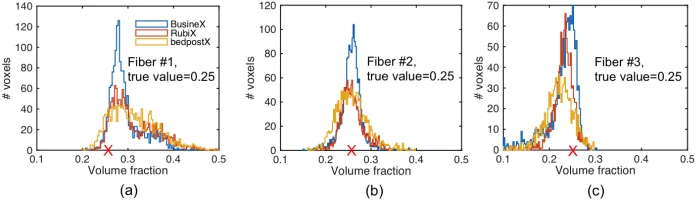
Fig. 4 presents the histogram results of volume fraction estimation in the 2
fiber case with SNR 15. The true value of both fiber 1 and 2 volume fractions
is 0.3. The comparisons show the improved volume fraction estimation in both
first and second fiber cases. A similar comparison in the 3 fiber case is shown
in Fig. 5, in which each fiber has equal volume fractions of 0.25.
Figure 4: Comparison of volume fraction estimation in the 2 fibers case (SNR=15,
no-acceleration). (a) & (b) are histograms of estimated volume fractions of fiber #1 & # 2
respectively. Each of the fibers have a true volume fraction of 0.30, marked with red cross on
the x-axis. The total number of voxels having a volume fraction of 0.3 is 1600.
Figure 5: Comparison of volume fraction estimation in the 3 fibers case (SNR=15,
no-acceleration). (a)-(c) are histograms of estimated volume fractions of fiber #1, #2, & #3
respectively. Each of the fibers have a true volume fraction of 0.25, marked with red cross on
the x-axis. The total number of voxels having a volume fraction of 0.25 is 1600.
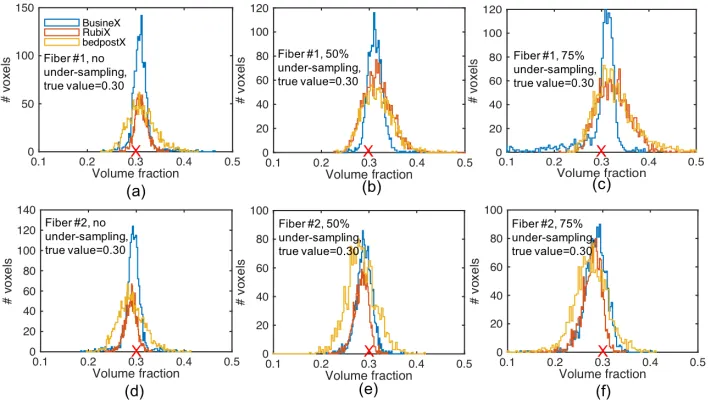
[image:22.612.133.482.465.566.2]acceleration. Fig. 6 shows a comparison under different accelerations
[image:23.612.128.482.170.374.2](under-sampling factors) in 2 fibers case with SNR 15.
Figure 6: Comparison of volume fraction estimation of fiber 1 (row 1) and fiber 2 (row 2) at
different under-sampling factors. Left column shows the case with no under-sampling, middle
column shows the case with 50% under-sampling, and the right column shows the case with
75% under-sampling. Each of the fibers have a true volume fraction of 0.30, marked with red
cross on the x-axis. The total number of voxels having a volume fraction of 0.3 is 1600. The
SNR of the data is 15.
3.2.3. Diffusivity Estimation
We used a diffusivity value of 1.7 x 10⁻⁹m2/sfor the data simulation using
Camino. The estimated mean diffusivity (mean of the diffusivity across 1600
voxels) is 1.6868 x 10⁻⁹m2/s with a variance 1.02 x 10⁻²¹. RubiX provided
identical results: mean diffusivity of 1.6813 x 10⁻⁹m2/s with a variance 1.14
x 10−21. BedpostX provided slightly lower accuracy in diffusivity estimation:
3.2.4. Estimation Uncertainty
Table 2 provides mean span of 95% cones of uncertainty, which is a measure
of the width of estimated distributions, representing the uncertainty in
esti-mation. The estimation uncertainty in BusineX is slightly better than that in
RubiX, and the estimation uncertainty in BedpostX is approximately two times
[image:24.612.137.482.310.375.2]that in BusineX.
Table 2: Comparison of estimation uncertainties - Mean span of 95% cones of orientation
uncertainty (in degrees)
No under-sampling 50% under-sampling 75% under-sampling
Fiber 1 Fiber 2 Fiber 1 Fiber 2 Fiber 1 Fiber 2
BusineX 2.55 2.62 3.31 3.47 4.63 5.00
RubiX 2.65 2.74 3.50 3.70 4.80 5.12
BedpostX 4.88 5.24 6.93 7.89 10.7 18.28
3.3. In-vivo Data Acquired using 3T Siemens Prisma Scanner
We acquired in-vivo data from a healthy subject using 3T Siemens Prisma
scanner. For HR acquisitions the acquisition matrix was 140×140×92 voxels
with a resolution of 1.5×1.5×1.5mm3. For LR acquisitions the resolution was reduced to 3×3×3 mm3 for an acquisition matrix size 70×70×46 voxels. Diffusion weighting was applied in 200 evenly spaced directions with a b-value
of 1500 s/mm2. Twenty one volumes without diffusion weighting are equally
interleaved in the dataset.
3.3.1. In-vivo Data Results
We report 4 sets of results from the in-vivo experiments showing, a) the
stability of fiber orientation and volume fraction estimates with acceleration
(Fig. 7),b) improved estimation of orientation and volume fractions (Fig. 8, 9
Fig. 11), andd) improved diffusivity estimation (Fig. 12). We used the
Con-nectome Workbench (Marcus et al., 2011) from the Human ConCon-nectome Project
for visualizing the results4 (Fig. 7-10).
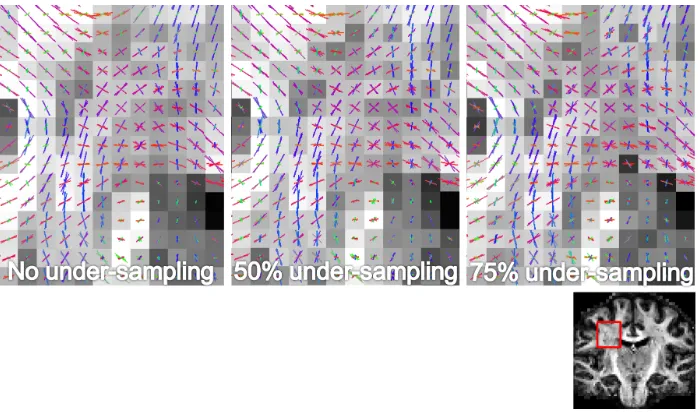
Fig. 7 shows a representative comparison of fiber orientation and sum of
volume fractions estimates at different accelerations (under-sampling factors in
number of diffusion scans). The region shown is the centrum semiovale area,
where commissural fibers (the corpus callosum, CC) and association fibers (the
superior longitudinal fasciculus, SLF) crosses the projection fibers (the
corti-cospinal tract, CST). The comparison shows the robustness of fiber orientation
and volume fraction estimates with acceleration.
We compare our in-vivo results to the reconstructions provided by RubiX
(Sotiropoulos et al., 2013), BedpostX (Behrens et al., 2007), and Constrained
Spherical Deconvolution (CSD) (Tournier et al., 2007). The implementations
of BedpostX available in FSL (Jenkinson et al., 2012a) and CSD available in
MRtrix3 (Tournier et al., 2012) are used for the experiments. The method used
for calculation of the response function is tourneir and for fiber orientation
distribution is csd. The spherical harmonic order (lmax) used is the default
value in MRtrix3 (lmax= 8). The visualization tool in MRtrix (mrview) is used
to visualize the estimated Orientation Distribution Functions (ODFs).
Fig. 8 provides representative comparisons from the centrum semiovale area,
showing improved detection of crossing fibers by BusineX, as compared to
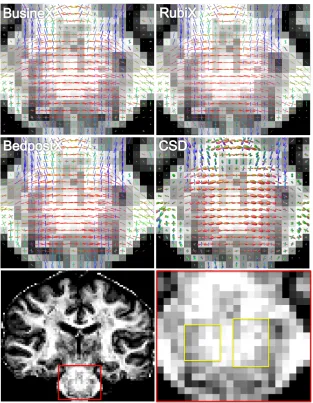
Ru-biX. Fig. 9 compares performance of BusineX with that of RubiX, BedpostX,
and CSD, showing improved estimations of the fibers crossing the pons. The
highlighted regions show improved detection of crossing fibers by BusineX.We
calculated the mean sum of volume fractions of first, second, and third fibers
from the region of interest (ROI) highlighted in red in Fig. 9. BusineX,
Ru-biX, and BedpostX provided values of 0.469, 0.399, and 0.408 respectively. The
4The processing in Workbench estimates bingham distributions from the set of estimated
posterior fiber parameter samples, for each fiber orientation in a voxel which is labeled a
Figure 7: Comparison showing the stability of fiber orientation and volume fraction estimates
with acceleration (under-sampling). Upper panel shows color coded orientation estimates at
the region near the centrum semiovale, highlighted in the coronal view in lower panel. The
background to the orientation estimates is the sum of anisotropic volume fractions. In the
upper panel left column shows the case with no under-sampling, middle column shows the case
Figure 8: Comparison between BusineX and RubiX, showing improved detection of crossing
fibers by BusineX. Panels 2 and 3 show color coded orientation estimates at the region near
right and left centrum semiovale, highlighted in the coronal view in uppermost and lowermost
panels, respectively. The background to the orientation estimates is the sum of anisotropic
volume fractions estimated by each method. The estimation is done from HR and LR datasets
higher mean sum of volume fractions obtained from BusineX may correspond
to improved detection of crossing fibers.
Fig. 10 shows another comparison of the performance of BusineX with
that of RubiX, BedpostX, and CSD, showing improved parameter estimates
near SLF. We also analyzed the performance improvement quantitatively, by
counting the number of second and third fiber crossings in the white matter, as
well as in several specific ROIs. Fig. 11 shows the number of second and third
fiber crossings in the white matter, near the pons in the ROI from Fig. 9, in the
left/right SLF and in the left/right posterior corona radiata (PCR). It can be
noticed that, while RubiX and BedpostX tend to recover fewer second and third
fiber crossings as the under-sampling factor increases, BusineX performs equally
well even with only a quarter of the original diffusion gradients. Lastly we have
shown a map of the estimated mean diffusivity in Fig. 12. By comparison with
DTI, both BusineX and BedpostX provide diffusivity estimates with improved
contrast. Compared to BedpostX, the estimate from BusineX also appears to
be less noisy.
4. Discussion
4.1. Complexity of Fiber Patterns
The use of SBL in BusineX enhances the variance adaptation of fiber volume
fractions to the data, at each voxel and for each possible fiber orientation. This is
made possible by moderating the strength of priors through associated
hyperpa-rameters. In other words, the proposed framework performs relevance learning
by tuning the variance hyperparameters spatially (across voxels) and angularly
(across possible fiber orientations), which is the main novelty of our approach.
Contrary to earlier approaches in fiber parameter estimation, which utilizes a
fixed ARD weight for all voxels and fibers (Behrens et al., 2007; Sotiropoulos
et al., 2013), this variance adaption through relevance determination improves
Figure 9: Comparison between BusineX, RubiX, BedpostX and CSD showing improved
de-tection of fibers crossing the pons. Upper and middle panels show color coded orientation
estimates (ODF in the case of CSD) at the pons region highlighted in the coronal view in
lower left panel. The background is the sum of anisotropic volume fractions estimated by
BedpostX for all the methods. A comparison of the areas highlighted in the lower right panel
shows improved detection of CST fibers at the level of the pontine crossing tract. The
estima-tion from BedpostX and CSD is done from the full HR dataset with 200 diffusion direcestima-tions.
The estimation from BusineX and RubiX is done from HR and LR datasets with 100 diffusion
directions per dataset. We use a total of 200 directions in all experiments to approximately
match the acquisition time (LR acquisitions can be done faster than HR). BedpostX and CSD
use only one dataset (HR), whereas BusineX and RubiX use two datasets (HR and LR) with
Figure 10: Comparison between BusineX, RubiX, BedpostX, and CSD showing improved
detection of crossing fibers by BusineX. Upper panels show color coded orientation estimates in
the SLF region highlighted in the sagittal view in lower right panel. Lower left panel shows the
color coded ODF estimated using MRtrix.The background is the sum of anisotropic volume
fractions estimated by BedpostX for all the methods. A comparison of the areas highlighted
in the lower middle panel shows improved detection of association fibers through the SLF.
BusineX resolves the association fibers in both highlighted areas. RubiX and BedpostX do
not resolve all the fibers at the yellow area, and CSD does not resolve all the fibers at the
magneta area. The estimation from BedpostX and CSD is done from the full HR dataset
with 200 diffusion directions. The estimation from BusineX and RubiX is done from HR and
LR datasets with 100 diffusion directions per dataset. We use a total of 200 directions in all
experiments to approximately match the acquisition time (LR acquisitions can be done faster
than HR). BedpostX and CSD use only one dataset (HR), whereas BusineX and RubiX use
Figure 11: Variation in number of second and third fiber crossings (with volume fractions
greater than 5%) in the white matter and in five selected ROIs.
Figure 12: Estimated mean diffusivity maps from BusineX (left), BedpostX (middle), and
[image:31.612.133.482.504.610.2]the improved performance of BusineX, as illustrated in our simulation as well
as in-vivo results.
Another reason for the possible improvement in detection of crossing fibers
is the automatic tuning of fiber complexity using the hybrid Metropolis-within
reversible jump Gibbs sampler (Section 2.5), which helps fiber complexity
adap-tation by accepting or rejecting addition and deletion of fibers. Also, the
rescal-ing of volume fractions after every addition (BIRTH) and deletion (DEATH) move, as per the non-negativity and sum-to-one constraints, further facilitates
improvement in parameter estimation.
4.2. Local and Spatial Diffusion Models
The proposed algorithm is generic with respect to the local diffusion model
and the corresponding model parameters. The algorithm can be applied to
any model which can represent the data in dictionary form (Section 2.1) . We
chose the ball & stick model to approximate the diffusion signal, but it can
be replaced with more complex models such as a non-monoexponential decay
model to approximate multi-shell data (Jbabdi et al., 2012). In order to support
the flexibility of the proposed method, we used different models for synthetic
data simulation: A Tensor-Cylinder-Sphere model for the Camino dataset and
a Multi-Tensor model for the ISBI HARDI dataset.
To verify our spatial model, the assumption that the attenuation signal at an
LR voxel can be approximated by a weighted linear combination of attenuation
signals at corresponding overlapping HR voxels (6), we calculated the mean
and standard deviation of the root mean square error (RMSE) of estimated LR
attenuation signal from the actual LR attenuation data. The mean RMSE for
our in-vivo data is 0.067 with a standard deviation of 0.048, which justifies our
assumption (RMSE close to zero).
The HR local model (1) and the LR spatial partial volume model (6)
(Sotiropou-los et al., 2013) adapted in the proposed approach were recently modified to
im-prove the generalizability and performance (Sotiropoulos et al., 2016): the local
2012). Moreover the weighted sum of signal attenuations in the spatial partial
volume model is replaced with the ratio of weighted sums of diffusion-weighted
signals and non-diffusion-weighted signals. Improvement in estimation,
partic-ularly in volume fractions and diffusivities at tissue boundaries, is reported. In
our current implementation, we maintained the models as in RubiX
(Sotiropou-los et al., 2013) to make the comparisons fair and as our objective is to show
the benefits of modeling sparsity. These model changes can be easily adapted
to the presented framework.
The elements of our over-complete dictionary (5) created from the HR local
model are obtained from an icosahedral tessellation of the sphere. We use a 5th
order tessellation limiting the number of possible fiber orientations to 10242, as
a compromise between orientation accuracy and computational expense. The
worst-case discretization error due to this approximation is 1.18 degrees. The
order of tessellation can be increased for slightly improved orientation estimation
accuracy, at the expense of computational time.
4.3. Multiple Resolutions, Benefits for Data at Single Resolution
We have introduced a novel method for mapping white matter fiber
param-eters by combining information from data at high and low spatial resolutions
through a sparse linear unmixing framework. The algorithm works on any
com-bination of voxel sizes provided the LR voxel size is an integer multiple (e.g. 2x)
of the HR voxel size. The resolutions used in our experiments are 1.5 mm (HR)
and 3.0 mm (LR). The idea of combining multiple resolutions for noise
regu-larization was previously presented, discussing the specific aspects and issues
related to combining multiple resolutions (Sotiropoulos et al., 2013).
The fiber pattern in the HARDI reconstruction challenge dataset mainly
varies across two dimensions (in-plane) and has limited variation in the third
dimension (slices). Both our algorithm and RubiX might have benefitted from
this spatial consistency to some extent, as these algorithms use the same priors
for all HR voxels overlapped by an LR voxel (2×2×2 = 8 HR voxels overlapped
% in SR and 1.71 Degrees in AP) which is attributable to the volume fractions
posterior computation using the proposed sparse Bayesian learning algorithm.
It is straight-forward to apply the algorithm for inference from data at a
single resolution. The sparse Bayesian unmixing inference procedure detailed
in Section 2 remains the same. However the multiresolution inference as in
RubiX, detailed in Appendix A, and the partial volume model for LR data,
detailed in Section 2.2, need modifications (or deletions). The improvement in
accuracy due to the sparse formulation, as well as the benefit of lower number of
diffusion measurements may remain similar to the proposed approach, though
the inference from data at single resolution may affect the noise regularization
behavior of the algorithm (which is originally a benefit of fusing information
from LR data).
4.4. Current Limitations and Future Work
Estimation using the BusineX algorithm requires the acquisition of two scans
of the same subject at different spatial resolutions, which may lead to specific
challenges in the pre-processing steps. The combined inference from two scans
may be more sensitive to distortions (motion, B0 inhomogeneity, and eddy
cur-rent). These EPI distortions can be different for the two scans, as the spatial
resolutions are different. We corrected these distortions independently using
FSL (Jenkinson et al., 2012b; Andersson and Sotiropoulos, 2015) before
align-ing the two datasets, to minimize their effects in the inference.
The use of LR data in BusineX is to regularize and mitigate the noise in
HR data, by defining the priors and hyper-priors. To overcome the
above-mentioned limitations caused by two scans, we plan to explore the possibility of
learning these priors from an atlas which can be registered to the single
resolu-tion (HR) data. This would allow reconstrucresolu-tion and estimaresolu-tion by acquiring
images at a single spatial resolution. We also plan to develop a multi-shell
version of BusineX since such dMRI data has been shown to improve fiber
ori-entation mapping and tractography, for example, the multi-shell multi-tissue
The current implementation of our algorithm is computationally intensive,
mainly due to the MCMC iterations. The algorithm takes about 8 seconds to
process one voxel with a CPU speed of 2.6 GHz. To speed-up the
process-ing, we parallelized the algorithm using OpenMP. It takes an average time of
250 milliseconds / voxel on a server with 32 processors. The computational
performance of the algorithm can be further improved using GPU/CUDA.
4.5. Concluding Remarks
Reducing acquisition time and maintaining SNR are two challenging goals in
dMRI acquisition. We proposed a sparse Bayesian algorithm, namely BusineX,
to achieve these goals simultaneously, extending and improving an existing
mul-tiresolution approach (RubiX) by efficiently introducing sparsity. BusineX is
useful for reconstruction of fiber parameters from accelerated dMRI data. The
results from simulation and in-vivo experiments have shown detection of more
number of second and third fiber crossings, with improved accuracy and lower
estimation uncertainty, for data under-sampled by a factor of up to four. The
near linear behavior of the orientation estimation error as well as the number of
detected fiber crossings with acceleration shows the potential of the proposed
approach for application in shortening the acquisition time of dMRI.
Our main motivation for this work is to demonstrate improvements in the
estimation of white matter parameters through explicit modeling of sparsity
using sparse Bayesian learning. As discussed above, the main limitation of
the proposed algorithm is the need to acquire data at two different spatial
resolutions. Several single resolution algorithms are available in the literature
(for example the algorithms we compared in Table 1), which can also achieve
good angular precision. Our future work will focus on extending BusineX for
fiber parameter estimation from single resolution multi-shell data.
Appendix A. Bayesian Inference
The application of Bayes rule with the complete Bayesian inference
(Sotiropou-los et al., 2013) with the proposed sparse linear unmixing framework (Section
2),
p(Ω/Y)∝p(Y /Ω)p(Ω), (A.1)
whereY = (YLR,{YHRm }) represents both HR and LR data, and
Ω = (fn, vn, d, SHR0 , ηHR, S0LR, ηLR) is the set of all parameters to be estimated.
As the priors are conditional on hyperparametersC,
p(Ω, C/Y)∝p(Y /Ω)p(Ω/C)p(C), (A.2)
where
p(Y /Ω) =p(YLR/Ω) M
Y
m=1
p(YHRm /Ω) = K
Y
k=1
p YLRk /Ω
M Y m=1 K Y k=1
p YHRmk/Ω
,
(A.3)
(A.4)
p(Ω/C) =p(S0LR)p(σLR)p(γ) M
Y
m=1
p(S0mHR)p(σmHR)p(dm/Cd)p(fm/CF) N
Y
n=1
p(vn/Cvn),
and
p(C) =p(Cd)p(CF) N
Y
n=1
p(Cvn). (A.5)
The priors and hyper-priors (other than that for volume fractions, Equation
(7)) used are as detailed next.
Priors:
p(S0LR) =p(S0HR) =U(0,∞),
p(σLR) = 1/σLR, p(σHR) = 1/σHR,
p(γ) =U(0,∞),
p(d/Cd) =p(d/µd, σd) =N µd, σ2d
,
p(vn/Cvn) =p(vn/µr, kr) =|sin(θ)|
R
X
r=1
c(kr)e−kr(µ
T
Hyper-priors:
p(µd) = Γ(a, c), p σ2d
=U(0,∞),
p(Cvn) =
R
Y
r=1
p(kr)p(µr),
p(kr) =U(0,∞), p(µr) =U S2. (A.7)
Appendix B. Acceptance Probability forBIRTH andDEATH Moves
Consider aBIRTH move from the state{f+(t), E+(t)
n0 , n (t)
0 } to a new state {f+∗, E+∗
n∗ 0, n
∗
0}. The acceptance probabilityρbforBIRTHmove isρb =min{1, Ab},
where Ab is the acceptance ratio given by (B.1) (Green, 1995; Denison et al.,
2002),
Ab=Pp×P rp×Tp× |J(f∗)|, (B.1)
where
Pp=
pf+∗, E+∗
n∗ 0, n
∗
0
pf+(t), E+(t)
n0 , n (t) 0
,the ratio of the posterior probabilities,
P rp=
qf(+t), E+(t)
n0 |f+∗, E +∗
n∗ 0
qf+∗, E+∗
n∗ 0|f
+(t), E+(t)
n0
,the ratio of proposal distributions,
Tp=
dR∗
bR(t)
,the ratio of transition probabilities, and
|J(f∗)|= the Jacobian of the transformation.
(B.2)
The Jacobian |J(f∗)| accounts for the change in scale when moving between
models of different dimensions. The ratio of transition probabilities is 1 in most
of the cases, when the birth and death moves are equally likely. The ratio of
the proposal distributionsP rp is given by (Dobigeon et al., 2008)
P rp=
1
g1,n(t) 0
(f+∗)
nmax
0 −n (t) 0 n(0t)+ 1
wherega,b(.) denotes the pdf of a Beta distributionBe(a, b). The posterior ratio
Pp can be written as the product of the likelihood ratio and prior probability
ratios of volume fractions, dictionary, and number of fibers (B.4),
Pp=
p(f∗, E∗, n∗0)
pf(t), E(t), n(t) 0
=
p(y|f∗, E+∗, n∗
0) py|f(t), E+(t), n(t)
0
× p(f
∗|n∗
0) pf(t)|n(t) 0
×
p(E+∗|n∗
0) pE+(t)|n(t) 0
×
p(n∗0)
pn(0t)
. (B.4)
The prior ratio of volume fractions is given by (B.5)
p(f∗|n∗
0) pf(t)|n(t) 0
=
Qn∗0
n=1N(fn+∗|0,1/α+n∗)
Qn
(t) 0
n=1N(f +(t)
n |0,1/α
+(t)
n )
=αn ∗ 0 2π
12 e−
αn∗ 0f
2 n∗0
2 . (B.5)
The prior ratio of the dictionary is given by (B.6) (Denison et al., 2002)
p(E+∗|n∗
0) pE+(t)|n(t) 0
=
n(0t)+ 1
nmax
0 −n (t) 0
. (B.6)
The prior associated to the number of fibers is uniform, and so the prior ratio
of number of fibers is 1.
Substituting the values ofPp,P rp, andTp in B.1, the acceptance ratio Ab
is given by
Ab =e
−
kyHR−E+∗ n∗0f
+∗ k2−kyHR−E+(t) n0 f+(t)k2 2
× dR∗
bR(t)
× 1
g1,n(t) 0
(f+∗)
×αn∗0 2π
12 e−
αn∗ 0 f2
n∗0
2 . (B.7)
The acceptance probabilityρdforDEATH move isρd=min{1, Ad}, where
Ad is the rejection ratio. The derivation and calculation of Ad is similar to
the calculation ofAb except that the ratio of transition probabilitiesTpis bR
∗
dR(t)
(Denison et al., 2002) and prior ratio of volume fractions is α
n(t)0 2π
12 e−
α n(t)0 f
2 n(t)0
2 .
Acknowledgements
This work was supported by NIH grants P41 EB015894, P30 NS076408, and
the Human Connectome Project (U54 MH091657). The work of GS on sparse
We would like to thank Sudhir Ramanna for his help with the acquisition of the
in-vivo dataset used in this paper.
References
Aganj I, Lenglet C, Sapiro G, Yacoub E, Ugurbil K, Harel N. Reconstruction of
the orientation distribution function in single and multiple shell q-ball imaging
within constant solid angle. Magnetic Resonance in Medicine 2010;64(2):554–
66.
Anderson AW. Measurement of fiber orientation distributions using high
angular resolution diffusion imaging. Magnetic Resonance in Medicine
2005;54(5):1194–206.
Andersson JLR, Sotiropoulos SN. Non-parametric representation and prediction
of single- and multi-shell diffusion-weighted mri data using gaussian processes.
Neuroimage 2015;122:166–76.
Araki S, Nakatani T, Sawada H, Makino S, Ieee . Blind sparse source separation
for unknown number of sources using Gaussian mixture model fitting with
dirichlet prior. In: IEEE ICASSP Proceedings. 2009. p. 33–6.
Aranda R, Ramirez-Manzanares A, Rivera M. Sparse and adaptive diffusion
dictionary (sadd) for recovering intra-voxel white matter structure. Medical
Image Analysis 2015;26(1):243–55.
Basser P, Mattiello J, LeBihan D. Mr diffusion tensor spectroscopy and imaging.
Biophysical Journal 1994;66:259–67.
Behrens TE, Berg HJ, Jbabdi S, et al. . Probabilistic diffusion tractography with
multiple fibre orientations: What can we gain? Neuroimage 2007;34(1):144–
55.
Behrens TE, Woolrich MW, Jenkinson M, Johansen-Berg H, Nunes RG, Clare
uncer-tainty in diffusion-weighted MR imaging. Magnetic Resonance in Medicine
2003;50(5):1077–88.
Bioucas-Dias JM, Plaza A, Dobigeon N, Parente M, Du Q, Gader P, Chanussot
J. Hyperspectral unmixing overview: Geometrical, statistical, and sparse
regression-based approaches. IEEE Journal of Selected Topics in Applied
Earth Observations and Remote Sensing 2012;5(2):354–79.
Canales Rodriguez E, Lin CP, Iturria-Medina Y, Yeh CH, Cho KH, Melie-Garcia
L. Diffusion orientation transform revisited. Neuroimage 2009;49:1326–39.
Caruyer E, Cheng J, Lenglet C, Sapiro G, Jiang T, Deriche R. Optimal design
of multiple q-shells experiments for diffusion MRI. In: MICCAI Workshop
Comput. Diffusion MRI (CDMRI). 2011. .
Castrodad A, Xing Z, Greer J, Bosch E, Carin L, Sapiro G. Learning
discrimi-native sparse representations for modeling, source separation, and mapping of
hyperspectral imagery. IEEE Transactions on Geoscience and Remote Sensing
2011;49(11):4263–81.
Cook PA, Bai Y, Nedjati-Gilani S, Seunarine KK, Hall MG, Parker GJ,
Alexan-der DC. Camino: Open-source diffusion-MRI reconstruction and processing.
In: Scientific Meeting of ISMRM, Seattle, WA, USA. 2006. .
Coupe P, Manjon JV, Chamberland M, Descoteaux M, Hiba B.
Collabora-tive patch-based super-resolution for diffusion-weighted images. Neuroimage
2013;83:245–61.
Daducci A, Canales-Rodriguez EJ, Descoteaux M, Garyfallidis E, Gur Y, Lin
YC, Mani M, Merlet S, Paquette M, Ramirez-Manzanares A, Reisert M,
Ro-drigues PR, Sepehrband F, Caruyer E, Choupan J, Deriche R, Jacob M,
Menegaz G, Prckovska V, Rivera M, Wiaux Y, Thiran JP. Quantitative
com-parison of reconstruction methods for intra-voxel fiber recovery from diffusion
Daducci A, Canales-Rodrguez EJ, Zhang H, Dyrbye TB, Alexander DC, Thiran
JP. Accelerated microstructure imaging via convex optimization (amico) from
diffusion mri data. Neuroimage 2015;105:32–44.
Daducci A, Ville DVD, Thiran JP, Wiaux Y. Sparse regularization for fiber
odf reconstruction: From the suboptimality of l2 and l1 priors to l0. Medical
Image Analysis 2014b;18(6):820–33.
Dell’Acqua F, Rizzo G, Scifo P, Clarke RA, Scotti G, Fazio F. A model-based
deconvolution approach to solve fiber crossing in diffusion-weighted MR
imag-ing. IEEE Transactions on Biomedical Engineering 2007;54(3):462–72.
Denison DGT, Holmes CC, Mallick BK, Smith AFM. Bayesian Methods for
Nonlinear Classification and Regression. Chichester, U K: Wiley 2002;.
Dobigeon N, Tourneret JY, Chang CI. Semi-supervised linear spectral unmixing
using a hierarchical bayesian model for hyperspectral imagery. IEEE
Trans-actions on Signal Processing 2008;56(7):2684–95.
Duarte-Carvajalino JM, Lenglet C, Xu J, Yacoub E, Ugurbil K, Moeller S, Carin
L, Sapiro G. Estimation of the CSA-ODF using bayesian compressed sensing
of multi-shell hardi. Magnetic Resonance in Medicine 2014;72(5):1471–85.
Green PJ. Reversible jump markov chain monte carlo computation and Bayesian
model determination. Biometrika 1995;82(4):711–32.
Henkelman RM. Measurement of signal intensities in the presence of noise in
MR images. Medical Physics 1985;12:232–3.
Iordache MD, Bioucas-Dias JM, Plaza A. Sparse unmixing of hyperspectral
data. IEEE Transactions on Geoscience and Remote Sensing 2011;49(6):2014–
39.
Jaynes ET. Prior probabilities. IEEE Transactions on Systems Science and
Jbabdi S, Sotiropoulos SN, Savio AM, Grana M, Behrens TEJ. Model-based
analysis of multishell diffusion MR data for tractography: How to get over
fitting problems. Magnetic Resonance in Medicine 2012;68(6):1846–55.
Jenkinson M, Beckmann C, Behrens T, Woolrich M, Smith S. Fsl. Neuroimage
2012a;62:782–90.
Jenkinson M, Beckmann CF, Behrens TE, Woolrich MW, Smith SM. Fsl.
Neu-roimage 2012b;62:782–90.
Jeurissen B, Tournier JD, Dhollander T, Connelly A, Sijbers J. Multi-tissue
con-strained spherical deconvolution for improved analysis of multi-shell diffusion
mri data. Neuroimage 2014;103:411–26.
Ji S, Dunson D, Carin L. Multitask compressive sensing. IEEE Transactions
on Signal Processing 2009;57(1):92–106.
Kaden E, Knosche TR, Anwander A. Parametric spherical deconvolution:
In-ferring anatomical connectivity using diffusion MR imaging. Neuroimage
2007;37(2):474–88.
MacKay DJC. Bayesian methods for backpropagation networks. Springer,
Mod-els of Neural Networks III, chapter 6 1994;:211–54.
Marcus DS, Harwell J, Olsen T, Hodge M, Glasser MF, Prior F, Jenkinson M,
Laumann T, Curtiss SW, Van Essen DC. Informatics and data mining: Tools
and strategies for the human connectome project. Frontiers in
Neuroinfor-matics 2011;5(4):1–12.
Michael Lustig DD, Pauly JM. Sparse MRI: The application of compressed
sens-ing for rapid MR imagsens-ing. Magnetic Resonance in Medicine 2007;58(6):1182–
95.
Moussaoui S, Brie D, Mohammad-Djafari A, Carteret C. Separation of