
Quantitative analysis of ruminal bacterial populations involved in lipid metabolism in dairy cows fed different vegetable oils
29
0
0
Full text
(2) 16S rDNA/ml by qPCR was decreased (P<0.05) by SO. Fibrobacter succinogenes, Butyrivibrio proteoclasticus, and Anaerovibrio lipolytica loads were not affected by dietary treatments. In contrast, compared with control, load of Prevotella bryantii was increased (P<0.05) with HPO diet. Compared with control and SO, HPO decreased (P<0.05) C18:2 cis n-6 in ruminal digesta. Contents of C15:0 iso, C18:11 trans-11 and C18:2 cis-9, trans-11 were increased (P<0.05) in ruminal digesta by SO compared with control and HPO. In conclusion, supplementation of SO or HPO do not affect ruminal fermentation parameters whereas HPO can increase load of ruminal Prevotella bryantii. Also, results observed in our targeted bacteria may have depended on the saturation degree of dietary oils.. Keywords: Soybean oil, rumen fermentation, vegetable oil, palm oil. Implications A better knowledge of the rumen microbiome may help us to understand, and eventually modulate, the effect of nutrition on milk fat production and quality. This work was conducted to evaluate the effect of two sources of dietary lipids; soybean oil (SO; an unsaturated source) and hydrogenated palm oil (HPO; a saturated source) on bacterial populations and the fatty acid profile of ruminal digesta. Contents of C15:0 iso, C18:11 trans-11 and C18:2 cis-9, trans-11 were increased by SO. Supplementation with SO or HPO (2.7 % DM) did not affect ruminal fermentation parameters whereas HPO can increase loads of ruminal Prevotella bryantii..
(3) Introduction Dietary polyunsaturated fatty acids (PUFA) have toxic effects on ruminal microorganisms, therefore, lipid supplementation often leads to changes in ruminal microbial populations and shifts in ruminal fermentation parameters (Zhang et al., 2008). Rumen microbes attempt to detoxify PUFA by biohydrogenation (Maia et al., 2010). Biohydrogenation pathways require an initial hydrolysis of ingested dietary glyceride by microbial lipases/esterases causing the release of FA (Prive et al., 2015) at this stage; Anaerovibrio lipolytica is recognized as one of the major species involved in lipid hydrolysis in ruminants (Prive et al., 2013). Wallace et al. (2006) proposed that Butyrivibrio genus contained the main bacterial species involved in the biohydrogenation process. However, Huws et al. (2011) demonstrated that as yet uncultured bacteria belonging to the genera Prevotella and Anaerovoax, and unclassified Ruminococcaceae and Clostridiales may play more important roles in ruminal biohydrogenation.. It is known that cellulolytic bacteria (Fibrobacter succinogenes, Ruminococcus flavefaciens, Ruminococcus albus, and Butyrivibrio fibrisolvens) are important in the biohydrogenation process of dietary sources of PUFA (Potu et al., 2011). Also, Butyrivibrio proteoclasticus has been reported to be the principal rumen bacteria involved in biohydrogenation of C18:1 FA (Boeckaert et al., 2008). On the other hand, Prevotella bryantii has been described as a ruminal bacterium that is involved in oligosaccharolytic and xylanolytic activities (Tajima et al., 2001) and also Prevotella spp. has been reported as resistant to inhibitory effects of dietary PUFA (Huws et al., 2010)..
(4) Supplementing dairy cow diets with soybean oil (SO) can increase milk bioactive FA such as C18:1 trans-11 (Allred et al., 2006; Vargas-Bello-Perez et al., 2015a). Also, SO has been shown to reduce cellulolytic bacteria, protozoa populations and total concentration of volatile fatty acids (Yang et al., 2009). On the other hand, hydrogenated vegetable oils have been used to increase the energy content of dairy cow diets in housed (Kargar et al., 2012) and pasture systems (Schroeder et al., 2002) without effect on milk composition (Vargas-Bello-Perez et al., 2015b).. To our knowledge, no study on the effect of dietary hydrogenated palm oil on ruminal bacterial populations in dairy cows has been published. Also, animal trials reporting use of oils and their effect on rumen microbiome have less risk of bias compared with in vitro studies. Therefore, the aim of this study was to make a quantitative analysis of bacterial populations involved in ruminal biohydrogenation (Fibrobacter succinogenes, Butyrivibrio proteoclasticus and Anaerovibrio lipolytica) and Prevotella bryantii (one of the most predominant ruminal bacteria) in dairy cows fed different vegetable oils (soybean oil as an unsaturated source and hydrogenated palm oil as a saturated source). The effect of fat supplements on the FA profile of ruminal digesta was another objective. Our hypothesis was that supplementation with saturated versus unsaturated oils would have different effects on bacterial populations that were or were not involved in biohydrogenation.. Materials and methods Animals and treatments.
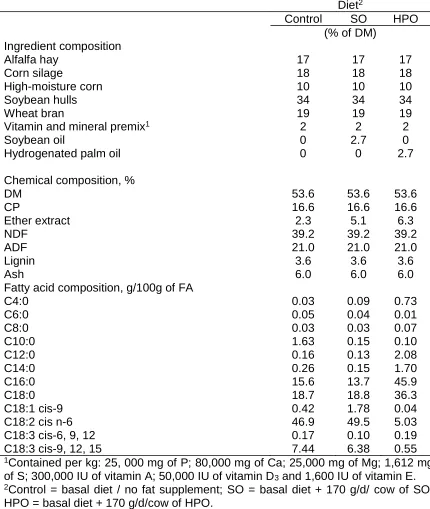
(5) Three non-lactating Holstein cows (684.7 ± 84.7 kg BW) fitted with ruminal cannulae # 3C (Bar Diamond, Inc., Boise, Idaho, USA) were used in a 3×3 Latin square design with 3 periods consisting of 21 d. Cows were fed to satisfy the requirements of a dry cow on the last trimester of gestation consuming 10 kg DM daily (NRC, 2001). Dietary treatments (Table 1) were a basal diet (C) containing 56% forage and 44% concentrate ratio with no fat supplement, and fatsupplemented diets containing soybean oil (SO; 170 g/d/cow = 2.7% DM) and hydrogenated palm oil (HPO; 170 g/d/cow = 2.7% DM). The amounts of oils used were similar to those reported to alter rumen FA in previous studies (Yang et al., 2009, Vargas-Bello-Perez et al., 2015a). The most important FA in dietary oils were: SO contained (g/100g) 25 of C18:1 cis-9 and 51 of C18:2 cis n-6, whereas HPO contained 47 of C16:0 and 43 of C18:0. Oils were administrated separately and mixed manually into the daily TMR for each cow. Animals were housed in individual stalls (2.4 × 6 m) and had free access to fresh water. Animal care and procedures were carried out according to the guidelines of the Animal Care and Use Committee of the Pontificia Universidad Católica de Chile.. Samples On the last day of each 21-d period, samples of whole ruminal digesta were collected from the anterior, dorsal and mid-ventral regions of the rumen at 0900 h (2 h post feeding) and were squeezed through three layers of cheesecloth. Ten ml of residual ruminal fluid was immediately used to determine pH by using a pH meter (PP-201 GOnDO Electronic, Taipei, Taiwan), 10 ml were kept for NH 3-N analysis (Bal et al., 2000) and another 10 ml were preserved for volatile fatty acid.
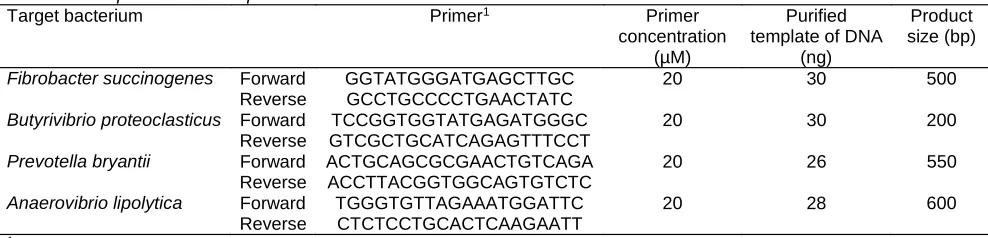
(6) (VFA) determination by adding 1 ml of 25% metaphosphoric acid. Samples were frozen (-20°C) for later analysis. The VFA measurement were performed by gas chromatograph (GC-2010) equipped with a 30-m wall-coated open tubular-fused silica capillary column (Stabilwax-DA; 30 m × 0.32 mm i.d., 0.25 µm film thickness, Restek, Bellefonte, PA). Oven temperature was programmed for 145°C for 2 min and then increased from 145 to 220°C at 4°C/min. The injector and flameionization detector were 250 and 300°C, respectively. Following pH determination, the strained ruminal fluid was centrifuged for 10 min at 3,000 × g at room temperature. The supernatant was discarded and the residue was stored at -20°C until microbiology analysis.. DNA extraction Samples from each cow and every period were weighed (240 ± 12 µg) and deposited in 1.5 ml Eppendorf tubes. Subsequently, 300 µl of phosphate-buffered saline (PBS) solution were added and mixed to homogenize the sample. DNA was obtained by incubating the sa then for 30 min at 37 °C with proteinase K (0.1 mg / mL). DNA extraction was performed using the Power Soil DNA Isolation Kit (Mo-Bio Laboratories, Inc.), according to manufacturer's recommendations.. qPCR conditions Primers (forward and reverse) used to target bacterial species of interest are described in Table 2. Primers for Anaerovibrio lipolytica (Tajima et al., 2001), Fibrobacter succinogenes (Tajima et al., 2001), Butyrivibrio proteoclasticus (Huws.
(7) et al., 2010), and Prevotella bryantii (Tajima et al., 2001) were those reported in previous research. Once obtained, the primers were tested for specificity using the probe. match. function. at. the. Ribosomal. Database. Project. (RDP;. https://rdp.cme.msu.edu/probematch/search.jsp) as described Huws et al. (2007). The oligonucleotides from each target bacteria were synthetized for Integrated DNA Technologies (IDT, Coralville, IA). These primers were also analyzed for the requirements necessary for real-time PCR.. Real-time PCR quantification (qPCR) of total ruminal bacteria and bacterial species of interest was performed on a Rotor Gene 6000 (Corbett Life Science, Brisbane, Australia). Quantification of total ruminal bacteria was accomplished by qPCR amplifying the V3-V4 region of the 16S rRNA gene using the conserved bacterial domain-specific GGACTACCAGGGTATCTAA-. -CCTACGGGAGGCAGCAG-. -. s were carried out in quadruplicate l of extracted DNA (1: 1000 dilution), 25. pmol/µL of each primer, DNAse-free water and 2× LightCycler® 480 DNA Master SYBR Green I (Roche Applied Science). PCR conditions started with an initial denaturation at 95°C for 5 min, followed by 50 cycles of denaturation at 95°C for 10 s, annealing at 60°C for 10 s and extension at 72°C for 15 s. The reaction mixture te, 20 pmol/µL of each specific primers described in Table 2, DNAse-free water and 2× LightCycler® 480 DNA Master SYBR Green I (Roche Applied Science). The PCR program was similar to total bacterial quantification, except for annealing temperature. Annealing for Anaerovibrio lipolytica and Butyrivibrio proteoclasticus.
(8) was performed at 62°C, and Fibrobacter succinogenes and annealing was performed at 60°C. Specificity of qPCR reactions was confirmed by analyzing the temperature characteristics of melting curves. increase of. temperature from 72 to 95°C, holding 1 s on the first step and 5 s on next steps.. The number of copies of the target bacterial 16S rDNA were determined by the serially dilution of purified genomic DNA extracted from ruminal samples, with the objective to construct specific calibration curves, and thus calculate the concentration of total and target bacteria in samples. The bacterial concentrations were calculated considering the rRNA operon copy number of each bacterial genome described in Genbank as follow: Fibrobacter succinogenes, 3 copies (Accession number CP001792.1); Prevotella bryantii, 4 copies (Accession number NZ_AUKF00000000.1); Butyrivibrio proteoclasticus, 6 copies Accession number NZ_JHWL00000000.1) and Anaerovibrio lipolytica, 1 copy (Accession number NZ_JHYA00000000.1). The qPCR efficiencies for bacterial species of interest were obtained using standard dilution curves in quadruplicate of Anaerovibrio lipolytica, Fibrobacter succinogenes, Butyrivibrio proteoclasticus and Prevotella bryantii 16S rDNA, respectively. The qPCR efficiencies were calculated according to the -1]. Standard curves were generated using relative concentration vs. the threshold cycle (Ct). The qPCR efficiencies (E) were calculated from the given slopes (M) in a RotorGene 6000 software. Based on the slopes of the standard curves, the qPCR efficiencies ranged from 80% to 97%. The transcripts studied showed high linearity: R2 > 0.99..
(9) Additionally, to check the expected sizes of each PCR product, the amplicons were visualized by electrophoresis on a 1% (w/v) agarose gel was stained using ethidium bromide and Lambda DNA/ HindIII marker was used to compare the 16S rDNA amplification fragments.. Sequence analysis To verify the correct amplification in the qPCR assays of specific bacteria, the PCR products were sequenced using the Macrogen USA sequencing service. The 16S rDNA sequences were compared to the available databases using the basic Local Alignment Search Tool (http://blast.ncbi.nlm.nih.gov/Blast.cgi) and aligned with reference sequences using Sequence Match function at the Ribosomal Database Project (https://rdp.cme.msu.edu/seqmatch/seqmatch_intro.jsp) to determine the approximate phylogenetic affiliations.. Fatty acid analysis Lipids from oils, diets and ruminal digesta were extracted with chloroform/methanol (2:1, v/v) by the method of Bligh and Dyer (1959) and trans-esterified with sodium methoxide according to the method of Christie (1982) using a methylation reagent (1.75 mL methanol:0.4 mL of 5.4 mol/L sodium methylate) and a termination reagent (1 g oxalic acid/30 mL diethyl ether) according to Chouinard et al. (1999). All chemicals and solvents used for this method were of analytical grade. A GC system (GC-2010, Shimadzu Scientific Instruments) equipped with a 100-m column (Rt-2560 column 100 m × 0.32 mm × 0.20 um column, Restek, Bellefonte, PA) was used. The GC conditions were as follows: the oven temperature was.
(10) initially set at 110°C for 4 min after injection, and then increased to 240°C (20°C/min) with equilibration time of 2 min. The inlet and flame-ionization detector temperatures were 260°C, the split ratio was 15:1 and a 2 µl injection volume was used. The hydrogen carrier gas flow to the detector was 40 mL/min, airflow was 400 mL/min, and the flow of nitrogen makeup gas was 25 mL/min. Fatty acid peaks were identified by using a fatty acid methyl ester standard (FAME; Supelco 37 Component FAME mix, Bellefonte, PA, USA).. Statistical analysis Bacterial qPCR data were log10-transformed to attain normality. Data were analyzed as a 3×3 Latin square design using the GenStat (12th Edition) statistical package (VSN International Ltd, Oxford, UK). Fixed effects were experimental periods and treatments and the random effect was the cow. When significant treatment effects were detected, means were separated using Tukey test. Probability of P < 0.05 was used to determine significant differences among means..
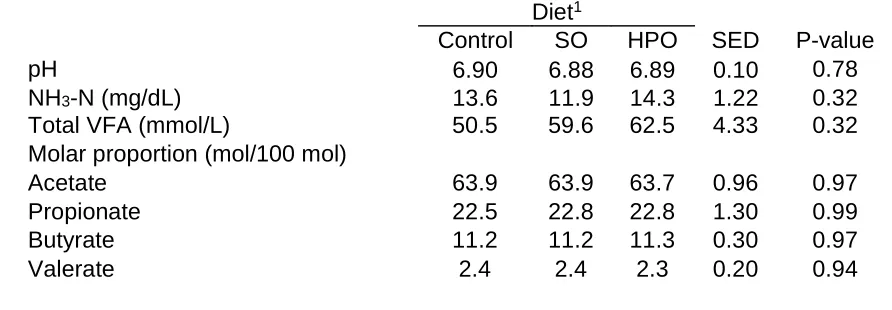
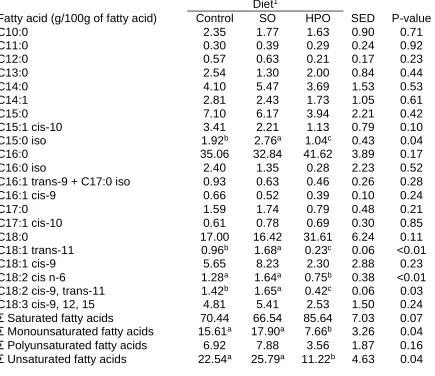
(11) Results Ruminal fermentation parameters and ruminal bacteria quantification Cows consumed all their individual allocation of TMR (10 kg DM per cow per day) with no feed refusals. Rumen digesta pH, NH3-N and total VFA were similar for the three dietary treatments and averaged 6.9, 13.3 mg/dL and 57.5 mmol/L, respectively. Molar proportions (mol/100 mol) of individual VFA were comparable across dietary treatments and averaged 63.8 for acetate, 22.7 for propionate, 11.2 for butyrate and 2.4 for valerate (Table 3).. In this study, ruminal bacterial populations involved in lipid metabolism were quantified by qPCR (Table 2). The obtained PCR products were checked by expected size and sequenced. All the PCR products corresponded to the expected size: Fibrobacter succinogenes (500 bp), Butyrivibrio proteoclasticus (200 bp), Prevotella bryantii (550 bp) and Anaerovibrio lipolytica (600 bp) (not shown) and the sequences corresponded to the target organism. Compared with control, total bacteria (copies of 16S rDNA / ml) was decreased (P < 0.05) by SO and increased (P < 0.05) by HPO. The load of target bacteria (bacteria / ml) was similar for all dietary treatments and averaged:. 4.52 for Fibrobacter succinogenes, 2.92 for. Butyrivibrio proteoclasticus and 4.19 for Anaerovibrio lipolytica (Table 4). However, the load of Prevotella bryantii was increased (P < 0.05) by HPO but not by SO.. Fatty acid composition of ruminal digesta Data from the FA composition of ruminal digesta is shown in Table 5. The most abundant FA in ruminal digesta regardless of dietary treatment were (g/100g):.
(12) C14:0 (4.4), C15:0 (5.7), C16:0 (36.5), C18:0 (21.7), C18:1 cis-9 (5.4) and C18:3 cis-9, 12, 15 (4.3). Compared with control and SO, HPO decreased (P < 0.05) C18:2 cis n-6 (1.28 and 1.64 vs. 0.75 g/100g) and total contents of monounsaturated (15.61 and 17.9 vs.7.66 g/100g) and unsaturated (22.54 and 25.79 vs. 11.22 g/100g) FA in ruminal digesta. Also, compared with control and HPO, SO increased (P < 0.05) contents (g/100g) of C15:0 iso (1.92 and 1.04 vs. 2.76), C18:1 trans-11 (0.96 and 0.23 vs. 1.68) and C18:2 cis-9, trans-11 (1.42 and 0.42 vs. 1.65). Dietary treatments did not affect contents (g/100g) of the following FA: C10:0, C11:0, C12:0, C13:0, C14:0, C14:1, C15:0, C15:1 cis-10, C16:0, C16:0 iso, C16:1 trans-9 + C17:0 iso, C16:1 cis-9, C17:0, C17:1 cis-10, C18:0, C18:1 cis9 and C18:3 cis-9, 12, 15.. Discussion In this study, ruminal pH and NH3-N were not affected by dietary treatments, this partly agrees with studies (Yang et al., 2009) who did not report ruminal pH changes when cows were fed soybean oil and linseed oil, but did observe increases in ruminal NH3-N concentration. Benchaar et al. (2012) reported no effect on pH, VFA and NH3-N when dairy cows were supplemented with linseed oil at 2, 3 and 4% DM. In the current study, lack of difference in ruminal fermentation parameters may be due to the amount (almost 3% of DM) of oil incorporated into the basal diet. Differences from other studies such as Yang et al. (2009), on the effect dietary oils on ruminal fermentation parameters in dairy cows may be explained by the amount of dietary oil and the forage source used, for example, VFA patterns were not affected when cows were supplemented with linseed oil.
(13) (3% DM) on a hay-base diet (Ueda et al., 2003) whereas on a corn silage-based diet they were changed (Doreau et al., 2009).. The chemical configuration of dietary lipids is associated with their effects on ruminal microorganisms. For example, PUFA are more toxic for biohydrogenating bacteria (e.g., Butyrivibrio fibrisolvens) than monoenoic FA (Lourenco et al., 2010). Consequently, SO which is a rich source of C18:2 cis n-6 is expected to have strong negative effects on ruminal bacterial populations; this agrees in part with the reduction of total bacteria (copies of 16S rDNA / ml) caused by SO treatment observed in this study. During rumen byohydrogenation, C18:2 cis n-6 yields several intermediate compounds until reduction to C18:0 (Castagnino et al., 2015). In the present study, C18:1 trans-11 and C18:2 cis-9, trans-11 (biohydrogenation intermediate isomers) were increased in rumen contents with SO compared to control and HPO. This is important for milk production because those FA can escape from the rumen and be secreted in milk as shown by Bu et al., (2007) who observed increases in the C18:1 trans-11 and C18:2 cis-9, trans-11 concentrations of milk fat when dairy cows were supplemented with vegetable oils and oilseeds rich in C18:2 cis n-6.. Increases of C15:0 iso provoked by SO are particularly interesting, since branchedchain FA have been suggested to reflect rumen function (e. g., ruminal fermentation pattern) and also contribute to the formation of the main odd- and branched-chain FA in milk (Vlaeminck et al., 2006). The odd- (C15:0 and C17:0) and branched (C13:0 iso, C14:0 iso, C15:0 iso, C16:0 iso, C17:0 iso, C18:0 iso,.
(14) C13:0 anteiso, C15:0 anteiso, C17:0 anteiso) chain fatty acids (OBCFA) profile of the rumen bacteria appears to be largely determined by the FA synthase activity of the microorganism rather than by the precursor availability (Vlaeminck et al., 2006). Consequently, variation in the OBCFA profile leaving the rumen is expected to mirror changes in the relative abundance of specific bacterial populations in the rumen rather than an altered bacterial FA synthesis. In this study, supplementation with SO may have influenced the FA synthase activity of ruminal microorganisms, specifically from Prevotella spp. and Butyrivibrio fibrisolvens (Fievez et al., 2012). It has been suggested that higher proportions of iso-fatty acids in solid associated bacteria reflect their enrichment in cellulolytic bacteria (e. g., Butyrivibrio fibrisolvens), whereas higher proportions of anteiso-C15:0 in liquid associated bacteria might indicate their enrichment in pectin and sugar fermenting bacteria (e. g., Prevotella spp.) (Bessa et al., 2009).. Normally in dairy cow diets, ruminal biohydrogenation of C18:2 cis n-6 varies between 70% and 95%, indicating that with the exception of diets containing marine lipids C18:0 is the major FA escaping from rumen (Shingfield et al., 2013). In the present study this was corroborated by the FA profile of rumen digesta where C16:0 and C18:0 were the most predominant saturated FA (especially in HPO). Also, in the current study, HPO decreased ruminal C18:2 cis n-6, which may be explained by the levels of C18:2 cis n-6 in the HPO diet which was notably lower that control and SO..
(15) It has been recognized that cellulolytic bacteria can be affected by dietary supplementation of lipid with high concentrations of PUFA (Paillard et al., 2007). This is explained by factors such as disruption of microbial cell membranes and cell function caused by PUFA and lipid coating of feed particles (especially fibrous components) and bacteria (Yang et al., 2009). The antimicrobial effect of lipids in the rumen is related to the cytotoxic effects of FA on membrane function of eukaryotic cells (Maia et al., 2010). Long chain unsaturated FA appear to be more toxic to ruminal bacteria since they can attach to lipid bilayers in bacterial membranes (because of their hydrophobic and amphiphilic nature). The longer the chains, and the more double bonds, the easier it is for FA to attach and destroy membranes of bacteria (Zheng et al., 2005).. Although, Prevotella spp. has been reported to be resistant to dietary PUFA (Huws et al., 2010), in this study, Prevotella bryantii load was increased by HPO (a saturated source), which agrees in part with Choi et al. (2013) who reported that C16:0 and C18:0 have less antibacterial effect than PUFA (HPO diet contained 46 g of C16:0 and 36 g of C18:0 per 100g total FA). In concordance with that, it has been reported that consumption of animal fats (mainly saturated FA) has been associated with the presence of Prevotella and Bacteroides (Tremaroli and Bäckhed, 2012). Another possible explanation for increased Prevotella with the HPO diet may be the interaction of a saturated lipid source and a substrate (our basal diet comprised of 56% forage and 44% concentrate ratio). The Prevotella spp. are the dominant bacteria in the rumen (Stevenson and Weimer, 2007) and their ruminal populations vary according to different substrates, for example; on a.
(16) hay diet, Prevotella ruminicola is the predominant whereas on a grain diet Prevotella bryantii is the most numerous among these species (Tajima et al., 2001). Our results are similar to those reported by Rico and Harvatine (2013) who fed dairy cows with a control diet composed by 60% forage and 40% concentrate and a low-fiber diet supplemented with 3 g/100g of SO, later, the authors (Rico et al., 2015), studied the ruminal microbiome and found that the abundance of Prevotella bryantii was lowered in the control diet.. DNA and did not use isolation from pure cultures. Compared to culture dependent. populations (Amann et al., 1995). The primers used in this study were previously validated (Huws et al., 2010; Tajima et al., 2001). Furthermore, the primers were checked using the probe match tool in the Ribosomal Database Project (Huws et al., 2007; Cole et al., 2014). One interesting point is that the sum of the selected bacterial populations corresponded to a half of the total bacterial, and this observation was independent of the diet used. Therefore, more studies should be performed to obtain a clear picture of the changes on ruminal bacterial populations; a metagenomic approach could provide a deeper composition of ruminal populations.. Conclusions.
(17) In conclusion, supplementation with SO or HPO (2.7 % DM) did not affect ruminal fermentation parameters whereas HPO can increase loads of ruminal Prevotella bryantii. Also, results observed in our target bacteria may have depended on the degree of saturation of dietary oils.. Acknowledgments This study was funded by a research grant from FONDECYT 11121142 and 1140734 (Fondo Nacional de Desarrollo Científico y Tecnológico, Chile). We would like to thank Juanita Clavijo, Jorge Manzor and Pamela Alvarez for technical assistance and Fundación Agro U.C. for the animal facilities and assistance in obtaining research data.. References Amann RI, Ludwig W, Schleifer KH 1995. Phylogenetic identification and in situ detection of individual microbial cells without cultivation. Microbiological Research 59, 143 169.. Allred SL, Dhiman TR, Brennand CP, Khanal RC, McMahon DJ, Luchini ND 2006. Milk and cheese from cows fed calcium salts of palm and fish oil alone or in combination with soybean products. Journal of Dairy Science 89, 234 248.. Bal MA, Shaver RD, Jirovec AG, Shinners KJ, Coors JG 2000. Crop processing and chop length of corn silage: Effects on intake, digestion, and milk production by dairy cows. Journal of Dairy Science 83, 1264 1273..
(18) Benchaar C, Romero-Perez GA, Chouinard PY, Hassanat F, Eugene M, Petit HV, Cortes C 2012. Supplementation of increasing amounts of linseed oil to dairy cows fed total mixed rations: Effects on digestion, ruminal fermentation characteristics, protozoal populations, and milk fatty acid composition. Journal of Dairy Science 95, 4578-4590.. Bligh EG, Dyer WJ 1959. A rapid method of total lipid extraction and purification. Canadian Journal of Biochemistry and Physiology 37, 911-917.. Boeckaert C, Vlaeminck B, Fievez V, Maignien L, Dijkstra J, Boon N 2008. Accumulation of trans C18:1 fatty acids in the rumen after dietary algal supplementation is associated with changes in the Butyrivibrio community. Applied and Environmental Microbiology 74, 6923 6930.. Bessa RJB, Maia MRG, Jeronimo E, Belo AT, Cabrita ARJ, Dewhurst RJ, Fonseca AJM 2009. Using microbial fatty acids to improve understanding of the contribution of solid associated bacteria to microbial mass in the rumen. Animal Feed Science and Technology 150, 197 206.. Bu DP, Wang JQ, Dhiman TR, Liu SJ 2007. Effectiveness of oils rich in linoleic and linolenic acids to enhance conjugated linoleic acid in milk from dairy cows. Journal of Dairy Science 90, 998 1007..
(19) Castagnino PS, Messana JD, Fiorentini G, De Jesus RB, Vito ES, Carvalho IP, Berchielli TT 2015. Glycerol combined with oils did not limit biohydrogenation of unsaturated fatty acid but reduced methane production in vitro. Animal Feed Science and Technology 201, 14-24.. Choi, J. S., N. H. Park, S. Y. Hwang, J. H. Sohn, I. Kwak, K. K. Cho, and I. S. Choi. 2013. The antibacterial activity of various saturated and unsaturated fatty acids against several oral pathogens. Journal of Environmental Biology 34, 673-676.. Chouinard PY, Corneau L, Saebo A, Bauman DE 1999. Milk yield and composition during abomasal infusion of conjugated linoleic acids in dairy cows. Journal of Dairy Science 82, 2737-2745.. Christie WW 1982. A simple procedure for rapid transmethylation of glycerolipids and cholesteryl esters. The Journal of Lipid Research 23,1072-1075.. Cole JR, Wang Q, Fish JA, Chai B, McGarrell DM, Sun Y, Brown CT, Porras-Alfaro A, Kuske CR, Tiedje JM 2014. Ribosomal Database Project: data and tools for high throughput rRNA analysis. Nucleic Acids Research 42, D633 642.. Doreau M, Aurousseau E, Martin C 2009. Effects of linseed lipids fed as rolled seeds, extruded seeds or oil on organic matter and crude protein digestion in cows. Animal Feed Science and Technology 150, 187-196..
(20) Fievez V, Colman E, Castro-Montoya JM, Stefanov I, Vlaeminck B 2012 Milk oddand branched-chain fatty acids as biomarkers of rumen function-An update. Animal Feed Science and Technology 172, 51 65.. Huws SA, Edwards JE, Kim EJ, Scollan ND 2007. Specificity and sensitivity of eubacterial primers utilized for molecular profiling of bacteria within complex microbial ecosystems. Journal of Microbiological Methods 70, 565 569.. Huws S, Lee M, Muetzel S, Scott M, Wallace R, Scollan N 2010. Forage type and fish oil cause shifts in rumen bacterial diversity. FEMS Microbiology Ecology 73, 396-407.. Huws SA, Kim EJ, Lee MRF, Scott MB, Tweed JKS, Pinloche E, Wallace RJ, ,Scollan ND 2011. As yet uncultured bacteria phylogenetically classified as Prevotella, Lachnospiraceae incertae sedis and unclassified Bacteroidales, Clostridiales and Ruminococcaceae may play a predominant role in ruminal biohydrogenation. Environmental Microbiology 13, 1500-1512.. Kargar S, Ghorbani GR, Alikhani M, Khorvash M, Rashidi L, Schingoethe DJ 2012. Lactational performance and milk fatty acid profile of Holstein cows in response to dietary fat supplements and forage: Concentrate ratio. Livestock Science 150, 274283..
(21) Llorente B, Bravo-Almonacid F, Cvitanich C, Orlowska E, Torres HN, Flawiá MM, Alonso GD 2010. A quantitative real-time PCR method for in planta monitoring of Phytophthora infestans growth. Letters in Applied Microbiology 51, 603 610.. Lourenco M, Ramos-Morales E, Wallace R 2010. The role of microbes in rumen lipolysis and biohydrogenation and their manipulation. Animal 4,1008-1023.. Maia M., Chaudhary L, Bestwick C, Richardson A, McKain N, Larson T, Graham I, Wallace R 2010. Toxicity of unsaturated fatty acids to the biohydrogenating ruminal bacterium, Butyrivibrio fibrisolvens. BMC Microbiology 10, 1-10.. NRC. Nutrient Requirements of Dairy Cattle. 7th rev. ed. Natl. Acad. Sci., Washington, DC. 2001.. Paillard D, McKain N, Chaudhary LC, Walker ND, Pizette F, Koppova I, McEwan NR, Kopecny J, Vercoe PE, Louis P, Wallace RJ 2007. Relation between phylogenetic position, lipid metabolism and butyrate production by different Butyrivibrio-like bacteria from the rumen. Antonie Van Leeuwenhoek 91,417-422.. Potu R, AbuGhazaleh A, Hastings D, Jones K, Ibrahim S 2011. The effect of lipid supplements on ruminal bacteria in continuous culture fermenters varies with the fatty acid composition. Journal of Microbiology 49, 216-223..
(22) Prive F, Kaderbhai NN, Girdwood S, Worgan HJ, Pinloche E, Scollan ND, Huws SA, Newbold CJ 2013. Identification and Characterization of Three Novel Lipases Belonging to Families II and V from Anaerovibrio lipolyticus 5ST. Plos One 8, e69076.. Prive F, Newbold CJ, Kaderbhai NN, Girdwood SG, Golyshina OV, Golyshin PN, Scollan. ND,. Huws. SA. 2015.. Isolation. and. characterization. of. novel. lipases/esterases from a bovine rumen metagenome. Applied Microbiology and Biotechnology 99, 5475-5485.. Rico DE, Harvatine KJ 2013. Induction of and recovery from milk fat depression occurs progressively in dairy cows switched between diets that differ in fiber and oil concentration. Journal of Dairy Science 96, 6621-6630.. Rico DE, Preston SH, Risser JM, Harvatine KJ 2015. Rapid changes in key ruminal microbial populations during the induction of and recovery from diet-induced milk fat depression in dairy cows. British Journal of Nutrition 114, 358-367.. Schroeder GF, Gagliostro GA, Becu-Villalobos D, Lacau-Mengido I 2002. Supplementation with partially hydrogenated oil in grazing dairy cows in early lactation. Journal of Dairy Science 85, 580-594.. Shingfield KJ, Bonnet M, Scollan ND 2013. Recent developments in altering the fatty acid composition of ruminant-derived foods. Animal 7, 132-162..
(23) Stevenson DM, Weimer PJ 2007. Dominance of Prevotella and low abundance of classical ruminal bacterial species in the bovine rumen revealed by relative quantification real-time PCR. Applied Microbiology and Biotechnology 75,165-174.. Tajima K, Aminov R, Nagamine T, Matsui H, Nakamura M, Benno Y 2001. Dietdependent shifts in the bacterial population of the rumen revealed with real-time PCR. Applied and Environmental Microbiology 67, 2766-2774.. Tremaroli V, Backhed F 2012. Functional interactions between the gut microbiota and host metabolism. Nature 489,242-249.. Ueda K, Ferlay A, Chabrot J, Loor JJ, Chilliard Y, Doreau M 2003. Effect of linseed oil supplementation on ruminal digestion in dairy cows fed diets with different forage: Concentrate ratios. Journal of Dairy Science 86, 3999-4007.. Vargas-Bello-Perez E, Fehrmann-Cartes K, Iniguez-Gonzalez G, Toro-Mujica P, Garnsworthy PC 2015a. Short communication: Chemical composition, fatty acid composition, and sensory characteristics of Chanco cheese from dairy cows supplemented with soybean and hydrogenated vegetable oils. Journal of Dairy Science 98, 111-117.. Vargas-Bello-Perez E, Iniguez-Gonzalez G, Fehrmann-Cartes K, Toro-Mujica P, Garnsworthy PC 2015b. Influence of fish oil alone or in combination with.
(24) hydrogenated palm oil on sensory characteristics and fatty acid composition of bovine cheese. Animal Feed Science and Technology 205, 60-68.. Vlaeminck B, Fievez V, Cabrita ARJ, Fonseca AJM, Dewhurst R 2006. Factors affecting odd- and branched-chain fatty acids in milk: a review. Animal Feed Science and Technology 131, 389 417.. Wallace RJ, Chaudhary LC, McKain N, McEwan NR, Richardson AJ, Vercoe PE, Walker ND, Paillard D 2006. Clostridium proteoclasticum: a ruminal bacterium that forms stearic acid from linoleic acid. FEMS Microbiology Letters 265,195-201.. Yang S, Bu D, Wang J, Hu Z, Li D, Wei H, Zhou L, Loor J 2009. Soybean oil and linseed oil supplementation affect profiles of ruminal microorganisms in dairy cows. Animal 3, 1562-1569.. Zhang CM, Guo YQ, Yuan ZP, Wu YM, Wang JK, Liu JX, Zhu WY 2008. Effect of octadeca carbon fatty acids on microbial fermentation, methanogenesis and microbial flora in vitro. Animal Feed Science and Technology 146, 259 269.. Zheng HC, Liu JX, Yao JH, Yuan Q, Ye HW, Ye JA, Wu YM 2005. Effects of dietary sources of vegetable oils on performance of high-yielding lactating cows and conjugated linoleic acids in milk. Journal of Dairy Science 88, 2037-2042..
(25) Table 1 Ingredients and chemical composition of control, soybean oil (SO), and hydrogenated palm oil (HPO) diets Diet2 Control SO HPO (% of DM) Ingredient composition Alfalfa hay 17 17 17 Corn silage 18 18 18 High-moisture corn 10 10 10 Soybean hulls 34 34 34 Wheat bran 19 19 19 1 Vitamin and mineral premix 2 2 2 Soybean oil 0 2.7 0 Hydrogenated palm oil 0 0 2.7 Chemical composition, % DM 53.6 53.6 53.6 CP 16.6 16.6 16.6 Ether extract 2.3 5.1 6.3 NDF 39.2 39.2 39.2 ADF 21.0 21.0 21.0 Lignin 3.6 3.6 3.6 Ash 6.0 6.0 6.0 Fatty acid composition, g/100g of FA C4:0 0.03 0.09 0.73 C6:0 0.05 0.04 0.01 C8:0 0.03 0.03 0.07 C10:0 1.63 0.15 0.10 C12:0 0.16 0.13 2.08 C14:0 0.26 0.15 1.70 C16:0 15.6 13.7 45.9 C18:0 18.7 18.8 36.3 C18:1 cis-9 0.42 1.78 0.04 C18:2 cis n-6 46.9 49.5 5.03 C18:3 cis-6, 9, 12 0.17 0.10 0.19 C18:3 cis-9, 12, 15 7.44 6.38 0.55 1Contained per kg: 25, 000 mg of P; 80,000 mg of Ca; 25,000 mg of Mg; 1,612 mg of S; 300,000 IU of vitamin A; 50,000 IU of vitamin D 3 and 1,600 IU of vitamin E. 2Control = basal diet / no fat supplement; SO = basal diet + 170 g/d/ cow of SO; HPO = basal diet + 170 g/d/cow of HPO..
(26) Table 2 PCR primers and template DNA for detection of ruminal bacteria Target bacterium Primer1. Fibrobacter succinogenes. Primer concentration (µM) 20. Purified template of DNA (ng) 30. Product size (bp). 30. 200. 26. 550. 28. 600. Forward GGTATGGGATGAGCTTGC Reverse GCCTGCCCCTGAACTATC Butyrivibrio proteoclasticus Forward TCCGGTGGTATGAGATGGGC 20 Reverse GTCGCTGCATCAGAGTTTCCT Prevotella bryantii Forward ACTGCAGCGCGAACTGTCAGA 20 Reverse ACCTTACGGTGGCAGTGTCTC Anaerovibrio lipolytica Forward TGGGTGTTAGAAATGGATTC 20 Reverse CTCTCCTGCACTCAAGAATT 1Fibrobacter succinogenes, Prevotella bryantii, and Anaerovibrio lipolytica primers were described whereas Butyrivibrio proteoclasticus primers were described by Huws et al. (2010).. 500. by Tajima et al (2001).
(27) Table 3 Ruminal pH, NH3-N and VFA from cows fed control, soybean oil (SO), and hydrogenated palm oil (HPO) Diet1 Control SO HPO SED P-value pH 0.78 6.90 6.88 6.89 0.10 NH3-N (mg/dL) 0.32 13.6 11.9 14.3 1.22 Total VFA (mmol/L) 50.5 59.6 62.5 4.33 0.32 Molar proportion (mol/100 mol) Acetate 63.9 63.9 63.7 0.96 0.97 Propionate 22.5 22.8 22.8 1.30 0.99 Butyrate 11.2 11.2 11.3 0.30 0.97 Valerate 2.4 2.4 2.3 0.20 0.94 1. Control = basal diet / no fat supplement; SO = basal diet + 170 g/d/ cow of SO; HPO = basal diet + 170 g/d/cow of HPO..
(28) Table 4 Quantification of ruminal bacteria by PCR from cows fed control, soybean oil (SO), and hydrogenated palm oil (HPO) Diet1 Control SO HPO SED P-value Total bacteria (copies 16S rDNA / ml)2 11.84b 11.75c 12.06a 0.08 <0.01 Target bacterium (bacteria/ml)2, 3 Fibrobacter succinogenes 4.96 4.25 4.36 0.32 0.26 Butyrivibrio proteoclasticus 3.04 2.74 2.99 0.37 0.73 b b a Prevotella bryantii 3.41 3.51 3.90 0.08 0.04 Anaerovibrio lipolytica 4.10 4.20 4.28 0.23 0.76 1. Control = basal diet / no fat supplement; SO = basal diet + 170 g/d/ cow of SO; HPO = basal diet + 170 g/d/cow of HPO. 2 Log 10 3 Based on ribosomal operon copy number Means in the same row with different superscripts (a, b, c) are different (P<0.05).
(29) Table 5 Fatty acid composition of ruminal digesta from cows fed control, soybean oil (SO), and hydrogenated palm oil (HPO) Diet1 Fatty acid (g/100g of fatty acid) Control SO HPO SED P-value C10:0 2.35 1.77 1.63 0.90 0.71 C11:0 0.30 0.39 0.29 0.24 0.92 C12:0 0.57 0.63 0.21 0.17 0.23 C13:0 2.54 1.30 2.00 0.84 0.44 C14:0 4.10 5.47 3.69 1.53 0.53 C14:1 2.81 2.43 1.73 1.05 0.61 C15:0 7.10 6.17 3.94 2.21 0.42 C15:1 cis-10 3.41 2.21 1.13 0.79 0.10 C15:0 iso 1.92b 2.76a 1.04c 0.43 0.04 C16:0 35.06 32.84 41.62 3.89 0.17 C16:0 iso 2.40 1.35 0.28 2.23 0.52 C16:1 trans-9 + C17:0 iso 0.93 0.63 0.46 0.26 0.28 C16:1 cis-9 0.66 0.52 0.39 0.10 0.24 C17:0 1.59 1.74 0.79 0.48 0.21 C17:1 cis-10 0.61 0.78 0.69 0.30 0.85 C18:0 17.00 16.42 31.61 6.24 0.11 b a c C18:1 trans-11 0.96 1.68 0.23 0.06 <0.01 C18:1 cis-9 5.65 8.23 2.30 2.88 0.23 a a b C18:2 cis n-6 1.28 1.64 0.75 0.38 <0.01 C18:2 cis-9, trans-11 1.42b 1.65a 0.42c 0.06 0.03 C18:3 cis-9, 12, 15 4.81 5.41 2.53 1.50 0.24 Saturated fatty acids 70.44 66.54 85.64 7.03 0.07 Monounsaturated fatty acids 15.61a 17.90a 7.66b 3.26 0.04 Polyunsaturated fatty acids 6.92 7.88 3.56 1.87 0.16 Unsaturated fatty acids 22.54a 25.79a 11.22b 4.63 0.04 1. Control = basal diet / no fat supplement; SO = basal diet + 170 g/d/ cow of SO; HPO = basal diet + 170 g/d/cow of HPO. Means in the same row with different superscripts (a, b, c) are different (P<0.05).
(30)
Figure
Related documents
clavicular plane rotation; E, clavicular elevation. Because subjects varied in total range of humerothoracic motion, the minimum and maximum points represent the average of the
Third, it is clear that no statute is able (1) to limit a school district’s pledge of its faith and credit to the payment of any of its general obligation indebtedness or (2) to
The market price of the Corporation’s common shares may fluctuate due to a variety of factors relating to the Corporation’s business, including the announcement of
In addition to finding a positive relation between stock liquidity and future investments, our findings highly suggest that the liquidity effect on future investments is
As regard sunflower-mungbean intercropping system all inter- crops gave more economic returns than sole cropping of sunflower and mungbean and planting 6 sunflower plants + 30
Informal learning needs to grow out of the workplace context and all of the participants identified that the learning that took place was as a result of the need to develop
Earnings upgrade for 2010, 2010 profit growth outlook of 12.13% The successful new game launches in 2H10 prompt us to revise our 2010 revenue outlook for AS slightly upwards
the chosen quantities of medical treatment, the number of patients treated by each of the two physicians, the benefit per patient treated, and the total profit per round (see the
