DERIVING DISTRIBUTED GARBAGE COLLECTORS
FROM DISTRIBUTED TERMINATION ALGORITHMS
Stuart J. Norcross
A Thesis Submitted for the Degree of PhD
at the
University of St Andrews
2004
Full metadata for this item is available in
St Andrews Research Repository
at:
http://research-repository.st-andrews.ac.uk/
Please use this identifier to cite or link to this item:
http://hdl.handle.net/10023/14986
Deriving Distributed Garbage
Collectors from Distributed
Termination Algorithms
Stuart ]. Norcross
PhD Thesis
9th September 2003
7
School of Computer Science
University of St Andrews
St Andrews
Fife. KY16 9SS
ProQuest Number: 10166188
All rights reserved INFORMATION TO ALL USERS
The quality of this reproduction is dependent upon the quality of the copy submitted. In the unlikely event that the author did not send a com plete manuscript and there are missing pages, these will be noted. Also, if material had to be removed,
a note will indicate the deletion.
uest
ProQuest 10166188
Published by ProQuest LLO (2017). Copyright of the Dissertation is held by the Author. All rights reserved.
This work is protected against unauthorized copying under Title 17, United States C ode Microform Edition © ProQuest LLO.
ProQuest LLO.
789 East Eisenhower Parkway P.Q. Box 1346
T A
Abstract
This thesis concentrates on the derivation of a modularised version of the DMOS distributed garbage collection algorithm and the implementation of this algorithm in a distributed computational environment. DMOS appears to exhibit a unique combination of attractive characteristics for a distributed garbage collector but the original algorithm is loiown to contain a bug and, previous to this work, lacks a satisfactory, understandable implementation.
The relationship between distributed termination detection algorithms and distributed garbage collectors is central to this thesis. A modularised DMOS algorithm is developed using a previously published distributed garbage collector derivation methodology that centres on mapping centralised collection schemes to distributed termination detection algorithms. In examining the utility and suitability of the derivation methodology, a family of six distributed collectors is developed and an extension to the methodology is presented.
The research work described in this thesis incorporates the definition and implementation of a distributed computational environment based on the ProcessBase language and a generic definition of a previously unimplemented distributed termination detection algorithm called Task Balancing.
Acknowledgements
A number of people have helped directly and indirectly with the work described in this thesis. In particular I would like to thank:
Ron Morrison, my supervisor, for his guidance and patience, for the opportunities he has given me and for providing an excellent research environment.
David Munro for all his help and enthusiasm, for all the quality drinldng time and for introducing me to research in the first place.
Ian and Alison Norcross, my parents, for their constant support and encouragement throughout my time in St Andrews.
I would also like to thank: Graham Kirby and Alan Dearie for many useful conversations and for always providing a different viewpoint; Aled Sage for all his help from back in the ‘early days’ right up until the end; the many visitors to the Persistent Programming Group in St Andrews; and everyone in the School who has helped me during my time as a postgraduate.
Thanks to Ron Monison, David Munro and Graham Kirby for the constructive criticism and insight that they have imparted during the writing of this thesis. Their assistance has been invaluable.
Declarations
I, Stuart John Norcross, hereby certify that this thesis, which is approximately
66,000 words in length, has been written by me, that it is the record of work carried out by me and that it has not been submitted in any previous application for a higher degree.
date 4^ signature o f candidate
I was admitted as a research student in September 1999 and as a candidate for the degree of Doctor of Philosophy in September 2000; the higher study for which this is a record was earned out in the University of St Andrews between 1999 and 2003.
date signature of_candidate__________ ________________
I hereby certify that the candidate has fulfilled the conditions of the Resolution and Regulations appropriate for the degree of Doctor of Philosophy in the University of St Andrews and that the candidate is qualified to submit this thesis in application for that degree.
In submitting this thesis to the University of St Andrews I understand that I am giving permission for it to be made available for use in accordance with the regulations of the University Library for the time being in force, subject to any copyright vested in the work not being affected thereby. I also understand that the title and the abstract will be published, and that a copy of the work may be made and supplied to any bona fide library or research worker.
Contents
1 Introduction... 1
1.1 An Abstract Distributed System...5
1.1.1 System M odel...6
1.1.2 Unreachability: A Stable State...7
1.1.3 Desirable Properties for a Distributed Garbage Collector...9
1.1/4 The Distributed Garbage Collection Problem... 11
1.2 A Distributed Garbage Collector Derivation Methodology...12
1.2.1 The Derivation Methodology from Blackburn et al... 13
1.2.2 A Separation of Concerns...13
1.3 The DMOS Collector... 14
1.4 Contribution of the Thesis...15
1.5 Thesi s S tructure...16
2 Related W ork... 17
2.1 A Review of Distributed Garbage Collectors...17
2.1.1 Distributed Reference Counting...17
2.1.2 Centralised Control of Distributed Collection... 24
2.1.3 Distributed Mark-S weep...26
2.1.4 Distributed Copying Collection...32
2.1.5 Hybrid Distributed Collectors... 34
2.1.6 Garbage Collecting the W orld...38
2.1.7 The DMOS Collector...40
2.2 Distributed Termination Detection... 42
2.2.1 A Model for Distributed Termination...43
2.2.2 Wave Based Algorithms... 44
2.2.3 Credit Recovery... 50
2.3 Summary...51
3 The Experimental Platfoim... 53
3.1 The ProcessBase Language... 53
3.1.1 Compliance in ProcessBase... 54
3.2 The Distributed ProcessBase Architecture...56
3.2.1 Inter-site Addressing... 57
3.2.2 The Distributed Object Cache... 59
3.3 The Distributed ProcessBase Implementation... 62
3.3.1 Message Passing in the Distributed VM...62
3.3.2 The Local Object Cache Layout...63
3.3.3 The Distributed Object Cache... 67
3.3.4 Local Garbage Collection... 73
3.3.5 Remote Thread Execution... 74
3.4 Summary...76
4 The Task Balancing Distributed Termination Algorithm...78
4.1 A Model for Distributed Termination... 79
4.2 Task Balancing... 79
4.2.1 Termination Detection at the Home Site...82
4.2.2 Implementation Choices...82
4.2.3 An Example Task Balancing Implementation...90
4.3 Why Use TB for DGC Implementation?...93
5 Separating Distributed and Local Collection...98
5.1 Forming the Club Rules...102
5.2 Distributed Mark-S weep Collection... 103
5.2.1 Club Rules for Distributed Mark-S w eep... 106
5.2.2 Club Rules for a Homogeneous Mark-S weep Collector... I l l 5.2.3 Separating Local and Distributed Collection... I l l 5.2.4 Local Collection in the Heterogeneous System...114
5.2.5 Discussion... 116
5.3 Distributed Generational Collection... 117
5.3.1 Two DTA Mappings... 119
5.3.2 Club Rules for Distributed Generational Collection... 121
5.3.3 Club Rules for Homogeneous Distributed Generational Collection ... 125
5.3.4 Separating Local and Distributed Collection... 126
5.3.5 Local Collection in the Heterogeneous System... 128
5.4 Distributed Reference Counting...129
5.4.1 Club Rules for Distributed Reference Counting...130
5.4.2 Club Rules for a Homogeneous Reference Counting Collector... 131
5.4.3 Separating Local and Distributed Collection...133
5.4.4 Club Rules for a Heterogeneous Reference Counting Collector 133 5.4.5 A Local Mark Sweep Collector...134
5.4.6 A Local Semi-Space Copying Collector... ...134
5.4.7 Discussion... 135
5.5 Summary... 136
6 Developing a DTA Mapping for DM OS...138
6.1 The UMOS Collection Algorithm...139
6.1.1 UMOS Safety and Completeness ... 146
6.1.2 Concurrency Issues in UM OS... 147
6.2 Mapping UMOS to Distributed Termination: The DMOS Algorithm 149 6.2.1 Distributing UMOS... 149
6.2.2 Train Collection... 153
6.2.3 Car Collection... 156
6.2.4 A Summary of the DTA Mappings...167
6.3 The Stepwise Refinement of DM OS... 169
6.3.1 Layer 1: Object Isolation...170
6.3.2 Layer 2: Car Reclamation...171
6.3.3 Layer 3: Isolated Train Detection...174
6.3.4 A DMOS Garbage Collection Cycle...179
6.4 Summary...181
7 Implementing the DMOS DTA Mappings...183
7.1 Cars and Trains in Distributed ProcessBase...184
7.1.1 Cars...185
7.1.2 Trains... 188
7.2 Isolated Train and Object Detection with Task Balancing... 190
7.2.1 Isolated Train Detection... 190
7.2.2 Isolated Object Detection...197
7.2.3 An Optimisation for Task Counting...204
7.3 Summary...205
8 Implementing DMOS in DPBASE...207
8.1.1 R AL Updates and Root Reference R AL Entries... 208
8.1.2 Adding RAL entries... 210
8.1.3 Removing RAL Entries...211
8.2 Requesting Train T asks...212
8.3 Collecting Isolated Trains...213
8.4 Car Collection... 215
8.4.1 Examining the Local Root Set... 216
8.4.2 Re-Associating Objects... 216
8.4.3 Reclaiming a C ar...218
8.5 Safety and Completeness of the DMOS Implementation... 219
8.5.1 Safety... 220
8.5.2 Completeness... 221
8.6 Summary...225
9 Conclusions... 227
9.1 The Mapping Methodology...227
9.1.1 DTA Mappings and Reference Counting Collectors...229
9.2 Task Balancing... 230
9.3 The DMOS Collector... 230
9.3.1 DMOS : Reference Counting with Trains...233
9.4 Contribution... 234
9.4.1 Summary...239
9.5 Future Research...240
9.5.1 A Foimal Proof for Task B alancing...240
9.5.2 A Modularized Formal Proof of DMOS... 241
9.5.3 Policy Evaluation... 241
9.6 Finally... 242
Appendix A ... 244
An Annotated Implementation of DMOS...244
DMOS Implementation Pseudo-Code...248
1 Introduction
Automatic storage management in high level languages saves the programmer from the time consuming and error prone task of manually managing the allocation and de-allocation of storage space. Instead, the language runtime systems abstract over the underlying storage mechanisms by dynamically allocating space and automatically reclaiming it when it is no longer used by the application.
This thesis concentrates on the mechanism by which space is reclaimed, known as garbage collection. The work described here concentrates specifically on the derivation and construction of distributed garbage collectors. The aim is to simplify the design and comparability of distributed collectors through modularisation. Central to this work, is the use of distributed termination algorithms in the implementation of distributed garbage collectors.
The discussion of distributed garbage collection in this thesis assumes that the reader is familiar with the more traditional non-distributed garbage collection algorithms. However, in establishing a universe of discourse it is useful to first outline the fundamental model assumptions and techniques underlying all garbage collection. An object* becomes garbage immediately after it is accessed for the last time by the computation. The purpose of a garbage collector is to identify and reclaim these objects^. Computing the exact set of garbage objects at any given time in the computation (through static analysis for instance) is at best difficult and
* This is object in the loosest sense of the word, which is an identifiable contiguous area of allocated storage space.
computationally intensive but often not possible. Instead, in systems which guarantee the integrity of references, garbage collectors consider the set of objects allocated by a computation as a rooted directed graph where vertices are objects and directed edges are references. An object is said to be reachable if it can be discovered through the traversal of a path of references from one of the set of root references. In other words, the computation of the transitive closure of the computation from its roots yields the set of reachable objects. Unreachable objects cannot be accessed by the computation and are therefore garbage. Reachability provides a conservative approximation to the set of non-garbage objects and thus allows the calculation of a conservative approximation to the set of garbage objects. This is a conservative approximation because, by the definition of garbage given above, an object that is reachable but which will not be accessed by the application again is garbage.
Wilson [W1192] defines an abstraction for garbage collection that consists of two parts: garbage identification; and garbage reclamation. Abdullahi and Ringwoods’s [AR98] taxonomy of single address space garbage collectors identifies two fundamental techniques for garbage identification;
cyclic garbage cannot be reclaimed since the reference count for each object in a cycle will never become zero.
• Indirect identification - corresponds more closely to the principle of computing the transitive closure of the object graph. That is, the collector traverses the object graph from the roots of reachability and takes some action for each reachable object it encounters to ensure that the object is not collected. Those objects not encountered by the collector during the traversal are garbage. Broadly spealdng, indirect collectors can be categorised as either copying collectors or mark-sweep collectors. Copying collectors segregate the storage space into a number of partitions, and reclaim space with a given partition by creating copies of all reachable objects (in that partition) in some other partition. Any objects not copied are garbage and thus the whole partition may be reclaimed when copying is complete. Copying collectors relocate objects on collection thus compacting the used storage space. The locality properties of stored data may or may not be improved as objects are moved. Mark-sweep collectors trace the object graph and record (mark) any reachable objects. To collect garbage, the space is scanned sequentially and any unmaiked objects are reclaimed. During the scan phase of the collection, live objects may be relocated to compact the used space and improve the locality of the data.
discussion of allocation is presented here (see [WJN+95] for a review of allocation techniques).
Every garbage collection scheme is based on one or a combination of these two basic techniques. However, the specific nature of individual garbage collection schemes varies widely. Comprehensive reviews of individual uni-processor collection algorithms can be found in [AR98, JL96, Wil92].
Garbage collection algorithms can be seen in use in reclaiming fixed-size double word storage cells in LISP systems as far back as the 1960’s. Later, through the 70’s and 80’s garbage collection was used for the reclamation of non-fixed-size objects in block structured imperative languages, such as the various Algol incarnations; Algol 68 [BLS+71], S-Algol [Mor79] and PS-Algol [ACC82], languages such as Napier-88 [MBC+89] and in functional languages such as ML [MTH89] and its derivatives.
More recent object-oriented systems also incorporate garbage collection techniques from Smalltalk [GR83] of the mid 80’s to Sun’s Java [GJS+00, LY99] from the late 90’s and later Microsoft’s C# [DAN02].
management abstractions, particularly garbage collection, in the distributed context has proven to require far more complex language support systems.
To ground the discussion on distributed systems it is necessary to specify the universe of discourse. This is achieved through the definition of an abstract system model.
1.1 An Abstract Distributed System
Lamport [Lam? 8] describes a distributed system as one consisting of a number of spatially separated processes that communicate through message passing. Given such a definition, the phrase “distributed system” can be used to describe a range of systems from loosely coupled multi-computers (such as a Beowulf cluster [BSS+95]) to tightly coupled (parallel) multi-processor systems. Lamport becomes more specific by defining a distributed system as one where the transmission delay between processes is significantly greater than the delay between events within a single process. [CDKOl] and [Sch93] give further properties that define a distributed system, such as multiple computers with inter-connections, concurrency, the lack of a global clock and the occuixence of independent failures.
Shared state
Qîstr 1 baited ; ru o-^tj m e,
Physical/ Logical Nodes
Distributed application
Com mu n lea tio n I nfra s t ru c lu re
Figure 1.1 - Shared Application State in a Distributed Run-Time
These properties are demonstrated in the system model that follows.
1.1.1 System Model
The system model (taken from [NMM+03]) is defined such that a computation executes over a number of sites where each site acts independently, concurrently and asynchronously. The following assertions are made:
1. Each site has its own local storage and communicates with other sites only through message passing.
2. Local storage is dynamically allocated and automatically (safely) reclaimed. 3. Sites appear to operate coiTectly, without Byzantine behaviour.
4. There is no bound on the relative rates of computation of the sites.
5. Events at a given site aie totally ordered; since messages are delivered only after being sent, events are partially ordered in the system as a whole.
The distributed computation operates over a set of objects that can be modelled by a directed graph with multiple roots. The graph is mutated by the concuiTent computation at each site through a series of explicit object update and object allocation operations. A node of the graph represents an object while a directed edge represents a reference. The object graph is distributed across the sites of the computation and each site maintains zero or more root pointers. An object at a site may contain references to other local objects or to objects on a remote site. An object is said to be garbage after it has been accessed for the last time by the computation. The set of reachable objects for a computation is defined as the set of all objects that can be reached through some path of references from a root of the computation. The run-time system maintains the property of referential integrity across the (potentially disjoint) graph of reachable objects in the face of two operations; object update (effected by the mutator) and object deletion (effected by the run-time system’s storage management mechanisms in reclaiming space). The property of referential integrity is that no object, at any site, can ever contain a dangling reference. Two rules guarantee the referential integrity of the system;
• References are never forged; that is to say references are only ever copied^. • An object may not be deleted before it becomes garbage.
1.1.2 Unreachability: A Stable State
By maintaining the property of referential integrity over the reachable data, unreachability becomes a stable state. If a reference to an object cannot be found, by tracing a path of references from a root, then it cannot be used in an object update
operation. That is, no reference exists to be copied. Thus an unreachable object can never become reachable again.
Referential integrity is maintained without resorting to a centralized service. That is, referential integrity is maintained by an agent at each site operating on local information and cooperating with agents at other sites though asynchronous message passing. To maintain referential integrity on object deletion only unreachable objects may be deleted.
Unreachable objects can be in one of two subsidiary stable states. If either of these states is detected an object can be deemed unreachable, and thus made a candidate for deletion. The first stable state is that of an object referenced by no other object. For some objects this state is detectable with completely local information"*^ and for other objects, a globally consistent view of the (disjoint) distributed object graph is required.
The second stable state for unreachable objects is that of a set of mutually referential objects, where each object in the set is referenced only by other objects in the set. The objects in such a set may be distributed across a number of sites. The members of such a set form a (potentially inter-site) cycle of unreachable objects. Garbage cycles that reside within a single site can be detected through completely local information while to detect inter-site garbage cycles a globally consistent view of the (disjoint) distributed object graph is always required. A distributed garbage collector must detect both of these states and thus provide safe and automatic space reclamation. However, both cyclic and non-cyclic garbage may exist that can be reclaimed without recourse to the distributed garbage collection mechanism and
there are potential benefits in allowing this space to be reclaimed independently (from the distributed collection mechanisms) at a site. Separation of local and distributed collection work is central to the work described in this thesis and is achieved through the use of a methodology that allows for a systematic modularisation of distributed garbage collector design and implementation; for instance allowing independent local garbage collection.
1.1.3 Desirable Properties for a Distributed Garbage Collector
A number of desirable properties for distributed garbage collectors are presented in [HMM+97]. Two of these properties are of fundamental importance in any (distributed or centralised) garbage collector;
• Safety - No object should be reclaimed before it would have been accessed for the last time by the application.
Given the system model described here, there are a number of further properties that one would wish of a distributed garbage collector;
• Non-disruptive - Each invocation of the collector carries out a bounded amount of work, thereby bounding the time taken to collect and the space required.
• Incremental - Space is reclaimed in increments without global knowledge of the system state.
• Non-blocldng - The collector does not require synchronisation between sites. • Scalable - No restrictions on scaling of the distributed system are introduced
by the distributed collector. This is achieved by ensuring that communication between sites is asynchronous; protocols do not require the participation of all sites and sub algorithms (within the collector) are not centralised. However, scalability is not a property that can be achieved in isolation. To achieve scalability the collector must demonstrate each of the properties described above.
• Independence - Collection progress can be made at a site independently from other sites.
Each of these properties affects the intrusiveness of the distributed garbage collection mechanism both on the implementation of the distributed system and on run-time behaviour.
1.1.4 The Distributed Garbage Collection Problem
The distributed garbage collection problem stems from the desire to apply the high level language abstraction of automatic storage management, more specifically gai'bage collection, to distributed systems. However, applying the same memory abstractions in a distributed environment requires more complex garbage collection mechanisms.
Many distributed garbage collectors have been published (see [AR98, PS95] for an overview); each with interesting and attractive properties. However, distiibuted garbage collectors are often difficult to understand. There are several reasons why this is the case. Solutions to the distributed garbage collection problem are necessarily complex, involving the co-ordination of independently operating asynchronous agents, each worldng with partial information while constructing a safe approximation to a globally consistent view. Achieving any one of the properties that we seek in distributed garbage collectors is difficult enough in a complex distributed system but achieving some or all in combination greatly increases the difficulty of collector design and implementation.
In the face of such complex systems and differing model assumptions, collector designers are forced to produce hand-crafted correctness and completeness arguments. This often adds to the difficulty in understanding individual collectors and in comparing two collectors.
1.2 A Distributed Garbage Collector Derivation
Methodology
A methodology for the derivation of distributed garbage collectors is presented in [BHM+01] and developed in [NMM+03] and describes a structured approach to the derivation of distributed garbage collectors with the aim of improving understandability and comparability in the resultant collectors. The methodology consists of a number of steps (described in Section 1.2.1 below and demonstrated later in Chapter 5) that are followed in order to transform a centralised garbage collector into a distributed garbage collector. The methodology builds on the result from Tel and Mattern [TM93] that all distributed garbage collectors contain an implementation of at least one distributed termination detection algorithm (DTA), a connection that is explored in more detail in Chapter 2.
1.2.1 The Derivation Methodology from Blackburn et al.
Blackburn et al. ([BHM+01]) suggest that the derivation of distributed garbage collectors can be structured through the mapping of distributed termination algorithms onto known centralized collection schemes as follows:
• Select or derive a distributed termination algorithm that is proven coiTect. • Prove safety, and maybe some other properties, of the centralised garbage
collector.
• Define an object reclamation mapping, from the centralised garbage collector to the distributed termination algorithm.
• Prove that termination is equivalent to the eventual reclamation of objects. The methodology starts by maldng a centralised collector concurrent and then mapping a DTA onto the resultant collector to provide a distributed garbage collection scheme. The resultant distributed collector maintains the properties of the original centralised scheme such as completeness and incrementality.
1.2.2 A Separation of Concerns
The complexity of distributed garbage collectors is addressed through a separation of concerns in the design of the distributed collector. The implementation of distributed termination detection necessary due to distribution is removed from the designer who can instead concentrate on garbage collection.
choice of policy in scheduling and controlling collection work. The club rules provide a secondaiy separation of concerns between implementing the distributed mechanism for distributed garbage identification and the purely local mechanisms by which space is reclaimed.
1.3 The DMOS Collector
DMOS [HMM+97] is a distributed garbage collection algorithm that exhibits all of the attractive properties listed earlier. DMOS is safe, complete, non-disruptive, incremental, non-blocking, independent and scalable. The collector partitions objects by cars and trains [HM92]. Cai's are local to a site while trains represent groups of cars that can span multiple sites. DMOS can be considered as consisting of two parts. The first part is called the pointer tracking protocol which is an implementation of the Task Balancing DTA [BHM+01, NMM+03] and identifies objects at a site that are not referenced from anywhere in the system. The second part is the train reclamation protocol which is an implementation of a wave based DTA which detects isolated trains.
Blackburn and Zigman [BZ99] identified a bug in DMOS which was due to an unanticipated race condition between the two DTAs. The result of the race condition was that a train could be reclaimed while its cars still contained live objects.
Only the site holding an object knows the train in which that object is held. Thus, the effects on the reachability of the train holding a particular object due to references to that object is determined by information sent to the site holding the object through the pointer tracking protocol. The pointer tracking mechanism assumes a fully connected communications network allowing direct site to site communication while the train reclamation mechanism assumes a logical ring topology. Since there is not necessarily any overlap in the communications path between two sites for the two mechanisms, it is possible for train isolation messages to overtake pointer tracking
messages, thus creating a race condition.
To-date no satisfactory implementation of the DMOS collector has been produced and the interaction of the two DTAs has yet to be suitably defined
The hypothesis being tested in this thesis is that there is benefit in applying modularisation to the design of distributed garbage collectors. Specifically, that an extended version of the mapping methodology can be used to guide the development of a modularised and understandable implementation of DMOS thus yielding an explanation of the interaction of the two collection mechanisms and defining the exact role played by the distributed teimination algorithms.
1.4 Contribution of the Thesis
Secondly, a platform for experimenting with the implementation of distributed garbage collectors, which represents an instantiation of the system model described above.
Thirdly, an implementation of the Task Balancing distributed termination algorithm is demonstrated. This is believed to be the first such implementation.
Fourthly, a new implementation of the DMOS collector is presented. Having shown the suitability and flexibility of the derivation methodology, it is used to produce an implementation of the previously published DMOS collection mechanism, the implementation of which has to-date been unsatisfactorily described.
1.5 Thesis Structure
Chapter 2 presents a review of previously published distributed garbage collection algorithms and examines the link to distributed termination detection. Particular attention is given to the DMOS algorithm.
Chapter 3 discusses an experimental platform that represents an instantiation of the abstract system described above. This is the target system for the derived distributed garbage collectors.
Chapter 4 examines the distributed termination problem and explains the Task Balancing DTA and the associated implementation issues.
Chapter 5 presents three example derivations each of which yields two distributed collection mechanisms; one homogenous mechanism and one heterogeneous mechanism that allows for locally independent collector behaviour.
2 Related Work
This chapter presents an overview of the two fields that are at the heart of this thesis, namely distributed garbage collection and distributed termination detection. Survey works in the field of distributed garbage collection have been published by Plainfossé and Shapiro [PS95], by Jones and Lins [JL96] and by Abdullahi and Ringwood [AR98]. A taxonomy of distributed termination algorithms is described by Camp and Matocha [CM98].
Non-distributed collection mechanisms are not discussed except when necessary in describing their distributed counter-parts. A comprehensive review of non distributed garbage collection schemes is given by Wilson [Wil92].
2.1 A Review of Distributed Garbage Collectors
2.1.1 Distributed Reference Counting
Reference counting appears attractive for a distributed system since it is inherently incremental. In a distributed context, the reference count for an object x represents a local view of the number of references to % in the distributed system. This view may be out-of-date due to asynchrony but the view is always safe (typically by being conservative). Any conect distributed reference counting collector must ensure that the reference count for x is non-zero while a reference to x exists. The difficulty in achieving this is due to a site’s incomplete view of the state of the distributed computation.
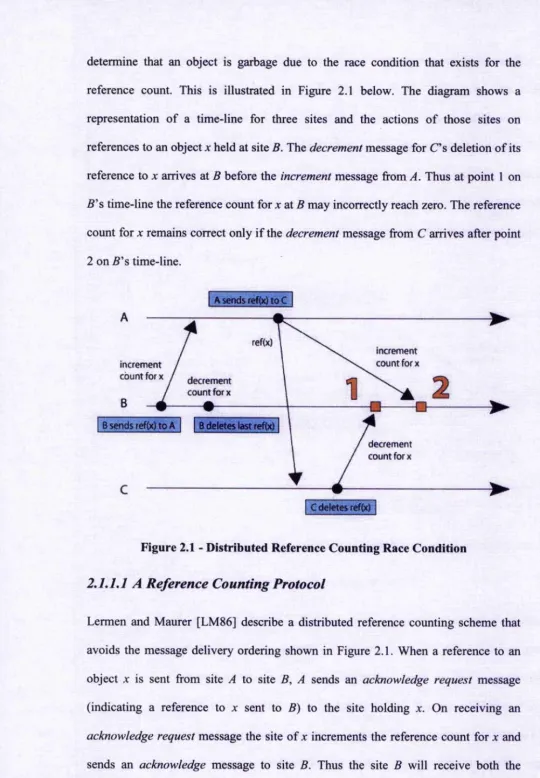
determine that an object is garbage due to the race condition that exists for the reference count. This is illustrated in Figure 2.1 below. The diagram shows a representation of a time-line for three sites and the actions of those sites on references to an object x held at site B. The decrement message for C’s deletion of its reference to x arrives at B before the increment message from A. Thus at point 1 on 5 ’s time-line the reference count for jc at 5 may incorrectly reach zero. The reference count for x remains correct only if the decrement message from C arrives after point 2 on B’s time-line.
Asendsref(x)tbC
ref(x)
increment count for x Increment
count for x decrement count for x
B sends refpc) to A B deletes last ref(x)
decrement count for X
[image:29.615.16.557.16.795.2]C deletes ref(x)
Figure 2.1 - Distributed Reference Counting Race Condition
2,1,1,1 A Reference Counting Protocol
Lermen and Maurer [LM86] describe a distributed reference counting scheme that avoids the message delivery ordering shown in Figure 2.1. When a reference to an object X is sent from site A to site 5, A sends an acknowledge request message (indicating a reference to jc sent to B) to the site holding x. On receiving an
message containing the reference to % and an acknowledgement message from %'s site.
When site B deletes a reference to %, the deletion is communicated to %’s site with a
delete message. However a delete message may only be sent from B to %’s site if the number of acknowledgement messages received at B (for %) is equal to or greater than the number of copies of % received at B. The reference count for % is decremented on receipt of a decrement message at %’s site. If the reference count for % becomes zero then the object may be reclaimed.
Thus, at the cost of three messages per reference copy the reference count is never incoiTectly determined to be zero.
2,1.1.2 Weighted Reference Counting
The message overhead of Lermen and Maurer’s protocol is avoided in Watson and Watson’s [WW87] weighted reference counting collector. Weighted reference counting associates an integer reference count with each object and an integer weight
value with each reference to the object. Note that the reference count value for an object % does not represent the number of references to % but it serves as an analogue of a traditional reference count. When the reference count value for % reaches zero, no reference to % exists.
When an object is created, its reference count is set to some non-zero integer value and the weight value of the first reference to that object is made equal to the
reference count value. The collector operates on the premise that the following invariant is maintained;
When a reference is copied its weight is divided between the original reference and the copy. On the deletion of a reference to an object %, a message containing the weight of the deleted reference is sent to the site holding %. The receiving site then subtracts this weight from the reference count for x. If the reference count for x
reaches zero then x may be reclaimed.
By ensuring that each weight value is always a power of two (allowing equal division of each weight) a logarithmic encoding may be used for weights. For a weight w, the value logjW is stored thus reducing the space over-head incuned by storing a weight value for each reference.
The obvious problem with this scheme is that a reference with a weight of one cannot be copied. The solution to this problem is to introduce an indirection object to act as a proxy for the original object. This works as follows:
• An object A contains a reference to an object x with a weight of one. This reference to x is to be copied to an object B.
• An indirection object C is created with a non-zero reference count value. • The reference to x in A is moved to C and in its place is left a reference to C
with a weight value that is equal to the reference count value for C. • The reference to C in A is then copied to B as normal.
Any access to the indirection object C must now be redirected to the original object x and reference values cannot be used to determine object identity. This is clearly not ideal in a distributed system.
the algorithm to [WenSO] while Bevan attributes the idea for indirection objects to Simon Peyton Jones.
2.1.1.3 Indirect Reference Counting
Piquer’s [Piq91] indirect reference counting algorithm represents an alternative method to avoiding the message overhead of Lermen and Maurer’s protocol. Indirect reference counting maintains a tree structure for each object x which represents the transmission of references from remote sites to x (remote references) through the distributed system. This tree is the equivalent of Dijkstra and Scholten’s [DS80] diffusion tree for termination detection, although here it is used to detect the absence of remote references to an object.
Each site that holds a reference to x coiTesponds to a node of the tree and the node for a particular site is held at that site. A node contains two fields; one field holds a reference to the node’s parent and the other holds a count of the node’s children. The
I children = 3
/ ^
children = 2 JL
Q O U
/ \ cliildren=Û children = Q
/ \
o o
ch ildren = 0 ch ildren = 0Figure 2.2 - A Diffusion Tree for Indirect Reference Counting
If the children value for x reaches zero, the object is no longer referenced from any remote site.
When a site A no longer holds any references to x and the children count at A is zero the node at A may be removed from the tree. On deletion of the node at A, a
decrement message is sent to the site that is A’s parent node. On receipt of a
decrement message a site reduces its children count by one. Only sites with a zero
children count can be removed from the tree. Thus a site that holds no references to x must wait for its children count to reach zero before sending a decrement message to its parent.
2.1.1.4 Generational Reference Counting
Goldberg’s [Gol89] generational reference counting collector associates a generation
identifier and a copy count with each reference. The first reference to an object has generation zero and any copy of this reference has generation 1. In general a copy of a reference of generation G/ is of generation G/+;.
Each object has an associated ledger structure which records the number of outstanding references from each generation. The ledger contains a reference count for each generation that is known to exist.
When a reference to an object x is copied locally or sent to a remote site, the reference’s copy count is incremented. When a reference to x is deleted on a remote site A a delete message containing the generation identifier and the copy count for the reference is sent from A to the site holding x.
On receipt of a delete message containing generation G, and count C for object x the ledger for x is modified as follows:
• ledgerAGi] = ledgerx\Gi^ - 1 • ledgerx{GM] = ledgerx[G{ + 1] + C
When the ledger for x contains a reference count of zero for all generations then x
may be reclaimed.
2.1.1.5 Reference Listing
Birrell et al. [BEN+93] describe an incremental technique for distributed garbage identification called reference listing. Reference listing, like reference counting, is incomplete and only allows the reclamation of acyclic garbage structures. A reference listing collector is implemented in the Network Objects system from
Reference listing differs from reference counting in that a site holding an object x
maintains a list of the remote sites that hold a reference to x rather than a count of the total number of remote reference to x. When the reference list for x is empty (indicating that no site holds a reference to x) the object may be reclaimed,
2.1.2 Centralised Control of Distributed Collection
2.1.2.1 A Centralised Distributed Garbage Collection Service
Liskov and Ladin [LL86] describe a distributed collector which is logically centralised but physically replicated in order to make it highly available.
Each site implements an independent local collector and local collectors do not communicate with each other. Instead infoimation about inter-site references is recorded by a centralised service. The local collectors communicate with the service to report references to remote objects and to discover those local objects that are accessible from a remote site. Each site maintains the following information:
• inlist - a list that records each local object x where a reference to x has been sent to a remote site.
• trans - a list of references that have been sent in messages to remote sites. The local collector uses the inlist and the local roots as roots of reachability for local collection. During collection the local collector constructs three sets of data which are then sent to the service:
• acc - The set of all remote objects reachable through a path of references from the local roots at the site.
• paths - The set of tuples <x,y> where x is an object in the local inlist and y
• qlîst - The set of all local objects which are in the inlist and that are not reachable from a local root.
The service provides a query interface which allows a local collector to ask which of the objects in its qlist are accessible from other sites. When the result of a query is returned to a site, any inlist entries for objects not reachable from a remote site are removed.
The service is made up of a number of replica sites and the local collector at a site communicates with only one replica site. Replicas communicate the data received from local collectors between each other through the exchange of gossip messages. Thus the result of a query is calculated by a replica site with global information which is possibly out-of-data. The service returns a result that allows for safe but conservative collection at a site. Each replica periodically runs a cycle detection algorithm over its global view of the object graph to identify inter-site cycles of garbage. This algorithm consists of a local mark-sweep algorithm which operates over the replica’s local infomiation about the object graph. When a cycle is detected information about the cycle’s component objects is communicated to each of the other replicas through further gossip messages.
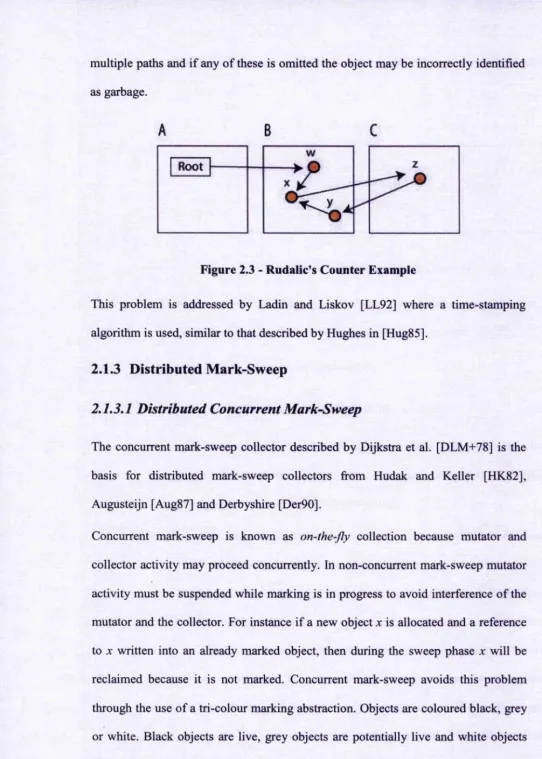
Computation of the acc and paths sets during local collection is potentially computationally very expensive in this scheme. For instance, it is not enough to run a standard marking algorithm at a site since every local path to an object must be discovered. Abdullahi and Ringwood [AR98] cite Rudalics’ [Rud90] counter example in explaining why this is the case. This is shown in Figure 2.3 below. Object X is accessible via two paths but if the local marker traverses y before w then only the path from z to y is sent to the service and not the path from w to z. Thus z
multiple paths and if any of these is omitted the object may be incorrectly identified as garbage.
A
B
C
[image:37.613.12.555.11.770.2]Root
Figure 2.3 - Rudalic's Counter Example
This problem is addressed by Ladin and Liskov [LL92] where a time-stamping algorithm is used, similar to that described by Hughes in [Hug85].
2.1.3 Distributed Mark-Sweep
2.1.3.1 Distributed Concurrent Mark-Sweep
The concurrent mark-sweep collector described by Dijkstra et al. [DLM+78] is the basis for distributed mark-sweep collectors from Hudak and Keller [HK82], Augusteijn [Aug87] and Derbyshire [Der90].
Concurrent mark-sweep is known as on-the-fly collection because mutator and collector activity may proceed concurrently. In non-concurrent mark-sweep mutator activity must be suspended while marking is in progress to avoid interference of the mutator and the collector. For instance if a new object x is allocated and a reference to X written into an already marked object, then during the sweep phase jc will be
marking. The problem is caused because a black (marked) object references a white (unmarked) object. Concurrent mai'k-sweep avoids this problem by ensuring the collector and mutator maintain the invariant that:
No black object contains a reference to a white object.
When an object is allocated it is coloured black. A write barrier ensures that the mutator does not create any black to white references by colouring any white object grey if a reference to that object is written to a black object. It is useful to imagine that as an object is coloured grey a reference to that object is added to a queue.
Note that there may be multiple mutator processes operating over the object graph but there is only one collector process. Within the collector process the mark (garbage identification) and sweep (garbage reclamation) phases are executed in strict serial order.
It is assumed that the operation to test or set an object’s colour is atomic. Collection proceeds as follows:
• The mark phase begins by first colouring each root object grey.
• While the queue of grey objects is not empty the collector removes a reference, to an object % say, from the grey queue. The object x is coloured black and each object referenced by x is coloured grey if it is white.
• When there are no more grey objects in the queue the storage space is swept sequentially. Any object which is white is reclaimed and all other objects are coloured white.
objects since all of the white objects that exist are unreachable by the mutator and black objects cannot be coloured grey.
Abdullahi and Ringwood [AR98] describe the centralised concurrent mark-sweep collector as incomplete since a single invocation of the collector reclaims only a subset of the garbage objects that existed before collection began. However this thesis takes a different view of completeness and chooses to define a collector that eventually reclaims a garbage object as complete. This is a fair definition considering that the thesis concentrates on distributed collection mechanisms. Therefore while concurrent mark-sweep is certainly conservative it is still complete. A newly created object is guaranteed to survive the collection cycle in which it was allocated but any garbage objects that survive one collection cycle are collected at the next.
A distributed version of the concurrent mark-sweep collector must address two issues:
1. Propagation of object marldng from one site of the distributed object graph to another.
2. Detecting completion of the maiic phase.
collectors make use of Dijkstra and Scholten’s diffusion tree distributed termination algorithm, although neither of the collectors states this explicitly.
In the centralised concuiTent mark-sweep collector the queue of grey objects (which provides a place-holder for objects that have still to be marked) is shared between the collector and the mutator processes. Hudak and Keller point out that in distributing the collector this structure becomes shared between multiple sites. Thus sharing is more complex and determining when the structure is empty requires the evaluation of a global predicate. Instead of a queue, their collector constructs a tree structure called a marking tree which acts as a place-holder for the distributed marking and is used to detect completion of the distributed mark phase.
Hudak and Keller’s system model states communication between sites occurs by spawning tasks from one site to another. The collector assumes that a single distinguished root object exists for the distributed object graph. This object is designated as the root of the maiidng tree. Each node of the tree conesponds to an object that is being marked and records an identifier for node’s parent and the number of children of the node.
An object is marked with a mark task. A mark task for an object x (which is white) creates a node of the tree containing its parent identifier and then colours x grey and spawns a mark task for each object referenced by x. For each mark task spawned, x’s children count is incremented. Thus the marldng is distributed when a mark task
spawns a mark task for a child on at a remote site. A mark task completes when the children count for its node of the tree becomes zero. On completion of a mark task
the object is coloured black and an up-tree task is spawned for the node’s paient. An
A mark task that is spawned for an already black object causes an up~tree task to be spawned for the parent immediately. Thus the tree collapses back to the root as maiidng progresses tow aids completion. When the root object’s children count reaches zero maiidng is complete and all reachable objects are black.
Augusteijn’s collector is similar to that of Hudak and Keller. However Augusteijn defines a single synchroniser site which is responsible for detecting completion of the mark phase. The aim of the mark phase is to establish a global state such that there are no grey objects. Each site has a set of root objects and when collection starts these objects are grey. Each site establishes a tree structure which spans across the sites of the object graph reachable from its roots. A site can only be a member of a single spanning tree at any time. If an inter-site reference to an object x on site B is discovered during marldng at site A a request message is sent to the site holding the target object and A’s children count is incremented. The object x is coloured grey if it is not black on receipt of the request message. If B is not already the child of another site then it becomes a child of A. However if B is a child already a continue message is sent to A. On receipt of the continue message, A decrements its children count. If a site holds no grey objects, has a children count of zero and is not the child of any site, a done message is sent to the synchroniser. If a site holds no grey objects, has a children count of zero and is the child of a site A then a continue message is sent to A.
Thus each site will send exactly one done message to the synchroniser, and send one
Effectively each site establishes a diffusion tree in marldng the sub-graph of the global distributed object graph reachable from the roots at that site. A centralised site is charged with determining when the marldng of each of the sub-graphs is complete. Note that the sub-graphs may overlap and in this case the responsibility of the marldng of the overlapping portion of the graph is handed-off to the diffusion tree already resident at the site where the overlap begins.
2.13,2 Distributed Mark-Sweep with Time-Stamps
Hughes’ [Hug85] distributed maik-sweep collector cames out multiple distributed collections in parallel. An independent local maiic-sweep collector at each site contributes to all of the currently active global collections every time it performs a local garbage collection.
Each global collection has an associated time-stamp value which is used to mark objects reached during that collection. Mutator activity is suspended while local collection is in progress. The local collector at a site propagates the time stamps of root objects at that site to the objects at that site which hold remote references. After local collection, for each object x which holds a reference to a remote object y where the time-stamp for x was increased during the last collection, the time stamp of x is sent to the site holding y. The time-stamps for remotely referenced objects are thus increased following a local collection.
There are two key assumptions in Hughes’ collector:
• Instantaneous communication - thus no references are ever in-flight between sites and time-stamps are transmitted instantly from one site to another following local collection.
• A globally synchronised clock.
Rana’s distributed termination algorithm (from [Ran83]) is used to detect the completion of each of the global mark-phases.
2.1.4 Distributed Copying Collection
Rudalics [Rud86] describes a distributed copying collector. The collector assumes that the distributed computation operates over adistributed graph and that one site of the graph holds the distinguished root object for the graph. Inter-site references are implemented as follows. A reference from an object x at site A to an object y at site B
is represented by a local reference in x to a remote reference object at A containing the site identifier for B and the address (at B) of a root object for y. The root object for y at site B holds a local reference to y.
The storage space at each site is divided into three spaces; a root space and semi spaces called fromSpace and toSpace. The root space holds the root objects for a site. The semi-spaces are used by the collector for moving (and compacting) local objects at a site. The lower portion of each semi-space is used to store objects, which contain local references. The upper portion of each semi-space is used to hold remote reference objects for inter-site references.
Collection starts at the global root and initially all root objects are In oldRoots.
Collection begins with a global SCAN phase by marldng the global root and setting a state variable at the root’s site to SCAN. Any root object which is marked and held in
oldRoots is moved to newRoots. If the object x referenced by the root is in fromSpace
then x is copied to the lower end of toSpace and a forwarding pointer is left in its place. The local graph is then traced from the object x and any local object is copied to the lower portion of toSpace while remote reference objects are copied to the upper portion of toSpace. For each remote reference object in toSpace a request message is sent to the referenced site and a local message count value is incremented. On receipt of a request message at a site where the state variable is not set to SCAN, the state is set to SCAN and a parent value is set to the site identifier for the sending site. The referenced root object is then marked and collection proceeds as described above.
On receipt of a request message at a site where the state value is set to SCAN a completion message is immediately sent to the sending site. On receipt of a
completion message a site decrements its message count value. When a site’s
message count value reaches zero, and there are no marked roots in oldRoots and no local objects in fromSpace which are still to be copied, a completion message is sent to the site’s parent. When this state occurs at the site holding the global root then the
SCAN phase is complete.
Collection continues with a FLIP phase whereby the root site broadcasts a flip signal to each site. On receiving the flip signal a site reclaims any root object in oldRoots,
makes the oldRoots list the new newRoots list (and visa versa), unmarks all roots in
oldRoots and inter-changes the semi-spaces. When a site has done this, an
2.1.5 Hybrid Distributed Collectors
Hybrid collectors typically consist of an incomplete collection mechanism (such as reference counting) for the collection of acyclic structures and a complete collection mechanism (such as mark-sweep) for the collection of cyclic garbage structures. The principle behind such collectors is that acyclic structures are more prevalent than cyclic structures. Thus, an inexpensive (in terms of collection overhead) but incomplete collector is used frequently to reclaim acyclic garbage and a more expensive complete collector is invoked less often to reclaim cyclic structures.
An example of such a scheme for a uni-processor system is the hybrid cyclic reference counting mark-sweep collector described by Martinez et al. in [MWL90]. Each time a reference count is decremented for an object x, where the result is non zero, a local mark-sweep is executed on the sub-graph reachable from x. As the sub graph is traversed during marldng, the reference count for each object that is encountered is decremented and the object is marked as gaibage. Next a scan of each object encountered during the mark phase is earned out. Each object with a non-zero reference count is unmarked as garbage and its count is reset. Each object that has a zero reference count is reclaimed.
the queue a mark-sweep is executed only if the object is black. Otherwise the next object is removed from the queue.
Lins and Jones [LJ91] describe a distributed version of Lins’ lazy cyclic reference counting algorithm. This distributed collector is called cyclic weighted reference counting. In this collector distributed reference counting is achieved through an implementation of the weighted reference counting algorithm. The mark-sweep mechanism for cyclic garbage candidates is similar to Lins’ [Lin92] mechanism. However the distributed version is centralised and synchronous. The authors do not give enough detail as to how teiinination of the mark phase is to be detected for an implementation to be imagined.
Rodrigues and Jones in [RJ96] describe a hybrid distributed collector similar to cyclic weighted reference counting. However this collector uses the reference listing mechanism from [BEN+93] for the collection of acyclic garbage and the distributed mark-sweep collector from [Der90] to identify those objects that are part of cyclic garbage structures from the set of candidates.
2.1,5.1 Distributed Back-Tracing
The collectors from Maeda et al. [MKI+95] and Fuchs [Fuc95] use mechanisms that identify objects which are suspected of being part of cyclic garbage structures. The sub-graph reachable from each suspect is then traced to see if it reaches a root. Fuchs’ collector traces references within the sub-graph in reverse to calculate whether or not the cycle is reachable from any root.
mai'k-sweep collection at each site. A reference listing mechanism is used to identify the objects at a site that are referenced from a remote site. Any object referenced from a remote site is treated as a root for local collection.
The reference listing mechanism maintains two sets of references at each site;
• inrefs - the set of references to local objects which are referenced from a remote site. Elements of this set aie logically tuples which identify the referenced object and a list of referencing sites (called the source list).
• outrefs - the set of references to remote objects which aie referenced from this site.
If site A sends a reference to an object x at site B to site C then on receipt of the reference to x, C adds x to its outrefs if x is not already in outrefs. C then sends an
insert message for x to site B. On receipt of the insert message for x, B adds an entry to its inrefs indicating a reference to x from C. To preserve safety a site A maintains its outrefs entry for x until B has received the insert message for x from C.
Following a local gaibage collection a site brings its outrefs set up-to-date. For each
outrefs entry that is removed an update message is sent to the site holding the referenced object. On receipt of an update message at a site A from a site B for an object X , A removes B from the source list in the inrefs entry for x.
The distance heuristic from [ML95] is used to identify objects which are suspected as being part of a distributed cycle of garbage. The heuristic is complete and ensures that every garbage object is eventually a suspect.
Back-tracing is based on the principle that if an object is reachable from some root then if each reference is reversed the root is reachable from the object. The key distinction between global marldng and back tracing is locality. That is, if a cyclic garbage structure spans only three sites then only those three sites are involved in tracing the cycle.
In back-tracing from a suspect object the algorithm jumps between outrefs and inrefs
as opposed to tracing the reverse of each reference in the cycle. The inrefs set already contains enough infoimation to allow the back tracing from and inrefs entry to the coiTesponding remote outrefs entry. However in order to jump from an outrefs
entry to the corresponding local inrefs entry from which it is reachable requires that a site record each inrefs entry from which a particular outrefs entry is reachable. In back-tracing from a suspect object the collector alternately jumps from an inrefs
entry to an outrefs entry and an outrefs entry to an inrefs entry.
The back-trace for a suspect object returns the value live if the trace encounters an
inrefs entry or an outrefs entry for an object that is not suspected of being garbage. This prevents a trace from traversing those parts of the object graph that are known to be live. Since every garbage object is guaranteed to become a suspect every garbage cycle is eventually reclaimed.
2.1.6 Garbage Collecting the World
Lang et al. [LQP92] describe a hybrid distributed collector that uses a reference counting scheme such as weighted reference counting [WW87] or indirect reference counting [Piq91] to reclaim acyclic garbage and a tracing collector to reclaim cyclic garbage structures. However the tracing collector operates within dynamically formed groups of sites to reclaim inter-site cycles wholly contained within those sites. The aim is to increase the locality of distributed collection (as in the back- tracing collector from [ML97]) and involve only those sites holding a distributed cycle in its collection.
The collector assumes that an inter-site reference is represented by an entry item/exit item pair. That is, a reference from an object x at a site A to an object y at a site B is represented by a reference in x to a local exit item (at A) where the exit item holds a reference to an entry item at B which in turn holds a local reference to y. Each object has only one entry item and each site maintains only one exit item for each remotely referenced object. Each entry item contains a reference count which is maintained by the distributed reference counting scheme. When a site no longer references a particulai' remote object the exit item is reclaimed and a decrement message (or equivalent) is sent to the remote site. An exit item is reclaimed when its reference count is zero. A local collector reclaims unreachable objects within a site.
The first phase of a distributed collection begins with group negotiation whereby the group of sites that will take part in the collection is formed. The initial marldng for the collection of a group is provided by the reference counting collector. Objects are initially marked as hard (reachable from outside the group or from a root) or soft
marks are then passed to the corresponding entry items if they are within the group. The local collectors are then responsible for once more propagating the mark values within sites. This process is repeated until group stability is reached. That is:
• No new exit item has a mark value that has not already been sent to its coiTesponding entry item.
• There are no messages in transit.
The tracing of the group is now complete. Any object in the group reachable from a root or from an object outside the group is maiked hard. Any object marked soft is reachable only from another object in the group and is thus part of a garbage cycle contained within the group. The group is now disbanded.
A hierarchical structure can be imposed on the groups such that increasingly large groups are traced. In order for the collector to be complete the entire space must eventually be traced.
2.1.6.1 Partitioned Collection
Maheshwari and Liskov [ML97a] present a collector for large partitioned object stores. This collector is not distributed but the partitioning of the store does bear a strong relation to the state partitioning that occurs in a distributed environment. The collector concentrates on providing independent collection within partitions and this is a theme that runs strongly in Chapter 5.