Building analytic skills to drive improvements in patient care and organisational decision making: An Information Analysts’ Development Programme
Glen Howard, East Midlands Academic Health Science Network
Project Manager, Next Level Informatics, East Midlands Academic Science Network Clinical Sciences Building, Nottingham City Hospital Campus, Hucknall Road, Nottingham NG5 1PB; 0115 8231912. Email: [email protected]
Alex Walker, East Midlands Academic Health Science Network (at the time of undertaking the research)
Senior Research Fellow, School of Life Sciences, University of Nottingham, West Block, A Floor, Queens Medical Centre, Nottingham NG7 2UH. 0115 8230752. Email:
Dominick Shaw, East Midlands Academic Health Science Network & University of Nottingham Department of Respiratory Medicine
Co-Lead, Next Level Informatics, East Midlands Academic Health Science Network & Associate Professor and Honorary Consultant, University of Nottingham Department of Respiratory Medicine, Clinical Sciences Building, Nottingham City Hospital Campus, Hucknall Road, Nottingham NG5 1PB; 0115 8231709. Email
Jim Hatton, East Midlands Academic Health Science Network & Nottingham University Hospitals NHS Trust
Purpose: This paper briefly outlines a development programme designed to improve the skills of NHS Information Analysts and assesses the extent these skills have been developed. There are significant opportunities for the NHS to utilise information more effectively, and Analysts have a key role. However, training opportunities prior to the development of this programme have been limited for this professional group. The paper explores the potential benefits to the organisations, patients and the NHS as a whole of improvements in the quality of analysis can deliver.
Approach: We compared pre-course and post-course self-assessment of skill levels of Analysts who attended the programme. We also considered general feedback and comments from participants.
Findings: All of the 40 skills areas assessed demonstrated an increase in mean competency score. In cohorts one and two, 38 of these were statistically significant
(P<0.001–0.041, mean increase in score 1.0). For cohorts three to five, 37 were statistically significant (P<0.001–0.012; mean increase 1.2). These findings were supported by the positive feedback from participants.
Practical implications: The programme develops skills for NHS Information Analysts which can improve the quality of analysis in the NHS, offering significant potential to improve the effectiveness and efficiency of healthcare.
Building analytic skills to drive improvements in patient care and organisational decision making: An Information Analysts’ Development Programme
Introduction
The Information Analysts Development Programme intends to enable healthcare Analysts to make a greater, more informed contribution to healthcare improvement. We wanted to evaluate whether this aim had been achieved and used the pre-course and post course assessments of participants to establish whether Analysts had improved their skills and confidence.
The programme was developed as part of the East Midlands Academic Health
Science Network’s (EMAHSN) desire to foster innovation in healthcare analytics. We focussed on inspiring excellence in the analysis which is undertaken every day in healthcare organisations in the region. Providing the first training programme that we are aware of that has been developed specifically for this key group of professionals, results in a wider and more sustained potential impact than focussing development in one project or one organisation.
The 11 day programme covers a range of essential skills from statistics to data science, including training in data presentation and measurement for improvement. By both maximising the value of new and existing information, and by improving the communication of this to managers and clinicians, the aim is for alumni of the
programme to make a difference to healthcare analysis which shape services across our region.
Background
Historically, NHS Information Analysts have not had a defined training programme to develop professional skills and promote high quality analysis. Given that allocation of healthcare resource depends upon such analyses, this is a serious omission with potentially widespread repercussions. Moreover, the role of Analysts is evolving as new technologies improve access to data and Managers and Clinicians require more subtle and complex information to inform their decision making. This requires a transition from extracting data to presenting a clear data narrative. The changing nature of what is being demanded from NHS Information Analysts creates the
requirement to invest in their development if we are to help them embrace these new roles.
currently employs over 47,000 health informatics staff working in a profession that is still not widely recognised…As a result, we do not systematically plan for or develop this crucial professional role.” (National Information Board, 2014, p48). Informatics needs greater recognition as a profession, and informatics skills will be critical for all working in healthcare (Department of Health, 2012). As all other specialities in healthcare have a recognised training pathway (Doctors, Nurses, Allied Health Practitioners, Managers, finance etc), we recognised the need to bring Analyst training onto an equal footing.
Overview of the programme
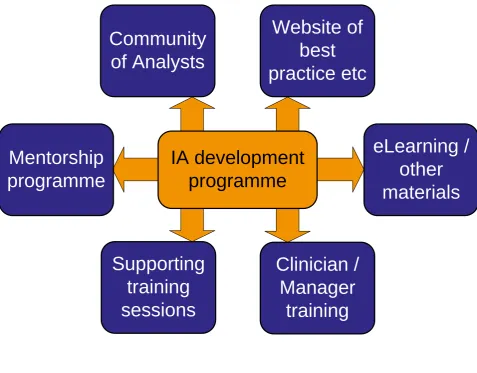
Figure 1 illustrates the full programme as designed. Some of these areas are in development (such as eLearning and the website of best practice), however the core programme of training for Analysts, Managers and Clinicians, is well established. This is the first available course developed specifically for professional healthcare Analysts that we are aware of.
The programme provides 10 days of formal teaching by industry and academic leaders ending with learners’ presentations of their own project on day 11. These sessions range from foundation skills in statistics to data science techniques, and include analysis and data presentation, supported by additional, optional sessions and networking opportunities. The course is delivered over approximately 20 weeks to facilitate Analysts’ release from their core role and to allow consolidation and application of the skills between sessions.
There are two additional sessions available for participants. The first explores
change management in the NHS. The second is a foundation presentation skills day to complement the material in the main sessions and provide additional support to those less confident or less experienced in presenting.
How the project was delivered
During the first year, the programme was free to attend for the first five cohorts as this was funded by the East Midlands Academic Health Science Network
(EMAHSN). Four cohorts were initially planned and were significantly
oversubscribed. The EMAHSN were able to fund an additional cohort, resulting in sixty funded places in the first year of the programme. NHS England purchased an additional cohort which was delivered in Leeds.
Each Analyst on the programme was asked to complete a pre-course assessment rating their knowledge, confidence and use of 40 topics covered in the programme. This was repeated when they finished the course. For the first two cohorts, we had 18 completed pre and post assessments.
For cohorts three to five, 13 sets of pre course and post course assessments were available at the time the analysis was undertaken. At that time, not all post course assessments had been returned, therefore we were unable to include additional assessments in this analysis.
The sixth cohort had not completed the programme at the time of analysis and could not be included.
The Analysts were asked to rate their confidence on a Likert scale based on the following definitions:
1. Not used, no awareness of the topic
2. Aware of the topic or activity, but have not used in practice
3. Have used a little, but are not confident in using or have not used but feel confident that would be able to in the future
4. Confident in using this in practice
5. Used frequently / expert
This was designed to measure the application and confidence in using these skills rather than simple awareness of the topic. Some candidates commented that they had over-estimated their prior knowledge in the pre-course assessment as they learned more leading to an artificially high pre-course score. This limitation is acknowledged. The pre-course assessment was not sent to the Analysts prior to undertaking the post course assessment, however we cannot exclude the possibility that they retained a copy and referred to it.
The course content did evolve slightly with the difference cohorts, partly based on the experience from the previous cohorts allowing the speakers to refine the content and partly as the content is responsive to the needs of individual groups. Most
Analysis method
For each question in the survey, mean competence scores were calculated for both the pre- and post-course surveys, along with the change in mean scores before and after the course. Students’ t-tests were then carried out to determine the statistical significance of any changes in the mean competence scores. The same procedure was also carried out for the overall mean score (across all questions) and the mean scores for each question category. These analyses were carried out separately for two different cohorts of people.
Where a response was omitted from the assessment, this did not contribute to the means calculated.
Results
We have demonstrated an improvement across the entire range of skills provided by the course: analysis of the first two cohorts has shown statistically significant
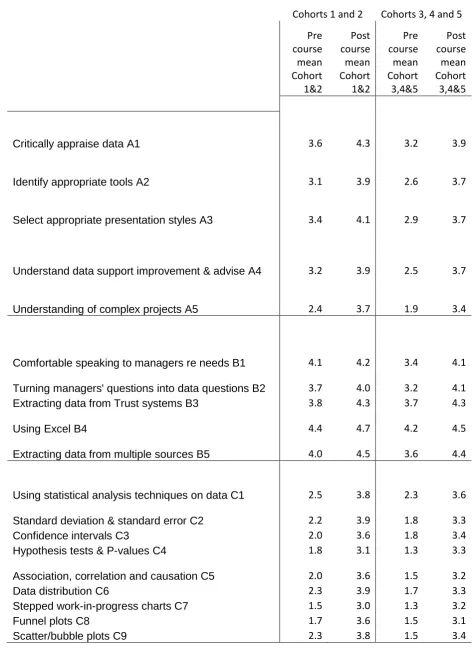
improvements in 38 of the topics (P<0.001–0.041), with the largest improvements in statistics and data science. The overall mean score across all questions was 2.66 (95% confidence intervals (CI) 2.56-2.75; range 1.6-3.5) for the pre-course survey, and 3.7 (95% CI 3.63-3.77; range 3.13-4.25) for the post-course survey. Analysis of subsequent cohorts have demonstrated similar improvements (mean score 2.28 pre, 95% CI 2.17-2.39 and 3.47 post, 95% CI 3.38-3.56) with a similar improvement in all topics, 37 of these being statistically significant (P<0.001-0.012). This can be seen in Figures 2 to 4.
The assessment was split into 6 domains covering both general skills and specific elements of the programme, and are explored in more detail below.
General skills
The largest improvement in the area of general skills related to an improvement in skills of more advanced analysis – question A5 (mean difference between pre and post course scores of 1.3 for cohorts one and two and 1.5 for cohorts three to five) and can be seen in Figure 4. As this was one of the key objectives of the
programme, this is reassuring, and is supported by question A2 which focussed on skills both identifying and utilising the appropriate tools for analysis (mean difference of 0.8 and 1.1 respectively).
differences in the groups or refinement of the sessions and will be confirmed by analysis of future cohorts.
Identifying information needs
These questions explored a key area of the Analysts’ role in discussing information requests with managers, illustrated in Figure 4. Both sets of cohorts were reasonably comfortable speaking to managers (means scores of 4.1 and 3.4 respectively prior to the programme) but the later cohorts showed a larger improvement an increase of 0.7 rather than a not statistically significant (P=0.395) 0.1 for the first cohorts. This may reflect changes to both the content and the order in the programme of the data conversations course. Developing skills on discussing complex organisational and clinical problems and how the available data can help is an area which is difficult to train in abstract and relies on the overall confidence and experience of Analysts. However, the programme appears to be supporting Analysts to develop in this area. Comments from some Analysts when they have attended Best Practice Days some time after completing the programme are that they feel more confident in speaking with managers. We feel that this is not only due to the material in the course specifically examining this area, but also the increased confidence gained from having new skills and seeing them recognised in the organisation in which they work.
Statistics
This section showed the highest overall improvement as can be seen in Figures 2 to 4. The programme is designed to build on the statistical techniques learned during the first two statistics sessions and both build on and apply these in the later sessions. The increase in skills demonstrated in the post-course assessments support the approach of the programme.
Sharing and presenting information
The greatest improvement in this domain amongst the Analysts was in question D8 (Figure 4) relating to creating a narrative around the data which is key to ensuring that the story which the data is telling can be heard. Some attendees on the
programme have very limited experience in formal presenting prior to the course and find it challenging, while others have had more experience. The additional, optional, presentation skills day has received excellent feedback and supports the whole programme in providing confidence as well as practice and experience in presenting. The pre and post course assessment examines presenting to different groups
confident presenting to their colleagues than more senior managers, which is unsurprising. However, it is the latter that shows the most improvement from the course (mean increase in competence score of 0.8 and 1.0) supporting the verbal feedback that confidence is being developed alongside practical skills.
Good analysis is limited in effectiveness if it cannot be effectively communicated, therefore these skills are a key aspect of the programme. It has been suggested that “Information is not always valued as a key tool to support decision making”
(Department of Health 2012, p76), however if information is not presented in a way which ensures that it is accessible, this view will persist. It is not on the quality of analysis which Analysts are judged, but how they are able to communicate, and with complex health data forming the basis of analysis in the NHS, this is a particular challenge.
Measurement for improvement
Figures 2 and 3 illustrates that this is another area of strong development, with average mean improvement across this section of 1.3 for both cohorts one and two and the later cohorts. There is the opportunity for Analysis develop their skills in providing evidence and data driven change, and the results from the assessment suggest that the programme is helping to prepare for this role.
Data Science
Data science techniques were new to many Analysts, and the concern was that this would be too theoretical and abstract for those supporting the operational
management of the NHS. The assessment suggests that some skills have been learned and can be applied, which is very positive. Feedback has been that some analysts have used data science techniques for projects in their own Trusts, aided by the sessions providing hands-on training utilising open source software.
It is acknowledged that the depth of understanding can only be limited in a two day programme, however the intention is to inspire attendees to explore techniques which are more advanced and to provide knowledge of the possibilities which such approaches may offer. The assessment suggest that this has been successful.
Feedback from participants
Comments have been excellent including ‘best course I’ve ever been on’ and ‘should be compulsory’ and have reflected on the practical nature of the course. As
highlighted above, there has been a lack of training available for Analysts, and for some this is the first opportunity they have been able to undertake professional development. The opportunity has been welcomed with considerable enthusiasm and appreciation, reflected in the feedback we have received.
Discussion – the role of high quality information analysis in the NHS
The indirect financial benefits of improved analysis leading to better decisions are hard to quantify. Improvements in data skills can help organisations improve performance and achievement of service delivery targets, reduce redundancy in work and improve job satisfaction, as well as identifying and measuring
improvements in patient safety and quality of care. Analysts will be involved in numerous projects and the impact of better quality decisions will offer significant benefits not captured by a standard return on investment calculation. Information allows professionals to understand the needs of their patients and how their services work (Department of Heath 2012), and Analysts who are able to present complex data in a way that professionals and Managers can access are invaluable to the NHS.
The Department of Health’s digital strategy update (2014a) outlines that a “more digital mindset, with a focus on using data to continually improve services and processes based on best evidence will enable the department to work more nimbly” (section 3.2) and that they will “enable officials to access and use the sources of data they need to make the best informed decisions about their work” (section 3.3). This suggests a belief that data driven improvement can deliver a more effective NHS, and is supported by the plans to develop improved analytical capability within the Department itself as part of the 2014 Department of Health Improvement Plan (Department of Health, 2014b).
There is the need for “strengthening the status of the informatics profession” (Department of Health, 2012 p85) and the feedback from Information Analysts’ programme is that it is helping to create that professional identity and build
confidence in Analysts in their skills and how to present their work. This is supported by the increase in skills demonstrated.
Analysis driving change
The benefits of the improved analysis of existing and new data for NHS organisations are extensive, and support better decision-making around
The National Information Board are clear about the impact of good use of data: “Better use of data and technology has the power to improve health,
transforming the quality and reducing the cost of health and care services.” (p3); “The failure to use information properly in health and care means people can experience unnecessary levels of preventable ill health” (National
Information Board (2014; p9)
The significant potential impact of using information to drive change is illustrated elsewhere (for example, Perez and Rushing, 2007) and warrants further discussion in of itself. There are patient safety and quality aspects, as the Department of Health (2012) states, “Information can also be used by regulators and local organisations to head off issues before they become the next major incident” (p4).
The data from the course assessments suggests that our programme is an effective tool in developing the Analyst profession in the NHS. Investing in NHS staff rather than outsourcing analysis is both more efficient and cost effective, capitalising on organisational intelligence and local knowledge. Building skills within the NHS will reduce the cost of buying in expertise from external sources and retains knowledge and experience within organisations.
We do not underestimate the challenge of investing in enabling staff to work
differently in highly pressured NHS Information departments, while recognising that this is critical if Analysts are going to realise their potential to significantly help the NHS face the considerable challenges it faces over the coming years.
Next stages and challenges to further roll out
keep costs as low as possible, we have found that it is difficult for organisations with limited training budgets to support their staff to attend.
Conclusion
The opportunities to harness the untapped power of healthcare information is just beginning to drive the evolution of healthcare, and this will be limited without
excellent analytical skills becoming routinely available to all healthcare organisations. Delivering an “information-led culture” (Department of Health, 2012, p5) and enabling the “better use of information …[that] will drive more effective and efficient services” (p9) will be challenging if the NHS does not invest in its existing Information Analysts and attract highly skilled and motivated new Analysts into the profession. Without a planned development programme, our information professionals will be less able to help managers and clinicians, and the organisations in which they work, to make the challenging decisions that are needed to deliver the high quality care patients
require. The status quo is not a viable option.
The evaluation of the skills gained on the programme supports the informal feedback from participants and confirms that the East Midlands Information Analysts’
Development Programme is a valuable contribution to development of Analysts’ skills. The discussion highlights the potential benefit to individual organisations and the NHS as a whole from the development of these skills.
Prior to this programme, there has been very limited development for this key group of staff. Using the best speakers from academia and professional practice has resulted in Analysts learning skills which are robust in evidence, but also practical in application. This is the foundation for both current practice and future development, something which the programme is fostering by developing Best Practice Groups to make sharing of good practice routine rather than the exception, and getting analysis out from behind the data and into the organisation where their skills can be fully exploited.
Our innovative programme empowers NHS Information Analysts to improve their precision and confidence when handling data, ultimately helping inform the difficult decisions required to shape services while meeting the performance and financial demands organisations continue to face.
Acknowledgements
Kurtosis (www.kurtosis.co.uk); Quality Healthcare Improvement Company (www.qihc.co.uk); t3intellegence (www.t3intelligence.co.uk/); Horizon Digital Economy Research Institute (www.horizon.ac.uk) and University of Nottingham Department of Epidemiology
We would also like to acknowledge the text mining analysis of the free text evaluation comments undertaken by Dr Julie Jones-Diette, however this paper focusses on the competency score data.
References
Department of Health (2012) The Power of Information: Putting all of us in control of the health and care information we need Department of Health, London available from
https://www.gov.uk/government/uploads/system/uploads/attachment_data/file/21368 9/dh_134205.pdf
Department of Health (2014a) DH digital strategy update: 2014 to 2015 available from https://www.gov.uk/government/publications/dh-digital-strategy-update-2014-to-2015/dh-digital-strategy-update-2014-to-2015--2
Department of Health (2014b) Department of Health Improvement Plan: April 2014 available from: https://www.gov.uk/government/publications/department-of-health-improvement-plan-april-2014/department-of-health-improvement-plan-april-2014 National Information Board (2014) Personalised Health and Care 2020 – Using Data and Technology to Transform Outcomes for Patients and Citizens available from https://www.gov.uk/government/uploads/system/uploads/attachment_data/file/38465 0/NIB_Report.pdf
Perez, Teresita and Rushing, Reece (2007) The CitiStat Model: How Data-Driven Government Can Increase Efficiency & Effectiveness Centre for American Progress available from
IA development
programme
Mentorship
programme
Community
of Analysts
eLearning /
other
materials
Supporting
training
sessions
Clinician /
Manager
training
Website of
[image:13.595.76.554.70.443.2]best
practice etc
Figure 4:
Cohorts 1 and 2 Cohorts 3, 4 and 5 Pre course mean Cohort 1&2 Post course mean Cohort 1&2 Pre course mean Cohort 3,4&5 Post course mean Cohort 3,4&5
Critically appraise data A1 3.6 4.3 3.2 3.9
Identify appropriate tools A2 3.1 3.9 2.6 3.7
Select appropriate presentation styles A3 3.4 4.1 2.9 3.7
Understand data support improvement & advise A4 3.2 3.9 2.5 3.7
Understanding of complex projects A5 2.4 3.7 1.9 3.4
Comfortable speaking to managers re needs B1 4.1 4.2 3.4 4.1
Turning managers' questions into data questions B2 3.7 4.0 3.2 4.1
Extracting data from Trust systems B3 3.8 4.3 3.7 4.3
Using Excel B4 4.4 4.7 4.2 4.5
Extracting data from multiple sources B5 4.0 4.5 3.6 4.4
Using statistical analysis techniques on data C1 2.5 3.8 2.3 3.6
Standard deviation & standard error C2 2.2 3.9 1.8 3.3
Confidence intervals C3 2.0 3.6 1.8 3.4
Hypothesis tests & P-values C4 1.8 3.1 1.3 3.3
Association, correlation and causation C5 2.0 3.6 1.5 3.2
Data distribution C6 2.3 3.9 1.7 3.3
Stepped work-in-progress charts C7 1.5 3.0 1.3 3.2
Funnel plots C8 1.7 3.6 1.5 3.1
Confident presenting to small groups D1 3.4 4.1 3.5 3.8
Confident presenting to Managers D2 3.5 3.9 3.1 3.6
Confident presenting to Executive Team D3 2.7 3.5 2.4 3.4
Designing clear tables D4 4.1 4.4 3.6 4.3
Designing clear charts D5 4.1 4.4 3.6 4.3
PowerPoint presentations D6 3.5 4.2 3.0 3.9
Presenting complex data D7 3.6 4.1 2.8 3.8
Using data to tell a story D8 2.9 4.1 2.4 3.5
Writing formal reports D9 2.7 3.4 2.4 3.1
SPC charts E1 2.4 4.1 1.9 3.3
Baseline measurements E2 2.4 3.7 2.1 3.1
Return on investment E3 1.7 3.0 1.7 2.7
Donabedian model E4 1.1 2.0 1.1 2.4
Calculating capability E5 1.3 2.7 1.3 2.7
SPC to define activity & capacity etc E6 1.7 3.3 1.5 3.0
Lean & six-sigma E7 1.7 2.9 1.3 2.8
Variation E8 1.9 3.5 1.9 3.2
Delivering change E9 2.0 3.3 1.7 3.4
What data science is F1 1.8 3.4 1.3 3.3
Data cycle F2 2.1 3.2 1.3 3.0
Selecting the right techniques F3 1.5 2.9 1.3 2.7