Redefining Progress
Consultation
R
eport
Introduction ...2
1. What should progress mean?...2
1.1 Sustainable Society ...2
1.2 Conceptions of progress ...4
1.3 Progress as sustainable development...7
2. Economic growth as progress ...10
2.1 Economic progress ...10
2.2 Outdated Economics ...10
2.3 Decoupling growth from impact ...12
2.4 Adjusted gross domestic product...13
2.5 Additional measures of progress ...14
3. The concept of wellbeing...15
3.1 Usage of wellbeing as a concept ...15
3.2 Issues with wellbeing concept ...17
4. Defining wellbeing ...19
5. Measuring wellbeing ...20
5.1 Illbeing or wellbeing? ...21
5.2 Subjective measures of wellbeing? ...22
5.3 One or many measures of wellbeing? ...25
5.4 Indicator format ...28
6. Governments role in shaping progress...29
6.1 Role of Government in Shaping Progress ...29
6.2 Barriers and other issues...31
6.3 Shaping progress: Actions for Government ...33
7. Wellbeing use and implications in policy making ...34
7.1 Role of Government in fostering wellbeing ...35
7.2 Barriers and issues...37
7.3 Specific actions for Government ...38
Appendices ...42
Appendix i - Questions for SD Panel - Session 1 ...42
Appendix ii - Questions for the SD Panel – session 2...46
Introduction
The SDC engaged with its stakeholder panel through a pilot online
consultation to gather a wide range of in-depth views on redefining progress to help inform our own views and advice to government.
There were two main sessions to the consultation which are covered in this report. The first session focused on how the panel perceived redefining and measuring progress. Comments were collated qualitatively to allow us to draw out the key themes emerging - (please note the collated groups do not
represent a statistical breakdown of participants’ views but are used to help with our analysis of the questions).
The second session was a further set of questions for members which were more tightly focused on measuring wellbeing. Again, the comments were collated, and due to the question format gave us both qualitative and
quantitative data. As well as
highlighting common themes, our in-depth analysis of both sessions allowed us to single out compelling individual arguments from panel members.
This report outlines the main findings from the panel responses. It will be used to:
• inform our recommendations to government and position to the Whitehall Indicator Group on wellbeing indicators, which will be released to members in early 2007
• advise on wellbeing policy across government departments
• contribute to our final report 'Redefining Prosperity Two' due in autumn 2007
A list of the consultation questions and breakdown of participants are available in the appendices at the end of the report. All the results from the consultation and more information on how the panel works are available on our website:
www.sd-commission.org.uk/
pages/sd_panel.html
1. What should progress
mean?
11.1 Sustainable Society
Many respondents began by discussing the importance of moving away from current understanding of progress as predominately economic, towards a new moral philosophy of progress more conducive to sustainable development. Economic growth was seen to be one-dimensional. Redefining progress was therefore seen as vital to start the ”deconstruction [of] the impoverished, myopic, dualistic understanding that underpins our dominant 'economic' conceptualisation.”i One stated that
“until crude, undifferentiated measures such as GNP/economic growth are integrated with more qualitative measures we will not make much progress towards the transition to a sustainable society, world or economy.”ii
Some responses also highlighted the many perverse impacts of our existing understanding of progress which were felt to be “anachronistic and
inappropriate in a post-industrial
society.” “The observable consequences of this model are increasingly pernicious; ill-health and disease, violence and
1
aggression, falling educational
standards, unfulfilled and undervalued individuals, damaged natural and social environments.”iii The consequence of our
pursuit of economic growth is seen as, “we chase dreams fuelled by advertising and media that are quite devoid from the real pleasures and essentials for life.”iv
Others respondents pointed out that, inspite of their political importance, economic growth and markets are
methods for maximising utility (or
wellbeing) and are not and should not be goals in themselves. “Progress should imply that we're moving towards a goal; 'progressing towards' rather than just 'wandering around'. The problem with economic growth is that it's not a goal.”v
Another member felt the issue was our partiality for easy measurement “Progress is a clouded concept. We are lazy, we look for the easy way not the best way. Progress is synonymous with economic performance because
economic performance measures appear tangible and easy to track.”vi
Many respondents explored the problems with the political system and Government’s entrenched approach to the electorate. One member quoted MP Colin Challon in an Independent from the previous year2 “Climate change means
that business as usual is dead. It means that economic growth as usual is dead. But the politics of economic growth and business as usual live on… We are imprisoned by our political Hippocratic oath: we will deliver unto the electorate more goodies than anybody else.”vii
The vicious circle of elections and political over-promising was felt to have lead to a crisis in politics and political leadership. “The Nation is not at peace with itself and honesty and leadership
2
28 March 2006 ‘The Independent’
http://comment.independent.co.uk/commentato rs/article354051.ece
are no longer admired or even required.”viii
Currently, many respondents felt that very little progress was being made towards a sustainable society. Indeed many felt that progress was still going in the wrong direction. “Making
appropriate changes to reduce the global footprint to less than one earth
(currently 1.2 earths) and to provide an acceptable quality of life to the
inhabitants of the world. Clearly this is an ideal that can never be attained, but the current direction is away from that goal, so a reversal from regress to progress would be a good start.”ix
Others felt that the complexity of the issues around progress required a fundamental assessment and
clarification about the direction of the future before any path should be embarked upon. “So progress is identification of what the issue is, thus identification of what needs to be done, then unified action in the aim of an
agreed outcome.”x
The question also asked respondents whether their visions of progress would differ if they took a global perspective. Most concluded that issues in a global context were the same, but were potentially more acute and may require a different emphasis.
The members of the panel addressed the question about what progress should mean in two main ways. Members either responded with critiques and explanations for the existing
1.2 Conceptions of progress
Some respondents put down a number of preconditions about how progress should be conceived and defined. These tended to highlight the complexities of such a task. “Progress must be defined in such a way as to acknowledge and reflect the complexity of human interactions with both human society and the natural environment.”xi
“The idea of progress must be
understood as a series of compromises between competing aspirations, in which the long term good should outweigh short term and individual gains.”xii
One respondent pointed out that progress is not teleological. “Progress is something that needs to be regarded as something chosen rather than ordained, and if it is to be sustainable, needs to be biased towards resolving decades long environmental decline and increasing global inequality.”xiii
Visions of the Future
The responses contained many implicit and explicit personal conceptions and definitions of progress. The words most commonly mentioned were those such as wellbeing, social equity (international and inter-generational), community, fulfilment, health and happiness.
An aspirational vision of the future society supported by everyone in that society was felt to be the first step in defining progress; the next step was devising how as a society we wanted to get there. “To achieve social progress, we need to think about what kind of people we want to be and what kind of society we want to live in, and then mobilise our knowledge, forces, powers and resources to aim for a better society.”xiv
Others attempted to describe that vision in terms that would have mass appeal. Progress “is a world that is clean and
free from pollution. It conserves limited resources and provides widespread natural landscapes and open spaces. It is safe, and prosperous and celebrates cultural identity and diversity. It allows its citizens to achieve all that they want to achieve, and be who they want to be without inhibiting others to do the same. And it is supportive when things go wrong.”xv
Progress & Growth – dynamic or static
A number of respondents had an instinctive distrust of the word progress because of the current association of progress with growth.
“The pursuit of progress is a human condition. We need progress to provide meaning or distraction from the reality that we are mortal; its our connection to the immortal. We have to assume that we will always seek progress, the myth that the next generation will be better, bigger and faster than the last. Progress until now has been easily associated with accumulation of wealth because that is what brings power.“xvi
“Society has taken the view that progress always has to mean more. I would argue that progress means better.”xvii Another saw human action
not as a need, but as a duty.
“Man is a responsible creature of God and has the duty to see the betterment of all world systems.” Or in humanist terms, “Progress should mean some form of positive advancement in the processes that allow us to be stewards of the earth's resources such that we pass on to future generations a world no less worse than the one that we
ourselves inherited.”
There was some disagreement amongst respondents as to whether the goal of progress was continuous improvement or whether it should be to reach a static end point. “Progress would be moving towards a 'stationary state'”xviii
necessary; the focus is on maintaining those conditions to maximise individual, collective, and non-human flourishing. That corresponds with the notion of sufficiency - we would know when enough is enough.”xix
Progress for a good number of respondents was felt to be the end of the materialism that has shaped the most developed societies for many centuries. Progress means “the link between social status and material wealth is broken, and affluence is no longer the carrot for innovation and enterprise.”xx For one person, the idea
of progress is that “success is no longer viewed simply in terms of material acquisition, but rather in terms of ones ability to live lightly and intelligently in the world.”xxi
Happiness & Wellbeing
Concepts of greater wellbeing and happiness in society were endemic in many of the panel responses and conceptions of progress. “The standard should be the same globally. How happy people are, or the percentage of people who class themselves as 'happy'.xxii”
However, happiness was most often spoken about within the context of environmental limits. People getting happier but without needing more stuff. One respondent felt that progress would be harnessing technology to support wellbeing. “The word progress is loaded. It conflates three concepts —
"movement forward", "increase in technological ability" and "improvement of the human condition", so that any one of these is assumed to engage the others. There is no intrinsic connection between technological advance and human wellbeing.”xxiii As a result,
”Progress should be towards a society in which the economy and the technology which sustains it are the servants of the people, not their masters.”xxiv
“Progress and development manifest themselves when the inhabitants of a society are more healthy, better
educated, and have a better standard of living than before. But perhaps these should be seen simply as symptoms of ‘happiness’ or ‘well-being’ (which would include environmental and social aspects in addition to the economic); that is, progress occurs when society becomes happier.”xxv
Tolerance & Respect
A priority goal for many of the panel was for progress that fostered tolerance and respect around the world.
One respondent highlighted global conflict as the cause of much of the unhappiness in the world, not least poverty, and therefore felt that
“progress could be measured in terms of harmony between people and
cultures.”xxvi Essentially peace brought
about by mutual concern and
understanding. ”Progress should mean greater tolerance, empathy and compassion.”xxvii
One respondent felt that holistic health was also an indicator of balance and tolerance in society. “Greater numbers of people in society displaying higher levels of mental, emotional and physical health. This would demonstrate higher levels of tolerance, understanding and appreciation of the diversity of people and the wider environment.”xxviii
There was some level of disagreement about whether or not we needed to embrace cultural differences, or whether in fact it was more constructive to move society away from culturally-defined measures of progress towards a more holistic and global understanding of human health and happiness.
Equity & Basic Needs
Equity was another key concept. Progress was felt to be the end of extreme poverty, and the ability of all people to meet basic human needs and rights. Many placed equity within the context of the efficient and equitable use of the planet’s resources, now and in the future. “Progress would actually mean a levelling of life styles so that people find contentment/satisfaction without the need to strive for more and more.”xxx
Progress was therefore convergence or equalisation. “We need to recognise that progress as we conceive of it is a
privilege, not a right.”xxxi ”If we accept
that resources are finite then we need to pay as much if not more attention to equalising down as to equalising up through growth.”xxxii
Another way of conceptualising equity was through security, or the absence of issues that undermine security. Progress is “moving towards the absence of fear, of war, crime etc, and also the absence of fear for our children and future generations.”xxxiii
Knowledge & Fulfilment
The final concept raised by many of the respondents was that of personal development, ability and knowledge. “Progress should be a continual journey towards the maximum individual and collective realisation of potential.”xxxiv
Meaningful participation was another theme, we should be aiming for “a society where everyone feels able to engage meaningfully in civic life and political process, at local, national and international levels.“xxxv
Greater critical thinking and empathy with others was seen to be key to changing individual priorities and the direction of travel. “To engage with these kind of problems, progress must also occur at an individual level to improve the ability of people to accept the need for change and modify their
behaviour appropriately. This necessarily requires people who are motivated to understand the views of others and to accept that they are sometimes might be wrong. Progress might therefore be seen as improving the critical thinking ability of individuals in addition to increased awareness of the social-environmental problems facing our society.”xxxvi
Knowledge was also perceived as a tool rather than as a goal in itself; with society unable to agree at present where our end point is, or what our vision of society should be, the proxy for progress should be knowledge.
“Knowledge is the tool we need to develop in order to be able to define long-term progress.” “One of the
greatest assets the human race has is its pool of knowledge. This is not simply recorded in computers and books (that is information), but largely held within the complex interplay of productive systems and human cultures. Knowledge and wisdom are hugely valuable and set one culture above another. So any measure of progress must also embrace evolution of these key elements individually, in groups, countries and globally.” xxxvii
Societal Values
A large number of respondents
mentioned the critical position of culture and values in determining a vision and setting the path for progress.
Our existing values were, in general, not felt to be conducive to living within environmental limits or to creating a just healthy society. “It seems to me that what is needed is a cultural change: the development of an awareness (one might call it enlightenment) that 'well being' is more important than 'economic prosperity'.”xxxviii It was then noted that
One respondent felt that it was our yearning for collective and group identities that undermined any
agreement on a more ‘mature’ approach to progress. “Taking a strategic view of our current path, we live quite
immaturely. We’re technologically very advanced, able to satisfy almost any need through our ingenuity and innovation. However, we put the technology to uses that are based on immature impulses like immediate gratification of senses or tribal responses to resources and territory protection. If progress is to move along a different path we need to concentrate on growing up and maturing as a society, creating an identity of ourselves that does not rely on the groups we're part of or the communities we live with, but is an internal picture of ourselves, largely independent of our immediate identifiable group.”xxxix
Environmental Limits
Almost all of the responses included a dimension dealing with natural resources or environmental limits. A few panel members also prioritised environmental issues; the state of the planet, and living within the capacity of the planet - above all else. Maximisation of human wellbeing was an important but secondary issue after planetary survival. ”Progress means ensuring survival for Gaia thus survival for ourselves and our descendants.”xl
“
P
rogress means moving towardsbalance, equilibrium, with nature. Thus progress is a journey towards understanding and knowing nature and her vital role as life-support system.”xli
In order to achieve this, the overarching imperative was felt to be “redressing the detachment of western culture from the natural world, to enhance the sense of spiritual meaning in peoples lives and reduce the increasing ecological debt burden - Replacement of human arrogance with humility vis a vis the natural world.”xlii
A minority felt that the concept of sustainability was not necessarily helpful given the enormous issues we need to address. “The sustainability approach to measuring success may unfortunately serve to over-complicate matters and weaken political resolve to tackle what are undeniably the major threats to human progress in the medium and long term - climate change, global
overpopulation, and the energy crisis caused when fossil fuels run out.
Progress should instead be seen in terms of critical path analysis - i.e. the extent to which we have slowed and halted our journey towards these compelling threats to global wellbeing.”xliii
1.3 Progress as sustainable development
As well as the more philosophical visions of progress, a good number of the panel members responded with their vision of progress within the context of
sustainability and short-term concrete actions. “SD is a process, and a goal, but cannot be measured directly. Movement towards SD is what we need to
measure, and progress should measure that - being closer to sustainability than we were before.”xliv
Although one respondent also noted that as well as short term aims, in the longer term “progress should mean redefining economic mantras that have been with us, more or less unchanged, since the industrial revolution.”xlv
Efficient Use of Resources
Progress for many was about resources and the most efficient use of them. One respondent felt that progress was “the holy grail of a decline in the consumption of energy, goods and resources without a corresponding decline in the economic health of the nation.”xlvi A more personal conception
energy and money trying to dispose of things properly.”xlvii
Experiences of the vulnerable
Another member felt that progress would be an improvement in the experiences of the most vulnerable people in society, children, elderly and disadvantaged and how well, as a society, we are working to improve those experiences. “Progress will begin to be demonstrated when deprivation measures begin to show positive movement towards closing the deprivation gap.”xlviii
Governance
Given the topic and the organisation holding the panel debate, it was unsurprising that a good number of respondents felt that progress would involve sustainable development being better integrated in government action and policy-making, locally, nationally and internationally. “Progress should mean that the principles of sustainable development are intrinsic within economic and social policy;”xlix
”Significant progress can be made in the public sector by providing clear
guidance, without conflicting agendas, planning joined up strategy and policy and having accountability that will be monitored on a regular basis.”l
Other suggestions for changes in style of governance included proactive and preventative policy as opposed to reactive response to issues and cross-party consensus. “It is of the utmost importance for us to decouple political short-termism from what is necessary to bring about a sustainable future in the UK. All parties should agree on strategies of essential action which will be tackled consensually irrespective of which party is in power now or in the future, and opposition parties must agree to support such action. Planet earth does not discriminate on the basis of political belief.”li
Others felt that progress would be the deepening of democracy and subsidiary decision making. Progress should happen at the local level. “Progress should be a lively and participatory democracy where people really fell they have control over the decisions that affect their lives.”lii Another felt that
“at the heart of progress should be community involvement and a sense of participation and ownership.”liii.
Individual Responsibility
Closely aligned to progress within government was progress in the role of as a facilitator or enabler of individual responsibility. “Government is not directly responsible for the well being of its citizens, but for developing the opportunity those citizens have to take responsibility for their lives and better themselves.”liv
Individual responsibility for progress towards a sustainable society was felt by many to be key to progress. This
involved primarily taking a perspective that was wider than ourselves and our own self-interest. “Progress is about changing attitudes - instilling a sense of the common good, rather than every man for himself.”lv The absence of this
attitude was blamed firmly on the media by one member. “The enormously influential popular media output aims at contented stupification rather than empowered thinking. It is this
submission by national media to pander to a perceived desire for such numbing of the intellect that has partly
contributed to the dislocation from society both local and global. Raising the expectation of the individual's
responsibility to society both locally and globally, could surely be seen as
progress.”lvi
Thus progress would be instilling in individuals a greater understanding of sustainability, awareness of their own environmental impact and the changes they could make that would make a difference and, most importantly, a desire to do something about it. However, one respondent challenged the Government to take more coercive action with reluctant individuals. “Progress therefore means moving beyond 'preaching to the converted'. Anyone who is concerned about the environment and who is going to take active steps to do something about it is already doing so. Now it is time to deal with the people who do not care enough to act on their own.”lviii
Consumption
The main activity in individual
responsibility was consumption. “A shift in the definition of progress needs to recognise that there is an absolute limit to consumption.”lix One respondent
stated that this would revolve around the pursuit of quality over quantity. “Progress in my mind would be made if the national consumption mindset moved away from its obsession with price and volume (pile them high, sell them cheap and buy it even if you don't really need it) to one based on the quality of the product and producer. This would be demonstrated through a shift in the brand positioning of major companies and in the proliferation of more micro operations and specialist producers. Advertising, the great barometer of the collective psyche, would reflect this as campaigns driven by pricing were replaced with those that featured quality and individualism above all else - encouraging the mass market to aspire, not to conspicuous
consumption based on volume, but to selective, necessity driven buying behaviour.”lx
The concept of choice was also raised and its relationship to awareness,
responsibility and ultimately indicators. “Informed choices need to be made by all sectors of society, government, business, individuals. That would be real progress.” lxi Progress was felt to be the
ability and freedom of individuals and communities to make choices, but with the recognition that this freedom comes with responsibility. A prerequisite for that responsibility is sufficient understanding of the impacts of that choice and thus ubiquitous indicators enable that understanding.
Education
Respondents felt that the role of education and learning was also central to progress. Sustainable development needed to be at the heart of any curriculum. Engagement of the whole population in learning about SD. “Better quality of public dialogue, more informed debate, more people engaged in learning.”lxii Or more sternly,
“education and awareness in order to temper our greed and help us question our acquisitive habits.”lxiii
One respondent conceptualised the question about what we would want for our children as a proxy of our
conceptualisation of national progress. “I want them to have a sense of social responsibility, in a personal, a national and a global sense. Similarly this is how I want our country to progress.”lxiv
Conclusion
2. Economic growth as
progress
2.1 Economic progress3
There was a significant minority of panel members that cautioned the dismissal of all ideas of using economic growth as a proxy for progress. “There is more to economic activity than selling
throwaway products. My feeling is that environmentalists are beating up economic growth in frustration at the absence of a convincing sustainable economic model.”lxv
A few respondents felt that our pursuit of growth is nature and not nurture, as a result, growth was not felt to be
something from which we could
naturally turn away. “A desire for growth in consumption (in its various forms) appears to be a universal human condition and therefore seems an appropriate baseline measure of progress.” lxvi
It was also noted that ”economic 'growth' is not based upon some fixed absolute external aspirations,”lxvii it is
essentially a value neutral model, the direction of travel simply reflects what is valued by that society. The conclusion being that these values needed to shift away from consumptive growth to preservative growth, and valuing sustainability more highly.
Another concern about sidelining economic growth was losing international comparisons and the element of competition. “We do not as a nation exist in isolation and the world is a competitive place. I cannot conceive a model which does not have national economic growth as a central driver in the foreseeable future. I know of no examples where the alternative of
3
Section A is a collation of responses from session 1, Q1 that mentioned economic growth specifically
economic stagnation or decline has benefited the indigenous population.”lxviii
It was also noted that the “benefits of GDP growth in terms of basic human welfare are particularly clear to see in the developing world.” Furthermore, the expansion of the UK economy was a driver of knowledge and technology transfer that, as Stern highlights, are key to tackling climate change in the less developed world.
Most of the respondents did however state the need or use for some sort of modification or supplement to existing measures of GDP in terms of globally agreed goals on finite natural resources. Essentially decoupling the negative impacts of growth. “Progress should mean where economic growth, wealth creation or success is decoupled from consumption of finite resources, damage to the environment, society and human health.”lxix
2.2 Outdated Economics4
When asked specifically about economic growth as a measure of progress in the second question to the panel, a large number of respondents felt that economic growth was an outdated concept of progress for the 21st Century.
Economic growth gave an indication of material wealth but not, most crucially, its uses or its distribution within society. “For at least the last 20 years it has been the single greatest distraction from, and obstruction to, pursuit of genuine progress. Economic growth is no longer necessary for, or even positively correlated to, any element of genuine progress. Indeed it is now undermining
4
many of them. Growth is jeopardising environmental sustainability and with it human security, at home and abroad; it is impoverishing the public realm and crowding out mutual and co-operative endeavour; it is eroding trust and solidarity and pushing people into the aridity of commoditised, depersonalised, competitive relationships. And it isn’t even helping meet basic needs because its fruits are going not to the needy but to those already glutted with over-consumption. Even its claim to maintain stability is bogus: it entails continual dislocation and insecurity for workers communities, and drives increasing geopolitical insecurity.”lxx
Economic growth ”says nothing about the distribution of wealth, or what the wealth actually buys in goods and services, or the multitude of benefits that are provided by individuals and voluntary organisations. It appears insolubly linked to classical economics, which discounts future costs and benefits to an insignificant net present value. It struggles and fails miserably to include non-financial capital and
transactional value, such as a healthy environment, and de-humanises society by treating human capital as an
exploitable resource. In short, economic growth is a measure of the rate (and not necessarily efficiently) people, animals and the environment all serve the economic system, rather than the other way round.“lxxi
Other respondents were slightly less scathing but still felt the emphasis on economic growth was deeply flawed. “The use of economic growth is a false barometer of the nation’s health and progress. It is based on the assumption that bigger is always better, greed is good, less is most definitely not more and that volume is always king.”lxxii
There was broad agreement that
economic growth should not be the goal of progress although many people and policy makers still conceptualised it as
such. “We are making important what can easily be measured, rather than measuring what is important.”lxxiii
The purpose of progress should be defined as wellbeing or sustainability. The economy was a subset of the environment and once the purpose and goal of progress was decided, the role of economic growth would be delivering it. “To define progress by reference to GDP and economic growth is to place method before substance. Factors that lend themselves to quantitative analysis tend to be given greater weight than those which cannot so easily be counted. It is easier to count than it is to evaluate or appraise.”lxxiv There was also appetite
from the panel for the development of a more accurate alternative measure of progress. “It is an indictment both of economists that it [economic growth] is nearly the best they can do, and of the rest of us that we can't come up with anything better.”lxxv
One respondent felt that a new
conception of progress was increasingly overdue as “I think more people are becoming suspicious of economic growth statements because the concept often doesn't match up with their experience or with how they feel or perceive the current state of the nation to be.”lxxvi
Evidence from the World Values Survey was cited as evidence against a close correlation between growth and wellbeing.
The panel responses fell into two main categories, the first felt that economic growth and the methodology for its calculation needed to be amended to take into account of externalities and un-costed goods and services.
2.3 Decoupling growth from impact
One respondent mentioned how systems thinking can illustrate how economic growth mutated from a measure to a goal, resulting in a reliance on ‘meaningless’ numbers.
“Systems thinking shows how attempts to isolate a target or activity outside their context results in a distorted understanding of a situation.
Anthropological research has shown how the 'audit culture' has come to dominate to the extent that the measures put in place to understand effectiveness have now become the goals of a project. How do we decouple the attachment of scientists and economists to numbers from the decisions made in government which are never about numbers.
Statistics are meaningless, they can used to say anything. People manipulate statistics to achieve their own goals.”lxxvii
Another noted that “Any modern CEO worth their salt would not use a performance metric that tells you so little about what is actually happening, either for reporting or
decision-making.”lxxviii
The current ‘orgy’ of consumption that modern developed societies have perpetuated was blamed on a number of things, not least the measure of economic growth itself. “I think its [economic growth] use probably arises from the fact that most of us are inherently greedy and selfish, wanting to increase their own wealth and that of their families. While this attitude
remains at the basis of people's motivations this measure will continue to be important.”lxxix Our greed has been
transferred into a race of consumerism. "Survival of the fittest" has been translated into having more than the person next door.”lxxx
“Nations like Britain have achieved sustained economic growth through an
orgy of consumer spending which has kept the economy buoyant but which has also produced a culture where we are 1) overworked so we can afford to ‘keep up’, and 2) heavily indebted. This has produced a culture where we increasingly emphasize the importance of acquiring the latest ipod, laptop, car, holiday abroad, and so on. The
consequence for the planet of this consumerism is profound.”lxxxi
Dampening this culture of materialism is therefore of enormous importance, but is a challenge that politicians were felt to have hindered rather than helped. “I believe that once people have security as regards the basics of life, such as food, shelter, energy and healthcare as examples, the importance of wealth acquisition diminishes, unless society attaches an importance to it that is culturally based as a status symbol. Unfortunately I believe that society's regard for the importance of wealth is a direct consequence of the importance successive politicians and political systems have attached to it.”lxxxii
Another felt that beneath this materialism lay another circle that perpetuated our need for economic growth. “We think we need growth to pay for increasing health spending to allow us to pay for the new
medicines/treatments developed to tackle the ilnesses/problems that may have been caused by the economic growth.”lxxxiii
Given the damage inflicted by our consumerism, a number of respondents then tackled the question about whether or not it was possible to decouple the damaging impacts of our excessive material consumption and energy use from economic growth. “‘Weightless growth’, i.e. economic growth which has been decoupled from growth in energy use and material consumption, will have to play an important role in our
The implications of decoupling for our patterns of work, travel, business and leisure are profound but may be not enough to be ‘sustainable’ unless levels of absolute consumption have also reduced. “Measures to improve environmental performance (e.g. through greater efficiency, etc) are continuously gobbled up through greater consumption levels.”lxxxv Services, rather
than goods, would therefore need to play a key part in a ‘weightless’ economy.
Despite our existing reliance on economic growth to stabilise our
economy, increasing levels consumption was not necessarily felt be a prerequisite for economic stability in other cultures. “There are many communities which are in fact stable socially, economically and environmentally without increasing consumption, particularly, but not
exclusively, in the developing world.”lxxxvi
Economic stability was felt to be a useful alternative goal to economic growth. One respondent felt that the need for consumption growth was a feature of an unstable economy in itself. “An economy which can only function by continuous growth in the cycle of production and demand is inherently unstable… We all know that we are on a highly dangerous roller coaster ride which may well derail if the brakes are applied.”lxxxvii
The key to shifting our culture of materialism was seen by one respondent to be communication. “Progress is actually about learning to manage with less. No doubt we would all be healthier as a result. So we need to work at definitions and
understandings of progress and
communicate them in a way that means they are not seen as vote losers by the politicians.”lxxxviii
2.4 Adjusted gross domestic product
Despite a strong sense that GDP and economic growth were deficient to the task of acting as a surrogate of progress in the 21st Century, many of the
responses were permeated with a mood of political pragmatism. “GDP is a cheap and cheerful measure of which there are few alternatives.”lxxxix “We cannot
expect to wean ourselves off popular and political expectations of growth quickly, nor off the economic role which growth plays in maintaining
employment and in enabling us to cope with rising demands on public services, particularly in an aging population.“xc
A number also pointed out the correlation (albeit indirect) between economic growth and environmental improvement. “One of the (many!) counter arguments is that more growth = more jobs = more housing needed = loss of high quality landscapes, but I think that in overall terms the
environment fairs better when economic growth is high.”xci
Many of the pragmatic supporters of economic growth did however highlight that firstly there was a general need for a better understanding of what GDP does and does not measure, and secondly that ultimately the measure needed to be modified and adjusted to account for un-costed environmental and social goods and services. “I have no problem with this measure - so long as it can include a monetised value for such matters as health, well being, clean air, access to a pleasing environment etc.”xcii
One respondent felt that turning away from GDP as a measure of success would alienate those in businesses that are trying to work within the sustainability agenda and a more constructive debate was required. “It is therefore perhaps more useful to consider the use to which growth is put, rather than measuring growth for its own sake.”xciv A modified
indicator might therefore take a view of desirable (renewable energy) or non-desirable (weapons) outputs in terms of sustainability. “It is important not to demonise trade but to change its terms and conditions so that they are integral to progress and wellbeing. Were trade balances improved through large
contracts for sustainable energy R&D we might be proud of our exports
activity.”xcv
Others did though feel that, ultimately, given our level of development had now breached environmental limits, we should be looking to move away from GDP.
“Thus, simplistically put, economic growth is progress when the nation is underdeveloped; i.e. its eco-footprint is less than its bio-capacity. Conversely, for developed nations whose eco-footprints exceed their bio-capacity, progress is the reduction of either population or per-capita consumption to bring economic activity into balance with indigenous resources.”xcvi
2.5 Additional measures of progress
Given the complications in replacing GDP, only a relatively small proportion of the panel argued for its abandonment as a key indicator. A common approach was therefore to suggest that several indicators of progress were needed to create a more accurate picture of progress and act as a supplement GDP. There is a relationship to GDP but it is not absolute “Measuring only economic growth as a determinant of success is like measuring shoe size to see how tall
someone is.”xcvii “It is the best proxy we
have at the moment for "progress" - however broadly defined that is. A good proxy has to be understandable,
objective, measurable, and
comparatively valid across nearly all countries and societies on the globe. Devising a better proxy will not be easy. Probably we should devise several independent proxies.”xcviii
Sustainability for many of the panel was a concept synonymous with balance and consideration of wider objectives. Sustainability required social,
environmental and economic objectives all going in the right direction. “Why do politicians have a desire to reduce everything to a single number? Is it because they don't think the rest of us are clever enough to deal with a variety of measures? Or are we all, including the politicians and some experts, too lazy to care?”xcix “Perhaps we need to develop a
similar measure of environmental and social 'growth' which would be given equal status as GDP when considering national progress.”c
“It is a reflection of our times and of our problems that there are only two addresses in Downing Street that are thought to have any importance: No.10 and NO.11. The environment and social bosses should be in No.9 and No.12.”ci
The role for the sustainable
development community was felt to be therefore “keep providing alternative measures and demonstrating how they can be used.”cii As well as to “make
people aware of what these measures are and why they matter.”
A good number of respondents did however mention the extra complexities of dealing with these issues in an international context. The conclusion being for many that it is impossible for one nation to act unilaterally in
more responsibly to the environment, the unscrupulous ones will just stamp all over them.”ciii
Others saw the role for the UK to act as an international leader and coordinator in changing the focus from quantity to quality. “We have to think big. The current model of economic growth means we are aiming for volume, when we should be aiming for quality at this stage in the nation's development. This would allow us to be truly a world leader and make a difference to the quality of life in other countries.”civ
3. The concept of
wellbeing
5Wellbeing was felt by some to signify the ‘ultimate stage of human
development’cv and therefore was the
only valid measure of progress. One response suggested that wellbeing was part of our genetic programming “We seek fulfilment through developing a sense of wellbeing. Having wellbeing allows us to be the best we can be and achieve our potential.”cvi
”What could possibly be the point of any economic or technological ‘progress’ if it does not improve human wellbeing? The fact this question appears to be meaningful shows what a warped idea of ‘progress’ we have drifted into.”cvii
3.1 Usage of wellbeing as a concept
Understandable
Unlike sustainability, which can cause confusion more often than clarity, panel members felt that many people
5
This section is a collation of panel responses from questions 4A & 4B of first panel debate. To what extent is the concept of ‘wellbeing’ a useful way of thinking about progress? Do you think ‘wellbeing’ is a useful measure of progress?
instinctively understand what wellbeing and life satisfaction means for them, though they may have an issue defining it.
As one respondent stated, wellbeing “puts the idea across very simply, in a way that can be easily understood, that we should be aiming for something other than ever greater consumption. A fair, just, more equal, more cohesive society which is living within its environmental limits will exhibit high levels of wellbeing, regardless of its income levels.”cviii
Improving Social & Support Networks
One of the key concepts arising out of the responses was the importance of relationships in wellbeing and rediscovery of the value of social and support networks. “The concept of wellbeing provides an opportunity to repair the support networks within society that have been damaged by the pursuit of material wealth, which in itself has left us ship-wrecked, and alone. It is tragic to think we sacrifice relationships with friends and family in order to create a sense of security.”cix
One panel member concluded ”To begin to achieve a sense of “Wellbeing” we must give serious consideration to socially re-engineering society through the power of television and media.”cx
Another felt that the rise of the transient society in modern society was
responsible for breaking fundamental social links.
Questioning Material Aspirations
Whether or not it was possible to define or measure wellbeing, it was felt to be a concept that opened out discussion and debate about where society was
manipulated and constantly increased by technology and more specifically, the marketing of new technology. “The general public bury their heads in the sand and continue on their personal treadmills regardless, which are oiled by aspiration marketing and influences. It is deceptively easy to be blind to the degradation of one’s own well-being for the sake of purely financial gains and this can be mirrored by using only financial measures for judging prosperity.”cxi
The concept of wellbeing “describes an internal and intrinsic state rather than external and extrinsic acquisitions.”cxii
And, consequently encourages individuals to re-evaluate the vicious cycle of materialism.
“Economic growth cannot function if our desires are satisfied, so the job of capitalism is to create desire, which we fulfil through material consumption. The concept of wellbeing creates a space within which we can analyse the cycle we are in, and question the results.” and, as a result, ”refocuses value on relationships, natural heritage and our physical and mental health, opening our eyes again to the real costs of
production.” cxiii
Empowering Individuals and Businesses
Individual empowerment was felt to be key factor in promoting individual wellbeing. Do people feel that they have any control or agency over the direction their lives progress towards?
One respondent made the point that “People undoubtedly would feel happier not knowing what environmental problems are around the corner which will affect their future quality of life or that of their children. However, a deeper sense of wellbeing can come from a real understanding of issues, and what choices individuals have, in order
to feel empowered to contribute to making a difference.”cxiv
Only a few panel members drew our attention to the crucial role of
businesses. One noted that it may be easier to define and measure wellbeing and take action to improve it within a business than on an individual or Government level. “Within business it is easier to set frameworks which measure wellbeing and sustainable progress in terms of flexible working policies, improved CSR reporting, reduced environmental impact, particularly reduction of travel.”cxv
Encouraging Sustainability
The capacity for a focus on wellbeing to instigate questioning of material aspirations was the primary reason that sustainability and wellbeing were felt to be intricately linked.
One person usefully summarised wellbeing as a measure of progress because “It encourages an outlook which can more easily adopt a sustainable lifestyle.”cxvi Wellbeing was felt to
persuade people to explore the potential gains from non-consumption based activities to “get the progress ball rolling in a sustainable direction”cxvii and
challenging the assumption that the absence of ‘stuff’ means people are unhappy.
Within this, wellbeing was felt to work towards resolving “the conflicts between what we want and what we need. It poses the age-old question: what does it profit a person if they gain the whole world, but lose their soul? So it is at the heart of discussion about the
environment and sustainability.”cxviii
Given that most respondents agreed that the current economic model has not created a society in which real ‘wellbeing’ can be fostered, it raises further questions about the sort of society we actually want to live in. Wellbeing must not be “considered in isolation but through the prism of the kind of people we want to be, the social values we want to cultivate and
sustain.”cxx
Another member pointed out that we should be looking to re-learn from other cultures, such as Bhutan, what the correct balance of priorities should be (between economic, social and
environmental) within a society that is conducive to maximising the wellbeing of its citizens.
3.2 Issues with wellbeing concept
Despite a fairly high level of support for the concept of wellbeing, many
respondents stated qualifications or concerns in its actual application and use. ”I remain to be convinced that the concept is strong enough to bear the pressures that you are intending to lay upon it.”cxxi
The responses varied as to whether or not they felt that these issues,
particularly with definition and
measurement, posed an insurmountable challenge. “In theory - it makes sense. In practice - a terrible concept. Just as we criticise GDP for not being an accurate or reflective measurement, wellbeing would mean different things to different people”cxxii
Individual v. Social Wellbeing
As well as cultural homogeneity, panel members also raised the issue of conflicts between individual wellbeing and societal wellbeing. In many cases individual freedoms were felt to have the potential to impose externalities on society. Should the state prioritise the interests of those that have not taken
personal responsibility for fostering their own wellbeing? What should be done about situations where people do have a real choice, but choose not to take it, and are effectively externalising costs on others. One example being the cost of healthcare for those choosing an unhealthy diet.
Respondents stressed that individual wellbeing should not be the sole measure and that the wellbeing of society and the wellbeing of future generations should be an important part of the concept. One member concluded “we have to look at what might
characterize wellbeing so that it benefits the most and detriments the fewest. Ultimately it comes back to progress being about social equity.”cxxiii Another
highlighted that without a dimension of individual ethics and responsibilities, wellbeing was not necessarily a useful concept to consider progress.
Compatibility with Sustainability
One of the main concerns about wellbeing was its implied
anthropocentrism and that this focus may be incompatible with the huge challenges of sustainability.
Wellbeing “is more useful than GDP, for example, but it is too narrow. Well-being is too anthropocentric. It considers only what benefits humans even if this is to the detriment of the world around us. This is a highly dangerous discourse. We should consider not just 'how well we are' in some absolute sense, but also 'how well we fit' with the world around us.”cxxiv
One respondent asked whether - as we feel loss more keenly than gain - a concentration on wellbeing measures during the transition to a more sustainable society would be counterproductive by breeding
that of human wellbeing given the urgency of the issues facing humanity. “Progress, in terms of sustainability, at this time can be easily measured by reductions in carbon emissions. This is the crux of the matter, other matters, such as can we keep people happy at the same time as we introduce change, are peripheral.”cxxv
As stated earlier, true pursuit of ‘wellbeing’ was felt to be compatible with sustainability, however, many respondents felt that for wellbeing to be defined as anything other than as modern lifestyle aspirations, required a huge, and perhaps overdue, cultural shift. Respondents again differed over whether this was possible or in fact useful.
“Sadly I suspect that people would not necessarily have a higher index of wellbeing even if some of the world's most pressing problems were
resolved.”cxxvi
The Economy and Wellbeing
A significant minority of respondents took issue with the implication of replacing the existing economic model and cautioned that doing so risked losing some of the virtues of the existing model. “Do not underestimate the importance of a reasonably strong economy to be able to lead other nations in delivering progress in environmental and social agendas.”cxxvii
Wellbeing was felt to be something that is hard to measure and address “So we tend to fall back on economic growth as something we can measure and (within limits) influence....”cxxviii
“The gritty satisfaction that our nation is worth more than yours stimulates those of us in money making to do more of it. A replacement for Gross Domestic Product must provide a similar impetus and allow individuals to, at least in theory, take satisfaction from their contribution.”cxxix
Others felt that despite its faults, economics was what would ultimately deliver sustainability and therefore efforts should be concentrated on improving the existing economic model. “Well-being is an issue because the current economic model is so ropey. Get the economic model right and most of the work on wellbeing will be done. In other words, you appear to be stuck on a symptom when it is the system that needs change.”cxxx
Within this there were also issues about the relationship between wellbeing and economics. One member felt the concept of wellbeing would make the existing economic model work better and ensure workforces are operating to maximum profitability. “If people are disaffected and unhappy then they will probably be highly unmotivated which will have an effect on our progress, in all manner of areas, such as economically, socially and education.”cxxxi Whereas
others saw the issue from a different perspective “The economy was made for man, not man for the economy.”cxxxii
“Economic progress at the expense of personal wellbeing is simply
slavery.”cxxxiii
Finally some respondents also raised the equity issue. “For many people I guess it depends on where individuals are in their own "economic" cycle. It is all very well for middle class intellectuals to talk about wellbeing and to intimate that perhaps economic sacrifice may improve overall wellbeing but I think that the majority of the population would find this hard to accept.”cxxxiv
Static or Dynamic?
of more and better, whereas wellbeing can be seen as more inherently static. Which one is it ‘human nature’ to pursue’?
The question was then raised as to which was preferable for sustainability. One member concluded that ”the real question is how to shift attitudes away from "must have more, bigger, better" to "enough for what I need.”cxxxv
One member also questioned whether it was possible to develop further at all without detriment to others. “Real life is more often zero-sum game in which those who win do so at the expense of others who lose out.”cxxxvi
One member stressed the importance of understanding “wellbeing as something active as opposed to passive or simply a 'state' of being.” In that it “relates to an understanding of wellbeing as ability to realise one's potential.”cxxxvii
4. Defining wellbeing
6Defining wellbeing
For many panel members, a definition of wellbeing was felt to be fundamental in order to measure and compare it across time and geographically. However, the issue raised most often in the responses was the whether or not it was possible reach a universally acceptable definition of wellbeing, both within different societies and globally. Wellbeing was felt to be culturally determined, value-laden and ethnocentric. In defining and measuring wellbeing, Government would need to embody particular cultural values, but whose values would those be? Though a minority disagreed, believing that “definitions of wellbeing are almost universal across different faiths and cultures.”cxxxviii
There was however wide agreement that establishing components of
6
Section collated from responses to questions 4a & b in first panel session.
wellbeing needed lengthy debate and consideration. Only after a truly
pluralistic discourse should government agree on a tight and appealing definition and measure. “If we are to promote this concept we need to use words that could come out of Chantelle's mouth and I can't ever hear her saying 'I am in a state of wellbeing'. We need to appeal to the masses. What would sound right on Big Brother? It is not patronising to reshape our approach but realistic.”cxxxix
In conclusion, one respondent felt that looking at wellbeing will necessarily require a better understanding of societal culture and values. “It will not be an easy task, that is no reason not to attempt it.”cxl
Members Definitions of Wellbeing
Within the panel responses to questions about the concept of wellbeing there were many stated and implied definitions and conceptions. Many focused on subjective measures and individual perceptions that implied an acceptance about where you are and rather than a striving for more, or an envy of others. Others questioned whether or not wellbeing and health should be strongly linked, as it is in some existing policy. Another member noted that the historic meaning of wealth was in fact a combination of wellbeing and health.
“Wellbeing, to me, suggests a
contentedness, not too extreme, but just right. It means an equilibrium in your life that you are happy with. It does not automatically mean that everything makes you happy, but that on reflection things are generally good.”cxli
“Helping people to constantly make connections between their immediate and distant environment.”cxlii
by our relationships and social networks as we are as individuals.”cxliii
“Comfortable, healthy and happy in a natural environment free from undue stress and strain.”cxliv
”Fundamental human needs - a sense of belonging.”cxlv
“Wellbeing is the feeling of worth a person has of his/her life and
contribution to society as a whole.”cxlvi
“Being comfortable with one's life and achievements.”cxlvii
”The environment that we all perceive as the ideal to live a happier and healthy life.”cxlviii
“My wellbeing is, to a large extent, linked to the wellbeing of my surrounds - people and the environment.” cxlix
“Well-being can be related to the sense of community around one and the positive interactions within that community... But that doesn't mean a return to the narrow bigotry and idiocy of medieval village life, where pigs were put on trial for blasphemy...”cl
Sustainable development should be defined “in terms of ensuring wellbeing for current and future generations.”cli
“Progress should mean improvements in society, the environment and the
'happiness' of the individual.”clii
Some respondents did however reject the word ‘wellbeing and’ suggested the following:
• “Prosperous is a word that has
emerged that might get closer to what we mean.”cliii
• “Vitality is another useful word; it is more active than the resting state of wellbeing.”cliv
• “It could still be interpreted in broader society as having a primarily individualistic
emphasis…. Would quality of life be a better phrase?”clv
Some respondents noted other definitions of wellbeing that already existed in various institutions including:
• Millennium Ecosystem Assessment: security, basic material for good life, health, good social relations, with freedom of choice and action • The United Nations Declaration
on Social Progress and
Development – wellbeing as part of social progress.
• World Health Organisation "health" being: "a state of complete physical, mental and social wellbeing and not merely the absence of disease or infirmity.”
• (Felce and Perry 1995) “[Wellbeing]…comprises objective descriptors and subjective evaluations of physical, material, social and emotional wellbeing, together with the extent of personal development and purposeful activity, all weighted by a personal set of values.”clvi
• HH Dalai Lama 'The Art of Happiness'. “Happiness in this sense is more to do with training the mind. It seems that our modern life style is rooted in discontentment and avarice.”clvii
5. Measuring wellbeing
Introduction7
A number of responses however
believed that in order for things to count in society at present – they first need to be measured. Many felt that defining and measuring wellbeing was a difficult but essential process. The hope being that once existing Government
7
indicators, such as economic growth, were changed to become more representative of what people really want, then attitudes and values of society may follow suit and become more balanced.
Others disagreed. Measuring wellbeing is ‘barking up the wrong tree’clviii “What
is needed is new thinking on economic models which can rival unsustainability. We need to reinvent capitalism and inspire the public with the elegance of the solution. New collections of statistics won't cut it.”
“To use wellbeing in a scientific way to measure progress seems a bit like trying to explain a joke - the point of it could get lost in the process.”clix
Although assessing wellbeing impacts of policy would be a useful tool, there also needs to be “some degree of
quantification which policy makers and funders often require, unfortunately.”clx
A number raised issues about correct analysis of measures. For example, are increased incidences of crime
demonstrating that there is more violence or better reporting? Should you classify treatment for drug use a good or a bad thing? Is it good to live longer if we are unhealthy? Is a cultural change good or bad? Does a high divorce rate “reflect unhappiness in human
relationships, or perhaps just a weakening of the traditional bonds of marriage, and so a change of culture.”
Whether or not it was possible or useful to define and measure wellbeing was one of the contentious issues arising out of the first round of the panel process. As a result, the second panel session asked members about wellbeing measurement specifically.
5.1 Illbeing or wellbeing?8
Illbeing
“If we prioritise stopping 'bad stuff', then we are bound to be on the right path, even if we are not 100% clear what 'good stuff' we want.”clxi
A significant minority of respondents to the second panel debate (21%)
emphasised illbeing measures in order to focus on social justice and meeting the basic conditions and needs on which wellbeing depends. “Measuring 'illbeing' is a powerful way of showing up the underbelly of 'business of usual' growth.clxii” One respondent felt that
illbeing indicators made people more grateful for what they had as opposed to wellbeing, which may highlight
deficiencies and encourage competition. “Sustainability requires equity and balance, rather than escalation and competition, and the focus of
measurement can have an influence on this.clxiii”
Political pragmatism was again a key feature in responses. Measuring illbeing implied relatively easy and
uncontroversial measurement. As a result, illbeing measures would be more useful in geographical comparison and benchmarking. “ill-being is something shared by all nations, regardless of how developed they are.clxiv” The greater
robustness of illbeing measures was also felt to be critical for credibility if findings were to be used to inform policy.
Wellbeing
“We should measure progress by the prosperity, happiness and wellness it creates, rather than the negatives that have been mitigated. It's simple psychology.clxv”
8
Direct wellbeing measures had nearly double the level of support than indirect measures of illbeing. Many of the respondents remarked on the psychology of concentrating on the positive rather than dwelling on the negative. “If you ask questions about how bad people think things are, you won't be surprised to find they tell you that things are bloody awful.”clxvi The
current focus on negatives, particularly by the media, disempowered individuals and spread de-motivating fear through society.
Focusing on wellbeing rather than illbeing was also felt to engender a radically different approach from Government. The implication being policies that progress towards a positive objective, rather than being focused on getting away from a negative. “We want to be happy, not not unhappy.”clxvii
Illbeing and Wellbeing
“All I know is that if this were a market research job you'd want to get both quant and qual to get a rounded picture....”!clxviii
Although some respondents felt that illbeing and wellbeing were simply two sides of the same coin, others pointed out that the relationship is more
complex and the correlation between is not absolute. As a result, 45 respondents felt that both illbeing and wellbeing were important and appropriate to measure. “An absence of ill-health does not necessarily mean that society and people are functioning well and happily; equally, poor health does not mean that you have low life-satisfaction and are unhappy.”clxix
The conclusion being that both illbeing and wellbeing need to be measured and treated differently in policy terms. “I don’t believe that we can measure one without the other in a meaningful way. It is obviously important that we start with the positive i.e. what gives
people a sense of wellbeing and how governments can help create a climate of wellbeing. We also need to measure the ill-being to establish the nature and scale of the problem.”clxx
One respondent replied that the absolute measure is irrelevant and can be misleading, “What's important is the change of that measure over time and how this correlates with other changes in society.” Another stressed the
importance geographical comparisons in order to highlight areas of deprivation and to measure increasing equality or inequality over time. Another raised the issue of relativity and with comparisons in an increasingly unequal leading to dissatisfaction.
However, a few members also
emphasised the need for action rather than expending energy on lengthy debates about an indicator. “We need to pursue greater wellbeing (and reduced ill-being - what a horrible phrase) and make rapid progress towards environ-mentally sustainable consumption levels at the same time - we have to get more happiness and relieve more suffering by consuming much, much less. That's the real challenge.clxxi”
5.2 Subjective measures of
wellbeing?9
As Einstein says “Not everything that can be counted counts, and not everything that counts can be counted.”
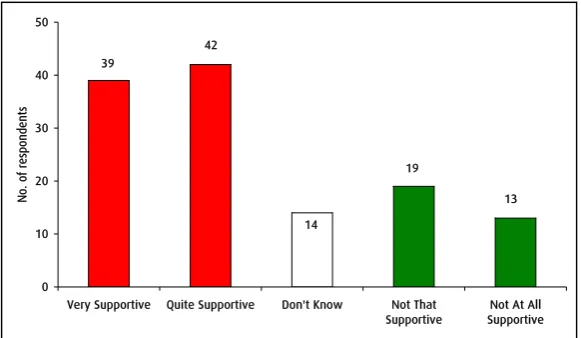
Respondents were asked for their level of support for a subjective or self
reported measure of wellbeing on a five point scale. The results show that the majority of respondents were very or quite supportive of such a measure.
9Collated from responses to question three of the