The discourse of a ‘smart’ technology:
implications for educational practice
Charles Crook
School of Education,
Learning Sciences Research Institute, University of Nottingham,
NG81BB, UK
Email: [email protected]
Abstract: The term ‘smart’ has become widely and sometimes carelessly employed in relation to contemporary design. However, in certain areas of cultural practice it also has acquired a more specialised and focussed meaning. One such area is education. The present paper explores the discourse of smart as it is emerging in relation to both educational technologies and educational spaces. The characteristics of smart learning tools and smart sites for learning with such tools are defined in terms of their capability for organising regulative interactions. However, it is argued that these artefacts and these spaces can not be fully productive unless they are enveloped by a framework of human intelligence and judgement. This locates the teacher has having an important, novel, and distinctive role in the management of smart education. The range of such responsibilities is illustrated and related to contemporary themes in the psychology of learning.
Keywords: smart; learning; technology; teachers; discourse.
Reference to this paper should be made as follows: Crook, C. (xxxx) ‘The discourse of a ‘smart’ technology: implications for educational practice’, Int. J. Smart Technology and Learning, Vol. X, No. Y, pp.xxx–xxx.
Biographical notes: Charles Crook is Professor of Education and Director of the Learning Sciences Research institute at the University of Nottingham. His academic background is in developmental and cultural psychology.
1 Introduction
Any concept like this – that is, one that migrates across spaces of theorising – is bound to bring with it a certain baggage of existing meanings. So it would help to identify the continuity of reference that the term ‘smart’ imports into education from its various other relationships. It may transpire that the structure and goals of educational practice differ from those obtaining within other contexts where the term ‘smart’ is applied. For example, in many contexts of application ‘smart’ is judged to be ‘good’. Yet, it will be suggested later in this paper that educational resources judged ‘smart’ need not be automatically ‘good’ – at least, not automatically well designed to the service of learning. They can be made good and, where possible, they should be. The interesting challenge for importing smart discourse into education may be one of understanding how the traditional practices and places for teaching and learning have to adjust to the interactive opportunities (and demands) of those resources we regard as ‘smart’. Here, it will be argued that embracing smart resources creates distinctive responsibilities for teachers.
In what follows, I shall identify how ‘smart’ is entering the discourse of education and then comment on its heritage, as apparent from how it functions in other domains of design activity. This will lead to characterising its use in terms of two kinds of relationship: adaptive smart and regulative smart. The second is of most relevance to educational design. But I will argue that adopting such smart educational technologies, or working in such smart educational spaces, brings a challenge of ‘management’. Such resources do not serve us to the full unless they are enveloped with a form of intelligence that is classically human and interpersonal. The discussion will end with some suggestions for useful future research on the implementation of smart educational worlds.
2 Getting ‘smart’ into education
Within commentaries on educational practice, we might expect to find the phrases ‘smart teaching’ and ‘smart learning’. They certainly exist (e.g., Ambrose et al., 2010; Chen et al., 2014). Yet, they do not seem to have acquired any tightness of reference. The same applies to the phrase ‘smart school’. For example, in Malaysia this is the favoured term for a recent transformation of the national education system. But, in practice, it seems to refer to rather non-specific (if admirable) investment in general educational ICT (Bajunid, 2012). The same breadth of definition can also sometimes be found for ‘smart classrooms’. Thus, Li et al. (2015) observe: “Now, many classrooms have connected with internet and equipped with a variety of advanced information devices, such as tablet PCs and interactive whiteboards. The type of classroom is named as smart classroom, intelligent classroom, or classroom in the future.” In other words, the label ‘smart’ used this way merely means a technically well-resourced context, it does not imply any particular functionality. Such hardware-defined meaning is sometimes tuned to be more specific: Middleton (2015) links the phrase ‘smart’ to any learning that involves smartphones or tablets.
As it happens, for some educational commentators this term has already been adopted with a greater precision of meaning. It tends to revolve around two particular phrases: ‘smart learning technology’ and ‘smart classroom’. These and their implications need to be understood. After all, ‘smart’ is not the only adjective that might be attached to educational resourcing. Technologies and classrooms can be totalised in other ways. So they have also been celebrated as, for instance, ‘immersive’ (Appelman, 2004), ‘constructivist’ (Marlowe and Page, 2005), ‘participative’ (Landau and Meirovich, 2011), ‘collaborative’ (Voyiatzaki and Avouris, 2012), ‘inquiring’ (Kawalkar and Vijapurkar, 2013), or ‘communities of practice’ (Brown, 2007). Against this background, we might ask what it means to be considered a ‘smart classroom’ or a ‘smart technology’. For these are now equally distinctive educational categories within the above mix of possibilities.
In which case, it helps to start from an awareness that ‘smart’ enjoys extensive currency elsewhere – thereby implying it is a helpful category of design. However, because it has now spread into the discourse of educational practice, it would be wise to notice the fabric of meaning that it imports from that established technical usage. One possibility is that how both educational technologies and designs for educational spaces are characterised as ‘smart’ might encourage theorising that is technologically determinist (Oliver, 2011). Perhaps to label a resource or an environment this way sets up optimistic expectations of impact: ones arising from incautious borrowing from those other contexts where smart things are prominent. Later sections of this paper will address this possible tension.
3 ‘Smart’: unexpected intelligence in simple things
This section considers the emerging use of the adjective ‘smart’ outside of educational contexts. Evidently, the term is an everyday one and so there will be areas where its application becomes vague or disorderly. Google Scholar was recruited here as a tool for sensing the landscape of use: drawing especially on 2015 publications with the word ‘smart’ in their titles. Because my concern is with a technical or systematising sense of the word, it seemed that the general scholarly literature must be the natural space to mine for its presence.
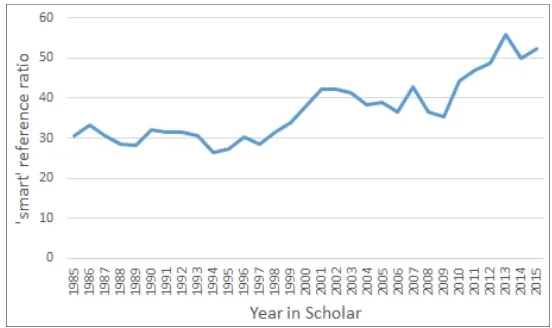
A key motive for the present paper is an awareness that use of the term ‘smart’ is on the increase when discussing designs for cultural artefacts and cultural practices. Figure 1 illustrates this by presenting data from year on year searches in Google Scholar. Occurrences of ‘smart’ are plotted as a percentage of the summed occurrences of both ‘smart’ and ‘intelligent’. Thus, preferential use of this term in the scholarly literature has almost doubled in the past 20 years – when normalised against the use of the term ‘intelligent’ (references to authors called ‘smart’ were excluded as were patents).
localised dimension of capability: that is, something manifest in some particular domain (‘smart at math’, ‘smart at networking’, etc.). Or, to express this intuition more cautiously: when a term is needed that expresses a focussing of competence, then ‘smart’ is a strong contender. So our first conclusion is that ‘smart’ seems to prove a useful adjective when the nature of some effective functioning is focussed or localised in respect of what it achieves.
Figure 1 Reference to ‘smart’ as a percentage of references to the sum of ‘smart’ and ‘intelligent’ in Google School search hits (see online version for colours)
This conclusion would generally apply to discourse that refers to human agents (‘she is smart at math’). However, the growth in use of this term reflects its frequent attachment to non-human referents and, most relevant here, its recent attachment to referents that relate to educational practice (of which more later). For now, let us call these non-human referents ‘simple things’. When something that is familiar and simple is designed with extended functionality, then its natural to seek an adjective to mark this new potential. Things that are inherently simple in structure are not likely to have their functionality extended in terms of breadth or reach. So whatever they do acquire through effective design evolution, it is unlikely to be understood in terms of a greater ‘intelligence’. On the other hand, the ‘targeting’ associations of ‘smart’ could fit well.
This suggests a second tentative conclusion: namely, that the term is useful for celebrating the creative functioning of some simple item which we do not normally expect to display such versatility. Indeed, we may be surprised to find it being claimed. So the idea that trousers can show any kind of functional ingenuity in relation to the world – that they have some sort of agency – this is an unexpected discovery. ‘Smart’ marks the revelation: it invites us to re-conceptualise a familiar place or resource in terms of newly-acquired potential.
So, one way to understand use of this term is to suppose that it applies well to items that traditionally have been understood as stable or inert in how they relate with their environment. And these ‘items’ need not be ‘things’ in the colloquial sense, they can, for instance, be cultural practices. So a book on rethinking regional innovation policy applies the label ‘smart specialisation’ to this theme (Foray, 2015). Why? Perhaps because, in the author’s view, such policy may have grown to become relatively inert: it is seen as a relatively stagnant domain. So reconfiguring it imbues it with a fresh and targeted effectiveness: one that suddenly transforms an inert policy framework into ‘smart specialisation’.
In short, when we think apart from human beings, we are more hesitant to apply the term ‘intelligent’ to the humble things and practices that are created to serve us. So when a familiar artefact or practice gets designed to reach beyond its familiar functioning (trousers, materials, and policy frameworks), our surprise (and pleasure) demands a term to celebrate it – ‘smart’ does that work. However, this then raises a further question: what forms does this ‘reaching beyond’ take when we find it in simple and inanimate things? What particular characteristics of functioning make our more mundane artefacts and practices seem to become ‘smart’?
4 Smart designs: adapting to, and regulating environments
The starting point for smartness is receptivity to an environment: specifically, an item that changes some property of itself in relation to the varying properties of its context. So, for things to be smart they must at least be ‘dynamic’ in this sense. Then, a possible basis for being ‘smart’ would be if the form of this change relationship proved productive or ‘adaptive’ for that item: that is, a dynamic relationship with its world that allows it to thrive. Yet, convention seems to require that this capacity for adaptation must be more than simply a property of nature or an outcome of natural forces of change. For instance, there may be an uneasiness about calling plants ‘smart’ simply because they come into leaf at certain times of year, or manifest colours that ensure pollination, or produce a chemical that effects repair after insect wounding (Ballare, 2001). These properties are adaptations that arise from long periods of natural selection. Employing the term ‘smart’ for environmental adaptations that are the outcome of gradual biological evolution seems to be too generous a use
viability has been protected by design features that allow it to change its structure and thereby adapt itself to environmental threats. The insentient nature of buildings ensures that we can not expect them to evolve this adaptability by analogy with natural selection. Instead, it is a feature that has been engineered into them by human design: they are ‘simple things’ that have been distinguished with an adaptive capacity that thereby invite the labelling ‘smart’.
We might term this kind of design ‘adaptive smart’ – a very basic realisation of the quality under consideration. ‘Basic’, because it is a rather one-sided encounter: the building changes, the seismic activity does not. However, there is a second form of adaptive reaction that is more two-sided. This might be termed ‘regulative smart’ and it implies a property of instrumentality. This is because regulative smartness would involve manifesting both a conventional capacity for detecting external events, but also a further capacity for causing changes in the very environment that generates these events. The output from the smart thing detecting environmental events becomes the input for its act of environment adjustment. The domestic thermostat could be an example of this.
This bi-directional potential of design shifts us from a vocabulary of ‘smart structures’ (dampened buildings, say) to one of ‘smart technologies’ (thermostatic mechanisms, say). Or, from ‘adaptive smart’ to ‘regulative smart’.
In the first case, the smartness is intrinsic to the design of the structure. Although it is ‘intrinsic’ according to a particular dynamic form: one that involves reading the environment and then self-adjusting on the basis of that reading. For example, dampers make a building smart because their presence achieves physical stability through reading the environment and self-adjusting. Having very deep and strong foundations may also ensure the stability of a building but we would more likely call such a design ‘strong’ rather than ‘smart’.
In the second case – that is, a smart technology – the adaptation is more than this. It is ‘regulative’, because the design is instrumental. The events detected do not simply cause effective adjustments to the device doing the detection (self-adaptation). These adjustments become a basis for effecting change in an external world that is the very source of those events. Metals change shape in response to temperature changes: these alterations of shape then trigger a heating element that resets environmental temperature. This iterative complexity of regulation requires an approach that is more about systems than structures. Anderson and Brynskov (2007, p.214) express what this involves by commenting: “…predicates such as intelligent, smart, sloppy, inefficient, and so forth are in the first place predicates of networks, not of their parts. Only analytically can one of its participants be singled out as the main factor.”
This systemic orientation to ‘smart’ has been introduced in relation to human engineering. Examples have largely concerned elements in the physical world (materials, chemicals, etc.) whereby a dynamic relationship with their environment has been mobilised into designs that manifest adaptive or regulative intelligence. Human engineering thereby inserts these dynamically responsive elements into configurations that we term ‘smart’ – at least when those configurations protect the viability of their structures or regulate activity within their systems.
In passing, it has been acknowledged that this same process of ‘rendering smart’ might be applied to cultural practices as well as to material things. Such practices commonly undergo development via cultural evolution, perhaps by analogy with biological evolution. Indeed, Skinner (1984) elaborated this analogy, invoking the vocabulary of natural selection as a credible way of thinking about cultural change. So some version of survival-of-the-fittest logic may be one way to understand changing patterns of cultural practice. However, there may be more going on in the case of culture. It may be a distinctive feature of human agency that we reflect on our practices and intentionally intervene to ‘engineer’ them into change – one that is thereby abrupt or discontinuous. In doing so, we seem to override the gradual and natural processes of social evolution: we design our own ecology. The example was given above of ‘smart specialisation’ – a concept derived from efforts to re-configure innovation policy. It was invoked as a form of cultural practice and one that was rendered smart by an intentional effort to re-configure something that had grown to be inert. In sum, the language of ‘smart’ may be usefully applied to cultural practices when intentional interventions in their design render them increasingly adaptive to a fluid and changing environment.
5 Enveloping smart with intelligence
Points made so far can be summarised as follows. It has become common to ascribe smartness to inaminate things. This is sometimes done in careless ways but there is nevertheless an underlying pattern to the use of this term. ‘Smart’ seems to fit where the effective quality in some referent is localised and/or when it is relatively unexpected to find it there. The quality itself concerns a capacity for adaptation to a changing environment and, sometimes, a capacity for the regulation of that environment. The things that are increasingly termed ‘smart’ in these senses may be materials or structures (organic or inorganic), technologies, spaces, or cultural practices. Interest here is in the implications of this term as it relates to teaching and learning. As such, the remainder of this discussion dwells upon uses that concern educational technology and educational spaces.
This means a special concern for defining ‘smart’ as it is applied to these particular referents. That is, what it means to label classrooms (or their resources) as ‘smart’ – in contrast to ‘collaborative’, ‘immersive’, ‘participative’, and so on. However, this will be done (in the following section) with special attention to issues around what might be termed ‘the management of smart’. It is because the intelligence of smart things may involve a focussing of targets and a narrowness in their range, that this must imply a scope (and sometimes need) for their effective management.
as parameters. So, a thermostat has a target temperature; a smart drug has a receiver operating characteristic. Where such smartness is incorporated into situations of complex human activity, there may be judgements to be made (or possibly overlooked) about what the right parameters should be for preferred functioning. Put another way: the smartness of things will often need to be enveloped by an overarching intelligence. Where the contexts of smart-enabled activity involves education, then this must be a responsibility of teachers.
However, to further reinforce the point about the importance of judgement, it is useful to consider how it is demanded in a smartness example taken from a domain other than education. Spigel (2005) quotes the designer Stephen Intille commenting on his team’s approach to supporting the elderly in ‘smart homes’: “The popular vision of the house of the future is where you hardly have to get up from your easy chair. That’s not ours at all. We want the house to enable you to lead a more active and richer life – and encourage you to do things, not to have them done for you.” This does not deny that there will always be some parameters of such smart home functioning that are necessary and uncontroversial. However, there are others that call upon judgement – considerations about what is ‘best’ or most enriching for the individual occupant. This is especially likely when the recipients of smart resources are vulnerable or frail. It is also likely when the recipient is a novice or a learner within the designed domain.
It seems a bold, but appropriate, attitude to design smart homes for the elderly that are challenging their residents – inviting them to resist inertia and thereby promote rich activity. Surely a similar attitude should prevail in the environments of young people engaged in learning. Smartness of resourcing should not create an ‘easy chair’ approach to learning, it should be stimulating and challenging. Because smart resourcing aims to achieve these ends, it must be wrapped up in human intelligence (particularly via the actions of teachers). Smart learning technology demands an orchestrating environment. This suggests a more useful basis for defining the ‘smart classroom’.
6 Smart classrooms: furnishing the envelope of intelligence
The appeal of ‘smart’ discourse to educationalists is reflected in the recent formation of the ‘International Association for Smart Learning Environments’ or IASLE (http://www.iasle.net/). Yet, as acknowledged at the start of this paper, much academic discussion of smart classrooms remains careless about defining what it means to call them ‘smart’. Often the conception may be framed in terms of learner cognitive and social outcomes: what students become by learning in a particular setting [cf. Spector, (2014) for one such list]. So this means a ‘smart classroom’ is defined as a classroom that produces graduates with certain cognitive and social competences. Other definitions merely refer to an abundance of ICT devices and thus a general commitment to the promise of digital tools (Li et al., 2015). Such resourcing may be said to be ‘ubiquitous’.
environment. So some homes may be termed ‘smart’ by virtue of creating such an aggregation of smart resources (Intille, 2006).
It might be thought enough to define a smart classroom as a learning space that has simply aggregated smart (learning) technologies in this sense. Hwang’s (2014, p.2) definition captures the idea of such a place that: “…not only enables learners to access digital resources and interact with learning systems in any place and at any time, but also actively provides the necessary learning guidance, hints, supportive tools or learning suggestions”. However, following from the points about managing smart made in the last section, it is suggested here that any claim to be a smart classroom needs to be based on an active culture of smart management. These technologies need to be experienced in an envelope of human intelligence and support.
The simple vision of the smart classroom as being technology-in-ubiquity introduces the first of three senses to be discussed here in which teachers must be implicated in the active management of ‘smart’. When this ‘ubiquitous’ term is applied to technology in other areas of human activity, its use implies rather more than ‘widespread’. It implies a degree of seamless embeddedness in the environment: one that renders the technology invisible, making itself ready-to-hand at moments of routine communication or information need (Weiser, 1993). It is the implication of this tight integration with learner activity that raises some of the concerns of management under consideration here.
6.1 Managing strategic ubiquity
Furnishing plentiful digital access can only be welcomed. But seamless ubiquity does not by itself make environments ‘smart’. That description is best reserved for when delivery of this ubiquitous information is more strategically managed. For as Fischer (2012) points out, while such contexts may have no scarcity of information, what is scarce for most users is attention. “Rather than creating an information overload problem, the context should be used to deliver the ‘right’ information, at the ‘right’ time, in the ‘right’ place, in the ‘right’ way to the ‘right’ person” (p.288, italics as original). Smartness depends on not just creating a ubiquity of resource, it depends also on targeting the information it provides: achieving the ‘right’ patterning of access.
Therefore, human filtering or directing should take place that is strategic: management that helps the learner cope with the daunting volume of information that ubiquity makes available. Yet, getting Fischer’s (2012) time, place, manner, and target ‘right’ is a considerable challenge. Solutions can take two broad forms. First, services that deliver information can employ searching algorithms that are made receptive to the skilfully-formulated requests of a student. Consider a student using a smart information search tool. Effective outcome in the system depends not only on the programming of the tool, it depends on the ‘programming’ of the user – because the judged smartness of the tool depends on the interrogation capability of its student partner. That capability has to be acquired by them somewhere else. It might be acquired through social osmosis from witnessing the searching activity of peers (Moraveji et al., 2011). However, it is more likely to be developed through the efforts of human teachers (Henry, 2006; Jones, 2009), thereby identifying the management of information literacy as an important teaching role – for making the learning environment become smart.
calculating the user’s needs – when users do not have the skills to dictate them personally. The successful achievement of such calculations is key to many designers’ vision for smart learning resources. In outlining such a vision of the ‘ubiquitous smart campus’, Atif et al. (2015, p.224) note how their approach “…is able to profile learners and record their behaviors”. Accordingly, in the smart learning environments described by de Oca et al. (2014, p.13): “…not only is learning being monitored, but it is also being analysed, and can therefore be considered a bottom-up approach to improving learning”.
Perhaps promise of ingenious artefacts for ‘improving learning’ is encouraged by seeing smart technology achieve similar rewards for more everyday user desires. The analogy of recommender systems familiar in shopping and media consumption may come to mind. However, education and retail differ in important ways. Enlightened education should be more disruptive than convivial shopping. It should aim to challenge its user (the learner), whereas enlightened retail strives to match the established preferences and habits of its user (the customer) – although see Brown (2001) for a radical re-thinking of such retail design.
It is interesting that this same tension of juggling challenge versus stability has been exercised in the context of smart homes. As noted earlier, the worry lurking in designing them for the elderly is that the home could become a narrow disciplinary agent – only encouraging routine behaviours relating to diet, exercise, and medication. There is surely a parallel worry for smart learning places. The managers of educational spaces must resist any forces that channel student inquiry along firm and familiar tracks rather as smart homes may channel leisure. Adopting a metaphor from everyday life: the management of information spaces (such as the internet) should afford encounters with information ‘strangers’ [as celebrated in Arendt’s (1958) considerations of urban space]. The danger of inhibiting such serendipity and openness of exploration has been characterised by Pariser (2011) as a form of rigidly structured information delivery that traps us into what he terms ‘filter bubbles’. Once again it is difficult to see how this can be well moderated without teacher intervention and imagination.
So in this first example of managing the smart learning encounter, the central task was one of cultivating powers of interrogation in the learner – rather than depending too much on the regulative smartness of devices. This involves cultivating a species of digital literacy in students: whereby the learner in some smart resource interaction becomes skilled at input that exploits the computational strategies of the technology – rather than being a passive victim of them.
This first example of managing the smart learning encounter has addressed the smart environment broadly: as a plentiful space of smart inquiry tools. The next example is one based on orchestrating smart learning encounters with other sort of tools for learning: it concerns the need to manage such encounters so as to foreground learning over (mere) performance.
6.2 Managing cognitive prosthesis
to work by allowing us to ‘outsource’ mental computations into the physical world (Dror and Harnard, 2008). Using a digital calculator might be an example. Computations it would be possible to do as mental operations are outsourced, such that the mind becomes ‘extended’ into the world as its computational activity loops into and out of the calculator.
Yet, the value of such cognitive tools depends on how their use is managed. For instance, a spell checker allows the mind to be ‘extended’ by outsourcing the work of spelling. The technology might thereby be termed ‘smart’ by virtue of its reading an input and giving feedback or correction. However, there is a risk that the context for such adaptive feedback functions as a ‘performance environment’, as opposed to a ‘learning environment’. A spell checker may help us perform spelling but there remains debate as to whether it helps users learn spelling. A similar example is easy to construct for GPS technologies and learning the geography of an area.
So what is taken from this second example is again the necessity of a management role for the ‘smart classroom’ teacher: taking responsibility for shaping performance interactions into becoming learning interactions. In a case such as the spell checker, it may be hard for learners to adopt a mindful attention to what the tool does. Indeed, it may be a price of such convivial tools that we are led to suppress active attention to how they direct what we are doing – attention necessary for real learning. Teachers on the other hand might create (and oversee) exercises in which learners were required to exercise such reflection – thereby turning a ‘mere’ performance (smart) technology into a learning (smart) technology.
6.3 Tutorial interactions
One aspiration of smart interaction designers is to re-create the traditional educational experience of tuition: that is, an informed and sympathetic voice tracking a learner’s progress through some problem space. There exists an extensive literature around such intelligent tutoring systems. They furnish the third smart design theme to be considered here: as before, in terms of identifying roles for the teacher in a smart context, and identifying continuities and discontinuities between educational and other contexts of smart design.
A classroom tutorial encounter is an instance of the more general case of ‘structured guidance’. Guidance routines employing technology have been successful in other smart settings. For instance, Hoey et al. (2010) report a smart process for guiding individuals with dementia into successful hand washing. In the clinical domain, it may be enough to simply direct each performance of the target activity (hand washing) to successful completion. However, if the domain is a traditional school curriculum, then ‘success’ involves sustaining effective performance when the scaffold of smart support is removed. Moreover, success defined in this context might be expected to generate further understandings – taking what is learned beyond the narrow space of what was explicitly tutored.
Tutorial guidance with smart technology typically entails:
1 specifying rules that direct the machine interpretation of user actions
The characteristic discipline and elegance of such programming should not imply that human learning naturally proceeds in an orderly (or well understood) fashion. For example, a central problem in designing for learning has been termed the ‘assistance dilemma’ (Koedinger et al., 2008). This dilemma addresses a long-running tension between whether learning is best supported through direct instruction or through facilitating the learner’s personal acts of discovery. Such discussions typically converge on a view that this is not an either/or judgement: the challenge is one of determining the right balance of these two formats for learning (Lee and Anderson, 2013).
Unfortunately, research has revealed a wide range of factors determining the right parameters for that balance. For example, there is the ‘expertise reversal effect’: whereby direct instruction works increasingly less well as student expertise in a domain accumulates – requiring understanding of a progress trajectory that governs the gradual fading in of more discovery experiences. Judgements of this kind are a challenge for the design of smart resources (Saiden et al., 2009).
The more comfortable success of guided interactions in smart systems outside of education may encourage metaphors such as ‘learning production workflows’ for the classroom [Artif, (2010), p.259]. This suggests a vision of: “…pedagogical processes through which learning is diffused just-in-time like a production process, when individual learners are ready to achieve a targeted level of instruction” [Atif et al., (2014), p.28]. These are worthy goals but ‘just-in-time’ will often not be as easy to diagnose as in ‘production processes’ orchestrated in systems elsewhere. For example, in programming learning episodes that guide a student through structured sequences of activity, it is surely tempting to design for orderly and frequent successes. Yet, there are accounts of learning that demonstrate the value for learners of failing (e.g., Kapur and Bielaczyc, 2012). And there is certainly a body of research that demonstrates the value of the learner’s struggle or their encounters with ‘desirable difficulties’ (Schmidt and Bjork, 1992) – these arrangements must compete with the common sense expectation that learning material should be always presented as explicit and all-inclusive instruction.
All of this implies that effective guidance is a nuanced process. Teachers are likely to be important in orchestrating any initiative whereby such guidance is mediated through the programming of smart technology. Although this ‘orchestration’ metaphor may not adequately imply the richness of what a teacher normally does when it is only them that is the partner-in-guidance (rather than a programmed system). Observation of skilled tutors suggests a form of interaction ‘management’ that is more than simply strategic insertions of advice or reinforcement. Such narrow conceptions may be encouraged by the fashionable discourse of teachers being ‘guides on the side’ (King, 1993) – a view sometimes aligned with the social constructivism made popular through Vygotsky’s (1933/1978) writing and the scaffolding metaphor of Wood et al. (1976). However, Vygotsky’s own formulation of such an expert’s scaffolded guidance was built more around notions of the expert’s participation in a shared activity – rather than simply their ability to calculate and contribute timely hints or answers. From engaging with a richer and more participative strategy, the learner might then internalise the very structure of a task solution and thus move forward in learning.
a too-ready extrapolation of guidance strategy from other smart environments. In these cases, much depends on a smart engine or environment being able to read the learner’s context – because its action is a considered calculation on that data. While this may feel a tractable problem in many other environments of smart design, it can be challenging in relation to learners and their educational context. As Fischer puts it: “context is more than a fixed entity to be inferred from sensors in a physical environment… or that can be restricted to user modelling techniques in environments in which users are limited to activities envisioned in detail at design time” [Fischer, (2012), p.292].
7 Summary
This paper began by noting the rather flamboyant manner in which the term ‘smart’ gets attached to all sorts of everyday artefacts and locations. Often this way of talking implies no more than the engineering of a more advanced functionality. So simple ID cards become ‘smartcards’, inert whiteboards become ‘smartboards’, digitised locks become ‘smart locks’. In marketing terms, when some everyday item enjoys an upgrade in functionality, the adjective ‘smart’ probably attracts the required customer attention. This is harmless enough. But it is a practice that competes with more targeted and considered use of the term and, as such, tends to conceal or dilute the challenges and implications of that specialised application.
‘Dilution’ matters when it is distracting attention from a critical analysis of the more technical use of the ‘smart’ adjective – and the promises its use may come with. Adopting such a critical stance has been one purpose in the present discussion. If a serious and focussed use for ‘smart’ is evolving in educational practice, then it is appropriate to give that use scrutiny – and not be distracted from doing so. It is true that within the arenas of educational practice the term can also be deployed with a certain careless abandon. But there has nevertheless developed a distinct and legitimate discourse of ‘smart’ alongside these more diffuse uses of the term.
In examining that use here, we have recognised a link between the ‘regulative smart’ characteristics ascribed to certain everyday artefacts and a ‘smartness’ that can be designed into educational artefacts. We have converged upon a discussion that stresses the significant responsibility of the teacher in managing the learner’s experiences of both smart educational technology and smart educational environments.
This is easy to overlook: especially when the discourse of smart is motivated by a general commitment to learner-centred methods. Such a perspective may mean that smart educational technologies are designed in a well-intentioned spirit of passing responsibility from teachers to learners. While cultivating autonomy in students must always be welcomed, achieving this through smart interventions will involve a re-configuration of the teachers’ role, not a replacement of it. The risk may be in thinking that the only thing that teachers do is the read-and-respond cycle associated with classic instruction. In practice, that may be what often is what is being done. But teachers do many other things beyond such instructional engagements: for instance, they explicate, facilitate, orchestrate, collaborate, participate, and congratulate.
to the designs of smart technology. They represent a psychological framework that has to envelop the use of educational technologies, if engagement with them is going to be effective. As Scardamalia and Bereiter (2014) observe in welcoming the potential of smart technology: “There needs to be some glue. The glue nature gave us is discourse”. Attention to this social glue will ensure that educational practice need not be disturbed from its long-standing investments in being a deeply social and human experience.
In short, technical innovation centred around the design of adaptive guidance and feedback – smart educational technology – must be applauded. Yet, after reviewing its status here, a number of research challenges can be identified. They are by no means obstructive to the progress of that innovation but they highlight areas deserving vigilance in design and progress in research.
8 Future challenges
In a paper concerned with smart education, it might seem natural to end on research imperatives that were about making educational devices and spaces even smarter. Yet, it may be that the most urgent research also concerns how we cultivate the teaching skills and regimes that support the creative use of these resources. In this final section, I suggest four themes where greater understanding would be welcome – to inform the implementation of smart educational practice.
8.1 Analytics and privacy
Liu and Slotta (2014, p.62) give a vivid characterisation of the smart classroom: “…where the physical environment (e.g., walls, furniture, etc.) is infused with carefully designed digital tools and materials to support student interactions across multiple social planes, scaffolding seamless and dynamic collaboration, enhancing real-time face-to-face interactions and capturing the collective wisdom of the entire class”. An ungenerous notion that might then come to mind is ‘surveillance’. Yet, we do live in times where surveillance and privacy have become matters of great social concern. It is not clear whether the monitoring of everyday life will leave students immune to it or leave them concerned about it – in particular, when it is configured into their classrooms. That is an empirical issue that has received little attention and deserves more. Although the rise of learning analytics has begun to stimulate debate around the ethical issues that follow (Slade and Prinsloo, 2013).
8.2 Information literacy for smart interactions
8.3 Learning stalled at performance
It has been suggested here that some smart educational innovations may draw design inspiration from the successes of such other domains as smart homes and smart buildings. If there is such inspiration to be taken, it should be from the perspective of designers such as Intille (2006, p.3): “Rather than striving to create computer technology that ubiquitously and proactively manages the details of the home, perhaps researchers should aim to create technology that requires human effort in ways that keep life mentally and physically stimulating as people age”. This is not questioning the ambition to render environments rich in smart technologies – it is questioning what design the affordances for smart interaction should take. Translated into the domain of classrooms and learning (rather than homes and well being), this position reminds us that performance and learning are not necessarily co-related outcomes of adaptive interaction. The successful guidance of classroom tasks is not simply to achieve a transitory successful performance. It must always be intended that such performances involve learning: that is function as a platform from which the student builds new knowledge and lasting understanding. Design research should help us understand what social structure of motivation and support allows successful performance to stimulate successful learning.
8.4 Understand effective instructional dialogue
This theme has always engaged educational research. However, the emergence of technologies that are smart in the present sense of hosting regulating dialogue makes such research still more urgent. There is a danger of carelessly designing on the basis of standard educational practice – which some reviews show to be often poorly grounded (Rohrer and Pashler, 2010). The developing literature on effective failure, desirable difficulties, expertise reversal, and so on is a reminder of how delicately balanced the design of learning sequences needs to be.
References
Ambrose, S.A., Bridges, M.W., DiPietro, M., Lovett, M.C. and Norman, M.K. (2010) How Learning Works: Seven Research-Based Principles for Smart Teaching, John Wiley & Sons, San Francisco, CA.
Andersen, P.B. and Brynskov, M. (2007) ‘The semantics of smart appliances and pervasive computing’, in Gudwin, R. and Queiroz, J. (Eds.): Semiotics and Intelligent Systems Development, pp.211–255, Idea Group Publishing, Hershey.
Appelman, R. (2004) ‘Designing experiential modes: a key focus for immersive learning environments’, TechTrends, Vol. 49, No. 3, pp.64–74.
Arendt, H. (1958) The Human Condition, University of Chicago Press, Chicago.
Atif, Y. (2010) ‘An architectural specification for a system to adapt to learning patterns’, Education and Information Technologies, Vol. 16, No. 3, pp.259–279.
Atif, Y., Mathew, S.S. and Lakas, A. (2014) ‘Building a smart campus to support ubiquitous learning’, Journal of Ambient Intelligence and Humanized Computing, Vol. 6, No. 2, pp.223–238.
Ballare, C.L. (2001) ‘Smart plants or stealthy bugs?’, Trends in Plant Science, Vol. 6, No. 4, p.142. Brown, R. (2007) ‘Exploring the social positions that students construct within a classroom
community of practice’, International Journal of Educational Research, Vol. 46, Nos. 3–4, pp.116–128.
Brown, S. (2001) ‘Torment your customers (they’ll love it)’, Harvard Business Review, Vol. 79, No. 9, pp.82–88.
Chen, G., Kumar, V., Kinshuk, Huang, R. and Kong, S.C. (Eds.). (2014) Emerging Issues in Smart Learning, Springer; Heidelberg, New York, NY; Dordrecht; London; Berlin.
Chopra, I. and Sirohi, J. (2013) Smart Structures Theory, Cambridge University Press, New York. Clark, A. and Chalmers, D. (1998) ‘The extended mind’, Analysis, Vol. 58, No. 1, pp.7–19. de Oca, A.M.M., Nistor, N., Dascalu, M. and Trausan-Matu, S. (2014) ‘Designing smart
knowledge building communities’, Interaction Design and Architecture(s), Vol. 22, No. 1, pp.9–21.
Dror, I.E. and Harnad, S.R. (2008) Cognition Distributed: How Cognitive Technology Extends Our Minds, John Benjamins Publishing, Amsterdam.
Fischer, G. (2012) ‘Context-aware systems: the ‘right’ information, at the ‘right’ time, in the ‘right’ place, in the ‘right’ way, to the ‘right’ person’, in Proceedings of the International Working Conference on Advanced Visual Interfaces, ACM, New York, NY, USA, pp.287–294. Foray, D. (2015) Smart Specialisation: Opportunities and Challenges for Regional Innovation
Policy, Routledge, London.
Henry, L.A. (2006) ‘SEARCHing for an answer: the critical role of new literacies while reading on the internet’, The Reading Teacher, Vol. 59, No. 7, pp.614–627.
Hoey, J., Poupart, P., Bertoldi, A. von, Craig, T., Boutilier, C. and Mihailidis, A. (2010) ‘Automated handwashing assistance for persons with dementia using video and a partially observable Markov decision process’, Computer Vision and Image Understanding, Vol. 114, No. 5, pp.503–519.
Hwang, G-J. (2014) ‘Definition, framework and research issues of smart learning environments – a context-aware ubiquitous learning perspective’, Smart Learning Environments, Vol. 1, No. 1, pp.1–14.
Intille, S.S. (2006) ‘The goal: smart people, not smart homes’, in Proceedings of the International Conference on Smart Homes and Health Telematics, Belfast, UK, pp.3–6.
Jones, G.J.F. (2009) ‘An inquiry-based learning approach to teaching’, Information Retrieval, Vol. 12, No. 2, pp.148–161.
Kapur, M. and Bielaczyc, K. (2012) ‘Designing for productive failure’, Journal of the Learning Sciences, Vol. 21, No. 1, pp.45–83.
Kawalkar, A. and Vijapurkar, J. (2013) ‘Scaffolding science talk: the role of teachers’ questions in the inquiry classroom’, International Journal of Science Education, Vol. 35, No. 12, pp.2004–2027.
King, A. (1993) ‘From Sage on the stage to guide on the side’, College Teaching, Vol. 41, No. 1, pp.30–35.
Koedinger, K.R., Pavlik Jr., P.I., McLaren, B.M. and Aleven, V. (2008) ‘Is it better to give than to receive? The assistance dilemma as a fundamental unsolved problem in the cognitive science of learning and instruction’, in Love, B.C., McRae, K. and Sloutsky, V.M. (Eds.): Proceedings of the 30th Annual Conference of the Cognitive Science Society, Cognitive Science Society, Austin, TX.
Landau, J. and Meirovich, G. (2011) ‘Development of students’ emotional intelligence: participative classroom environments in higher education’, Academy of Educational Leadership Journal, Vol. 15, No. 3, p.89.
Li, B., Kong, S.C. and Chen, G. (2015) ‘Development and validation of the smart classroom inventory’, Smart Learning Environments, Vol. 2, No. 3, DOI: 10.1186/s40561-015-0012-0. Liu, M. and Slotta, J.D. (2014) ‘Immersive simulations for smart classrooms: exploring
evolutionary concepts in secondary science’, Technology, Pedagogy and Education, Vol. 23, No. 1, pp.57–80.
Marlowe, B.A. and Page, M.L. (2005) Creating and Sustaining the Constructivist Classroom, Corwin Press, Thousand Oaks, CA.
Middleton, A. (2015) Smart Learning: Teaching and Learning with Smartphones and Tablets, Sheffield Hallam University, Sheffield.
Moraveji, N., Morris, M., Morris, D., Czerwinski, M. and Riche, H.N. (2011) ‘ClassSearch: facilitating the development of web search skills through social learning’, in Proceedings of the SIGCHI Conference on Human Factors in Computing Systems, pp.1797–1806, New York, NY, USA.
Norman, D. (1994) Things That Make Us Smart: Defending Human Attributes in the Age of the Machine, New ed., Basic Books, Reading, Mass.
Oliver, M. (2011) ‘Technological determinism in educational technology research: some alternative ways of thinking about the relationship between learning and technology’, Journal of Computer Assisted Learning, Vol. 27, No. 5, pp.373–384.
Pariser, E. (2011) The Filter Bubble: What the Internet Is Hiding from You, Penguin Press, New York.
Rohrer, D. and Pashler, H. (2010) ‘Recent research on human learning challenges conventional instructional strategies’, Educational Researcher, Vol. 39, No. 5, pp.406–412.
Salden, R.J.C.M., Aleven, V., Schwonke, R. and Renkl, A. (2009) ‘The expertise reversal effect and worked examples in tutored problem solving’, Instructional Science, Vol. 38, No. 3, pp.289–307.
Scardamalia, M. and Bereiter, C. (2014) ‘Smart technology for self-organizing processes’, Smart Learning Environments, Vol. 1, No. 1, pp.1–13.
Schmidt, R. and Bjork, R. (1992) ‘New conceptualizations of practice: common principles in three paradigms suggest new concepts for training’, Psychological Science, Vol. 3, No. 4, pp.207–217.
Skinner, B.F. (1984) ‘The phylogeny and ontogeny of behavior’, Behavioral and Brain Sciences, Vol. 7, No. 4, pp.669–677.
Slade, S. and Prinsloo, P. (2013) ‘Learning analytics ethical issues and dilemmas’, American Behavioral Scientist, Vol. 57, No. 10, pp.1510–1529.
Spector, J.M. (2014) ‘Conceptualizing the emerging field of smart learning environments’, Smart Learning Environments, Vol. 1, No. 1, pp.1–10.
Spigel, L. (2005) ‘Designing the smart house: posthuman domesticity and conspicuous production’, European Journal of Cultural Studies, Vol. 8, No. 4, pp.403–426.
Tarascon, J-M., Simon, P., Tarascon, J-M. and Simon, P. (2015) ‘Smart materials’, in Electrochemical Energy Storage, pp.49–52, John Wiley & Sons.
Voyiatzaki, E. and Avouris, N. (2012) ‘Support for the teacher in technology-enhanced collaborative classroom’, Education and Information Technologies, Vol. 19, No. 1, pp.129–154.
Vygotsky, L. (1933/1978) Mind in Society: The Psychology of Higher Mental Functions, Harvard University Press, Cambridge, MA.
Weiser, M. (1993) ‘Some computer science issues in ubiquitous computing’, Commun. ACM, Vol. 36, No. 7, pp.75–84.