to Bacterial Attachment-Resistant (Meth)acrylate Polymers
Kevin Adlington, Nam Trong Nguyen, Elizabeth Eaves, jing yang, CHIEN YI CHANG, Jianing Li, Alexandra L. Gower, Amy Stimpson, Daniel G. Anderson, Robert Langer, Martyn C. Davies, Andrew L. Hook, Paul Williams, Morgan Russell Alexander, and Derek J Irvine
Biomacromolecules, Just Accepted Manuscript • DOI: 10.1021/acs.biomac.6b00615 • Publication Date (Web): 26 Jul 2016 Downloaded from http://pubs.acs.org on July 27, 2016
Just Accepted
Application of Targeted Molecular and Material Property Optimization to
Bacterial Attachment-Resistant (Meth)acrylate Polymers
Kevin Adlington,a Nam T. Nguyen,a,b Elizabeth Eaves,a,b Jing Yang,c Chien-Yi Chang,c,d Jianing Li,a,b Alexandra L. Gower,a Amy Stimpson,a Daniel G. Anderson,e Robert Langer,e Martyn C. Davies,f Andrew L. Hook,f Paul Williams,c Morgan R. Alexander,f* and Derek J.
Irvinea*
a Department of Chemical and Environmental Engineering, Faculty of Engineering,
University of Nottingham, Nottingham, NG7 2RD, UK.
b School ofChemistry, University of Nottingham, Nottingham, NG7 2RD, UK. c Centre for Biomolecular Sciences and School of Life Sciences, School of Chemistry,
University of Nottingham, Nottingham, NG7 2RD, UK.
d Current address - School of Life Sciences, Heriot-Watt University, Edinburgh, EH14 4AS,
UK.
e Department of Chemical Engineering, Institute for Medical Engineering and Science,
Harvard-MIT Division of Health Sciences and Technology, David H. Koch Institute for Integrative Cancer Research, Massachusetts Institute of Technology, 500 Main Street,
Cambridge, MA, 02139, USA.
f Laboratory of Biophysics and Surface Analysis, School of Pharmacy, University of
Nottingham, Nottingham, NG7 2RD, UK.
Abstract
Developing medical devices that resist bacterial attachment and subsequent biofilm formation
is highly desirable. In this paper, we report the optimization of the molecular structure and
thus material properties of a range of (meth)acrylate copolymers which contain monomers
reported to deliver bacterial resistance to surfaces. This optimization allows such monomers
to be employed within novel coatings to reduce bacterial attachment to silicone urinary
catheters. We show that the flexibility of copolymers can be tuned to match that of the
silicone catheter substrate, by copolymerizing these polymers with a lower Tg monomer such
that it passes the flexing fatigue tests as coatings upon catheters, that the homopolymers
failed. Furthermore, the Tg values of the copolymers are shown to be readily estimated by the
Fox equation. The bacterial resistance performance of these copolymers were typically found
to be better than the neat silicone or a commercial silver containing hydrogel surface, when
the monomer feed contained only 25 v% of the ”hit” monomer. The method of initiation
(either photo or thermal) was shown not to affect the bacterial resistance of the copolymers. 2
Optimized synthesis conditions to ensure that the correct copolymer composition and prevent
the onset of gelation are detailed.
Introduction
Biofouling, or the formation of biofilms on the surfaces of devices/implants/manufactured
structures, represents a major problem for the application of such constructs in
industrial/market sectors such as medical implantation, healthcare devices, aerospace, marine
structures, oil recovery and in manufacturing industry.1 The formation of biofilms is hugely
undesirable as can lead to many negative effects during device use/application, from the
development of infection or irritation in medical or healthcare applications through to
increased fuel demand in transportation uses due to increased drag and blockage/erosion of
pipes in manufacturing plants. Consequently, the development of novel biofouling-resistant
materials or coatings which outperform existing commercial benchmark materials will deliver
enormous economic and societal benefits.
In the particular area of medical devices, the presence of bacterial biofilms (i.e. surface
attached communities of bacterial cells embedded in a self-generated exopolymer matrix)
leads to greater persistence, since bacteria within biofilms exhibit up to 1000 times greater
resistance to the action of both antimicrobial additives/agents and the host’s natural immune
defenses than their free-living (planktonic) counterparts.1b, 2 The current methods for reducing
biofilm associated infections typically focus on the modification of the materials used to
manufacture in-dwelling medical devices via the incorporation of antibiotics, or other
antimicrobial agents, such as silver salts, nitrofurazone, chlorhexidine, polymerized
quaternary ammonium surfactants, antibacterial peptides and anionic nanoporous hydrogels.3
These approaches are designed to kill bacteria through direct contact with the incorporated
microbiocidal agents. However, these strategies have a number of drawbacks such as cost, the 2
toxicity of the additives, a limited operational lifetime related to the depletion of the active
antibacterial agents from the coating over time, and the potential to contribute toward the
potential development of antibiotic resistant bacterial strains due to an inability to maintain a
therapeutic dose throughout the lifetime of the device. Consequently, new strategies to
combat biofouling have begun to focus on the design of new materials that exhibit an inherent
resistance to bacterial attachment in order to minimize biofilm formation.4 In this case
“inherent” defines that the microbial resistance is achieved from the molecular structure
and/or ordering of the polymer alone, with no additive or active required. Furthermore, in the
case of these copolymers, it has been shown that they do not kill the bacteria and so do not
contribute to the potential selection of resistant strains. Such bacterial attachment-resistant
(BAR) materials could be used on their own or in conjunction with traditional microbiocidal
agent impregnation approaches to achieve greater efficacy of the coating.5 To date, few
materials have successfully achieved this anti-attachment strategy to produce low-fouling
coatings. Those that have been reported include poly(ethylene glycol) brushes,6 and
zwitterionic polymers,7 which have achieved reductions in bacterial attachment of between
1.4 and 25 fold respectively when compared with a native glass surface.
Over the last few decades the use of high throughput materials discovery microarray
screening methods to assess polymers has been demonstrated to be a powerful tool in
identifying materials with desirable properties.8 For example, this type of microarray
screening approach has previously proven useful for identifying polymeric materials that
support stem cell self-renewal.8c, 8f Using such high throughput microarray methods and
commercially available monomers, the authors reported the screening of more than 1300
unique copolymers in nearly 20,000 different bacterial attachment assays.9 This study led to
the identification of the specific molecular motifs in the monomers, and their daughter 2
polymers leading to the discovery of a new class of bacterial resistant synthetic polymers that
produced the highest levels of BAR performance in this first generation screen.9
These resultant “hit” polymers (i.e. those exhibiting high BAR performance) were shown
to exhibit inherent bacterial anti-attachment properties, in other words the polymers alone
generated up to a 30-fold reduction in bacterial attachment compared to silver hydrogel
catheters without the need for a bio-active additive.9 “The BAR performance exhibited by
these coating materials has been attributed to both their weakly amphiphilic nature and the
molecular rigidity of the polymers’ pendant groups.10 For example, the BAR resistance of a
certain subset of these polymers correlated with the presence of pendant hydrophobic
aromatic and cyclic aliphatic hydrocarbon groups only when accompanied by the ester moiety
of a (meth)acrylate, which constituted the polymerizable center. The former provided both the
pendent group rigidity and a segment of hydrophobic character whilst the latter provided a
segment with some hydrophilic nature. Comparison of the BAR performance of these “hit”
monomers with poly(styrene), a very hydrophobic material that contains aromatic pendant
groups not associated with an ester group that is known to support bacterial attachment,
indicated that the ester group was important in attachment prevention. If polymers that exhibit
good BAR performance are to be successfully commercially exploited in coating
applications, they also need to possess suitable mechanical and adhesion properties such that
they can function as viable coatings for a specific target surface/bulk materials. For example,
they may be applied as a coating upon a device such as a urinary catheter and thus will need
to exhibit the same level of flexibility as the matrix material from which catheter has been
made. This will ensure that the resulting coating neither fails in use (e.g. appearance of
cracks) nor restricts the ability to insert the device. Similarly, it will have to adhere well to the
surface structure of the material used to construct the device, so that the coating does not 2
delaminate and expose regions of the native surface, which are likely to promote biofilm
formation.
This paper details initial studies into the molecular optimization and scale up of these
weakly amphiphilic coating polymeric materials as a first step toward developing
commercially viable coating materials that exhibit good anti-attachment performance. The
initial targets were to: (a) obtain “hit” copolymers that exhibit a glass transition temperature
(Tg) such that they would exhibit flexibility that matched that of the catheter material, but
would not be prone to excessive creep at manufacturing/body temperatures (here this was
defined as a Tg in the range to -20 to 15 oC), (b) pass the surface adhesion/compatibility test
set for the target catheter application, (c) increase hydrophilicity of the coating without the
degradation of the bacterial attachment-resistance and (d) achieve successful scale up from a
microarray spot to a 50 g batch scale.
Experimental
Materials; All materials were used as supplied unless stated otherwise. All monomeric
species used in this study, ethylene glycol dicyclopentenyl ether acrylate (EGDPEA), benzyl
acrylate (BA), benzyl methacrylate (BMA, 96%), diethylene glycol ethyl ether methacrylate
(DEGMA, 95%), 3,3,5-trimethyl cyclohexyl methacrylate (TMCHMA, 98%) and isobornyl
methacrylate (IBMA), were purchased from Sigma Aldrich. Bis[(difluoroboryl)
diphenylglyoximato]cobalt(II) (PhCoBF, DuPont) was used as supplied without further
purification. 2,2’-Azobis(4-methoxy-2,4-dimethylvaleronitrile) (V70, 98%, Sigma Aldrich)
was purified by recrystallization with methanol. Dichloromethane (DCM) was molecularly
distilled then dried with molecular sieves.
Polymer synthesis - General Procedure for Catalytic Chain Transfer Polymerization (CCTP):
The typical protocol used for the catalytic chain transfer polymerization synthesis of
poly(‘‘hit’’-co-DEGMA), where “hit” designates one of the monomers of interest identified 2
from the high throughput screening assessment, was as follows. Bis[(difluoroboryl)
diphenylglyoximato] cobalt(II) (PhCoBF, 500 ppm for acrylate/5 ppm for methacrylate) and
2,2’-Azobis(4-methoxy-2,4-dimethyl valeronitrile) (0.5 mol% relative to monomer) were
added to a 500 mL flask under an inert atmosphere. The appropriate quantities of the “hit”
monomers required to make the target (co)polymer, were then added to the flask in the
necessary predefined molar ratio along with dichloromethane (DCM) which was the reaction
solvent in a 1:3 v:v ratio. The subsequent reaction solution was then degassed using at least
two freeze-pump-thaw cycles and an inert argon atmosphere introduced to the flask. The
reaction mixture was then raised to and held at 35 °C for 24 h during which time the
polymerization occurred. After 24 h, the polymerization was terminated by cooling the
contents to room temperature and exposure of the reaction mixture to air with rapid stirring.
NMR spectroscopic analysis was carried out on the crude polymerization solution to
determine conversion and overall monomer composition. The DCM was removed under
reduced pressure at room temperature and this crude polymer was dissolved in HPLC grade
THF for GPC analysis, then the sample was precipitated into an excess of hexane and dried
prior to for DSC analysis being conducted.
Polymer/material characterization - Gel Permeation Chromatography (GPC): In a typical
GPC analysis, an HPLC pump was employed as the solvent delivery system to maintain a
constant, pulseless rate of solvent flow at 1 mL min-1. The polymer solution in THF was
prepared in a GPC vial with Teflon cap at concentration of approximately 7 mg mL-1. The
sample was then injected to the GPC system by an autosampler. The solvent transports the
sample through a series of three columns: one PLgel 5 µm Guard column (Polymer
Laboratories) and then two PLgel 5 µm MIXED-C columns (Polymer Laboratories) which
were kept at 35 oC. The two PLgel 5 µm MIXED-C columns were used to separate the
polymer samples into weight fractions to determine the molecular weight (both number 2
average (Mn) & weight average (Mw)) and dispersity (Ð). After separation, the polymer
fractions were analyzed by the IR detector.
Nuclear Magnetic Resonance (NMR) Spectroscopy:1H and 13C NMR spectroscopic analyses
were recorded at 25 oC using Bruker DPX-300 and AV-400 MHz spectrometers. The samples
were dissolved in deuterated chloroform (CDCl3) (1mg mL-1) to which chemical shifts are
referenced (residual chloroform at 7.26 ppm). Chemical shifts were recorded in δH andδC
(ppm). Analysis of the spectra was carried out using ACDLABS 12 software.
Differential scanning calorimetry (DSC): Glass transition temperatures (Tg) of the product
polymers was determined using a Thermal Analysis (TA) Q2000 Differential Scanning
Calorimeter (DSC) under a nitrogen stream (flow rate 50 mL min-1). Changes in heat flow
were recorded between -50 oC and 90 oC over 3 cycles. A scan rate of 10 oC/min with a 10
minute isotherm at either end of the range was employed. The instrument was calibrated
using indium metal standards supplied by TA Instruments and has a quoted calorimetric
precision and reproducibility of ±0.05% and temperature control accuracy of ±0.1 oC.
Analysis of the data was performed using Universal Analysis by TA and a series of repeat
measurements on a single polymer product showed the standard deviation from the mean Tg
was ±0.35 oC using this software. Unless otherwise stated, the second scan was used to
remove the thermal history of the polymer being analyzed.
Time of flight secondary ion mass spectrometry (ToF SIMS): ToF-SIMS measurements were
conducted on an ION-ToF IV instrument operated using a monoisotopic Bi3+ primary ion
source operated at 25 kV and in “bunched mode”. A 1 pA primary ion beam was used, and
both positive and negative secondary ions were collected from a 100 x100 µm area of each
polymer coating over 10-second acquisition time. Secondary ion masses were determined
using a high resolution Time-of-Flight analyser allowing accurate mass assignment. The
typical mass resolution (at m/z 41) was just over 6000. 2
Material application testing: Dip coating and fatigue testing: Sectioned catheters were
oxygen plasma treated for 5 minutes using a power of 50 W and initial oxygen pressure of 0.4
mbar. Treated catheters were immediately dip-coated with a 20% polymer solution in DCM
for approximately 10 seconds before being gradually withdrawn from the solution. The
samples were then dried in air overnight and at <50 mTorr for at least 7 days. Polymer coatings
were typically between 5 and 10 microns and an example SEM has been included in the ESI document
as Figure S2. Fatigue testing was carried out on a Mayes Servohydraulic testing machine with
a set of Instron wedge grips with ‘V’ jaws. The sample length between the two grips was 6
cm. The sample was bent 500 times and the total distance of movement between the two grips
during bending was 1 cm.
Bacterial strains and assays: Three bacterial species,9 Pseudomonas aeruginosa strainPAO1,
Staphylococcus aureus strain 8325-4 and uropathogenic Escherichia coli strain 536 were
routinely grown on either LB (Luria-Bertani, Oxoid, UK) agar plates at 37 oC or in broth at
37 oC with 200 rpm shaking.9 Bacterial cells were inoculated onto 4 cm sections of coated
catheters as previously described.9 Briefly, prior to incubation with the bacteria, the coated
catheters were washed in distilled H2O for 10 min and air-dried. UV-sterilized catheters were
incubated in 10 mL RPMI-1640 defined medium (Sigma, UK) inoculated with bacteria
(OD600 = 0.01) from overnight cultures grown at 37 oC with 60 rpm shaking. At the desired
time points, the catheters were removed (0 to 72 h), and washed three times with 15 mL
phosphate buffered saline (PBS, Oxoid, UK) at room temperature for 5 min. After rinsing
with distilled H2O to remove salts, the catheters were stained with 20 µM SYTO17 dye
(Invitrogen, UK) at room temperature for 30 min. After air drying, the samples were
examined using a Carl Zeiss LSM 700 Laser Scanning Microscope with ZEN 2009 imaging
software (Carl Zeiss, Germany). Bacterial surface coverage was quantified using open source
Image J 1.44 software (National Institute of Health, US). For scanning electron microscopy 2
(SEM), the washed samples were fixed, gold coated and examined using a Philips XL30
Scanning Electron Microscope. For cross-section images samples, were first frozen in liquid
nitrogen before cutting with a razor blade.
Results and Discussion
In this study, a range of copolymers was synthesized using a library containing five
acrylate/methacrylate monomers which had demonstrated good BAR performance in initial
high throughput screening.9 A sixth monomer (diethylene glycol methyl ether methacrylate -
DEGMA), was included to allow the glass transition point (Tg) and level of hydrophilicity of
the final copolymer to be controlled to match key physical properties with that of the device
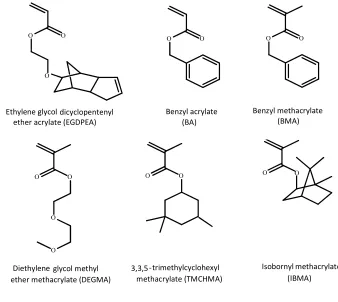
that was to be coated and its intended application. The molecular structures of these
[image:10.612.124.462.371.673.2]monomers are shown in Figure 1.
Figure 1. Structures of monomers used in the synthesis of the copolymers
O O
O
O
O O
ie hy le neglyc ol
m e thylethe r
m e thacr yla te (D G
3 ,3,5 -trime thy lcyc lohexyl
m e thac r ylat e (TMCM A)
O O
Be nzy l
me th acr yla te(B A )
O O
Iso b or ny l m e th ac r y la te
(I B MA )
O
O
O O O
E th yle ne glyc oldicyclop enten yl
eth er acrylate (Mon 4)
B e n z yl
a c r yl a te( B A )
Ethylene glycol dicyclopentenyl ether acrylate (EGDPEA)
Benzyl acrylate (BA)
Benzyl methacrylate (BMA)
3,3,5 -trimethylcyclohexyl methacrylate (TMCHMA) Diethyleneglycol methyl
ether methacrylate (DEGMA)
methacrylate (IBMA) Isobornyl
DEGMA homopolymer has previously been shown not to exhibit bacterial attachment
resistance.9, 11 The aim was to investigate the effect that introducing DEGMA had upon both
BAR and material properties and so begin to define how to optimize the biofilm resistant
coating copolymer material for use in medical devices.
Polymers were synthesized using catalytic chain transfer free radical polymerization
(CCTP) methods to ensure control of molecular weight (Mwt) down to the oligomeric level if
required.12 Furthermore, this polymerization technique was used because it does not leave any
additional inorganic functional group on the polymer as a result of the control mechanism,
which may affect the overall performance/toxicity of the material.12 For example while thiol
chain transfer agents introduce a sulfur containing heat group, the CCTP mechanism leaves the
polymer with only an unsaturated terminal group that is equivalent to that which results from
disproportionation termination. Additionally, this pre-polymerization strategy also allowed
assessment of any effects that the Mwt of the copolymer had on the dip coating process, final
coating integrity and/or BAR performance. The anti-bacterial attachment performance was
tested by culturing bacteria on polymer dip-coated silicone catheters where commercial
catheters were used as benchmarking controls of performance.
Molecular Structure Optimization: The initial solution homopolymerization of ethylene
glycol dicyclopentenyl ether acrylate (EGDPEA) using this strategy resulted in acrylate
polymers that were brittle. This observation was linked to the Tg of the homopolymer being
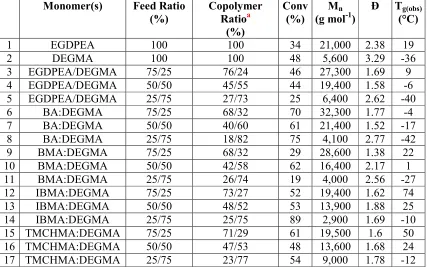
too high for the target application, (see Table 1, Entry 1). To address this issue and achieve
the desired target material property modification, copolymerization of several "hit" monomers
with diethylene glycol methyl ether methacrylate (DEGMA) was conducted. DEGMA was
chosen because its incorporation into the polymer will lower the Tg of the copolymer
improving its physical compatibility with the test catheter matrix material (silicone) and it
hydrophilic nature should lead to the formation of hydrated coatings. 2
Table 1. Physical and Molecular Characteristics of ‘Hit’ Monomer Containing Copolymers Synthesized by Solution CCTP.
Monomer(s) Feed Ratio
(%) Copolymer Ratioa (%)
Conv
(%) (g molMn-1) Ð T(°C)g(obs)
1 EGDPEA 100 100 34 21,000 2.38 19
2 DEGMA 100 100 48 5,600 3.29 -36
3 EGDPEA/DEGMA 75/25 76/24 46 27,300 1.69 9
4 EGDPEA/DEGMA 50/50 45/55 44 19,400 1.58 -6
5 EGDPEA/DEGMA 25/75 27/73 25 6,400 2.62 -40
6 BA:DEGMA 75/25 68/32 70 32,300 1.77 -4
7 BA:DEGMA 50/50 40/60 61 21,400 1.52 -17
8 BA:DEGMA 25/75 18/82 75 4,100 2.77 -42
9 BMA:DEGMA 75/25 68/32 29 28,600 1.38 22
10 BMA:DEGMA 50/50 42/58 62 16,400 2.17 1
11 BMA:DEGMA 25/75 26/74 19 4,000 2.56 -27
12 IBMA:DEGMA 75/25 73/27 52 19,400 1.62 74
13 IBMA:DEGMA 50/50 48/52 53 13,900 1.88 25
14 IBMA:DEGMA 25/75 25/75 89 2,900 1.69 -10
15 TMCHMA:DEGMA 75/25 71/29 61 19,500 1.6 50
16 TMCHMA:DEGMA 50/50 47/53 48 13,600 1.68 24
17 TMCHMA:DEGMA 25/75 23/77 54 9,000 1.78 -12
a) Defined by NMR analysis. An example NMR has been included as Figure S1 in the extra scientific information document and example integrals calculation as Table S1.
As well as Tg, the level of chain entanglement can also affect the level brittleness exhibited by the
copolymer. Therefore, the introduction of DEGMA which has an "oligomeric" pendant group into the
copolymer also affects the level of chain interaction and hence entanglement within these new
copolymers. Thus, addition of DEGMA will tend to reduce both of these chain characteristics by
disrupting the chain packing and so lead to a further reduction in the likelihood of the material
exhibiting brittle failure. The copolymers synthesized within this study are detailed in Table 1.
Experiments were conducted to; (a) define the optimum copolymerization ratios required
to deliver a decrease in the Tg of materials containing the differing “hit” monomers to
improve material flexibility such that coatings can be developed with material properties that
match those of the silicone catheter matrix, (b) investigate how the inclusion of DEGMA at
varying levels affected the onset of gelation during the reaction and (c) assess whether 2
[image:12.612.93.520.95.362.2]copolymers with these optimum ratios retained sufficient bacterial attachment resistance to be
candidate BAR coating materials.
To investigate the ability to tune the Tg of the resultant copolymer, three representative
feed ratios ("hit":DEGMA ratio = 75/25, 50/50, and 25/75) were used and the resulting
copolymers were subjected to both spectroscopic analysis (to define composition) and
bacterial attachment resistance assays to confirm fitness for purpose. NMR spectroscopic
analysis of the copolymers showed that the final compositions were typically close to the
target levels (Table 1). These results defined that the reactivity ratios of the monomer used
were sufficiently alike that the polymerization process was robust enough for commercial
manufacture of the target coating materials with an acceptable level of batch to batch
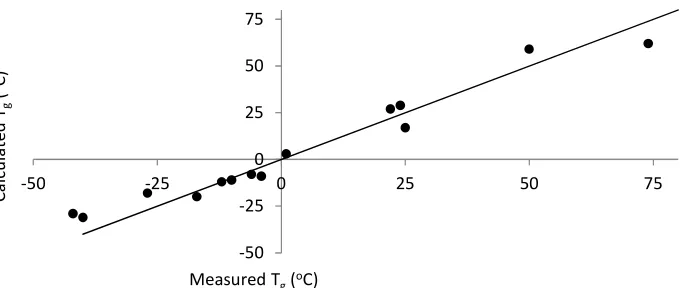
reproducibility. The Tgs of the resultant copolymers were then measured experimentally and
plotted against the values predicted by the Fox equation (see Figure 2) and were found to be
in good agreement showing a linear trend (R2 = 0.95).13 Deviation from the predicted value is
[image:13.612.132.472.450.594.2]likely due to residual high boiling monomer within the copolymer material.
Figure 2. Comparison of the observed Tgs with those calculated by the Fox equation.13 The
y=x line is drawn, R2 = 0.95.
The linear trend in the data confirmed that this polymerization technique could be used to
predictably deliver a copolymer with a target Tg by measuring thatof the “hit” homopolymers
-50 -25 0 25 50 75
-50 -25 0 25 50 75
Ca
lc
u
la
te
d
Tg
(
oC)
Measured Tg(oC)
potentially the consequent mechanical properties. Subsequent experiments investigated the
material/bacterial attachment properties of the polymer initially using the lowest level of
DEGMA incorporation. The data in Table 1 show that of the 75:25 mol% ratio polymers
synthesized only EGDPEA/DEGMA and BA:DEGMAexhibited a Tg that was below room
temperature and thus likely to produce a flexible coating. Thus these combinations were
selected for further study.
The molecular weights of the resulting polymers were shown to typically reduce as the
DEGMA concentration increased. Since the copolymerizations had been conducted using
CCTP in DCM at 35 oC, this was attributed to two effects. Firstly, in the case of the acrylate
“hit” monomers, CCTP catalysts cannot control the polymerization of acrylates as efficiently
as methacrylates. This is because of the propensity to form a more stable Co-C bond between
CoPhBF and the radical species of the growing chain, which slows the reaction rate.12
Therefore, increasing the methacrylate content of the monomer mixture by increasing
DEGMA concentration resulted in more efficient CCTP chain transfer and so a lower overall
molecular weight. In the case of the methacrylate “hit” monomers, the increase in DEGMA
concentration led to a reduction in the system viscosity because the reaction temperature
employed is ~70 oC above DEGMA’s Tg but is closer to or below that of the “hit”
methacrylates. Thus any diffusion limitations that CCTP catalysts encounter are reduced as
the lower Tg monomer concentration is increased, and therefore they operate more efficiently
resulting in a lower molecular weight product. The 75:25 mol% ratios were again highlighted
as the candidates to be taken forward because they produce the higher molecular weights and
so were likely to make the most viable coatings. Nevertheless, the effect of varying DEGMA
concentration on the Mwts of the final polymers requires further investigation to confirm
these proposed hypotheses. 2
It was also noted that the Ð values of the copolymers typically increase with increasing
DEGMA concentration. This was attributed to a combination of the “oligomeric” nature and
hydrophilic character of the EO chain forming the pendant group in this monomer. Therefore,
this group will influence both its relative reactivity compared to the other monomers due to its
steric bulk/ pendant chain flexibility and the GPC analysis of the homo/copolymers, where it
will influence the hydrodynamic volume when compared with the hydrophobic standards
containing smaller, non-oligomeric pendant groups. The influence of these combined effects
are reflected in the experimentally recorded Ð for the DEGMA homopolymer of >3.
This conclusion was also supported by the fact that the 50/50 copolymers with the
acrylate monomers, i.e. EGDPEA/DEGMA and BA:DEGMA, did not appear to follow this
trend. This observation was considered to be due to the reduced steric bulk around the
polymerizable double bond of the acrylates, which allowed easier initial copolymerization, so
resulting in a lower Ð than the methacrylate equivalents. Ð was then noted to increase as the
DEGMA content in the polymer was raised to 75% so that its properties dominate.
The 25/75 copolymer of these acrylate monomers also exhibited Tgs below that recorded
by the experimentally measured value of the DEGMA homopolymer. However, this was
within experimental error at these low temperatures, which is reflected in the broad range of
literature-quoted values for DEGMA homopolymer. Hence it was necessary to determine the
value experimentally in this study.
The onset of gelation during the polymerization was investigated with the DEGMA
included copolymers. The initial copolymerization work employed a 50:50 v/v
co-monomer:solvent ratio. Thus, a series of polymerizations were conducted in which this
relative comonomer:solvent ratio was varied to investigate the effect that increasing the
monomer/polymer concentration in the reaction medium has upon both the onset of gelation
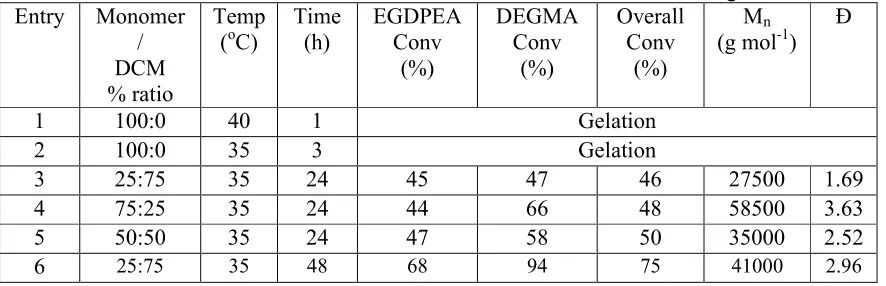
and the rate of conversion achieved. The results of these experiments, which used a 75:25 2
ratio EGDPEA:DEGMA relative mol% monomer feed concentration as a model system, are
[image:16.612.86.529.158.301.2]shown in Table 2.
Table 2 – Effect of solvent concentration upon the copolymerization of EGDPEA:DEGMA with a relative monomer molar feed concentration of 75%:25% conducted using CCTP
Entry Monomer
/ DCM % ratio
Temp (oC)
Time (h)
EGDPEA Conv
(%)
DEGMA Conv
(%)
Overall Conv
(%)
Mn
(g mol-1) Ð
1 100:0 40 1 Gelation
2 100:0 35 3 Gelation
3 25:75 35 24 45 47 46 27500 1.69
4 75:25 35 24 44 66 48 58500 3.63
5 50:50 35 24 47 58 50 35000 2.52
6 25:75 35 48 68 94 75 41000 2.96
The bulk copolymerization (i.e. polymerization conducted in the absence of solvent) led to
gelation after 1 h and 3 h at 40 oC and 35 oC, respectively (Table 2, Entries 1 and 2)
suggesting that the use of solvent to dilute the monomer concentration was essential.
Consequently, all subsequent copolymerizations were conducted at 35 oC to reduce the risk of
reaching the gel point prior to terminating the polymerization. Three different total
monomer:DCM volume ratio of 25%:75%, 50%:50% and 75%:25% v:v were then examined
(Table 2, Entries 3-5) to define the influence of solvent concentration on the polymerization.
Adopting this reaction temperature resulted in an initiator half-life of approximately 10 h,
thus as the 24 h polymerization time represents only 2 half-life turnovers, it was found to
deliver an overall ~50 % yield as would be expected. Reducing the volume of DCM did not
significantly affect the overall conversion achieved, but both the Mn and the Ð values were
noted to increase, implying that the formation of branched polymers was increasingly likely
to occur at lower solvent concentrations. Additionally, the relative level of DEGMA
incorporation increased as the solvent concentration was reduced. This was attributed to the
increased likelihood of DEGMA being incorporated into the chain because the reaction
temperature employed was ~70 oC higher than DEGMA’s Tg, but only ~15 oC higher than
that of EGDPEA. Thus, relative to EGDPEA, the physical form of DEGMA will be more
“fluid-like”, and so it is much less likely to encounter diffusion limitations and thus reactivity
issues as the reaction media become more viscous as the solvent concentration is reduced. It
was concluded from the data in Table 2 that, for a 75 mol% EGDPEA: 25 mol% DEGMA
copolymer, then a 25%:75% v:v comonomer:solvent ratio exhibits the best conditions for
achieving equivalent co-monomer reactivity ratios.
Consequently, a reaction was conducted using a 25:75 v:v monomer:DCM for 48 h at
35oC (Table 2, Entry 6), in an attempt to obtain higher overall conversion. However, whilst
increasing the time to 4 half-life turnovers did deliver the desired increase in conversion in
the 48 h reaction, it was associated with an increase in Mn and the Ð indicating the onset of
branching within the system. Since these increases were in relation to a rise in DEGMA
incorporation, this suggested that this was as a result of higher viscosity of the reaction
medium as conversion increased.
Therefore, due to the observed issues that are related to the viscosity-related onset of
gelation, it was concluded that the strategy for bacterial assessment was to synthesize these
polymers in the form of a polymer in solvent/monomer solution (or resin) for direct dip
coating the test catheters. The polymerization conditions chosen to give the best opportunity
to achieve equivalent co-monomer and prevent the onset of branching in these dip coating
resins was a volume ratio of monomer:DCM of 25%:75% v:v with a reaction time 24 h at 35
oC. Coated samples were characterized by SEM prior to use in bacterial assays (see Figure S2
in the ESI document).
Bacterial Attachment Assessment: To quantify the effect that the addition of DEGMA into
“hit” materials had upon bacterial attachment, the surface coverage of three different bacterial
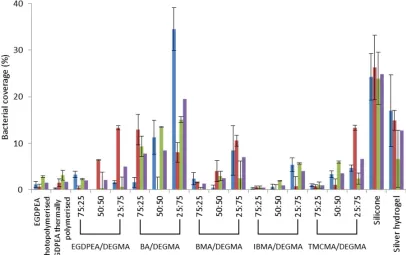
species upon the surface of the copolymers detailed in Table 1 was quantified. Both the 2
results for the each species and the average surface coverage across three different species are
shown in Figure 3. Commercial silicone and silver hydrogel catheters were used to
[image:18.612.102.508.176.431.2]benchmark the performance of the “hit” materials.
Figure 3. Bacterial coverage of three different strains after 72 h culture where PA = P. aeruginosa, PAO1 (blue/first bar), SA = S. aureus 8325-4, (red/second bar), UPEC = uropathogenic E. coli 536 (green/third bar). Average bacterial attachment across the three
different strains (purple/fourth bar). No homopolymer DEGMA data is presented in this figure because this material did not form a viable stable film for subsequent material testing under the experimental conditions used. DEGMA materials only proved sufficiently stable when copolymerized.
The data in Figure 3 shows that the catheters coated with the copolymers containing “hit”
monomers showed reduced bacterial attachment compared with the silicone catheters and,
except for the 25:75 BA/DEGMA polymer, attracted less than the commercially available
silver hydrogel coated catheter. The polymer with the overall lowest bacterial attachment was
the 75:25 IBMA/DEGMA polymer with a bacterial coverage less than 0.5% for all three
bacterial species. For comparison a homopolymer of EGDPEA was also synthesized by
photoinitiated polymerization similar to the in-situ polymerization method used for polymer 2
microarray synthesis. The biological performance of the photo- and thermal- initiated
EGDPEA homopolymers were identical within the error of the measurement, indicating that
both synthetic routes are viable for producing coatings for catheters. For all copolymers, the
average bacterial attachment increased with increasing DEGMA concentrations, suggesting
that DEGMA compromises the anti-attachment performance as would be expected as we are
“diluting” the level of “hit” monomer in the copolymer structure. However, even with less 50
% of the “hit” monomer all the copolymer-coated catheters outperformed the commercially
available silver hydrogel coated device. Furthermore, the level of variation in molecular
weight and dispersity exhibited by the “hit”:DEGMA copolymers did not appear to adversely
influence their bacterial attachment resistance, rather it appeared to be dominated by the
DEGMA content. This was primarily attributed to the substitution of a lower performing
monomer but may also be chain length related as the inclusion of DEGMA generally resulted
in a significant reduction in Mwt. At present our understanding of the influence that the
acrylate and methacrylate fragment has upon BAR performance not been fully defined and is
currently under investigation. Additionally, polymer coatings were typically between 5 and 10
microns and an SEM of a typical coating has been included as Figure S2 in the ESI document, In this
range we have not observed any influence of coating thickness on resistance to bacterial attachment.
Material Property Optimization - Surface composition: Understanding the chemical
composition of the surface is critical in interpreting bacterial attachment as bacteria only
contact the top surface of materials they attach to. Time of flight secondary ion mass
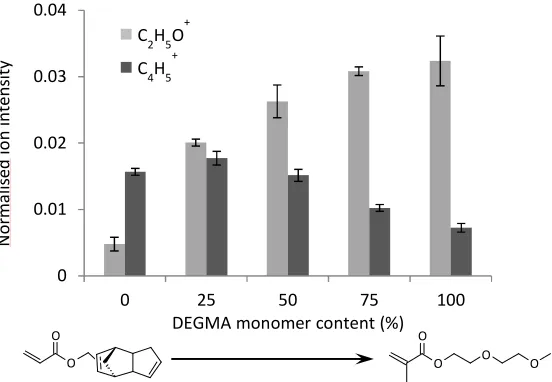
spectrometry (ToF SIMS) was used to qualitatively characterize the level of DEGMA
presence on the surface, and the result is shown in Figure 4. 2
Figure 4. The level of DEGMA present on the surface of the EGDPEA/DEGMA copolymers. Secondary ion C2H5O+ was chosen as an indicative DEGMA daughter ion, whilst secondary
ion C4H5+ was chosen as an indicative EGDPEA daughter ion.
The data in Figure 4 show that the intensity of the C2H5O+ species, which is the indicative ion
of for DEGMA, increased with the increasing amount of DEGMA in the copolymer.
Meanwhile, that of C4H5+, which is a characteristic secondary ion of EGDPEA, decreased
with decreasing concentration of EGDPEA. This indicates that the addition of DEGMA in
bulk also resulted in the increase of its concentration on the surface. The ion images for
characteristic ions showed no evidence of micron-scale phase separation on the polymer.
Material Property Optimization - Fatigue Testing: To determine whether the copolymers are
sufficiently flexible as a layer of thin coating on the silicone catheter substrate, catheter
segments were dip-coated in polymer resin solutions, dried and subjected to fatigue testing.
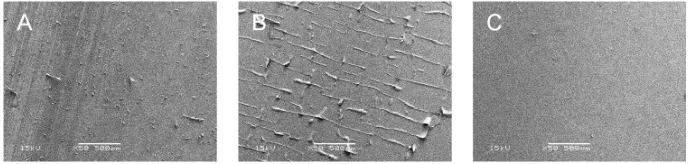
The compressed side of the coating was examined by SEM to determine the integrity of the
coating after repeated bending. SEM images of the compressed side of polymer coated
silicone catheters after cyclic bending are shown in Figure 5. 0
0.01 0.02 0.03 0.04
0 25 50 75 100
No
rma
lis
ed
io
n
in
te
n
sit
y
DEGMA monomer content (%)
O O
O O
O O
! C2H5O+
! C4H5+ 2
Figure 5. SEM images of polymer-coated silicone catheters after fatigue tests. Polymers were dip coated onto silicone catheters. (A) silicone without coating; (B) EGDPEA; (C)
EGDPEA/DEGMA(75/25)
Homopolymer EGDPEA was observed to show signs of wrinkling on the surface after the
fatigue test, whilst the EGDPEA:DEGMA(75:25) copolymers showed no sign of coating
damage. The Tg of this copolymer is 9 °C, which is below the testing temperature of 20 °C,
whilst that of homopolymer EGDPEA exhibits a Tg of 19 °C. This demonstrates the
importance of lowering the Tg of “hit” copolymers to introduce flexibility to the copolymers.
However, the potential influence of chain entanglement on these coating performance results also
needs to be defined. Thus future work will report studies on the effects of molecular weight on the
polymer with respect to bacterial attachment resistance and the level of brittleness exhibited, where
the effect of entanglement will be investigated further by progressing to very low molecular weight.
Conclusion
Five “hit” monomers, which have been shown to produce homopolymers with significant
antibacterial attachment resistance via high throughput polymer microarray screening and
photo-induced polymerization, were successfully co-polymerized with DEGMA to lower the
Tg and so introduce increased flexibility using thermally induced polymerization. The aim of
this study was to optimize the materials properties for application as coatings upon flexible
silicone-based urinary catheters. It was demonstrated that the Tg of resultant copolymers
could be accurately estimated via the Fox equation, which means the Tg can be further
fine-tuned to meet other applications. Furthermore, the onset of gelation in the thermal
polymerization was found to be dependent on the solvent concentration and reaction time. 2
Optimum conditions to obtain the target copolymers were defined as a 25:75 v:v%
monomer:solvent ratio at 35 oC for 24 h. Increasing the DEGMA concentration in the reaction
mixture lead to reduced molecular weight and to increased deviation from the target
co-monomer ratio in the final product. Both of these effects were attributed to a reduction in the
viscosity in the reaction medium caused by increasing the DEGMA concentration that helps
to overcome diffusion issues. The overall conclusion from the molecular optimization was
that 75:25 mol% EGDPEA:DEGMA copolymers were the key structures to review in the rest
of the study. The bacterial attachment assays showed that although copolymerizations with
DEGMA increased the bacterial copolymer surface coverage, it was still significantly lower
on these copolymers compared with the benchmarks of silicone and silver hydrogel coated
catheters, where the results for the 75:25 v:v% materials exhibited up to 25-fold greater
bacterial attachment. Additionally, these copolymer exhibited superior BAR to the
benchmarks when up to 75% of the monomer mixture was DEGMA, with the exception of
the BA:DEGMA where only up to 50 % of the monomer feed could be DEGMA to achieve
this. Furthermore, it was demonstrated that neither the variation in molecular weight /
dispersity, nor the mode of initiating polymerizations (i.e. photo or thermal) affected the
bacterial attachment resistance performance exhibited by the copolymers. ToF-SIMS analysis
showed that the surface composition of the coating reflected the bulk composition of the
polymer, and fatigue testing demonstrated that a 75:25 mol% EGDPEA:DEGMA copolymer
performed well as a functional coating as it was capable of being repeatedly flexed without
delamination developing stress cracking unlike the homopolymer EGDPEA which failed this
fatigue test. 2
Supporting Information:
This document contains two figures (a) an example 1H NMR spectrum of precipitated
IBMA:DEGMA 75/25 (300 MHz, CDCl3) product to demonstrate how the copolymer ratios
were defined and (b) an example SEM image of a cross-section of a coated catheter
demonstrating that the coating is typically between 5-10 microns in thickness.
Acknowledgements
The authors would like to acknowledge the Impact Accelerators Account at the University of
Nottingham for funding (Alexandra Gower) and Camstent Ltd for funding (Amy Stimpson).
The Wellcome Trust (ref 085245 and 103882) are kindly acknowledged for funding this
work. Morgan R. Alexander gratefully acknowledges the Royal Society for the provision of
his Wolfson Research Merit Award.
References
1. (a) Banerjee, I.; Pangule, R. C.; Kane, R. S., Antifouling Coatings: Recent Developments in the Design of Surfaces That Prevent Fouling by Proteins, Bacteria, and Marine Organisms. Adv. Mater. 2011,23 (6), 690-718; (b) Costerton, J. W.; Stewart, P. S.; Greenberg, E. P., Bacterial biofilms: A common cause of persistent infections. Science 1999,284 (5418), 1318-1322. 2. Smith, A. W., Biofilms and antibiotic therapy: Is there a role for combating bacterial resistance
by the use of novel drug delivery systems? Adv. Drug Delivery Rev. 2005,57 (10), 1539-1550. 3. (a) Caillier, L.; de Givenchy, E. T.; Levy, R.; Vandenberghe, Y.; Geribaldi, S.; Guittard, F.,
Synthesis and antimicrobial properties of polymerizable quaternary ammoniums. Eur. J. Med. Chem. 2009, 44 (8), 3201-3208; (b) Costa, F.; Carvalho, I. F.; Montelaro, R. C.; Gomes, P.; Martins, M. C. L., Covalent immobilization of antimicrobial peptides (AMPs) onto biomaterial surfaces. Acta Biomater. 2011, 7 (4), 1431-1440; (c) Darouiche, R. O.; Mansouri, M. D.; Gawande, P. V.; Madhyastha, S., Efficacy of combination of chlorhexidine and protamine sulphate against device-associated pathogens. J. Antimicrob. Chemother. 2008,61 (3), 651-657; (d) Greenfeld, J. I.; Sampath, L.; Popilskis, S. J.; Brunnert, S. R.; Stylianos, S.; Modak, S., Decreased bacterial adherence and biofilm formation on chlorhexidine and silver sulfadiazine-impregnated cnetral venous catheters implanted in swine. Crit. Care Med. 1995,23 (5), 894-900; (e) Guay, D. R., An update on the role of nitrofurans in the management of urinary tract infections. Drugs 2001,61 (3), 353-364; (f) Jaeger, K.; Osthaus, A.; Heine, J.; Ruschulte, H.; Kuhlmann, C.; Weissbrodt, H.; Ganser, A.; Karthaus, M., Efficacy of a benzalkonium chloride-impregnated central venous catheter to prevent catheter-associated infection in cancer patients.
Chemotherapy 2001,47 (1), 50-55; (g) Li, P.; Poon, Y. F.; Li, W. F.; Zhu, H. Y.; Yeap, S. H.; Cao, Y.; Qi, X. B.; Zhou, C. C.; Lamrani, M.; Beuerman, R. W.; Kang, E. T.; Mu, Y. G.; Li, C. M.; Chang, M. W.; Leong, S. S. J.; Chan-Park, M. B., A polycationic antimicrobial and biocompatible hydrogel with microbe membrane suctioning ability. Nat. Mater. 2011, 10 (2), 149-156; (h) Yorganci, K.; Krepel, C.; Weigelt, J. A.; Edmiston, C. E., Activity of antibacterial 2
impregnated central venous catheters against Klebsiella pneumoniae. Intensive Care Med. 2002, 28 (4), 438-442.
4. Monds, R. D.; O'Toole, G. A., The developmental model of microbial biofilms: ten years of a paradigm up for review. Trends in Microbiol. 2009,17 (2), 73-87.
5. Cloutier, M.; Mantovani, D.; Rosei, F., Antibacterial Coatings: Challenges, Perspectives, and Opportunities. Trends in Biotechnol. 2015,33 (11), 637-652.
6. Holmes, P. F.; Currie, E. P. K.; Thies, J. C.; van der Mei, H. C.; Busscher, H. J.; Norde, W., Surface-modified nanoparticles as a new, versatile, and mechanically robust nonadhesive coating: Suppression of protein adsorption and bacterial adhesion. J. Biomed. Mater. Res., Part A 2009, 91A (3), 824-833.
7. (a) Cheng, G.; Li, G. Z.; Xue, H.; Chen, S. F.; Bryers, J. D.; Jiang, S. Y., Zwitterionic carboxybetaine polymer surfaces and their resistance to long-term biofilm formation.
Biomaterials 2009, 30 (28), 5234-5240; (b) Cheng, G.; Zhang, Z.; Chen, S. F.; Bryers, J. D.; Jiang, S. Y., Inhibition of bacterial adhesion and biofilm formation on zwitterionic surfaces.
Biomaterials 2007,28 (29), 4192-4199.
8. (a) Anderson, D. G.; Levenberg, S.; Langer, R., Nanoliter-scale synthesis of arrayed biomaterials and application to human embryonic stem cells. Nat. Biotechnol. 2004, 22 (7), 863-866; (b) Celiz, A. D.; Harrington, H. C.; Hook, A. L., High throughput assessment and chemometric analysis of the interaction of epithelial and fibroblast cells with a polymer library. Appl. Surf. Sci. 2014,313, 926-935; (c) Celiz, A. D.; Smith, J. G. W.; Patel, A. K.; Hook, A. L.; Rajamohan, D.; George, V. T.; Flatt, L.; Patel, M. J.; Epa, V. C.; Singh, T.; Langer, R.; Anderson, D. G.; Allen, N. D.; Hay, D. C.; Winkler, D. A.; Barrett, D. A.; Davies, M. C.; Young, L. E.; Denning, C.; Alexander, M. R., Discovery of a novel polymer for human pluripotent stem cell expansion and multilineage differentiation. Adv. Mater. 2015,27 (27), 4006-4012; (d) Hook, A. L.; Anderson, D. G.; Langer, R.; Williams, P.; Davies, M. C.; Alexander, M. R., High throughput methods applied in biomaterial development and discovery. Biomaterials 2010, 31 (2), 187-198; (e) Tourniaire, G.; Collins, J.; Campbell, S.; Mizomoto, H.; Ogawa, S.; Thaburet, J. F.; Bradley, M., Polymer microarrays for cellular adhesion. Chem. Commun. 2006, (20), 2118-2120; (f) Zhang, R.; Mjoseng, H. K.; Hoeve, M. A.; Bauer, N. G.; Pells, S.; Besseling, R.; Velugotla, S.; Tourniaire, G.; Kishen, R. E. B.; Tsenkina, Y.; Armit, C.; Duffy, C. R. E.; Helfen, M.; Edenhofer, F.; de Sousa, P. A.; Bradley, M., A thermoresponsive and chemically defined hydrogel for long-term culture of human embryonic stem cells. Nat. Commun. 2013,4, 1335.
9. Hook, A. L.; Chang, C.; Yang, J.; Luckett, J.; Cockrayne, A.; Atkinson, S.; Mei, Y.; Bayston, R.; Irvine, D. J.; Langer, R.; Anderson, D. G.; Williams, P.; Davies, M. C.; Alexander, M. R., Combinatorial discovery of polymers resistant to bacterial attachment. Nat. Biotechnol. 2012,30
(9), 868-875.
10. Sanni, O.; Chang, C.; Anderson, D. G.; Langer, R.; Davies, M. C.; Williams, P. M.; Williams, P.; Alexander, M. R.; Hook, A. L., Bacterial attachment to polymeric materials correlates with molecular flexibility and hydrophilicity. Adv. Healthcare Mater. 2015,4 (5), 695-701.
11. Hook, A. L.; Chang, C.; Yang, J.; Atkinson, S.; Langer, R.; Anderson, D. G.; Davies, M. C.; Williams, P.; Alexander, M. R., Discovery of novel materials with broad resistance to bacterial attachment using combinatorial polymer microarrays. Adv. Mater. 2013,25 (18), 2542-2547. 12. (a) Gridnev, A. A.; Ittel, S. D., Catalytic chain transfer in free-radical polymerizations. Chem.
Rev. 2001,101 (12), 3611-3659; (b) Wang, W. X.; Stenson, P. A.; Marin-Becerra, A.; McMaster, J.; Schroder, M.; Irvine, D. J.; Freeman, D.; Howdle, S. M., New thiolate-cobalt(II) complexes for catalytic chain transfer polymerization of methyl methacrylate. Macromolecules 2004, 37
(18), 6667-6669.
13. (a) Cypcar, C. C.; Camelio, P.; Lazzeri, V.; Mathias, L. J.; Waegell, B., Prediction of the glass transition temperature of multicyclic and bulky substituted acrylate and methacrylate polymers using the energy, volume, mass (EVM) QSPR model. Macromolecules 1996,29 (27), 8954-8959; (b) Fox, T. G., Influence of diluent and of copolymer composition on the glass transition temperature of a polymer system. Bull. Am. Phys. Soc. 1956,1, 123; (c) Krause, S.; Gormley, J. J.; Roman, N.; Shetter, J. A.; Watanabe, W. H., Glass temperatures of some acrylic polymers. J. Polym. Sci., Part A:-Gen. Pap. 1965,3 (10PA), 3573-3586; (d) Lu, Y. H.; Hsu, C. S.; Chou, C. H.; Chou, T. H., Preparation of poly(2,5-thienyleneethylene) and poly(2,5-furyleneethylene) by 2
vapor phase pyrolysis of (5-methyl-2-thienyl)methyl benzoate and (5-methyl-2-furyl)methyl benzoate. Macromolecules 1996,29 (17), 5546-5550; (e) Shetter, J. A., Effect of stereoregularity on glass temperatures of a series of polyacryaltes and polymethacrylates. J. Polym. Sci., Part B: Polym. Lett. 1963,1 (5), 209-213.
TOC Document for the Manuscript
“
Application of Targeted Molecular
and Material Property Optimization to Bacterial Attachment-Resistant
(Meth)acrylate Polymers
”
Kevin Adlington,
aNam T. Nguyen,
a,bElizabeth Eaves,
a,bJing Yang,
cChien-Yi Chang,
c,dJianing Li,
a,bAlexandra L. Gower,
aAmy Stimpson,
aDaniel G. Anderson,
eRobert Langer,
eMartyn C. Davies,
fAndrew L. Hook,
fPaul Williams,
cMorgan R. Alexander,
f*and Derek J.
Irvine
a*a
Department of Chemical and Environmental Engineering, Faculty of Engineering,
University of Nottingham, Nottingham, NG7 2RD, UK.
b
School of
Chemistry, University of Nottingham, Nottingham, NG7 2RD, UK.
cCentre for Biomolecular Sciences and School of Life Sciences, School of Chemistry,
University of Nottingham, Nottingham, NG7 2RD, UK.
d
Current address - School of Life Sciences, Heriot-Watt University, Edinburgh, EH14 4AS,
UK.
e
Department of Chemical Engineering, Institute for Medical Engineering and Science,
Harvard-MIT Division of Health Sciences and Technology, David H. Koch Institute for
Integrative Cancer Research, Massachusetts Institute of Technology, 500 Main Street,
Cambridge, MA, 02139, USA.
f