Background Music in Educational Films:
The effect of background music induced arousal on the memory and the evaluation of
information presented in educational films.
Angelito Pérez Nijhuis Studentnumber 0074977
Master Thesis Psychology
Department of Media, Communication & Organization Faculty of Behavioural Sciences
University of Twente
Supervisor: Dr. A. Heuvelman Co reader: L. H. Tan, MSc
2
Contents
ABSTRACT ... 3
INTRODUCTION ... 4
Background music in educational films ... 5
A limited capacity model for educational films ... 6
Background music to induce arousal ... 7
METHOD ... 9
Design and subjects ... 9
Stimulus development ... 9
Measures ... 13
Procedure ... 14
RESULTS ... 16
Manipulation check ... 16
Memory for presented information ... 17
Evaluation of educational films ... 19
CONCLUSION ... 21
Interpretation of findings ... 21
DISCUSSION ... 23
Recommendations ... 23
REFERENCES ... 25
APPENDIX I ... 30
APPENDIX II ... 38
APPENDIX III ... 41
3
Abstract
4
Introduction
Since the early days of mankind there has been music. In fact, music is known to be one of the oldest forms of expression (Menuhin and Davis, 1979). Through recent advances in technology and the availability of digital music, music has become more widespread and accessible than ever. Although music is used for leisure activities or to be enjoyed as a pleasurable art form, music also has numerous psychological functions, like playing a powerful social role, arousing (deep) emotions, and influencing cognitive functioning. The effect of music on the responses of human beings is evident and therefore a growing body of academic research is focusing on the physiological, psychological, behavioural, emotional and cognitive effects of music (Cassidy and Macdonald, 2007).
Research in various fields such as advertising, retail, neuroscience and education has shown that (background) music can affect human behaviour. Advertising effects are more probable with the right music (Zander, 2006). In retail context, background music can influence customer behaviour in the form of sales value and volume, repeat purchase and quantity purchased. Also many indirect returns to business are apparent such as positive perceptions of quality and venue/store brand image (Garlin and Owen, 2006). Background music can also mediate emotional responses to waiting cues and on-hold phone calls (Hui, Dubé and Chebat, 1997; North, Hargreaves and McKendrick, 1997; Oakes and North, 2008). Moreover music perception influences the autonomic nervous system, the hormonal and immune systems and activates (pre) motor representations (Koelsch and Siebel, 2005). In educational settings music is also used to improve the cognitive abilities of students. A famous example in this is the so called ‘Mozart effect’. Rauscher et al. (1993) reported in their study that participants who listened to a recording of music composed by Mozart performed better on abstract and spatial abilities than when they listened to relaxation instructions or nothing. The enhancement of spatiotemporal reasoning through music is still a subject of debate (Jones and Zigler, 2002; Steele et al., 1999). Nevertheless, research indicates that by introducing background music, performance and behaviour of students may be enhanced (Hallam, Price and Katsarou, 2002).
5 story’s meaning. According to Boltz (2004), this contribution of music contains a schematic structure that integrates a scene’s action into one cohesive framework that directs the path of perception and attention.
In many educational films, on television as well as those specifically designed for classroom-use, background music is - like in feature film and TV industries - used to get approval and keep attention. It appears to be administered as a matter of routine, a ‘finishing touch’. It is however, unclear if and to what extend music really helps to improve comprehension and helps to achieve learning-objectives. According to the limited capacity model of mediated message processing (Lang, 2000), video and audio structural information (e.g., luminance levels, cuts, slow motion, animation, zooms, pans, video graphics, frequency levels, sound effects, music, rate of presentation, narrative structure) have an influence on how television messages are processed. The limited capacity model describes television watching as a combination of controlled and automatic resource allocating mechanisms that combine to allocate processing resources to the encoding, storage, and retrieval of the bits of information that make up a television message. Certain message characteristics, such as structural features (e.g., background music) or emotion, as well as the goals of the viewer, may affect the resources allocated to storage, which in turn may affect how much and how well content information is stored (Lang, 2000).
Using the limited capacity approach to television viewing, the aim of this study is to analyze which effect the structural feature background music, with varying arousal levels, has on memory and evaluation of information presented in an educational film. The role of enclosed background music on the processing of information of educational films will be evaluated.
Background music in educational films
6 produced by the multimedia machinery or sounds made by people. Second, music helps to connect disparate events in other domains. The most prominent musical gestalt seems to attract media events from different domains. Continuous music signals continuation in the current theme, while a break in music signals a change in the film; for instance when the camera alternates between close-ups of two people who are looking at each other (Magliano, Dijkstra and Zwaan, 1996). Third, music may direct attention to specific aspects of a visual scene through structural or associationist congruence (Bolivar, Cohen and Fentress, 1994; Marshall and Cohen, 1988). Fourth, music alters the mood and feelings of the viewer of the movie (Pignatiello, Camp and Rasar, 1986). It can be used to encourage positive multimedia experiences. Fifth, different features of music can convey the emotional meaning of the movie. Sadness for example, is conveyed by slow pace, and happiness is conveyed by a fast or rising tempo. Further, music communicates meaning, especially in ambiguous situations (Cohen, 1993; Kalinak, 1992). Sixth, music can be used as a memorial cue by taking on the meaning of that which it accompanies. Music alone will then cause imagination of a particular individual or theme. Seventh, music has an aesthetic function. Whether or not music has the intended effect depends partially on personality characteristics, introverts for example may need less stimulation (Cassidy and MacDonald, 2007). Finally the eighth, and for this study the most important, function that music can have in a film, is arousal and focal attention. It is known that when there is music, a larger part of the brain is active than when there is no music. The increased level of arousal results in higher attention and higher impact of the multimedia experience, filtering out distractions.
A limited capacity model for educational films
7 suggests that the viewers’ resources to process information are limited. There may be a mismatch between provided and required resources, resulting in an incomplete processing of the message. If there are not sufficient resources available, processing the educational film will be less effectively.
According to the model, introducing structural features (i.e., cuts, edits, graphics, and background music) makes it possible to elicit emotional arousal. This arousal may cause the automatic allocation of additional processing resources to the tasks of encoding and storage, resulting in an improved information recall and recognition (Vettehen, Nuijten and Peeters, 2008).
Background music to induce arousal
Arousal induced by background music could be considered a variable that explains the extent of memory and evaluation for an educational film. Arousal may be defined as the degree of excitation that viewers experience while watching an educational film (Vettehen, Nuijten and Peeters, 2008). Music has the capability to induce arousal. Rickard (2004) determined that different sorts of music can increase the level of arousal. Further findings suggest that background music can be used to increase or maintain the arousal level of students (Hallam, Price, and Katsarou, 2002). Another interesting finding, which has been mentioned briefly earlier on, is the so-called Mozart effect which implied that students would perform better on spatial-temporal tasks after listening to a Mozart sonata (Rauscher et al., 1993). This effect was afterwards elaborated with the mediating role of arousal, in which the used Mozart sonatas could be characterized as a kind of fast-tempo piece in a major key which is capable of inducing higher levels of arousal affecting performance (Schellenberg et al., 2007; Thompson et al., 2001).
When exposed to music, arousal levels will be promoted accordingly. If the arousal level of background music has an effect on the viewers’ arousal, it is expected that the extent to which background music affects this arousal level will be dependent on the level of arousal of the background music that is used. Therefore the following hypothesis was tested:
H1: As the arousal level of background music increases, the arousal level of the viewers of the educational film will increase.
8 information as long as the processing system is not overloaded. This results in an improved recall of the information (Lang, 2000). The model predicts an inverted U-shaped relationship between an increase in structural features and memory, since initially structural features will help viewers to process the presented information by increasing the processing resources allocated to the presented information (Lang et al., 2000). The Yerkes-Dodson law provides a representation to clarify this further. This model of performance and arousal suggests that arousal will increase task performance to an optimum level. Once that level is crossed, task performance deteriorates (Yerkes and Dodson, 1908). Once the arousal stimulant - background music - crosses this threshold it could be considered to be an interference. Therefore it is expected that memory for the presented information in educational films will be better in educational films with background music with medium arousal than educational films with background music with low or high levels of arousal. In light of this, the following hypothesis is proposed:
H2: The arousal level of background music will be positively related to the memory for the presented information in educational films, following the U-shape described in the limited capacity model.
In the context of this study, high arousing background music may be perceived as more emotionally interesting than low arousing background music because of the dynamism conveyed by more arousing background music. It is assumed that higher arousal levels of background music will result in more positive evaluations of educational films. However this will only occur up to a certain level of arousal. Beyond that level, arousal will result in more negative evaluations of the educational films. Consequently, it is predicted that:
9
Method
Design and subjects
The design of this study is a 3 x 2 between-subjects experimental design with musical background induced arousal (low, medium and high), and two educational films (relatively neutral on arousal levels and valence levels) as independent variables. The control conditions in this study are the two educational films without the addition of background music. Subjects are assigned to either the condition of background music with low arousal, medium arousal, high arousal, or to the control condition. The dependent variables measured are memory for the given information in the educational films and the evaluation of the educational films. Memory is measured with forced choice questions. Per educational film 15 true/false questions and ten multiple choice questions were used. The evaluation of the educational film is measured with semantic differentials, whereas educational film elicited emotions are measured with the Self-Assessment Manikin (SAM), a non-verbal pictorial questionnaire (Bradley and Lang, 1994).
The subjects were 167 primary school pupils (89 male and 78 female) from grades seven (91 pupils) and eight (76 pupils) of four primary schools in the city Enschede (The Netherlands). More specifically, these were three catholic primary schools with the same educational structure and one Freinet primary school. From each primary school two classes (grade seven and grade eight) participated in the experiment. The subjects were aged seven to 13 years, with a mean age of 11,14 (SD = 1.00). The experiment was implemented as a part of the daily curriculum and functioned as a integrated biology and geography lesson. Because of the experimental setting, classes were randomly assigned to the experimental conditions and not the subjects.
Stimulus development
10 tracks. Garlin and Owen (2006) concluded that tempo is the main structural component of music that affect the arousal level of listeners. Tempo manipulations with fast tempo (160-180 bpm) induce greater arousal levels than low tempo (60 bpm) (Husain, Thompson, and Schellenberg, 2002; Kellaris and Kent, 1994). Tonality/mode manipulation affects the mood in which music in major modes is associated with happy emotional responses, and music in minor modes is associated with sad emotional responses (Webster and Weir, 2005). The texture of music refers to the non harmonized, simpler melodies versus thicker, harmonized music. Melodies and simple harmonies are associated with positive emotions, while more complex harmonies evoke negative emotions (Gabrielsson and Lindström, 2001 in Webster and Weir, 2005). In this study, each musical background condition (level of arousal and valence) consist of two music tracks in order to exclude the possibility that variables other than musical arousal and musical valence are accounted for the effects. The arousal and valence levels of these musical tracks must therefore be similar to each other. Furthermore the difference between vocal (with sung words) music and non-vocal (instrumental) music has to be taken into account. In the presence of instrumental music, added vocals may not increase the music’s capacity to arouse very differently. Though vocal music is considerably more disruptive than purely instrumental music (Furnham, Trew and Sneade, 1999; Pring and Walker, 1994). Hence, the musical tracks in used in this study are instrumental.
11 musical track Herotrance and the three versions of the musical track Newhiphop could considered to reach the intended valence and arousal levels the best. Furthermore, the valence and the arousal ratings of the three versions of Herotrance were comparable to the three versions of Newhiphop. Herotrance and Newhiphop were rated medium on the valence scale (M = 5,52, SD = 0,68 and M = 5,69, SD = 0,34). On the arousal dimension the three versions of Herotrance were rated low (M = 2,79, SD = 1,81), medium (M = 4,36, SD 1,82) and high (M = 6,64, SD = 1,34). Newhiphop was also rated low (M = 3,43, SD = 1,51), medium (M = 4,57, SD = 1,45) and high (M = 5,64, SD = 1,15) on the arousal dimension. The accompanying valence and arousal levels of the musical tracks used in the pretest can be found in table 1.
Table 1
12
Educational films. To increase the validity of this experiment, the used educational films must suffice some boundary conditions. In the first place the used educational films had to be very rich in information and this information must be well distributed across the film, i.e. throughout the whole film the film must contain an equal amount of information. Secondly, the films had to be relatively neutral on both arousal and valence levels in order to exclude background music - educational film congruency effects. Finally, real educational films were aimed at for enhancing the external validity of this study. To meet the mentioned requirements educational films from the public educational broadcaster of the Netherlands Teleac were examined. After screening 62 educational films, two educational films were selected on their information richness and neutrality by means of personal evaluation. The content of the first educational film was about the human body, more specific about blood circulation, and had a duration of approximately 19 minutes. The content of the second educational film was about Dutch landscapes; this film attended the matter river clay and had a duration of 10 minutes. For both of the educational films the original voice-over and background music were cut-out. The original voice-over was replaced with a newly recorded voice-over, to rule out the influence of different voice-overs, and to remove additional sound effects. The original background music was replaced with the different versions of the musical tracks selected in the pretest (equal volume of 6 db and in stereo).
Experimental conditions. The experiment consists of six experimental conditions and
13 Table 2
Design experiment
Measures
This study measured the effects of musical background induced arousal on respectively memory for and evaluation of the presented information in the two educational films.
Arousal and valence measures. Arousal and valence levels were measured for
emotions evoked by the musical tracks selected in the pretest. To measure whether the two educational films elicited the intended emotions, a manipulation check was carried out for subjects’ arousal en valence levels evoked by the two educational films. To measure the evoked emotions the Self-Assessment Manikin (SAM), a non-verbal pictorial questionnaire that allows subjects to make three judgments regarding their emotions (Bradley & Lang, 1994), was used. The SAM measures the dimensions valence, arousal and dominance by using a graphic character arrayed along a continuous nine-point scale. The pleasure scale contains characters raging from frowning and unhappy to smiling and happy. The arousal scale ranges from a sleeping and calm character with eyes closed to an excited character with eyes wide open and a sparkling body. Finally, the dominance scale goes from a very small character to a really big character. The arousal and valence scales of SAM correlate highly with psycho-physiological measures of arousal and valence (Greenwald, Cook & Lang, 1989). In order to follow the instruments’ protocol dominance was measured as well although the dominance ratings were not used in the analyses of this study. To make the SAM more obvious, the valence and the arousal scales were inverted, so high scores on valence represent positive valence levels, and high scores on arousal represent high arousal levels.
14 educational films. Four other items adapted from Kamins et al. (1991) were used to measure the degree to which the educational films were clear and understandable. Subjects rated the educational films as being incomprehensible to comprehensible, difficult to simple, boring to exciting and uninteresting to interesting.
Memory measures. Memory for the educational films was measured using forced
choice questions. Per educational film, subjects were confronted with 15 true/false questions and ten multiple choice questions containing information that was presented in the educational film they had just seen. One point was given for each question that was answered correctly. Besides determining separate scores for each measure and the total score for the educational film, the total score of the two educational films were added and combined into an overall memory score. See appendix IV for the questionnaire.
Procedure
The experiment was conducted in four primary schools in the city of Enschede, the Netherlands. From every primary school, only the pupils from grades seven and eight participated in this experiment. The experimental conditions were randomly divided between the eight classes. Two classes were assigned to the low arousal condition, two classes to the medium arousal condition, two classes to the high arousal condition and two classes were assigned to the control condition. The experiment was carried out in the classroom of the pupils since the experiment was implemented as a integrated biology/geography lesson as part of the daily curriculum. The educational films were presented to the whole class at the same time on a digital media screen (digibord). This is a large digital media screen connected to a personal computer that is used by teachers and pupils for educational purposes and is placed in front of the classroom so that every pupil can see it from their work-bench. For answering the scales and questions of the experiment the pupils were given a pen and paper test. The whole experiment, including a general opening and ending, the explanation of the answering scales, the questions and the video had a duration of approximately one and a half hour. Depending on the schedule of the teachers the experiment was given in the morning or in the afternoon. The teachers were informed of the purpose of the experiment but were instructed not to share this information with the pupils.
16
Results
Six subjects (all of them in the high arousal condition) did not properly follow the instructions they were given with respect to some of the forced choice questions. Therefore, they were excluded from the analyses concerning the overall memory score. Furthermore, effects between the grades seven and eight, the gender and nationality on the combined scores of the forced choice questions per educational film and the overall memory score were analyzed. This was done by performing a independent samples t-test. Between grades seven and eight there was a significant difference on the combined score for the educational film about blood circulation (t(164) = 3.24, p < .01) and a significant difference on the overall memory score (t(159) = 3.22, p < .01). Regarding this difference grade eight had significant higher scores than grade seven. Analyses of the gender of the subjects did not produce any significant effects. However, there were significant differences in the outcome of the scores between subjects with a Dutch nationality and subjects with other ethnic backgrounds. For both of the combined scores for the two educational films, blood circulation (t(164) = 5.03, p < .01) and river clay (t(160) = 6.14, p < .01) as for the overall memory score (t(159) = 6.52, p < .01) subjects with the Dutch nationality scored significant higher than subjects with other ethnical backgrounds.
Manipulation check
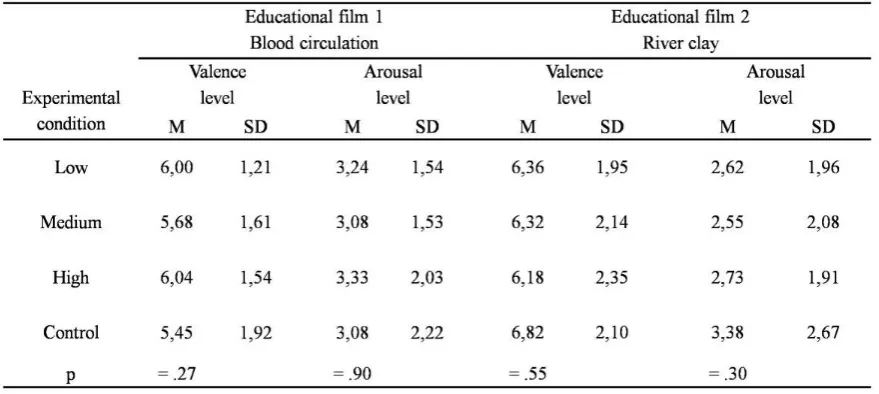
17 in condition 3A (blood circulation - Herotrance – river clay - Newhiphop) (M = 3.36, SD = 2.36) than condition 3B (blood circulation - Newhiphop – river clay - Herotrance) (M = 2.13, SD = 1.10). In the other conditions such significant differences were not found.
Table 3
Means of valence and arousal levels evoked by educational films
Memory for presented information
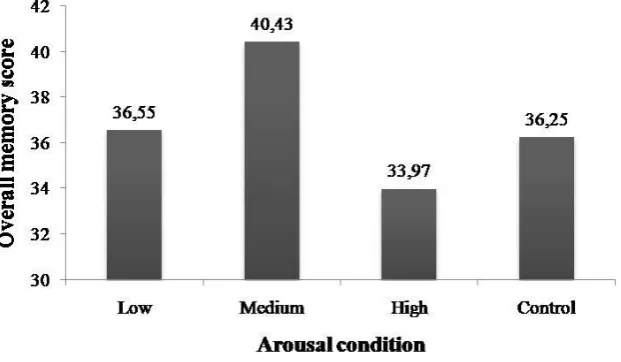
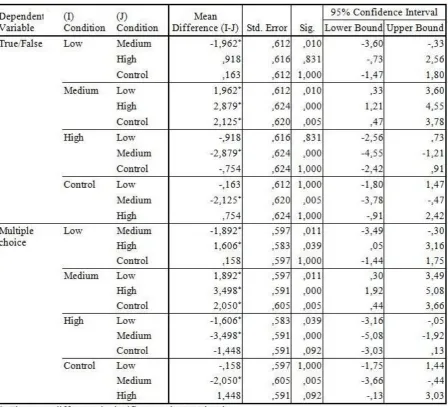
The effect of the arousal condition on the memory for the presented information in the educational films was measured with true/false questions and multiple choice questions. For the overall memory score (combined score of true/false - and multiple choice questions for the two educational films), an analysis of variance (one-way ANOVA) was conducted, with the arousal condition as factor and the overall memory score as dependent variable. A main effect was found for the arousal condition on total memory score (F(1, 157) = 12.00, p < .01). Results showed that the overall memory score of the subjects in the medium arousal condition was significant higher (M = 40.42, SD = 4.01) than that of subjects in the low (M = 36.55, SD = 4.55), high (M = 33.97, SD = 5.66) and control condition (M = 36.25, SD = 5.11). No significant differences were found between the total memory score of the subjects on the remaining conditions (figure 1 & Appendix I).
18 were significant higher (M = 24.70; M = 15.72) compared to the conditions low arousal (M= 22.74; M = 13.83), high arousal (M = 21,82; M = 12.23) and control (M = 22.58; M = 13.68). There were no significant differences between the other conditions (Appendix I & II).
Figure 1
Overall memory score per arousal condition
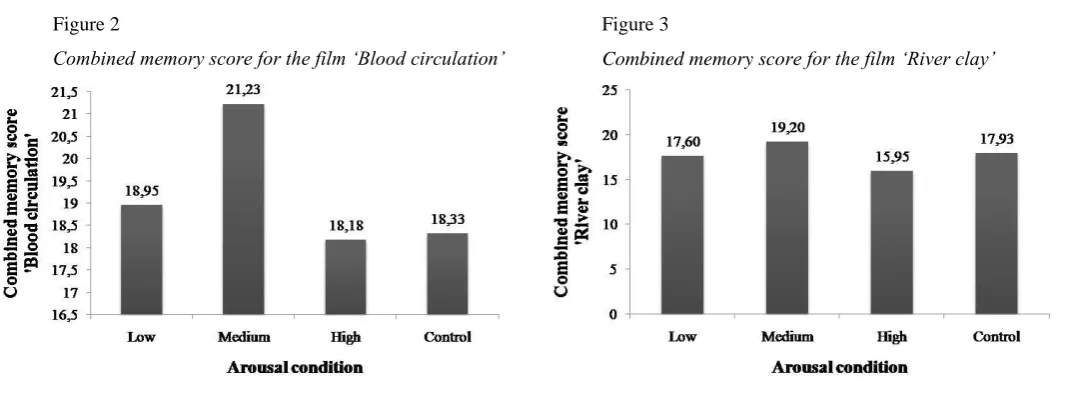
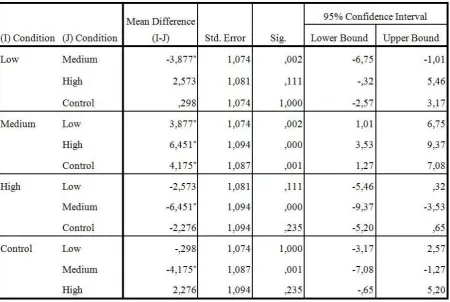
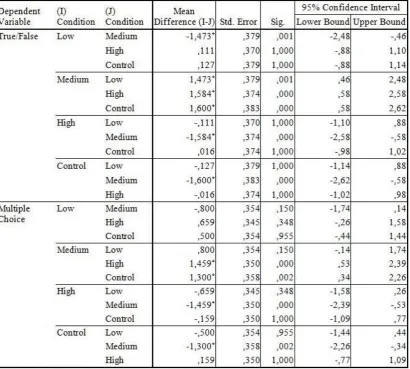
Furthermore, an analysis of variance (one-way ANOVA) was conducted for the combined memory score (i.e., true/false questions and multiple choice questions) of the educational film about blood circulation. As factor the arousal condition was applied and as dependent variable the combined memory score of the subjects. For the two memory measures separately the same analysis of variance was executed. A significant main effect was found for the combined memory score (F(3,162) = 11.66, p < .01), the true/false questions (F(3, 162) = 8.35, p < .01) and the multiple choice questions (F(3, 162) = 6.90, p < .01). A Bonferroni post hoc test showed that for the combined memory score and the true/false questions the scores of the subjects in the medium condition were significant higher than the scores of subjects in the other three conditions. For the multiple choice questions, subjects in the medium condition scored significant higher (M = 8.30 SD = 1.31) than the subjects in the high (M = 6.84, SD = 1.82) and control condition (M= 7.00, SD = 1.66). Besides the found significant differences, the differences between the other conditions were insignificant (Appendix I & II).
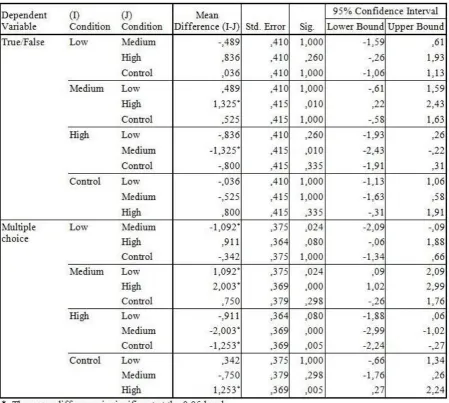
19 3.49, p = .02). For the combined and multiple choice scores, subjects in the medium condition scored significant better (M = 19.20; M = 7.42) than in the high condition (M = 15.95; M = 5.42). Other findings were a difference (p = .02) between the scores of the subjects in the medium condition (M = 19.20, SD = 2.59) and in the control condition (M = 17.92, SD = 3.08) concerning the combined score, and a difference (p = .02) between the scores in the medium condition (M = 7.42, SD = 1.39) and in the low condition (M = 6.33, SD = 1.79) for the multiple choice questions. Further, the score of the subjects on true/false questions were significant higher (p = .01) in the medium condition (M = 11.78, SD = 1.70) than in the high condition (M = 10.45, SD = 2.12). No other significant results were found (Appendix I & II).
Finally, a t-test demonstrated that the scores of the subjects on the educational film about blood circulation were significantly (p < .01) higher compared to the scores of the subjects on the educational film about river clay.
Evaluation of educational films
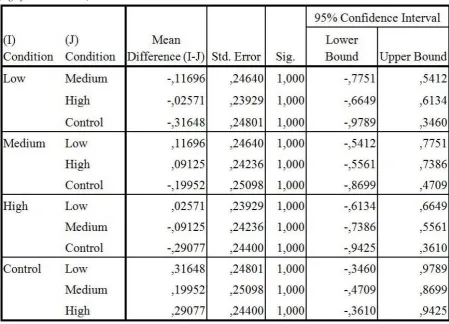
For the educational films a reliability analysis was conducted to test whether the ten items measuring the evaluation of the educational films (for blood circulation as well as for river clay) could be combined into an additive score for evaluation of the educational films. The Cronbach’s alpha for the ten items used for both of the educational films, was high (alpha = .90). The alpha represents a reliable measure, so an additive index of the ten semantic differentials was constructed for evaluation of the educational films. One of the subjects failed to complete all the items and was therefore excluded from the analysis.
[image:19.595.42.575.359.556.2]The effect of the level of arousal of musical tracks on the evaluation of the educational films was measured using an analysis of variance (one-way ANOVA), with the arousal Figure 2
Combined memory score for the film ‘Blood circulation’
Figure 3
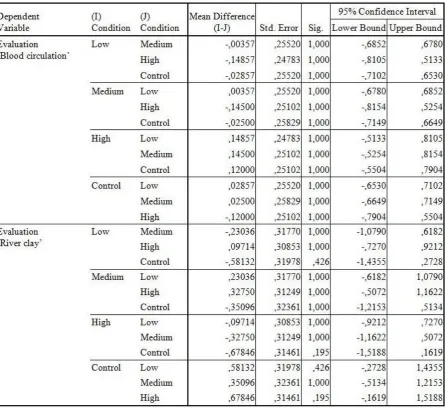
20 condition as factor and the evaluation of the educational films as the dependent variable. There were no significant differences found between the conditions low, medium, high and no arousal. Results showed that the level of arousal of the used musical tracks did not affect the evaluation of the educational films (Appendix I & II).
21
Conclusion
Interpretation of findings
It was hypothesized that the viewers’ level of arousal will increase with increasing arousal level of the background music of educational films. The results shows that valence levels as well as the arousal levels of subjects elicited by both of the educational films did not significantly differ between the different conditions of background music. However, the pre-test showed that just listening to the musical tracks did induce different levels of arousal in the subjects of the pre-test. A reason for this could be the difference between the age of the subjects in both the pre-test and the experiment. Younger viewers are more at ease with higher levels of arousal than older viewers because they are used to the fast pace used in the media (Bellamy and Walker, 1996). Furthermore, they are at an age in which sensation seeking is higher than the subjects of the pre-test (Zuckerman, 1994). In addition, young children seem to be less nuanced in the way they classify their levels of arousal. Another explanation might be the fact that the film is subtracting the subject from the music, which makes them feel less aroused by the music.
The main aim of this study was to evaluate whether the arousal level of background music influences the memory of the information presented in educational films. It was expected that up to a certain extent, the arousal level of background music is positively related to the memory of the presented information. It was found that the overall memory score of the subjects in the medium arousal condition was significantly higher than that of subjects in the low, high and control condition. The total memory scores of the subjects in the control, low and high condition, were not significantly different from each other. This finding is in accordance with the limited capacity model described by Lang (2000). This model predicts an inverted U-shape relationship between increase in structural features and memory. In this study, an inverted U-shape relationship was found between the level of arousal of background music and memory of presented information in educational films. Other research shows a similar relationship between the level of arousal and memory (Lang, Dhillon, and Dong, 1995; Tavassoli, Shultz, and Fitzsimons, 1995; Shapiro, MacInnes, and Park, 2002).
22 affect memory compared to the other conditions. However in the results of the film about River clay, only a significant difference was found between the medium and high condition. Furthermore, the scores of the subjects on the educational film about blood circulation were significantly higher compared to the scores of the subjects on the educational film about river clay. This might be explained by the fact that the educational film about River clay was the second film that was presented to the subjects, which possibly resulted in a decreased concentration for the second film.
23
Discussion
Previous studies generally used different music to represent music with high and low levels of arousal (Schellenberg et al., 2007; Thompson, Schellenberg, Husain, 2001). This study shows however that even with the same musical track it is only the manipulation of tempo (i.e., beats per minute) that can affect the level of arousal. It is suggested that tempo of music is an important component which directly relates to the level of arousal.
A final remark concerns the problem of producers of educational films who want to attract and at the same time inform viewers. Although a lot of producers believe that music with a higher tempo leads to greater attention, and therefore memory of the presented information, in reality this may not be so. This study indicates that producers can use background music to elicit arousal from viewers without necessarily sacrificing the viewers’ ability to process the information presented in educational films. The findings of this study suggest that producers need to search for music with an optimum level of arousal at which the presented content would be memorized most effectively.
Recommendations
Significant differences were found within the group of subjects of the experiment. Subjects from grade eight scored significantly higher than subjects from grade seven. There was also a significant different found between subjects with a Dutch nationality and subjects with other backgrounds. This different might be caused by arrears in the Dutch language. To rule out these differences, it is recommended to perform experiments with subjects with the same academic level.
Furthermore it was observed that after ten minutes during the first educational film the concentration of the children decreased. The children became more restless. Therefore, it is recommended to use a film of not more than approximately ten minutes for these type of experiments. Furthermore it was noticed that watching two educational films (of longer duration) in a row decreased the subjects focus. The Quiz in the film Blood circulation and the sound-effects of animals in the film about River clay proved to be a good tool to attract the children’s attention. Such features may enhance the attention level for other educational films as well.
25
References
Baddeley, A. D. (1986). Working Memory. Oxford: Oxford University Press
Bellamy, R. V., & Walker, J. R. (1996).Television and remote control: Grazing on a vast
wasteland. New York: Guilford Press.
Bolivar, V. J., Cohen, A. J., & Fentress, J. C. (1994). Semantic and formal congruency in music and motion pictures: Effects on the interpretation of visual action.
Psychomusicology, 13, 28-59.
Boltz, M., Schulkind, M., & Kantra, S. (1991). Effects of Background Music on the Remembering of Filmed Events. Memory & Cognition, 19, 593-606.
Boltz, M. G. (2001). Musical soundtracks as a schematic influence on the cognitive processing of filmed events. Music Perception, 18, 427-454.
Boltz, M. G. (2004). The cognitive processing of film and musical soundtracks. Memory &
Cognition, 32, 1194-1205.
Bradley, M. M., & Lang, P. J. (1994). Measuring Emotion - the Self-Assessment Mannequin and the Semantic Differential. Journal of Behavior Therapy and Experimental Psychiatry, 25, 49-59.
Cassidy, G., & MacDonald, R.A.R. (2007). The effect of background music and background noise on the task performance of introverts and extraverts. Psychology of Music,35, 517-537.
Cohen, A. J. (1993). Associationism and musical soundtrack phenomena. Contemporary
26 Cohen, A. J. (1999). The functions of music in multimedia: A cognitive approach. In S. W. Yi
(ed), Music, mind, and science (pp. 53-69), Seoul, Korea: Seoul National University Press.
Furnham, A., Trew, S., & Sneade, I. (1999). The distracting effects of vocal and instrumental music on the cognitive test performance of introverts and extraverts. Personality and Individual Differences, 27, 381-392.
Garlin, F. V., & Owen, K. (2006). Setting the tone with the tune: A meta-analytic review of the effects of background music in retail settings. Journal of Business Research, 59, 755-764.
Goldberg, M. E., & Gorn, G. J. (1987). Happy and sad tv programs: How they affect reactions to commercials. Journal of Consumer Research, 14, 387-403.
Greenwald, M. K., Cook, E. W., & Lang, P. J. (1989). Affective judgement and pschychophysiological response: Dimensional covariation in the evaluation of pictorial stimuli. Journal of Psychophysiology, 3, 51-64.
Gunter, B. (1987). Poor Reception: Misunderstanding and forgetting broadcast news. Hillsdale, NJ: Lawrence Erlbaum Associates.
Hallam, S., Price, J., & Katsarou, G. (2002). The effects of background music on primary school pupils' task performance. Educational Studies, 28, 111-122.
Hui, M. K., Dube, L., & Chebat, J. C. (1997). The impact of music on consumers' reactions to waiting for services. Journal of Retailing, 73, 87-104.
Husain, G., Thompson, W. F., & Schellenberg, E. G. (2002). Effects of musical tempo and mode on arousal, mood, and spatial abilities. Music Perception, 20, 151-171.
Jones, S. M., & Zigler, E. (2002). The Mozart effect - Not learning from history. Journal of
27 Kalinak, K. M. (1992). Setteling the score: Musi and the classical Hollywood Film. Madison,
WI: University of Winsconsin Press.
Kamins, M. A., Marks, L. J., & Skinner, D. (1991). Television commercial evaluation in the context of program induced mood: Congruency versus consistency effects. Journal of Advertising, 20, 1-14.
Kellaris, J. J., & Kent, R. J. (1994). An exploratory investigation of responses elicted by music varying in tempo, tonality and texture. Journal of Consumer Psychology, 2, 381-401.
Koelsch, S., & Siebel, W. A. (2005). Towards a neural basis of music perception. Trends in
Cognitive Sciences, 9, 578-584.
Lang, A. (2000). The limited capacity model of mediated message processing. Journal of
Communications, 50, 46-70.
Lang, A., Dhillon, K., & Dong, Q. (1995). The effects of emotional arousal and valence on television viewers’ cognitive capacity and memory. Journal of Broadcasting and
Electronic Media, 39, 313-327.
Lang, A., Zhou, S., Schwartz, N., Bolls, P. D., & Potter, R. F. (2000). The effects of edits on arousal, attention, and memory for television messages: When an edit is an edit can an edit be too much? Journal of Broadcasting & Electronic Media, 44, 94-109.
Magliano, J. P., Dijkstra, K. & Zwaan R. A. (1996). Generating predictive inferences while viewing a movie. Discourse processes, 22, 199-224.
Marshall, S. & Cohen, A. J. (1988). Effects of musical soundtracks on attitudes to geometric figures. Music perception, 6, 95-112.
28 North, A. C., Hargreaves, D. J., & McKendrick, J. (1997). In-store music affects product
choice. Nature, 390, 132-132.
Oakes, S., & North, A. C. (2008). Reviewing congruity effects in the service environment musicscape. International Journal of Service Industry Management, 19, 63-82.
Pignatiello, M. F., Camp, C. J., & Rasar, L. (1986). Musical mood induction: An alternative to the Velten technique. Journal of Abnormal Psychology, 95, 295-297.
Pring, L., & Walker, J. (1994). The Effects of Unvocalized Music on Short-Term-Memory.
Current Psychology, 13, 165-171.
Rauscher, F. H., Shaw, G. L., & Ky, K. N. (1993). Music and Spatial Task-Performance.
Nature, 365, 611-611.
Rickard, N. S. (2004). Intense emotional responses to music: A test of the physiological arousal hypothesis. Psychology of Music, 32, 371-388
Schellenberg E. G., Nakata T., Hunter P. G., & Tamoto S. (2007). Exposure to music and cognitive performance: Tests of children and adults. Psychology of Music, 35, 5-19.
Shapiro, S., MacInnis, D. J., & Park, C. W. (2002). Understanding program-induced mood effects: Decoupling arousal from valence. Journal of Advertising, 31, 15-26.
Steele, K. M., Dalla Bella, S., Peretz, I., Dunlop, T., Dawe, L. A., Humphrey, G. K., et al. (1999). Prelude or requiem for the 'Mozart effect'? Nature, 400, 827-827.
Tavassoli, N. T., Schultz, C. J., & Fitzsimons, G. J. (1995). Program involvement: Are moderate levels best for ad memory and attitude toward the ad? Journalof Advertising Research, 35, 61-72.
29 Vettehen, P. H., Nuijten, K., & Peeters, A. (2008). Explaining effects of sensationalism on
liking of television news stories: The role of emotional arousal. Communication
Research, 35, 319-338.
Webster, G. D., & Weir, C. G. (2005). Emotional responses to music: Interactive effects of mode, texture, and tempo. Motivation and Emotion, 29, 19-39.
Yerkes, R. M., Dodson, J. D. (1908). The relation of strength of stimulus to rapidity of habit formation. Journal of Comparative Neurology and Psychology, 18, 459-482.
Zander. M. F. (2006). Musical influences in advertising; how music modifies first impressions of product endorsers and brands. Psychology of Music, 34, 465-480.
30
Appendix I
In this appendix the tables of the results (descriptive and post hoc) concerning the memory and evaluation of the two educational films are presented.
[image:30.595.73.570.220.347.2]1.1 Overall memory score for the educational films ‘Blood circulation’ and ‘River clay’ Table 1
Descriptives overall memory score educational films ‘Blood circulation’ and ‘River Clay’
Table 2
[image:30.595.75.526.416.718.2]31 Table 3
32 1.2 Memory scores for the educational film ‘Blood circulation’
Table 4
33 Table 5
34 1.3 Memory scores for the educational film ‘River clay’
Table 6
35 Table 7
Post hoc test, multiple comparisons for the memory score (true/false questions & multiple choice questions) on the educational film ‘River clay’ (significance level .05)
1.4 Evaluation of the educational films ‘Blood circulation’ and ‘River clay’ Table 8
[image:35.595.72.537.614.748.2]36 Table 9
37 Table 10
38
Appendix II
In this appendix the figures of the results concerning the memory for the two educational films are presented.
[image:38.595.77.352.239.413.2]2.1 Combined memory score for educational films ‘Blood circulation and ‘River clay’
Figure 1
Overall score true/false questions per arousal condition
Figure 2
[image:38.595.76.355.479.627.2]39 2.2 Memory score for the educational film ‘Blood circulation’
Figure 3
[image:39.595.81.355.374.538.2]Score true/false questions per arousal condition for the educational film ‘Blood circulation’
Figure 4
Score multiple choice questions per arousal condition for the educational film ‘Blood circulation’
2.3 Memory score for the educational film ‘River clay’ Figure 5
[image:39.595.78.358.617.778.2]40 Figure 6
41
Appendix III
In this appendix the pretest using the Self-Assessment Manikin (SAM) (Bradley & Lang, 1994) in order to check the induced arousal and valence by the musical tracks is presented.
Welkom bij dit onderzoek.
In dit onderzoek wordt geen koppeling gemaakt tussen uw naam en tijdens het onderzoek verkregen antwoorden en gedragingen.
Bij dit onderzoek worden antwoorden op vragen en/of gedrag geregistreerd. Dit gebeurt d.m.v. antwoorden op vragenlijsten. Deze gegevens worden vervolgens anoniem behandeld, samengevoegd met andere proefpersonen, aan statistische analyses onderworpen en eventueel gebruikt voor wetenschappelijke publicaties.
U wordt vriendelijk verzocht per vraag het voor u juiste antwoord aan te kruisen, dan wel de gevraagde informatie in te vullen. Het is voor ons van groot belang dat u alle vragen in de vragenlijst beantwoordt. Het invullen van de vragenlijst duurt ongeveer 10 minuten.
Als u meer wilt weten over het onderzoek en/of geïnteresseerd bent in de resultaten van dit onderzoek dan kunt u aan het einde van deze vragenlijst uw e-mailadres achterlaten. Na afloop van dit onderzoek zal u dan per e-mail worden geïnformeerd over de inhoud en resultaten van dit onderzoek
Participantnummer ___
42
Muziek en Emotie
In deze sectie zijn we geïnteresseerd in uw mening over uw gevoelens betreffende de aan u gepresenteerde muziek.
Muzieknummer 1
Kruis één van de negen hokjes onder de visuele schaal aan die het best weergeeft hoe u
zich voelde ten tijde van het luisteren naar het muzieknummer. Let op: Luister minimaal 1
minuut voordat u antwoord geeft.
1. Onplezierig Plezierig
2. Kalm Opgewonden
43 Muzieknummer 2
Kruis één van de negen hokjes onder de visuele schaal aan die het best weergeeft hoe u
zich voelde ten tijde van het luisteren naar het muzieknummer. Let op: Luister minimaal 1
minuut voordat u antwoord geeft.
1. Onplezierig Plezierig
2. Kalm Opgewonden
44 Muzieknummer 3
Kruis één van de negen hokjes onder de visuele schaal aan die het best weergeeft hoe u
zich voelde ten tijde van het luisteren naar het muzieknummer. Let op: Luister minimaal 1
minuut voordat u antwoord geeft.
1. Onplezierig Plezierig
2. Kalm Opgewonden
45 Muzieknummer 4
Kruis één van de negen hokjes onder de visuele schaal aan die het best weergeeft hoe u
zich voelde ten tijde van het luisteren naar het muzieknummer. Let op: Luister minimaal 1
minuut voordat u antwoord geeft.
1. Onplezierig Plezierig
2. Kalm Opgewonden
46 Muzieknummer 5
Kruis één van de negen hokjes onder de visuele schaal aan die het best weergeeft hoe u
zich voelde ten tijde van het luisteren naar het muzieknummer. Let op: Luister minimaal 1
minuut voordat u antwoord geeft.
1. Onplezierig Plezierig
2. Kalm Opgewonden
47
Muzieknummer 6
Kruis één van de negen hokjes onder de visuele schaal aan die het best weergeeft hoe u
zich voelde ten tijde van het luisteren naar het muzieknummer. Let op: Luister minimaal 1
minuut voordat u antwoord geeft.
1. Onplezierig Plezierig
2. Kalm Opgewonden
48
Persoonlijk
Tot slot zijn we geïnteresseerd in een aantal persoonlijke gegevens. Deze gegevens worden gevraagd ten behoeve van het gehele onderzoek en zullen volledig anoniem
behandeld worden.
1. Wat is uw leeftijd? …………
2. Wat is uw geslacht?
vrouw
man
3. Wat is uw hoogst voltooide opleiding?
lager algemeen (lagere/basisonderwijs)
lager beroepsonderwijs
middelbaar algemeen beroepsonderwijs (bijv. MAVO)
middelbaar beroepsonderwijs
voortgezet algemeen onderwijs (bijv. HAVO, VWO, Atheneum, Gymnasium)
hoger beroepsonderwijs
wetenschappelijk onderwijs, doctoraal
wetenschappelijk onderwijs, gepromoveerd
4. Wilt u per e-mail op de hoogte worden gebracht van de uitkomsten van dit onderzoek?
ja
nee
Indien ja, e-mailadres:______________________________________
Heeft u opmerkingen of suggesties over de vragenlijst of wilt u iets kwijt over de aan u gepresenteerde muziek wilt u dat dan hieronder vermelden?
49
Appendix IV
50
Welkom bij dit onderzoek.
Leuk dat je meedoet! Waarom dit onderzoek vraag je je misschien af. Wij willen graag weten wat jij van de informatiefilmpjes vindt die jij in de klas te zien krijgt. Vind jij ze leuk of juist helemaal niet. Leer je wat van de filmpjes of juist niet. Om op deze en andere vragen antwoorden te krijgen laten we je zo dadelijk 2 filmpjes zien.
Na elk filmpje krijg je een aantal vragen. Eerst een paar vragen waarin je je mening mag geven over het filmpje en daarna een paar vragen over de inhoud van het filmpje. Let dus goed op.
Dankzij jouw hulp kunnen we in de toekomst informatiefilmpjes voor kinderen nog beter maken. Dank je wel.
Basisschool:
Voornaam:
Klas:
Datum:
51
Persoonlijk
Als eerst zijn we geïnteresseerd in een aantal persoonlijke gegevens van jou. Deze gegevens worden gevraagd om een algemeen beeld te vormen van de kinderen die
met dit onderzoek meedoen en zullen volledig anoniem behandeld worden.
1. Wat is jouw leeftijd? ………
2. Wat is jouw geslacht?
Meisje
Jongen
3. In welk land ben jij geboren?
52
Film 1
53 Groot Ik begreep alles. Klein Ik snapte er niets van
Evaluatie aflevering ‘De bloedsomloop’
In dit deel zijn we geïnteresseerd in jouw mening over de aflevering over de bloedsomloop uit de serie ‘De Mens’.
Wat moet je doen?
Hieronder zie je drie rijen met verschillende plaatjes. Probeer bij iedere rij plaatjes zo goed mogelijk aan te geven hoe jij je voelde tijdens het kijken naar de aflevering over de bloedsomloop. Kruis 1 van de negen rondjes onder de plaatjes aan die jij het beste vindt passen bij jouw gevoel. Het gaat om je eigen mening dus je antwoord is altijd goed.
Vraag 1: Hoe voelde je je tijdens het kijken naar de aflevering?
1 2 3 4 5 6 7 8 9
Vraag 2: Hoe voelde je je tijdens het kijken naar de aflevering?
1 2 3 4 5 6 7 8 9
Vraag 3: Hoe voelde je je tijdens het kijken naar de aflevering?
VOLGENDE PAGINA VRAAG 4
Plezierig Niet plezierig
Opgewonden Kalm
54 Wat moet je doen?
Hieronder staan 10 keer twee woorden die elkaars tegenpool zijn. Tussen elk van die twee woorden zie je steeds 9 hokjes staan. Kruis bij elke twee woorden steeds dat hokje aan dat het best beschrijft wat je vindt. Als een hokje dichter bij een woord staat betekent het dat je het meer eens bent met dat woord. Als een hokje verder van een woord vandaan staat dan betekent het dat je het minder eens bent met dat woord.
Vraag 4: Wat vond jij van het filmpje over ‘de bloedsomloop’? Het filmpje over ‘de
bloedsomloop’ was….
55
Opgaven aflevering ‘De bloedsomloop’
In dit deel stellen we je wat vragen over een aantal zaken die behandeld zijn in de aflevering over de bloedsomloop uit de serie ‘De Mens’.
Heel veel succes!
Goed of Fout?
Hieronder staan een aantal beweringen. Geef telkens voor elke bewering aan of deze goed of fout is. Doe dit door een kruis in het juiste hokje achter de vraag te zetten.
Heb je een verkeerd hokje aangekruist maak dan het hele hokje zwart en zet een kruis in het goede hokje.
56 Meerkeuzevragen
Hieronder staan een aantal meerkeuzevragen. Geef bij iedere vraag aan wat volgens jou het meest juiste antwoord is. Doe dit door een kruis in het juiste hokje (A, B, C, D) achter de vraag te zetten.
Heb je een verkeerd hokje aangekruist maak dan het hele hokje zwart en zet een kruis in het goede hokje.
57
58
Film 2
59
Groot
Ik begreep alles.
Klein
Ik snapte er niets van
Evaluatie aflevering ‘Het rivierkleilandschap’
In dit deel zijn we geïnteresseerd in jouw mening over
de aflevering over het rivierkleilandschap uit de serie ‘Landschap & Grondsoort’.
Wat moet je doen?
Hieronder zie je drie rijen met verschillende plaatjes. Probeer bij iedere rij plaatjes zo goed mogelijk aan te geven hoe jij je voelde tijdens het kijken naar de aflevering over ‘het rivierkleilandschap’ . Kruis 1 van de negen rondjes onder de plaatjes aan die jij het beste vindt passen bij jouw gevoel. Het gaat om je eigen mening dus je antwoord is altijd goed.
Vraag 1: Hoe voelde je je tijdens het kijken naar de aflevering?
1 2 3 4 5 6 7 8 9
Vraag 2: Hoe voelde je je tijdens het kijken naar de aflevering?
1 2 3 4 5 6 7 8 9
Vraag 3: Hoe voelde je je tijdens het kijken naar de aflevering?
VOLGENDE PAGINA VRAAG 4
Plezierig Niet plezierig
Opgewonden Kalm
60 Wat moet je doen?
Hieronder staan 10 keer twee woorden die elkaars tegenpool zijn. Tussen elk van die twee woorden zie je steeds 9 hokjes staan. Kruis bij elke twee woorden steeds dat hokje aan dat het best beschrijft wat je vindt. Als een hokje dichter bij een woord staat betekent het dat je het meer eens bent met dat woord. Als een hokje verder van een woord vandaan staat dan betekent het dat je het minder eens bent met dat woord.
Vraag 4: Wat vond jij van het filmpje over ‘het rivierkleilandschap’? Het filmpje over ‘het
rivierkleilandschap’ was….
61
Opgaven aflevering ‘Het rivierkleilandschap’
In dit deel stellen we je vragen over een aantal zaken die behandeld zijn in de aflevering over het rivierkleilandschap uit de serie ‘Landschap & Grondsoort’.
Heel veel succes!
Hieronder staan een aantal beweringen. Geef telkens voor elke bewering aan of deze goed of fout is. Doe dit door een kruis in het juiste hokje achter de vraag te zetten.
Heb je een verkeerd hokje aangekruist maak dan het hele hokje zwart en zet een kruis in het goede hokje.
62 Meerkeuzevragen
Hieronder staan een aantal meerkeuzevragen. Geef bij iedere vraag aan wat volgens jou het meest juiste antwoord is. Doe dit door een kruis in het juiste hokje (A, B, C, D) achter de vraag te zetten.
Heb je een verkeerd hokje aangekruist maak dan het hele hokje zwart en zet een kruis in het goede hokje.
63