Thesis
Testing Six Mate Preference Theories
Mate Preferences and Judgments in Mate Selection Process
Rianne Kaptijn (s0044563)
30-08-2010
First supervisor
Dr. P.A.T.M. Geurts
Second supervisor
Dr. N. Torka
Supervisors from company
Ir. F.C. van Viegen
2 Abstract
Six mate preference theories; ideal personality mate preferences, stated mate preferences, revealed mate preferences, asymmetrical mate preference theory and positive and negative assortative mating, were tested on a large dataset (N=5733) of a Dutch dating site. The focus was on hetroseksuals that were looking for a long-term relationship. Personality characteristics, demographics, leisure activities, sociosexuality and attractiveness of individuals were analyzed in relation to the appreciation scores individuals gave each other. Most evidence is found for the asymmetrical mate preference theory derived from the social exchange theory. Individuals prefer others with a minimum of undesirable traits and maximum of desirable traits. The depreciation of undesirable traits is seen more often than the appreciation of desirable traits. This means that individuals prefer someone who scores the same or higher on desirable traits. In practice this mechanism will lead to similarity in partners.
3 Testing Six Mate Preference Theories
Mate Preferences and Judgments in Mate Selection Process
Mate preferences, predictors of marriage quality or nonmarital romantic relationship quality are reported by e.g. Bereczkei and Csanaky (1996); de Vaus, Gray, Qu and Stanton (2007); Ferstl, Eggert, Westphal, Zavazova and Müller-Ruchholtz (1992). A high quality relationship, that is a relationship in which partners manifest attachment, care giving and sexual mating (Bowlby 1982; Shaver, Hazan & Bradshaw, 1988), is associated with well-being and well-functioning for the individuals involved (Seiffge-Krenke & Lang, 2002). Low-quality relationships however are marked by irritation, antagonism, more conflict situations and controlling behaviour (Galliher, Welsh, Rostosky & Kawaguchi, 2004). Ending a relationship and divorce are associated with lower levels of well-being (Amato, 2000), less home ownership, less wealth later in life (de Vaus, Gray, Qu & Stanton, 2007) and it is even one of the strongest triggers for a major depression (Bruce & Kim, 1992). Not only can ending a relationship or a divorce have a big influence on the individuals involved in the relationship, their children can also suffer from it. Because of the positive effects of having a high quality relationship and the (potential) negative effects of having a lower quality relationship or ending a relationship, it is worthwhile to study which mate preferences individuals have, how they judge in the selection process and which mate selection theory can be empirically validated.
4 characteristics are associated with maintaining a long, loving and stable relationship by looking at happily married, unhappily married and divorced couples. Recently, speed date events are also used to evaluate mate preferences, for example in Kurzban and Weeden (2003).
Based on the studies described above and related studies, six mate selection theories were extracted and will be tested. This study uses data of a dating site to test which mate selection theory explains most in the appreciation score dating site members gave each other.
The ideal personality mate preference theory contains the personality traits which predict whether a satisfying, loyal, faithful and stable relationship develops and holds. Below will be explained in what manner the personality traits extraversion, neuroticism, agreeableness, conscientiousness and openness to new experiences influence the quality of a relationship.
Neuroticism reflects the emotional stability of a person. Neurotic persons have a lower threshold for feelings such as anxiety, stress, guilt, jealousy and depression. As Buss (2000) pointed out, human jealousy often leads to relationship problems. Neuroticism is the strongest predictor of low spouses‟ marital satisfaction and relationship satisfaction (Karney & Bradbury, 1997; Kelly & Conley, 1987; Robins, Caspi & Moffitt, 2000).
Conscientiousness concerns responsibility, self-discipline, aim for achievement and sense of duty. Individuals scoring low on this trait are more likely to have impulsive sex, be promiscuous and are more likely to cheat on their partners (Miller, Lynam, Zimmerman, Logan, Leukefeld & Clayton, 2004; Schmitt et al., 2004; Schmitt & Buss, 2001). People are more satisfied with their relationship if their partner can control his or her impulses (Kelly & Conley, 1987). Very conscientious individuals impose less stress on their relationship (Robins, Caspi & Moffitt, 2000).
5 (Schmitt et al., 2004; Schmitt & Buss, 2001). Agreeable partners were also seen as loving, affectionate and good conversation partners (Botwin, Buss & Shackelford, 1997). Spouses of agreeable individuals tend to be more satisfied with their relationship and sexual activities (Botwin, Buss & Shackelford, 1997; Oldham & Morris, 1991).
Openness to experiences reflects openness to diverse art forms, personal experiences, aesthetics and adventure. Openness is a good predictor of creative output, which is a predictor of the number of sexual partners (Nettle & Clegg, 2006). Individuals who are open to adventure expose themselves more to risks and as a result end up in hospitals more often (Nettle, 2005) and become involved in criminal or anti-social behaviour more frequently (Ellis, 1987), than individuals who are less open to adventure. Openness is also associated with psychotic disorders (Nettle, 2006).
Extraverts are more outgoing and have higher energy levels and engage more in social situations. Therefore it is more likely for them to meet an attractive alternative than it is for introverts (Schmitt & Buss, 2001). Attractive alternatives are one of the biggest reasons to cheat or end a relation (Kelley, 1983; Leik & Leik, 1977; Rusbult, 1983; Thibaut & Kelley, 1959). It is found that extraverts tend to have more sexual partners (Heaven, Fitzpatrick, Craig, Kelly & Sebar, 2000), and are more likely to have affairs and terminate a relationship (Nettle, 2005). However, extraversion is also associated with a higher social status and large social network, which women find desirable in men (Botwin, Buss & Shackelford, 1997).
6 In sum, extraversion is a negative characteristic when an monogamous relationship is desired, however it can be a positive characteristic for men because of the social status and networks associated with extraversion. Neuroticism, openness and perceived desirability are negative characteristics for men as well as for women and will predict a less positive appreciation. Conscientiousness and agreeableness are positive characteristics when a long, loving and stable relationship is desired. It is hypothesized that persons displaying positive characteristics will be appreciated more than persons displaying negative characteristics.
7 are large gender preference differences, good looks and good financial prospect do not seem to be very important or more important than for example kindness (Powers, 1971). There are also differences in cultural mate preferences, these can also be seen as a deviation from the absolute preferences. Some cultures vary substantial on the importance placed on specific characteristics. The variable most culturally dependent, is the desire for a virgin; in The Netherlands least importance is placed on virginity, whereas in China most importance is placed on this characteristic (Buss, 1989, 2006; Buss et al., 1990). In sum people say they prefer a person that is intelligent, friendly, agreeable and healthy over the specific gender preferences like financial prospect and good looks. In this paper is tested whether individuals prefer absolute preferences over gender specific preferences. In other words, it is tested if there is empirical evidence for the stated mate preference theory.
8 conclusion of the speed date experiments is that physical attractiveness is the most important feature in the initial selection process, where more attractive individuals are favourable over less attractive individuals and that attractive men and women were more selective. Which is contrary to the stated mate preference theories. It also suggests that the evolutionary perspective, which states that men more than women value physical attractiveness and women more than men value a person who can provide income or has good financial prospects and status (Buss, 1989; Buss, Shackelford, Kirkpatrick, & Larsen, 2001; Hill, 1945; Hoyt & Hudson, 1981; Hudson & Henze, 1969; Kenrick, Groth, Trost, & Sadalla, 1993; McGinnis, 1958; Wiederman & Allgeier, 1992), is not applicable in the initial selection process. Because the stated mate preference theory and the revealed mate preference theory are contradictory, it is tested for which theory most empirical evidence can be found.
9 done by giving higher appreciation scores to people with desirable traits. For example, people give a higher appreciation score to more attractive individuals, while they do not give lower appreciation scores to individuals that are less attractive than themselves. The third and fourth hypotheses are the maximization hypothesis and the minimization hypothesis, those hypotheses indicate that people not only prefer to minimize the costs they also prefer to maximize the rewards. When people maximize, they give higher appreciation scores to people that score higher on a trait (for example attractiveness) and give lower appreciation scores to someone that scores lower than themselves on that trait. When people minimize they give lower appreciation scores to someone that scores higher than themselves and give higher appreciation scores to someone that scores lower. Maximization will be applied on desirable traits and minimization will be applied on undesirable traits. It is assumed that rewards (appreciation) and (costs) depreciation are asymmetrical. For example, people may neither appreciate nor depreciate others that have an higher education level than themselves but they may depreciate others that have an lower educational level. Or people may appreciate someone scoring higher on for example openness to new experiences, but they may depreciate someone who score as high of lower than themselves, more than they appreciated the higher scoring individuals. In this paper will be tested whether people depreciate others that score lower than themselves and appreciate people that score higher than themselves on desirable characteristics and whether the rewards and costs are asymmetrical.
10 personality characteristics and demographic variables of both members of a couple (e.g., Barry, 1970; Bentler & Newcomb, 1978; Burgess & Wallin, 1953; Dean, 1966; Eysenck & Wakefield, 1981; Hollingshead, 1950; Kennedy, 1944; Lutz, 1918; Terman & Buttenweiser, 1935). Therefore it will be tested whether individuals prefer someone that it similar to themselves.
The last theory that will be tested is negative assortative mating, this is the opposite of positive assortative mating. This means that individuals desire someone who is different from themselves. For example if someone is extravert, he or she will be looking for someone who is introvert. Zhang and Liu (2003) found that the correlation between spouses‟ wages is negative, which indicates negative assortative mating, however it also may be due to uneven positions of men and women in society. McManus and Mascie-Taylor (1984) also found negative assortative mating for very long women, these women where involved with shorter men than themselves. This, of course, may be due to the lack of very tall men. There is little evidence for this theory, but for the purpose of completeness, this theory will also be tested.
11 if considered at all, are possibly overlooked or may not be realistic. Research based on speed dates (Kurzban & Weeden, 2003; Todd, Penke, Fasolo & Lenton, 2006) has an binary dependent variable; it is only asked whether an individual wants to see another individual again or not, thus there is no specification of how much they like or dislike the other person. Another speed date experiment drawback is that the duration of a date is so short that some or even all characteristics are observed imperfectly (Fisman, Iyengar, Kamenica, Simonson, 2006).
To overcome these limitations it is important that the personal characteristics of the potential mates are known, before the relationship or dating starts. Furthermore, it is important that people indicate to what extent they like or dislike their contact and had the time to get to know each other a bit. This paper reports the outcome of a questionnaire which is filled out before the members of the dating site came in contact with each other. This contact consists of on- or offline chat messages. After approximately 50 messages both individuals can fill out whether or not they like their chat partner on a 100-point scale.
12 Method
Participants
The dataset consisted of 5733 chat couples. A chat couple consists of 2 individuals which exchanged at least 50 chat messages with each other. The individual that gave an appreciation score of the contact, will be called the judge, the individuals that underwent the judgment will be called the judged. Individuals differed in the number of times they judged a contact, therefore some individuals are included in the sample more than others. On average a judge evaluated 3.77 individuals, the judged were judged 3.03 times. All individuals are in the sample as judge and as judged. Ideally multilevel analysis should be used on this type of data, however the sample size would be to small when the people who only judged one person were removed.
To enable the analysis of gender specific mate preferences the sample was split into two subsamples; one subsample consisted on women who judged men (N=2887) and the other subsample consisted on men who judged women (N=2846). Besides the gender specific preferences, men also appreciate women on average significantly higher than women men, resp. (M=63.5, SD=20.6) and (M=54.7, SD= 20.0).
Individuals with a homosexual or bisexual orientation were removed from the initial data set because an homosexual orientation is associated with different mate preferences (Deaux & Hanna, 1984). Individuals that were not looking for a long-term relationship were also removed because individuals that are looking for a long-term relationship have different priorities than those looking for a short-term relationship (Kenrick et al., 1993; Regan, 1998).
13 Table 1
Descriptive statistics of the judges
Variable Unit
Women Mean S.D.
Men Mean S.D.
N of questions
Cronbach’s alpha Personality characteristics
Appreciation score 0 (low) to 100 (high) 63.5 20.61 54.7 20.00 1
Extraversion 1 (low) to 7 (high) 4.85 0.70 4.74 0.74 8 .79
Neuroticism 1 (low) to 7 (high) 3.74 0.87 3.28 0.86 7 .84
Openness to new experiences
1 (low) to 7 (high) 4.72 0.86 4.87 0.78 4 .66
Psychoticism 1 (low) to 7 (high) 3.13 0.84 2.91 0.85 5 .77
Agreeableness 1 (low) to 7 (high) 5.81 0.64 5.61 0.64 3 .60
Conscientiousness in planning
1 (low) to 7 (high) 4.20 1.14 3.94 1.14 2 .78
Conscientiousness in expressing
1 (low) to 7 (high) 4.19 1.25 4.73 1.18 2 .76
Insensitiveness 1 (low) to 7 (high) 3.38 0.93 3.46 0.95 3 .70
Talking about feelings
1 (low) to 7 (high) 4.87 1.16 4.61 1.22 2 .75
Dominance 1 (low) to 7 (high) 3.86 0.84 3.82 0.88 3 .75
Shyness 1 (low) to 7 (high) 3.42 1.27 3.83 1.37 2 .68
Social skills 1 (low) to 7 (high) 5.85 0.88 5.42 1.04 1
Spontaneousness 1 (low) to 7 (high) 5.87 0.79 5.43 1.00 1
Attractiveness
Facial attractiveness 1 (low) to 10 (high) 5.26 2.45 5.12 2.36 ≥1
Bodily attractiveness 1 (low) to 10 (high) 5.25 2.17 4.77 2.22 ≥1
Length centimetres 170.71 6.75 183.57 7.38 1
Weight kilograms 72.14 13.05 80.07 12.28 1
Leisure activities
Sports 1(never) to 10(everyday) 2.10 1.69 2.55 2.05 1
Club / dance events 1(never) to 10(everyday) 0.34 0.50 0.41 0.55 1
Bars 1(never) to 10(everyday) 0.67 0.72 0.85 0.91 1
0 of friends 1(never) to10(everyday) 3.28 2.07 2.96 2.20 1
Education 1 (low) to 9 (high) 6.54 1.51 6.54 1.57 1
Politics 1 (low) to 7 (high) 4.89 1.08 5.25 1.05 2 .75
Morning person 1 (low) to 7 (high) 3.65 1.63 3.54 1.58 1
Sociosexuality 1 (low) to 7 (high) 2.54 1.07 4.32 1.12 3 .80
Humorousness 1 (low) to 7 (high) 5.29 0.87 5.36 0.84 1
Ambitiousness 1 (low) to 7 (high) 4.71 1.13 4.90 1.04 1
Perceived desirability 1 (low) to 7 (high) 4.66 1.03 4.18 1.04 3 .83
Niceness childhood 1 (low) to 7 (high) 5.26 1.50 5.34 1.39 1
Happiness 1 (low) to 7 (high) 5.56 0.90 5.38 1.05 1
Smoking 1 (never) to 5 (a lot) 1.85 1.27 1.76 1.24 1
Alcohol 1 (never) to 5 (a lot) 2.43 0.71 2.68 0.75 1
TV hours per day 3.93 2.36 3.45 2.30 1
14 Table 2
Descriptive statistics of the judged
Variable Unit
Women Mean S.D.
Men Mean S.D. Personality characteristics
Extraversion 1 (low) to 7 (high) 4.85 0.71 4.77 0.72
Neuroticism 1 (low) to 7 (high) 3.75 0.87 3.25 0.82
Openness to new experiences 1 (low) to 7 (high) 4.73 0.87 4.89 0.77
Psychoticism 1 (low) to 7 (high) 3.13 0.84 2.90 0.83
Agreeableness 1 (low) to 7 (high) 5.79 0.65 5.61 0.64
Conscientiousness in planning 1 (low) to 7 (high) 4.23 1.14 3.88 1.14
Conscientiousness in expressing 1 (low) to 7 (high) 4.16 1.24 4.76 1.17
Insensitiveness 1 (low) to 7 (high) 3.39 0.93 3.43 0.93
Talking about feelings 1 (low) to 7 (high) 4.82 1.16 4.60 1.20
Dominance 1 (low) to 7 (high) 3.88 0.85 3.85 0.88
Shyness 1 (low) to 7 (high) 3.45 1.28 3.72 1.35
Social skills 1 (low) to 7 (high) 5.84 0.91 5.48 1.01
Spontaneousness 1 (low) to 7 (high) 5.86 0.80 5.44 0.99
Attractiveness
Facial attractiveness 1 (low) to 10 (high) 5.43 2.45 5.22 2.34
Bodily attractiveness 1 (low) to 10 (high) 5.40 2.15 4.88 2.19
Length centimetres 170.75 6.62 183.49 7.26
Weight kilograms 71.96 13.39 79.99 12.10
Leisure activities
Sports 1(never) to 10(everyday) 2.22 1.82 2.52 2.05
Club / dance events 1(never) to 10(everyday) 0.37 0.54 0.43 0.55
Bars 1(never) to 10(everyday) 0.70 0.74 0.89 0.95
Company of friends 1(never) to 10(everyday) 3.41 2.22 2.93 2.12
Education 1 (low) to 9 (high) 6.48 1.53 6.64 1.50
Politics 1 (low) to 7 (high) 4.82 1.10 5.30 1.03
Morning person 1 (low) to 7 (high) 3.54 1.66 3.49 1.59
Sociosexuality 1 (low) to 7 (high) 2.51 1.08 4.38 1.11
Humorousness 1 (low) to 7 (high) 5.27 0.90 5.39 0.82
Ambitiousness 1 (low) to 7 (high) 4.71 1.13 4.92 1.04
Perceived desirability 1 (low) to 7 (high) 4.64 1.05 4.25 1.01
Niceness childhood 1 (low) to 7 (high) 5.30 1.48 5.37 1.38
Happiness 1 (low) to 7 (high) 5.55 0.92 5.43 1.01
Smoking 1 (never) to 5 (a lot) 1.83 1.25 1.75 1.23
Alcohol 1 (never) to 5 (a lot) 2.42 0.70 2.69 0.75
TV hours per day 1.98 0.80 1.80 0.80
Age years 31.63 9.81 32.11 8.91
Measures
The constructs used for analyses are shown in table 1 and 2. The Cronbach‟s alphas shown in table 1, are calculated on the aggregated data set so every individual was included only once. Principal component analyses showed that al scales loaded on 1 factor, indicating that every scale had one underlying factor.
15 conscientiousness, insensitiveness, talking about feelings, dominance and shyness are derived from the NEO-PI-R (Costa & McCrae, 1992) and are modified to what is hypothesized to be important personality characteristics in relationships and relationship forming. In the same way the trait psychoticism of Eysenck Personality Questionnaire (EPQ; Eysenck & Eysenck, 1991) and the atitutional items of the Sociosexual Orientation Inventory (SOI; Simpson & Gangestad,
1991) were measured.
Except for the multiple choice questions, all the questions and statements where measured on a 7-point likert scale. The answer alternatives could be chosen using track bars. On fixed positions on the track bar anchors appeared, ranging from „no, not at all‟, to „yes, very much‟ as answers to the questions. The anchors on the track bar of the statements ranged from „totally disagree‟ to „totally agree‟. The entire questionnaire can be found in the appendix.
The dependent variable “how good do you fit together?” is measured on a 100-point scale. Where 0 indicated not a fit at all and 100 indicated very good fit.
Procedure
The data used in this paper are obtained from a free Dutch dating site Paiq, which operates on national basis. It has approximately 100000 members, but is still growing. Paiq is a commercial firm that facilitates contact between heterosexual, homosexual and bisexual men and women who are looking for a short- or long-term relationship.
16 variable in this paper. The uploaded photos are not only shown to the chat partners, they are also used to calculate the attractiveness scores. Members of the site can judge photos by dichotomous choice; they were presented two photos of different members and they had to choose which one appealed most to them. This process was repeated numerous times and every time more similar appealing individuals were shown. The more a photo was chosen as more appealing, the higher the photo score. A photo had to be shown at least 25 times before the score was calculated.
Individuals got in contact with each other through online “speed dates”. When a member requests a speed date, other online members see the name, age, distance they live apart and whether the person initiating the speed date is single or not. The other members can choose to accept the invitation and chat for 5 minutes. Then they are both asked whether they want to continue chatting. When both individuals answer positively they can chat for another 10 minutes. After that period they are both asked whether they want to be in each others contact lists. Being in each other‟s contact lists means that both individuals are able to contact each other through online and offline chat messages.
Results
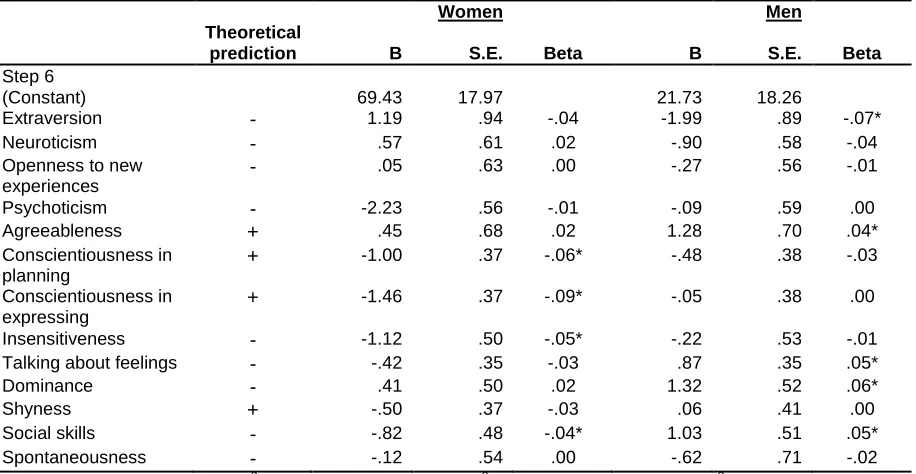
17 with the ideal personality traits more appreciated?‟. Table 3 contains the results for women resp. men.
Table 3
Ideal personality mate preference theory controlling for all other characteristics
Theoretical
prediction B
Women
S.E. Beta B
Men
S.E. Beta Step 6
(Constant) 69.43 17.97 21.73 18.26
Extraversion - 1.19 .94 -.04 -1.99 .89 -.07*
Neuroticism - .57 .61 .02 -.90 .58 -.04
Openness to new experiences
- .05 .63 .00 -.27 .56 -.01
Psychoticism - -2.23 .56 -.01 -.09 .59 .00
Agreeableness + .45 .68 .02 1.28 .70 .04*
Conscientiousness in planning
+ -1.00 .37 -.06* -.48 .38 -.03
Conscientiousness in expressing
+ -1.46 .37 -.09* -.05 .38 .00
Insensitiveness - -1.12 .50 -.05* -.22 .53 -.01
Talking about feelings - -.42 .35 -.03 .87 .35 .05*
Dominance - .41 .50 .02 1.32 .52 .06*
Shyness + -.50 .37 -.03 .06 .41 .00
Social skills - -.82 .48 -.04* 1.03 .51 .05*
Spontaneousness - -.12 .54 .00 -.62 .71 -.02
Note for women judging men R2 =.02 for Step 1, p < .05; ΔR2 =.01 for Step 2. p < .05; ΔR2 =.02 for Step 3. p < .05; ΔR2 =.05 for Step 4. p < .05; ΔR2 =.01 for Step 5. p < .05; ΔR2 =.01 for Step 6. p < .05. R2 adjusted total= 0.11 Note for men judging women R2 =.01 for Step 1, p < .05; ΔR2 =.01 for Step 2. p < .05; ΔR2 =.02 for Step 3. p < .05; ΔR2 =.07 for Step 4. p < .05; ΔR2 =.02 for Step 5. p < .05; ΔR2 =.01 for Step 6. p < .05. R2 adjusted total = 0.11
As shown in the table 3, for men as well as for women 6 of the 13 signs were in the direction the theory predicted. Both men and women had only 2 traits that were significant and in the right direction. The explained variance for block 6 entered in step 6 was very low, indicating that the personality characteristics of the judged did not have a big influence on the appreciation score in the mate selection process when there was controlled for the other characteristics of the judged and for the characteristics of the judge.
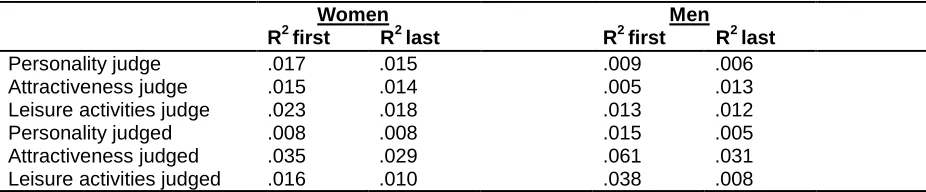
18 that attractiveness is the most important factor in mate selection for both men and women, because these two theories are mutually exclusive. In order to test if personality characteristics explain more than looks or intelligence, the blocks as defined above where entered on the first and last step of the hierarchical linear regression analyses. The coefficient of determination indicates which block of characteristics explained most of the variance in the appreciation score.
Table 4
Adjusted R square women judging men and men judging women, block 1 and 6 to test the stated and the revealed mate preference theories
Women R2 first R2 last
Men R2 first R2 last
Personality judge .017 .015 .009 .006
Attractiveness judge .015 .014 .005 .013
Leisure activities judge .023 .018 .013 .012
Personality judged .008 .008 .015 .005
Attractiveness judged .035 .029 .061 .031
Leisure activities judged .016 .010 .038 .008
Table 4 shows that only the attractiveness of the judged explained over 2% of the variance when there was controlled for the other characteristics of the judge and the judged. This indicates that men and women both consider attractiveness of the other most important in the mate selection process. Which is in congruence with the revealed mate preference theory and contrary to the stated mate preference theory.
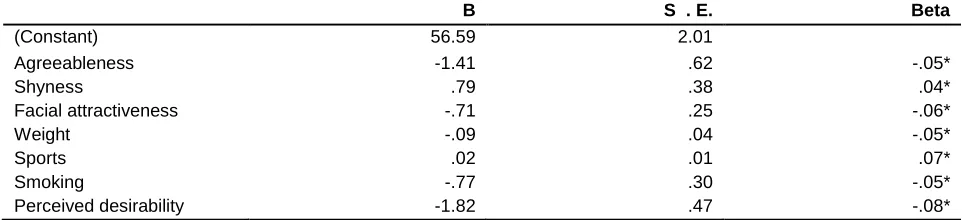
[image:18.612.68.531.292.388.2]19 appreciation score. Regression parameters with a positive sign indicate that individuals rate a person higher when that person is dissimilar to themselves. Regression coefficients that have a negative sign indicate that individuals rate a person higher when that person is similar to themselves.
Table 5
Women judging men all absolute differences regressed to appreciation score to test assortative mating
B S . E. Beta
(Constant) 56.59 2.01
Agreeableness -1.41 .62 -.05*
Shyness .79 .38 .04*
Facial attractiveness -.71 .25 -.06*
Weight -.09 .04 -.05*
Sports .02 .01 .07*
Smoking -.77 .30 -.05*
Perceived desirability -1.82 .47 -.08*
Note R2 =.02. p < .05 all non significant parameters are omitted from the table.
Table 6
Men judging women all absolute differences regressed to appreciation score to test assortative mating
B S. E. Beta
Constant 67.45 2.01
Openness -1.38 .60 -.05*
Facial attractiveness -.70 .25 -.06*
Club disco .06 .02 .06*
Educational degree -.86 .31 -.06*
Note R2 =.01. p < .05 all non significant parameters are omitted from the table.
[image:19.612.68.545.517.591.2]20 negative, indicating that the positive assortative mating theory explained the mate preferences of the men better then the negative assortative mating theory. However the absolute differences explained 1% and 2% of the variance in appreciation score, which is an extremely low fraction, indicating that the positive assortative mating theory as well as the negative assortative mating theory do not hold in practice. The assumption underlying these analyses is that negative differences were evaluated the same as positive difference. This however is contradictory to the asymmetrical mate preference theory, that argues that people do not prefer others that score lower than themselves on desirable traits but do appreciate people that score higher.
To see whether positive or negative deviations from the judges own score influenced the appreciation score, two new variables were made. The score of the judged was subtracted by the score of the judge, in case the judge scored more than 1 point higher than the judged, the first variable got the subtracted value. In case the judge scored at least one point lower than the judged the second variable got the subtracted value. The first variable is set to zero when the second variable got the subtracted value and the second variable is set to zero when the first variable got the subtracted value. It is argued that if the scores of both individuals differ by 1 point they score the same because introspection is challenging for individuals and therefore may not be accurate (Nisbett & Wilson, 1977; Harris & Schaubroeck, 1988). Thus the variables represented whether the judge or the judged scored higher respectively lower on a trait. These analyses do not only answer the question if the direction of the difference between the judge and the judged explained a part appreciation score, as argued by the asymmetrical mate preference theory, they also tested the assortative mating theories.
21 parameter 1 was negative and parameter 2 is positive this was maximization, when parameter 1 was positive and parameter 2 is negative this was a form of minimization. When parameter 1 was significant and positive and parameter 2 not significant it indicated a contributing factor; it was contributing to the appreciation score that the judged scored lower than the judge, therefore it will be called a progressive one sided contributing factor. When parameter 2 is significant and positive and parameter 1 was not significant it also indicated a progressive one sided contributing factor. When parameter 1 was significant and negative and parameter 2 was not significant, it was diminishing the appreciation score if the judged scored lower than the judge, this will be called a progressive one sided diminishing factor. When parameter 2 is significant and negative and parameter 1 not significant it also indicated a progressive one sided diminishing factor. Table 9 shows a schematic representation of the interpretation of the variables.
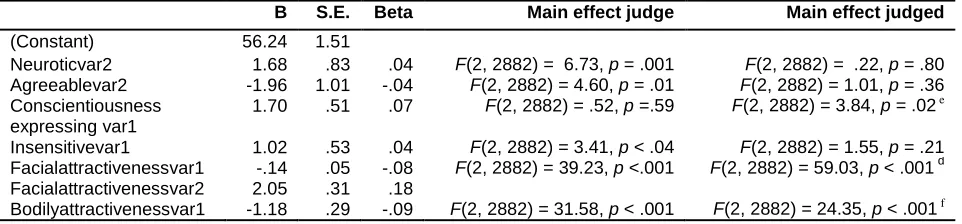
[image:21.612.67.548.607.719.2]As seen in the analyses above in table 4 the appreciation score was not solely dependent on the trait level of the judged, the score of the judge also had influence. Regression parameters do not indicate whether the characteristics of the judge or the judged or both determined the appreciation score, therefore ANOVA main effects were included in table 7 and 8.
Table 7
Women judging men on all variables regressed to appreciation score supplemented with main effects ANOVA
B S.E. Beta Main effect judge Main effect judged
(Constant) 56.24 1.51
Neuroticvar2 1.68 .83 .04 F(2, 2882) = 6.73, p = .001 F(2, 2882) = .22, p = .80 Agreeablevar2 -1.96 1.01 -.04 F(2, 2882) = 4.60, p = .01 F(2, 2882) = 1.01, p = .36 Conscientiousness
expressing var1
1.70 .51 .07 F(2, 2882) = .52, p =.59 F(2, 2882) = 3.84, p = .02 e
Insensitivevar1 1.02 .53 .04 F(2, 2882) = 3.41, p < .04 F(2, 2882) = 1.55, p = .21 Facialattractivenessvar1 -.14 .05 -.08 F(2, 2882) = 39.23, p <.001 F(2, 2882) = 59.03, p < .001 d Facialattractivenessvar2 2.05 .31 .18
22
Weightvar2 -.10 .04 -.06 F(2, 2882) = 4.06, p < .02 F(2, 2882) = 9.87, p < .001 f Sportsvar1 .63 .26 .05 F(2, 2882) = 1.77, p = .09 F(2, 2882) = 5.46, p < .005 a
Sportsvar2 .52 .24 .05
Interestsinpoliticsvar1 -1.29 .60 -.04 F(2, 2882) = 5.62, p < .005 F(2, 2882) = 3.07, p < .05 f HoursTVvar1 -.39 .18 -.04 F(2, 2820) = 8.25, p < .001 F(2, 2820) = 1.56, p = .21 Companyfriendsvar1 -.67 .24 -.06 F(2, 2882) = .28, p = .75 F(2, 2882) = 16.80, p < .001 d
Companyfriendsvar2 .45 .23 .04
Perceiveddesirabilityvar1 -1.27 .46 -.06 F(2, 2882) = 20.55, p < .001 F(2, 2882) = 15.77, p < .001 f Nicechildhoodvar1 -.86 .34 -.05 F(2, 2882) = 7.30, p < .002 F(2, 2882) = .40, p = .67
Nicechildhoodvar2 .71 .31 .05
Educationaldegreevar1 -1.46 .44 -.06 F(2, 2882) = 7.76, p < .001 F(2, 2882) = 4.89, p < .01 f
[image:22.612.72.539.308.513.2]Note R2 =.09. p < .05 all non significant parameters are omitted from the table.
Table 8
Men judging women on all variables regressed to appreciation score supplemented with main effects ANOVA
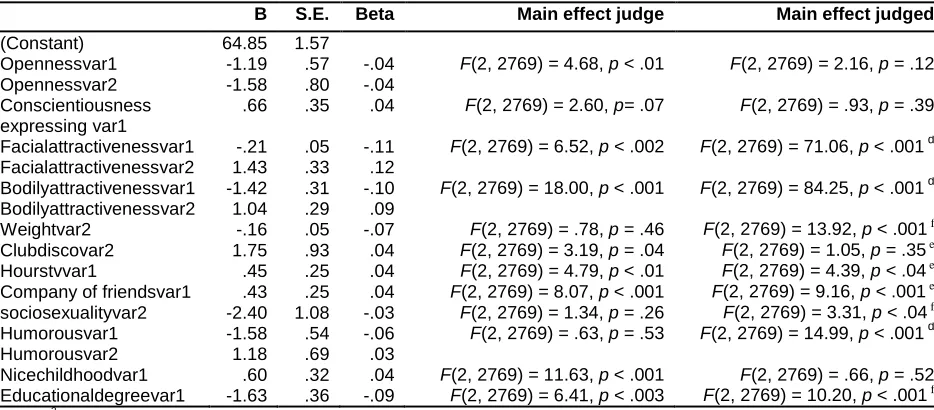
B S.E. Beta Main effect judge Main effect judged
(Constant) 64.85 1.57
Opennessvar1 -1.19 .57 -.04 F(2, 2769) = 4.68, p < .01 F(2, 2769) = 2.16, p = .12
Opennessvar2 -1.58 .80 -.04
Conscientiousness expressing var1
.66 .35 .04 F(2, 2769) = 2.60, p= .07 F(2, 2769) = .93, p = .39
Facialattractivenessvar1 -.21 .05 -.11 F(2, 2769) = 6.52, p < .002 F(2, 2769) = 71.06, p < .001 d Facialattractivenessvar2 1.43 .33 .12
Bodilyattractivenessvar1 -1.42 .31 -.10 F(2, 2769) = 18.00, p < .001 F(2, 2769) = 84.25, p < .001 d Bodilyattractivenessvar2 1.04 .29 .09
Weightvar2 -.16 .05 -.07 F(2, 2769) = .78, p = .46 F(2, 2769) = 13.92, p < .001 f Clubdiscovar2 1.75 .93 .04 F(2, 2769) = 3.19, p = .04 F(2, 2769) = 1.05, p = .35 e Hourstvvar1 .45 .25 .04 F(2, 2769) = 4.79, p < .01 F(2, 2769) = 4.39, p < .04 e Company of friendsvar1 .43 .25 .04 F(2, 2769) = 8.07, p < .001 F(2, 2769) = 9.16, p < .001 e sociosexualityvar2 -2.40 1.08 -.03 F(2, 2769) = 1.34, p = .26 F(2, 2769) = 3.31, p < .04 f Humorousvar1 -1.58 .54 -.06 F(2, 2769) = .63, p = .53 F(2, 2769) = 14.99, p < .001 d
Humorousvar2 1.18 .69 .03
Nicechildhoodvar1 .60 .32 .04 F(2, 2769) = 11.63, p < .001 F(2, 2769) = .66, p = .52 Educationaldegreevar1 -1.63 .36 -.09 F(2, 2769) = 6.41, p < .003 F(2, 2769) = 10.20, p < .001 f
[image:22.612.66.549.618.712.2]Note R2 =.08. p <0.5 all non significant parameters are omitted from the table. The interpretation of the letters in the superscript can be found in table 9
Table 9
Interpretation of the parameters testing the asymmetrical mate preference theory Variable 1
Judge scored higher than judged
Variable 2
Judge scored lower than judged
Assortative mating hypotheses
+
+
Dissimilarity a-
-
Similarity bAsymetrical mate preference hypotheses
23
-
+
Maximization d+
Progressive one sided contributing traits e-
Progressive one sided diminishing traits f+
Progressive one sided contributing traits e-
Progressive one sided diminishing traits fAs shown in table 7 and 8 the absolute differences explained 9% and 8% of the variance in appreciation score.
Table 7, containing the results of women judging men, shows that five of the 14 traits have a significant main effect of the judging women and a non-significant main effect of the judged men. This indicates that it was not the score of the men that influenced the appreciation score, the score of the judging women did. In other words, it did not matter how men scored on those traits, the score of the women on those traits determined the appreciation score. This is the case for neurotic, agreeable, insensitive women, women who had a nice childhood and women that watched TV many hours a day. The less neurotic women are the higher the appreciation score they will give. The more agreeable women are, the higher the appreciation score they will give. Women that scored high on insensitiveness appreciate men more than women who score low or average on insensitiveness. Women that had a nice childhood and women that did not have a nice childhood appreciated men more than women who had an average childhood. Women that score high on hours they watch TV appreciated men less than women who scored lower. These outcomes cannot be directly related to one of the theories described above. The asymmetrical mate preference theory, the revealed mate preference theory and the negative and positive assortative mating theories take the scores of the judges into account but do not solely attribute the mate preferences of the judge to the characteristics of the judge.
[image:23.612.70.529.74.149.2]24 conscientiousness in expressing) had had a main effect of solely the judged, indicating that independent of the trait level of the judge, judged with a specific trait level were more appreciated or depreciated. This is consistent with the ideal and the stated mate preference theories that also only take in account the characteristics of the judged, without examining the characteristics of the judge. Seven traits had main effects from the judge as well as the judged. This indicates that the trait level of the judge and of the judged both effect the appreciation score. This is consistent with the asymmetrical mate preference theory, the revealed mate preference theory and the negative and positive assortative mating theories, that all take into account the influences of both the judge and the judged.
On two traits women preferred to maximize. Maximization implies that people prefer to minimize the costs and maximize the rewards. Women preferred men that scored maximal the following traits of men; facial attractiveness and company of friends. The higher men scored on facial attractiveness in comparison to the judge, the more appreciated they were and the lower the men scored the more depreciated they were. The lower men scored on the number of times they had company of friends in comparison to the judges, the more depreciated they were and the higher men scored in comparison to women the more appreciated they were.
25 Except for the trait company of friends, all the maximization and diminishing traits had main effects of men as well as main effects of women. Thus the effects these traits had on the appreciation score were also partly due to the trait level of the women. On average, the higher the women scored on facial and bodily attractiveness, weight, interest in politics, company of friends, perceived desirability and educational degree the lower they appreciated men.
Conscientiousness in expressing is the only trait that is seen by women as a progressive one sided contributing trait. Progressive one sided contributing traits indicate that people prefer to maximize the rewards. Maximization of the rewards is done by giving higher appreciation scores to people with desirable traits. The lower men scored on conscientiousness in expressing in comparison to the women who judge them the higher the appreciation score they received. Dissimilarity is preferred by women on sports. They preferred it when men scored lower than themselves on sports, but they also preferred it when men scored higher then themselves on sports.
Table 8 showed that in three (openness to new experiences, having had a nice childhood and conscientiousness in expressing) of the eleven traits mate selection was based on characteristics of the men themselves. Men who scored lower on openness and men who scored higher on openness appreciated women on average less than men that scored around the mean. Men who had a nice childhood appreciated women on average higher than men who did not have a nice childhood. Conscientiousness in expressing is also associated more with the characteristics of the men then with the characteristics of the women. Men who are more conscientious in expressing prefer women in general more than men that are less conscientious in expressing.
26 There were 3 traits men preferred to maximize. Maximization implies that people prefer to minimize the costs and maximize the rewards on the same trait. Men preferred women that scored higher on humor and facial and bodily attractiveness than themselves. The higher they scored the more appreciated they were. They also depreciated women that scored lower on those traits than themselves, the lower the scored the less appreciated they were. For the traits facial and bodily attractiveness this effect is partly due to the fact that on average more attractive men appreciated women lower than less attractive men.
Weight, sociosexuality and educational degree where seen by men as progressive one sided diminishing traits. Progressive one sided diminishing traits indicate that people prefer to minimize the costs. The higher women scored on sociosexuality in comparison to the men that judged them the less appreciated they were. This is not found in ANOVA because there were a few women that scored higher than men and these exceptions are not grouped in ANOVA. ANOVA however indicated that women who scored higher on sociosexuality were more appreciated than lower scoring women. Men depreciated women that weight more than they did. They also depreciated women with a lower educational degree than they had.
How many times people go to a club, disco or dance event, the hours they watch TV and the number of times they have company of friends were the progressive one sided contributing traits. Progressive one sided contributing traits indicate that people prefer to maximize the rewards. The more women go to a club, disco or dance event in comparison to men the more appreciated they were. The lower women score on hours they watch TV and company of friends in comparison to men the more appreciated they were.
Discussion
27 themselves. For women, however, appreciation is more dependent on their own traits. This is in accordance with Darwin‟s (1871) statement that mate selection is “female choice”. Not only are women more selective than men, physical attractive individuals are also more selective than less attractive individuals.
People do not prefer individuals that are similar to themselves as the positive assortative mating theory argues. However dissimilarity in others, as the negative assortative mating theory argues is also not preferred. Therefore these theories are to be rejected.
The personality of the judged individuals is less important in the selection process than his or her attractiveness, educational level and leisure activities. Thus the stated personality characteristics theory, that is what people say they prefer (Buss, 1989), does not appear to hold. Most important trait in the selection process is attractiveness which is in agreement with the revealed mate preference theory (Kurzban & Weeden, 2005; Todd, Penke, Fasolo & Lenton, 2006), more on the revealed mate preference theory in the next paragraph.
28 people prefer to minimize the costs and on the same trait maximize the rewards. The higher the judged scores the more they will be appreciated and the lower the judged scores the less appreciated he/she will be. However it has to be noted that appreciation and depreciation are not always symmetrical. Although there is support for the revealed mate preference theory as well as the asymmetrical mate preference theory, most evidence is found for the latter and furthermore the latter is more precise and hypotheses generating and therefore is preferable to the former.
Men as well as women prefer a partner that is more beautiful than they are themselves and depreciate others that are less beautiful. This is not in accordance with the evolutionary hypothesis that men are more interested in women‟s looks than vice versa. It also cannot be true that both members of a couple have a more attractive partner, either they are equally attractive or one is more attractive than the other. Since both individuals prefer someone that is more attractive than themselves, it is likely that they end up with someone who is as attractive as themselves. That way losses on both sides are limited. This can be the reason why research on already formed couples found evidence for assortative mating.
Buss and Barnes (1986) argued that individuals sometimes cannot get what they want. There is a shortage of desirable mates in comparison to the numbers looking for them, especially when there is agreement about what characteristics are desired. Therefore it is reasonable to assume that many involved in a relationship with someone who deviates from their ultimate preference. This study however finds that people generally do not have irrational ideals; most evidence indicates that people want someone on their own level or higher and that the depreciation for someone who scores lower is not extreme. Therefore it is plausible that most individuals find a partner that does not deviate that much from their preferences.
29 their social undesirable traits in the questionnaire. Even though the dating organization is strict about not letting other members see the answers to the questions, people may adjust the truth in their assumed best interest. It is assumed that most people lessen their undesirable traits in the questionnaire, but still poses and display those undesirable traits in the conversation. This will result in underestimation of the effect of the undesirable traits on the appreciation score. Sending chat messages using a computer is not the same as talking face- to- face. In chat sessions there is more time to think before replying, therefore it is possible that people come across as more humorous or understanding. Slow responders of course may seem uninterested, while they could be thinking about the right thing to say. In short: in chat messages, mimic, timing and personality may be interpreted different than in real life contact. This limits the generalizability of this study to face- to- face mate selection.
Another limitation is that the appreciation score can only be filled out after at least 50 messages. However lots of people ended the conversation before 50 messages were send. For example there are lots of women who complain about men who begin to talk about sex in the first few chat lines. Women who do not like that, end the conversation and delete the man from their contact list before they can give an appreciation score. This results in not measuring all possible depreciation reasons. Future research can benefit from asking people who delete someone from their contact list for their reasons.
31 References
Amato, P. (2000). The consequences of divorce for adults and children. Journal of Marriage and the Family, 62(4), 1269–1287.
Barry, W. A. (1970). Marriage research and conflict: An integrative review. Psychological Bulletin, 73, 185-193.
Bentler, P. M., & Newcomb, M. D. (1978). Longitudinal study of marital success and failure. Journal of Consulting and Clinical Psychology, 46,1053-1070.
Bereczkei, T. & Csanaky, A. (1996). Mate choice, marital success, and reproduction in a modern society. Ethology and Sociobiology 17, 17–35.
Botwin, M., Buss, D. M., & Shackelford, T. K. (1997). Personality and mate preferences: Five factors in mate selection and marital satisfaction. Journal of Personality.
Bowlby, J. (1982). Attachment and loss: Vol. 1. Attachment (2nd ed.). New York: Basic Books. (Original work published 1969)
Bruce, M. L., & Kim, K. M. (1992). Differences in the effects of divorce on major depression in men and women. American Journal of Psychiatry,149, 914-917.
Burgess, E.W., & Wallin, P. (1953). Engagement and marriage, Philadelphia: Lippincott. Buss, D. M. (1985). Human mate selection. American Scientist, 73. 47-51.
Buss, D. M. (1989). Sex differences in human mate preferences: Evolutionary hypotheses tested in 37 cultures. Behavioral and Brain Sciences, 12, 1-49.
Buss, D.M., & Barnes, M. F. (1986). Preferences in human mate selection. Journal of Personality and Social Psychology, 50, 559-570.
Buss, D. M., Abbott, M., Angleitner, A., Biaggio, A., Blanco-Villasenor, A., BruchonSchweitzer, M [& 45 additional authors]. (1990). International preferences in selecting mates: A study of 37 societies. Journal of Cross Cultural Psychology, 21, 5-47.
Buss, D. M. (2000). The evolution of happiness. American Psychologist, 55, 15-23. Buss, D. M., (2006) Strategies of human mating. Psychological Topics, 15, 239-260. Buss, D. M., Shackelford, T. K., Kirkpatrick, L. A., & Larsen, R. J. (2001). A half century of American mate preferences: The cultural evolution of values. Journal of Marriage and the Family, 63, 491–503.
Costa, P.T. Jr., & McCrea, R.R. (1992). Revised NEO personality Inventory (NEO-PI-R) and NEO Five-Factor Inventory (NEO-FF-I) Professional manual. Odessa. FL; Psychological Assesment Resources.
32 Dean, D. G. (1966). Emotional maturity and marital adjustment. Journal of Marriage and the Family, 9(2), 186-192.
Deaux, K., & Hanna, R. (1984). Courtship in the personal column: the influence of gender and sexual orientation. Sex Roles, 1, 363-375.
de Vaus, D., Gray, M., Qu, L., & Stanton, D. (2007). The consequences of divorce for financial living standards in later life, Research Paper 38, Australian Institute of Family Studies,
Melbourne.
Ellis, L. (1987). Relationships of criminality and psychopathy with eight other apparent mainfestations of sub-optimal arousal. Personality and Individual Differences, 8, 905–925. Eysenck, H.J., & Eysenck, S.B.G. (1991). Manual of the Eysenck Personality Scales (ESP Adult). London: Hodder & Stoughton.
Eysenck, H. J., & Wakefield, J. A. (1981). Psychological factors as predictors of marital satisfaction. Advances in Behavior Research and Therapy, 3, 151-192.
Ferstl, R., Eggert, F., Westphal, E., Zavazova, N., & Müller-Ruchholtz, W. (1992). MHC-related odors in humans. In: Doty, R.L. and Müller-Schwarze, D, Editors, 1992. Chemical signals in vertebrates, Plenum Press, New York, pp. 205–212.
Galliher, R. V. Welsh D. P., Rostosky S. S., & Kawaguchi M. C.(2004). Interaction and relationship quality in late adolescent romantic couples. Journal of Social and Personal Relationships, 21, 203-216.
Harris, M. M., & Schaubroeck, J. (1988). A meta-analysis of self-supervisor, self-peer and peer-supervisor ratings. Personnel Psychology, 41, 42-62.
Heaven, P. L., Fitzpatrick, J., Craig, F. L., Kelly, P., & Sebar, G. (2000). Five personality factors and sex: Preliminary findings. Personality and Individual Differences, 28, 1133–1141.
Hollingshead, A. B. (1950). Cultural factors in the selection of marriage mates. American Sociological Review, 15, 619-627.
Hill, R. (1945). Campus values in mate selection. Journal of Home Economics, 37, 554–558. Hoyt, L. L., & Hudson, J. W. (1981). Personal characteristics important in mate preferences among college students. Social Behavior and Personality, 9, 93–96.
Howard, J.A., Blumstein, P., & Swartz, P. (1987). Social or evolutionary theories? Some observations on preferences in human mate selection. Journal of Personality and Social Psychology, 53, 194-200.
Hudson, J. W., & Henze, L. F. (1969). Campus values in mate selection: A replication. Social Forces, 31, 772–775.
33 divorce in a population of male applicants for psychiatric evaluation. Journal of Abnormal
Psychology, 89, 510- 513.
Karney, B., & Bradbury, T. N. (1997). Neuroticism, marital interaction, and the trajectory of marital satisfaction. Journal of Personality and Social Psychology, 72, 1075–1092.
Kelley, H. H. (1983). Love and commitment. In H. H. Kelley, E. Berscheid, A. Christensen, J. H. Harvey, T. L. Huston, G. Levinger, E. McClintock, L. A. Peplau, & D. P. Peterson (Eds.), Close relationships (pp. 265-314). New York: W. H. Freeman.
Kelly, E. L., & Conley, J. J. (1987). Personality and compatibility: A prospective analysis of marital stability and marital satisfaction. Journal of Personality and Social Psychology, 52, 27-40.
Kennedy, R. J. R. (1944). Single or triple melting pot ? Intermarriage trends in New Haven, 1870-1940. American Journal Of Sociology, 49, 331-339.
Kenrick, D. T., Groth, G. E., Trost, M. R., & Sadalla, E. K. (1993). Integrating evolutionary and social exchange perspectives on relationships: Effects of gender, self-appraisal, and
involvement level on mate selection criteria. Journal of Personality and Social Psychology, 64, 951–969.
Kurzban, R., & Weeden, J. (2005). HurryDate: Mate preferences in action. Evolution & Human Behavior, 26, 227-244.
Larson, J. H., Holman, T. B., Klein, D. M., Busby, D., & Stah-mann, R. F. (1992). Advances in Education, Therapy, & Research with Premarital Couples: The Use of the PREP-M Instrument. Paper presented at the meeting of the National Council on Family Relations, Orlando, FL. Leik, R. K., & Leik, S. A. (1977). Transition to interpersonal commitment. In R. L. Hamblin & J. H. Kunkel (Eds.), Behavioral therapy in sociology (pp. 299-322). New Brunswick, NJ:
Transaction Books.
Lutz, F. (1918). Assortative mating in man. Science 16: 249-250.
McGinnis, R. (1958). Campus values in mate selection: A repeat study. Social Forces, 36, 368– 373.
McManus, I. C. & Mascie-Taylor, C. G. 1984 Human assortative mating for height: non-linearity and heteroscedasticity. Human Biology, 56, 617-623.
Miller, J.D., Lynam, D., Zimmerman, R.S., Logan, T.K., Leukefeld, C. & Clayton, R. (2004) The utility of the five factor model in understanding risky sexual behaviour. Personality and individual differences, 36, 1611–1626.
Nettle, D. (2005). An evolutionary approach to the extraversion continuum. Evolution and Human Behavior, 26, 363–373.
34 Nettle, D., & Clegg, H. (2006). Schizotypy, creativity and mating success in humans.
Proceedings of the Royal Society of London, Series B:Biological Sciences, 273, 611–615. Nisbett, R. E., & Wilson, T. D. (1977). Telling more than we can know: Verbal reports on mental processes. Psychological Review, 84, 231-259.
Oldham, J., & Morris, L. (1991). Personality self-portrait. New York: Bantam.
Powers, E. A. (1971). Thirty years of research on ideal mate characteristics: What do we know? International Journal of Sociology of the Family, 1, 207–215.
Robins, R. W., Caspi, A., & Moffitt, T. E. (2000). Two personalities, one relationship: Both partners‟ personality traits shape the quality of their relationship. Journal of Personality and Social Psychology, 79, 251– 259.
Rusbult, C. E. (1983). A longitudinal test of the investment model: The development (and deterioration) of satisfaction and commitment in heterosexual involvements. Journal of Personality and Social Psychology, 45, 101-117.
Seiffge-Krenke, I., & Lang, J., (2002, April). Forming and maintaining romantic relations from early adolescence to young adulthood: Evidence of a developmental sequence: In S.
Shulman&I. Seiffge-Krenke (co-chairs), Antecedents of the Quality and Stability of Adolescent Romantic Relationships. Symposium at the conference of the Society for Research on
Adolescence, New Orleans, LA.
Schmitt, D. P., & Buss, D. M. (2001). Human mate poaching: Tactics and temptations for infiltrating existing relationships. Journal of Personality and Social Psychology, 80, 894-917. Schmitt, D. P., Alcalay, L., Allik, J., Angleiter, A., Ault, L., Austers, I., et al. (2004). Patterns and universals of mate poaching across 53 nations: The effects of sex, culture, and personality on romantically attracting another person‟s partner. Journal of Personality and Social
Psychology,86, 560–584.
Shaver, P., Hazan, C., & Bradshaw, D. (1988). Love as attachment: The integration of three behavioral systems. In R. J. Sternberg & M. L. Barnes (Eds.), The psychology of love (pp. 68-99). New Haven, CT: Yale University Press.
Simpson, J. A., & Gangestad, S. W. (1991). Individual differences in sociosexuality: Evidence for convergent and discriminant validity. Journal of Personality and Social Psychology, 60, 870– 883.
Terman, L. M., & Buttenweiser, P. (1935). Personality factors in marital compatibility. Journal of Psychology, 6, 143-171.
35 Wiederman, M. W., & Allgeier, E. R. (1992). Gender differences in mate selection criteria:
Sociobiological or socioeconomic explanation? Ethology & Sociobiology, 13, 115–124.
Wiederman, M. W. (1993). Evolved gender differences in mate preferences: Evidence from personal advertisements. Ethology and Sociobiology, 13, 331–352.
36 Appendix 1
The questionnaire
Demografische variabelen
Ik ben een Man/ Vrouw
Ik val op Mannen/ Vrouwen/ Mannen en vrouwen
Wat is je geboortedatum?
Ben je op dit moment single? Ja/ Nee/ Lang verhaal
Hoe lang ben je?
Hoeveel weeg je?
Wat is de hoogste opleiding die je hebt afgerond, of waar je op het moment mee bezig bent?
Extraversie
Ben jij een gangmaker als feestjes saai zijn?
Ben je het liefst altijd onder de mensen?
Ga je makkelijk een gesprek aan met onbekenden?
Heb je regelmatig energie te veel?
Ben je impulsief?
Vind je het erg om het middelpunt van de aandacht te zijn?
Vind je het leuk om nieuwe mensen te ontmoeten?
Houd je je doorgaans op de achtergrond in groepsverband?
Neurotisisme
Ben je vaak gestressed?
Ben je een piekeraar?
Voel je je snel gekwetst?
Voel je je vaak hulpeloos?
37
Ben je snel beledigd
Aantrekken van anderen
Ik heb de neiging me te veel aan te trekken van wat andere mensen over me zeggen.
Inschikkelijkheid:
Houd je veel rekening met de gevoelens van anderen?
Help je graag andere mensen?
Ben je een zorgzaam type?
Zorgvuldigheid in het uitdrukken van gedachten
Denk je eerst goed na voordat je een vraag beantwoordt?
Ik denk goed na voordat ik iets zeg.
Zorgvuldigheid in het plannen
Plan je graag dingen van te voren?
Heb je dingen graag gepland of blijf je liever flexibel?
Openheid voor ervaring/ideeën:
Doe je graag dingen die je nog niet eerder hebt gedaan?
Ben je avontuurlijk?
Ben je een huismus?
Ben je een uithuizig type?
Psychoticism
Raak je snel geirriteerd?
Word je vaak kwaad om het gedrag van andere mensen?
Als je heel erg boos bent, moet je dan moeite doen om jezelf in de hand te houden?
38
Doe je uit woede vaak dingen waar je later spijt van hebt?
Praten over gevoelens
Deel je intieme gevoelens makkelijk met anderen?
Ik praat veel over mijn gevoelens.
Lompheid
Vind je het belangrijk om gelijk te krijgen?
Drijf je vaak je mening door?
Probeer je vaak je gelijk te halen, ook wanneer dat tot ruzie leidt?
Verlegenheid
Ben je verlegen?
Vind je het moeilijk om mensen van het geslacht waar jij op valt aan te spreken?
Spontaniteit
Ben je spontaan?
Sociale vaardigheden
Ik heb goede sociale vaardigheden.
Politics
Vind je het interessant om te weten wat zich in de wereld afspeelt?
Volg je wat er in de politiek gebeurt?
Seksualiteit
Sta je open voor seksafspraakjes?
Sta je op dit moment open voor een one-night-stand?
39
Gepercipieerde aantrekkelijkheid
Staan de mannen/vrouwen voor je 'in de rij'?
Wek je met je uiterlijk en uitstraling als vanzelf de interesse van mannen/vrouwen?
Ben je gewild bij de mannen/vrouwen?
Bezigheden
Sport je veel?
Ga je vaak naar een club/discotheek/dancefeest/... ?
Ben je vaak in de kroeg te vinden?
Hoe vaak zoek je gemiddeld het gezelschap van vrienden op?
Rook je? Nee/ Niet meer dan een paar sigaretten per dag/ Elke week wel iets/ Dagelijks/ Meer dan een
pakje per dag.
Drink je alcohol? Nee, geen druppel/ Hooguit een paar glazen per maand/ Een paar glazen per week/
Gemiddeld een paar glazen per dag/ Ik ben een stevige drinker.
Hoe lang kijk je gemiddeld op een dag tv?
Overig
Ben je een ochtendmens?
Vinden anderen jou grappig?
Ik heb veel over voor mijn carrière.
Heb je een fijne jeugd gehad?