J. Exp. Biol. (1968), 49, 477-493 4 7 7 With 6 text-figures
Printed in Great Britain
DEVELOPMENT OF A COMPUTER
MODEL SIMULATING SOME ASPECTS OF THE
CARDIOVASCULAR-RESPIRATORY DYNAMICS
OF THE SALMONID FISH
BY W. TAYLOR, A. H. HOUSTON AND J. D. HORGAN
Departments of Biology, Physiology, and Biomedical Engineering, Marquette University, Milwaukee, Wisconsin, 53233
{Received 16 April 1968)
INTRODUCTION
Oxygen demand in teleost fishes varies as an exponential function of motor activity (Brett, 1964), and is markedly influenced by a wide range of intrinsic and environ-mental factors (Brett, 1962; Beamish, K)6^.a-c; Beamish & Mookherjii, 1964). The nature of the adaptive systemic responses which permit respiratory adjustment in these animals is, however, poorly understood at present. Nevertheless, a series of recent theoretical and experimental studies, which define the operation of the several factors influencing gas exchange in the aquatic environment, provide a basis for speculation upon several aspects of respiratory adaptation (Hughes, 1964; Rahn, 1966; Randall, Holeton & Stevens, 1967). These focus attention upon five probable sites of adjust-ment : ventilatory flow, cardiac output, branchial exchange area, blood oxygen capacity and the mean environment-to-blood diffusion pathlength. Consideration of the con-sequences of singly modifying these loci of control demonstrates that the system as a whole embodies a number of restrictive elements.
It is apparent, for example, that attempts to meet heightened oxygen demand solely through increases in ventilation quickly become self-limiting; this being largely due to the much-increased metabolic cost of operating the branchial pump (Schuman & Piiper, 1966). The situation, in essence, represents a form of positive feedback (Hughes, 1964), which, operating without control, would tend to de-stabilize the system. Further-more, increasing flow velocity reduces the exposure time of any given volume of water to the exchange surface, while elevation of ventilatory stroke volume increases the diffusional deadspace within the branchial chamber (Rahn, 1966). Shunting of sub-stantial portions of the respiratory current between adjacent branchial arches, rather than over their lamellar surfaces, also follows increases in ventilation (Pasztor & Kleere-koper,"i962). In net, these factors lead to a sharp diminution of the efficiency of oxygen extraction as maximum flow rates are approached (Saunders, 1962). Thus, much of the potential benefit of heightened ventilation is lost as a consequence of the reduced efficiency of the exchanger system, and the increased energy requirement of pump operation.
Adjustment of branchial perfusion rate (essentially cardiac output in the teleost) provides a second possible mechanism for meeting increasing oxygen demand. The metabolic costs of cardiac function have apparently not been accurately evaluated as
478 W. TAYLOR, A. H. HOUSTON AND J. D. HORGAN
yet, but are thought to be less than half of that associated with ventilation (Hughes, 1966; H. Rahn, personal communication). However, the effective operation of a countercurrent exchange system of the type represented by the teleost gill requires precise adjustment of the ventilation: perfusion ratio. In theory, at least, maximally effective oxygenation is attained as this ratio approaches zero (Hughes, 1964). Consis-tent with this, experimentally determined ratio values in a variety of aquatic organisms are generally less than o-i (Rahn, 1966). Accordingly, it would appear that the extent to which cardiac output can be effectively elevated will be limited by the extent to which it is metabolically practical to increase ventilation.
An increase in oxygen uptake, other factors being equal, might also be achieved by expansion of the effective exchange area. The existence of alternate respiratory and non-respiratory vascular pathways in the teleostean gill, and the ability of the animals to govern flow distribution between these has been demonstrated (Steen & Kruyyse, 1964). Thus, respiratory compensation by some form of branchiovascular adjustment represents a distinct possibility. It should be noted, however, that although this type of response would undoubtedly be efficacious from the respiratory viewpoint it is not without concomitant disadvantages. Increases in functional exchange area must, in the absence of selective permeability adjustments, promote endosmosis, salt efflux and a reduction in carbon dioxide tension. Accordingly, a need for adjustment in the activities of the several components of the water-electrolyte and acid-base regulating systems would necessarily follow.
Finally, enhancement of blood oxygen capacity might resolve the problem of meeting increases in oxygen demand. This could be achieved through an increase in circulating haemoglobin level, or by a shift or form-change in the dissociation relationship. Although increases in haemoglobin levels do occur during activity (Black et al. 1962) and following acclimation to hypoxic conditions (Prosser et al. 1957) their magnitude must be functionally limited by the effect of increasing haematocrit upon blood vis-cosity. Similarly, although the blood of fishes typically displays a marked Bohr effect, the carbon dioxide tensions in these animals are normally low (Rahn, 1966).
Cardiovascular-respiratory dynamics of the salmonid fish 479
DEVELOPMENT OF THE MODEL
(1) General form and basic assumptions
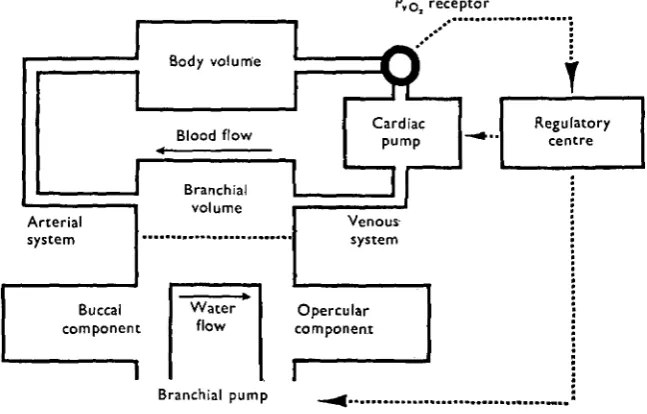
The teleostean cardiovascular-respiratory complex has been visualized as consisting of two perfect mixing chambers, the 'branchial volume' and the 'body tissue volume' (Fig. 1). These areas represent effective volumes of dilution of dissolved oxygen, and do not necessarily correspond to anatomical volumes. The effective body volume, essentially a storage volume for oxygen, would presumably include the extrabranchial blood volume, and an undefined portion of the extravascular fluid system. The branchial volume is considered to be analogous to the volume of blood actually in contact with the effective exchange area. No attempt has been made to further compartmentalize the model, or to account for exchange phenomena between the blood, interstitial fluid and cellular phases.
3 receptor
Body volume
Blood flow
Arterial system
Branchial volume
Buccal component
I
Water flow
£
t
Cardiac pump
Regulatory centre
Venous system
Opercular component
i
[image:3.451.65.389.243.450.2]Branchial pump _^a «...._
Fig. i. Diagrammatic representation of model system.
Flow through the system has been assumed to be continuous in character, and not subject to breath-by-breath or beat-by-beat variations.
Finally, for purposes of subsequent testing, the model has been taken as representing a salmonid fish of unit size (i -o kg.) existing in a constant thermal environment (50 C ) . This conception of the respiratory-cardiovascular complex is basically similar to that proposed by Hughes (1964), differing from it only in the location of the neural control mechanism. Hughes has suggested that the error detector device is an oxygen receptor, probably located on the arterial side of the system. While the operation of the present model supports the hypothesis that cardiac and ventilatory activity is regulated by reference to oxygen tensions the necessary receptor has, for reasons to be brought out in subsequent paragraphs, been sited in the venous portion of the circulation.
Two series of equations have been used to describe the model. The first group (the
480 W. TAYLOR, A. H. HOUSTON AND J. D. HORGAN
controlled system equations) summarize the principal physical exchange processes believed to operate in the system. The second series of equations (feedback, or system-controlling equations) are used to link the exchange processes into a coherent, re-sponsive unit. In contract to the controlled system equations, which are expressions of physical principles, the feedback equations are descriptions of physiological activities. Accordingly, they are to be regarded as essentially empirical, and approximate in character.
The symbols used in the model are defined in Table 1.
Table 1. Model symbols
Va Effective volume of branchial compartment (ml.) V, Effective volume of body compartment (ml.) Va Effective extrabranchial volume (ml.)
MR Metabolic rate, i.e. oxygen consumption (ml./min.)
Vot Volume flow of oxygen across respiratory exchange surface (ml./min.)
Poo, Volume flow of oxygen in arterial system (ml./min.) P»o, Volume flow of oxygen in venous system (ml./min.)
Vi Ventilatory flow (ml./min.) Q Cardiac output (ml./min.)
Caot Oxygen content of arterial blood (ml./ioo ml.)
C,,oa Oxygen content of venous blood (ml./100 ml.)
Paoa Oxygen tension of arterial blood (mm. Hg)
Pvo2 Oxygen tension of venous blood (mm. Hg) P/o8 Oxygen tension of inspired water (mm. Hg) PgOj Oxygen tension of exspired water (mm. Hg) a
iro2 Coefficient of oxygen solubility in water (ml./ml./mm. Hg) aB0a Coefficient of oxygen solubility in blood (ml./ml./mm. Hg)
A* Effective diffusion pathlength across respiratory lamellae (mm.)
D Coefficient of oxygen diffusion across respiratory lamellae A Effective respiratory exchange area (cm.2)
s Condition of resting or routine active, e.g. V}, Q', A', Pios, etc.
(2) Controlled system equations
The sum of the rates of flow of oxygen into a given volume must equal the sum of rates of flow out of the volume, plus the rate of oxygen storage within the volume. Mass balance relationships were, therefore, developed to describe oxygen transport and storage in the extra-branchial, branchial and body phases.
For the body compartment such a relationship can be expressed in the form
fao2-(%o2 + MR) = [dldt]VOi. (r)
If to2 = Q(CaOJioo) (2)
and ^ = Q(CvOJioo) (3)
and FOa = Vs(CvOJioo), (4)
then, equation (1) can be recast in the form
$/ioo)(CaO2 -Cv02) -MR = (VJioo)([dldt)CvOi) (5)
Cardiovascular-respiratory dynamics of the salmonid fish 481
In actuality, distributive oxygen gradients are to be anticipated. A lumped-parameter model of the body compartment must, then, be accepted in order to express equation (1) in the form of equation (5).
An equation analogous to equation (5) can be developed for the branchial compart-ment,
(<3/ioo)(CBOa -CaO2) + fOi = (VJzoo)([dldt]CaOa). (6) A mass balance equation describing the fate of the dissolved oxygen brought in during inspiratory activity can be derived in much the same fashion as were equations (5) and (6). This has the form
?i " W ^ o , ~PEO2) -?<>, = VJffldt] awoPEOi). (7) If storage effects are accepted as negligible, an assumption supported by the recent findings of Stevens & Randall (1967 a, b), equation (7) can be simplified to
P*o, = PiOt-VojVwOhro,- (8)
Oxygen transfer across the respiratory lamellae can be described in terms of the Fick diffusion equation
POa = -DA ([dldx]P02). (9) Assuming the oxygen tension gradient across the lamellar wall to be spacially constant permits expression of the term d\dxPOi as APOa/Aa\ The mean oxygen
tension, AFOa, is equivalent to (PaOa -PIOi+PuO%-PEo^2. Accordingly, equation (9) can be expressed as
Vo, = DA/zAx ( P/ o, - Pa O a+ PE O i -PvO2). (10) Finally, it is necessary to consider the oxygen uptake and release characteristics of haemoglobin in venous and arterial blood, and to relate oxygen tension to oxygen content. These functional relationships are symbolically represented by equations (11) and (12).
^o2=/(Ca O 2), (n)
P*o2 = g (Cv0>)- (12)
Quantitative expression of the foregoing equations has been based upon dissociation curves reported by Black, Kirkpatrick & Tucker (1966). These were approximated by a
series of fifteen linear segments for purposes of incorporation into the model.
(3) Controlling system equations
Equations (5), (6), (8), and (io)-(i2) are considered to depict the principal physical relationships prompting oxygen flow through the model system. To complete the simulation, a series of relationships describing the regulatory elements governing the
expression of these processes is needed.
Hughes (1964) has reviewed information relating to the control of ventilation in fishes, and suggests that this is based upon the monitoring of arterial oxygen tensions. Until recently little experimental evidence bearing on this question has been available. Stevens & Randall (1967 a, b) have, however, provided experimental values for VIt ^*«O2> PvOtf -P«co2 a nd -PvcOam moderately exercised rainbow trout. It is apparent from
their data that Tj is correlated with Pv0 , but that no simple relationship obtains be-tween ventilation and the remaining variables. This correlation has been approximated in the form of equation (13).
482 W. TAYLOR, A. H. HOUSTON AND J. D. HORGAN
A similar relationship apparently exists between cardiac output and venous oxygen tension, and can also be described by means of a linear equation equivalent to (13). However, it would appear that % and Q approach zero at the same value for PvOa,
i.e., that the ratio $/F/ is a system constant. This conclusion was subsequently verified using values scaled from the figures presented by Stevens & Randall (1967 a, b). Accordingly, cardiac output has been expressed as a constant fraction of ventilation:
Q = KVZ.
(14)
In a system of this type any increase in MR should lead to a reduction in venous oxygen tension from the value represented by P£o • Equations (13) and (14) specify
that Q and fy will then increase. As a consequence V^will rise, and PvOi approach its
original value, P^. It will be apparent, however, that the degree to which fOs can be
in-creased depends to a large extent upon the magnitude of AP02. Preliminary trials
with the model clearly indicated that increases in APOa would not permit the model to
adjust VQ^ SO as to keep pace with Mi?. It became necessary, therefore, to make a decision upon the extent to which the model might be allowed to incur the biological equivalent of an oxygen debt, i.e. predict very low or zero oxygen tensions. The only data sufficiently detailed to permit testing of the model deal with the rainbow trout. This species, like most salmonids, has relatively little capacity for anaerobiosis. Accordingly, it was decided not to allow the model to accumulate any oxygen debt, and to establish the condition that VOt must approximate MR.
Accordingly, it became necessary to amplify 1^ beyond the limits permitted by variation in AP02. The work of Steen & Kruyyse (1964), alluded to earlier, suggests
that controlled shunting of blood from non-respiratory to respiratory portions of the gill would achieve this through increasing the effective exchange surface area (A in equation (9)). It has been assumed, therefore, that A is a function of $, and is, there-fore, also related to PvC,2. This relationship is indicated in equation (15).
Q-ty). (15)
APPLICATION OF THE MODEL
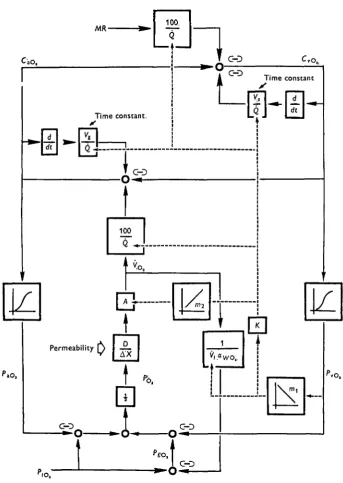
The relation of the various elements embodied in the controlled system and feed-back equations are summarized in Fig. 2; a block diagram of the respiratory, circulatory and neuroregulatory components of the simulation. It will be apparent that the evalua-tion of this model requires informaevalua-tion bearing upon several system constants, and the responses of the teleost to stress situations. As a consequence of several recent studies, data sufficient for preliminary testing of the model under conditions of (a) routine activity, (b) exercise-induced increases in oxygen demand, and (c) routine activity during progressive hypoxia is now available (Hughes, 1964,1966; Rahn, 1966; Holeton & Randall, 1967; Stevens & Randall, 1967a, b).
The controlled situation (equations (5), (6), (8), (io)-(i2)) and system-controlling equations (equations (i3)-(is)) were simultaneously solved on an IBM 7040 digital computer. Numerical values for MR or P/Oa were used as input-driving functions in
the various experiments carried out. These, and the state of the system at any given time, were used to predict succeeding system states in terms of 1^, 1^, Q, PvOn, Pa0^
Cardiovascular-respiratory dynamics of the salmonidfish 483
factor, VjQ, which varied in value from 070 (standard or routine activity) to 0-13 min. (maximum activity). Accordingly, solutions were generated at o-oi min. intervals.
(1) Routine cardiovascular-respiratory activity
[image:7.451.54.398.152.635.2]Testing the model under conditions of routine activity was largely associated with the development of approximations for several essential constants, and the adjustment of all relationships to yield reasonable values for the several parameters predicted.
484 W. TAYLOR, A. H. HOUSTON AND J. D. HORGAN
The value for aw0 (572 x io~5 ml./ml./mm. Hg) was interpolated from the data
assembled by Rahn (1966), and corrected to coincide with the dimensions used in this study. The coefficient of diffusion, D, was estimated according to the procedure used by Hughes (1966) as 3-29 x icr8. Values scaled from Holeton & Randall (1967) and Stevens & Randall (1967a, b) were employed for MR" (0-42 ml./min.), P/ O a
(134 mm. Hg), PVQ2 (19 mm. Hg) and Ff (564 ml./min.). Hughes's investigations upon the functional dimensions of the teleost gill suggest that about 10% of total blood volume is contained within the branchial apparatus at any given time. Using the mean of a number of recent estimates gives a value of 5-50 ml. for Vg (Schiffman &
Fromm, 1959; Conte et al. 1963; Smith & Bell, 1964; Smith*, 1966).
No similar values exist for the body-phase volume, Vs. An empirical estimate was,
therefore, made by solving the system for several trial values for this parameter. It may be assumed that the range of possible values for Vs is limited by a minimum
corres-ponding to blood volume, and a maximum correscorres-ponding to the total volume of the body fluid system. Accordingly, the following values were used: (1) blood volume (taken as 5-5 % of body weight, 55-0 ml.), (2) extracellular phase volume (taken as 8-0 % of body weight, 8o-o ml.), and (3) total fluid volume (taken as 8o-o% of body weight, 8oo-o ml.). Predictions of J^>2 and gas tensions based upon these values were all similar
in magnitude, suggesting that Vs is not a critical parameter in this model. Least squares
analysis indicated, however, that Vs = 8o-o ml. provided the best correspondence
between predicted and actual performance. This value was consequently employed. Estimates of total gill area have been provided by Hughes (1966) for a variety of fishes, including the brown trout. It is unlikely, however, that all available respiratory exchange area is used in the state of routine activity (Steen & Kruyyse, 1964). An approximation of As was obtained by solution of equation (10) for the resting state, using the values for MR, D, P/oa> ^>oa a nd Pao2 previously noted. This calculation also
requires a value for A#, the mean diffusion pathlength. Hughes's analysis of respiratory function (Hughes, 1966) suggests that, under resting conditions, this is ' . . .almost exactly that from halfway between two secondary lamellae to the centre of the blood space...'. Values for interlamellar distance range from 35 to 47 fi in the brown trout (Hughes, 1966; Steen & Berg, 1966). Accepting 20/* as a reasonable estimate of diffusion pathlength suggests that As is 338 cm.2 in the resting state, or about one-tenth of the maximum area.
Table 2. Experimental and predicted variables under conditions of routine activity Parameter Experimental* Model-predicted
PEO Pao2 PvOa
Vj
* Values scaled from
134
1 2 1
85 19 S64
figures presented
134-0 I2I-O
84-5 19-0
566
by Randall & Shelton (1967).
Cardiovascular-respiratory dynamics of the salmonid fish 485
The system was then solved for 1^, $, P/oa> ^£O2> ^ o2 a nd Pao2 under conditions of
routine activity. As may be seen from the values summarized in Table II the model generated accurate predictions for this situation.
(2) Respiratory responses in exercised fish
In investigation of exercise-induced responses in rainbow trout Stevens & Randall (1967 a, b) subjected specimens to a graded schedule of changes in water velocity, and followed immediate response and recovery processes. To simulate this situation P/oa
was set at 134 mm. Hg, which corresponds to that used experimentally. The input forcing function, MR, was developed for this simulation in accordance with the previously noted assumption that oxygen consumption faithfully reflects the actual metabolic rate. Temporal variations in metabolism were then expressed in a series of three equations (16a, b, c). In establishing this expression values scaled from figures presented by Randall & Stevens were histographically plotted (Fig. 3), and fitted with two exponential curves. The first (166) describes oxygen uptake during exercise, the second (16 c) indicating changes in metabolic rate during recovery. Both obey the restriction that the areas under equivalent portions of the curve and histogram have equal values. The resulting over-all curve differs somewhat from the visually fitted function described by the authors, but is felt to provide a more realistic description of the original data.
= 0-42 ml./min., (J6a)
< t ^ 1$) = 0-42+1-84(1 -<r"3"8) ml./min., (16&) (« = 15) = 0-42+1-81 e ^ -1 5"4 4 ml./min. (16c)
Using this group of equations values for Vt were recalculated by the Fick method
employing the data for P/oa— PEO* provided by Stevens & Randall (1967 b), and the
value for awc,2 previously noted. The resulting curve is seen in Fig. 3.
The value for m^ the slope of the relationship in equation (13) was estimated as — 1440 from the data of Randall & Shelton (1967a, b). An empirical determination of m2 was carried out, as before by solution of the model using a series of trial values.
Of the various estimates used, m2 = 179 provided the least deviation between
predic-tion and actual performance. Lesser values lead to unacceptably large differences between actual and predicted gas tensions, while values of greater magnitude produced unrealistically large increases in ventilation.
In Fig. 4 the predictions of the model are compared to recalculated values for T^. Good correspondence is apparent. Predicted variations in Pv02 also parallel the changes
observed in the trout. Less satisfactory agreement was obtained with respect to Pao2>
although the over-all trends are similar. On the whole, nevertheless, the behaviour of the model can be taken as providing a reasonably good picture of the experimental situation.
This being the case, the role of branchiovascular adjustment (equation (15)) was further investigated by generating predictions of blood gas tensions with A fixed at
A8, and Ax held constant. The results of this simulation are also indicated in Fig. 4.
486 W. TAYLOR, A. H. HOUSTON AND J. D. HORGAN
could be approximately doubled without change in As, but that this represented the
upper limit possible with this restriction. Reference to the recent work of Brett (1964) upon the relationship between temperature, oxidative metabolism and swimming speed in yearling sockeye salmon suggests that a doubling of MR would permit less
2 5
-E 20
f-1-5
1 0
OS
0 0
4000
3000
2000
1000
Oxygen uptake. Data source: Stevens & Randall (1967b, Fig.3).
Computer exponential curve fit ^0, (rest) =0-42 ml./min.
VO, (exercise) =0-42 + 1 84 [ 1 - f « " ]
^(recover,, =0-42 + 1 8 1 e - " -1 5^
Ventilatory flow rate
Region of
standard error
Vo from above expontial curve awo from Rahn (1966)
PiO—PEOj from Stevens &
' Randall (1967b, Table 1)
J L
Rest Exercise Recovery
40 SO 60 70 80
0 5 10 0 10 20 30 Time min.)
Fig. 3. Computer-fitted exponential curve describing Ko2 during rest, exercise and recovery of rainbow trout (data from Stevens & Randall, 19676). Ventilation flow rate calculated from values for Vot (above), P/OjpPjso2 (Stevens & Randall, 19676) and aH,Oa (Rahn, 1966).
Cardiovascular-respiratory dynamics of the salmonid fish 487
3500 3000 2500 2000 1500
1000
500
0
100
90
80
70
60
50
40
30
20
-1 10
-f
Computer predictions of ventilation, and arterial and venous oxygen tension under conditions of rest, moderate exercise and recovery vs. experimental data (Stevens & Randall,
1967)
A held constant at As
Y
1Rest Exercise Recovery
0 5 10 0 10 20 30 40 50 60 70
Time (min.)
W. TAYLOR, A. H. HOUSTON AND J. D. HORGAN
(3) Prediction of cardiovascular-respiratory responses to environmental hypoxia
The response of rainbow trout to progressive environmental hypoxia has been investigated by Holeton & Randall (1967). The time scale of the study was such as to preclude acclimatory effects equivalent to those described by Prosser et al. (1957). Under such conditions it might be anticipated that an ever-increasing fraction of Mi? would be needed to satisfy the metabolic demands of the branchial pump (Hughes, 1964; Schuman & Piiper, 1966). This, in effect, represents a positive feedback loop which, in the absence of any braking action, would lead to system instability given
30 40 50 60 70 80 90 100 120
Fig. 5. Computer predictions of PBo2, Paot and Pvos during progressive hypoxia. Symbols; values for ^ o2 (solid circles), Paot (open triangles) and f^Oj (solid squares) from Holeton & Randall (1967).
sufficient stress. To test the consequences of an uncontrolled positive feedback loop of this type the model was adjusted to permit the expenditure of a portion of the total oxygen uptake in the form of ventilatory work. The value for MR was then expressed as the sum of respiratory (RMR) and non-respiratory (SMR) oxygen requirements.
Mi? =
RMR + SMR, (17)
or MR
= f i i ^
-f!)
+mlQ, -&) + SMR. (18)
Inasmuch as the perfusion-ventilation ratio has been taken as a system constant (equation (14)) the foregoing equation can be expressed in the form,Cardiovascular-respiratory dynamics of the salmonidfish 489
Assuming that 25 % of the oxygen consumed under conditions of routine activity is expended in ventilatory work the slope function of equation (19) can be estimated as
m
h= SMRlffi. (20)
The model was then used to generate solutions for J^, PEOz, Pao* a n^ Ao2 a t Pro~
gressive 2 mm. Hg depressions in PIOi under conditions of routine activity. In this
instance the available experimental data provide values for trout at 150 C , whereas the model was developed for trout respiring at 50 C. Furthermore, some uncertainty,
7000
6000
5000
-"I 4000
i
^ 3000
2000
1000
-1
Computer simulation of the consequences of unrestrained 1 positive feedback 1 upon ventilation
• , 1
1 1I t
1
•
-1
\..u Stevens
\ \ ^ Randall
v <
(1967)&
[image:13.451.138.313.170.481.2]20 40 60 80 100 120 140 160
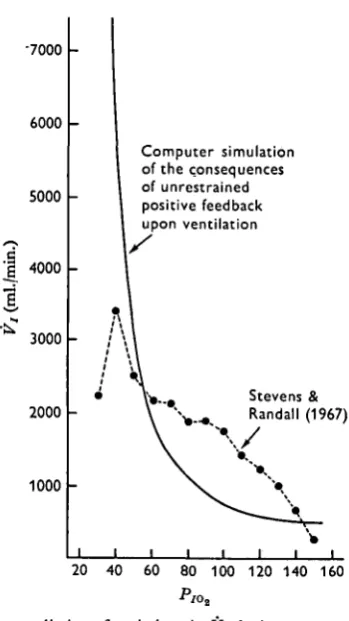
Fig. 6. Computer prediction of variations in Kt during progressive hypoxia with unrestrained positive feedback loop in operation.
of course, attends the assumption that RMR is actually fixed at the value selected under the conditions imposed. Therefore, qualitative agreement only was anticipated. Pre-dicted variations in oxygen tensions are summarized in Fig. 5. Values for PEo2 were
lower than experimental values scaled from the figures presented by Holeton & Randall (1967) by some 2 to 10 mm. Hg. In general, PaOi in the trout corresponded closely
to JP#oa> a nd was from 10 to 25 mm. Hg higher than the values predicted by the model.
Better agreement between experimental and predicted venous oxygen tension was achieved. In all instances, however, qualitative correspondence existed.
Model predictions of Vx under hypoxic conditions are indicated in Fig. 6. Again
49° W. TAYLOR, A. H. HOUSTON AND J. D. HORGAN
the model to predict unbounded increase in J^. This can be regarded as verification of the de-stabilizing influence of a positive feedback element of the type alluded to earlier. In actuality, of course, this does not occur in the teleost. At low environmental oxygen tensions the rising phase of ventilatory flow is abruptly terminated, and ventilation stabilizes or actually diminishes (Hughes, 1964; Holeton & Randall, 1967). Consequently it would seem reasonable to hypothesize the existence of at least one braking function which, coming into play under conditions of hypoxic crisis, overrides the influence of the positive loop.
DISCUSSION
The model developed in this study represents, in several respects, a gross over-simplification of the biological reality. Among other things it incorporates assumptions regarding flow continuity which are met only in the sense of mean flow and largely disregards intercompartmental transfer processes. The feedback elements of the system (equations (i3)-(is)) have been depicted as linear relationships, whereas, by analogy with the mammalian system, it seems more probable that such functions would actually be non-linear in character. Nevertheless, despite these and other limitations the model does predict the performance of the fish quite closely, and provides insights relating to a number of aspects of teleostean cardiovascular-respiratory dynamics.
For example, the operation of the model strongly supports the view that respiratory responses, in the situations simulated, are based upon the monitoring of blood oxygen tension. No realistic simulations could be achieved in trials using either Pacoa o r ^coa
as reference factors in the feedback equations modifying T^, Q and A. Furthermore, the use of PaOa did not provide correspondence of the responses of the model with those
of the fish. The accuracy achieved with values for PvOi as the reference point, therefore,
suggests a venous rather than an arterial location of the receptor system.
This model study has also emphasized the probable importance of branchiovascular adjustments in the over-all pattern of response. This was not appreciated initially, and simulations of forced activity in the absence of this factor inevitably lead to quick depletion of stored oxygen, and the prediction of very low, or zero values for PaOi and
Pv0 (i.e. Fig. 4). On the other hand, the value for m2 required for accurate predictions
of f'Oi and blood gas tensions may be too high.This facet of the behaviour of the model
undoubtedly stems from the restrictions incorporated in its development. For example, the model was not permitted to incur any oxygen debt whatsoever, i.e. FOa = MR.
As was previously noted the salmonid fishes do not, on the whole, have great capacity for anerobic metabolism. They can, however, accumulate some degree of oxygen debt (Black et al. 1962; Brett, 1964), and this would reduce the necessity of keeping J^, abreast of metabolic demand. Accordingly, the value for m2 would not have to have the
magnitude necessary to satisfy the condition imposed, and A.4 could be reduced. The equation also carries the implication that area only is modified. In fact, however, it can be readily shown that this condition cannot be entirely satisfied. At the maximum value for VQ2 recorded (2-23 ml./min.) solution of equation (9) with Ax at 20 fi requires
Cardiovascular-respiratory dynamics of the salmonid fish 491
made for the probability that that portion of the lamellar surface which lies over the pillar cells cannot effectively contribute to gas exchange. Estimations of pillar surface area range from 30 to 40%, reducing the effective area to 2040-2380 cm.2; values which are still in excess of that required. Brett (1964) has, however, shown that salmon exercised at low temperature can amplify resting V~Ol by 12 to 13 times. Satisfaction of
this level of oxygen flow demands full utilization of gill surface, plus a drop in A# (mean diffusion pathlength) from 20 to 10-8-12-3 /*. Such a situation would appear to be biologically reasonable. Lloyd (1961) has discussed the relationship between POa and
branchial ventilation, and suggests that the oxygen tension gradient extending outward from the lamellar surface varies as a function of the square root of flow velocity. Thus, although the efficiency of oxygen extraction is diminished by increasing ventilation, some degree of compensation is to be anticipated since shifting the diffusional dead-space boundary closer to the lamellar surface would, of course, effect a reduction in mean diffusion pathlength.
Whether a decrease of the magnitude suggested is actually necessary is problematical. Although blood oxygen capacity has been assumed to be constant in the simulation it will be readily appreciated that an increase in this factor could resemble the con-sequences of either an increase in exchange area, or a decrease in diffusion pathlength. Although this parameter was not measured by Stevens & Randall, an increase in venous viscosity, which might be attributable to a rise in haematocrit, was observed (Stevens & Randall, 1967a). In context with this it is of interest that Black et al. (1962) report rapid and sustained elevation of haemoglobin levels in severely exercised trout. Con-sequently, it seems likely that the high value for m2 needed to achieve reasonably
accurate predictions probably represents the consequences of a lumping effect, to which individually smaller variations in aBOl!, Ax and A contribute.
Simulations of the response to progressive environmental hypoxia may also be considered. As has been noted, the ever-increasing oxygen demand of branchial pump operation under such conditions constitutes a type of positive feedback effect which, if of sufficient magnitude, might be expected to produce system instability. Under the conditions imposed this expectation finds verification in the predicted exponential increase in VT at low values for P/oa- In actuality, this does not, of course, occur in the
teleost. Reduction in environmental oxygen availability is often accompanied by some elevation in ventilatory flow at intermediate tensions. However, stabilization or even reduction in T^r is typically encountered at critically low oxygen levels (Hughes, 1964; Holeton & Randall, 1967). It would seem reasonable to hypothesize, therefore, trie existence of a ventilatory suppressor function, whose operation is invoked by exposure to acutely hypoxic conditions. Although the basis of this activity remains entirely speculative at present, the operation of a system of this type implies the existence of a mechanism capable of monitoring P/o2- In connexion with this, it is of some interest
that De Kock (1963) has identified large numbers of apparently chemoreceptor 'end buds' within the pharyngeal cavity of both the brown trout and Atlantic salmon. It is also of note from the viewpoint of functional analogy that a similar braking action upon the stimulatory effects of reduced blood oxygen-tension is also found as a com-ponent of the mammalian regulatory complex.
492 W. TAYLOR, A. H. HOUSTON AND J. D. HORGAN
critical features of the respiratory response. Forcing functions of the type so far considered operate too slowly to shed much light upon the fast dynamics of the system. Experimental studies are needed in which the test animals are exposed to stresses approximating step-input, rather than ramp functions as employed by Holeton & Randall (1967) and Stevens & Randall (1967a, b). Perturbations of the former type should yield much information concerning the operational characteristics of the system, including values for the time constants of the responding elements. Investiga-tions of this type are now under way in this laboratory, and will be reported at a later date.
SUMMARY
1. A digital computer simulation depicting some features of cardiovascular-respira-tory interaction in the salmonid fish has been developed. This embodies six controlled system relationships; three of which are mass balance equation describing oxygen transport and storage in the extra-branchial, branchial and general body phases. A Fick equation, and two relationships approximating the transport characteristics of venous and arterial blood are also included in the system equations. Three feedback equations provide for adjustments in cardiac output, ventilation and exchange surface area.
2. The model predicts, with reasonable accuracy, values for ventilation, cardiac output and blood gas tensions under conditions of routine and moderate activity in an oxygen-sufficient environment. Qualitative agreement between predicted and experi-mental values has been obtained in simulations of responses to progressive environ-mental hypoxia.
3. The study emphasizes the probable role of venous oxygen tension in the regula-tion of ventilatory and cardiac activity. A central role for branchiovascular responses in adaptation to elevated oxygen demand is also indicated. The existence of a depressor function, operating under conditions of acute hypoxia to dampen positive ventilatory feedback effects is suggested by simulation of responses to reduced environmental oxygen tensions.
The financial support of the National Science Foundation (Grant GB-4212) and Public Health Service (Grant HE-08456) is gratefully acknowledged, as is the interest of Dr Herman Rahn.
REFERENCES
BEAMISH, F. W. H. (1964a). Respiration of fishes with special emphasis on standard oxygen consump-tion. II. Influence of weight and temperature on respiration of several species. Can. J. Zool. 42, 177-88.
BEAMISH, F. W. H. (19646). Respiration of fishes with special emphasis on standard oxygen consump-tion. III. Influence of oxygen. Can. J. Zool. 42, 355-66.
BEAMISH, F. W. H. (1964c). Respiration of fishes with special emphasis on standard oxygen consump-tion. IV. Influence of carbon dioxide and oxygen. Can. J. Zool. 42, 847-56.
BEAMISH, F. W. H. & MOOKHERJII, P. S. (1964). Respiration of fishes with special emphasis on standard oxygen consumption. I. Influence of weight and temperature on respiration of goldfish, Carassius
auratus L. Can. J. Zool. 42, 161-75.
BLACK, E. C , CONNOR, A. R., LAM, K. D. & CHIU, W. G. (1962). Changes in glycogen, pyruvate and lactate in rainbow trout (Salmo gairdneri) during and following muscular activity. J. Fish. Res. Bd
Canada 19, 409-36.
BLACK, E. C , KIRKPATRICK, D. & TUCKER, H. H. (1966). Oxygen dissociation curves of the blood of brook trout (Salvelinus fontinalis) acclimated to summer and winter temperatures. J. Fish. Res. Bd
Cardiovascular-respiratory dynamics of the salmonid fish 493
BRETT, J. R. (1962). Some considerations in the study of respiratory metabolism in fish, particularly-salmon. J. Fish. Res. Bd Canada 19, 1025-1038.
BRETT, J. R. (1964). The respiratory metabolism and swimming performance of young sockeye salmon.
J. Fish. Res. Bd Canada 21, 1183-226.
CONTE, F. P., WAGNER, H. H. & HARRIS, T. O. (1963). Measurement of blood volume in the fish)
(Salmo gairdneri). Am. J. Physiol. 205, 533-540.
DE KOCK, L. L. (1963). A histological study of the head region of two salmonids with special reference to pressor and chemoreceptors. Ada Anat. 55, 39-50.
GRODINS, F. S., BUELL, J. & BART, A. J. (1967). Mathematical analysis and digital simulation of the respiratory control system. J. appl. Physiol. az, 260-76.
HOLETON, G. F. & RANDALL, D. J. (1967). The effect of hypoxia upon the partial pressure of gases in the blood and water afferent and efferent to the gills of rainbow trout. J. exp. Biol. 46, 317—27. HORGAN, J. D. & LANCE, R. (1965). An analog computer analysis of Cheyne-Stokes breathing. J. appl..
Physiol. 20, 328-33.
HUGHES, G. M. (1964). Fish respiratory homeostasis. Symp. Soc. exp. Biol. no. 28, pp. 81-107. HUGHES, G. M. (1966). The dimensions of fish gills in relation to their function. J. exp. Biol. 45, 177-95. LLOYD, R. (1961). Effects of dissolved oxygen concentrations on the toxicity of several poisons to rainbow
trout (Salmo gairdneri) Richardson. J. exp. Biol. 38, 447-55.
MILHORN, H. T. & GUYTON, A. C. (1965). A mathematical model of the human respiratory control system. Biophys. J. 5, 27-46.
PASZTOR, V. M. & KLEEREKOPER, H. (1962). The role of the gill filament musculature in teleosts. Can..
J. Zool. 40, 785-802.
PROSSER, C. L., BARR, L. M., PINC, R. D. & LAUER, C. Y. (1957). Acclimation of goldfish to low
con-centrations of oxygen. Physiol. Zool. 30, 137-41.
RAHN, H. (1966). Aquatic gas exchange: theory. Resp. Physiol. i, 1-12.
RANDALL, D. J., HOLETON, G. F. & STEVENS, E. D. (1967). The exchange of oxygen and carbon dioxide across the gills of rainbow trout. J. exp. Biol. 46, 339—48.
SAUNDERS, R. L. (1962). The irrigation of the gills in fishes. II. Efficiency of oxygen uptake in relation to-respiratory flow, activity and concentration of oxygen and carbon dioxide. Can.J. Zool. 40, 817-62. SCHIFFMAN, R. H. & FROMM, P. O. (1959). Measurement of some physiological parameters in rainbow
trout (Salmo gairdneri). Can. J. Zool. 37, 25-32.
SCHUMAN, D. & PIIPER, J. (1966). Der Sauerstoffbedarf der Atmungbei Fischen nach Messunger an der Narkotisierten Schleie (Tinea tinea). Pfliigers Arch. ges. Physiol. 288, 15-26.
SMITH, L. S. (1966). Blood volumes of three salmonids. J. Fish. Res. Bd Canada 23, 1439-46. SMITH, L. S. & BELL, G. R. (1964). A technique for prolonged blood sampling in free-swimming salmon..
J. Fish. Res. Bd Canada 21, 711-717.
STEEN, J. B. & BERG, T. (1966). The gills of two species of haemoglobin-free fishes compared with those-of other teleosts—with a note on severe anaemia in an eel. Comp. Biochem. Physiol. 18, 517—526. STEEN, J. B. & KRUYYSE, A. (1964). The respiratory function of teleostean gills. Comp. Biochem. Physiol..
12, 127-142.
STEVENS, E. D. & RANDALL, D. J. (19670). Changes in blood pressure, heart rate and breathing rate-during moderate swimming activity in rainbow trout. J. exp. Biol. 46, 307-315.
STEVENS, E. D. & RANDALL, D. J. (19676). Changes of gas concentrations in blood and water during; moderate swimming activity in rainbow trout. J. exp. Biol. 46, 329-37.