456
Diffusion Anisotropy of the Internal Capsule and the
Corona Radiata in Association with Stroke and Tumors
as Measured by Diffusion-weighted MR Imaging
Shuichi Higano, Jianhui Zhong, David A. Shrier, Dean K. Shibata, Yukinori Takase, Henry Wang, and Yuji Numaguchi
BACKGROUND AND PURPOSE: Diffusion-weighted MR images have enabled measurement of directionality of diffusion (anisotropy) in white matter. To investigate differences in the anisotropy for various types of pathologic findings and the association between the anisotropy of tracts and neurologic dysfunction, we compared the anisotropy of the posterior limb of the internal capsule and the corona radiata between patients with stroke and those with tumors and between patients with and without hemiparesis.
METHODS: Thirty-three patients consisting of 11 with tumors and 22 with ischemic disease (16 acute infarction, four old infarction, and two transient ischemic attack) and nine control patients were studied with a 1.5-T MR imager. Diffusion-weighted images were obtained with diffusion gradients applied in three orthogonal directions. The diffusion anisotropy measure-ments were obtained from regions of interests defined within the internal capsule and the corona radiata.
RESULTS: The diffusion anisotropy was significantly reduced in all internal capsules and coronae radiata involved by infarcts, tumors, and peritumoral edema compared with that of the control patients (P, .0001). This reduction was most prominent in the tracts involved by tumors (P,.05). The anisotropy of the internal capsules and coronae radiata was significantly decreased in cases with moderate-to-severe hemiparesis as compared with those with no or mild hemiparesis (P , .0001). Diffusion anisotropy tended to be also reduced in normal-ap-pearing internal capsules and coronae radiata that were remote from the involved segment of the corticospinal tract.
CONCLUSION: The degree of impaired diffusion anisotropy may vary in different pathologic conditions and correlate with neurologic dysfunction. The measurement of diffusion anisotropy may provide additional information relating to neurologic function and transneuronal effects.
Diffusion-weighted imaging is a method of MR imaging that is sensitive to the random motion (diffusion) of water molecules. Using specific pulses (motion-probing gradients), the phase dif-ferences between mobile protons and immobile ones are accentuated (1, 2). On diffusion-weighted images, therefore, MR signal decreases in regions
Received December 1, 1999; accepted after revision August 8, 2000.
From the Department of Radiology (S.H., J.Z., D.A.S., D.K.S., Y.T., H.W., Y.N.), Division of Neuroradiology, Uni-versity of Rochester Medical Center, Rochester, NY.
A summary of this work was presented at the 37th Annual Meeting of the American Society of Neuroradiology, San Di-ego, CA, April 1999.
Address reprint requests to Yuji Numaguchi, MD, PhD, De-partment of Radiology, Division of Neuroradiology, University of Rochester Medical Center, 601 Elmwood Avenue, Box 648, Rochester, NY 14642.
qAmerican Society of Neuroradiology
in which water diffusion rates are high and in-creases in areas that have more restricted diffu-sion. The magnitude of water diffusion (ie, the ap-parent diffusion coefficient) is known to change in various pathologic conditions, including ischemic disease, brain tumor, and demyelinating diseases (3–10).
In addition to the pathologic state, the water dif-fusion is varied in normal brain tissue. In the my-elinated white matter, the water molecules move relatively freely in the direction parallel to the fiber tracts but are restricted in their movement perpen-dicular to the tracts, which is called diffusion
an-isotropy (11–14). Recently, diffusion-weighted
AJNR: 22, March 2001 STROKE AND TUMORS 457
determining changes in diffusion anisotropy when lesions involve white matter tracts (17–21).
Some studies have shown that diffusion anisot-ropy in the white matter and the apparent diffusion coefficient change under pathologic conditions (17, 22–26). As far as we know, however, there have been no reports evaluating changes in the anisot-ropy of white matter tracts in various disease states. Several investigators have examined the relation-ship between involved and/or dysfunctional tracts and diffusion anisotropy (17, 20, 24). The purposes of this study were to compare diffusion anisotropy in white matter tracts of patients with various types of pathologic findings and to investigate the asso-ciation between anisotropy of the tracts and neu-rologic dysfunction. We chose supratentorial seg-ments of the corticospinal tract (the posterior limb of the internal capsule and the corona radiata) as a target for investigation, and comparison was made between patients with stroke and those with tumors and between patients with and without hemiparesis.
Methods
Patients
We retrospectively reviewed MR studies that included dif-fusion-weighted images from January 1998 to October 1998 and selected those patients with supratentorial tumors and those with supratentorial cerebrovascular disease. We also se-lected nine control patients who had undergone diffusion-weighted imaging during the same period. The inclusion cri-teria for the control patients were normal results of their neurologic examinations and MR imaging of the brain. The selected control patients had only minor complaints, such as headache, nausea, and dizziness. Patients with bilateral hemi-spheric neurologic deficits, involvement of bilateral cortico-spinal tracts, and infratentorial lesions were excluded from this study. Patients with asymmetrical head positioning and those who moved during diffusion-weighted image acquisition were also eliminated.
Thirty-three patients and nine control patients constituted the study, including 23 men and 19 women (age range, 8–81 years; mean age, 51 years). Eleven patients had tumors (three malig-nant gliomas, two metastatic tumors, three low-grade gliomas, two brain abscesses, and one unknown nodular tumor), 16 had acute cerebral infarctions less than 2 weeks after ictus (range, 0–14 days; mean, 3.4 days), and four had chronic cerebrovas-cular disease. Two patients who presented with transient is-chemic attacks (hemiparesis) showed no MR abnormality.
Image Acquisition
All MR studies were conducted using a 1.5-T supercon-ducting system. The typical imaging protocol consisted of sag-ittal T1-weighted (400/14/1 [TR/TE/excitations]) spin-echo, axial T1-weighted (400/14/1) spin-echo, axial T2-weighted (4000–4300/105 [TR/TEeff]; echo train length, 10–12) fast
spin-echo, axial and/or coronal fluid-attenuated inversion re-covery (10002/148 [TR/effective TE]; inversion time, 2200 ms), and axial diffusion-weighted imaging sequences. For some of the patients, contrast-enhanced T1-weighted (400/14/ 1) sequences were additionally obtained. For these sequences, with the exception of the diffusion-weighted imaging sequenc-es, the field of view was 20 to 22 cm, the matrix size was 256
3192, and the section thickness was 5 mm, with a 2.5-mm intersection gap.
Diffusion-weighted images were obtained using multisection single-shot spin-echo echo-planar imaging (10000/98 [TR/
TEeff]). The field of view was 303 19 cm, and the matrix
size was 1283128. The section thickness was 7 mm, with a 3-mm intersection gap, and 11 to 17 axial sections were ob-tained. The motion-probing gradients were applied sequentially in three orthogonal axes in the direction of the section select (z), phase-encoding (x), and readout (y) gradients, with a b factor of 1000 s/mm2, to generate three orthogonal axis
dif-fusion-weighted images (x, y, z). T2-weighted images without motion-probing gradients (b50 s/mm2) were also obtained.
The patient’s head was symmetrically positioned and fixed in the head coil.
Neurologic Findings
We reviewed each patient’s medical record for neurologic findings at the time of MR imaging. We paid special attention to motor deficits (hemiparesis), which were graded into four categories: none (no hemiparesis), transient (hemiparesis that disappeared before MR imaging study), slight-mild (hemipa-resis but muscles capable of contracting against (hemipa-resistance), and moderate-severe (hemiparesis with muscles incapable of contracting against resistance).
Evaluation of MR Images
Using both conventional MR and diffusion-weighted imag-es, we evaluated the presence or absence of lesional involve-ment of the supratentorial seginvolve-ments of the corticospinal path-way, including the posterior limb of the internal capsule, the corona radiata, and the cortical or subcortical region around the central sulcus, including sensorimotor cortices.
Data Analysis for Diffusion Anisotropy
The signal intensity (Si, i 5 x, y, z) on each
diffusion-weighted image (x, y, z) is described by Si5S0exp(2bDi) (i 5x, y, z), where S0is the signal of the reference image and
Di is the apparent diffusion coefficient in the ‘‘i’’ direction of the motion-probing gradient. We evaluated diffusion anisot-ropy according to the SD index (ASD) defined by the following
formula (27):
2 2
ASD5{[(Dx2DAV) 1(Dy2DAV)
2 1/2 1(Dz2DAV) ] / 6} / DAV
where, DAV5(Dx1Dy1Dz) / 3.
The three-orthogonal diffusion- and T2-weighted images (b
50) were transferred to a workstation for image processing. ASDvalues were calculated on a pixel-by-pixel basis to
gen-erate ASDmap images using numerical computation software.
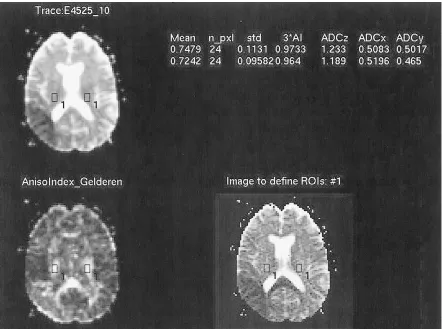
For every case, we selected two or three sections in which the posterior limb of the internal capsule or the corona radiata was included. On each section, the rectangular regions of in-terest (ROI) were defined in the posterior limb of the internal capsule or the corona radiata on both the affected side and the contralateral unaffected side. To define the ROI on these ana-tomic structures as accurately as possible, we used our origi-nally developed software. Using this software, three different images of the same section, including the ASDmap image, the DAVimage, and a selected reference image, were displayed at
the same time. When an ROI was defined on the reference image, the location of the ROI was shown on the other two images simultaneously (Fig 1). Because the fiber tracts of the posterior limb of the internal capsule and the corona radiata run in the craniocaudal direction, we used the Dz image as a reference image. These anatomic structures were usually easily identified on the Dz and ASD map images because of their strong anisotropy, and the lesions were identified on the DAV
FIG1. Screen of defining ROI. The DAVimage (upper left), the ASDmap image (lower left), and the Dz image (lower right) were displayed on the screen, and the location of the defined ROI were shown on the three images simultaneously.
TABLE 1: Relationship between the degree of hemiparesis and the type of pathologic abnormality
Degree of
Hemiparesis N
MR-revealed Disease No
Lesion Acute Infarct
Old
CVD Tumor None
Transient Slight-mild Moderate-severe
11 3 12 7
0 2 0 0
4 1 8 3
3 0 1 0
4 0 3 4 Total 33 2 16 4 11
Note.—Data in the table represent the number of patients in each category. N: Total number of each category.
To standardize these ROI values, an asymmetry index (%) of ASD, AI(ASD), between the affected side and the
contralat-eral side, was calculated according to the following equation: AI (ASD)5(ASD cntASD aff) / [(ASD cnt1ASD aff) / 2]
3100
ASD affand ASD cntrepresent ASDvalues from the ROI of the
corticospinal tracts on the affected side and the corresponding ROI on the contralateral side, respectively. In cases with hemi-paresis, the responsible side for the hemiparesis was regarded as the affected side. In cases with no paresis, the hemisphere having the main lesion was regarded as the affected side. In control cases that had neither hemiparesis nor a lesion, the index was calculated by supposing the left side to be the af-fected side. The greater the AI(ASD) was, the greater was the
reduction in anisotropy of the internal capsule or the corona radiata on the affected side. The diffusion anisotropy may change with age. Using the asymmetry index should minimize the influence of age-related change.
These AI(ASD) values were compared among the various
subgroups classified by the type of lesion that involved the ipsilateral corticospinal tract: control group, uninvolved tract, acute infarction, old cerebrovascular disease, tumor edema, and tumor. We also compared the AI(ASD) for various degrees of
hemiparesis, including control group, no paresis, transient pa-resis, slight-mild papa-resis, and moderate-severe paresis. Statis-tical analysis was conducted using analysis of variance with Scheffe’s post hoc test for multiple comparison. P values less than .05 for multiple comparison were used to determine sig-nificant differences.
Results
According to the medical records, 22 of 33 pa-tients had hemiparesis (Table 1). One patient with transient attacks of hemiparesis had acute infarction in the frontal operculum.
[image:3.612.301.529.466.579.2]AJNR: 22, March 2001 STROKE AND TUMORS 459
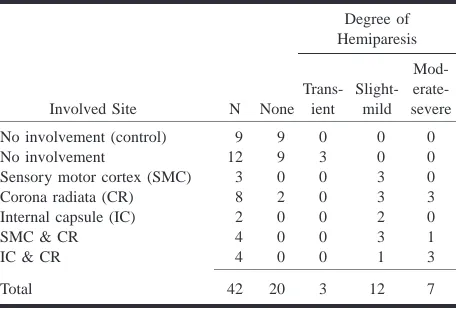
TABLE 2: Relationship between the involved site of the cortico-spinal pathway and the degree of hemiparesis
Involved Site N None
Degree of Hemiparesis Trans-ient Slight-mild Mod- erate-severe No involvement (control)
No involvement
Sensory motor cortex (SMC) Corona radiata (CR) Internal capsule (IC) SMC & CR IC & CR
9 12 3 8 2 4 4 9 9 0 2 0 0 0 0 3 0 0 0 0 0 0 0 3 3 2 3 1 0 0 0 3 0 1 3 Total 42 20 3 12 7
Note.—Data in the table represent the number of patients in each category. N: Total number of each category for involved site.
FIG 2. Mean and SD of AI(ASD) of the internal capsule or the corona radiata involved by various types of lesions. Analysis of variance, F539.6;P,.0001; Post hoc test (Scheffe); *,P5 .05 as compared with the control group; **,P,.0001 as com-pared with both control and uninvolved groups.
showed hemiparesis contralateral to the involved hemisphere. Two patients with involvement of the corona radiata (one with old infarction and the other with a low-grade astrocytoma) showed no hemiparesis.
Figure 2 shows the mean and SD of AI(ASD) of the internal capsule or the corona radiata involved by various lesions. All involved tracts had signifi-cantly larger AI(ASD) than did uninvolved and con-trol tracts (Figs 3 and 4). In addition, the mean AI(ASD) of the tracts involved by tumors (mass le-sions) was significantly larger than that of tracts involved by the other three lesions.
Figure 5 shows the mean and SD of AI(ASD) for each category, classified by the means of the degree of hemiparesis. The mean AI(ASD) of the cases with moderate-severe hemiparesis was significantly larger than that of the remaining four groups, in-dicating more decreased diffusion anisotropy of the affected side. The mean AI(ASD) of the group of slight-mild hemiparesis showed a higher value than
that of the control, no paresis, and transient groups, but no significant statistical difference was noted.
As shown in Table 2, at least one segment of the corticospinal pathway from the sensorimotor cor-tices to the posterior limb of the internal capsule was involved in 21 cases. However, involvement of both the internal capsule and the corona radiata was noted in only four cases. In the remaining 17 cases, either the internal capsule or the corona radiata or both on the affected hemisphere were not involved. We compared the mean AI(ASD) value of the nor-mal-appearing (uninvolved) internal capsule or co-rona radiata between the 17 patients having some involved segments of the corticospinal tract and the other 21 patients with entirely intact corticospinal tracts (Fig 6). The mean AI(ASD) value of the group having involved segments tended to be larger than that of the group with the intact tract, although a statistically significant difference was not noted. The former group included 12 acute infarctions less than 2 weeks old, four tumors, and one old cere-brovascular disease. Eleven of these patients showed slight-mild hemiparesis, four showed mod-erate-severe hemiparesis (Fig 3), and two had no paresis. All of them showed no MR finding of wal-lerian degeneration.
Discussion
There are six major descending motor control pathways: corticospinal tracts, corticobulbar tracts, vestibulospinal tracts, reticulospinal tracts, rubro-spinal tracts, and tectorubro-spinal tracts. The former two pathways originate in the cerebral cortex, mainly in the primary motor cortex, and descend through the corona radiata and the posterior limbs of the inter-nal capsule supratentorially. They reach motor nu-clei of cranial nerves and other brain stem sites (corticobulbar fibers) or terminate to spinal cord motor neurons and interneurons (corticospinal fi-bers) (28, 29). Therefore, supratentorial lesions in-volving the primary motor cortex, corona radiata, or posterior limb of the internal capsule often cause motor deficits. We studied patients with supraten-torial lesions and found that 19 (90%) of 21 pa-tients with involvement of these structures had hemiparesis.
The fibers descending through the internal cap-sule fan out as the corona radiata, just above the internal capsule. The posterior limb of the internal capsule contains not only the corticospinal and cor-ticobulbar fibers but the fibers interconnecting ven-troanterior and ventrolateral nuclei of the thalamus with the motor and premotor cortices and some of the somatosensory fibers (28, 29). This means that the involvement of the corona radiata or the pos-terior limb of the internal capsule does not always produce motor deficits. Two cases, each with a co-rona radiata lesion, did not show hemiparesis in this series.
[image:4.612.63.288.280.443.2]hin-FIG3. Acute cerebral infarction of the right corona radiata with moderate-severe left hemiparesis.
A, T2-weighted echo-planar image (b50) shows an oval hyperintense lesion involving the right corona radiata. B, Apparent diffusion coefficient image shows a decreased diffusion coefficient in the lesion.
C, In the ASDimage, the diffusion anisotropy is also reduced.
D, T2-weighted echo-planar image (10000/98 [TR/TEeff]) that includes the internal capsule shows no involvement of the right internal capsule, although high intensity spotty lesions were noted in the bilateral lentiform nuclei.
E, Apparent diffusion coefficient image of the same section as that shown in D shows no definite abnormality in the internal capsule. F, ASDimage shows decreased diffusion anisotropy in the posterior limb of the right internal capsule as compared with the left side.
dered perpendicular to the tracts. This results in directional water diffusion or anisotropy. The dif-fusion anisotropy may reflect the integrity of the white matter structure. Therefore, impairment of water diffusion in the white matter may correlate with the degree of the damage to its structure. In our measurements, all involved internal capsules and coronae radiata showed significantly decreased anisotropy in comparison with uninvolved ones. This reduction of anisotropy means decreased di-rectionality of the water molecular motion in the white matter tracts. This phenomenon may be due to loss of myelin, or replacement of myelinated fi-bers with glial cells, or abnormal structures such as tumors (24). We found that the diffusion anisotropy was significantly more impaired in the fiber tracts involved by tumors than in those with infarction or peritumoral edema. A possible explanation is that a tumor may be more invasive and may completely
replace the fiber tracts with neoplastic tissue or ne-crotic tissue in the tumor. In our series, all the tu-mors that involved the internal capsule or the co-rona radiata were high-grade gliomas. Our results indicate that the decrease in diffusion anisotropy of the white matter tracts varies for different types of pathologic conditions.
AJNR: 22, March 2001 STROKE AND TUMORS 461
FIG4. Glioblastoma involving the right corona radiata and basal ganglia with moderate-severe hemiparesis.
A, T2-weighted echo-planar image shows an irregular mass with marked perifocal edema involving the right corona radiata. B, Apparent diffusion coefficient image shows an irregular mass with marked perifocal edema involving the right corona radiata. C, In the ASDimage, the diffusion anisotropy of the right corona radiata is hardly noted.
FIG 5. Mean and SD of AI(ASD) of the internal capsule or the corona radiata for each degree of hemiparesis. Analysis of var-iance, F517.0;P,.0001; Post hoc test (Bonferroni); *,P, .0001 as compared with every other group.
FIG6. Comparison of AI(ASD) value (mean and SD) of normal-appearing internal capsule and corona radiata between the pa-tients with entirely intact corticospinal tract (Intact) and those hav-ing some involved segments of the corticospinal tract (Involved). of the tract by the mass effect and showed good
correlation between the findings and the pre- and postoperative motor functions. Karibe et al (20) studied patients with deep intracerebral hemorrhage by use of anisotropic diffusion-weighted imaging and evaluated the correlation between motor func-tion and corticospinal tract injury on diffusion-weighted images obtained at admission. Initial cor-ticospinal tract injury was not correlated with the motor impairment at admission but was closely correlated with motor impairment 1 month after on-set. They concluded that early evaluation of corti-cospinal tract injury using diffusion-weighted im-aging could provide predictive value for motor function outcome in patients with cerebral hemor-rhage. In these two studies, the continuity of the fiber tracts on diffusion-weighted images was vi-sually evaluated. In a quantitative evaluation,
hemi-paresis, whereas we studied different types of path-ologic conditions, including tumors and acute and chronic infarctions. These different constituents may have affected the differing results.
In the cases having some segments of the corti-cospinal tract involved by pathologic abnormality, the diffusion anisotropy tended to be reduced not only in the involved segments but also in the ap-parently uninvolved segments on the affected side. Several investigators have reported similar find-ings. Pierpaoli et al (25) reported decreased an-isotropy in the midbrain and medulla oblongata of the affected side by measuring the diffusion tensor in patients with chronic supratentorial infarction. Wieshmann et al (24) showed the reduction of an-isotropy in the cerebral peduncle remote from su-pratentorial lesions in patients with severe chronic hemiparesis. A possible explanation for such phe-nomena is wallerian degeneration of the fiber tracts secondary to the supratentorial lesion. The waller-ian degeneration along the corticospinal tracts is usually detected at 4 weeks after cerebral infarction as a hypointense signal band on conventional T2-weighted images. It then becomes hyperintense af-ter 10 to 14 weeks and finally results in hemiatro-phy of the brain stem (30). These two reports of reduced anisotropy dealt with patients with chronic disease. Our cases included patients with acute in-farction of less than 2 weeks’ duration and no de-tectable wallerian degeneration on standard MR images. This shows that evaluation of the anisot-ropy might detect wallerian degeneration or some secondary degenerative change in white matter ear-lier and with greater sensitivity than conventional MR imaging.
There have been some reports regarding the re-lationship between wallerian degeneration and clin-ical findings. Wallerian degeneration of the pyra-midal tracts was often found in patients with capsular infarction, especially when associated with motor deficit (31). Orita et al (32) measured an area of wallerian degeneration in the pons on T2-weighted coronal images in patients with cerebro-vascular disease of the internal capsule and con-cluded that the area of wallerian degeneration was related to the severity of the motor deficit. Watan-abe and Tashiro (33) and Sawlani et al (34) com-pared the functional prognosis between patients with and without wallerian degeneration and found that the presence of wallerian degeneration corre-lated well with persistent functional disability. Therefore, the measurement of the diffusion an-isotropy might help to predict the functional prog-nosis of patients earlier in the acute stage of in-farction. Igarashi et al (17) evaluated the change in diffusion anisotropy associated with wallerian de-generation of the pyramidal tracts in patients with supratentorial cerebrovascular accidents by use of 3D anisotropy contrast MR images. Patients ex-amined during the acute stage who later recovered from hemiparesis had no visible changes on the 3D anisotropy contrast images, whereas patients who
recovered poorly showed distinct color fading in the pyramidal tract within 14 days after stroke.
Our study had several limitations. We did not have software to obtain diffusion tensor imaging on our MR imaging unit, so we could not measure the diffusion tensor exactly. The study was limited to evaluate the diffusion anisotropy by using data with three orthogonal diffusion gradients. Because most of the white matter fibers pass obliquely to the magnet coordinates, the diffusion anisotropy cal-culated by three-directional diffusion-weighted im-aging tends to be underestimated and the measured values are also rotationally variant (15, 16). The more accurate measurement of the diffusion an-isotropy exactly along each fiber orientation re-quires diffusion tensor imaging, with at least nine different directional motion-probing gradients. To minimize errors associated with our incomplete measurements, we standardized the value using an asymmetry index. However, such incomplete mea-surements of the diffusion anisotropy can lead to erroneous results, especially in some patients with brain tumors in which the white matter fibers are distorted asymmetrically because of the mass ef-fect. This measurement error intrinsic to this study might partly account for the markedly impaired an-isotropy in the tracts involved by tumors as com-pared with that in tracts involved by other lesions. More exact evaluation by diffusion tensor mea-surement is required for further clarification. The number of cases in our study was too small to alyze statistically the reduction of the diffusion an-isotropy between various types of pathologic con-ditions involving the tracts and the degree of motor impairment separately. Another limitation of our study was that the control group consisted of pa-tients, not of healthy volunteers. However, we care-fully selected patients who did not have any neu-rologic signs and who had normal results of MR imaging of the brain as the control patients. Despite these limitations, our results show some consisten-cy with those of previous reports (24, 25, 32).
Conclusion
AJNR: 22, March 2001 STROKE AND TUMORS 463
References
1. Taylor DG, Bushell MC. The spatial mapping of translational
diffusion coefficients by the NMR imaging technique. Phys Med
Biol 1985;30:345–349
2. Le Bihan D, Breton E, Lallemand D, Grenier P, Cabanis E, Laval-Jeantet M. MR imaging of intravoxel incoherent motions:
ap-plication to diffusion and perfusion in neurologic disorders.
Radiology 1986;161:401–407
3. Krabbe K, Gideon P, Wagn P, Hansen U, Thomsen C, Madsen F.
MR diffusion imaging of human intracranial tumors.
Neuro-radiology 1997;39:483–489
4. Beauchamp Jr NJ, Ulug AM, Passe TJ, van Zijl PCM. MR
dif-fusion imaging in stroke: review and controversies.
Radi-ographics 1998;18:1269–1283
5. Brunberg JA, Chenevert TL, McKeever PE, et al. In vivo MR
determination of water diffusion coefficients and diffusion an-isotropy: correlation with structural alteration in gliomas of the cerebral hemispheres. AJNR Am J Neuroradiol 1995;16(2):
361–371
6. Provenzale JM, Sorensen AG. Diffusion-weighted MR imaging
in acute stroke: theoretic considerations and clinical applica-tions. AJR Am J Roentgenol 1999;173(6):1459–1467
7. Christiansen P, Gideon P, Thomsen C, Stubgaard M, Henriksen O, Larsson HBW. Increased water self-diffusion in chronic plaques
and in apparently normal white matter in patients with mul-tiple sclerosis. Acta Neurol Scand 1993;87:195–199
8. Droogan AG, Clark CA, Werring DJ, Barker GJ, McDonald WI, Miller DH. Comparison of multiple sclerosis clinical subgroups
using navigated spin echo diffusion-weighted imaging. Magn
Reson Imaging 1999;17(5):653–661
9. Larsson HBW, Thompsen C, Frederiksen J, Stubgaard M, Henrik-sen O. In vivo magnetic resonance diffusion measurement in
the brain of the patients with multiple sclerosis. Magn Reson
Imaging 1992;10:7–12
10. Tievsky AL, Ptak T, Farkas J. Investigation of apparent
diffu-sion coefficient and diffudiffu-sion tensor anisotrophy in acute and chronic multiple sclerosis lesions. AJNR Am J Neuroradiol 1999;
20(8):1491–1499
11. Chenevert TL, Brunberg JA, Pipe JG. Anisotropic diffusion in
human white matter: demonstration with MR techniques in vivo. Radiology 1990;177(2):401–405
12. Le Bihan D, Turner R, Douek P. Is water diffusion restricted in
human brain white matter? An echo-planar NMR imaging study. Neuroreport 1993;4(7):887–890
13. Moseley ME, Kucharczyk J, Asgari HS, Norman D. Anisotropy in
diffusion-weighted MRI. Magn Reson Med 1991;19(2):321–326
14. Sakuma H, Nomura Y, Takeda K, et al. Adult and neonatal
hu-man brain: diffusional anisotropy and myelination with dif-fusion-weighted MR imaging. Radiology 1991;180(1):229–233
15. Pierpaoli C, Basser PJ. Toward a quantitative assessment of
diffusion anisotropy. Magn Reson Med 1996;36(6):893–906
16. Pierpaoli C, Jezzard P, Basser PJ, Barnett A, Di Chiro G.
Diffu-sion tensor MR imaging of the human brain. Radiology 1996;
201(3):637–648
17. Igarashi H, Katayama Y, Tsuganezawa T, Yamamuro M, Terashi A, Owan C. Three-dimensional anisotropy contrast (3DAC)
mag-netic resonance imaging of the human brain: application to as-sess wallerian degeneration. Intern Med 1998;37(8):662–668
18. Inoue T, Shimizu H, Yoshimoto T. Imaging the pyramidal tract
in patients with brain tumors. Clin Neurol Neurosurg 1999;
101(1):4–10
19. Nakada T, Matsuzawa H. Three-dimensional anisotropy
con-trast magnetic resonance imaging of the rat nervous system: MR axonography. Neurosci Res 1995;22(4):389–398
20. Karibe H, Shimizu H, Tominaga T, Koshu K, Yoshimoto T.
Dif-fusion-weighted magnetic resonance imaging in the early eval-uation of corticospinal tract injury to predict functional motor outcome in patients with deep intracerebral hemorrhage. J
Neurosurg 2000;92(1):58–63
21. Nakada T, Nakayama N, Fujii Y, Kwee IL. Clinical application
of three-dimensional anisotropy contrast magnetic resonance axonography. J Neurosurg 1999;90(4):791–795
22. Yang Q, Tress BM, Barber PA, et al. Serial study of apparent
diffusion coefficient and anisotropy in patients with acute stroke. Stroke 1999;30(11):2382–2390
23. Sorensen AG, Wu O, Copen WA, et al. Human acute cerebral
ischemia: detection of changes in water diffusion anisotropy by using MR imaging. Radiology 1999;212(3):785–792
24. Wieshmann UC, Clark CA, Symms MR, Franconi F, Barker GJ, Shorvon SD. Anisotropy of water diffusion in corona radiata
and cerebral peduncle in patients with hemiparesis.
Neuroim-age 1999;10(2):225–230
25. Pierpaoli C, Barnett A, Virta A, Penix L, Chen R. Diffusion MRI
of wallerian degeneration: a new tool to investigate neural con-nectivity in vivo? Presented at the 6th Scientific Meeting of the
ISMRM, Sydney, 1998
26. Jones DK, Lythgoe D, Horsfield MA, Simmons A, Williams SC, Markus HS. Characterization of white matter damage in
is-chemic leukoaraiosis with diffusion tensor MRI. Stroke 1999;
30(2):393–397
27. van Gelderen P, de Vleeschouwer MH, DesPres D, Pekar J, van Zijl PC, Moonen CT. Water diffusion and acute stroke. Magn
Reson Med 1994;31(2):154–163
28. Martin JH. Neuroanatomy: Text and Atlas. Amsterdam: Elsevier Science Publishing; 1989
29. Nolte J. The Human Brain: An Introduction to Its Functional
Anatomy. 4th ed. St. Louis: Mosby-Year Book; 1999
30. Kuhn MJ, Mikulis DJ, Ayoub DM, Kosofsky BE, Davis KR, Tav-eras JM. Wallerian degeneration after cerebral infarction:
evaluation with sequential MR imaging. Radiology 1989;
172(1):179–182
31. Pujol J, Marti-Vilalta JL, Junque C, Vendrell P, Fernandez J, Cap-devila A. Wallerian degeneration of the pyramidal tract in
cap-sular infarction studied by magnetic resonance imaging. Stroke
1990;21(3):404–409
32. Orita T, Tsurutani T, Izumihara A, Kajiwara K, Matsunaga T.
Py-ramidal tract wallerian degeneration and correlated symptoms in stroke. Eur J Radiol 1994;18(1):26–29
33. Watanabe H, Tashiro K. Brunnstrom stages and wallerian
de-generations: a study using MRI. Tohoku J Exp Med 1992;
166(4):471–473
34. Sawlani V, Gupta RK, Singh MK, Kohli A. MRI demonstration