Monitoring data exchanges between information systems
Master Thesis Business Information Technology
Tycho Bom
Master Thesis
Monitoring data exchanges between information systems
Place and date
Hilversum, November 10th 2010
Author
Tycho M. Bom
Master Business Information Technology University of Twente
University supervisors
Dr. Marten J. van Sinderen
Faculty of Electrical Engineering, Mathematics and Computer Science Dr. Maria E. Iacob
School of management and governance
CRM Resultants supervisor
Abstract
ContextInformation systems are more and more connected to each other and exchange more and more data with each other. As the number of data exchanges increases, it becomes increasingly difficult to maintain an overview of how these data exchanges are performing. This is especially a problem for application service providers which host systems for customers because they host multiple systems and each system can have multiple data exchanges. Although there are monitoring tools available that monitor the states of systems, there are no tools available to monitor the functional aspects of data exchanges. Due to this lack of oversight on the functional performance of data exchanges, problems can be unnoticed and customers can become unsatisfied. The purpose of this study is to create a reference architecture for systems that can provide central monitoring of data exchanges with the possibility of aggregating information on different data exchanges into useful diagnostic reports. The scope of this study is focused on monitoring only at the target system of a data exchange.
Approach
Our research combines information from literature and information from a case study at CRM Resultants. The combined information is about different aspects of data exchanges, possible failures in data exchanges, data quality and monitoring concepts. Based on this information we specify a reference architecture for monitoring functional aspects of data exchanges. When monitoring functional aspects we make a distinction between syntactic monitoring and semantic monitoring. Syntactic monitoring is about monitoring erroneous and successful transactions. Semantic monitoring also takes into account the contents of data in a transaction. To validate this reference architecture we create a prototype based on the reference architecture and test it in the environment of CRM Resultants.
Reference architecture and prototype
The reference architecture consists of three main components: a monitoring plugin, a data collection mechanism and a central monitoring server. The monitoring plugin is used to acquire monitoring information from a data exchange. This information is then collected by the data collection mechanism of the central monitoring server and the central monitoring server presents the data to the end user and is able to generate alerts if necessary. This architecture is capable of monitoring different types of data exchanges because for each type of data exchange a different monitoring plugin can be used and the possible differences in the data format the monitoring plugins generate can be compensated by the data collection mechanism.
In the prototype the monitoring plugin is implemented by Log4Net for monitoring web service data exchanges and by Scribe for monitoring Scribe data exchanges. Scribe is also used as a data collection mechanism to transfer data from the monitoring plugins to the central monitoring server. We use Microsoft Dynamics CRM as the central monitoring server to show the result to the end user.
Findings
Benefits resulting from this research Our research resulted in the following benefits.
Based on our reference architecture monitoring solutions can be created for monitoring functional aspects of data exchanges.
By monitoring data exchanges insight is gained in the transactions data exchanges execute.
Errors in data exchanges can be detected before a customer complains about a problem. This can increase customer satisfaction.
In our prototype all monitoring information is accessible from a single web based user interface. There is no need any more to check separate databases and folders with error logs. This can speed up the investigation on problems.
Monitoring data exchanges can be offered as a service to customers. Customers can pay a monthly fee for this service or they can monitor their own data exchanges and pay a licence fee for the monitoring software. This can increase revenue for the application service provider.
Although it has never been an objective of this research, using our prototype it is now possible to view which data exchanges put the most information in a CRM system. It was already possible to determine the records that were created in a specified period in the CRM system itself, but it could be hard to determine from which source the information originated.
Recommendations
We formulate recommendations for application service providers in general and for CRM Resultants in particular. The most important recommendations are the following.
General recommendations
Implement our reference architecture to monitor data exchanges between information systems to maintain oversight of the successful transactions of data exchanges and errors in data exchanges.
Create an implementation of our reference architecture that can monitor all technologies that are used in the environment that is to be monitored.
Recommendations for CRM Resultants
Use the monitor for all new data exchanges that are developed and add it to existing data exchanges which are known to be prone to errors.
Extend the alerting functions of the monitor to make them more reliable and to increase the ease of use.
Include a service module to support the process of following up errors in data exchanges.
Preface
Years ago companies did all administration on paper and used manually ordered systems to store information. The most well-known examples of these systems are card catalogs and large filing cabinets. The most important asset in this process of storing and retrieving information was the employee itself. The employee needed to know all necessary procedures exactly because all actions were executed manually. As a result the employee had a feeling of the quality of data and the frequency of transactions. In large organizations where multiple people worked in the same files, it was difficult to maintain oversight, but at least each individual transaction was checked by humans and each employee was able to signal abnormalities in his or her work. You could state that employees were in touch with the information they worked with.
Nowadays most companies have replaced their card catalogs and filing cabinets by computer systems which store all their data. These systems vary from simple Excel sheets to the most advanced online ERP systems. This brings numerous benefits such as the increased accessibility of information, the ability to quickly search through the information and of course possibilities to easily copy and back up data. Along with these replacements also more and more actions, which were executed manually in the past, are automated by IT systems. This includes data exchange between information systems. This saves a lot of work which was previously done by hand. It is less error prone and it is often a lot faster.
Automation of information systems certainly brings a lot of benefits to companies. Maybe the most important of these benefits is cost reduction. The downside of all this automation is that IT systems are black boxes to a lot of users. They enter data into the system, but they do not know what the system does with it and how it works in the background. Especially if data is exchanged with other IT systems most users have no clue on what is actually happening. Users expect that the systems takes care of the data and executes all necessary procedures but as the amount of data increases it becomes impossible for users the check if the data is still correct. As long as everything is functioning correctly this is not a problem, but things become different if IT systems do not behave as desired or expected. Users will often not be able to signal these problems directly.
Acknowledgements
During the execution of this research I was supported by several people, who I want to thank for their support. I want to thank my supervisors from the University of Twente Marten van Sinderen and Maria Iacob for their valuable feedback and the easy way in which discussions were held. All meetings went very smooth in my opinion.
I completed this research at CRM Resultants. I would like to thank Roel Hilberink and especially Marc la Chapelle for providing me this opportunity. Marc has been a really flexible supervisor and has been a valuable sparring partner for discussing research topics and possible solutions.
Table of contents
Master Thesis ... II Monitoring data exchanges between information systems ... II Place and date ... II Author ... II University supervisors ... II CRM Resultants supervisor... II Abstract ... III Context ... III Approach ... III Reference architecture and prototype ... III Findings... III Benefits resulting from this research ... IV Recommendations... IV Preface ... V Acknowledgements ... VI
1 Introduction ... 1
Motivation ... 1
1.1 1.1.1 Background of the topic ... 1
1.1.2 About the company ... 1
1.1.3 Current situation ... 2
1.1.4 Desired situation ... 2
1.1.5 Difference between the current and desired situation ... 2
1.1.6 Problem definition ... 2
Research objective ... 2
1.2 Research approach ... 4
1.3 Report structure ... 5
1.4 2 State of the art ... 6
Data exchanges between information systems ... 6
2.1 2.1.1 Architectures of data exchanges ... 6
2.1.2 Layers of data exchanges ... 7
2.1.3 Timeliness of messages ... 10
Possible failures in data exchanges ... 11
2.2 2.2.1 Failures in network communication ... 11
2.2.2 Application failures ... 11
Data quality ... 12
2.4.2 Levels of monitoring ... 15
2.4.3 Polling versus publish and subscribe ... 17
2.4.4 Reporting results of monitoring ... 18
3 Case study on failures of data exchanges ... 19
Web service data exchanges of the Hogeschool Utrecht ... 19
3.1 3.1.1 Reasons for failures that have occurred... 20
Scribe data exchange Hogeschool Utrecht... 21
3.2 3.2.1 Reasons for failures that have occurred... 22
BizTalk data exchange between Peoplesoft and Microsoft CRM of ROC van Amsterdam ... 22
3.3 3.3.1 Errors that can occur ... 22
Combined results of this case study ... 23
3.4 3.4.1 Errors resulting from the contents of data ... 23
3.4.2 Errors in middleware ... 23
3.4.3 Connection and performance errors ... 24
Mapping of errors to data quality ... 24
3.5 4 Monitoring reference architecture ... 25
Components of the architecture ... 25
4.1 Monitoring requirements of the architecture ... 26
4.2 Monitoring process steps ... 26
4.3 Contents of monitoring information ... 27
4.4 Events that must be monitored ... 28
4.5 Requirements of the central monitoring server ... 28
4.6 How this reference architecture improves data quality ... 29
4.7 5 Assessment of technical alternatives ... 30
Hyperic ... 30
5.1 5.1.1 Monitoring plugin ... 30
5.1.2 Central monitoring server ... 31
5.1.3 Monitoring data collection mechanism ... 31
5.1.4 Conclusion ... 31
WSMonitor ... 31
5.2 5.2.1 Monitoring plugin ... 31
5.2.2 Conclusion ... 31
SoapKnox ... 32
5.3 5.3.1 Monitoring plugin ... 32
5.3.2 Conclusion ... 32
ManageEngine ... 32
5.4.3 Monitoring data collection mechanism ... 32
5.4.4 Conclusion ... 33
Scribe ... 33
5.5 5.5.1 Monitoring plugin ... 33
5.5.2 Monitoring data collection mechanism ... 33
5.5.3 Conclusion ... 34
soapUI ... 34
5.6 5.6.1 Monitoring plugin ... 34
5.6.2 Conclusion ... 35
Log4Net ... 35
5.7 5.7.1 Monitoring plugin ... 35
5.7.2 Conclusion ... 36
Microsoft Dynamics CRM ... 36
5.8 5.8.1 Central monitoring server ... 36
5.8.2 Conclusion ... 36
Conclusion on technical alternatives for monitoring ... 36
5.9 6 Our prototype ... 38
Components and architecture... 38
6.1 Requirements ... 39
6.2 6.2.1 Aggregate data from different sources which may use different technologies... 39
6.2.2 Monitor syntactic and semantic aspects of data exchanges ... 39
6.2.3 Support real time and deferrable messages ... 40
6.2.4 Detect patterns in data exchanges ... 40
6.2.5 Report different types of failures ... 40
Monitoring web service data exchanges ... 40
6.3 Monitoring Scribe data exchanges ... 41
6.4 Monitoring semantics ... 42
6.5 Central monitoring server ... 43
6.6 User experience of the central monitoring server ... 44
6.7 6.7.1 General interface ... 44
6.7.2 Following up alerts ... 45
6.7.3 Viewing batch results ... 48
6.7.4 Viewing semantic results ... 52
Collection mechanism ... 53
6.8 6.8.1 Collection of data from web service data exchanges ... 53
6.8.2 Collection of data from Scribe data exchanges ... 54
Monitoring the monitor ... 58
6.10 Security aspects ... 59
6.11 Interoperability ... 59
6.12 Test results of the prototype ... 59
6.13 6.13.1 Types of errors found by the prototype ... 60
6.13.2 Counts of monitoring results ... 60
6.13.3 Real problems that were found by the monitor ... 63
6.13.4 Test limitations ... 64
7 Validation and discussion ... 65
Validation ... 65
7.1 Discussion ... 66
7.2 8 Conclusion ... 68
Summary of results ... 68
8.1 Benefits ... 69
8.2 Recommendations... 70
8.3 8.3.1 General recommendations ... 70
8.3.2 Recommendations for CRM Resultants... 70
Limitations and future work ... 70
1
Introduction
In this chapter we explain the background of this research and why this research is conducted. We first give a motivation and some background information about the topic. Then we continue with the research objective. How we reach the objective is described in the research approach. Finally we explain the report structure.
Motivation
1.1
In this section we explain the background of the topic. We explain the current situation, the desired situation and the difference between them. At the end we present our problem definition.
1.1.1 Background of the topic
Enterprise application integration and service oriented architectures (SOA) are becoming increasingly popular. These concepts mean that data from different enterprise systems is combined, resulting in added value and a total overview of all information that is available. To be able to combine data from different systems, data exchanges between information systems have to be created. When the number of data exchanges increases, the oversight on how they are performing can easily be lost. Another upcoming trend in the past few years is that companies are shifting from hosting enterprise systems themselves to using systems that are offered by application service providers. Companies can use these systems without having to install and maintain their own servers. The application service provider takes away a lot of possible obstacles for implementing and using a system and in return the customer can pay per user or per usage. This concept is often referred to as software as a service or cloud computing. One of the key success factors for software as a service is reliability of the systems. If this reliability is lower than when the customer hosts the system himself, the customer will not use the hosted platform. Also because for most systems there are multiple application service providers, there exists competition between them. If the reliability is not at least as high as that of your competitor, you will lose the competition beforehand.
Combining these two trends one can imagine that systems that are offered by application service providers are often integrated with other systems the customer uses. Because reliability of these systems is so important, it is necessary to monitor these data exchanges. For monitoring servers itself and the application that is offered, there are normally sufficient monitoring tools. For monitoring data exchanges this is different. When monitoring data exchanges not only the connections have to be monitored, but also the functional aspects of data exchanges will have to be monitored. Among other aspects this includes monitoring quality of data, the number of executed transactions and the number of transactions that cannot be processed with the corresponding reason etcetera.
1.1.2 About the company
This research is carried out at CRM Resultants. Cases and experience from this company are used to gather information and to test the solution.
CRM Resultants executes two main activities: consulting and hosting. The consultancy activity is focused on implementing Microsoft Dynamics CRM. CRM Resultants analyzes the business needs of customers and implements the CRM system to suit the needs of the customer. Because each customer has different needs, the system is always tailor made. Often there is a need to exchange data between the CRM system and other systems customers use. During the implementation project also these data exchanges are specified and built.
such as SharePoint, Exchange and even Windows desktops can be hosted on the platform of CRM Resultants. Support on these systems is also included.
Although CRM Resultants does a lot of CRM implementations and is a major player in the Microsoft CRM market, it is a small company. It has around 20 employees. Most of these employees are consultant or project manager. A few of them are developers. The developers build custom solutions and data exchanges with other systems.
1.1.3 Current situation
In the current situation there are no standard monitoring tools for monitoring data exchanges between information systems. For some data exchanges there are execution logs available, but these reside at different servers and locations and are not frequently checked. This can result in problems not being noticed until the customer complains. In the meantime data can be lost. This results in customers becoming unsatisfied. In the end this can even result in a customer switching to in house hosting of the system or switching to a competitor. Both of these are undesirable.
1.1.4 Desired situation
ASP platforms should have a very high reliability and should outperform in house installations of enterprise systems. Monitoring tools have to detect possible errors in data exchanges and should notify support employees. These employees can then investigate the problem and fix it before the customer notices the problem and files a complaint. This results in satisfied customers who see that everything is under control.
1.1.5 Difference between the current and desired situation
The main difference between the current situation and the desired situation consists of tools and knowledge. There are no tools for central monitoring of data exchanges. Some data exchanges log errors somewhere, but because the information is fragmented, no checks are executed on the information. Also, there is no knowledge of what and how these tools should monitor. Nowadays there are only tools in use which monitor if a server is online and what the CPU load is etcetera, but if a server is online that does not mean that data exchanges are functioning properly.
This research will contribute in reaching the desired situation. It will focus on monitoring data exchanges between information systems. Monitoring tools can help in detecting possible errors and it is up to the system administrator to take actions on this monitoring information.
1.1.6 Problem definition
Analyzing the current situation, the desired situation and the difference between them, we formulate the following problem definition:
There is a lack of insight in how data exchanges are performing. This results in failures of data exchanges which are unnoticed and on which no corrective actions are taken.
Research objective
1.2
We formulate the following research objective:
Create a reference architecture for systems that can provide central monitoring of data exchanges with the possibility of aggregating information on different data exchanges into useful diagnostic reports.
In this section we explain the background of this objective. Also we state the main research question that is answered and which sub questions are used to answer the main question.
Satisfied customers Good data quality
Reliable data exchanges Monitoring and
recovery procedures
Figure 1 Causal relation
We state the main target of an application service provider as having satisfied customers. Satisfied customers will remain customers and will possibly attract more customers. These customers are of vital essence for an application service provider. We continue with the question: ‘How to make customers satisfied?’ Customer satisfaction depends on a lot of variables, but certainly one of them is good data quality. Customers use enterprise systems to store data of for example their orders. It is important that this data is as good as possible. If an application service provider can deliver better data quality than the customer can by hosting the system itself, it is even an additional reason for the customer to use the platform of the application service provider.
There are basically two ways in which data can be put into the enterprise system. The user can enter data or data can be entered by data exchanges with other systems. If these data exchanges are not reliable or enter wrong data, this degrades the data quality in the system. So to keep the data quality in the system high, the data exchanges need to be reliable.
Creating reliable data exchanges starts with a good design and a solid implementation. However, at runtime there are a lot of things that can go wrong. Therefore monitoring is needed. Monitoring does not directly increase the reliability of a data exchange, but if concrete actions are taken by support personnel if the monitoring tools signal a problem, the data exchange does become more reliable. To summarize this section: monitoring tools will eventually lead to increased customer satisfaction. There are a lot of other opportunities to increase customer satisfaction, but in this research we focus on this opportunity.
A data exchange always has a source system and a target system. In our research we focus on monitoring the transaction results of data exchanges on the target system, because only at the target system we know the exact impact of transactions of a data exchange. We are interested in the errors of transactions and the successful transactions. By monitoring the errors we can identify potential problems and by monitoring successful transactions we can determine the effect a data exchange has on the data in the target system and detect the absence of transactions. Often an application service provider only has influence on one side of the data exchange. In our research we focus on the target system so we use the case where the target system is in the domain of the application service provider. This is schematically shown in Figure 2.
Figure 2 Overview of a data exchange and the scope of our research
How should a reference architecture that implements syntactic and semantic monitoring at the target system of data exchanges be specified?
To acquire knowledge to answer the research question, the following sub questions are used.
What types of data exchanges are available and need to be distinguished?
What problems can occur?
How can data exchanges be monitored so that problems are detected?
How should the architecture of a data exchange that includes monitoring functionality be specified?
Which existing solutions are available which offer monitoring and recovery procedures and do they meet the requirements?
This research aims to develop a reference architecture for monitoring data exchanges. This should bring the current state of art closer to the desired situation as described in 1.1.4. Monitoring can be added to existing data exchanges and new data exchanges can incorporate monitoring from the design stage.
Research approach
1.3
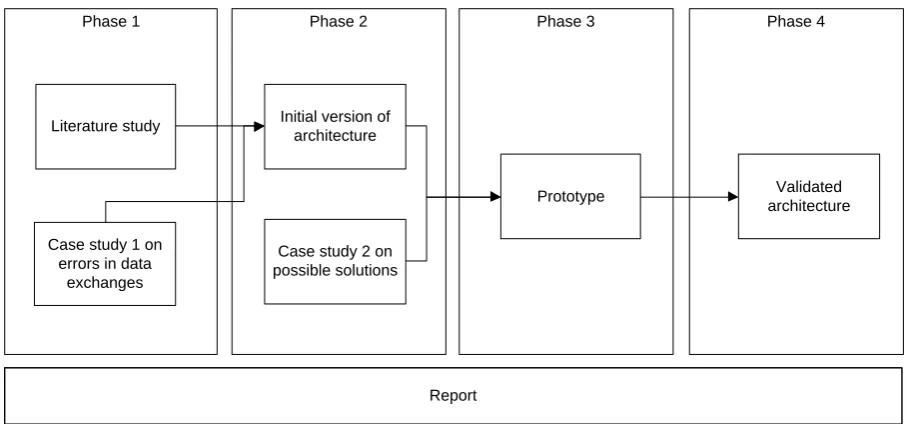
The final product of this research is a reference architecture for monitoring data exchanges. In this reference architecture monitoring tools are specified and guidelines are given for what has to be monitored. To get to the final result, this research is split up into four phases. These phases are depicted in Figure 3.
In the first phase the state of the art concerning relevant topics in literature are investigated and a case study on real world errors is executed. In the literature study we focus on types of data exchanges, possible failures, data quality and monitoring concepts. In the case study we gather errors that have occurred in data exchanges of customers of CRM Resultants.
Based on the information we retrieved in phase one, we create our reference architecture in phase two. After we specified our reference architecture, we execute a case study on existing monitoring solutions. We compare them with our reference architecture and see if they meet the requirements. Phase three consists of building our own prototype of a monitoring solution. We make use of a solution we found in our case study in phase two or a combination of solutions. By building and testing this prototype we validate our reference architecture.
Phase 4 Phase 3
Phase 2 Phase 1
Initial version of architecture
Case study 1 on errors in data
exchanges
Prototype
Case study 2 on possible solutions
Validated architecture
[image:15.595.70.525.68.280.2]Report Literature study
Figure 3 Schematic overview of our research approach
Report structure
1.4
In this section we describe the structure of the report.
Chapter 1 explains why this research is carried out. It gives background information on the topic, the company and the problems that exist. By analyzing the current and desired situation a problem definition is given. How the process of solving this problem looks like, is explained in the research approach.
Chapter 2 describes the current state of the art of relevant concepts. Results from a literature study are presented per topic.
Chapter 3 describes the results of the first case study about the problems that can occur in practice in data exchanges. This information is gained from experience of CRM Resultants.
Chapter 4 elaborates on the monitoring reference architecture. This reference architecture is based on the literature study from chapter 2 and the case study from chapter 3.
Chapter 5 concerns a case study on available monitoring solutions that might meet the requirements of our reference architecture. Solutions found in this case study are used to create our prototype. Chapter 6 is about implementing and testing the prototype of the monitoring solution. Results from these tests are also presented in this chapter.
Chapter 7 validates if our prototype and reference architecture are correct by analyzing our results from the prototype and our experience with building it.
Chapter 8 gives a conclusion on our research project. Also the benefits and limitations of our solution are discussed and recommendations for future work are presented.
2
State of the art
In this chapter we present the state of the art concerning relevant topics for this research. We execute a literature review to find out what knowledge is already available [1]. We discuss this information from literature per topic and for each topic we explain why it is relevant for this research. At the end of each topic we relate the retrieved information to our research to make clear how we use the information.
In this research we do not strive to give a complete overview of all literature that is available about the relevant topics. We make use of the search engines Google Scholar [2], Scopus [3] and Web of Science [3] to gather the most important information about topics. Also we make use of books that give an introduction to topics and that can hint for other relevant topics.
Data exchanges between information systems
2.1
In this research data exchanges are the most important concept. Therefore we have to define what data exchanges are and what properties of data exchanges are important for our research.
In the past years enterprise application integration has gained more and more attention. By combining data from different information systems additional value can be created. Integrating data creates possibilities for data mining and for creating a complete overview of all data that is available to an organization [4]. When integrating enterprise applications, data exchanges have to be created. We define a data exchange as follows: A data exchange is a process that transfers data from a source system to one or more target systems.
In the following sections we describe the following general properties of data exchanges.
Architectures of data exchanges. This section explains the possible relations between involved systems in data exchanges.
We refine the architecture of data exchanges by describing the layers of data exchanges and the layers of applications that exchange data. Also the relation between the application and the available network layers are explained.
Timeliness of messages. This section explains the difference between real time messages and deferrable messages and explains batch data exchanges and real time data exchanges. 2.1.1 Architectures of data exchanges
The relations between information systems that exchange data can vary. We distinguish three types of architectures of data exchanges, which we based on Britton and Bye [5].
Bus architecture. This architecture is well known under the name of enterprise service bus. In this architecture there is a central bus to which all systems connect. This bus is middleware that manages all communications between those systems. It is a tightly coupled architecture because all systems must use the same technology and follow the same protocol. This type of architecture has several advantages. It is fast because the hardware and software are made for this job. It is secure because all security can be built into this one piece of middle ware. It is flexible because new systems can easily be added.
Hub architectures. Information systems can be connected using a hub. A hub is a server that routes messages between systems and can perform additional actions. These additional actions can be reformatting of the message, routing the message, adding information to the message and monitoring the message flow. In one enterprise architecture multiple hubs can be placed that serve different purposes and use different technologies and protocols.
additional middleware. This makes is possible to connect systems with different platforms with each other. Furthermore, they are designed to work over the internet, so they do not need additional connections between systems and do not have problems with firewalls. What all three architectures have in common is that middleware is used. This middleware can consist of integration applications, but it can also consist of web services. In Figure 4 the architecture of a data exchange between a source system and a target system is shown. We based this generalized architecture on the book of Bussler [6].
Source information
system
Target middleware Source
middleware
Target information
system
Figure 4 Layered data exchange using middleware
Now we take a look at what each piece of middleware does. First we take a look at the middleware of the source system. Its activities are shown in Figure 5. First it extracts data from the source system. If needed, it transforms this data to a specific format and finally it sends this data to the target system.
Extract data Analyze/
transform data Send data
Figure 5 Process of middleware at the source system
The process of the middleware at the target system is similar to the process of the middleware in the source system. It starts with receiving data from the source system. Then it analyses and transforms that data to make it fit in the target system and finally it stores the data in the target system.
Receive data Analyze/
transform data Store data
Figure 6 Process of middleware at the target system
Relation to this research
For this research it is important to note that data exchanges always have a source system and a target system. To make interaction between these systems possible, middleware is used. This middleware can transform data to make it compatible with middleware at the other side to the data exchange.
2.1.2 Layers of data exchanges
The OSI model is a very generic model, which can be applied to various technologies. The most common technology is TCP/IP. This technology only distinguishes four of the seven layers of the OSI model. In this model the application layer, presentation layer and session layer are simply called application layer. In this application layer protocols such as FTP, HTTP and SMTP are used.
TC
P
/I
P
m
o
d
el
H
o
st
la
ye
rs
M
ed
ia
la
ye
rs
Application layer (Network Process to Application)
Presentation layer (Data Representation and Encryption)
Session layer (Interhost communication)
Transport layer (End-to-End Connections and Reliability)
Network layer (Path Determination and IP (Logical Addressing)
Data Link layer (MAC and LLC, Physical addressing)
Physical layer (Media, signal, and binary transmission)
[image:18.595.77.521.132.486.2]Network interface layer Internet layer Transport layer Application layer
Figure 7 The OSI layered architecture and the TCP/IP model
Now that we described the layered architecture of computer networks, we take a look at the layered architecture of applications that interact with the application layer of the TCP/IP model.
Figure 8 Layered architecture of Microsoft information systems [8]
In this architecture each layer uses functionality from the layer below and provides functionality to the layer above it. The basic three layers are the data layer, the business layer and the presentation layer. Because in this research the information systems often expose services to other systems and exchange data with other systems, we use the variant of the layered system that also incorporates a services layer. We shortly describe each layer, based on the Microsoft Application Architecture Guide [8].
Presentation layer. This layer is responsible for providing the user oriented functionality and for managing the user interaction. The layer contains components that provide a bridge to the services layer, or if that is not available, to the business layer.
Services layer. This layer is not explicitly available in all information systems. However, if the system must offer services to other systems as well as providing functions to support clients, the services layer is a common approach to expose business functionality of the system.
Business Layer. This layer contains the core functionality of the system, and encapsulates the relevant business logic. It generally consists of components, some of which may expose service interfaces that other systems can use.
Now we relate the application architecture to the TCP/IP model. The relation between the architecture of the application and the TCP/IP model is that the services layer from the application uses the application layer from the TCP/IP model. So suppose the services layer from the source system needs to send data to the services layer of the target system, the data goes to the TCP/IP model and its lower layers and eventually reaches the services layer of the target system. The data flow in this situation is depicted in Figure 9. In the picture is not shown how the services layer of the source system acquires its data from lower layers and how the services layer of the target system stores its data because it is out of the scope of this research.
TCP/IP model
Network interface layer Internet layer Transport layer Application layer
Application architecture
Data layer Business layer Services layer Presentation layer
Source system
Target system
TCP/IP model
Network interface layer Internet layer Transport layer Application layer Application architecture
Data layer Business layer
Services layer Presentation layer
Figure 9 Overview of layers involved in a data exchange
Relation to this research
In our research we do not investigate monitoring on layers that are part of the TCP/IP model. For monitoring these layers, there are already a lot of tools available. We only focus on the services layer from the application architecture because we want to monitor the ultimate result of a transaction in the target system.
For this research the most important fact to note is that applications are composed of layers and that the services layer of an application interacts with the application layer of the TCP/IP model. The layers of the applications architecture and the layers of the TCP/IP model are not directly comparable.
2.1.3 Timeliness of messages
In data exchanges between systems, messages with information are exchanged. It is important to distinguish real-time and deferrable messages. Messages are real-time if the result of the message is needed immediately. So if the message cannot be processed the system must halt and report an error. Deferrable messages are messages of which the result is not immediately needed. This means that the system can process the message after the transaction which created the message has completed. If the message cannot be sent at a certain time it can be useful to report that, but it does not directly impose a problem because the system can retry it later [5].
Relation to this research
For monitoring purposes it is important to make the distinction between real-time and deferrable messages because the monitoring tool will have to monitor different aspects. For real-time messages actions can be monitored at the time the message is received, but for deferrable messages monitoring can be done when the batch process is started.
Possible failures in data exchanges
2.2
In this section we identify possible failures that can occur in data exchanges. We need to investigate these failures to be able to determine what should be monitored. Before we go into detail about possible failures, we first define the term failure.
A failure is defined as a deviation between the observed behavior and the desired behavior of a software system [9].
In IT systems failures can occur at various components of the system. Data exchanges consist of at least four components: a source system, middleware of the source system, middleware of the target system and the target system itself. The components use layered application architectures and layered network architectures. At both layered systems failures can occur.
2.2.1 Failures in network communication
Failures can happen at several layers of the data exchange. In section 2.1 we explained that application that exchange data make use of the TCP/IP model, also referred to as the OSI model. For this model there are numerous solutions available to monitor its status and process. Therefore we exclude errors at this level in this research. For this research it is sufficient to know that errors can occur in this part of the data exchange.
2.2.2 Application failures
In this research we focus on failures that affect layers in the application architecture. As mentioned before errors can also occur in the TCP/IP model, but most of those errors will not propagate to the application. However, if a link between two systems is completely malfunctioning, the application will suffer from these error and these errors can be monitored.
Robinson [10] identified a list of problems that can occur when using services. This illustrates why monitoring is important. According to Robinson the following problems can occur.
Service Failure. A service can (silently) fail to produce any results.
Tardy Service. A service can produce results after a specified deadline. Dissatisfaction may also be associated with results produced by the service.
The Reluctant Service. A service can consistently produce late results.
Service Spam. A service may make frequent requests of other services.
This failure cannot happen in the case we use in our research because all connections are secured and are not publicly available.
Run on the Bank. A set of buyers, or an individual buyer, can overload a service with
requests. For example, a collection of competing retailers could flood a vendor with requests for a popular product (e.g., “tickle me Elmo” at Christmas). Knowing this, a strategic retailer could abuse other retailers by using a Service Spam strategy to prevent them from placing requests.
This failure cannot happen in the case we use in our research because all connections are secured and are not publicly available.
The Gang that can’t Shoot Straight. Just as an individual service may fail to work with another service, an aggregation of services may be prone to failure.
Service Spoof. A non-legitimate trader can penetrate an electronic marketplace, in spite of security precautions. Thus, it will be important to monitor transactions for unusual behavior that can be associated with a spoofed service.
This failure cannot happen in the case we use in our research because all connections are secured and are not publicly available.
Denial of Service. A non-legitimate trader can make frequent requests of services, as part of a denial of service strategy.
This failure cannot happen in the case we use in our research because all connections are secured and are not publicly available.
Some of the above failures are caused by software failures, which are errors in the program code of software. According to Britton and Bye [5] software failures are the worst kind of error. To minimize problems in software, programmers should write code that:
Prevents bad data from getting in the database. All inputs should be checked and if any errors in the data are found, the transaction should not be committed.
Checks for corrupt data when data is read from the database.
Displays as much information as possible when errors are detected. Relation to this research
In this research we do not concern communication failures, but only failures that can be detected at the services layer of an application. From the complete list which was given by Robinson, only a subset of the possible failures is applicable to this research because not all failures can happen or are important in this research. We use only the following failures.
Service failure
Tardy service
The reluctant service
Doesn’t play well with others
The gang that can’t shoot straight
For failures that we do not use in our research, the reason why they are not used is explained in the complete list above.
Data quality
2.3
Data quality
Intrinsic data quality Contextual data quality
Representational data quality
Accessibility of data quality Believability Accuracy Objectivity Reputation Uniqueness Value-added Relevancy Timeliness Completeness Appropriate amount of data Interpretability Ease of understanding Representational consistency
Concise representation
[image:23.595.124.471.69.294.2]Accessibility Access security
Figure 10 A combination of Wang and Strong [11] and Akoja et al. [12]
According to Wang and Strong data quality has four aspects as shown in Figure 10. Each of these aspects has several properties. These aspects are the following:
Intrinsic data quality. This aspect includes accuracy and objectivity, but, in contrary to the traditional view, also believability and reputation. This is similar to some aspects of product quality. So when implementing a system you should also ensure believability and reputation of the data.
Contextual data quality. This means that data quality must we considered within the context at hand. So the data consumer must see relevant data which is needed for the task that is executed. In the context of this research timeliness and completeness are the most important.
Representational data quality. This aspect is about the format of the data and the meaning of data. This implies that for end users data must not only be concise and consistently presented, but also interpretable and easy to understand.
Accessibility of data quality. Accessibility is presumed by consumers. Not all studies threat accessibility as part of data quality, but according to Wang and Strong there is little difference in treating accessibility as an aspect of overall data quality or separating it from other categories of data quality.
The same classification of data quality aspects is used by Batini and Scannapieco [13]. They call it the empirical approach. This approach is based on feedback from data consumers, so we use this approach in our research. In the end the target of this research is to make customers satisfied, so we can use their opinion on data quality.
Akoja et al [12] add to the framework of data quality the uniqueness property. Especially for CRM systems this is an important property. Because CRM systems often aggregate data from different sources, these data has to be combined instead of duplicated.
approaches by improving the process and monitoring of data entry in information systems. We do not strive to improve the data quality of existing data.
In section 2.2 we identified possible failures of data exchanges. We now map those failures to concepts of data quality. These concepts are taken from the lowest row of Figure 10 and only the affected aspects are shown. Each failure can affect other aspects of data quality. The mapping of failures to data quality aspects is shown in Figure 11.
Possible failures
Possible failures
Service failure
Tardy service
Data quality aspects
Intrinsic data quality
Contextual data quality
Representational data quality Reluctant
service
Service spam
Run on the bank
Accessibility data quality
Doesn’t play well with others The gang that
can’t shoot straight
Service spoof
Denial of service
Figure 11 Mapping of failures to data quality aspects
Relation to this research
As can be seen in Figure 11 all four aspects of data quality are impacted by possible failures of data exchanges. In section 2.2 we explained that not all possible failures can happen in our case. Because service spam, run on the bank and denial of service failures cannot happen in the case we use in our research, accessibility of data quality is not important for this research. So if we look at the failures that can happen and the affected aspects of data quality only the following aspects are important for this research:
Intrinsic data quality
Contextual data quality
Monitoring concepts for data exchanges
2.4
Because this research focuses on monitoring, it is important to investigate existing concepts of monitoring. These concepts can be used to create the reference architecture for data exchanges with monitoring.
When software is developed several verification techniques such as testing, model checking and theorem proving can be applied to verify its theoretical correctness. To check the current execution of software, monitoring is needed. Monitoring helps in detecting possible failures and in providing additional information on failures. This information can be used to correct errors and speed up the recovery of data [9].
In organizations where systems are hosted for customers a robust monitoring system is needed. This system should provide the service desk with all information needed about the current state of systems [14].
2.4.1 Methods of monitoring
There are a lot of monitoring tools for information systems available. However, most tools monitor if the operating system is still running and if there is enough drive space etc. For monitoring functional aspects of an application other monitoring tools are needed that monitor different aspects.
If standard middleware is used, the default monitoring capabilities of the middleware can be used. If these do not suffice or if monitoring of functional aspects is needed, interceptors can be used. This is described by Morgan et al. [15]. These interceptors can be configured to analyze the data that is processed by the middleware. This results in the opportunity to monitor the data that is processed. It can for example count certain values and report them to another system which gathers the data and creates a visual representation of the monitoring data.
2.4.2 Levels of monitoring
Monitoring can be done by middleware or agents that are plugged into middleware. Monitoring can be done at different levels. For our research we are interested in syntactic monitoring and semantic monitoring. Both levels of monitoring are described in this section.
Syntactic monitoring
Receive input
Process input
Error occured? No
End
Store error and related information Yes
Store information about the number of records created
Figure 12 Process of syntactic monitoring
Semantic monitoring
Semantics is about the meaning of content. This content can consist of words, phrases or other types of data. In our research we define a semantic correct transaction as a transaction that is syntactic correct and has meaningful data as a result. To illustrate this, we give an example. Suppose there is a transaction that creates a person with a phone number of only 3 digits. Syntactic this transaction is correct because the transaction completes without errors, but the transaction is semantic incorrect because a phone number of 3 digits is not meaningful and obviously incorrect.
So in contrast to syntactic monitoring, semantic monitoring also analyzes the content of messages that are exchanged. The contents can be compared to rules that are specified beforehand. If the input matches the rules, no error occurs. If the input does not match the rules there is an error. In some cases restrictions on the contents of messages are included in the syntax of the target system. If this is the case and the contents of the message do not meet the requirements the message will be rejected and a syntactical error will occur. In the case we use in our research most data fields are strings and will accept any input. Therefore separate monitoring has to be done to monitor semantics. So to summarize: if a transaction error occurs we call it a syntactic error. If the contents of data in the message do not meet the requirements we call it a semantic error.
Receive input
Compare input with specified rules
Error occured?
Store correct results Store error and related information yes
no
End
Figure 13 Process of semantic monitoring
2.4.3 Polling versus publish and subscribe
On the web there is a lot of debate on whether polling or publish and subscribe is the best solution to send monitoring results to a central server. There is no hard conclusion to draw on this topic and each solution has its advantages [16].
Publish and subscribe monitoring is the concept in which the system that is monitored, runs a monitoring agent which collects data and reports to a central server that is subscribed to the agent. This monitoring agent is plugged into the software that is to be monitored.
Polling, also called agent-less monitoring, works without an additional running process on the server that is monitored. In this concept the central server polls the servers that it wants to monitor and collects the data itself. Also in this case the server that is to be monitored, has to deliver the required data to the central server. So in some way there is still a monitoring agent, which collects the data and is able to send the data to the central monitoring server.
According to Roepke [17] the difference between publish and subscribe and polling lies in the fact whether the server that is monitored takes the initiative to send data or that the central server asks for data. If the server that is monitored uses a sort of interrupt based model and initiates the transfer of monitoring results, we call it publish and subscribe. If the central server initiates the data transfer to request data, we call it polling.
2.4.4 Reporting results of monitoring
At each data exchange a monitoring plugin gathers information. This information is sent to a central monitoring server to create an overview of all data exchanges that are monitored. In Figure 14 the relation between the data exchange, the monitoring plugin and the central monitoring server is shown. Middleware often has monitoring capabilities. These monitoring capabilities can be used to implement the monitoring plugin functionality. This functionality is used to gather information and to send useful information to the central monitoring server. We do not go into detail about the configuration of middleware and the format in which information is sent. This can be determined for each data exchange separately as long as the format is supported by the central monitoring server. As can be seen in the figure, monitoring is done at the target system. This is because in practice we often only have influence on the target system, which in the case of CRM Resultants is Microsoft Dynamics CRM. Monitoring can also be done at the source system, but this would be the responsibility of the external administrator of the source system. In cases where our system functions as the source system, monitoring can be done by the external party that manages the target system. They can use the reference architecture we specify in this research to set up their own monitoring solution.
Source information
system
Target information
system Middleware
Monitoring plugin
Central monitoring server
Middleware
Figure 14 Monitoring architecture of a data exchange
The central monitoring server can be connected to multiple monitoring plugins. In this way it can monitor multiple data exchanges and create and overview of all data exchanges. This is further explained in our reference architecture.
Relation to this research
3
Case study on failures of data exchanges
In our literature review in chapter 2 we found several possible failures of data exchanges. These are possible failures for data exchanges in general. Because we execute this research on a specific case and we build our prototype for a specific case, we execute a case study to find failures that can occur in this specific situation.
This case study is focused on data exchanges that are built by CRM Resultants. We take some data exchanges of which is known that they do not always function as desired and we gather all failures that occur in these data exchanges. Gathering this information from practice helps in building the prototype and eventually validating if failures are correctly monitored.
Web service data exchanges of the Hogeschool Utrecht
3.1
The CRM system of the Hogeschool Utrecht has a custom built web service data exchange with the website of the Hogeschool Utrecht. The CRM side of the data exchange is built by CRM Resultants and the side of the website is built by Evident, the company which builds the website for the Hogeschool Utrecht. The following data is exchanged between CRM and the website.
Requests for brochures. People who are interested in following a study at the Hogeschool Utrecht can fill out a form to request a brochure, which is sent by post. Information that is entered on this form is sent to CRM using web services. This information is sent in two steps. First information about the person is sent. This is for example the name, birthdate and address. Afterwards information is sent about the brochure that is requested and this information is related to the personal information that is sent in the previous step.
Events. In CRM events can be created which are then sent to the website.
Subscriptions for events. People can subscribe for events. These subscriptions are sent to CRM in two steps. First the contact information is sent and afterwards the information about the subscription is sent.
Information about studies of the Hogeschool Utrecht is sent from CRM to the website.
Courses are retrieved by CRM from the website.
Information about postal codes is sent from CRM to the website. On the website in forms only the postal code and house number have to be filled in and the rest of the address is completed automatically.
Website
Request for brochures
Event
Subscription for event
Webservice Webservice
Study
Course
Postal code information
Microsoft Dynamics CRM
Figure 15 Overview of the web service data exchange between the website and CRM
Unfortunately these data exchange have had some problems in the beginning. By doing extensive analysis on these problems a lot of errors are identified and changes to the data exchange are made to prevent these errors from occurring. Because in this research we aim to gather as much information about errors as possible, we also list errors that cannot happen anymore.
3.1.1 Reasons for failures that have occurred
In this section we list the reasons for failures that have occurred in practice. Information about these failures is retrieved from employees of CRM Resultants and log files of data exchanges.
Message cannot be processed because it is syntactically incorrect. This can happen if one party that builds the data exchange changes something to the specification without notifying the other party.
The record that is referenced cannot be found. Because information about the brochure request has to be related to the contact information, the unique ID of the contact has to be referenced in the second message. It is possible that this record is not found.
There is no reference specified to which the record should be linked.
Multiple records found. Because information should not be duplicated in the database, before inserting records, a lookup is done based on certain criteria to check if the record already exists. If this is the case, the record is updated instead of a new record being created. If multiple records are found, it is impossible to determine which of them should be updated.
Data wrongly formatted. The message is syntactically correct, but the data it contains does not meet the requirements of the data format of the target system.
Data incomplete. The message is compatible with the specified WSDL, but some attributes are missing.
Web service is very slow and responds after a reasonable amount of time. This does not directly result in a failure, but can cause long waiting times for the user.
Time out. If the web service responds too slowly, a time out occurs and the transaction is aborted. This data is not sent again afterwards.
Could not establish trust relationship for the SSL/TLS secure channel. The underlying connection for the data exchange did not work.
SOAP exception because an invalid argument was passed to the web service.
SOAP exception because the length of an attribute is exceeded.
Send failure. A connection to send data cannot be opened.
Scribe data exchange Hogeschool Utrecht
3.2
The CRM system of the Hogeschool Utrecht has various data exchanges. Data exchanges are not only realized with web services, but most of them are built with Scribe [18]. Scribe is an integration product that can connect to various information systems and can handle various interfaces such as web services, FTP, e-mail and file systems. From this interfaces it accepts files in different formats such as XML, Excel and CSV. Most data exchanges that are built with Scribe, are batch exchanges in which a file with multiple records is imported in one job. Jobs can be scheduled to check for input at a certain time.
For each data exchange a definition has to be made in Scribe to define which steps have to be taken to transform and store the data. Scribe has built in functionality to export failed records to a file and to e-mail a summary of the job that is executed.
The Hogeschool Utrecht uses Scribe to exchange data with Osiris, a student administration system, and to import data from Excel files. In Figure 16 this data exchange is schematically shown.
Microsoft CRM Scribe
Osiris
Students in CSV file
Studies in CSV file
Enrollments in CSV file
User
Excel file with various information Middleware
3.2.1 Reasons for failures that have occurred
In this section we list the reasons for failures that have occurred in practice. Information about these failures is retrieved from employees of CRM Resultants and log files of data exchanges.
Multiple records found. Because information should not be duplicated in the database, before inserting records, a lookup is done based on certain criteria to check if the record already exists. If this is the case, the record is updated instead of a new record being created. If multiple records are found, it is impossible to determine which of them should be updated. This error can occur with different types of records.
Generic SQL error. For some reason the SQL server is not able to process the request.
Post job failure. After a job has completed, Scribe moves files from one folder to another. This can fail because of a lack of disk space or files being in use.
BizTalk data exchange between Peoplesoft and Microsoft CRM of ROC
3.3
van Amsterdam
The ROC van Amsterdam has a data exchange between Peoplesoft and Microsoft CRM. This data exchange is built with BizTalk. The data exchange executes the following tasks:
Inserting/updating student information from Peoplesoft to CRM
Inserting/updating enrolment information from Peoplesoft to CRM
Deleting enrolment information from CRM.
Inserting/updating company information from CRM to Peoplesoft
Inserting/updating training periods (internships) information from CRM to Peoplesoft The architecture of this data exchange is shown in Figure 17.
Figure 17 Data exchange between Peoplesoft and Microsoft CRM
In this data exchange the possible errors were specified beforehand. The result is that all possible errors are caught by the system. Therefore for this data exchange we list the errors that are caught by the system.
3.3.1 Errors that can occur
As can be seen in the figure above the complete data exchange consists of multiple components. At each component different errors can occur. Therefore we list the errors per component.
BizTalk file watcher
General exception in reading the file.
SOAP exception which can be caused by an incorrect SOAP format. BizTalk web service
The BizTalk web service processes the XML messages and stores the information in the target systems. The following errors can occur in this process.
Format invalid. The format in which data is received does not meet the requirements.
Invalid CRM ID. The record that should be updated or deleted is not found in the CRM database.
ID from Peoplesoft is invalid. In CRM the Peoplesoft ID of a company is stored and in Peoplesoft the CRM ID of a company is stored. If a company in CRM already has a Peoplesoft ID, but this is different than the Peoplesoft ID that is provided, this error occurs and the request is discarded.
System exception. The system can have a failure which makes it impossible to store data.
Company not found. There is no company found in CRM with the supplied ID.
Failure to connect to web service of CRM.
SOAP exception. A general SOAP exception occurred while interacting with the web service.
BizTalk web service exception. The web service of BizTalk has a generic failure. BizTalk Functoids
Functoids in BizTalk are building blocks which are used in field mappings.
Unable to open registry key. For some configuration tasks settings are stored in registry keys. This error can occur if the registry key is not found.
Combined results of this case study
3.4
In this case study we looked at three types of data exchanges. For each type of data exchange different errors can occur, but some errors overlap. Therefore in this section we create a list of all possible errors regardless of the type of data exchange and we list each type of error only once. To create an overview of the errors we grouped them in four categories. Within each category we estimated which errors occur most frequently and we list the errors by descending frequency. We estimate that most errors result from the contents of data. We estimate that errors in the other categories do not differ much from each other if we compare them by frequency of occurrence. Note that all ranking of errors is based on estimation because there is currently no monitoring executed on these errors. There is no statistical data available yet.
3.4.1 Errors resulting from the contents of data 1. Multiple records found.
2. The record that is referenced cannot be found.
3. There is no reference specified to which the record should be linked. 4. Message cannot be processed because it is syntactically incorrect. 5. Data wrongly formatted.
6. Data incomplete
3.4.2 Errors in middleware 1. Generic SQL error. 2. Post job failure.
3. General exception in reading the file. 4. System exception.
3.4.3 Connection and performance errors 1. Time out.
2. Could not establish trust relationship for the SSL/TLS secure channel. 3. A SOAP exception.
4. Web service is very slow and responds after a reasonable amount of time. 5. Send failure.
Mapping of errors to data quality
3.5
To determine the impact of the errors, we mapped the errors to the aspects of data quality that are impacted by the error. In Figure 18 the errors are shown in grey blocks and the aspects of data quality are shown in blue. The category of the aspects is shown between brackets.
Syntactically incorrect
Referenced record not
found
Accuracy (Intrinsic) Completeness
(Contextual)
Timeliness (Contextual)
No record referenced
Multiple records found
Data incorrect Data
incomplete
Errors that do not impact data quality
Slow web service
Time out
No SSL connection SOAP exception
Send failure
Generic SQL error
Post job faliure File read error
System exception
Unable to open registry key
Representational consistency
Figure 18 Mapping of errors to aspects of data quality
4
Monitoring reference architecture
Based on information from literature which is presented in chapter 2 and information from our case study in chapter 3 in this chapter we present our reference architecture. In this architecture we discuss the components that the monitoring solution has to incorporate and which requirements have to be met.
Components of the architecture
4.1
In the reference architecture we distinguish two types of components. First there are components that are needed by the data exchange itself and secondly there are components that are needed for monitoring those data exchanges.
Minimal components of data exchanges
Source system. This is the system from which data is sent to the target system.
Middleware of the source system. The middleware of the source system is responsible for extracting data from the source system, formatting it in the correct way and sending it to the middleware of the target system.
Middleware of the target system. This middleware is responsible for receiving data from the middleware of the source system and processing it to store it in the target system.
Target system. The target system is the system to which the data is stored. Components for monitoring data exchanges
Monitoring plugins. For each type of data exchange a plugin is needed that collects data about the transactions that are executed and the data that is exchanged. These plugins can be implemented by different applications. If middleware applications have built-in features f

![Figure 8 Layered architecture of Microsoft information systems [8]](https://thumb-us.123doks.com/thumbv2/123dok_us/1204057.643900/19.595.68.468.66.468/figure-layered-architecture-microsoft-information-systems.webp)
![Figure 10 A combination of Wang and Strong [11] and Akoja et al. [12]](https://thumb-us.123doks.com/thumbv2/123dok_us/1204057.643900/23.595.124.471.69.294/figure-combination-wang-strong-akoja-et-al.webp)