Proceedings of the 4th Workshop on Events: Definition, Detection, Coreference, and Representation, pages 51–61,
CaTeRS: Causal and Temporal Relation Scheme
for Semantic Annotation of Event Structures
Nasrin Mostafazadeh1, Alyson Grealish1, Nathanael Chambers2, James Allen1,4, Lucy Vanderwende3
1University of Rochester,2United States Naval Academy,
3Microsoft Research,4The Institute for Human & Machine Cognition
{nasrinm,agrealis,james}@cs.rochester.edu [email protected],[email protected]
Abstract
Learning commonsense causal and temporal relation between events is one of the major steps towards deeper language understanding. This is even more crucial for understanding stories and script learning. A prerequisite for learning scripts is a semantic framework which enables capturing rich event structures. In this paper we introduce a novel seman-tic annotation framework, called Causal and Temporal Relation Scheme (CaTeRS), which is unique in simultaneously capturing a com-prehensive set of temporal and causal relations between events. By annotating a total of 1,600 sentences in the context of 320 five-sentence short stories sampled from ROCStories cor-pus, we demonstrate that these stories are in-deed full of causal and temporal relations. Furthermore, we show that the CaTeRS an-notation scheme enables high inter-annotator agreement for broad-coverage event entity an-notation and moderate agreement on semantic link annotation.
1 Introduction
Understanding events and their relations in natural language has become increasingly important for var-ious NLP tasks. Most notably, story understand-ing (Charniak, 1972; Winograd, 1972; Turner, 1994; Schubert and Hwang, 2000) which is an extremely challenging task in natural language understanding, is highly dependent on understanding events and their relations. Recently, we have witnessed a re-newed interest in story and narrative understanding based on the progress made in core NLP tasks.
Perhaps the biggest challenge of story under-standing (and story generation) is having common-sense knowledge for the interpretation of narrative events. This commonsense knowledge can be best represented as scripts. Scripts present structured knowledge about stereotypical event sequences to-gether with their participants. A well known script is the Restaurant Script, which includes the events
{Entering, Sitting down, Asking for menus, Choos-ing meals, etc.}, and the participants {Customer, Waiter, Chef, Tables, etc.}. A large body of work in story understanding has focused on learning scripts (Schank and Abelson, 1977). Given that develop-ing hand-built scripts is extremely time-consumdevelop-ing, there is a serious need for automatically induced scripts (Chambers and Jurafsky, 2008; Chambers and Jurafsky, 2009; Balasubramanian et al., 2013; Cheung et al., 2013; Nguyen et al., 2015). It is evi-dent that various NLU applications (text summariza-tion, co-reference resolution and question answer-ing, among others) can benefit from the rich infer-ential capabilities that structured knowledge about events can provide.
The first step for any script learner is to decide on a corpus to drive the learning process. The most recent resource for this purpose is a corpus of short commonsense stories, called ROCStories (Mostafazadeh et al., 2016), which is a corpus of 40,000 short commonsense everyday stories1. This
corpus contains high quality2 five-sentence stories
1These stories can be found here: http://cs. rochester.edu/nlp/rocstories
2Each of these stories have the following major characteris-tics: is realistic, has a clear beginning and ending where some-thing happens in between, does not include anysome-thing irrelevant
that are full of stereotypical causal and temporal lations between events, making them a perfect re-source for learning narrative schemas.
One of the prerequisites for learning scripts from these stories is to extract events and find inter-event semantic relations. Earlier work (Chambers and Ju-rafsky, 2008; Chambers and JuJu-rafsky, 2009; Pichotta and Mooney, 2014; Rudinger et al., 2015) defines verbs as events and uses TimeML-based (Puste-jovsky et al., 2003) learning for temporal ordering of events. This clearly has many shortcomings, in-cluding, but not limited to (1) not capturing a wide range of non-verbal events such as ‘earthquake’, (2) not capturing a more comprehensive set of semantic relations between events such as causality, which is a core relation in stories.
In this paper we formally define a new compre-hensive semantic framework for capturing stereo-typical event-event temporal and causal relations in commonsense stories, the details of which can be found in Sections 2-4. Using this semantic frame-work we annotated 320 stories sampled from ROC-Stories to extract inter-event semantic structures. Our inter-annotator agreement analysis, presented in Section 5 shows that this framework enables high event entity annotation agreement and promising inter-event relation annotation agreement. We be-lieve that our semantic framework better suits the goals of the task of script learning and story un-derstanding, which can potentially enable learning richer and more accurate scripts. Although this work focuses on stories, the CaTeRS annotation frame-work for capturing inter-event relations can be ap-plied to other genres.
2 Event Entities
Our semantic framework captures the set of event entities and their pairwise semantic relations, which together form an inter-connected network of events. In this Section we define event entities and discuss their annotation process.
2.1 Definition
Event is mainly used as a term referring to any sit-uation that can happen, occur, or hold. The def-inition and detection of events has been a topic
to the core story.
of interest in various NLP applications. However, there is still no consensus regarding the span of events and how they should be annotated. There has been some good progress in domain-specific anno-tation of events, e.g., recent Clinical TempEval task (Bethard, 2013) and THYME annotation scheme (Styler et al., 2014), however, the detection of events in broad-coverage natural language has been an on-going endeavor in the field.
One of the existing definitions for event is pro-vided in the TimeML annotation schema (Puste-jovsky et al., 2003):
“An event is any situation (including a process or state) that happens, occurs, or holds to be true or false during some time point (punctual) or time interval (durative).”
According to this definition, adjectival states such as ‘on board’ are also annotated as events. As we are focused on the task of narrative structure learn-ing, we want to capture anything that ‘happens and occurs’, but not including holds. Formally, we there-fore define an event as follows:
“An event is any situation (including a process or state) that happens or occurs either instantaneously (punctual) or dur-ing a period of time (durative).”
In order to make the event annotation less subjec-tive, we specifically define an event to be any lexical entry under any of the following ontology types in the TRIPS ontology3(Allen et al., 2008):
– Event-of-state: e.g., have, lack. – Event-of-change: e.g., kill, delay, eat.
– Event-type: e.g., effort, procedure, turmoil, mess, fire.
– Physical-condition: all medical disorders and conditions, e.g., cancer, heart attack, stroke, etc. – Occurring: e.g., happen, occur.
– Natural-phenomenon: e.g., earthquake, tsunami. This ontology has one of the richest event hierar-chies, which perfectly serves our purpose of broad-coverage event extraction.
2.2 How to annotate events?
After pinpointing an event entity according to the formal definition presented earlier, one should an-notate the event by selecting the corresponding span
in the sentence. Here, we define the event span to be the head of the main phrase which includes the complete event. For example, in the sentence ‘I [climbed] the tree’, we annotate ’climb’, the head of the verb phrase, while the complete event is ‘[climb] tree’ . This implies that only main events (and not their dependents) are annotated. Annotat-ing the head word enables us to delegate the deci-sion about adding the dependent children to a post-process, which can be tuned per application.
Moreover, no verbs which take the role of an aux-iliary verb are annotated as events. For instance, in the sentence ‘She had to [change] her jeans’ the main event is ‘change’. For multi-word verbs such as ‘turn out or ‘find out’, the entire span should be selected as the event. The annotators can consult lexicons such as WordNet (Miller., 1995) for distin-guishing multi-word verbs from verbs with preposi-tional phrases adjuncts.
2.2.1 The Case for Embedded Events
Another important controversial issue is what to do with embedded events, where one event takes an-other event as its core argument (if neither of the verbs are auxiliary). For instance, consider the fol-lowing example:
(1) Sam [wanted]e1 to [avoid]e2 any trouble, so
he [drove]e3slowly.
According to our event entity definition, there are three events in example 1,e1ande2ande3, all of which should be annotated. However, more compli-cated is the case of a main event in an embedded event construction which signals any of the seman-tic relations in the annotation scheme. Consider the sentence in example 2. In this sentence, there are also three events according to our definition of event entities, where (cause (die)) is an embedded event construction. In this case the verb ‘cause’ simply signals a causal relation between e1 ande3, which will be captured by our existing semantic relation (to be described in Section 3), and so we do not annotate the verb ‘cause’ as an event.
Likewise, the sentence in example 3 showcases another embedded event construction, (cause (ex-plosion)), so the event ‘cause’ should not be anno-tated.
(2) The [explosion]e1caused him to [die]e3.
(3) The [fire]e1caused an [explosion]e2.
The same rule applies to the synonyms of these verbs in addition to other verbs that signal a temporal or causal relation, including but not limited to{start, begin, end, prevent, stop, trigger}, which hereinafter we call ‘aspectual verbs’4. It is important to note
that the above rule for aspectual verbs can be applied only to embedded event constructions and may be overridden. Consider example 4. In this example, it is clear that the event ‘prevent’ plays a key semantic role in the sentence and should be annotated as an event since it is the only viable event that can be semantically connected to other events such ase3.
(4) John [prevented]e1the vase from [falling]e2
off the table, I was [relieved]e3.
2.3 The Case for Copulas
A copula is a verb which links the subject of a sen-tence with a predicate, such as the verb ‘is’ which links ‘this suit’ to the predicate ‘dark blue’ in the sentence ‘This suit is dark blue’. Many such con-structions assign a state to something or someone which holds true for some duration. The question is what to specify as the event entity in such sentences. According to our definitions, an adjective such as ‘blue’ is not an event (that is, it does not occur or happen), but after many rounds of pilot annotations, we concluded that annotating the predicate adjective or predicate nominal best captures the core semantic information. Thus, the sentences 5-6 will be anno-tated as follows:
(5) He was really [hungry]e1.
(6) He [ate]e1a juicy burger.
It is important to emphasize that annotating states such as ‘hungry’ as an event is only done in the case of copulas, and, for example in sentence 6, the ad-jective ‘juicy’ will not be annotated as an event.
Our annotation of light verb constructions (e.g., do, make, have) is consistent with the annotation of copulas and auxiliary verbs. Whenever the seman-tic contribution of the verb is minimal and the non-verb element of the construction is an event in the
TRIPS ontology, we annotate the non-verb element as the event. Thus, we annotate the noun predicate ’offer’ in the sentence ‘Yesterday, John made an of-fer to buy the house for 350,000’, similarly to the way Abstract Meaning Representation (AMR) drops the light verb and promotes the noun predicate (Ba-narescu et al., 2013). This annotation is also close to the PropBank annotation of copulas and light verbs (Bonial et al., 2014), where they annotate the noun predicate and predicate adjective as the event; how-ever, PropBank includes an explicit marking of the verb as either a light verb or a copula verb.
3 The Semantic Relations Between Event Entities
A more challenging problem than event entity de-tection is the identification of the semantic relation that holds between events. Events take place in time, hence temporal relations between events are crucial to study. Furthermore, causality plays a cru-cial role in establishing semantic relation between events, specifically in stories. In this Section, we provide details on both temporal and causal seman-tic relations.
3.1 Temporal Relation
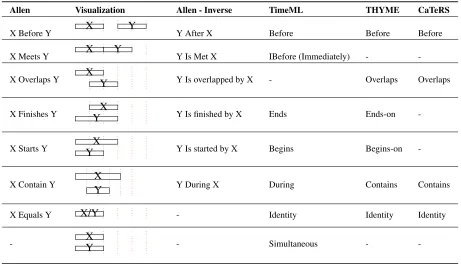
Time is the main notion for anchoring the changes of the world triggered by sequences of events. Of course having temporal understanding and tempo-ral reasoning capabilities is crucial for many NLP applications such as question answering, text sum-marization and many others. Throughout the years the issue of temporal analysis and reasoning in nat-ural language has been addressed via different ap-proaches. Allen’s Interval Algebra (Allen, 1984) is one theory for representing actions and introduces a set of 13 distinct, exhaustive, and qualitative tempo-ral relations that can hold between two time inter-vals. The first three columns of Table 1 list these 13 temporal relations together with their visualiza-tion, which includes 6 main relations and their corre-sponding inverses –together with the ‘equal’ relation which does not have an inverse.
Based on Interval Algebra, a new markup lan-guage for annotating events and temporal expres-sions in natural language was proposed (Pustejovsky et al., 2003), named TimeML. This schema is
de-signed to address problems in event and tempo-ral expression markup. It covers two major tags: ‘EVENT’ and ‘TIMEX3’. The EVENT tag is used to annotate elements in a text that represent events such as ‘kill’ and ‘crash’. TIMEX is mainly used to annotate explicit temporal expressions, such as times, dates and durations. One of the major features introduced in TimeML was the LINK tag. These tags encode the semantic relations that exist between the temporal elements annotated in a document. The most notable LINK is TLINK: a Temporal Link rep-resenting the temporal relationship between entities (events and time expressions). This link not only encodes a relation between two entities, but also makes a partial ordering between events. There are 14 TLINK relations in TimeML, adding ‘si-multaneous’ to the list of temporal links between events. The fourth column of Table 1 shows the cor-respondence between Allen relations and TimeML TLINKs. Furthermore, in the fifth column we in-clude the THYME annotation schema (to be dis-cussed in Section 6).
We propose a new set of temporal relations for capturing event-event relations. Our final set of tem-poral relations are shown in the sixth column of Ta-ble 15. As compared with TimeML, we drop the
relations ‘simultaneous’, ‘begins’ and ‘ends’. ‘Si-multaneous’ was not a part of the original Allen relations. Generally it is hard to be certain about two events occurring exactly during the same time span, starting together and ending together. Indeed, the majority of events which are presumed ‘simulta-neous’ in TimeML annotated corpora are either (1) EVENT-TIMEX relations which are not event-event relations, or (2) wrongly annotated and should be the ‘overlapping’ relation, e.g., in the following sen-tence from TimeBank corpus the correct relation for the two eventse1ande2should be ‘overlap’:
She [listened]e1to music while [driving]e2.
We acknowledge that having ’simultaneous’ can make the annotation framework more comprehen-sive and may apply in few certain cases of punc-tual events, however, such cases are very rare in our corpus, and in the interest of a more compact and less ambiguous annotation, we did not include
Allen Visualization Allen - Inverse TimeML THYME CaTeRS
X Before Y X Y Y After X Before Before Before
X Meets Y X Y Y Is Met X IBefore (Immediately) -
-X Overlaps Y X Y Y Is overlapped by X - Overlaps Overlaps
X Finishes Y YX Y Is finished by X Ends Ends-on
-X Starts Y YX Y Is started by X Begins Begins-on
-X Contain Y XY Y During X During Contains Contains
X Equals Y X/Y - Identity Identity Identity
- XY - Simultaneous -
-Table 1: The correspondence of temporal relation sets of different annotation frameworks.
it. THYME also dropped ‘simultaneous’ for similar reasons.
As for the ‘begins’ and ‘ends’, our multiple pilot studies, indicated that these relations are more accu-rately captured by one of our causal relations (next subsection) or the relation ‘overlaps’. We believe that our simplified set of 4 temporal relations can be used for any future broad-coverage inter-event tem-poral relation annotation. We also drop the temtem-poral relation ‘IBefore’, given that this relation usually re-flects on causal relation between two events which will be captured by our causal links.
3.2 Causal Relation
Research on the extraction of event relations has concerned mainly the temporal relation and time-wise ordering of events. A more complex semantic relationship between events is causality. Causality is one of the main semantic relationships between events where an event (CAUSE) results in another event (EFFECT) to happen or hold. It is clear that identifying the causal relation between events is cru-cial for numerous applications, including story un-derstanding. Predicting occurrence of future events is the major benefit of causal analysis, which can itself help risk analysis and disaster decision
mak-ing. There is an obvious connection between causal relation and temporal relation: by definition, the CAUSE event starts ‘BEFORE’ the EFFECT event. Hence, predicting causality between two events also requires/results in a temporal prediction.
[image:5.612.76.537.65.329.2]and Song, 2003) base their theory of causal verbs on force dynamics. Wolff proposes (Wolff, 2007) that causation includes three main types of causal concepts: ‘Cause’, ‘Enable’and‘Prevent’. These three causal concepts are lexicalized through distinc-tive types of verbs (Wolff and Song, 2003) which are as follows:
– Cause-type verbs: e.g. cause, start, prompt, force.
– Enable-type verbs: e.g. allow, permit, enable, help.
– Prevent-type verbs: e.g. block, prevent, hinder, restrain.
Wolff’s model accounts for various ways that causal concepts are lexicalized in language and we base our annotation framework on this model. How-ever, we will be looking at causal relation be-tween events more from a‘commonsense reason-ing’ perspective than linguistic markers. We de-fine cause, enable and prevent for commonsense co-occurrence of events, inspired by mental model the-ory of causality (Khemlani et al., 2014), as follows:
– ACauseB: In the context, If A occurs, B most probably occurs as a result.
– AEnable B: In the context, If A does not oc-cur, B most probably does not occur (not enabled to occur).
– A P revent B: In the context, If A occurs, B most probably does not occur as a result.
where In the context refers to the underlying con-text in which A and B occur, such as a story. This definition is in line with the definition of CAUSE and PRECONDITION presented in the RED anno-tation guidelines (Ikuta et al., 2014) (to be discussed in Section 6).
In order to better understand the notion of com-monsense causality, consider the sentences 7-9.
(7) Harry [fell]e1and [skinned]e2his knee.
(8) Karla [earned]e1 more money and finally
[bought]e2a house.
(9) It was [raining]e1 so hard that it prevented
me from [going]e26to the school.
6As discussed earlier, here the embedded event construction is (prevent (going)) where only the event ‘going’ will be anno-tated.
In the above three sentences, the relation betweene1
ande2is ‘cause’, ‘enable’ and ‘prevent’ in order. It is important to note that our scope of lexical se-mantic causality only captures events causing events (Davidson, 1967), however, capturing individuals as cause (Croft, 1991) is a another possible extension.
3.2.1 Temporal Implications of Causality
The definition of causality implies that when A Causes B, then A should start before B in order to have triggered it. It is important to note that for durative events the temporal implication of causal-ity is mainly about the start of the causal event, which should be before the start of the event which is caused. Consider the following example:
(10) The [fire]e1[burned down]e2the house.
In this example there is a ‘cause’ relation between
e1ande2, where ‘fire’ clearly does not finish before starting of the ‘burn’ event. So the temporal rela-tion between the two events is ‘overlaps’. Here we conclude that when ‘A cause/enable/prevent B’, we know as a fact that As start is before Bs start, but there is no restriction on their relative ending. This implies that a cause relation can have any of the two temporal relations:beforeandoverlaps.
All the earlier examples of causal concepts we ex-plored involved an event causing another event to happen or to start (in case of a durative event). How-ever, there are examples of causality which involve not starting but ending an ongoing event. Consider the sentence 11. In order to capture causality rela-tions between pairs of events such ase1ande2, we introduce a Cause-to-end relation, which can have one of the three temporal implications:before, over-laps, andduring. Hence, in sentence 11, the relation betweene1ande2will beCause-to-end (overlap).
(11) The [famine]e1ended the [war]e2.
3.3 How to annotate semantic relations between events?
In summary, the disjunctive7set of 13 semantic
re-lations between events in our annotation framework are as follows:
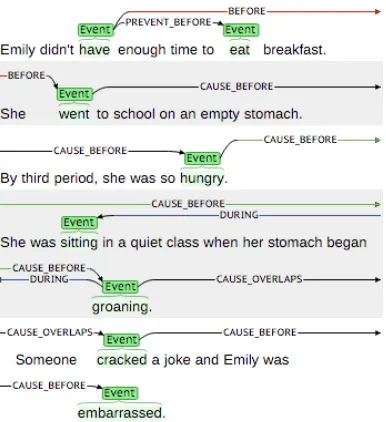
Figure 1: Semantic annotation of a sample story.
– 9 causal relations: Including ‘cause (be-fore/overlaps)’, ‘enable (before/overlaps)’, ‘prevent (before/overlaps)’, ‘cause-to-end (be-fore/overlaps/during)’
– 4 temporal relations: Including ‘Before’, ‘Overlaps’, ‘Contains’, ‘Identity’.
The semantic relation annotation between two events should start with deciding about any causal relations and then, if there was not any causal rela-tion, proceed to choosing any existing temporal re-lation.
4 Annotating at Story level
It has been shown (Bittar et al., 2012) that tempo-ral annotation can be most properly carried out by taking into account the full context for sentences, as opposed to TimeML, which is a surface-based an-notation. The scope and goal of this paper very well aligns with this observation. We carry out the an-notation at the story level, meaning that we annotate inter-event relations across the five sentences of a story. It suffices to do the event-event relation speci-fication minimally given the transitivity of temporal relations. For example for three consecutive events
e1 e2 e3one should only annotate the ‘before’ re-lation betweene1ande2, ande2ande3, since the ‘before’ relation betweene1ande3can be inferred from the other two relations. The event-event
rela-Figure 2: Frequency of semantic links in our dataset.
tions can be from/to any sentence in the story. It is important to emphasize here that the goal of annota-tion is to capture commonsensical relaannota-tions between events, so the annotation effort should be driven by intuitive commonsensical relation one can pinpoint throughout a story.
Consider an example of a fully annotated story shown in Figure 1. As you can see, all of the semantic annotations reflect commonsense relation between events given the underlying story, e.g., ‘cracked a joke’cause-before‘embarrassed’.
5 Annotated Dataset Analysis
We randomly sampled 320 stories (1,600 sentences) from the ROCStories Corpus. This set covers a va-riety of everyday stories, with titles ranging from ‘got a new phone’ to ‘Left at the altar’. We pro-vided our main expert annotator with the annota-tion guidelines, with the task of annotating each of the 320 stories at story level. The annotation task was set up on Brat tool8. On average, annotation
time per story was 11 minutes. These annotations can be found throughhttp://cs.rochester. edu/nlp/rocstories/CaTeRS/.
5.1 Statistics
Overall, we have annotated 2,708 event entities and 2,715 semantic relations. Figure 2 depicts the dis-tribution of different semantic relations in our an-notation set. For this Figure we have removed any semantic relations with frequency less than 5. As you can see, the temporal relation before is the most common relation, which reflects on the natu-ral reporting of the sequence of events throughout a
[image:7.612.313.549.67.194.2]story. There are overall 488 various causal links, the most frequent of which iscause-before. Given these statistics, it is clear that capturing causality along with temporal aspects of stories is crucial.
Our annotations also enable some deeper analy-sis of the narrative flow of the stories. One major question is if the text order of events appearing in consecutive sentences mirrors the real-world order of events. Although the real-world order of events is more complex than just a sequence of before re-lations, we can simplify our set of semantic links to make an approximation: we count the number of links (from any9type) which connect an event entity
appearing in positionX to an event entity appear-ing in positionX −i. We found that temporal or-der does not match the text oror-der 23% of the time. This reinforces the quality of the narrative flow in the ROCStories corpus. Moreover, 23% is statisti-cally significant enough to motivate the requirement for temporal ordering models for these stories.
5.2 Inter-annotator Agreement
In order to compute inter-annotator agreement on our annotation framework, we shared one batch of 20 stories between four expert annotators. Our an-notation task consists of two subtasks: (1) entity span selection: choosing non-overlapping event en-tity spans for each story, (2) semantic structure an-notation: building a directed graph (most commonly connected) on top of the entity spans.
5.2.1 Agreement on Event Entities
Given that there are no prefixed set of event en-tity spans for straight-forward computation of inter-annotator agreement, we do the following: among all the annotators, we aggregate the spans of the an-notated event entity as the annotation object (Art-stein and Poesio, 2008). Then, if there exists a span which is not annotated by one of the coders (anno-tators) it will be labeled as ‘NONE’ for its category. The agreement according to Fleiss’s Kappaκ= 0.91, which shows substantial agreement on event entity annotation. Although direct comparison of κ val-ues is not possible, as a point of reference, the event
9This is based on the fact that any relation such as ‘A enable-before B’ or ‘A overlaps B’ can be naively approximated to ‘A before B’.
span annotation of the most recent clinical TempE-val (Bethard et al., 2015) was 0.81.
5.2.2 Agreement on Semantic Links
Decisions on semantic links are dependent on two things (1) decisions on event entities; (2) the deci-sion about the other links. Hence, the task of anno-tating event structures is in general a hard task. In order to relax the dependency on event entities, we fix the set of entities to be the ones that all annota-tors have agreed on. Following the other discourse structure annotation tasks such as Rhetorical Struc-ture Theory (RST), we aggregate all the relations captured by all annotators as the annotation object, then labeling ‘NONE’ as the category for coders who have not captured this relation. The agreement according to Fleiss’s Kappa κ = 0.49 without ap-plying basic closure and κ = 0.51 with closure10,
which shows moderate agreement. For reference, the agreement on semantic link annotation in the most recent clinical TempEval was 0.44 without clo-sure and 0.47 with cloclo-sure.
6 Related Work
One of the most recent temporal annotation schemas is Temporal Histories of Your Medical Event (THYME) (Styler et al., 2014). This annotation guideline was devised for the purpose of establish-ing timelines in clinical narratives, i.e. the free text portions contained in electronic health records. In their work, they combine the TimeML annota-tion schema with Allen Interval Algebra, identifying the five temporal relations BEFORE, OVERLAP, BEGINS-ON, ENDS-ON, and CONTAINS. Of note is that they adopt the notion of narrative contain-ers (Pustejovsky and Stubbs, 2011), which are time slices in which events can take place, such as DOC-TIME (time of the report) and before DOCDOC-TIME. As such, the THYME guideline focuses on ordering events with respect to specific time intervals, while in our work, we are only focused on the relation between two events, without concern for ordering. Their simplification of temporal links is similar to ours, however, our reasoning for simplification takes
into account the existence of causality, which is not captured by THYME.
Causality is a notion that has been widely stud-ied in psychology, philosophy, and logic. However, precise modeling and representation of causality in NLP applications is still an open issue. A formal definition of causality in lexical semantics can be found in (Hobbs, 2005). Hobbs introduces the no-tion of “causal complex”, which refers to some col-lection of eventualities (events or states) for which holding or happening entails the happening of ef-fect. In part, our annotation work is motivated to learn what the causal complexes are for a given event or state. The Penn Discourse Tree Bank (PDTB) corpus (Prasad et al., 2008) addresses the annota-tion of causal relaannota-tions, annotating semantic rela-tions that hold between exactly two Abstract Ob-jects (called Arg1 and Arg2), expressed either ex-plicitly via lexical items or imex-plicitly via adjacency in discourse. In this paper, we present a semantic framework that captures both explicit and implicit causality, but no constraint of adjacency is imposed, allowing commonsense causality to be captured at the inter-sentential level (story).
Another line of work annotates temporal and causal relations in parallel (Steven Bethard and Mar-tin, 2008). Bethard et al. annotated a dataset of 1,000 conjoined-event temporal-causal relations, collected from Wall Street Journal corpus. Each event pair was annotated manually with both tem-poral (BEFORE, AFTER, NO-REL) and causal re-lations (CAUSE, NO-REL). For example, sentence 12 is an entry in their dataset. This dataset makes no distinction between various types of causal relation.
(12) Fuel tanks had leaked and contaminated the soil. - (leaked BEFORE contaminated)
- (leaked CAUSED contaminated).
A recent work (Mirza and Tonelli, 2014) has proposed a TimeML-style annotation standard for capturing causal relations between events. They mainly introduce ‘CLINK’, analogous to ‘TLINK’ in TimeML, to be added to the existing TimeML link tags. Under this framework, Mirza et al (Mirza and Tonelli, 2014) annotates 318 CLINKs in TempEval-3 TimeBank. They only annotate explicit causal relations signaled by linguistic markers, such as
{because of, as a result of, due to, so, therefore,
thus}. Another relevant work is Richer Event De-scriptions (RED) (Ikuta et al., 2014), which com-bines event coreference and THYME annotations, and also introduces cause-effect annotation in adja-cent sentences to achieve a richer semantic represen-tation of events and their relations. RED also distin-guishes between ‘PRECONDITION’ and ‘CAUSE’, similarly to our ‘ENABLE’ and ‘CAUSE’ rela-tions. These can be in the context of BEFORE or OVERLAP, but they do not include PREVENT and CAUSE-TO-END. Our set of comprehensive 9 causal relations distinguishes between various tem-poral implications, not covered by any of the related work.
7 Conclusion
In this paper we introduced a novel framework for semantic annotation of event-event relations in commonsense stories, called CaTeRS. We annotated 1,600 sentences throughout 320 short stories sam-pled from ROCStories corpus, capturing 2,708 event entities and 2,715 semantic relations, including 13 various types of causal and temporal relations. This annotation scheme is unique in capturing both tem-poral and causal inter-event relations. We show that our annotation scheme enables high inter-annotator agreement for event entity annotation. This is due to our clear definition of events which (1) is linked to lexical entries in TRIPS ontology, removing prob-lems caused by each annotator devising his or her own notion of event, (2) captures only the head of the underlying phrase.
Our inter-annotator analysis of semantic link an-notation shows moderate agreement, competitive with earlier temporal annotation schemas. We are planning to improve the agreement on semantic links even further by setting up two-stage expert an-notation process, where we can pair annotators for resolving disagreements and modifying the annota-tion guideline. A comprehensive study of tempo-ral and causal closure in our framework is a future work.
cap-turing inter-event relations can be applicable to other genres. It is important to note that this framework is not intended to be a comprehensive analysis of all temporal and causal aspects of text, but rather we focus on those temporal and causal links that sup-port learning stereotypical narrative structures. As with any annotation framework, this framework will keep evolving over time, the updates of which can be followed through http://cs.rochester. edu/nlp/rocstories/CaTeRS/.
Acknowledgments
We thank Martha Palmer and the anonymous re-viewers for their invaluable and extensive comments on this paper. This work was supported in part by Grant W911NF-15-1-0542 with the US Defense Advanced Research Projects Agency (DARPA), the Army Research Office (ARO) and Office of Naval Research (ONR).
References
James F. Allen, Mary Swift, and Will de Beaumont. 2008. Deep semantic analysis of text. InProceedings of the 2008 Conference on Semantics in Text Process-ing, STEP ’08, pages 343–354, Stroudsburg, PA, USA. Association for Computational Linguistics.
James F. Allen. 1984. Towards a general theory of action and time.Artif. Intell., 23(2):123–154, July.
Ron Artstein and Massimo Poesio. 2008. Inter-coder agreement for computational linguistics. Comput. Lin-guist., 34(4):555–596, December.
Niranjan Balasubramanian, Stephen Soderland, Oren Et-zioni Mausam, and Oren EtEt-zioni. 2013. Generating coherent event schemas at scale. In EMNLP, pages 1721–1731.
Laura Banarescu, Claire Bonial, Shu Cai, Madalina Georgescu, Kira Griffitt, Ulf Hermjakob, Kevin Knight, Philipp Koehn, Martha Palmer, and Nathan Schneider. 2013. Abstract meaning representation for sembanking.
Steven Bethard, Leon Derczynski, Guergana Savova, James Pustejovsky, and Marc Verhagen. 2015. Semeval-2015 task 6: Clinical tempeval. In Proceed-ings of the 9th International Workshop on Semantic Evaluation (SemEval 2015), pages 806–814, Denver, Colorado, June. Association for Computational Lin-guistics.
Steven Bethard. 2013. Cleartk-timeml: A minimalist ap-proach to tempeval 2013. InSecond Joint Conference
on Lexical and Computational Semantics (*SEM), Vol-ume 2: Proceedings of the Seventh International Work-shop on Semantic Evaluation (SemEval 2013), pages 10–14, Atlanta, Georgia, USA. Association for Com-putational Linguistics.
Andr Bittar, Caroline Hagge, Vronique Moriceau, Xavier Tannier, and Charles Teissdre. 2012. Temporal an-notation: A proposal for guidelines and an experiment with inter-annotator agreement. In Nicoletta Calzo-lari (Conference Chair), Khalid Choukri, Thierry De-clerck, Mehmet Uur Doan, Bente Maegaard, Joseph Mariani, Asuncion Moreno, Jan Odijk, and Stelios Piperidis, editors, Proceedings of the Eight Interna-tional Conference on Language Resources and Eval-uation (LREC’12), Istanbul, Turkey, may. European Language Resources Association (ELRA).
Claire Bonial, Julia Bonn, Kathryn Conger, Jena D. Hwang, and Martha Palmer. 2014. Propbank: Se-mantics of new predicate types. In Nicoletta Cal-zolari (Conference Chair), Khalid Choukri, Thierry Declerck, Hrafn Loftsson, Bente Maegaard, Joseph Mariani, Asuncion Moreno, Jan Odijk, and Stelios Piperidis, editors, Proceedings of the Ninth Interna-tional Conference on Language Resources and Evalu-ation (LREC’14), Reykjavik, Iceland, may. European Language Resources Association (ELRA).
Nathanael Chambers and Daniel Jurafsky. 2008. Unsu-pervised learning of narrative event chains. In Kath-leen McKeown, Johanna D. Moore, Simone Teufel, James Allan, and Sadaoki Furui, editors,ACL, pages 789–797. The Association for Computer Linguistics. Nathanael Chambers and Dan Jurafsky. 2009.
Unsuper-vised learning of narrative schemas and their partici-pants. InProceedings of the Joint Conference of the 47th Annual Meeting of the ACL and the 4th Interna-tional Joint Conference on Natural Language Process-ing of the AFNLP: Volume 2 - Volume 2, ACL ’09, pages 602–610, Stroudsburg, PA, USA. Association for Computational Linguistics.
Eugene Charniak. 1972. Toward a model of children’s story comprehension. December.
Patricia W. Cheng and Laura R. Novick. 1992. Covari-ation in natural causal induction. Psychological Re-view, 99(2):365382.
Jackie Cheung, Hoifung Poon, and Lucy Vanderwende. 2013. Probabilistic frame induction. InACL.
William. Croft. 1991. Syntactic categories and gram-matical relations : the cognitive organization of infor-mation / William Croft. University of Chicago Press Chicago.
Alfonso Gerevini, Lenhart K. Schubert, and Stephanie Schaeffer. 1995. The temporal reasoning tools time-graph i-ii. International Journal on Artificial Intelli-gence Tools, 4(1-2):281–300.
Jerry R. Hobbs. 2005. Toward a useful concept of causality for lexical semantics. Journal of Semantics, 22(2):181–209.
Rei Ikuta, Will Styler, Mariah Hamang, Tim O’Gorman, and Martha Palmer. 2014. Challenges of adding cau-sation to richer event descriptions. In Proceedings of the Second Workshop on EVENTS: Definition, De-tection, Coreference, and Representation, pages 12– 20, Baltimore, Maryland, USA, June. Association for Computational Linguistics.
Sangeet Khemlani, Aron K Barbey, and Philip Nicholas Johnson-Laird. 2014. Causal reasoning with mental models. Frontiers in Human Neuroscience, 8(849). David Lewis. 1973. Counterfactuals. Blackwell
Pub-lishers, Oxford.
G. Miller. 1995. Wordnet: A lexical database for english. InIn Communications of the ACM.
Paramita Mirza and Sara Tonelli. 2014. An analysis of causality between events and its relation to tem-poral information. In COLING 2014, 25th Interna-tional Conference on ComputaInterna-tional Linguistics, Pro-ceedings of the Conference: Technical Papers, August 23-29, 2014, Dublin, Ireland, pages 2097–2106. Nasrin Mostafazadeh, Nathanael Chambers, Xiaodong
He, Devi Parikh, Dhruv Batra, Lucy Vanderwende, Pushmeet Kohli, and James Allen. 2016. A corpus and cloze evaluation for deeper understanding of com-monsense stories. In Proceedings of NAACL HLT, San Diego, California, June. Association for Compu-tational Linguistics.
Ad Neeleman and Hans Van De Koot. 2012. The theta system: Argument structure at the interface. The Lin-guistic Expression of Causation, pages 20–51. Kiem-Hieu Nguyen, Xavier Tannier, Olivier Ferret, and
Romaric Besanc¸on. 2015. Generative event schema induction with entity disambiguation. InProceedings of the 53rd annual meeting of the Association for Com-putational Linguistics (ACL-15).
Karl Pichotta and Raymond J Mooney. 2014. Statisti-cal script learning with multi-argument events. EACL 2014, page 220.
Rashmi Prasad, Nikhil Dinesh, Alan Lee, Eleni Milt-sakaki, Livio Robaldo, Aravind K. Joshi, and Bon-nie L. Webber. 2008. The penn discourse treebank 2.0. InLREC. European Language Resources Associ-ation.
James Pustejovsky and Amber Stubbs. 2011. Increasing informativeness in temporal annotation. In Proceed-ings of the 5th Linguistic Annotation Workshop, LAW
V ’11, pages 152–160, Stroudsburg, PA, USA. Asso-ciation for Computational Linguistics.
James Pustejovsky, Jos Castao, Robert Ingria, Roser Saur, Robert Gaizauskas, Andrea Setzer, and Graham Katz. 2003. Timeml: Robust specification of event and temporal expressions in text. In Fifth Interna-tional Workshop on ComputaInterna-tional Semantics (IWCS-5.
Rachel Rudinger, Pushpendre Rastogi, Francis Ferraro, and Benjamin Van Durme. 2015. Script induction as language modeling. InProceedings of the 2015 Con-ference on Empirical Methods in Natural Language Processing (EMNLP-15).
Roger C. Schank and Robert P. Abelson. 1977. Scripts, Plans, Goals and Understanding: an Inquiry into Hu-man Knowledge Structures. L. Erlbaum, Hillsdale, NJ. Lenhart K. Schubert and Chung Hee Hwang. 2000. Episodic logic meets little red riding hood: A com-prehensive, natural representation for language un-derstanding. In Natural Language Processing and Knowledge Representation: Language for Knowledge and Knowledge for Language. MIT/AAAI Press. Sara Klingenstein Steven Bethard, William Corvey
and James H. Martin. 2008. Building a cor-pus of temporal-causal structure. In Bente Mae-gaard Joseph Mariani Jan Odijk Stelios Piperidis Daniel Tapias Nicoletta Calzolari (Conference Chair), Khalid Choukri, editor, Proceedings of the Sixth In-ternational Conference on Language Resources and Evaluation (LREC’08), Marrakech, Morocco, may. European Language Resources Association (ELRA). http://www.lrec-conf.org/proceedings/lrec2008/. IV William F. Styler, Steven Bethard, Sean Finan, Martha
Palmer, Sameer Pradhan, Piet C. de Groen, Brad Er-ickson, Timothy Miller, Chen Lin, Guergana Savova, and James Pustejovsky. 2014. Temporal annotation in the clinical domain. Transactions of the Association for Computational Linguistics, 2:143–154.
Leonard Talmy. 1988. Force dynamics in language and cognition. Cognitive Science, 12(1):49–100.
Scott R. Turner. 1994. The creative process: A computer model of storytelling. Hillsdale: Lawrence Erlbaum. Terry Winograd. 1972. Understanding Natural
Lan-guage. Academic Press, Inc., Orlando, FL, USA. Phillip Wolff and Grace Song. 2003. Models of
cau-sation and the semantics of causal verbs. Cognitive Psychology, 47(3):276–332.