K
-Embeddings: Learning Conceptual Embeddings for Words using Context
Thuy Vu and D. Stott Parker
Department of Computer Science University of California, Los Angeles
Los Angeles, CA 90095
{thuy;stott}@cs.ucla.edu
Abstract
We describe a technique for adding conttual distinctions to word embeddings by ex-tending the usual embedding process — into two phases. The first phase resembles existing methods, but also constructsKclassifications of concepts. The second phase uses these clas-sifications in developing refined K embed-dings for words, namely wordK-embeddings. The technique is iterative, scalable, and can be combined with other methods (including Word2Vec) in achieving still more expressive representations.
Experimental results show consistently large performance gains on a Semantic-Syntactic Word Relationship test set for differentK set-tings. For example, an overall gain of 20% is recorded at K = 5. In addition, we demon-strate that an iterative process can further tune the embeddings and gain an extra 1% (K = 10in 3 iterations) on the same benchmark. The examples also show that polysemous concepts are meaningfully embedded in ourKdifferent conceptual embeddings for words.
1 Introduction
Neural-based word embeddings are vectorial repre-sentations of words in high dimensional real valued space. Success with these representations have re-sulted in their being considered for an increasing range of natural language processing (NLP) tasks. Recent advances in word embeddings have shown great effects that are pushing forward state-of-the-art results in NLP (Koo et al., 2008; Turian et al., 2010; Collobert et al., 2011; Yu et al., 2013; Mikolov et al.,
2013a; Mikolov et al., 2013b; Mikolov et al., 2013c). Embedding learning models for words are also being adapted for tasks in other research fields (Reinanda et al., 2015; Vu and Parker, 2015). The Continuous bag of words (CBOW) and Skip-gram (Mikolov et al., 2013a) are currently considered as state-of-the-art in learning algorithms for word embeddings.
The ability of words to assume different roles (syntax) or meanings (semantics) presents a basic challenge to the notion of word embedding (Erk and Pad´o, 2008; Reisinger and Mooney, 2010; Huang et al., 2012; Tian et al., 2014; Neelakantan et al., 2014; Chen et al., 2015). External resources and features are introduced to address this challenge. In general, individuals with no linguistic background can gener-ally resolve these differences without difficulty. For example, they can distinguish “bank” as referring to a riverside or a financial establishment without se-mantic or syntactic analysis.
Distinctions of role and meaning often follow from context. The idea of exploiting context in lin-guistics was introduced with a distributional hypoth-esis: “linguistic items with similar distributions have similar meanings” (Harris, 1954). Firth soon after-wards emphasized this in a famous quote: “a word is characterized by the company it keeps” (1957).
We propose to exploit only context information to distinguish different concepts behind words in this paper. The contribution of this paper is to note that atwo-phase word embeddingtraining can be helpful in adding contextual information to existing embed-ding methods:
• we use learned context embeddings to
ciently cluster word contexts into K classifi-cations of concepts, independent of the word embeddings.
• this approach can complement existing sophis-ticated, linguistically-based features, and can be used with word embeddings to achieve gains in performance by considering contextual dis-tinctions for words.
• two-phase word embedding may have other ap-plications as well, conceivably permitting some ‘non-linear’ refinements of linear embeddings.
In the next section we present our learning strat-egy for word K-embeddings, outlining how the value of K affects its power in increasing syntac-tic and semansyntac-tic distinctions. Following this, a large-scale experiment serves to validate the idea — from several different perspectives. Finally, we offer con-clusions about how adding contextual distinctions to word embeddings (with our second phase of embed-ding) can gain power in distinguishing among dif-ferent aspects of words.
2 Learning WordK-Embeddings
The use of multiple semantic representations for a word in resolving polysemy has a significant liter-ature (Erk and Pad´o, 2008; Reisinger and Mooney, 2010; Huang et al., 2012; Tian et al., 2014; Nee-lakantan et al., 2014; Chen et al., 2015). Strategies often focus on discrimination using syntactic and se-mantic information.
We investigate another direction — the extension of the word embedding process into a second phase — which allows context information to be consol-idated with the embedding. Rather than annotating words with features, our technique treats context as second-order in nature, suggesting an additional rep-resentation step.
Our learning strategy for word K-embeddings is therefore done, possibly iteratively, in two phases:
1. Annotating words with concepts (defined by their contextual clusters)
2. Training embeddings using the resulting anno-tated text.
2.1 Concept Annotation using Context Embeddings
We propose to annotate words with concepts given by learned context embeddings, which are an under-utilized output of word embedding training. Our strategy is based on the assumption that the context of a word is useful for discriminating its conceptual alternatives in polysemy. In general, our concept an-notation for words is performed in two steps — clus-tering of context embeddings followed by annota-tion.
Specifically, we first employ a clustering algo-rithm to cluster the context embeddings. K-means is our algorithm of choice. The clustering algorithm will assign each context word to a distinct cluster. This result is then used to re-assign words in train-ing data to their contextual cluster.
Second, we annotate words in the training data with their most common contextual cluster (of their context words). We define context words to mean the surrounding words of a given word. Formally, a word is annotated with a concept given by the fol-lowing function:
max c∈C
X
(wi,ci)∈W
f(ci, c)
Here W is the set of context words of the current word, andf(ci, cj)is a boolean function whose out-put is1if the input parameters are equal:
f(ci, cj) = (
1, ifci =cj 0, otherwise.
The cluster-annotated dataset is then passed into the next training phase.
2.2 Training WordK-Embeddings
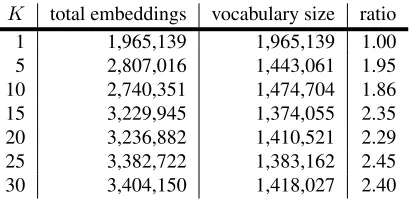
The second phase is similar to existing word embed-ding training systems. The number of clustersK de-fines the maximum number of different representa-tions for words. Table 1 presents the statistics for dif-ferent selections ofKusing the dataset mentioned in theExperimentssection.
Each valueK in Table 1 is shown with the total number of embeddings and vocabulary size. Words in the vocabulary can have up to K different em-beddings for different annotated concepts. As K
K total embeddings vocabulary size ratio 1 1,965,139 1,965,139 1.00 5 2,807,016 1,443,061 1.95 10 2,740,351 1,474,704 1.86 15 3,229,945 1,374,055 2.35 20 3,236,882 1,410,521 2.29 25 3,382,722 1,383,162 2.45 30 3,404,150 1,418,027 2.40
Table 1:Total embeddings and vocabulary size for differentK for Wikipedia dataset. Words with frequency lower than 5 are filtered during pre-processing.
yet remains largely stable for different values ofK
greater than 1. This is explained by the count of words being scattered to different concepts, result-ing in a lower word count per concept. In our set-ting, concept-annotated words with fewer than 5 oc-currences will be discarded during training of word embeddings.
It is interesting to note that the total number of embeddings is broadly stable and less affected by
K. For example, as we allow up to10different con-cepts for a word (K = 10), the total number of em-beddings grows only slightly compared to the result forK = 1. The average number of embeddings for a word is1.86forK = 10. In other words, concept annotations do converge as we increaseK.
2.3 WordK-Embedding Training Workflow Figure 1 presents our proposed workflow to train context-based conceptual wordK-embeddings. Our system allows each word to have at mostK differ-ent embeddings, where each is a represdiffer-entation for a certain concept.
The input to the workflow is a large-scale text dataset. Initially, we compute context embeddings for words as presented previously. We can derive context embeddings directly from the training of al-most any context-based word embeddings, where word embeddings are computed via their context words.
Subsequently, we cluster context embeddings into groups which reflect varied concepts on some se-mantic vector space. Each context embedding is as-signed to a cluster denoting its conceptual role as a context word. Any clustering algorithm for vectors can be applied for this task.
Embeddings of annotated context words are used
Text Context Embeddings
Context-based Concepts
Concept Annotated Text
WordK-Embeddings
clustering algorithm
concept annotation
word embeddings training conte
xt embeddings trainin
g
con
t
ex
te
m
bedd ings
[image:3.612.314.544.60.258.2]train ing
Figure 1:Training WordK-Embeddings
to compute concepts of words in a sentence. We hy-pothesize that the concept of a word is defined by the concept of its surrounding words. We annotate concepts for all words in the training data.
Finally, the concept-annotated training data is passed into any standard algorithm for training word embeddings for the conceptual word K -embeddings.
3 Experiments
3.1 Settings
Our training data for word embeddings is Wikipedia for English, downloaded on November 29, 2014. It consists of 4,591,457 articles, with a total of 2,015,823,886 words. The dataset is pre-processed with sentence and word tokenization. We convert text to lower-case prior to training. We consider |W|= 5for the size of the context windowW pre-sented in Section 2.1.
We used the Semantic-Syntactic Word Relation-ship test set (Mikolov et al., 2013a) for our exper-imental studies. This dataset consists of 8,869 se-mantic and 10,675 syntactic queries. Each query is a tuple of four words(A, B, C, D)for the question “A
We evaluate the accuracy of the prediction of D
in these queries. A query is considered hit if there exists at least one correct match and all the words are in the same concept group. This is based on the assumption that if “Ais toB asC is toD”, either (A, B) and(C, D)OR(A, C) and(B, D) have to be in the same concept group.
3.2 Results
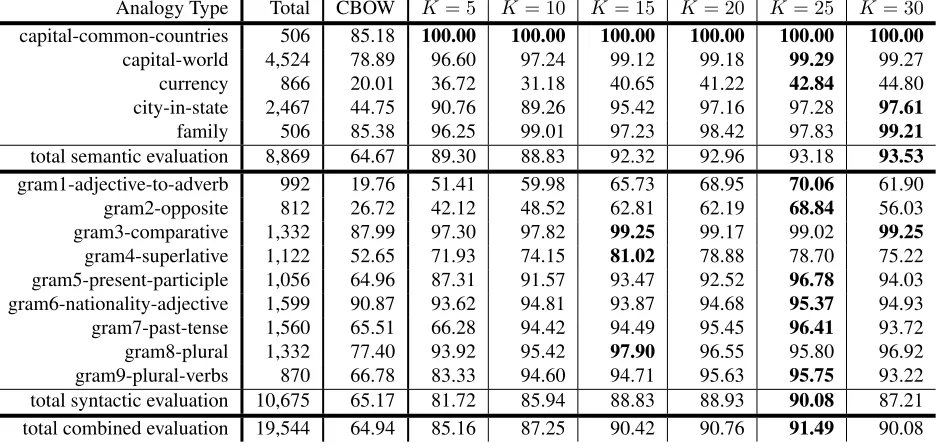
The embeddings learned in phases 1 and 2 can be compared, using different values for K in the K-means clustering. Word relationship performance re-sults are shown in Table 2.
Our proposed technique in phase 2 achieves con-sistently high performance. For example, whenK= 5, our absolute performance is 89% and 81% in se-mantic and syntactic relationship evaluations, gain-ing 24% and 16% from the standard CBOW model (phase 1). When K = 25, the performance yields the best combined result. As shown in Table 1, the total number of embeddings and vocabulary size dif-fer by a small multiplicative factor asKincreases.
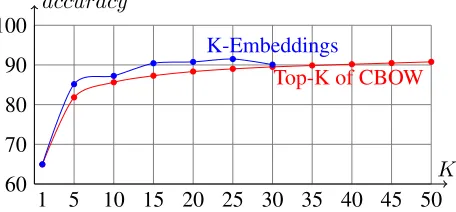
In another comparison, Figure 2 plots our K -Embeddings results versus the results of a relaxed
evaluation for CBOW, which considers the top K
embeddings instead of the best. Even though our evaluation is restricted to one-best for each of the
Kembeddings, the overall (combined) performance for different K settings is still consistently better than the top K embeddings of CBOW. Moreover, for a specificK setting, the total number of differ-ent embeddings considered inK-Embeddings is al-ways less than that of the topK. For example, in our peak result (K = 25), the total number of embed-dings considered in the evaluation set is only about 76.17% of the total embeddings with the top 25 of CBOW.
In addition, we also compare the performances of K-embeddings in multiple iterations under the same K setting in Table 3. It shows that the K -embeddings are improved after certain number of it-erations. Particularly, forK = 10, we can achieve best performance after 3 to 4 iterations, gaining roughly1%.
Finally, it is also worth noting that the perfor-mance does not always increase linearly with the number of embeddings or vocabulary size. This sug-gests that as we achieve better performance in K
-K accuracy
1 5 10 15 20 25 30 35 40 45 50 60
70 80 90 100
Top-K of CBOW
K-Embeddings
Figure 2:WordK-Embeddings and Top-Kof CBOW accuracy comparison
[image:4.612.311.539.65.171.2]Type iter 1 iter 2 iter 3 iter 4 iter 5 Semantic 88.8 89.6 90.3 90.0 89.0 Syntactic 85.9 84.8 86.7 86.7 85.8 Combined 87.3 87.0 88.3 88.2 87.3
Table 3:Performance ofK= 10in five iterations
embeddings, we should also gain more compact conceptual embeddings.
3.3 Word Expressivity Analysis
Expressivity of word groups for “mercury” and “fan” are studied in Table 4. The first two rows shows most related words of “mercury” and “fan” without concepts annotation (baseline). The follow-ing rows present ourK-embeddings result. This ta-ble illustrates the differences that arise in multiple representations of a word, and shows semantic dis-tinctions among these representations.
Analogy Type Total CBOW K= 5 K= 10 K= 15 K= 20 K= 25 K= 30
[image:5.612.74.543.63.287.2]capital-common-countries 506 85.18 100.00 100.00 100.00 100.00 100.00 100.00 capital-world 4,524 78.89 96.60 97.24 99.12 99.18 99.29 99.27 currency 866 20.01 36.72 31.18 40.65 41.22 42.84 44.80 city-in-state 2,467 44.75 90.76 89.26 95.42 97.16 97.28 97.61 family 506 85.38 96.25 99.01 97.23 98.42 97.83 99.21 total semantic evaluation 8,869 64.67 89.30 88.83 92.32 92.96 93.18 93.53 gram1-adjective-to-adverb 992 19.76 51.41 59.98 65.73 68.95 70.06 61.90 gram2-opposite 812 26.72 42.12 48.52 62.81 62.19 68.84 56.03 gram3-comparative 1,332 87.99 97.30 97.82 99.25 99.17 99.02 99.25 gram4-superlative 1,122 52.65 71.93 74.15 81.02 78.88 78.70 75.22 gram5-present-participle 1,056 64.96 87.31 91.57 93.47 92.52 96.78 94.03 gram6-nationality-adjective 1,599 90.87 93.62 94.81 93.87 94.68 95.37 94.93 gram7-past-tense 1,560 65.51 66.28 94.42 94.49 95.45 96.41 93.72 gram8-plural 1,332 77.40 93.92 95.42 97.90 96.55 95.80 96.92 gram9-plural-verbs 870 66.78 83.33 94.60 94.71 95.63 95.75 93.22 total syntactic evaluation 10,675 65.17 81.72 85.94 88.83 88.93 90.08 87.21 total combined evaluation 19,544 64.94 85.16 87.25 90.42 90.76 91.49 90.08
Table 2:K-embeddings performance
# Word Most Similar Words
0 mercuryfan cadmium, barium, centaur, jupiter, venusfans, fanbase, fan-base, supporter, fandom
1
mercury1 vanadium1, iron1, sulfur1, polonium1
mercury3 tribune3, dragon3, curlew3, keith3, stanley3
mercury5 ammonia5, magnesium5, sulfur5, mercury9
mercury9 mercury5, mercury2, neptune9, titan9
1
fan1 inlet1, crinoids1, sect1, wedge1, beach1
fan4 supporter4, likes4, legend4, bust4, member4
fan5 fan9, fan0, fans5, fandom5, fanbase5, gamer5
fan8 xiang8, yong8, xin8, yang8, cui8, guo8
3
mercury1 polaris1, mercury3, mercury6, cadmium1
mercury4 chrysler4, sheedy4, mohammad4, gott4
mercury6 arsenic6, lithium6, oxygen6, methane6, dust6
mercury7 cadmium7, nickel7, pollutants7, impurities7
mercury8 rubidium8, xenon8, selenium8, cadmium8
3
fan2 yong2, ye2, ching2, hao2, yi2, chang2, guo2
fan4 member4, parody4, protg4, supporter4
fan6 fanbase6, buzz6, fans3, fandom6, video6
fan7 imprints7, gnatcatchers7, minuta7, flat7
fan8 impeller8, inlet8, spinner8, spring8, hot8
5
mercury2 titanium2, jupiter2, sapphire2, saturn2
mercury3 sodium3, helium3, oxygen3, hydrogen3
mercury6 blue6, leopards6, lotus6, unilever6, copper6
mercury7 arsenic7, sulfur7, radioactivity7, lithium7
mercury9 chlorine9, strontium9, ammonia9, arsenic9
5
fan2 buzz2, fanbase2, gamer2, loudest1, fans1
fan3 blower3, ducts3, cooler3, compressor3
fan5 zang5, huang5, yan5, dun5, zhang5, kao5
fan6 youngster6, participant6, mobster6
fan7 fanbase7, buzz7, youtube7, blogging7
fan8 supporter8, fandom8, enthusiast8, parody8
Table 4:Word Expressivity Analysis
4 Conclusion
In this paper, we have presented a technique for adding contextual distinctions to word embeddings with a second phase of embedding. This contextual information gains power in distinguishing among different aspects of words. Experimental results with embedding of the English variant of Wikipedia (over 2 billion words) shows significant improvements in both semantic- and syntactic- based word embed-ding performance. The result also presents a wide range of interesting concepts of words in expressiv-ity analysis.
These results strongly support the idea of using context embeddings to exploit context information for problems in NLP. As we highlighted earlier, context embeddings are underutilized, even though word embeddings have been extensively exploited in multiple applications.
[image:5.612.75.307.331.685.2]References
Tao Chen, Ruifeng Xu, Yulan He, and Xuan Wang. 2015. Improving distributed representation of word sense via wordnet gloss composition and context clustering. In
Proceedings of the 53rd Annual Meeting of the Associ-ation for ComputAssoci-ational Linguistics and the 7th Inter-national Joint Conference on Natural Language Pro-cessing (Volume 2: Short Papers), pages 15–20, Bei-jing, China, July. Association for Computational Lin-guistics.
Ronan Collobert, Jason Weston, L´eon Bottou, Michael Karlen, Koray Kavukcuoglu, and Pavel Kuksa. 2011. Natural language processing (almost) from scratch. J. Mach. Learn. Res., 12:2493–2537, November. Katrin Erk and Sebastian Pad´o. 2008. A structured
vector space model for word meaning in context. In
Proceedings of the Conference on Empirical Meth-ods in Natural Language Processing, EMNLP ’08, pages 897–906, Stroudsburg, PA, USA. Association for Computational Linguistics.
J. Firth. 1957. A Synopsis of Linguistic Theory 1930-1955. Studies in Linguistic Analysis, Philological. Longman.
Zellig Harris. 1954. Distributional structure. Word, 10(23):146–162.
Eric H. Huang, Richard Socher, Christopher D. Manning, and Andrew Y. Ng. 2012. Improving word representa-tions via global context and multiple word prototypes. InProceedings of the 50th Annual Meeting of the As-sociation for Computational Linguistics: Long Papers - Volume 1, ACL ’12, pages 873–882, Stroudsburg, PA, USA. Association for Computational Linguistics. Terry Koo, Xavier Carreras, and Michael Collins. 2008.
Simple semi-supervised dependency parsing. In Pro-ceedings of ACL-08: HLT, pages 595–603. Associa-tion for ComputaAssocia-tional Linguistics.
Tomas Mikolov, Kai Chen, Greg Corrado, and Jeffrey Dean. 2013a. Efficient estimation of word representa-tions in vector space. CoRR, abs/1301.3781.
Tomas Mikolov, Ilya Sutskever, Kai Chen, Greg S Cor-rado, and Jeff Dean. 2013b. Distributed representa-tions of words and phrases and their compositionality. In C.J.C. Burges, L. Bottou, M. Welling, Z. Ghahra-mani, and K.Q. Weinberger, editors,Advances in Neu-ral Information Processing Systems 26, pages 3111– 3119. Curran Associates, Inc.
Tomas Mikolov, Wen tau Yih, and Geoffrey Zweig. 2013c. Linguistic regularities in continuous space word representations. InProceedings of the 2013 Con-ference of the North American Chapter of the Asso-ciation for Computational Linguistics: Human Lan-guage Technologies (NAACL-HLT-2013). Association for Computational Linguistics, May.
Arvind Neelakantan, Jeevan Shankar, Alexandre Pas-sos, and Andrew McCallum. 2014. Efficient non-parametric estimation of multiple embeddings per word in vector space. InProceedings of the 2014 Con-ference on Empirical Methods in Natural Language Processing (EMNLP), pages 1059–1069, Doha, Qatar, October. Association for Computational Linguistics. Lin Qiu, Yong Cao, Zaiqing Nie, Yong Yu, and Yong Rui.
2014. Learning word representation considering prox-imity and ambiguity.
Ridho Reinanda, Edgar Meij, and Maarten de Rijke. 2015. Mining, ranking and recommending entity as-pects. InProceedings of the 38th International ACM SIGIR Conference on Research and Development in Information Retrieval, SIGIR ’15, pages 263–272, New York, NY, USA. ACM.
Joseph Reisinger and Raymond J. Mooney. 2010. Multi-prototype vector-space models of word meaning. In
Human Language Technologies: The 2010 Annual Conference of the North American Chapter of the Association for Computational Linguistics, HLT ’10, pages 109–117, Stroudsburg, PA, USA. Association for Computational Linguistics.
Fei Tian, Hanjun Dai, Jiang Bian, Bin Gao, Rui Zhang, Enhong Chen, and Tie-Yan Liu. 2014. A probabilis-tic model for learning multi-prototype word embed-dings. InProceedings of COLING 2014, the 25th In-ternational Conference on Computational Linguistics: Technical Papers, pages 151–160, Dublin, Ireland, Au-gust. Dublin City University and Association for Com-putational Linguistics.
Joseph Turian, Lev-Arie Ratinov, and Yoshua Bengio. 2010. Word representations: A simple and general method for semi-supervised learning. In Proceed-ings of the 48th Annual Meeting of the Association for Computational Linguistics, pages 384–394. Associa-tion for ComputaAssocia-tional Linguistics.
Thuy Vu and D. Stott Parker. 2015. Node embed-dings in social network analysis. In Proceedings of the 2015 IEEE/ACM International Conference on Ad-vances in Social Networks Analysis and Mining 2015, ASONAM ’15, pages 326–329, New York, NY, USA. ACM.