A Mixed Hierarchical Attention based Encoder-Decoder Approach for
Standard Table Summarization
Parag Jain† Anirban Laha†∗
Karthik Sankaranarayanan†
Preksha Nema∗ Mitesh M. Khapra∗‡ Shreyas Shetty∗
†IBM Research ∗IIT Madras, India
‡Robert Bosch Center for Data Science and Artificial Intelligence, IIT Madras
{pajain34,anirlaha,kartsank}@in.ibm.com
{preksha,miteshk,shshett}@cse.iitm.ac.in
Abstract
Structured data summarization involves gen-eration of natural language summaries from structured input data. In this work, we con-sider summarizing structured data occurring in the form of tables as they are prevalent across a wide variety of domains. We formulate the standard table summarizationproblem, which deals with tables conforming to a single pre-defined schema. To this end, we propose a mixed hierarchical attention based encoder-decoder model which is able to leverage the structure in addition to the content of the ta-bles. Our experiments on the publicly avail-able WEATHERGOV dataset show around 18 BLEU (∼30%) improvement over the current state-of-the-art.
1 Introduction
Abstractive summarization techniques from struc-tured data seek to exploit both structure and con-tent of the input data. The type of structure on the input side can be highly varied ranging from key-value pairs (e.g. WIKIBIO (Lebret et al.,
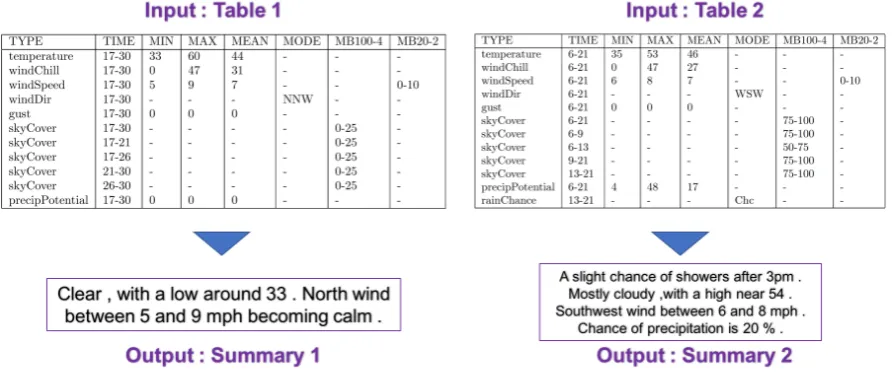
2016)), source code (Iyer et al., 2016), ontolo-gies (Androutsopoulos et al., 2014; Colin et al., 2016), or tables (Wiseman et al., 2017), each of which require significantly varying approaches. In this paper, we focus on generating summaries from tabular data. Now, in most practical ap-plications such as finance, healthcare or weather, data in a table are arranged in rows and columns where the schema is known beforehand. How-ever, change in the actual data values can neces-sitate drastically different output summaries. Ex-amples shown in the figure 1 have a predefined schema obtained from the WEATHERGOVdataset
(Liang et al., 2009) and its corresponding weather report summary. Therefore, the problem that we seek to address in this paper is to generate ab-stractive summaries of tables conforming to a
pre-defined fixed schema (as opposed to cases where the schema is unknown). We refer to this set-ting as standard table summarizationproblem. Another problem that could be formulated is one in which the output summary is generated from multiple tables as proposed in a recent challenge (Wiseman et al., 2017) (this setting is out of the scope of this paper). Now, as the schema is fixed, simple rule based techniques (Konstas and Lapata, 2013) or template based solutions could be em-ployed. However, due to the vast space of selec-tion (which attributes to use in the summary based on the current value it takes) and generation (how to express these selected attributes in natural lan-guage) choices possible, such approaches are not scalable in terms of the number of templates as they demand hand-crafted rules for both selection and generation.
We attempt to solve the problem of standard table summarization by leveraging the hierarchi-cal nature of fixed-schema tables. In other words, rows consist of a fixed set of attributes and a ta-ble is defined by a set of rows. We cast this prob-lem into a mixed hierarchical attention model
following the encode-attend-decode (Cho et al., 2015) paradigm. In this approach, there is static attention on the attributes to compute the row representation followed by dynamic attention on the rows, which is subsequently fed to the de-coder. This formulation is theoretically more effi-cient than the fully dynamic hierarchical attention framework followed by Nallapati et al. (2016). Also, our model does not need sophisticated sam-pling or sparsifying techniques like (Ling and Rush, 2017; Deng et al., 2017), thus, retaining differentiability. To demonstrate the efficacy of our approach, we transform the publicly avail-able WEATHERGOV dataset (Liang et al., 2009)
into fixed-schema tables, which is then used for our experiments. Our proposedmixed
Figure 1: Standard Table Summarization with fixed schema tables as input.
cal attention modelprovides animprovement of around 18 BLEU (around 30%) over the cur-rent state-of-the-art resultby Mei et al. (2016).
2 Tabular Data Summarization
A standard table consist of set of records (or rows) R = (r1, r2, ...rT) and each record r
has a fixed set of attributes (or columns) Ar = (ar1, ar2, ...arM). Tables in figure 1 have 7
columns (apart from ‘TYPE’) which correspond to different attributes. AlsoU = (u1, u2, ...uT)
rep-resents the type of each record where uk is
one-hot encoding for the record type for record rk.
Training data consists of instance pairs (Xi, Yi)
fori = 1,2, ..n, whereXi = (Ri, Ui)represents
the input table and Yi = (y1, ..., yT0) represents the corresponding natural language summary. In this paper, we propose an end-to-end model which takes in a table instanceX to produce the output
summaryY. This can be derived by solving inY
the following conditional probability objective:
Y∗ = arg max Y
T0
Y
t=1
p(yt|y1, ..., yt−1, X) (1)
2.1 Mixed Hierarchical Attention Model (MHAM)
Our model is based on theencode-attend-decode
paradigm as defined by Cho et al. (2015). It con-sists of anencoderRNN which encodes a variable length input sequencex= (x1, ..., xT)into a
rep-resentation sequencec= (c1, ..., cT). Another
[image:2.595.314.515.306.487.2]de-coder RNN generates sequence of output symbols
Figure 2: Proposed Architecture
y = (y1, ..., yT0), attending to different combina-tions ofciwhile generating differentyt.
example, with respect toWEATHERGOVdataset, a temperaturerecord will always be defined by the attributes like min, max and mean irrespective of the decoder time step. So, attention over attributes can be static. On the other hand, while generating a word by the decoder, there can be a preference of focusing on a record type say,temperature, over some other type say, windSpeed. Thus, dynamic attention is used across records.
[!ht]
¯ Ar
j =WjArj,∀j ∈[1, M] (2) Ijr= ¯Ar
j u¯r , u¯r=W0ur (3) αrj =sof tmaxj(Ir) (4)
Br=X j
αrjA¯r
j (5)
cr= [hr;Br] , hr =GRU(Br) (6)
gr=σ(qTtanh(P cr)) (7)
βtr=vTtanh(Wsst−1+Wccr) (8) wtr=sof tmaxr(βt) (9)
zt=
X
r
γtrcr , γtr = grwtr
P
r grwtr
(10)
st=GRU(zt, st−1) (11) lt=W1st+W2zt+bl (12) pt=sof tmax(lt) (13)
Capturing attribute semantics: We learn record type embeddings and use them to calculate attentions over attributes. For the trivial case of all records being same type, it boils down to having a single record type embedding. Given attributesAr for a record r, where each attribute ar
i is encoded into a vector Ari based on the
attribute type (discussed further in section 3), using equation 2 we embed each attribute where
Wj is the embedding matrix forjth attribute. We
embed record type one-hot vectorurthroughW0,
which is used to compute the importance scoreIjr
for attributejin recordraccording to equation 3.
Static Attribute attention: Not all attribute val-ues contribute equally to the record. Hence, we introduce attention weights for attributes of each record. These attention weights are static and does not change with decoder time step. We calculate the attention probability vectorαr over attributes
using the attribute importance vectorIr. The
at-tention weights can then be used to calculate the
record representation Br for record r by using
equations 4 and 5.
Record Encoder: A GRU based RNN encoder takes as input a sequence of attribute attended records B1:N and returns a sequence of hidden
states h1:N, where hr is the encoded vector for
record Br. We obtain the final record encoding cr(equation 6) by concatenating the GRU hidden
states with the embedded record encodingsBr.
Static Record attention: In a table, a subset of record types can always be more salient com-pared to other record types. This is captured by learning a static set of weights over all the records. These weights regulate the dynamic at-tention weights computed during decoding at each time step. Equation 7 performs this step wheregr
is the static record attention weight forrth record
andq andP are weights to be learnt. We do not
have any constraints on static attention vector.
Dynamic Record attention for Decoder: Our decoder is a GRU based decoder with dynamic at-tention mechanism similar to (Mei et al., 2016) with modifications to modulate attention weights at each time step using static record attentions. At each time step t attention weights are calculated
using 8, 9, 10, whereγtr is the aggregated
atten-tion weight of recordr at time stept. We use the
soft attention over input encoder sequencescr to
calculate the weighted average, which is passed to the GRU. GRU hidden statestis used to calculate
output probabilities pt by using a softmax as
de-scribed by equation 11, 12, 13, which is then used to get output wordyt.
Due to the static attention at attribute level, the time complexity of a single pass is O(T M + T T0), where T is the number of records, M is
the number of attributes and T0 is the number
of decoder steps. In case of dynamic attention at both levels (as in Nallapati et al. (2016)), the time complexity is much higherO(T M T0). Thus, mixed hierarchical attention model is faster than fully dynamic hierarchical attention. For bet-ter understanding of the contribution of hierar-chical attention(MHAM), we propose a simpler non-hierarchical (NHM) architecture with atten-tion only at record level. In NHM, Br is
Input Table Generated Output
TYPE TIME MIN MAX MEAN MODE MB100-4 MB20-2 temperature 17-30 27 36 29 - - -windChill 17-30 14 26 18 - - -windSpeed 17-30 14 20 16 - - 10-20 windDir 17-30 - - - SSW - -gust 17-30 0 0 0 - - -skyCover 17-30 - - - - 75-100 -skyCover 17-21 - - - - 75-100 -skyCover 17-26 - - - - 75-100 -skyCover 21-30 - - - - 75-100 -skyCover 26-30 - - - - 75-100 -precipPotential 17-30 26 58 43 - - -rainChance 17-21 - - - Lkly - -snowChance 17-30 - - - Chc - -snowChance 17-26 - - - Lkly -
-Reference: Periods of rain and possibly a thunderstorm . Some of the storms could produce heavy rain . Temperature rising to near 51 by 10am , then falling to around 44 during the remainder of the day . Breezy , with a north northwest wind between 10 and 20 mph . Chance of precipitation is 90 % . New rainfall amounts between one and two inches possible .
NHM:Periods of rain and possibly a thunderstorm . Some of the storms could produce heavy rain . Temperature rising to near 51 by 8am , then falling to around 6 during the remainder of the day . Breezy , with a north northwest wind 10 to 15 mph increasing to between 20 and 25 mph . Chance of precipitation is 90 % . New rainfall amounts between one and two inches possible .
MHAM: Periods of rain and possibly athunderstorm. Some of the storms could produceheavy rain. Temper-ature rising tonear 51 by 8am, then falling toaround 44during the remainder of the day . Breezy , with anorth northwest windbetween10 and 20 mph. Chance of precipitation is90 %. New rainfall amounts betweenone and two inchespossible.
TYPE TIME MIN MAX MEAN MODE MB100-4 MB20-2 temperature 17-30 27 36 29 - - -windChill 17-30 14 26 18 - - -windSpeed 17-30 14 20 16 - - 10-20 windDir 17-30 - - - SSW - -gust 17-30 0 0 0 - - -skyCover 17-30 - - - - 75-100 -skyCover 17-21 - - - - 75-100 -skyCover 17-26 - - - - 75-100 -skyCover 21-30 - - - - 75-100 -skyCover 26-30 - - - - 75-100 -precipPotential 17-30 26 58 43 - - -rainChance 17-21 - - - Lkly - -snowChance 17-30 - - - Chc - -snowChance 17-26 - - - Lkly -
-Reference: A chance of rain and snow . Snow level 5500 feet . Mostly cloudy , with a low around 31 . Calm wind becoming north northeast around 6 mph . Chance of precipitation is 40% .
NHM: A chance of rain and snow . Mostly cloudy , with a low around 31 . North northwest wind at 6 mph becoming east southeast . Chance of precipitation is 40% .
MHAM: A chance ofrain and snow. Snow level5800 feet lowering to 5300 feetafter midnight . Mostly cloudy , with a lowaround 31.North northwest windat6 mphbecoming south southwest . Chance of precipitation is 40%.
TYPE TIME MIN MAX MEAN MODE MB100-4 MB20-2 temperature 17-30 27 36 29 - - -windChill 17-30 14 26 18 - - -windSpeed 17-30 14 20 16 - - 10-20 windDir 17-30 - - - SSW - -gust 17-30 0 0 0 - - -skyCover 17-30 - - - - 75-100 -skyCover 17-21 - - - - 75-100 -skyCover 17-26 - - - - 75-100 -skyCover 21-30 - - - - 75-100 -skyCover 26-30 - - - - 75-100 -precipPotential 17-30 26 58 43 - - -rainChance 17-21 - - - Lkly - -snowChance 17-30 - - - Chc - -snowChance 17-26 - - - Lkly -
-Reference: Rain and snow likely , becoming all snow after 8pm . Cloudy , with a low around 22 . South southwest wind around 15 mph . Chance of precipitation is 60% . New snow accumulation of less than one inch possible .
NHM: Rain or freezing rain likely before 8pm , then snow after 11pm , snow showers and sleet likely before 8pm , then a chance of rain or freezing rain after 3am . Mostly cloudy , with a low around 27 . South south-east wind between 15 and 17 mph . Chance of precipitation is 80% . Little or no ice accumulation expected . Little or no snow accumulation expected .
[image:4.595.79.516.63.369.2]MHAM: Snow , and freezing rain ,snow after 9pm. Cloudy , with a steady temperaturearound 23. Breezy , with asouth windbetween15 and 20 mph. Chance of precipitation is60%. New snow accumulation ofaround an inchpossible .
Table 1: Anecdotal example. Records which contain all null attributes are not shown in the example. MB100-4 and MB20-2 correspond to mode-bucket-0-100-4 & mode-bucket-0-20-2 resp. in the dataset.
3 Experiments
Dataset and methodology: To evaluate our model we have usedWEATHERGOVdataset (Liang et al.,
2009) which is the standard benchmark dataset to evaluate tabular data summarization techniques. We compared the performance of our model against the state-of-the-art work of MBW (Mei et al., 2016), as well as two other baseline mod-els KL (Konstas and Lapata, 2013) and ALK (Angeli et al., 2010). Dataset consists of a to-tal of 29,528 tables (25000:1000:3528 ratio for train:validation:test splits) corresponding to sce-narios created by collecting weather forecasts for 3,753 cities in the U.S.A over three days. There are 12 record types consisting of both numeric and categorical values. Each table contains 36 weather records (e.g., temperature, wind direction etc.) along with a corresponding natural language summary.
Input Encodings: Attributes were encoded based on the attribute type. Numbers are encoded in binary representation. Record type is encoded as a one-hot vector. Mode attribute is encoded us-ing specific ordinal encodus-ings for example ‘Lkly’,
‘SChc’, ‘Chc’ are encoded as ‘00100000000000’, ‘00010000000000’ and ‘00001000000000’ re-spectively. Similar works for directions, for example ‘NW’, ‘NNE’ and ‘NE’ are encoded as ‘00000100000000’, ‘00000011000000’ and ‘00000001000000’ resp. Time interval were also encoded as ordinal encodings, for example ‘6-21’ is encoded as ‘111100’ and ‘6-13’ is encoded as ‘110000’, the six bits corresponding to six atomic time intervals available in the dataset. Other at-tributes and words were encoded as one-hot vec-tors.
3.1 Training and hyperparameter tuning
was separately performed to give both models a fair chance of performance. For both the models, Adam optimizer (Kingma and Ba, 2014) was used with learning rate set to 0.0001. We found embed-ding size of 100, GRU size of 400, static record attention sizeP of 150 to work best for MHAM
model. We also experimented using bi-directional GRU in the encoder but there was no significant boost observed in the BLEU scores.
Evaluation metrics: To evaluate our models we employed BLEU and Rouge-L scores. In addi-tion to the standard BLEU (sBleu) (Papineni et al., 2002), a customized BLEU (cBleu) (Mei et al., 2016) has also been reported. cBleu does not pe-nalize numbers which differ by at most five; hence 20 and 18 will be considered same.
[image:5.595.309.524.61.266.2]4 Results and Analyses
Table 2 describes the results of our proposed mod-els (MHAM and NHM) along with the afore-mentioned baseline models. We observe a sig-nificant performance improvement of 16.6 cBleu score (24%) and 18.3 sBleu score (30%) compared to the current state-of-the-art model of MBW. MHAM also shows an improvement over NHM in all metrics demonstrating the importance of hi-erarchical attention.
Model sBleu cBleu Rouge-L
KL 36.54 -
-ALK 38.40 51.50
-MBW 61.0 70.4
-NHM 76.2 85.0 86.4
MHAM 79.3 87.0 88.5
Table 2: Overall results
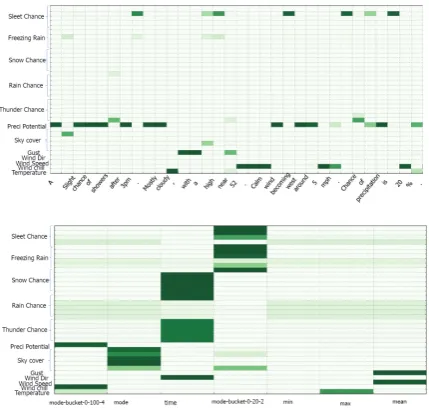
Attention analysis: Analysis of figure 3 re-veals that the learnt attention weights are reason-able. For example, as shown in figure 3(a), for the phrase ‘with a high near 52’, the model had a high attention ontemperaturebefore and while gener-ating the number ‘52’. Similarly while genergener-ating ‘mostly cloudy’, the model had a high attention onprecipitation potential. Attribute attentions are also learned as expected (in figure 3(b)). The tem-perature, wind speedandgust records have high weights on min/max/mean values which describe these records.
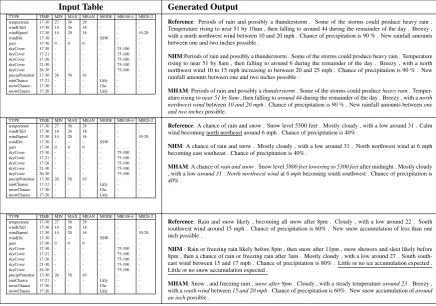
Qualitative analysis: Table 1 contains exam-ple table-summary pairs, with summary generated by the proposed hierarchical and non-hierarchical
Figure 3: Heatmaps: (a) record level attention (top) and (b) attribute level attention (bottom).
versions. We observe that our model is able to gen-erate numbers more accurately by enabling hierar-chical attention. Our model is also able to capture weak signals likesnow accumulation. Further, our proposed model MHAM is able to avoid repetition as compared to NHM.
5 Conclusion and Future Work
In this work, we have formulated the problem of
standard table summarization where all the ta-bles come from a predefined schema. Towards this, we proposed a novel mixed hierarchical at-tention based encoder-decoder approach. Our ex-periments on the publicly availableWEATHERGOV
benchmark dataset have shown significant im-provements over the current state-of-the-art work. Moreover, this proposed method is theoretically more efficient compared to the current fully dy-namic hierarchical attention model. As future work, we propose to tackle general tabular sum-marization where the schema can vary across ta-bles in the whole dataset.
6 Acknowledgements
We would like to acknowledge Abhijit Mishra for his valuable feedback and comments.
References
[image:5.595.97.266.441.527.2]Sanjay Ghemawat, Ian Goodfellow, Andrew Harp, Geoffrey Irving, Michael Isard, Yangqing Jia, Rafal Jozefowicz, Lukasz Kaiser, Manjunath Kudlur, Josh Levenberg, Dan Man´e, Rajat Monga, Sherry Moore, Derek Murray, Chris Olah, Mike Schuster, Jonathon Shlens, Benoit Steiner, Ilya Sutskever, Kunal Tal-war, Paul Tucker, Vincent Vanhoucke, Vijay Vasude-van, Fernanda Vi´egas, Oriol Vinyals, Pete Warden, Martin Wattenberg, Martin Wicke, Yuan Yu, and Xi-aoqiang Zheng. 2015. TensorFlow: Large-scale ma-chine learning on heterogeneous systems. Software available from tensorflow.org.
Ion Androutsopoulos, Gerasimos Lampouras, and Dimitrios Galanis. 2014. Generating natural lan-guage descriptions from OWL ontologies: the nat-uralowl system. CoRR, abs/1405.6164.
Gabor Angeli, Percy Liang, and Dan Klein. 2010. A simple domain-independent probabilistic approach to generation. InProceedings of the 2010 Confer-ence on Empirical Methods in Natural Language Processing, pages 502–512. Association for Com-putational Linguistics.
KyungHyun Cho, Aaron C. Courville, and Yoshua Bengio. 2015. Describing multimedia content using attention-based encoder-decoder networks. CoRR, abs/1507.01053.
Emilie Colin, Claire Gardent, Yassine Mrabet, Shashi Narayan, and Laura Perez-Beltrachini. 2016. The webnlg challenge: Generating text from dbpedia data. InINLG 2016 - Proceedings of the Ninth Inter-national Natural Language Generation Conference, September 5-8, 2016, Edinburgh, UK, pages 163– 167.
Yuntian Deng, Anssi Kanervisto, Jeffrey Ling, and Alexander M. Rush. 2017. Image-to-markup gener-ation with coarse-to-fine attention. InProceedings of the 34th International Conference on Machine Learning, ICML 2017, Sydney, NSW, Australia, 6-11 August 2017, pages 980–989.
Xavier Glorot and Yoshua Bengio. 2010. Understand-ing the difficulty of trainUnderstand-ing deep feedforward neu-ral networks. InIn Proceedings of the International Conference on Artificial Intelligence and Statistics (AISTATS10). Society for Artificial Intelligence and Statistics.
Srinivasan Iyer, Ioannis Konstas, Alvin Cheung, and Luke Zettlemoyer. 2016. Summarizing source code using a neural attention model. InProceedings of the 54th Annual Meeting of the Association for Com-putational Linguistics (Volume 1: Long Papers), pages 2073–2083, Berlin, Germany. Association for Computational Linguistics.
Diederik Kingma and Jimmy Ba. 2014. Adam: A method for stochastic optimization. arXiv preprint arXiv:1412.6980.
Ioannis Konstas and Mirella Lapata. 2013. Inducing document plans for concept-to-text generation. In EMNLP.
R´emi Lebret, David Grangier, and Michael Auli. 2016. Neural text generation from structured data with ap-plication to the biography domain. In Proceed-ings of the 2016 Conference on Empirical Methods in Natural Language Processing, pages 1203–1213, Austin, Texas. Association for Computational Lin-guistics.
Percy Liang, Michael I. Jordan, and Dan Klein. 2009. Learning semantic correspondences with less super-vision. InProceedings of the Joint Conference of the 47th Annual Meeting of the ACL and the 4th Interna-tional Joint Conference on Natural Language Pro-cessing of the AFNLP: Volume 1 - Volume 1, ACL ’09, pages 91–99, Stroudsburg, PA, USA. Associa-tion for ComputaAssocia-tional Linguistics.
Jeffrey Ling and Alexander M. Rush. 2017. Coarse-to-fine attention models for document summarization. InProceedings of the Workshop on New Frontiers in Summarization, NFiS@EMNLP 2017, Copenhagen, Denmark, September 7, 2017, pages 33–42.
Hongyuan Mei, Mohit Bansal, and Matthew R. Walter. 2016. What to talk about and how? selective gener-ation using lstms with coarse-to-fine alignment. In Proceedings of the 2016 Conference of the North American Chapter of the Association for Computa-tional Linguistics: Human Language Technologies, pages 720–730, San Diego, California. Association for Computational Linguistics.
Ramesh Nallapati, Bing Xiang, and Bowen Zhou. 2016. Sequence-to-sequence rnns for text summa-rization. CoRR, abs/1602.06023.
Kishore Papineni, Salim Roukos, Todd Ward, and Wei-Jing Zhu. 2002. Bleu: a method for automatic eval-uation of machine translation. In Proceedings of the 40th annual meeting on association for compu-tational linguistics, pages 311–318. Association for Computational Linguistics.