USFD at SemEval-2016 Task 1: Putting different
State-of-the-Arts into a Box
Ahmet Aker, Frederic Blain, Andres Duque
∗, Marina Fomicheva
+,
Jurica Seva, Kashif Shah
and
Daniel Beck
University of Sheffield, UK
University of Madrid, Spain
∗Universitat Pompeu Fabra, Spain
+ahmet.aker@ f.blain@ j.seva@ kashif.shah@
sheffield.ac.uk
[email protected], [email protected]
[email protected]
Abstract
In this paper we describe our participa-tion in the STS Core subtask which is the determination of the monolingual seman-tic similarity between pair of sentences. In our participation we adapted state-of-the-art approaches from related work ap-plied on previous STS Core subtasks and run them on the 2016 data. We inves-tigated the performance of single meth-ods but also the combination of them. Our results show that Convolutional Neu-ral Networks (CNN) are superior to both the Monolingual Word Alignment and the Word2Vec approaches. The combination of all the three methods performs slightly better than using CNN only. Our results also show that the performance of our systems varies between the datasets.
1 Introduction
Semantic Textual Similarity (STS) is a metric which aims to determine the likeness between two short textual entities. Therefore, STS is widely used in many research areas such as Nat-ural Language Processing, for a large amount of tasks like Information Retrieval (IR), Natural Language Understanding (NLU) or even Ma-chine Translation (MT) evaluation, for which
STS allows capturing more information than traditional metrics based onn-grams match like
BLEU (Papineni et al., 2002).
Part of the SemEval campaign, STS compe-tition benefits from a growing interest over the year (Agirre et al., 2012; Agirre et al., 2013; Agirre et al., 2014; Agirrea et al., 2015). In 2016, participants had the possibility to com-pete in two tasks: (i) STS split into ’STS Core’ and ’Cross-lingual STS’ which are respectively an English monolingual and English/Spanish bilingual subtasks; (ii) iSTS which focuses on the interpretable aspect of STS assessment. In-troduced for the first time in 2015, iSTS became a standalone task this year.
This paper describes our participation in the STS Core subtask and is organised as follows: we first describe in Section 2 methods we have adapted to tackle the task. Next, we present and discuss our results (Section 3). Finally, Sec-tion 4 will conclude this system descripSec-tion pa-per with some remarks.
2 System description
For adressing monolingual semantic similarity between two sentences different methods have been proposed in related work. In our mono-lingual STS participation we have focused on some methods that were reported as
the-art systems. Given that those methods have been reported separately a natural question that arises from this is what the performance is when those methods are combined. This is exactly what we did and what we propose in this pa-per. We adapted methods from related work that have been applied on the monolingual STS task and used their combined version on the new 2016 monolingual task. Methods adapted and the strategy we used to combine them are de-scribed in the following sections.
2.1 Monolingual Alignment
We use an alignment-based approach, which was among the top-perfoming submissions in the past year’s task (Sultan et al., 2015). Sen-tence similarity score is computed in two sepa-rate steps. First, an alignment between related words in the input sentences is established us-ing Monolus-ingual Word Aligner (MWA) (Sultan et al., 2014). Next, sentence similarity is calcu-lated based on the proportion of aligned content words:
sim(S1, S2) = n a
c(S1) +nac(S2)
nc(S1) +nc(S2)
(1)
where nc(Si) and nac(Si) are the number of
content words and the number of aligned con-tent words in sentence i, respectively. MWA makes alignment decisions based on lexical similarity and contextual evidence. Lexical similarity component identifies word pairs that are possible candidates for alignment. Context words are considered as evidence for alignment if they are lexically similar and have the same or equivalent syntactic relations with the words to be aligned. Word pairs are aligned in decreas-ing order of a weighted sum of their lexical and contextual similarity.
2.2 Convolutional Neural Network Score Another method adapted in our system is a Con-volutional Neural Network (CNN), which gen-erates a similarity score for each pair of
sen-tences. More specifically, we replicated the sys-tem presented in (He et al., 2015), using previ-ous SemEval data for training the network and generating similarity values between 0 and 5, for each of the test sentences given by the orga-nizers. In the following subsections, we briefly summarize the CNN system, although specific details can be found in the cited paper.
Word Representation
Words in the sentences to be compared are first transformed into vectors using the GloVe word embeddings (Pennington et al., 2014). These embeddings are trained on 840 bil-lion tokens, and the resulting vectors are 300-dimensional. Hence, each sentence sent with n words will be transformed into a matrix Msent ∈ Rn×300. Hence, senti:j denotes the
word embeddings of words i to j inside the
sentence,sent[ik]denotes thek-th dimension of
word embedding i and sent[ik:j] the k-th
dimen-sion of wordsitojinside the sentence.
Sentence modelling
The technique makes use of two different types of filters for extracting features from the sentences: holistic and per-dimension. Holis-tic filters generate a vector representing a ”tem-poral” convolution, this is, complete regions of the word sequence. On the other hand, per-dimension filters perform spatial convolutions, limited to a predefined dimensionk. After the
application of those filters, the last step of the convolutional layer is to perform pooling op-erations over the vectors generated by the fil-ters, in order to convert those vectors into scalar values. The system defines three types of pool-ing: max, min andmean. Finally, the system
also defines a group as a specific convolution
layer (with either holistic or per-dimension fil-ters) with widthwsand a specific type of
Similarity Measurement Layer
Once that the sentence representation is done through the use of filters and pooling functions, a way to compare two sentences has to be de-fined. The comparison of two different sen-tences is made over local regions of the sentence representation. For this purpose, the system consider the output of the convolutional layers in order to perform both “horizontal” and “ver-tical” comparisons. Given two vectors, each of them representing the same region of an input sentence, a new output vector is created by mea-suring cosine distance, L2 Euclidean distance and element-wise absolute difference. This out-put vector is added to an accumulated vector which stores the outputs of all the compared regions of the input sentences. The final out-put of the system generates an outout-put similarity score through a final log-softmax layer, which receives the accumulated vector. System pa-rameters (window size, number of filters, learn-ing rate, regularization parameter, hidden units) are maintained with respect to the original work in which the system is presented.
2.3 Word2Vec
Word embeddings using Word2vec (Mikolov et al., 2013) have been extensively used to mea-sure the semantic similarity between words. Our word embeddings comprise the vectors published by Baroni et al. (2014). To measure the similarity between a pair of sentences we first remove from each sentence stop-words as well as punctuations, query for each word its vector representation and create a averaged sum of the word vectors. The number of remaining words in each sentence is used to average that sentence. Finally, we use the resulting averaged sum vectors and determine their similarity us-ing cosine.
2.4 Model Combination
In this section, we present the experiments to combine all methods described in previous sec-tions. We formulated the problem as a
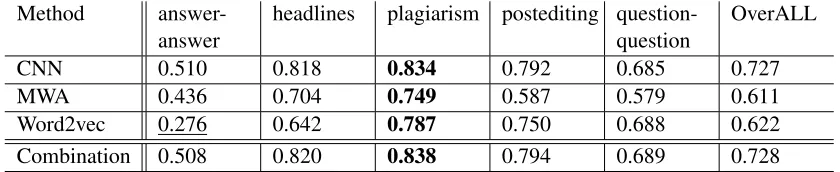
regres-sion task where we are given multiple features capturing different attributes of inputs along with gold labels and we predict the output for unseen examples. Support Vector Regression (SVR) (Chang and Lin, 2001) is the most com-monly used algorithm for such tasks. We used the 3 features described in previous sections and trained SVR models to estimate a continuous score within [0,5]. We evaluated different set-tings of these models including various avail-able kernels. Based on optimum performance, we used a radial basis function (RBF) kernel, which has been shown to perform very well in quality estimation tasks (Callison-Burch et al., 2012). Kernel parameters are optimised using grid search with 5-fold cross-validation. The correlation scores using SVR as learning algo-rithm are reported in Table 3. It can be seen that adding all features together improves the results in as compared to the individual scores for each of the methods.
Application on SemEval Data
The described system has been trained with data from previous Semantic Textual Similarity tasks of SemEval, more specifically data from 2012, 2013, 2014 and 2015. The final training dataset is composed by 13,560 sentence pairs.
3 Results
In SemEval STS Core Task the performance of each method (or system) is evaluated us-ing Pearson Correlation that measures the lin-ear correlation between the system’s outputs and gold-standard data. A score of 1indicates
100% correlation and0no correlation at all.
Ta-ble 3 shows the individual results for methods adapted in this work as well as the result when all methods are combined together as a single system.
We can first observe that the best single performing method is CNN, with an overral achievement of0.727correlation score (see last
Method
[image:4.612.95.515.60.146.2]answer-answer headlines plagiarism postediting question-question OverALL CNN 0.510 0.818 0.834 0.792 0.685 0.727 MWA 0.436 0.704 0.749 0.587 0.579 0.611 Word2vec 0.276 0.642 0.787 0.750 0.688 0.622 Combination 0.508 0.820 0.838 0.794 0.689 0.728
Table 1:Pearson correlation between the prediction and gold standard data.
substantially lower correlation figures with a drop of about 0.10. Monolingual Word
Align-ment is the less performing method achieving
0.611, just behind Word2Vec with0.622. From
our results we can also remark that the com-bined version of all the three methods lead to
0.728which is similar to the CNN method only.
Secondly, if we look at the results for each dataset individually, we can also remark that the performance of our system drastically change from one to another. While all approaches per-form poorly on the answer-answer data, they achieve high correlation scores on the head-lines, post-editing and plagiarism data sets. The latter being the data on which our approaches are the most efficient with a minimum of0.749
correlation.
4 Conclusions and further studies
In this paper we described our participation to the STS Core Task for SemEval 2016. We adapted state-of-the-art methods from previ-ous studies applied on the monolingual seman-tic similarity task and run them on the 2016 data. We investigated the performance of sin-gle methods individually but also combined al-together.
Overall, our results show that the CNN-based approach was the most effective compared to the others individual approaches. The combi-nation of those methods achieves slightly better results than CNN only. We can also observe that results vary between the different dataset: they are highly satisfactory on both the headlines and plagiarism dataset, but perform poorly on the answer-answer data, especially Word2Vec with
only 0.276 Pearson Correllation compared to gold-standard.
For the future work we aim to conduct a deeper analysis about the performance of our different systems. This will also include the un-derstanding concerning their effectiveness over on diverse datasets. Finally, we would like to investigate the QuEst framework (Specia et al., 2013) as additional method to describe the se-mantic similarity between sentences:
QuEst framework
For our future work we aim to use the QuEst framework (Specia et al., 2013) and extract features to capture the semantic similarity be-tween monolingual sentences. These features are used and have shown to perform well in the WMT shared tasks on QE. They include simple counts, e.g. number of tokens in the segments, language model probabilities and perplexities, number of punctuation marks in source and tar-get segments, among other features reflecting the complexity and fluency of the given seg-ments. Though these features are originally de-signed to estimate the quality of machine trans-lation, we aim to adapt and explore their poten-tial in addition to the methods discussed in pre-vious sections.
Acknowledgements
References
Eneko Agirre, Mona Diab, Daniel Cer, and Aitor Gonzalez-Agirre. 2012. Semeval-2012 task 6: A pilot on semantic textual similarity. In Pro-ceedings of the First Joint Conference on Lexi-cal and Computational Semantics-Volume 1: Pro-ceedings of the main conference and the shared task, and Volume 2: Proceedings of the Sixth International Workshop on Semantic Evaluation, pages 385–393. Association for Computational Linguistics.
Eneko Agirre, Daniel Cer, Mona Diab, Aitor Gonzalez-Agirre, and Weiwei Guo. 2013. sem 2013 shared task: Semantic textual similarity, in-cluding a pilot on typed-similarity. InIn* SEM 2013: The Second Joint Conference on Lexical and Computational Semantics. Association for Computational Linguistics. Citeseer.
Eneko Agirre, Carmen Banea, Claire Cardie, Daniel Cer, Mona Diab, Aitor Gonzalez-Agirre, Weiwei Guo, Rada Mihalcea, German Rigau, and Janyce Wiebe. 2014. Semeval-2014 task 10: Multi-lingual semantic textual similarity. In Proceed-ings of the 8th international workshop on seman-tic evaluation (SemEval 2014), pages 81–91. Eneko Agirrea, Carmen Baneab, Claire Cardiec,
Daniel Cerd, Mona Diabe, Aitor Gonzalez-Agirrea, Weiwei Guof, Inigo Lopez-Gazpioa, Montse Maritxalara, Rada Mihalceab, et al. 2015. Semeval-2015 task 2: Semantic textual similarity, english, spanish and pilot on inter-pretability. In Proceedings of the 9th inter-national workshop on semantic evaluation (Se-mEval 2015), pages 252–263.
Marco Baroni, Georgiana Dinu, and Germ´an Kruszewski. 2014. Don’t count, predict! a systematic comparison of context-counting vs. context-predicting semantic vectors. InACL (1), pages 238–247.
Chris Callison-Burch, Philipp Koehn, Christof Monz, Matt Post, Radu Soricut, and Lucia Specia, editors. 2012. Proceedings of the Seventh Work-shop on Statistical Machine Translation. Asso-ciation for Computational Linguistics, Montr´eal, Canada, June.
Chih-Chung Chang and Chuan-bi Lin. 2001.
Train-ing v-support vector classifiers: theory and algo-rithms. Neural computation, 13(9):2119–2147. Hua He, Kevin Gimpel, and Jimmy Lin. 2015.
Multi-perspective sentence similarity modeling with convolutional neural networks. In Pro-ceedings of the 2015 Conference on Empirical Methods in Natural Language Processing, pages 1576–1586.
Tomas Mikolov, Ilya Sutskever, Kai Chen, Greg S Corrado, and Jeff Dean. 2013. Distributed rep-resentations of words and phrases and their com-positionality. In Advances in neural information processing systems, pages 3111–3119.
Kishore Papineni, Salim Roukos, Todd Ward, and Wei-Jing Zhu. 2002. BLEU: a method for auto-matic evaluation of machine translation. In Pro-ceedings of the 40th Annual Meeting on Associ-ation for ComputAssoci-ational Linguistics, pages 311– 318, Juillet.
Jeffrey Pennington, Richard Socher, and Christo-pher D Manning. 2014. Glove: Global vectors for word representation. InEMNLP, volume 14, pages 1532–1543.
Lucia Specia, Kashif Shah, Jose G. C. De Souza, Trevor Cohn, and Fondazione Bruno Kessler. 2013. Quest - a translation quality estimation framework. In In Proceedings of the 51th Con-ference of the Association for Computational Lin-guistics (ACL), Demo Session.
Md Arafat Sultan, Steven Bethard, and Tamara Sum-ner. 2014. Back to basics for monolingual align-ment: Exploiting word similarity and contextual evidence. Transactions of the Association for Computational Linguistics, 2:219–230.