NLANGP: Supervised Machine Learning System for Aspect Category
Classification and Opinion Target Extraction
Zhiqiang Toh
Institute for Infocomm Research 1 Fusionopolis Way
Singapore 138632
Jian Su
Institute for Infocomm Research 1 Fusionopolis Way
Singapore 138632
Abstract
This paper describes our system used in the Aspect Based Sentiment Analysis Task 12 of SemEval-2015. Our system is based on two supervised machine learning algorithms: sig-moidal feedforward network to train binary classifiers for aspect category classification (Slot 1), and Conditional Random Fields to train classifiers for opinion target extraction (Slot 2). We extract a variety of lexicon and syntactic features, as well as cluster features induced from unlabeled data. Our system achieves state-of-the-art performances, rank-ing 1st for three of the evaluations (Slot 1 for both restaurant and laptop domains, and Slot 1 & 2) and 2nd for Slot 2 evaluation.
1 Introduction
The amount of user-generated content on the web has grown rapidly in recent years, prompting in-creasing interests in the research area of sentiment analysis and opinion mining. Most previous work is concerned with detecting the overall polarity of a sentence or paragraph, regardless of the target enti-ties (e.g. restaurants) and their aspects (e.g. food). By contrast, the Aspect Based Sentiment Analysis task of SemEval 2014 (SE-ABSA14) is concerned with identifying the aspects of given target enti-ties and the sentiment expressed towards each as-pect (Pontiki et al., 2014).
The SemEval-2015 Aspect Based Sentiment Analysis (SE-ABSA15) task is a continuation of SE-ABSA14 (Pontiki et al., 2015). The SE-ABSA15 task features a number of changes that
address issues raised in SE-ABSA14 and also en-courage further in-depth research. For example, (1) instead of isolated (potentially out of context) sen-tences, the input datasets will contain entire reviews; (2) information linking aspect terms and aspect cat-egories are now provided; (3) besides in-domain ABSA (Subtask 1), SE-ABSA15 will include an out-of-domain ABSA subtask (Subtask 2).
We participate in Subtask 1 of SE-ABSA15, namely aspect category classification (Slot 1) and opinion target extraction (Slot 2). We also partici-pate in the evaluation which assesses whether a sys-tem identifies both the aspect categories and opinion targets correctly (Slot 1 & 2).
For Slot 1, we model the problem as a multi-class classification problem where binary classifiers are trained to predict the aspect categories. We follow the one-vs-all strategy and train a binary classifier for each category in the training set. Each classifier is trained using sigmoidal feedforward network with 1 hidden layer. For Slot 2, we follow the approach of Toh and Wang (2014) by modeling the problem as a sequential labeling task, using Conditional Random Fields (CRF) as the training algorithm. For Slot 1 & 2, we perform a simple combination of Slot 1 pre-dictions and Slot 2 prepre-dictions.
The remainder of this paper is structured as fol-lows. In Section 2, we describe our system in detail, including the feature description and approaches. In Section 3, the official results are presented. Feature ablation results are shown in Section 4. Finally, Sec-tion 5 summarizes our work.
2 System Description
In this section, we present the details of our sen-timent analysis system. The training set consists of 254 English review documents containing 1315 sen-tences for the restaurant domain and 277 English re-view documents containing 1739 sentences for the laptop domain.
As a first step of our system, we perform basic data preprocessing. All sentences are tokenized and parsed using the Stanford Parser1.
2.1 Features
This section briefly describes the features used in our system, where some of the features are useful across different slots. The features used are a subset of the features described in Toh and Wang (2014), which also provides a more detailed description of the features.
2.1.1 Word
The current word is used as a feature. For opinion target extraction, the previous word and next word are also used as features.
2.1.2 Bigram
All word bigrams found in a sentence are used as features.
2.1.3 Name List
For the restaurant domain, we extract two high precision name lists from the training set and use them for membership testing. For the first list, we collect and keep only high frequent opinion targets. For the second list, we consider the counts of in-dividual words in the opinion targets and keep those words that frequently occur as part of an opinion tar-get in the training set.
2.1.4 Head Word
From the sentence parse tree, we extract the head word of each word and use it as a feature.
2.1.5 Word Cluster
We induce Brown clusters and K-means clus-ters from two different sources of unlabeled dataset: the Multi-Domain Sentiment Dataset that contains
1http://nlp.stanford.edu/software/lex-parser.shtml
Amazon product reviews (Blitzer et al., 2007)2, and
the Yelp Phoenix Academic Dataset that contains user reviews3. We also experiment using a third
dataset that is created by combining the initial two datasets into one.
For Brown clusters4, we experiment with
differ-ent datasets, cluster sizes ({100,200,500,1000}), minimum occurrences ({1,2,3}) and binary prefix lengths. The best settings to use are determined us-ing 5-fold cross validation.
K-means clusters are induced using the
word2vec tool (Mikolov et al., 2013)5.
Sim-ilarly, among different datasets, word vector sizes ({50,100,200,500,1000}), cluster sizes ({50,100,200,500,1000}), and sub-sampling thresholds ({0.00001,0.001}), we use 5-fold cross validation to select the best settings.
2.1.6 Name List Generated using Double Propagation
For the restaurant domain, we generate a name list of possible opinion targets using the Double Propagation (DP) algorithm (Qiu et al., 2011). The propagation rules are modified from the logic rules presented in Liu et al. (2013), where we write our rules in Prolog and use SWI-Prolog6 as the solver.
As the rules can only identify single-word targets, to consider multi-word targets, we extend the left boundary of the identified target to include any con-sective noun words right before the target.
2.2 Approaches
We developed our system to return results for Slot 1 (restaurant and laptop domains), Slot 2 (restaurant domain) and Slot 1 & 2 (restaurant domain). This section describes our machine learning approaches used to generate the predictions for each slot.
2.2.1 Aspect Category Classification (Slot 1)
Aspect category classification is based on a set of one-vs-all binary classifiers, one classifier for each
2We used the unprocessed.tar.gz archive found
at http://www.cs.jhu.edu/ mdredze/datasets/sentiment/
3http://www.yelp.com/dataset challenge/
4Brown clusters are induced using the implementation
by Percy Liang found at https://github.com/percyliang/brown-cluster/
Parameter Restaurant Laptop
learning rate 0.9 0.7
hidden units 4 4
[image:3.612.365.486.55.243.2]threshold 0.2 0.2
Table 1: Tuned parameter values for Slot 1 on the restau-rant and laptop domain.
category found in the training set. For each sentence in the training set, we extract features from all words in the sentence to create a training example. The la-bel of the example depends on which categoryCwe are training: 1 if the sentence containsC as one of its categories,−1otherwise. The number of binary classifiers is 13 for the restaurant domain and 79 for the laptop domain, which equals to the number of categories annotated in the training set for the re-spective domain.
We use the Vowpal Wabbit tool7 to train the
bi-nary classifiers. Each classifier is trained using sig-moidal feedforward network with 1 hidden layer (--nn), with--ngramenabled to generate word bigrams. The learning rate (-l) and number of hid-den units are tuned using 5-fold cross validation.
We also tuned the probability threshold where we regard the classifier output as positive outcome. Any classifier that returns a probability score greater than the threshold will be added to the output set of cate-gories. The tuned parameter values used are shown in Table 1.
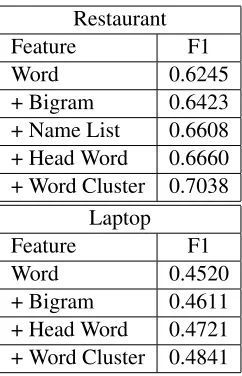
Table 2 shows the features used for the restau-rant and laptop domain, as well as the 5-fold cross-validation performances after adding each feature group.
2.2.2 Opinion Target Extraction (Slot 2)
Opinion target extraction is modeled as a sequen-tial labeling task, where each word in the sentence is assigned a label using the IOB2 scheme (Sang and Veenstra, 1999). The classifier is trained using Con-ditional Random Fields (CRF), which has shown to achieve state-of-the-art performances in previous work (Toh and Wang, 2014; Chernyshevich, 2014). We use the CRFsuite tool (Okazaki, 2007) for CRF training and enable negative state and transition features (-p feature.possible states=1
7https://github.com/JohnLangford/vowpal wabbit/wiki
Restaurant
Feature F1
Word 0.6245
+ Bigram 0.6423
+ Name List 0.6608
+ Head Word 0.6660
+ Word Cluster 0.7038 Laptop
Feature F1
Word 0.4520
+ Bigram 0.4611
+ Head Word 0.4721
+ Word Cluster 0.4841
Table 2: 5-fold cross-validation performances for Slot 1 on the restaurant and laptop domain. Each row uses all features added in the previous rows.
-p feature.possible transitions=1).
We experiment with two different methods of re-turning predicted opinion targets, one suitable for Slot 1 & 2 evaluation (Method-1), the other suitable for Slot 2 evaluation (Method-2).
For Slot 1 & 2 evaluation, the explicit opinion tar-gets may have more than one categories. Thus, we use the following method (Method-1): we train a separate CRF model for each category found in the training set. That is, for each categoryC, we assign the label “B-C” to indicate the start of an opinion target, “I-C” to indicate the continuation of an opin-ion target, and “O” if the opinopin-ion target does not haveCas one of its categories.
Using FOOD#PRICES category as an ex-ample, for the training set that is used to train the FOOD#PRICES CRF model, we as-sign the label “B-FOOD#PRICES” to indicate the start of a FOOD#PRICES opinion target, “I-FOOD#PRICES” to indicate the continuation of a FOOD#PRICES opinion target, and “O” if the opin-ion target does not have FOOD#PRICES as one of its categories.
[image:3.612.101.272.57.114.2]Slot 1
Restaurant Laptop
System Type Rank P R F1 Type Rank P R F1
NLANGP (U) U 1 0.6386 0.6155 0.6268 U 1 0.6425 0.4209 0.5086
NLANGP (C) C 2 0.6637 0.5806 0.6194 C 4 0.5743 0.4283 0.4906
1st U 1 0.6386 0.6155 0.6268 U 1 0.6425 0.4209 0.5086
2nd C 2 0.6637 0.5806 0.6194 U 2 0.5773 0.4409 0.5000
3rd C 3 0.5698 0.5742 0.5720 C 3 0.5548 0.4483 0.4959
Baseline – – – – 0.5133 – – – – 0.4631
Slot 2 Slot 1 & 2
Restaurant
System Type Rank P R F1 Type Rank P R F1
NLANGP (U) U 2 0.7053 0.6402 0.6712 U 1 0.4463 0.4130 0.4290
NLANGP (C) C 7 0.7129 0.5406 0.6149 C 4 0.4387 0.3645 0.3982
1st U 1 0.6893 0.7122 0.7005 U 1 0.4463 0.4130 0.4290
2nd U 2 0.7053 0.6402 0.6712 C 2 0.5937 0.3337 0.4273
3rd C 3 0.6723 0.6661 0.6691 U 3 0.5832 0.3278 0.4197
[image:4.612.75.541.55.308.2]Baseline – – – – 0.4807 – – – – 0.3444
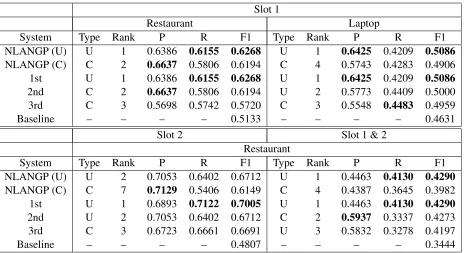
Table 4: Comparison of our unconstrained (U) and constrained (C) systems with the top three participating systems and official baselines for Slot 1, Slot 2 and Slot 1 & 2. P, R, and F1 denote the precision, recall and F1 measure respectively.
Restaurant
Feature F1
Word 0.6225
+ Name List 0.6796
+ Head Word 0.6840
[image:4.612.120.248.367.470.2]+ Word Cluster 0.7224 + DP Name List 0.7237
Table 3: 5-fold cross-validation performances of Slot 2 on the restaurant domain. Each row uses all features added in the previous rows. The cross-validation experi-ments use Method-1 to train the models.
Since Slot 2 evaluation only requires the identi-fied text span to be returned and does not require any category information, we can increase the num-ber of positive training examples by collapsing all categories into a single category (e.g. “TERM”). Thus, for Slot 2 evaluation, the following method (Method-2) is used: we train a single CRF model where all opinion targets in the training set are as-signed the labels “B-TERM”, “I-TERM” and “O” accordingly.
Table 3 shows the features used for the restaurant
domain as well as the 5-fold cross-validation perfor-mances after adding each feature group.
Due to time constraints, all cross-validation ex-periments for Slot 2 use Method-1 to train the mod-els. The same settings will then be used to train the final models using both Method-1 (for Slot 1 & 2 evaluation) and Method-2 (for Slot 2 evaluation).
2.2.3 Slot 1 & 2
To create the predictions for Slot 1 & 2 evalua-tion, we perform a simple combination of Slot 1 pre-dictions and Slot 2 prepre-dictions. First, we use all Slot 2 predictions. Next, for each sentence, we add cat-egories that are found in Slot 1 predictions but not Slot 2 predictions of the same sentence. Those ad-ditional categories are assumed to be NULL targets.
3 Results
Restaurant
System Method-1 Method-2
NLANGP (U) 0.6099 0.6712
NLANGP (C) 0.5489 0.6149
Table 5: Comparison of F1 performances for Slot 2 eval-uation. Our official submissions for Slot 2 evaluation use Method-2, which is better than Method-1 used for Slot 1 & 2 evaluation.
participating systems and official baselines for com-parison (Pontiki et al., 2015).
As shown from the table, our system performed well for all four evaluations. Our system is ranked 1st for three of the evaluations (Slot 1 for both restaurant and laptop domains, and Slot 1 & 2) and 2nd for Slot 2 evaluation. In addition, our con-strained system also achieves competitive results, ranking 2nd in Slot 1 Restaurant and 4th in Slot 1 Laptop and Slot 1 & 2. Another observation is that our unconstrained systems achieved better perfor-mances than the corresponding constrained systems for all evaluations, indicating the use of external re-sources are beneficial.
[image:5.612.345.505.53.241.2]We are interested to know whether the Slot 2 pre-dictions that help to achieve best results in Slot 1 & 2 evaluation are also useful for Slot 2 evaluation. Table 5 shows the F1 performances of Slot 2 eval-uation if we have used Method-1 (Section 2.2.2) to generate the Slot 2 predictions. As shown from the table, using the same Slot 2 predictions for both Slot 2 evaluation and Slot 1 & 2 evaluation are detrimen-tal to Slot 2 performances, with performance differ-ence greater than 6.0%. Our approach of using a different method to generate Slot 2 predictions for Slot 2 evaluation helps to overcome the data sparse-ness problem and improves the performances of tar-get extraction.
[image:5.612.93.278.57.113.2]4 Feature Ablation
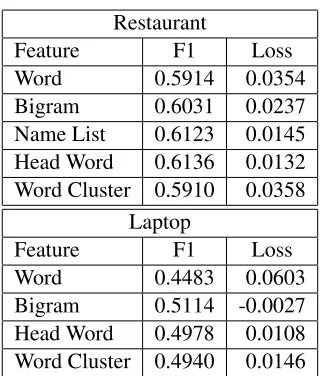
Table 6 and Table 7 show the (unconstrained) F1 measure and loss on the test set resulting from train-ing with each group of feature removed for Slot 1 and Slot 2 respectively. The ablation experiments indicate that each feature is helpful in improving the performance, with performance gains in the range of1.0%−6.0%. The only exception is the use of
Restaurant
Feature F1 Loss
Word 0.5914 0.0354
Bigram 0.6031 0.0237
Name List 0.6123 0.0145
Head Word 0.6136 0.0132
Word Cluster 0.5910 0.0358 Laptop
Feature F1 Loss
Word 0.4483 0.0603
Bigram 0.5114 -0.0027
Head Word 0.4978 0.0108
Word Cluster 0.4940 0.0146
Table 6: Test set ablation experiments for Slot 1 on the restaurant and laptop domain. The quantity is the (uncon-strained) F1 measure and loss resulted from the removal of a single feature group.
Restaurant
Feature F1 Loss
Word 0.6280 0.0432
Name List 0.6540 0.0172
Head Word 0.6602 0.0110
Word Cluster 0.6387 0.0325 DP Name List 0.6608 0.0104
Table 7: Test set ablation experiments for Slot 2 on the restaurant domain. The quantity is the (unconstrained) F1 measure and loss resulted from the removal of a single feature group.
bigram feature in Slot 1 evaluation on the laptop do-main, where a slight decrease of0.27%is observed. Among the external resources used, the Word Clus-ter feature consistently provides the most gain: an increase in F1 measure greater than 3.0%for both slots on the restaurant domain.
5 Conclusion
[image:5.612.345.506.315.414.2]re-maining evaluation. In future, we hope to improve our opinion target extraction system by taking into account surrounding sentence context and incorpo-rating sentiment lexicon features to better classify aspect categories and detect opinion expressions.
Acknowledgments
This work is a study conducted at Baidu-I2R
Re-search Centre.
We thank the anonymous reviewers for their help-ful comments and suggestions.
References
John Blitzer, Mark Dredze, and Fernando Pereira. 2007. Biographies, Bollywood, Boom-boxes and Blenders: Domain Adaptation for Sentiment Classification. In
Proceedings of the 45th Annual Meeting of the Asso-ciation of Computational Linguistics, pages 440–447, Prague, Czech Republic, June.
Maryna Chernyshevich. 2014. IHS R&D Belarus: Cross-domain Extraction of Product Features using Conditional Random Fields. InProceedings of the 8th International Workshop on Semantic Evaluation (Se-mEval 2014), pages 309–313.
Qian Liu, Zhiqiang Gao, Bing Liu, and Yuanlin Zhang. 2013. A Logic Programming Approach to Aspect Extraction in Opinion Mining. In Proceedings of the 2013 IEEE/WIC/ACM International Joint Confer-ences on Web Intelligence (WI) and Intelligent Agent Technologies (IAT) - Volume 01, WI-IAT ’13, pages 276–283, Washington, DC, USA, November.
Tomas Mikolov, Wen-tau Yih, and Geoffrey Zweig. 2013. Linguistic Regularities in Continuous Space Word Representations. In Proceedings of the 2013 Conference of the North American Chapter of the As-sociation for Computational Linguistics: Human Lan-guage Technologies, pages 746–751, Atlanta, Georgia, June.
Naoaki Okazaki. 2007. CRFsuite: a fast implementation of Conditional Random Fields (CRFs).
Maria Pontiki, Dimitris Galanis, John Pavlopoulos, Har-ris Papageorgiou, Ion Androutsopoulos, and Suresh Manandhar. 2014. SemEval-2014 Task 4: Aspect Based Sentiment Analysis. InProceedings of the 8th International Workshop on Semantic Evaluation (Se-mEval 2014), pages 27–35.
Maria Pontiki, Dimitris Galanis, Harris Papageorgiou, Suresh Manandhar, and Ion Androutsopoulos. 2015. SemEval-2015 Task 12: Aspect Based Sentiment Analysis. In Proceedings of the 9th International Workshop on Semantic Evaluation (SemEval 2015).
Guang Qiu, Bing Liu, Jiajun Bu, and Chun Chen. 2011. Opinion Word Expansion and Target Extraction through Double Propagation.Computational Linguis-tics, 37(1):9–27.
Erik F. Tjong Kim Sang and Jorn Veenstra. 1999. Rep-resenting Text Chunks. InProceedings of the Ninth Conference on European Chapter of the Association for Computational Linguistics, EACL ’99, pages 173– 179, Stroudsburg, PA, USA.