1277
YNU-HPCC at SemEval-2019 Task 9: Using a BERT and
CNN-BiLSTM-GRU Model for Suggestion Mining
Ping Yue, Jin Wang and Xuejie Zhang School of Information Science and Engineering
Yunnan University Kunming, P.R. China
Contact: [email protected]
Abstract
Consumer opinions towards commercial enti-ties are generally expressed through online re-views, blogs, and discussion forums. These opinions largely express positive and negative sentiments towards a given entity; however, they may also contain suggestions for improv-ing the entity. In this task, we extract sugges-tions from a given unstructured text, in con-trast to the traditional opinion mining system-s. This type suggestion mining is more ap-plicable and extends capabilities. In this pa-per, we propose the use of bidirectional en-coder representation learned from transform-ers (BERT) to address the problem of domain specific suggestion mining in task A. In detail, BERT is also used to extract feature vectors and perform fine-tuning for the task . For Task B, we applied an ensemble model to combine the BiLSTM, CNN, and GRU models, which can perform cross domain suggestion mining. Officially released results show that our sys-tem performs better than the baseline algorith-m does.
1 Introduction
Suggestion mining is used to extract advice from text such as that provided in online reviews, blogs, discussion forums, and social media platform-s where conplatform-sumerplatform-s platform-share their opinionplatform-s toward-s commercial entitietoward-s like brandtoward-s, toward-servicetoward-s, and products. Most of the traditional sentiment anal-ysis methods are emotion classifications. Opinion mining can improve service and quality. Such sys-tems have become an effective way for marketing, economics, politics, and advertising. The applica-tion of suggesapplica-tion mining provides the motivaapplica-tion, for the SemEval 2019 Task 9 (Negi et al.,2019), which contains two subtasks that classify giv-en sgiv-entgiv-ences into suggestion and non-suggestion classes. Subtask A requires a system to achieve domain specific training, whereby the test dataset
will belong to the same domain as the training and development datasets. This was part of a sugges-tion forum for windows platform developers. Sub-task B applies the system to cross domain training, where training, development, and test datasets will belong to different domains. Training and devel-opment datasets will remain the same as Subtask A, while the test dataset will belong to the domain of hotel reviews.
There are many methods in sentiment analy-sis. In many reports on this subject, it has been implied that these models help improve classifi-cation. Successful models include convolutional neural networks (CNN), long short-term memory (LSTM), and bi-directional LSTM (BiLSTM). C-NN can capture local n-gram features, while LST-M can maintain memory in the pipelines and solve the problem of long sequence dependence in neu-ral networks.
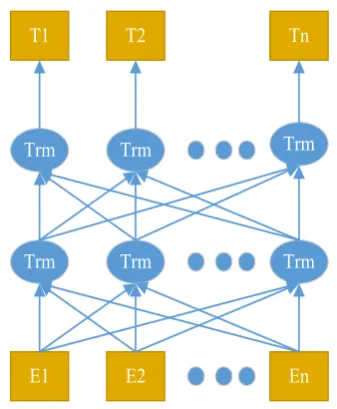
In this paper, we propose a bidirectional en-coder representation learned from transformers (BERT) model (Devlin et al., 2018) for Task A. It comprises two phases. The first phase is called pre-training and is similar to word embedding. The second phase is called fine-tuning and uses a pre-trained language model to complete specif-ic NLP downstream tasks. We used a pre-trained model that was provided by Google AI team. It in-cluded weights for the pre-trained model and a vo-cab file that maps component words of sentences to indexes of words. It also included the JSON file, which specifies the model hyper-parameters. Fine-tuning was applied to sequence classification: the BERT directly takes the final hidden state of the first [CLS] token, adds a layer of weight, and then softmax predicts the label probability. The struc-ture is shown in Figure 2.
intro-Embedding
Layer Convolutional Layer Max-Pooling Layer
Dense Layer Voting
Input BiLSTM
GRU
[image:2.595.83.515.75.179.2]Output
Figure 1: The CNN-BiLSTM-GRU architecture
E1 E2 En
Trm Trm
Trm
Trm
Trm Trm
[image:2.595.93.262.214.419.2]T1 T2 Tn
Figure 2: The architecture of BERT
duced an ensemble model that includes the CNN, BiLSTM, and GRU model. The structure is shown in Figure 1. We constructed the word vectors from 300-dimensional Glove vector. Then, a word vec-tor matrix was loaded into the embedding layer. After this, the CNN applies the convolutional lay-er and max pooling laylay-er to extract n-gram fea-tures, and passes through the dense layer to clas-sify the sentence. BiLSTM can obtain the seman-tic information from the context. The forward and backward layers are connected to the output layer. GRU has a structure similar to that of LSTM, but is simpler. Finally, we combined CNN with BiL-STM and GRU using a soft-voting method, and output the results. The experimental results show that our model has good performance. According to the official review, we achieved sixth place a-mong the 34 teams working on Task A.
The rest of the paper is organized as follows. In Section 2, we describe the BERT model. There, we also detail CNN, BiLSTM, and GRU and their combination. The comparative experimental
re-sults are presented in Section 3. Conclusions are drawn in Section 4.
2 The BERT and CNN-BiLSTM-GRU model
Figure 2 shows the BERT model. First, for each token, a representation is generated by its corre-sponding token embedding, segment embedding, and position embedding. Word-Piece was embed-ded (Wu et al.,2016) along with 30,000 token vo-cabularies. Finally, an output layer was used to fine-tune the parameters. Figure 1 shows the en-semble model used to combine the CNN, BiLST-M, and GRU models. First, all component words were transformed to a feature matrix by an embed-ding layer. Then a convolutional layer and a max pooling layer, were used for feature extraction. To avoid over-fitting, a dropout layer was used after both convolution and max-pooling layers. BiLST-M outputs predictive label sequence directly to in-put sentences. GRU is a variant of LSTM that has fewer parameters and is relatively easier to train. We embedded these models with the vote method and finally output the result.
2.1 Bidirectional Encoder Representations from Transformers (BERT)
Input characterization. For the task of sentence classification, BERT will add the [CLS] and [SEP] identifiers to the beginning and end of each input text; thus, the maximum sequence length can be described as follows.
max seq=St+ 2 (1)
where max seq denotes the maximum sequence length, and St is the set text length. We set the
St=78, and max seq=80. For every input
the sum of token embedding, segmentation em-bedding, and position embedding.
Transformer. The multi-layer transformer
Vaswani et al. (2017) structure operates through the attention mechanism to convert the distance between two words at any position into the numer-al 1. Owing to the transformer’s overnumer-all architec-ture, the input sequence will first be converted in-to a word embedding vecin-tor, which can be used as the input of the multi-head self-attention module after adding the position coding vector. The out-put of the module can be used as the outout-put of the encoder module after passing through a fully con-nected layer.
Output.The highest hidden layer of [CLS] is di-rectly connected to the output layer of softmax as a sentence. The output result of BERT is label prob-ability. The sum of the probabilities of all labels is 1, and the probability value of returning a label is the same as the order of setting labels in Mr-pcProcessor. This task sets the labels to 0 and 1. The probability of the first column returned in this experiment is 0, and the probability of the second column is 1.
2.2 CNN
Embedding Layer. The embedding layer is the first layer of model. Load Glove (Lee et al.,2016;
Cun et al., 1990) with word embedding (Zahran et al., 2015) and is used for model initialization of online reviews. The embedded layer converts a positive integer (subscript) into a vector of fixed size N. N is defined as 80; any sentence exceeding this size is reduced to 80, and any sentence with a size less than 80 is padded to 80 by adding 0s.
Convolution Layer. The convolution layer is used to extract n-gram features from the embed-ding matrix. The calculation method of the convo-lution layer is as follows,
conv=σ(M at◦W +b) (2)
where σ is an activation function, Mat indicates an embedding matrix, W and b respectively denote convolution kernel and bias. Here, ◦ is a convolution operation. We use 3*3 convolution kernels. The activation function is ReLU (Nair and Hinton,2010)
Max pooling layer. Pooling is selecting a part of the input matrix and is used to choose the best representative for the region. The max pooling
layer selects the max feature.
Dropout Layer. To avoid over-fitting, we in-troduce the dropout layer (Hinton et al., 2012) after both a convolution layer and max pooling layer, which is to randomly throw away some weight of the current layer. It can reduce model complexity and enhance the generalization ability of the model.
w1 w1 w1
w2 w2 w2 w2
w3
w4 w4
w5 w5
w5 w5
w6 w6 w6
w3 w4 w3 w4
[image:3.595.321.516.202.331.2]Input Layer Forward Layer Backward Layer OutputLayer
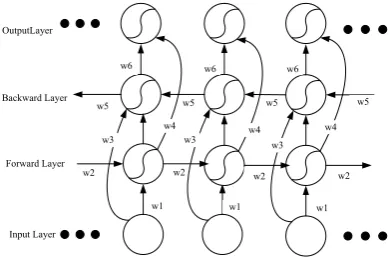
Figure 3: The architecture of BiLSTM
2.3 BILSTM and GRU
Bi-directional Long Short-Term Memory (BiL-STM) (Brueckner and Schuller, 2014; Li and Chang,2015) is a variant of Recurrent Neural Net-work (RNN). Owing to its design characteristic-s, BiLSTM is ideal for modeling time-series data such as text data. Figure 3 shows the BiLSTM structure. BiLSTM is an abbreviation of LSTM
Graves(2012);Greff et al.(2016);Graves(2012), which is a combination of forward LSTM and backward LSTM. Both are often used to model context information in natural language process-ing tasks.
Gated Recurrent Unit (GRU)(Cho et al.,2014) is a variant of LSTM, although the model is sim-pler than the standard LSTM model. It combines a forget gate and input gate into a single update gate. It also mixes cell state with hidden state.
zt=σ(Wz·[ht−1, xt]) rt=σ(Wr·[ht−1, xt]) ˜
ht= tanh(W ·[rt∗ht−1,xt])
ht= (1−zt)∗ht−1+zt∗˜ht)
(3)
wherehtis hidden states,xtis the input vector,σ
is the sigmoid function, andrtandztare the reset
2.4 Ensemble
Each classifier is independently classified, and the integrated model can improve the correct rate. In this task, each base learner has a predicted val-ue, and we used a soft-voting classifier as the final predicted value. The soft-voting classifier predicts the class label based on the sums of the predict-ed probabilities. The corresponding type with the highest probability is the final prediction result.
Model Trial Test
[image:4.595.104.259.201.273.2]CNN 0.505 0.216 BiLSTM 0.498 0.180 CNN-BiLSTM 0.667 0.210 BERT 0.851 0.735
Table 1: The experiment results.
Parameters BiLSTM/GRU CNN
Neurons 60 120
Dropout rate 0.4 0.0
Weight 2 5
Activation softmax softmax Init mode LeCun LeCun Learning rate 0.001 0.2
Momentum 0.4 0.4
Table 2: The best-tuned parameters.
3 Experiments and Evaluation
In this section, we report the experiments were conducted to evaluate the proposed models on both sub-tasks. We also report the results of the official review. The details of the experiment are described as follows.
3.1 Data Preparation
Subtask A. Organizers provided training data from online forum comments that included three parts: id, sentence, and label. The given label is 0, indicating that the suggestion is not recom-mended. Here, 1 indicates a positive suggestion. This is equivalent to the suggestion mining used to discover sentences with suggestions. The positive and negative emotional statements of a given data set are unbalanced, and the negative emotions are three times more abundant than the positive emo-tions. According to this situation, we used over-sampling to process the data; the positive emo-tional sentences were randomly copied from the
training set in the same proportion as the negative emotional sentences. We extracted 0.2 ratio data as a validation set in the training set. In this ex-periment, we used the BERT-Base model which is pre-trained by Google AI team to process the text.
Subtask B. To address the problem of imbalance in data distribution, Task B uses the define loss function. In our model, we introduced a focal-loss function (Lin et al.,2017) that reduced the weight of many negative samples in training. This loss function is a dynamically scaled cross entropy loss function. As the correct classification increases, the scale factor in the function is reduced to ze-ro. This scale factor can automatically reduce the impact of simple samples during training. Quick-ly focus your model on difficult samples. Da-ta processing removes stop words, replaces URLs with <urls>, and removes characters except for alphanumeric characters and punctuation.
3.2 Implementation Details
Subtask A. In this experiment, TensorFlow (GPU backed) was used. We used the BERT-Base mod-el to process the data. We introduced other three models (CNN, BiLSTM, and BiLSTM) as base-line algorithms. We combined commonly used pa-rameters to tune-in the training. For the task, the batch size was 30, the learning-rate set was 2e-5, and the number of the training epoch was 10.
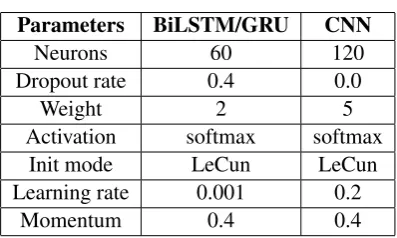
Subtask B. We used Scikit-Learn to perform a grid search (Pedregosa et al., 2013) to tune the hyper-parameters, by which we could find the best parameters to evaluate the system. The weight indicates the weight constraint. The LeCun indi-cates LeCun uniform. The fine-tuned parameters are summarized in Table 2.
3.3 Evaluation Metrics
Classification performance of the submissions will be evaluated based on binaryF1-score for the
pos-itive class. Binary F1-score will range from 1 to
0.
3.4 Results and Discussion
The trial and test data for the baseline model and the BERT model shows that our model has the best score in Table 1.
[image:4.595.82.281.311.430.2]sys-tem is a significant improvement over the base-line. The main reason is that not only the BERT is a multi-layer bidirectional transformer encoder, but also the BERT-Base model is powerful pre-training model.
Subtask B. Our model score was 0.5035, while the baseline score was 0.7329. There is a need to do more for improvement. For cross-domain sug-gestion mining, it is necessary to increase the gen-eralization ability of the training model to achieve use in multiple domains.
4 Conclusion
In this paper, we describe a task system that we submitted to SemEval-2019 for suggestion min-ing. For Subtask A, we use the BERT model. For Subtask B, we introduced CNN combined with BiLSTM and GRU. The experimental results show that the models we introduced achieved good per-formance in the final evaluation phase. In future research, we will attempt to generalize models with better capabilities to obtain more better re-sults.
Acknowledgements
This work was supported by the National Nat-ural Science Foundation of China (NSFC) un-der Grants No.61702443 and No.61762091, and in part by Educational Commission of Yunnan Province of China under Grant No.2017ZZX030. The authors would like to thank the anonymous reviewers and the area chairs for their constructive comments.
References
Raymond Brueckner and Bjrn Schuller. 2014. Social signal classification using deep blstm recurrent
neu-ral networks. InIEEE International Conference on
Acoustics.
Kyunghyun Cho, Bart Van Merri¨enboer, Caglar Gul-cehre, Dzmitry Bahdanau, Fethi Bougares, Holger
Schwenk, and Yoshua Bengio. 2014. Learning
phrase representations using rnn encoder-decoder
for statistical machine translation. arXiv preprint
arXiv:1406.1078.
Y. Le Cun, B. Boser, J. S. Denker, D. Henderson, R. E. Howard, W. Hubbard, and L. D. Jackel. 1990. Hand-written digit recognition with a back-propagation
network. Advances in Neural Information
Process-ing Systems, 2(2):396–404.
Jacob Devlin, Ming Wei Chang, Kenton Lee, and Kristina Toutanova. 2018. Bert: Pre-training of deep bidirectional transformers for language understand-ing.
Alex Graves. 2012. Long Short-Term Memory.
K Greff, R. K. Srivastava, J Koutnik, B. R. Steunebrink, and J Schmidhuber. 2016. Lstm: A search space
odyssey. IEEE Transactions on Neural Networks &
Learning Systems, 28(10):2222–2232.
Geoffrey E Hinton, Nitish Srivastava, Alex Krizhevsky, Ilya Sutskever, and Ruslan R Salakhutdinov. 2012. Improving neural networks by preventing co-adaptation of feature detectors. arXiv preprint arX-iv:1207.0580.
Yang Yin Lee, Hao Ke, Hen Hsen Huang, and Hsin H-si Chen. 2016. Less is more: Filtering abnormal
dimensions in glove. In International Conference
Companion on World Wide Web.
Tianshi Li and Baobao Chang. 2015. Semantic role labeling using recursive neural network.
Tsung Yi Lin, Priya Goyal, Ross Girshick, Kaiming He, and Piotr Dollar. 2017. Focal loss for dense
ob-ject detection.IEEE Transactions on Pattern
Analy-sis & Machine Intelligence, PP(99):2999–3007.
Vinod Nair and Geoffrey E. Hinton. 2010. Rectified linear units improve restricted boltzmann machines. In International Conference on International Con-ference on Machine Learning.
Sapna Negi, Tobias Daudert, and Paul Buitelaar. 2019. Semeval-2019 task 9: Suggestion mining from
on-line reviews and forums. In Proceedings of the
13th International Workshop on Semantic Evalua-tion (SemEval-2019).
Fabian Pedregosa, Gal Varoquaux, Alexandre Gram-fort, Vincent Michel, Bertrand Thirion, Olivier Grisel, Mathieu Blondel, Peter Prettenhofer, Ron
Weiss, and Vincent Dubourg. 2013. Scikit-learn:
Machine learning in python. Journal of Machine
Learning Research, 12(10):2825–2830.
Ashish Vaswani, Noam Shazeer, Niki Parmar, Jakob Uszkoreit, Llion Jones, Aidan N. Gomez, Lukasz Kaiser, and Illia Polosukhin. 2017. Attention is all you need.
Yonghui Wu, Mike Schuster, Zhifeng Chen, Quoc V. Le, Mohammad Norouzi, Wolfgang Macherey, Maxim Krikun, Cao Yuan, Gao Qin, and Klaus Macherey. 2016. Google’s neural machine transla-tion system: Bridging the gap between human and machine translation.
Mohamed A. Zahran, Ahmed Magooda, Ashraf Y. Mahgoub, Hazem Raafat, Mohsen Rashwan, and
Amir Atyia. 2015. Word Representations in Vector