29
Train, Sort, Explain: Learning to Diagnose Translation Models
Robert Schwarzenberg1, David Harbecke1, Vivien Macketanz1, Eleftherios Avramidis1, Sebastian M¨oller1,2
1German Research Center for Artificial Intelligence (DFKI), Berlin, Germany
2Technische Universit¨at Berlin, Berlin, Germany
{firstname.lastname}@dfki.de
Abstract
Evaluating translation models is a trade-off be-tween effort and detail. On the one end of the spectrum there are automatic count-based methods such as BLEU, on the other end lin-guistic evaluations by humans, which arguably are more informative but also require a dis-proportionately high effort. To narrow the spectrum, we propose a general approach on how to automatically expose systematic dif-ferences between human and machine trans-lations to human experts. Inspired by adver-sarial settings, we train a neural text classi-fier to distinguish human from machine trans-lations. A classifier that performs and general-izes well after training should recognize sys-tematic differences between the two classes, which we uncover with neural explainability methods. Our proof-of-concept implementa-tion, DiaMaT, is open source. Applied to a dataset translated by a state-of-the-art neu-ral Transformer model, DiaMaT achieves a classification accuracy of 75% and exposes meaningful differences between humans and the Transformer, amidst the current discussion about human parity.
1 Introduction
A multi-dimensional diagnostic evaluation of per-formance or quality often turns out to be more helpful for system improvement than just consid-ering a one-dimensional utilitarian metric, such as BLEU (Papineni et al.,2002). This is exemplified by, for instance, the pioneering work ofBahdanau et al.(2014). The authors introduced the attention mechanism responding to the findings ofCho et al. (2014) who reported that neural translation qual-ity degraded with sentence length. The attention mechanism was later picked up byVaswani et al. (2017) for their attention-only Transformer model, which still is state of the art in machine translation (MT) (Bojar et al.,2018). Furthermore, while MT
output approaches human translation quality and the claims for ”human parity” (Wu et al., 2016; Hassan et al., 2018) increase, multi-dimensional diagnostic evaluations can be useful to spot the thin line between the machine and the human.
Diagnostic (linguistic) evaluations require human-expert feedback, which, however, is very time-consuming to collect. For this reason, there is a need for tools that mitigate the effort, such as the ones developed by Madnani (2011); Popovi´c (2011);Berka et al.(2012);Klejch et al.(2015).
In this paper we propose a novel approach for developing evaluation tools. Contrary to the above tools that employ string comparison methods such as BLEU, implementations of the new approach derive annotations based on a neural model of ex-plainability. This allows both capturing of seman-tics as well as focusing on the particular tenden-cies of MT errors. Using neural methods for the evaluation and juxtaposition of translations has al-ready been done by Rikters et al. (2017). Their method, however, can only be applied to attention-based models and their translations. In contrast, our approach generalizes to arbitrary machine and even human translations. After first discussing the abstract approach in the next section, we present a concrete open-source implementation, “DiaMaT” (fromDiagnoseMachineTranslations).
2 Approach
The proposed approach consists of the three steps (1)train, (2)sort, and (3)explain.
2.1 Step 1: Train
systematic or frequent differences between the two classes (herinafter also referred to as “class evi-dence”). Class evidence may be, for instance, style differences, overused n-grams but also errors. The text classifier can be implemented through various architectures, ranging from deep CNNs (Conneau et al.,2017) to recurrent classifiers built on top of pre-trained language models (Howard and Ruder, 2018).
2.2 Step 2: Sort
In a second step, we suggest letting the trained classifier predict the labels of a test set which con-tains human and machine translations and then sort them by classification confidence. This is based on the assumption that if the classifier is very certain that a given translation was produced by a machine (translation moved to the top of the list in this step), then the translation should con-tain strong evidence for a class, i.e. errors typical for only the machine. Furthermore, even if we are dealing with a very human-like MT output, which means that our classifier may only slightly perform above chance, sorting by classification confidence should still move the few systematic differences that the classifier identified to the top.
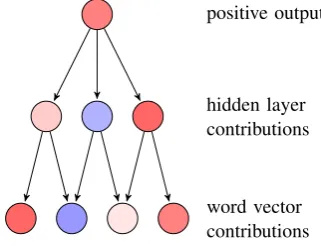
positive output
hidden layer contributions
[image:2.595.342.490.157.260.2]word vector contributions
Figure 1: Contributions propagated from output to in-put space. Colors represent positive (red) and negative (blue) contributions. The Figure is adapted from Kin-dermans et al.(2018).
2.3 Step 3: Explain
Arras et al.(2016,2017a,b) demonstrated the data exploratory power of explainability methods in Natural Language Processing (NLP). This is why in a third step, we propose to apply an explain-ability method to uncover and visualize the class evidence on which the classifier based its deci-sions. Our definition of an explanation follows Montavon et al.(2018), who define it as “the col-lection of features of the interpretable domain, that
[image:2.595.92.253.426.549.2]have contributed for a given example to produce a decision (e.g. classification or regression).”1 In our case the interpretable domain is the plain text space. There exist several candidate explainability methods, one of which we present in the following as an example.
Figure 2: A heatmap of contribution scores in word vector space over a sequence of tokens. Red means positive contribution (score>0), blue means negative contribution (score<0).
2.3.1 Explainability and Interpretability Methods for Data Exploration
In their tutorial paper, Montavon et al. (2018) discuss several groups of explainability methods. One group, for instance, identifies how sensitively a model reacts to a change in the input, others extract patterns typical for a certain class. Here, we discuss methods that propagate back contribu-tions.
The contribution flow is illustrated in Fig.1. At the top, the depicted binary classifier produced a positive output (input classified as class one). The classification decision is based on the fact that in the previous layer, the evidence for class one ex-ceeded the evidence for class zero: The left and the right neuron contributed positively to the de-cision (reddish), whereas the middle neuron con-tributed negatively (blueish). Several explainabil-ity methods, such as Layerwise Relevance Prop-agation (Bach et al., 2015) or PatternAttribution (Kindermans et al.,2018), backtrack contributions layer-wise. The methods have to preserve coher-ence over highly non-linear activation functions. Eventually, contributions are projected into the in-put space where they reveal what the model con-siders emblematic for a class. This is what we ex-ploit in step 3.
1Montavon et al.(2018) distinguish between
Figure 3: Screenshot of demonstrative results in DiaMaT. Filters that allow the user to analyse the corpus are not shown. The bold label is the true label. The activations of the machine neuron are shown in brackets; on the left the unnormalized logit activation, on the right the softmax activation. Positive logits and softmax probabilities greater 0.5 indicate machine evidence, as do tokens highlighted in red. Consequently, blue indicates evidence for the human. The more intense the colour, the stronger the evidence.
Explainability methods in NLP (Arras et al., 2016, 2017a,b; Harbecke et al., 2018) are typi-cally used to first project scores into word-vector space resulting in heat maps as shown in Fig. 2. To interpret them in plain text space, the scores are summed over the word vector dimensions to compute RGB values for each token, resulting in plain text heatmaps as shown in Fig.3.
3 Implementation
For step 1 (training phase), DiaMaT2 deploys a CNN text classifier, the architecture of which is depicted in Fig.4. The classifier consumes three embeddings: the embedding of a source and two translations of the source, one by a machine and one by a human. It then separately convolves over the embeddings and subsequently applies max pooling to the filter activations. The concate-nated max features are then passed to the last layer, a fully connected layer with two output neurons. The left neuron fires if the machine translation was passed to the left input layer, the right neuron fires if the machine translation was passed to the right input layer. Note that this layer allows the model to combine features from all three inputs for its classification decision.
For step 2 (sorting phase), DiaMaT offers to sort by unnormalized logit activations or by softmax activations. Furthermore, one can choose to use
2Source code, data and experiments are available at
https://github.com/dfki-nlp/diamat.
the machine neuron activation or the human neu-ron activation as the sorting key.
For step 3 (explaining phase), DiaMaT employs the iNNvestigate toolbox (Alber et al., 2018) in the back-end that offers more than ten explainabil-ity methods: Replacing one method with another only requires to change one configuration value in DiaMaT, before repeating step 3 again. In step 3, DiaMaT produces explanations in the form of
(token, score) tuple lists that are consumed by
a front-end server which visualizes the scores as class evidence (see Fig.3).3
Translation Source Translation Conv Conv Conv
Max Pooling & Concatenation FC2×F
Figure 4: Architecture of the text classifier.
4 Datasets and Experiments
We tested DiaMaT on a corpus translated by an NMT Transformer engine (Vaswani et al., 2017)
3The front-end was inspired by the demo LRP server
of the Fraunhofer HHI insitute https://lrpserver.
conforming to the WMT14 data setup (Bojar et al., 2014). The NMT model was optimized on the test-set of WMT13 and an ensemble of 5 best models was used. It was trained using OpenNMT (Klein et al.,2017), including Byte Pair Encoding ( Sen-nrich et al.,2015) but no back-translation, achiev-ing 32.68 BLEU on the test-set of WMT14.
Next, we trained the CNN text classifier sketched in Fig. 4 for which we randomly drew 1M training samples (human references and ma-chine translations alongside their sources) from the WMT18 training data (Bojar et al.,2018), ex-cluding the WMT14 training data. The valida-tion set consisted of 100k randomly drawn sam-ples from the same set and we drew another 100k samples randomly for training the explainability method of choice, PatternAttribution, which learns explanations from data. All texts were embed-ded using pre-trained fastText word vectors (Grave et al.,2018).
We evaluated the classifier on around 20k sam-ples drawn from the official test sets, excluding WMT13. On this test set, the classifier achieved an accuracy of 75%, which is remarkable, consid-ering the ongoing discussion about human parity (Wu et al., 2016; Hassan et al., 2018). We also used this test set for steps 2 and 3. Thus, neither the translation model, nor the text classifier, nor the explainability method encountered this split during training. For step 2, the machine transla-tion was always passed to the right input layer and contributions to the right output neuron were re-trieved with PatternAttribution.4 We then sorted the inputs by the softmax activation of the machine neuron, which moved inputs for which the clas-sifier is certain that it has identified the machine correctly to the top.
5 Demonstration and Observations
We observed that the top inputs frequently con-tained sentences in which DiaMaT considered the token after a sentence-ending full stop strong ev-idence for the human (Fig. 3, top segment). We take this as evidence that DiaMaT correctly rec-ognized that the human generated multiple sen-tences instead of a single one more often than the machine did. At this point, we cannot, however, offer an explanation for why the token preceding the punctuation mark is frequently considered
ev-4In order to visualize evidence for the human (blue),
pos-itive contributions in the left input needed to be inverted.
idence for the machine.
Furthermore, DiaMaT also regarded reduced negations (“n’t”) as evidence for the human (see Fig.3, middle segment) which again is reflected in the statistics. The machine tends to use the unre-duced negation more frequently.
The last segment in Fig.3shows how DiaMaT points to the fact that the machine more often pro-duced sentence end markers than the human in cases where the source contained no end marker. The claims above are all statistically significant in the test set, according to aχ2test withα= 0.001.
6 Future Work
The inputs in Fig. 3 contain easily readable evi-dence. There is, however, also much evidence that is hard to read. In general, we can assume that with increasing architectural complexity, more com-plex class evidence can be uncovered, which may come at the cost of harder readability.
In the future, it is worth exploring how different architectures and model choices affect the quality, complexity and readability of the uncovered ev-idence. For instance, one direction would be to to train the classifier on top of a pretrained lan-guage model (Howard and Ruder, 2018; Devlin et al., 2019) which could improve the classifica-tion performance. Furthermore, other explainabil-ity methods should also be tested.
7 Conclusion
We presented a new approach to analyse and juxta-pose translations. Furthermore, we also presented an implementation of the approach, DiaMaT. Dia-MaT exploits the generalization power of neural networks to learn systematic differences between human and machine translations and then takes advantage of neural explainability methods to un-cover these. It learns from corpora containing mil-lions of translations but offers explanations on sen-tence level. In a stress test, DiaMaT was capa-ble of exposing systematic differences between a state-of-the-art translation model output and hu-man translations.
Acknowledgements
References
Maximilian Alber, Sebastian Lapuschkin, Philipp Seegerer, Miriam H¨agele, Kristof T Sch¨utt, Gr´egoire Montavon, Wojciech Samek, Klaus-Robert M¨uller, Sven D¨ahne, and Pieter-Jan Kindermans. 2018. iNNvestigate neural networks! arXiv preprint arXiv:1808.04260.
Leila Arras, Franziska Horn, Gr´egoire Montavon, Klaus-Robert M¨uller, and Wojciech Samek. 2016. Explaining Predictions of Non-Linear Classifiers in NLP. InProceedings of the 1st Workshop on Repre-sentation Learning for NLP, pages 1–7.
Leila Arras, Franziska Horn, Gr´egoire Montavon, Klaus-Robert M¨uller, and Wojciech Samek. 2017a. ”What is relevant in a text document?”: An inter-pretable machine learning approach. PLOS ONE, 12(8).
Leila Arras, Gr´egoire Montavon, Klaus-Robert M¨uller, and Wojciech Samek. 2017b. Explaining recurrent neural network predictions in sentiment analysis. In
Proceedings of the EMNLP’17 Workshop on Com-putational Approaches to Subjectivity, Sentiment & Social Media Analysis (WASSA), pages 159–168. Association for Computational Linguistics.
Sebastian Bach, Alexander Binder, Gr´egoire Mon-tavon, Frederick Klauschen, Klaus-Robert M¨uller, and Wojciech Samek. 2015. On pixel-wise explana-tions for non-linear classifier decisions by layer-wise relevance propagation. PLoS ONE, 10(7):e0130140.
Dzmitry Bahdanau, Kyunghyun Cho, and Yoshua Ben-gio. 2014. Neural machine translation by jointly learning to align and translate. arXiv preprint arXiv:1409.0473.
Jan Berka, Ondˇrej Bojar, Mark Fishel, Maja Popovi´c, and Daniel Zeman. 2012. Automatic MT Error Analysis: Hjerson Helping Addicter. In Proceed-ings of the Eight International Conference on Lan-guage Resources and Evaluation, pages 2158–2163, Istanbul, Turkey. European Language Resources As-sociation.
Ondˇrej Bojar, Christian Buck, Christian Federmann, Barry Haddow, Philipp Koehn, Johannes Leveling, Christof Monz, Pavel Pecina, Matt Post, Herve Saint-Amand, Radu Soricut, Lucia Specia, and Aleˇs Tamchyna. 2014. Findings of the 2014 Workshop on Statistical Machine Translation. In Proceedings of the Ninth Workshop on Statistical Machine Transla-tion, pages 12–58, Baltimore, Maryland, USA. As-sociation for Computational Linguistics.
Ondˇrej Bojar, Christian Federmann, Mark Fishel, Yvette Graham, Barry Haddow, Matthias Huck, Philipp Koehn, and Christof Monz. 2018. Find-ings of the 2018 conference on machine translation (wmt18). In Proceedings of the Third Conference on Machine Translation, Volume 2: Shared Task Pa-pers, pages 272–307, Belgium, Brussels. Associa-tion for ComputaAssocia-tional Linguistics.
Kyunghyun Cho, Bart van Merri¨enboer, Dzmitry Bah-danau, and Yoshua Bengio. 2014. On the properties of neural machine translation: Encoder–decoder ap-proaches. Syntax, Semantics and Structure in Statis-tical Translation, page 103.
Alexis Conneau, Holger Schwenk, Lo¨ıc Barrault, and Yann Lecun. 2017. Very deep convolutional net-works for text classification. InProceedings of the European Chapter of the Association for Computa-tional Linguistic (EACL).
Jacob Devlin, Ming-Wei Chang, Kenton Lee, and Kristina Toutanova. 2019. BERT: Pre-training of Deep Bidirectional Transformers for Language Un-derstanding. Proceedings of the 2019 Conference of the North American Chapter of the Association for Computational Linguistics: Human Language Tech-nologies.
Ian Goodfellow, Jean Pouget-Abadie, Mehdi Mirza, Bing Xu, David Warde-Farley, Sherjil Ozair, Aaron Courville, and Yoshua Bengio. 2014. Generative ad-versarial nets. In Advances in neural information processing systems, pages 2672–2680.
Edouard Grave, Piotr Bojanowski, Prakhar Gupta, Ar-mand Joulin, and Tomas Mikolov. 2018. Learning word vectors for 157 languages. In Proceedings of the International Conference on Language Re-sources and Evaluation (LREC 2018).
David Harbecke, Robert Schwarzenberg, and Christoph Alt. 2018. Learning explanations from language data. In Proceedings of the 2018 EMNLP Workshop BlackboxNLP: Analyzing and Interpreting Neural Networks for NLP, pages 316–318.
Hany Hassan, Anthony Aue, Chang Chen, Vishal Chowdhary, Jonathan Clark, Christian Feder-mann, Xuedong Huang, Marcin Junczys-Dowmunt, William Lewis, Mu Li, Shujie Liu, Tie-Yan Liu, Renqian Luo, Arul Menezes, Tao Qin, Frank Seide, Xu Tan, Fei Tian, Lijun Wu, Shuangzhi Wu, Yingce Xia, Dongdong Zhang, Zhirui Zhang, and Ming Zhou. 2018. Achieving Human Parity on Auto-matic Chinese to English News Translation. CoRR, abs/1803.05567.
Jeremy Howard and Sebastian Ruder. 2018. Universal language model fine-tuning for text classification. In
Proceedings of the 56th Annual Meeting of the As-sociation for Computational Linguistics (Volume 1: Long Papers), volume 1, pages 328–339.
Pieter-Jan Kindermans, Kristof T. Sch¨utt, Maximilian Alber, Klaus-Robert M¨uller, Dumitru Erhan, Been Kim, and Sven D¨ahne. 2018. Learning how to ex-plain neural networks: PatternNet and PatternAttri-bution. In International Conference on Learning Representations (ICLR).
Open-source toolkit for neural machine translation.
arXiv preprint arXiv:1701.02810.
Ondrej Klejch, Eleftherios Avramidis, Aljoscha Bur-chardt, and Martin Popel. 2015. MT-ComparEval: Graphical evaluation interface for Machine Transla-tion development. The Prague Bulletin of Mathe-matical Linguistics, 104(1):63–74.
Nitin Madnani. 2011. iBLEU: interactively debugging and scoring statistical machine translation systems. In2011 IEEE Fifth International Conference on Se-mantic Computing, pages 213–214.
Gr´egoire Montavon, Wojciech Samek, and Klaus-Robert M¨uller. 2018. Methods for interpreting and understanding deep neural networks. Digital Signal Processing, 73:1–15.
Kishore Papineni, Salim Roukos, Todd Ward, and Wei-Jing Zhu. 2002. BLEU: a method for automatic evaluation of machine translation. InProceedings of the 40th annual meeting on association for compu-tational linguistics, pages 311–318. Association for Computational Linguistics.
Maja Popovi´c. 2011. Hjerson: An Open Source Tool for Automatic Error Classification of Machine Translation Output. The Prague Bulletin of Mathe-matical Linguistics, 96(-1):59–68.
Mat¯ıss Rikters, Mark Fishel, and Ondˇrej Bojar. 2017. Visualizing Neural Machine Translation Attention and Confidence. The Prague Bulletin of Mathemat-ical Linguistics, 109(1):39–50.
Rico Sennrich, Barry Haddow, and Alexandra Birch. 2015. Neural Machine Translation of Rare Words with Subword Units. CoRR, abs/1508.0.
Ashish Vaswani, Noam Shazeer, Niki Parmar, Jakob Uszkoreit, Llion Jones, Aidan N Gomez, Łukasz Kaiser, and Illia Polosukhin. 2017. Attention is all you need. InAdvances in Neural Information Pro-cessing Systems, pages 5998–6008.
Lijun Wu, Yingce Xia, Li Zhao, Fei Tian, Tao Qin, Jianhuang Lai, and Tie-Yan Liu. 2017. Ad-versarial Neural Machine Translation. CoRR, abs/1704.06933.
Yonghui Wu, Mike Schuster, Zhifeng Chen, Quoc V. Le, Mohammad Norouzi, Wolfgang Macherey, Maxim Krikun, Yuan Cao, Qin Gao, Klaus Macherey, Jeff Klingner, Apurva Shah, Melvin Johnson, Xiaobing Liu, Łukasz Kaiser, Stephan Gouws, Yoshikiyo Kato, Taku Kudo, Hideto Kazawa, Keith Stevens, George Kurian, Nishant Patil, Wei Wang, Cliff Young, Jason Smith, Jason Riesa, Alex Rudnick, Oriol Vinyals, Greg Corrado, Macduff Hughes, and Jeffrey Dean. 2016. Google’s Neural Machine Translation System: Bridging the Gap between Human and Machine Translation.
Computer Research Repository, abs/1609.0.
Zhen Yang, Wei Chen, Feng Wang, and Bo Xu. 2017. Improving Neural Machine Translation with Conditional Sequence Generative Adversarial Nets.